In this post I want to elaborate more on DK’s comment from my last entry:
…Pre-capitalist tribes had examples of both success and failure, perhaps equal measure of both. The key principle to these types of cultures succeeding is the principle of superabundance. There is strong correlation to the disappearance of superabundance and destructive tendencies…
In his essay ‘Are Wars Inevitable?‘, William T. Hathaway explains that modern research has shown that scarcity of resources acts as a trigger for social strife and that violence and war is NOT a genetic predisposition of humans:
…research, however, led to a key discovery: The chimps who invaded their neighbors were suffering from shrinking territory and food sources. They were struggling for survival. Groups with adequate resources didn’t raid other colonies. The aggression wasn’t a behavioral constant but was caused by the stress they were under. Their genes gave them the capacity for violence, but the stress factor had to be there to trigger it into combat. This new research showed that war is not inevitable but rather a function of the stress a society is under. Our biological nature doesn’t force us to war, it just gives us the potential for it. Without stress to provoke it, violence can remain one of the many unexpressed capacities our human evolution has given us. Studies by professors Douglas Fry, Frans de Waal, and Robert Sapolsky present the evidence for this.
Militarists point to history and say it’s just one war after another. But that’s the history only of our patriarchal civilization. The early matriarchal civilization of south-eastern Europe enjoyed centuries of peace. UCLA anthropologist Marija Gimbutas describes the archeological research in The Civilization of the Goddess. No trace of warfare has been found in excavations of the Minoan, Harappa, and Caral cultures. Many of the Pacific islands were pacifistic. The ancient Vedic civilization of India had meditation techniques that preserved the peace, and those are being revived today to reduce stress in society...
Now DK goes on to say that in the absence of plentiful resources, the only logical and sane option is to give up our current exploitive and pathological economic model of capitalism and replace it with something that reflects today’s reality of rampant resource depletion and environmental collapse. Modern weapons of war are infinitely more destructive and, in and of themselves, pose a danger to all of mankind and global civilization; hence the need to get rid of capitalism is even more imperative:
…When superabundance is (inevitably) rendered invalid, it must be supplanted by a means to re-appropriate surplus in a fair and equitable manner- devoid of exploitation and informed by tangible limits, such as those posed by the environment and population limits. Such a system is not compatible with profit seeking, as many in the environmental movement are now discovering- nor has it ever been put successfully into practice.
One could say that mankind’s ability or inability to successfully transition away from the self-destructive nature of capitalism will determine the fate of the whole human species. Tragedy of the commons, as I said previously, is on a global scale now. Hathaway goes on to elaborate a little on capitalism’s dog-eat-dog tendencies and the need to move away from this paradigm:
Our society, though, has a deeply entrenched assumption that stress is essential to life. Many of our social and economic structures are based on conflict. Capitalism’s need for continually expanding profits generates stress in all of us. We’ve been indoctrinated to think this is normal and natural, but it’s really pathological. It damages life in ways we can barely perceive because they’re so built into us…
…We can create a society that meets human needs and distributes the world’s resources more evenly… But that’s going to take basic changes…
These changes threaten the power holders of our society. Since capitalism is a predatory social and economic system, predatory personalities rise to power. They view the world through a lens of aggression. But it’s not merely a view. They really are surrounded by enemies. So they believe this false axiom they are propagating that wars are inevitable.
In the past their predecessors defended their power by propagating other nonsense: kings had a divine right to rule over us, Blacks were inferior to Whites, women should obey men. We’ve outgrown those humbugs, and we can outgrow this one.
Of course, as Gail of ‘Wit’s End’ pointed out, we will inevitably need to address the problem of overpopulation:
…although once upon a time some tribes (arguably) may have lived cooperatively and harmoniously (although the opposite is certainly more common) the only reason they could do so is because their numbers were so low and food was plentiful and relatively easy to obtain. Once human population outstrips resources, things get ugly no matter what social or cultural system is in place. And I don’t know of a place where human population didn’t eventually overrun the environment, with the possible exception of cultures that practiced infanticide, or had the ability to export people willing to emigrate.
It seems to me the problem is that we have filled every corner of the globe that is remotely habitable, and then some, and yet our population and levels of consumption continue to increase. There is no place left to emigrate to. It can’t last.
Resource constraints(i.e. peak oil, peak fertilizer, peak water) on our fossil fuel based agricultural system as well as environmental degradation(i.e. climate change and ocean acidification) are going to cause an epic population crash during this century before we have time, or for that matter the cooperation and agreement, to implement any sort of voluntary population reduction.
As far as implementing this egalitarian distribution model, I also agree that the odds of that happening are slim to none, as DK said:
…Such a system[egalitarian and respective of resource limits] is not compatible with profit seeking, as many in the environmental movement are now discovering – nor has it ever been put successfully into practice.
Nor is it likely to be.
Unfortunately, the world’s stockpile of thermonuclear weapons may not stay on the shelf forever, especially in a world where the Four Horsemen of Industrial Civilization are quickly converging: Climate Change, Peak Net Energy, Ocean Acidification, and Peak Water. I’m not saying we shouldn’t try everything we can to stop what seems to be our inevitable fate; I’m just saying that the prognosis is grim.
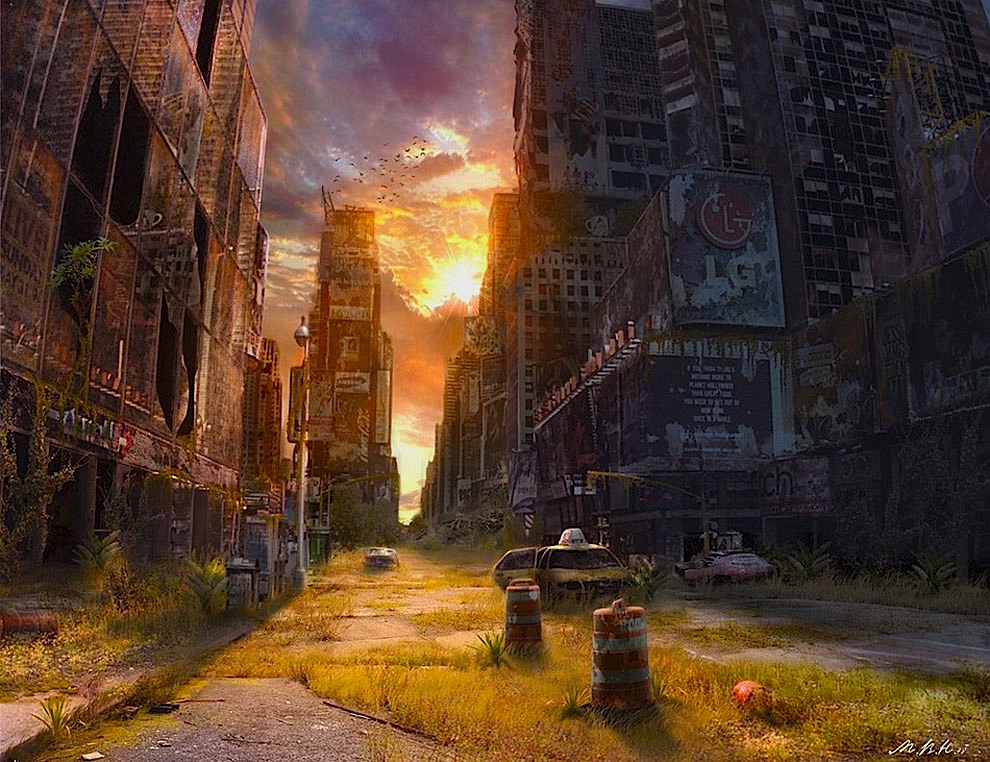
I thought I’d post a few pictures of what the world will look like before the end of this century. Artists have the intuitive imagination to conjure up such visions the general public can only imagine through Hollywood zombie flicks which seem to be all the rage these days. Why do I feel this vision is inevitable? Just look at the daily news to see what I mean:
It used to be that the mentally insane, flailing their arms and talking to invisible people in the streets, were the ones ranting and raving about the end of the world, but now it’s scientists who, in an attempt not to offend the beliefs of the scientific illiterati and free-market faithful, downplay their findings as much as possible. Optimism bias infects even the scientific community.
…we are the most tragic species. We not only destroy all of the world around us, we are aware of doing it but unable to stop ourselves. We have faith and hope that things will get better, that we can turn around at the last second what we’ve screwed up over years and decades. Which of course is nothing but an excuse to keep on screwing up. All courtesy of our optimism bias.
What better exemplifies the delusional optimism of man than the belief that he could hide out in a bunker to survive the ravages of a nuclear war? I’ll tell you what tops that fantasy – the belief that man can continue to do what he has done and expect the planet to unfailingly absorb all the environmental assaults we can throw at it via the endless growth of capitalist production and consumption. The planet is not some massive ShamWow towelette for man’s nonstop flow of excrement.
Of all the findings in the 2012 edition of the World Energy Outlook, the one that merits the greatest international attention is the one that received the least. Even if governments take vigorous steps to curb greenhouse gas emissions, the report concluded, the continuing increase in fossil fuel consumption will result in “a long-term average global temperature increase of 3.6 degrees C.”
This should stop everyone in their tracks. Most scientists believe that an increase of 2 degrees Celsius is about all the planet can accommodate without unimaginably catastrophic consequences: sea-level increases that will wipe out many coastal cities, persistent droughts that will destroy farmland on which hundreds of millions of people depend for their survival, the collapse of vital ecosystems, and far more. An increase of 3.6 degrees C essentially suggests the end of human civilization as we know it.
To put this in context, human activity has already warmed the planet by about 0.8 degrees C — enough to produce severe droughts around the world, trigger or intensify intense storms like Hurricane Sandy, and drastically reduce the Arctic ice cap. “Given those impacts,” writes noted environmental author and activist Bill McKibben, “many scientists have come to think that two degrees is far too lenient a target.” Among those cited by McKibben is Kerry Emanuel of MIT, a leading authority on hurricanes. “Any number much above one degree involves a gamble,” Emanuel writes, “and the odds become less and less favorable as the temperature goes up.” Thomas Lovejoy, once the World Bank’s chief biodiversity adviser, puts it this way: “If we’re seeing what we’re seeing today at 0.8 degrees Celsius, two degrees is simply too much.”
At this point, it’s hard even to imagine what a planet that’s 3.6 degrees C hotter would be like, though some climate-change scholars and prophets — like former Vice President Al Gore in An Inconvenient Truth — have tried. In all likelihood, the Greenland and Antarctica ice sheets would melt entirely, raising sea levels by several dozen feet and completely inundating coastal cities like New York and Shanghai. Large parts of Africa, Central Asia, the Middle East, and the American Southwest would be rendered uninhabitable thanks to lack of water and desertification, while wildfires of a sort that we can’t imagine today would consume the parched forests of the temperate latitudes.
In a report that leads with the “good news” of impending U.S. oil supremacy, to calmly suggest that the world is headed for that 3.6 degree C mark is like placing a thermonuclear bomb in a gaudily-wrapped Christmas present. In fact, the “good news” is really the bad news: the energy industry’s ability to boost production of oil, coal, and natural gas in North America is feeding a global surge in demand for these commodities, ensuring ever higher levels of carbon emissions. As long as these trends persist — and the IEA report provides no evidence that they will be reversed in the coming years — we are all in a race to see who gets to the Apocalypse first.
Enjoy industrial civilization’s fossil fuel blow-out sale while it lasts. This is a one-time-only, circus-like ‘liquidation event’. Everything must be commodified regardless of ecological loss or intrinsic value to the web of life. The Human species won’t want to miss these deals! There will be no returns or exchanges available as we are going out of business for good due to bankruptcy proceedings with Mother Earth. All life forms and resources on the planet must go!!!
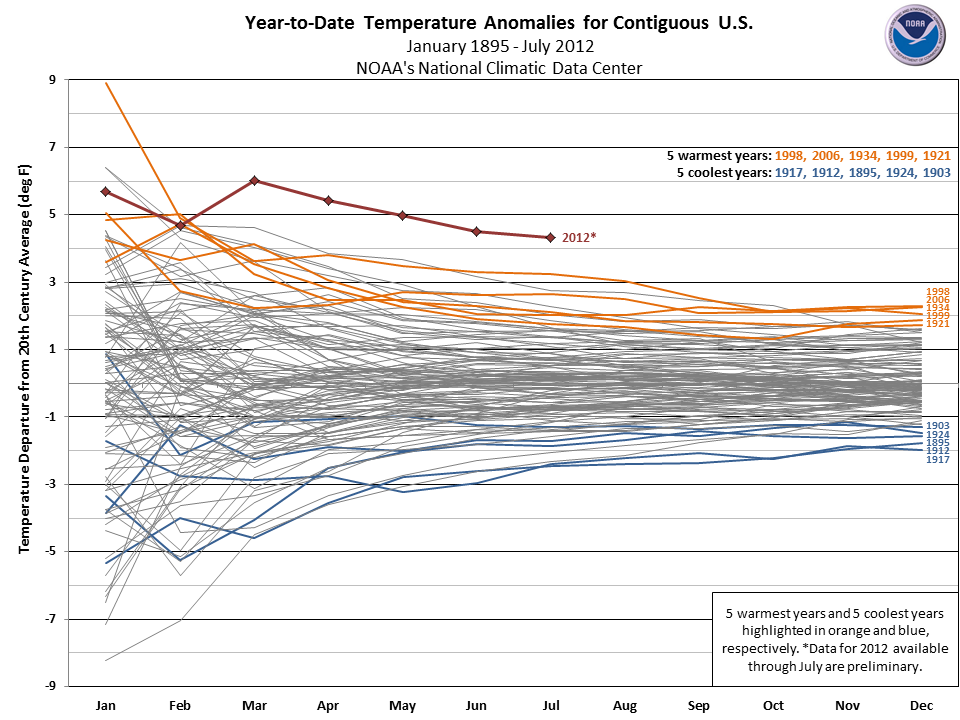
“This time series shows the 2012 year-to-date temperature through July, which was the warmest first seven months of any year on record for the lower 48. The year-to-date evolution of the contiguous U.S. temperatures for each year back to 1895 are also shown, with the five warmest and five coolest years highlighted.The January-July 2012 contiguous U.S. average temperature was 56.4°F, 4.3°F above average. The data for 2012 are preliminary.”
“This time series also shows the 2012 year-to-date temperature through July. Outcome scenarios based on persistence of temperature from August through December, the remaining five months of 2012, are shown. The January-July 2012 contiguous U.S. average temperature was 56.4°F, 4.3°F above average. The data for 2012 are preliminary.” And the following is a map of extreme global weather for July 2012(click to enlarge): At this point, even if you don’t believe humans have anything to do with these extreme weather events which have grown progressively worse, the fact is that the climate is no longer falling within historic parameters from the records that have been kept over the last 116 years. An epic climate event is underway and there are 7 billion people in its path. Our leaders and the ‘captains’ of industry act as if they are powerless to do anything about it, much less alter our dependance on fossil fuels. In fact, we’re scrambling to the thawing Arctic to exploit more carbon-rich resources to cook. Nearly all scientists acknowledge that the release of CO2 from humankind’s burning of fossil fuels since the industrial revolution is the primary factor in today’s abnormal weather events. And recently, even former Koch-funded climate scientist deniers are changing their tune on the reality of anthropogenic climate change. It’s worth repeating the mind-blowing computation that we, the industrialized world, burn more than 100,000 tons of fossil fuel every hour. Certainly this has caused the acidification of the world’s oceans. A startling report from late last year stated:
The acidification of the world’s oceans from an excess of CO2 has already begun, as evidenced recently by the widespread mortality of oyster larvae in the Pacific Northwest. Scientists say this is just a harbinger of things to come if greenhouse gas emissions continue to soar.
Aug. 19 (Bloomberg) — Mercury contaminated every fish studied in 291 U.S. streams and rivers tested by scientists, and one in four had levels unsafe for people who eat average amounts of fish, a government report said today.
And in July a confrontational piece in the New York Times, written by marine ecologist Roger Bradbury, states rather bluntly:
IT’S past time to tell the truth about the state of the world’s coral reefs, the nurseries of tropical coastal fish stocks. They have become zombie ecosystems, neither dead nor truly alive in any functional sense, and on a trajectory to collapse within a human generation.
And:
Overfishing, ocean acidification and pollution have two features in common. First, they are accelerating. They are growing broadly in line with global economic growth, so they can double in size every couple of decades. Second, they have extreme inertia — there is no real prospect of changing their trajectories in less than 20 to 50 years. In short, these forces are unstoppable and irreversible.
And:
Coral reefs will be the first, but certainly not the last, major ecosystem to succumb to the Anthropocene — the new geological epoch now emerging.
As blogger it’ll-all-end-in-tearsputs it, “The naming of the epoc feels like an appropriately hubristic climax to our age. The consequences of our prolonged war on the ecosystems that support (not serve…) us might well be coming around to extract their own price.”
Funny thing about the environment that we abuse and take for granted on a daily basis…Everything seems OK, until it suddenly isn’t.
I don’t know about you, but I like things to be somewhat predictable and dependable. It appears, however, that we have transgressed Mother Nature one too many times. Consider that at a one degree celsius increase, marked changes to the climate include the USA midwest becoming a desert with the remaining topsoil blowing away. The thinning polar ice caps and melting permafrost will release methane which is twenty times more potent than CO2:
Two new research papers published today improve our understanding of the planet’s methane emissions, and might raise worries about the role of the gas in warming the planet. The first suggests that there may be extensive methane deposits under the Antarctic ice sheets. Meanwhile, the second concludes that emissions of the gas from Arctic permafrost have been underestimated.
Island nations will flood. Forest fires will be more frequent. The frequency and intensity of storms will increase. Between a 1 and 2 degree increase, the albedo effect is diminished at the poles where sunlight reflects back into the atmosphere. Trees stressed from drought will also add more CO2 than O2. The world’s rivers will shrink. Countries will become destabilised and unleash waves of ecological and political refugees in search of H20, food, and fuel. Between a 2 and 3 degrees increase, life becomes unbearable as soils emit more CO2, forests such as the Amazon burn away and release vast amounts of stored carbon, and the basic essentials of life (water, food, and fuel) become scarce. Nations wither and disappear.
And yet there will still be people who think it’s all a conspiracy.