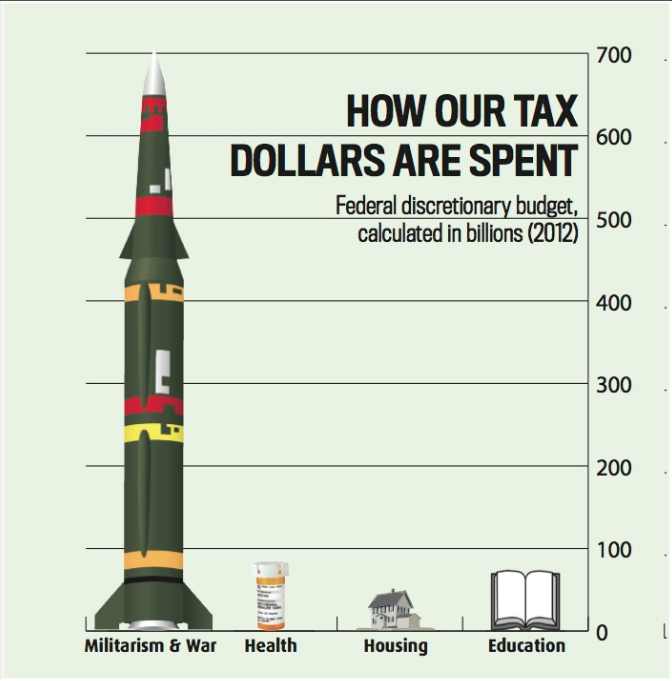
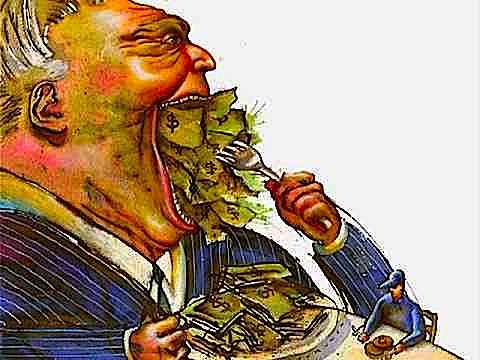
The U.S. military industrial complex is the single biggest leech upon society. Both parties unquestioningly support it. While many view a Romney in the White House would be like adding an accelerant to the flame of U.S. militarism, Obama has proven himself one of the most militarily aggressive American leaders in decades. The military industrial complex sucks up more than half of every tax dollar and enriches weapons manufacturers at the expense of this country’s citizens. If you look back in history and read some of the essays of William Blum, you’ll have all the proof you need that the capitalists of America are not a stabilizing force in the world, but a destabilizing one. As others have noted, empires collapse from within. While they continue expanding outward and investing in their reach of hegemony, the needs of the citizens back at home are overlooked and neglected. We have an empire at the expense of democracy:
…In the first minutes of the debate, Biden gloated about how the economic blockade of Iran orchestrated by Washington had devastated the Iranian economy and caused widespread suffering among the people. He boasted of the US role in aiding the Syrian forces seeking to overthrow the Assad regime. And he repeatedly defended the administration by declaring that it had the full support of the Pentagon brass—accepting Ryan’s premise that the generals should have veto power over foreign policy.
The questions offered by debate moderator Martha Raddatz—an ABC News foreign correspondent with close ties to the US military-intelligence apparatus—took as their point of departure the unchallengeable legitimacy of the operations of American imperialism abroad and the profit system at home.
Many of them touched on foreign and military policy, in every case tacitly assuming that the United States has the right to bomb, invade and conquer any country it chooses. The discussion between the candidates dealt with the expediency of such military actions, not whether they were legally or morally justifiable.
Similarly, the parts of the debate that touched on domestic policy—the economy, health care, taxes and social issues like abortion—took for granted the existing division of the wealth of society between the tiny minority that controls nearly all of it and the large majority who are struggling to survive.
In the entire 90 minutes, there was not a single question or answer about the conditions of life of the working class—about cuts in wages, pensions and other benefits; the growth of poverty, homelessness and hunger; the spreading plague of evictions and foreclosures; the deterioration of public services such as education; the collapse of the social infrastructure…
Do you see a problem with this picture of the U.S.?
Other threats loom larger than the boogeyman terrorist. While we create enemies to fight, real manmade dangers like global warming and climate change are growing, threatening to wipe all of humanity off the face of the Earth. Humans don’t have that much time left on this planet, so it would probably be a wise decision to ratchet back all the war mongering, move away from a war-based economy, and try another approach to how we interact with the rest of the world before it all ends in more and more resource wars and the plume of a mushroom cloud.
Iran appears to be next on our bombing agenda. If we had not covertly overthrown their democratically elected leader, Mohammad Mosaddegh, in 1953 because he wanted to nationalize their oil resources, could we have averted this impending war?…
Here is the interview with Alf Hornborg along with a couple of essays of his. To understand our predicament, you must understand that the flow of energy, fossil fuels, humans have tapped into for running our economy, machinery, and energy-intensive mode of living has some serious environmental drawbacks, namely climate change and ocean acidification, which will certainly lead to our own destruction with the business-as-usual path we are so determined to follow. Some of the other consequences of basing our way of life so heavily upon fossil fuels are resource wars, support of brutal dictatorships in resource-cursed countries, hypocritical foreign policies based on resource control rather than the publicly professed mantra of human rights and democracy, the fomentation of resentment and terrorism towards the West, etc. So if you couple fossil fuels with capitalism, then you have a truly planet-destroying system. Capitalism is coerced competition for finite wages and resources, pitting person against person, company against company, and nation against nation. What the State calls Terrorism is really defined as those who have grievances with the plunder of their homeland’s resources to support the unsustainable lifestyles of OECD countries. If China continues to follow the same arc of resource consumption as America, the ‘War on Terror’ will be theirs as well. My favorite quote from Horborg:
Is the war on terrorism and climate debate two sides of the same coin? Imports of cheap oil are just as crucial as exports of carbon dioxide for a high-energy future. Both are confined to the parts of the world that have amassed the most purchasing power.
14 July 2011, 12:54 PM
Alf Hornborg on How We Have Been Mystified by Technology
by Adam Robbert & JP Hayes
Alf Hornborg, professor in the department of Human Ecology at Lund University, Sweden has long been untangling the tightly fused networks that merge the material dimensions of the environment with the cultural processes of society. “Machine Fetishism” Hornborg’s term for the way in which we have been mystified by technology highlights the links between technology and asymmetries in global exchange and uncovers the relationship between ecology and power. As technological devices multiply exponentially in a vain attempt to make our lives “efficient,” “luxurious” and “productive,” Hornborg, restless in his critique of technocapitalism, reminds us that on planet earth everything is a zero-sum game – one person’s gain is always another’s loss. Last January we caught up with Professor Hornborg to see where his latest thinking on machines, money and climate change stand and how we, as the concerned and informed, can intervene to make a difference.
Q: You have suggested that the difficulties in understanding the relationship between the environment, the economy and technology arise partly out of the separation between the social and natural sciences within the university. Bringing the natural and social sciences together implies entangling material dimensions of the environment with the cultural processes of society. How has this split mystified our understanding of the relationships between ecology and economics, and how is this affecting our ability to respond to major events such as the mass extinction of species, climate change and global inequality?
It is becoming increasingly obvious that material processes in the biosphere are very much intertwined with cultural aspects such as our ways of thinking and our consumption patterns. The most obvious example is perhaps climate change, which we know is largely driven by our patterns of consumption. If ecologists look at the biosphere as if there were no human societies in it, and economists look at societies as if they didn’t depend on the biosphere, none of them will know how to handle things like climate change. As long as economists continue to think that the only relevant metric for measuring global trade is money, they will not see the asymmetric net transfers of real resources such as energy and matter that make technological expansion possible within some areas of the world.
Q: Your analysis of technology as a globally situated event that requires the establishment of multiple asymmetric economic linkages to be in place raises questions about the role of technology in current ecological problems. If technology, and in particular machine technology, requires inequalities in the terms of global trade, how are we to assess the appropriate use and level of technology employed in solving ecological problems?
I don’t think modern technology will be of much use in solving ecological problems, because modern technology is basically a way of shuffling around resources and problems between different social groups. For example, by shifting to ethanol European car drivers may think they are becoming sustainable, but Brazilians engaged in growing sugar cane may be growing less sustainable as a result. Solving ecological problems should not be about finding new technological solutions, which generally means shifting the problems onto someone else, but about developing new economies and lifestyles which reduce environmental degradation.
Q: You advocate a “zero-sum” approach to your analysis of the relationship between ecology and economics, with technology acting as a kind of basin within which material exchanges of the biosphere and economic or political policies churn. In this way, what you call “machine fetishism” produces the image of a machine that exists without its connections to culture, power and ecology. Could you elaborate on how the illusion of machine technology came to take hold and what relevance unmasking machine power for what is –a globally situated object- has for encouraging a more politically just and environmentally sound society?
Our faith in technology emerged most markedly in the early nineteenth century, as colonial Britain was accumulating resources from all over the world and investing its economic surpluses in new machinery. To British economists of the time, it seemed as if ecological (land) constraints had been overcome once and for all, and the magic wands of labor and capital would suffice for economic progress to continue. That is exactly the time when modern economic ideology was born. What these Europeans could not grasp was that their capital was built on the exploitation of land and labor elsewhere in the world. In other words, the factors of production were NOT substitutable in an absolute sense. We are all ultimately dependent on land.
Q: Following David Harvey’s analysis of money, you have suggested that money is a social institution that generates “space-time” in such a way that is both an “objective, political ecological framework” and a “subjective experience.” In other words, money becomes the medium by which society, technology and even the whole biosphere are transformed within a particular set of cultural ideas. Given the latest financial crises, what do you foresee the role of currency to be in the transformation of the relationship between ecology and economics?
The financial crises illustrate the risks a society takes when it permits monetary assets and real, biophysical resources to become so thoroughly dissociated from each other. Our current problems with overconsumption would not have been possible if money had not become so completely disconnected from material resources. I am not saying that the gold standard that we abandoned in the seventies was a solution, but at least it limited the possibilities of printing ever more money to keep the treadmill of consumption (and production) spinning at a pace that satisfies the corporate demand for profits. But the real problem with money is not that it is fictitious, as all money must be, but that it embodies the idea that everything can be exchanged for everything else. What we need is an economy with at least two incommensurable currencies, to distinguish between values that should not be interchangeable, such as local subsistence and survival versus globalized entertainment.
Q: In your analysis of the industrial revolution you suggest that the “technomass” of industrial civilization is now competing with the “biomass” for living space on planet earth. How are we to approach the reality that we are already thoroughly enmeshed within a technosphere that now seems to require our continued maintenance (so as not to leak the wrong toxic substances into the wrong environments) and the fact the we need to be equally attentive to the livelihood of the biosphere which we depend upon for life?
The sooner we stop prioritizing the metabolic needs of our “technomass”, at the expense of human and other biomass, the better. Our technological fixes are no less absurd than the fetishism that brought earlier civilizations to collapse, whether through overinvestment in armies (Rome), temples (Maya), or megalithic statues (Easter Island).
Q: Given that you believe that an integration of the social and natural sciences would lead to better policy strategies, could you comment on the differences or similarities between these two spheres? Do the cultural, political and economic relations that social scientists study differ in nature from the ecological and material systems that a natural scientist study? Their conjunction seems necessary, and yet problems of integration seem numerous. What is our way forward here?
Yes, the social and natural sciences study different kinds of phenomena and need to respect the limitations of either approach. Societies have always implicated questions of power, unequal distribution, and collective processes of meaning-creation and ideology. Ecosystems can be studied and understood without insights about any of these things. On the other hand, as economists and others illustrate, social systems can be studied (if not understood) without any regard to the flows of matter and energy that preoccupy the ecologists. To understand the interface between social and ecological systems we need to understand POWER as partly material, partly symbolic. Social power is based on unequal access to material resources, but also on the ideological mystification of such inequalities.
Q: Uncertainties of measurement and misleading methodological approaches characterize current economic attempts to manage the world system. Such a measurement/theory mismatch creates uncertainty and error in understanding what is occurring in the present state of economic-ecological affairs. As a result of these poor methodologies, modern bureaucracies have created a routine of socioeconomic functioning that is notable for its lack of applicability to social & environmental reality. How can we characterize and develop change that ensures the development of a truly sustainable world system? How can we, as academics, activists, and concerned citizens, best intervene, as you say, “in the destructive logic of our current economic system?”
First of all by recognizing the dilemma as I have outlined it in my earlier responses. Second by using their political agency (ultimately as voters in democratic political systems) to choose representatives who are prepared to reorganize the economy for the long-term good of all people and ecosystems, rather than for the short-term benefits of corporate interests.
Q: Could you comment on the role of emergent popular discourses on the environment such as “green capitalism,” “sustainable development” and “ecological economics?” Though each is different in character and always subject to a variety of uses, do you think that these movements, in general, are adequate to the tasks they set out to solve?
I don’t believe in “green capitalism” or “sustainable development” the way they are currently conceived, as both are oxymorons. “Ecological economics” is a very important arena for discussion, but will lead to real changes in our thinking only if it is able to radically transcend the assumptions of conventional economics.
Q: What, in your opinion, are the most effective modes available with which to express a need for change within the current political and economic regimes? If traditional models of education, politics and economic theories are not serving the urgency of the crises at hand, what action do you advise concerned peoples to take?
The best we can do is to develop awareness of our global predicament and resort to it as opportunities for real change appear, not least as we confront crises of various kinds in the future. Crises, whether financial, environmental, or other (or a combination of them), can offer possibilities of change, and it is important for society not to be confused by such events, but to understand what is happening and be prepared to safeguard the health and security of citizens.
Q: If you are correct in asserting that “mainstream” thinking about the environment is fundamentally flawed and will not lead to positive change (as advocated by the sustainable development movement, for example) where do we start? Must we begin from scratch so as to completely re-interpret the ingredients and causes of our crises, or do we in fact have something like a base or foothold from which we can begin a renewed attempt to make a difference in the world? Who are the primary thinkers involved that provide us with tools that the 21st century can believe in?
The Internet has provided humanity with a unique chance to globally communicate about crises and how to handle them. I will not mention any specific thinkers, only note that the social and natural sciences both have rich traditions of thought that attempt to show how social power and inequalities are interconnected with natural circumstances such as land constraints, soil fertility, and thermodynamics. We need more current researchers working on how these different kinds of knowledge can be stitched together. Unfortunately, a very small minority of researchers is dedicated to such challenges.
Published January 6, 2010 – 10:00
Updated January 7, 2010 – 09:31
What will future historians say about the early 2,000’s?That it was the turning point.In the course of that decade were visualized the unsustainable contradictions within global fossil fuel-driven industrial capitalism.
First came 9/11. We sat glued in front of the television screen and saw the towers fall, again and again. We were just as shocked as the European upper classes two hundred years ago when the mob guillotined the royals in Paris. How could such a hit happen to us? Where did all this hate come from? Are there really such contradictions in the global community? Could it have to do with oil, this stored solar energy from the ancient landscape that drives most of our lives, that we can afford to continue paying for it? And to whom then is this resource so critical that some countries are prepared to go to war for it.
Then came the Peace Prize of Al Gore, a person who appeared to have become the world’s most powerful man able to say that we were destroying the planet, and be rewarded for it. If a U.S. Vice President, Nobel Committee and the UN climate panel agree on the reality of global warming, may we take it seriously? Should we stop using fossil fuels?
Then came the financial crisis – the worst stock market collapse since 1929.Is the world economy really so vulnerable?And how is it that economists could not predict it?Are there contexts in the world that economists have not understood?
The early 2,000’s was the decade when we passed the peak of conventional oil production, that which in English is called peak oil. We now, therefore, use the remaining oil faster than we can find new deposits. We realize that oil prices will rise in the future, making our current lifestyle increasingly untenable… a two hundred year old bubble approaching the breaking point.
In two centuries we have been able to forget that the earth’s land surface is the resource that limits us.We have become used to deriving our energy from drilled holes in the earth’s crust instead of from our landscape.We have lived in the former solar energy of epochs instead of the annual insolation stored in living plants.
What should we do when we can no longer afford oil? How will the land be sufficient when it once again will have to support both people and vehicles? It used to be horse feed we had to compete with, now it is the cane for ethanol.
Not only do biofuels take up land space needed for food for a growing world population, but they also can not be nearly enough to sustain the consumption levels that the rich world has become accustomed to.
The early 2,000’s was also the decade when we definitely realized that the balance of power in the world would not be forever. China became an economic power by cashing in on cheap labor and lax environmental laws. We buy Chinese goods like never before. But is continuing to wallow in their products the best thing we can do for the Chinese, their environment and our common atmosphere?
The early 2,000’s was also the decade when a new kind of president moved into the White House. A whole world had understood that the American people could no longer hope to solve global conflicts by taking up arms. But what options are there really for Obama?
During the past decade, two of America’s most powerful politicians received the Nobel Peace Prize, the one for his warning us of what can happen to the climate if we continue to burn oil, the other in hopes that he will refrain from war…always for oil.
And just before the decade is over, we will experience COP 15. Fifteen thousand delegates and a hundred heads of state will gather in Copenhagen to discuss whether there is any hope. We know that carbon dioxide emissions are only continuing to increase despite all the warnings and promises. We recognize that emissions are as unevenly distributed in the world as money. An average American emits 18.7 tons of carbon dioxide per year; an average of 1.3 tons for Indians.
Perhaps we can imagine a connection between these various trends and events? Is the war on terrorism and climate debate two sides of the same coin? Imports of cheap oil are just as crucial as exports of carbon dioxide for a high-energy future. Both are confined to the parts of the world that have amassed the most purchasing power.
Economic growth is basically about earning money to expend resources.And the more money we earn today, the more resources we can afford to consume tomorrow.No wonder it is difficult to reduce carbon emissions.
But this is a logic that economists are not trained in. Can we hope that the next decade offers more insight – and more power shifts?
Alf Hornborg
Professor of Human Ecology, Lund University
The following is an excerpt from an article published just yesterday by Vijay Prashad, chair of South Asian history and director of international studies at Trinity College and author of Arab Spring, Libyan Winter. To understand why those on the blunt end of American foreign policy feel compelled to lash out, you should read this:
Western support for Gaddafi not forgotten
…After 9/11, when the West wanted to outsource torture to prisons outside its direct control, Gaddafi (like Mubarak and Syria’s Assad) offered his services. In March 2004, the US opened a diplomatic mission in Tripoli, and the CIA opened up an office there as well. Later that month, Tony Blair came to Libya, the first British prime minister to visit the country since 1943, and he spent considerable time talking about commercial interests (to get Shell its oil concessions) and the “common cause” in fighting terrorism. Blair was excited to meet Gaddafi (the “Leader,” as the British faxes to Tripoli put it) in his tent because “journalists would love it. If this is possible, No. 10 would be grateful.” As quid pro quo, the British organized the “rendition” of LIFG [Libyan Islamic Fighting Group] militants into the hands of the Gaddafi regime. “This was the least we could do for you and for Libya to demonstrate the remarkable relationship we have built over the years,” wrote Sir Mark Allen, head of Britain’s MI6 to Gaddafi’s henchman Moussa Koussa on 18 March 2004. The specific matter here was the “safe arrival of Abu Abdallah Sadiq,” the nom de plume of Abdul Hakim Belhadj, former emir of LIFG and now leader of the al-Watan political party (and a crucial leader of the military part of the 2011 Revolution).
A comprehensive Human Rights Watch report, Delivered into Enemy Hands: US-Led Abuse and Rendition of Opponents to Gaddafi’s Libya, released last week details the stories of a number of the leading figures who were arrested around the world, tortured in US-run prisons in Afghanistan and elsewhere, and then delivered back to Libya. They were handed over to the Libyan authorities with full-awareness that they were going to be tortured or even killed. Belhadj and his wife, Fatima Bouchar (four months pregnant at the time), were picked up in Malaysia and allegedly tortured by the CIA in Bangkok, Thailand. Bouchar told Human Rights Watch, “They knew I was pregnant. It was obvious,” and yet, she, who had no affiliations with any militant groups, was chained up and given no food for five days. The couple were then taken to Libya. In one fax, the CIA thanks the Libyan security service for its “hospitality” and says that its visit was “very productive.” When the couple arrived in Libya, Moussa Koussa chillingly greeted Belhadj, “I’ve been waiting for you.”
In April 2012, Belhadj told the European Parliament, “All we seek is justice. We hope the new Libya, freed from its dictator, will have positive relationships with the West. But this relationship must be built on respect and justice. Only by admitting and apologizing for past mistakes can we move forward together as friends.” People like Belhadj stand for a social section that has had its dignity compromised by Western actions. A longing for dignity drives revolts. It is what compelled the rebellion against Gaddafi’s regime. It is what remains a major catalyst for unrest in the region against Western interests, particularly since there will be no apology for the rendition program or for the close, even servile, collaboration with the Gaddafi regime from, at least, 2003 to 2011. Gaddafi’s henchman, Moussa Koussa was spirited off on a British military plane in March 2011, payback for his services to MI6, and now lives in a comfortable bungalow in Doha, Qatar. Neither he, nor his friend Sir Mark Allen, nor the CIA’s Steve Kappes, will ever have to admit to what they did, apologize for it, or be charged with grave violations of international law.
The humiliations accumulate without outlet.
Libyan rage despite elections
The elections in July heralded an opening for Libya. The results were celebrated in the West, since it seemed that unlike Tunisia and Egypt, the Islamists had not garnered the fruits of the revolts. The neo-liberal sections, led by Mahmoud Jibril’s National Forces Alliance won a majority. Jibril had been the political face of the Libyan Diaspora. After a career in the Gulf, he returned to Libya in the 2000s at the urging of Saif al-Islam Gaddafi, who wanted to convert his country into a “Kuwait on the Mediterranean.” When things did not work out as planned, Jibril got frustrated. He had no political base. When the rebellion broke out, Jibril threw in his lot with it, and thanks to NATO intervention, was able to use his affinity with the West to put himself into a position of political power. His victory in the polls vindicated NATO, which now felt that it had its man in charge – open to sweetheart deals for Western oil companies and eager to push further the neo-liberal agenda that was constrained five years ago…
And in a recent article in the Hindu Times concerning the writings of the above author Vijay Prashad:
Over Libya, Prashad shows just how dirty western conduct has been. Libya, one of Africa’s wealthiest countries, was seriously harmed by U.N. sanctions imposed in 1992 for its alleged involvement in the bombing of a U.S. airliner over the Scottish village of Lockerbie in 1988 (a crime yet to be satisfactorily explained, even according to some of the families who lost loved ones in the attack). The chaos following the illegal invasion of Iraq in 2003, however, revived western fears over access to oil; George W. Bush and Tony Blair renewed links with Qadhafi, who while no saint himself was now easy prey for Libyan neoliberals — including his son Saif al-Islam, the politician Mahmoud Jibril, the oil corporations, and consultants like McKinsey.
Sensing likely exclusion from the spoils, the eastern region of Cyrenaica rebelled. This was the excuse the Atlantic powers wanted; Qadhafi had long alienated Saudi Arabia, which effectively pushed the Arab League into supporting the U.N. no-fly zone over Libya (only 11 of the 23 members attended the vote), and the west totally ignored the African Union’s strong mediation plan. Western officials’ wild claims of genocide and mass rape — still unproven — by government forces helped override Arab leaders’ doubts, and by the time the latter withdrew their support for the no-fly zone it was too late. Mahmoud Jibril emerged as prime minister of the new state. And a dead Qadhafi could tell no tales…
Sociologist Mahdi Darius Nazemroaya explains how the West uses an instrument called “CONTACT GROUPS” in order to facilitate the toppling of governments and secure the interests of multinational corporations and neoliberal capitalism.
Anybody who has studied how the US and NATO worked to topple the Jamahiriya in Libya knows that the US has tried to replicate the same regime-change mechanism in Syria.
The formation of multilateral contact groups supporting proxy oppositions has been a key to this process. What most people do not know is that the Americans’ contact group industry started in Somalia…
…The NTC [National Transitional Council] has privatized Libya’s assets and siphoned off its wealth under the management of Libyan-American neo-liberal economist turned “oil and finance minister” Ali Tarhouni. Libya’s oil is no longer in the hands of Libyans, who are now too busy fighting one another with RPG launchers, armored vests, and light infantry rifles, courtesy of NATO.
In Somalia and Libya what has replaced the ICU [The Islamic Court Union] and Jamahiriya is a never-ending state of “transition” and enclaves of guarded bureaucrats tied to Washington, Brussels, the IMF, and World Bank, who are detached from the violent reality in their countries.
Outside of these bureaucratic offices, the rule of law has crumpled and the streets are run by militias and thugs. The Libyan Islamic Fighting Group (LIFG) took over in Libya and Al-Shaabab ran wild in Somalia, both with the help of foreign fighters.
The word on the street is that all the candidates in the recent Libyan election were proxies of Western imperialism, and the winner appears to be hand-picked:
Libya’s national congress picked Mustafa Abu Shagour as prime minister on Wednesday, the US-trained optical engineer naming improved services and security as his priorities a day after suspected Islamist gunmen killed the US ambassador to Libya.
Abu Shagour defeated wartime rebel premier Mahmoud Jibril in a close second round vote by 96 votes to 94 in a contest that was shown live on national television.
As government chief he will be responsible for the day-to-day running of Libya’s oil-based economy while the national congress elected in July passes laws and helps draft a new constitution for the North African state…
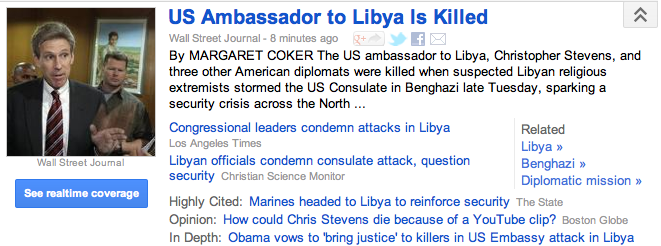
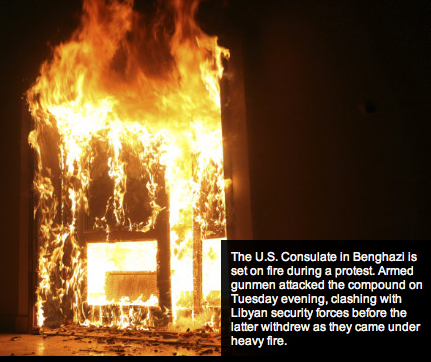
The vote was overshadowed by the killing of the US ambassador to Libya, Christopher Stevens, and three other Americans in an attack on the US consulate and a safe house refuge in Benghazi.
“It makes security high on my priorities,” he said…
I wonder if he’ll follow in the footsteps of Iraq’s Prime Minister Nouri al-Maliki:
First off, I need to make it clear that I do not subscribe to the bizarre conspiracy theories about planned detonations of the twin towers. Did top government officials know something was afoot? Yes, there were ample detailed warnings concerning an impending attack. As the above news story from the NYT describes, intelligence officials were so convinced that an attack was imminent that they wanted to quit their jobs to avoid being blamed for what was coming. What ensued afterward is best described as taking advantage of a crisis or “not letting a good crisis go to waste.” Iraq’s oil resources were already on the minds of the neocons and the oil corporations; a spectacular terrorist attack on America would be the perfect event by which the Western elite could demonize all of the Middle East in order to make one last run on what was left of the world’s depleting hydrocarbons. When the lifeblood of your economy is running out, more extreme and radical options get thrown onto the table. And so the media whipped up the nationalist fervor of the country and false claims of Al Qaeda ties with Iraq and WMD’s were spun into the national consciousness. Much blood and treasure were spent; the coffers of the Arms Dealers swelled; a security and surveillance state blossomed to tamp down domestic social unrest; and a new enemy was born to take the place of disaster capitalism’s old nemesis of communism. The financial elite and the neocons, the American war machine, and Big Oil gloated over their Machiavellian maneuvers. But blowback is always the counterweight to the perceived success of such unscrupulous deeds. What’s in the news today:
Making the world safe for capitalism and empire definitely has its drawbacks, don’t you think? When you support oppressive tyrants, throwing them under the bus when their usefulness has expired, fund and arm radical Islamist rebels, and only give lip service to democracy, reality has a way of raising its ugly head in the end.
The following interview from yesterday dovetails with the above commentary on 9-11 and foresees the future. Eventually, unfettered capitalism consumes entire planets when left to its own devices:
CHRIS HEDGES: Yes, because it was an understanding that unfettered, unregulated, unchecked, unimpeded corporate capitalism knows only one word, and that’s “more.” They commodify everything. Human beings are commodities, the natural world is a commodity, that they exploit until exhaustion or collapse. And we see that with the melting of the summer Arctic ice, 40 percent gone. What is the response of our corporate overlords? It’s to raid those waters for the last fish stocks, mineral, oil, natural gas. It makes Herman Melville’s Moby Dick the most prescient book in American literature. It’s utterly suicidal. These are all Ahabs. There’s a quote. I think Ahab says, you know, “My means and my methods are sane. My object is mad.” It’s utter insanity. And if we do not wrest power back from these corporate forces, if we do not reverse this corporate coup d’état, they will quite literally kill off the ecosystem on which the human species depends for life and force all of us in this downward race to the bottom, so that the conditions of workers in Immokalee, Florida, begin to replicate the conditions of workers everywhere.
We’re caught in capitalism’s feedback loop of self-destruction. The corporate state will make everything cower before the altar of “The Market”. Unfortunately, the ecosystems of the planet will have the final say on such demands.
Sometimes, in order to move forward we must look back. I am reflecting once more on another man’s life and words, very prescient and witty words. I was reminded again of his legacy this morning after reading the Congressional Record honoring the life and accomplishments of Gore Vidal by US Congressman Steve Cohen who was brave enough to give it. Before we get to Gore, let’s talk a bit about mankind’s technological prowess in terms of lethal weaponry.
In the great expanse of Earth’s history, industrial civilization will be chronicled as a mere blip in geologic memory, but in the human scale of time perception, our self-inflicted demise by way of ecocide is slow and seemingly imperceptible. And so while we quietly commit self-extermination by breaching environmental tipping points, mankind’s annihilation may also arrive via the proliferation of weapons of mass destruction, facilitated by the ongoing advancement of technology:
Scott Kemp, an assistant professor of nuclear science and engineering at the Massachusetts Institute of Technology, says that the worry with SILEX laser technology “is that it is particularly suited for nuclear proliferation, even better than centrifuges. SILEX can also enrich fuel-grade uranium to weapons-grade in fewer steps than a … centrifuge.”
Kemp was until 2011 science advisor in the Office of the Special Advisor for Nonproliferation and Arms Control at the U.S. State Department.
Writing in the latest issue of the Bulletin of the Atomic Scientists, he says that before the plant is licensed the U.S. government or Congress should commission an independent inquiry into whether its benefits outweigh the added proliferation risk. Other U.S. nuclear scientists and arms control specialists have previously called for similar action….
A U.S. State Department assessment in 1999 of the SILEX technology and the plans to start commercial processing conceded that a laser enrichment facility “might be easier to build without detection and could be a more efficient producer of high enriched uranium for a nuclear weapons program.”…
“It seems likely,” the State Department said, “that success with SILEX would renew interest in laser enrichment by nations with benign intent as well as by proliferants with an interest in finding an easier route to acquiring fissile material for nuclear weapons.”
While there are still some details to sort out, it’s pretty clear that making weapons at home using 3-D printers from commonly available materials is going to become much more commonplace in the near future. In fact, as 3-D printing technology matures, materials feedstock improves, and designs for weapons proliferate, we might soon see the day when nearly everyone will be able to print the weapons of their choice in the numbers they desire, all within the privacy of their own homes.
“Through my work at NTI, I’m often asked, “What are the odds of nuclear use by a terrorist group?” Today, I received a letter from Warren Buffett, who is an adviser to NTI, describing the statistical chance of a nuclear, biological or chemical weapon attack in the United States. His letter said:”
If the chance of a weapon of mass destruction being used in a given year is 10 percent and the same probability persists for 50 years, the probability of the event happening at least once during that 50 years is 99.5 percent. Thus, the chance of getting through the 50-year period without a disaster is .51 percent — just slightly better than one in 200.
“If the probability of similar weapons being utilized can be reduced to 3 percent per year, the world has a 21.8 percent chance of making it through 50 years without an event. And if the annual chance can be reduced to 1 percent, there is a 60.5 percent chance of making it through 50 years.
Now back to the insightful and prophetic words of Gore Vidal:
JAY: Fascism in Germany wasn’t a coup; it was a many-year process. [crosstalk] feel normal. I’m not suggesting we’re living in an equivalent period, but there are lessons to be learned about.
VIDAL: But it is equivalent. I mean, don’t be shy of saying that. The response to the Reichstags Fire is precisely that to 9/11, which was invoked by this administration’s people. “And if we don’t fight them over there, we gotta fight ’em over here.” This little fool. How are they going to get here? Greyhound bus? I mean, he is so stupid himself that he assumes everybody else is equally stupid. If he had been really elected, I would say everybody else was stupid, but he wasn’t.
…
VIDAL: After all, you are in opposition to American media, and so am I. And we know how false it is, and how corrupt it is, and how engaged they are for mischief, making money for the ownership of the country. There’s nothing to be done about them. And no wonder, even when the American people might ever again, which I doubt, have an uncorrupted presidential election. 2000 was corrupted. 2004 was corrupted. I don’t think we’ll ever get to know the people’s voice, and the people have no voice because they have no information. That is why you’re doing useful work here. That’s why I’m chatting with you here. That could be useful, to tell them actually what happens around the world. That poor guy running for Congress, everybody jumped on him, particularly [inaudible] people. He suggested that our foreign policy might have had something to do with 9/11, that we were deeply disliked in the Muslim world for other reasons. It’s the same presidential, I guess. “Do you believe in evolution?” said this idiot. I mean, to reveal the leadership of the United States hasn’t made it to the 20th century, that our leadership is as ignorant as that. Five of them said, no, no, thinking little lord Jesus was going to vote for them.
JAY: It’s in these moments of crisis, like terrorist attack, that you start to see people’s colors.
VIDAL: Yellow.
JAY: In Britain as well, and I was really taken aback. After the bus London bombings, Ken Livingstone, ‘Red’ Ken Livingstone, was asked, was there any connection between these bombings and UK foreign policy, and he said there’s no connection whatsoever. This is just people that hate our way of life.
VIDAL: Yeah, that’s the new lie that they like to tell. Well, that’s Bush allover. “They just hate us.” Why? Nobody has to ask them why. He doesn’t know why. “Well, they envy us, our form of government.” Who envies us that can of worms we’ve got in Washington? And it’s been many years in the United States since I have seen a Norwegian coming to get a green card.
JAY: The economic structure of television makes what I’m going to ask difficult to accomplish. But do you think television journalists have learned anything from this last four years?
VIDAL: Well, they’ve always been lazy, and they’re not used to getting to the heart of problems, of matters. They’re not used to investigating anything. Socrates tells us that the unexamined life is not worth living, and that is an absolute truth. Those who want to examine life don’t go in for journalism, because they’re not allowed to. So they’ve got to be very careful. They have to think about tenure if they’re at a university. They’ve got to think about, you know, the publisher and advertisers. So it’s a difficult row to hoe, and we have no intellectual tradition of any kind in the United States. I even told Arthur Schlesinger, “You know, Arthur, one Schlesinger does not make a spring.” He was horrified.
…
VIDAL: …It’s when the news starts to break, how two presidential elections, 2000 and 2004, were stolen and The New York Times would not review the book written about it by Congressman Conyers, nor Washington Post, nor Wall Street Journal, the great instruments of news were silent. Well, they’re saying, “We don’t give a goddamn about the United States. Just stew in your own juice. Leave us alone. We have corporate figures to add up now, and we have certain things we want to put in place, and we may have a couple of candidates for you dumdums, but you probably won’t like them.” You know, I’ve been around the ruling class all my life, and I’ve been quite aware of their total contempt for the people of the country. And the Republican machine became so good at transmitting its own feelings about the world to the enemy, to the liberals, once anyone, any of the right wing hear what I just said, he’ll say, “Oh, the liberals have always hated America. We know that. They despise family values, because they’re only interested in gang bangs and drugs and so forth.” This is the way they deal. And whenever they have a real coward for president, like Bush himself, and you have a hero like Kerry, “Oh, he’s a coward. Didn’t you know that? We’ve got five guys who were in Vietnam with him.” What they do is whatever is their transgression, whatever are their faults, they lie and apply it to the other person. That confuses everything. If I were an average voter in the United States, I wouldn’t know who was telling the truth, whether Kerry really had run away and didn’t get purple hearts, or whether Junior, you know, had actually learned how to fly a plane.
JAY: And television news covers the lies like news.
VIDAL: Yes. It has a lock on it.
…
VIDAL: …There’s not anyone with an IQ above, you know, lowest room temperature who isn’t interested in something like this [truth in news]. Everybody is on to the con act of our media, that they are obeying bigger, richer interests than informing the public, which is the last thing that corporate America has ever been interested in doing. So I think, you know, the sky’s the limit to the amount of audience you can get. And one of the secrets is, aside from telling the truth which most people in America hate because they’ve been brought up on advertising, and they think the truth is just something irrelevant, irrelevant, you know. Everybody lies. You know, I love that line. So it’s alright to steal the election. Well, that isn’t what the world’s about. And I think it’s really come down to we’re going to be blown up one of these days. We have now acquired so many enemies with so much power in the world that, well, they’re going to take a couple of cracks at us. I would rather have Real News here telling us just where it was they struck, where it is, intelligence says they may strike again, and maybe why they’re doing it – we blew up their mosque, we killed their president, or whatever it was that set them off. What our fictional news does now, and this is–all it is is fiction, whether it’s CNN or CBS or NBC, it’s all fiction. The people making this junk know that. The viewers suspect it. But where are they going to turn to? Where are they going to find out? They can’t all go out and get a, you know, subscription to The Nation, which would help straighten them out, at least in print. So you’re going to be the only alternative, and the word will start to spread. Look at the speed with which, you know, just by telling jokes, John Stewart and company, got the attention of everybody. And now they say, well, most of the real news that the people know about they get from the satirizing of it that Stewart does. And very funny he is, too. In other words you build a better mousetrap, and the mouse will come to your door.
“…You can’t just go into Iraq and smash them to pieces and pretend that they are an enemy. They will become one if you knock down their houses and kill them. They get very grumpy, you know, when you do things like that to them. So he [Bush] managed to make a lot of enemies. We’re the ones the bombs are going to fall on… He’ll [Bush] be in his bunker in that awful place in Texas where he lives. He’ll be hidden away. He’ll be safe. It will be our cities that are going to get it when some of these suicide bombers get angry at us and blame us for his misdeeds… It was a coup d’état after 9-11. A bunch of ambitious hoods, from the oil and gas business mostly, decided now is the time to take over everything. And the neoconservatives were right there with them, and they wanted big armies in the Middle East to destroy countries they didn’t like. They wanted to get rid of Syria, Iraq, Afghanistan, Iran… they have a long list, they’ve still got it. I don’t think they’re going to have a chance to utilize it because we ran out of money…”
Dear potential contributors (DK, Tom Tom, Kramerfaust, Sunson),
I am going to send you an invitation tonight so that you can contribute. You’ll have to sign up with wordpress in order to submit your work to me. It looks like Kramerfaust already has a wordpress account set up. Per the WordPress staff:
Your new user will now be able to access your blog by visiting the My Blogs section of their dashboard when they log in to WordPress.com.
You won’t have to blog at the site you initially create; it’s just a required formality. Or you can simply email me at Collapsitarians@gmail.com. I’m looking forward to reading your posts. More voices means more worldly knowledge to glean from and different perspectives to appreciate.
Since I started this site, the stats tell me that the top four google searches which have brought people here are the following:
1.) collapse of industrial civilization
2.) the price of offshore revisited
3.) james holmes sociopath
4.) collapse peak oil
The first one is an obvious outcome. I was surprised this domain had not been previously claimed since it seems to be such a hackneyed phrase. As Greer has noted, in the twilight of past civilizations, the elite are increasingly seen as corrupt and stories of societal collapse become popular in the mainstream culture. The second one relates to my post about the trillions being hoarded in offshore tax havens by the 0.001%. Backed by the power of the State, the global elite live in a cocoon of cossetted comfort, indifferent to the hand-to-mouth existence of the majority. They’ve got the iron fist of the Military Industrial Complex and Police State to protect their wealth from the rest of humanity who will be falling off the net energy cliff into poverty and desperation.
The third google search phrase is apparent to all unless you have been living under a rock since July 20th. We have these mass shootings periodically here in the Land of the Second Amendment just as a reminder that guns don’t kill people. Guns are completely innocent in these mass bloodlettings and should not be denied their freedom of getting into the hands of every man, woman, and child in the country. The response by the public is simply to buy even more guns. Why refute such logic in a world that thinks more debt is the answer. More debt, more growth, more firepower, more people, more wars, more cars, more profit, more, more, and more…..
And the last google search is not a surprise either. Despite all the propaganda of another oil surfeit, educated peak-oilers have not been swayed.
Connecting the ‘War on Terror’ with the control of resources abroad and the crushing of dissent both here and overseas:
In order to overtake and dominate, sometimes you have to draw your opponent in close to you. Knowing that the oil and gas reserves of the Middle East make it an area of vital geopolitical and national security importance, an empire would use all available opportunities to insert itself there, even if it meant invasion under some false pretense. With the trumped-up claims of terrorist ties to Iraq and WMD, 9-11 gave the empire the pretense to invade. Today we can see the results here and here and here.
“Moreover, as America becomes an increasingly multi-cultural society, it may find it more difficult to fashion a consensus on foreign policy issues, except in the circumstance of a truly massive and widely perceived direct external threat.” (p. 211)
“Never before has a populist democracy attained international supremacy. But the pursuit of power is not a goal that commands popular passion, except in conditions of a sudden threat or challenge to the public’s sense of domestic well-being. The economic self-denial (that is, defense spending) and the human sacrifice (casualties, even among professional soldiers) required in the effort are uncongenial to democratic instincts. Democracy is inimical to imperial mobilization.” (p.35)
“To put it in a terminology that harkens back to the more brutal age of ancient empires, the three grand imperatives of imperial geostrategy are to prevent collusion and maintain security dependence among the vassals, to keep tributaries pliant and protected(!), and to keep the barbarians from coming together.” (p.40)
Now we get to today’s video from Journeyman pictures which gives further evidence from a whistleblower that all the stops were pulled in order to make this ‘War on Terror’ fly. No more Geneva Convention, no more questioning of the efficacy or, for that matter, morality of the brutal torture done by countries we once condemned as barbaric:
The War on Terror was the perfect existential threat needed to prop up neoliberal capitalism and its resultant world of an opulently rich class ruling over the teeming masses of serfs. In a civilization dominated globally by such an economic system which is designed to funnel the shrinking wealth (i.e. energy) of society into the hands of a tiny elite, there can be no other future to look forward to for those at the bottom but despair and poverty:
I’m politically agnostic so I don’t really pay too much attention to the machinations of our faux democracy, best described as a “kabuki theater of empty formalisms that disguise the offstage conspiracies of corporate/state elites.” Politics has become like the fake professional wrestling of the WWF: a rigged and meaningless spectacle for the apathetic masses.
The latest titillating maneuver comes from the DNC in the form of a video illustrating King Romney waffling over if/when he’ll disclose his income tax returns. It features Romney’s Olympic-qualified dressage horse named Rafalca and was to be Volume 1 of a series of videos:
But apparently the video cut too close to the bone for the Romney Royalty, and since late Wednesday the DNC has decided to pull the plug on the series:
…At the time, the DNC was billing the video as “the first in a series of digital products highlighting Rafalca.”
But by late Wednesday, the DNC had done a complete 180 and decided it “will longer use the Romney’s Olympic-bound dressage horse to portray Mitt Romney as ‘dancing around the issues’ because it could be seen as offensive to the (Mitt Romney’s) wife Ann,” CNN’s Political Ticker blog reported….
…The catalyst for the DNC’s about-face on the wisdom of “highlighting Rafalca” was an interview, scheduled to air Thursday, in which Ann Romney told Good Morning America’s Robin Roberts, “It makes me laugh. It’s like ‘Really?’ You know, there’s so many people out of work right now, and there’s this guy right here that has the answers for fixing the economy, and all these attacks are going to be — they’re going to try everything. They’re going to throw spaghetti at the wall.”
What’s even more offensive and alarming is that the masses can’t readily see that, for all practical purposes, there is no difference between the two candidates we are being offered when it comes to reality-based issues such as the collapsing middles class, institutionalized criminal behavior on Wall Street, enthrallment to the banks and military industrial complex, and myopic vision on dire environmental issues like climate change which threatens to take us all down, rendering every other issue moot. But let’s humor the idea that humanity will still be here in any sizable numbers by mid-century and take a look at the financial viability of the 99%:
So we have the poverty-stricken plebs choosing between a wealthy elite and an exorbitantly wealthy elite. And many still think that’s a choice they need to make. To what end I don’t know. As some like to say, “Jesus wept!”
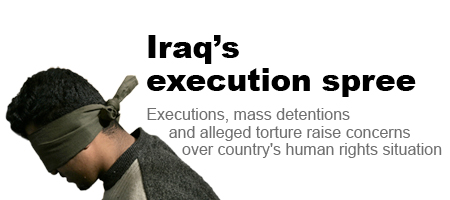
Someone said in my last post that I’m making energy into a God. I’m here to tell you that energy is a God. Like a diehard cigarette addict smoking through their tracheostomy, we continue to use the stuff in the face of extinction-threatening effects to the climate. Our foreign policy revolves around how to get the stuff. In patriotic flag-waving fervor, we send our kids off to war over the stuff. Hell, we’ll butcher an entire country to grab the stuff while dressing it all up as a War on Terror. We even have a term for those poor souls suffering from the affliction of sitting on the stuff. We call it the resource curse. True to form, Iraq is the most glaring example of this feeding frenzy by the multinational oil companies, accompanied by wholesale corruption and that thunderous sucking sound of taxpayer money down a bottomless pit:
“The Saudis have a saying that acknowledges their luck in being born on top of billions of barrels of oil and the inevitability of its depletion:
“My father rode a camel, I drive a car, my son flies a jet plane, his son will ride a camel.”
Delusional Americans believe they have a right to cheap plentiful oil forever. They refuse to acknowledge that luck has played the major part in their rise to economic power. The American saying will be:
My great grandfather rode a horse, my grandfather drove a Model T, my father drove a Buick, I leased a Cadillac Escalade, my son died in the Middle East fighting for my oil, his son will never be born.” – Jim Quinn
If you needed further proof of the ulterior motives behind the invasion and destruction of Iraq, I give you this post from Farooque Chowdhury’s Diary. [I have embedded links in the article and done some grammatical edits.]
“Mysteries” of the Iraq War are getting exposed: Rupert Murdoch, the media Moghul, pressed Tony Blair, the British prime minister, to hasten joining the Iraq War. Murdoch did it on behalf of the US Republicans. And, the war took over 100,000 lives.
It is not only the interests behind waging the war, but also the principles and interests the bourgeois press uphold, and the secretive and conspiratorial way the bourgeois democracy works, the lies that are fabricated, how the readers are misinformed, and the manipulation of mass psychology that is being divulged.
The Guardian, British newspaper and AFP, news agency, reported the facts.
The news reports said:
“Rupert Murdoch took part in an ‘over-crude’ attempt by US Republicans to push Tony Blair into action before the invasion of Iraq, the former British prime minister’s ex-media chief claimed [Alastair Campbell…].
“Alastair Campbell said the News Corporation media baron warned Blair in a phone call of the dangers in delaying signing up to the March 19, 2003 invasion, as part of an attempt to speed up Britain joining the military campaign.”
Campbell’s assertions were made in The Burden of Power: Countdown to Iraq, diaries from his years at Blair’s side. [Here is his blog]
The news reports said:
“Campbell suggested Murdoch made moves to help the right-wing Republican Party of then US president George W. Bush before the March 18 vote in the […] House of Commons on deploying troops to Iraq, which was passed.”
Citing Campbell the news reports said:
On March 11, 2003, Blair “took a call from Murdoch who was pressing on timings, saying how News International would support us […]”
The reports said:
“‘Both TB [Tony Blair] and I felt it was prompted by Washington, and another example of their over-crude diplomacy. Murdoch was pushing all the Republican buttons, how the longer we waited the harder it got.’
“Campbell said Murdoch’s intervention came ‘out of the blue’.
“‘On one level (Murdoch) was trying to be supportive, saying ‘I know this is a very difficult place, my papers are going to support you on this’. Fine.
“‘But I think Tony did feel that there was something a bit crude about it. It was another very right-wing voice saying to him: ‘Look, isn’t it about time you got on with this?’”
The news reports said:
“Gordon Brown agitated so aggressively against Tony Blair – demanding a departure date soon after the 9/11 attacks – that Downing Street concluded in 2002 that the then chancellor was ‘hell-bent on TB’s destruction’.
Murdoch’s “worldwide contacts through the businesses that” he operated should not be missed while going through the news items. However, in his witness statement to the Leveson inquiry Murdoch said: “As for the three telephone calls with the then prime minister, Tony Blair, in 2003, I cannot recall what I discussed with him now, […] or indeed even if I spoke with him at all. I understand that published reports indicate that calls were placed by him to me. What I am sure about is that I would not in any telephone call have conveyed a secret message of support for the war; the NI titles’ position on Iraq was a matter of public record before 11 March 2003.” His famous declaration: “I’ve never asked a prime minister for anything.” He cited “four articles from the Sun and the News of the World which illustrated their ‘pro-war stance’ before 11 March 2003 when the main phone call took place.” The media Moghul’s company termed the assertion that he lobbied Blair over the Iraq War on behalf of the US Republicans as “complete rubbish”. It said: “Furthermore, there isn’t even any evidence in Alastair Campbell’s diaries to support such a ridiculous claim.” It should be mentioned that News International is News Corp.’s British newspaper arm, publishing The Times, The Sun and The Sunday Times. Blair faced a challenge getting his Labour Party lawmakers to back UK’s involvement. Many of them rebelled. (“Murdoch pushed Blair on Iraq: ex-media chief” and “Rupert Murdoch pressured Tony Blair over Iraq, says Alastair Campbell”, June 16, 2012)
Already known is the Bush – Blair 2003 Iraq memo or Manning memo, a secret memo of a meeting between Bush and Blair. The historic meeting took place on January 31, 2003 in the White House. The memo, written by David Manning, Blair’s chief foreign adviser, showed that the US had already decided on the invasion of Iraq at that point. Manning participated at the meeting. The memo showed Bush and Blair made a secret deal to carry out the invasion regardless of whether WMD were discovered by UN inspectors. The fact contradicts statements Blair made to the British parliament that Saddam Hussein would be given a final chance to disarm. Existence of the memo was made by Philippe Sands in his book Lawless World. The New York Times collected the memo and confirmed its authenticity.
Then, there is the Colin Powell case. While arguing for invading Iraq Powel claimed that Saddam was hiding a secret biological weapons program. Powell dramatically and confidently held up a vial he said could contain anthrax during his presentation of the Iraq case at the UN in 2003. But, later, the claim proved bogus.
Powel relied on information provided by an Iraqi defector. The defector was code-named “Curveball”. CBS News identified Rafid Ahmed Alwan al-Janabi as “Curveball”. Rafid made the false claims to German intelligence officials. The US used the claim that ultimately turned out to be a lie. But the Empire used the false information to start the war. The UN inspectors found no evidence of a biological weapons program, which was claimed.
In interviews with The Guardian, Rafid told the way he sought asylum in Germany and wanted to see an end to Saddam’s regime. “They gave me this chance. I had the chance to fabricate something to topple the regime. I and my sons are proud of that […]”
Defector tells how US officials ‘sexed up’ his fictions to make the case for 2003 invasion.
The “story” of falsehood and fabrication doesn’t end there.
Citing Britain’s The Independent, Thomas Ferguson, Senior Fellow at the Roosevelt Institute and Professor of Political Science at the University of Massachusetts, Boston, wrote: The Independent news report “buries forever all claims that the US, the UK, and other governments did not have oil on their minds as they prepared to invade Iraq.” He referred to a book that drew on more than a thousand secret government documents. These show meetings between the UK government and British oil companies in the run up to the war. “These demonstrate that all the denials in London and Washington that policymakers were not concerned about oil as they invaded were as false as the famous cover story about weapons of mass destruction.” These also show that all the governments were negotiating over rights to oil long before the invasion and that they were working closely with their companies. Dick Cheney’s Energy Task Force was reviewing documents on Iraqi oil well before the attack on 9/11. (“Oil-Soaked Politics: Secret U.K. Docs on Iraq”)
So, the profit issue emerges. The Iraq war brought profit to all interested: weaponeer, supplier, infrastructureer, defense contractor, mercenary companies, and a section of media and politicians.
According to MSN Money(link to Cheney and his war profits), Halliburton’s KBR, Inc. division made $17.2 bn in the desert war in the 2003-2006 period, which was one-fifth of KBR’s total revenue for the 2006 fiscal year. Halliburton was involved with construction and maintenance of military bases, oil field repairs, and infrastructure rebuilding projects in the country.
Veritas Capital Fund/DynCorp, the private equity fund, gathered $1.44 bn through its DynCorp subsidiary by imparting training to new Iraqi police forces. The company is termed by many as a ‘state within a state’.
Through repair, maintenance, etc. work in Iraqi oil fields the Washington Group International gathered $931 mn in the period 2003-2006. Through the work of munitions disposal the Environmental Chemical got $878 mn by the end of fiscal 2006. The Aegis of the UK made $430 mn. (“25 Most Vicious Iraq War Profiteers”)
And, after the Bush Blair, Murdoch, Halliburton war business, where stood Iraq?
Thomas E. Ricks, Washington Post Pentagon correspondent quoted Mohammed Abdullah, an Iraqi in his Fiasco: The American Military Adventure in Iraq: “They said they came to liberate us. Liberate us from what? They came and said they would free us. Free us from what? We have traditions, morals, and customs. We are Arabs. We’re different from the West. Baghdad is the mother of Arab culture, and they want to wipe out our culture, absolutely.”
Iraq now stands devastated, a bold sign of Naked Imperialism (title of a book by John Bellamy Foster). Parts of life in the land have been wiped out. Does imperialism have the power to restore what has been lost in Iraq? It’s incapable. Imperialism’s devastating power lacks power to create and nourish life and nature. Iraq is one of the monuments of destruction imperialism has constructed in many parts of the world.






 Collapse of Industrial Civilization