In a previous post, New C.I.A.-Commissioned Report on Climate Change Stresses to Civilization, we were given a window into dangers created by human-induced climate change. Now we learn that President Obama has axed that program. Why study the ultimate existential threat to industrial civilization when you can just build more weapons to fight the social instability and wars brought on by abrupt, chaotic and extreme weather patterns. This mindset would be in keeping with the American ruling establishment’s practice of treating the symptoms rather than the root cause – ignoring the fact that we, aka industrial ‘civilized’ humans, are the destabilizing force of the biosphere and the primary cause behind climatic disasters to civilization. We’ve pumped so much CO2 into the atmosphere that it has now gained an intractable foothold as a driving force behind possible runaway climate change.
Excerpt…
CURWOOD:…One of the more startling scientific reports presented at Doha — based, so far, on preliminary data – suggests that emissions from the melting Arctic are heading for a tipping point that could lead to runaway warming...
CURWOOD: Now we understand that the CIA has shut down its center for climate change and security – why did they have the center in the first place, do you think?
ROMM: Well, there has been increasing awareness in the intelligence community and the Pentagon that global warming and climate change was going to have an impact on US national security interests. Whether it is military bases that are seeing sea level rise or countries that are subject to worse droughts and famines, so, you know, I think many countries around the world had come to the view that climate change was going to have a big impact on security.
CURWOOD: Why shut this unit down now?
ROMM: Apparently the unit didn’t have much support when Panetta left and General Petraeus took over at the CIA. Petraeus was very focused on terrorism, and there’s a lot of congressional Republicans, who, you know, deny climate science and therefore attack any action by the federal government to study climate change and its impacts.
CURWOOD: Some suggest that the CIA shutting down its Center for Climate Change and Security is a budget matter. What’s your analysis?
ROMM: Well, I think that everyone knows that budgets are under duress. We have this fiscal cliff, in all likelihood, discretionary spending, even for intelligence, is going to be cut. Some were saying that the CIA was trying to make nice with Congressional Republicans and not continue this center that kind of annoyed them.
I hope that’s not the case, because, this is a matter of pretty basic science and it would be a shame if our intelligence organization, whose job is to sift through the facts and be completely separate from ideological spin, it would be a shame if they were getting pressured to not look at science and facts…
ROMM: Closing the center was absolutely a mistake. If the intelligence apparatus in this country with its $75 billion dollar budget can’t have a small center to study one of the gravest threats facing the world, that’s a pretty sad state of affairs…
~~~~~~~~~~~~~~~~~
That’s a pretty sad state of affairs. The weapons of mass destruction have been in plain site all along…
Listen to the real reasons…
…Our national security has been reduced, in large part, to energy security which has led us to militarizing our access to oil through establishing a military presence across the oil-bearing regions of the world and instigating armed conflict in Iraq and sustaining it in Afghanistan…
Gail from Wit’s End referred me to Guy McPherson’s presentation above. I just finished watching it a few minutes ago. Here are my thoughts on the talk.
This is the big wild card which may well bring everything down since the IPCC assessments and climate models either don’t factor in these feedback effects or, if they do, don’t do it with much accuracy. For example, the Arctic is melting three times faster than predicted and that will have implications for the entire planet. The Arctic melt, as well as Greenland melt, makes all global climate change predictions unreliable. Another example just came across the news today:
Doha, Nov 27 (Prensa Latina) The rapid increase in temperature in the Arctic has caused a loss of ice in the subsoil of the region, a fact that should be considered in climate models, experts said today. If the “permafrost” melts, it will free all the carbon accumulated for centuries, said Kevin Schaefer, of the United Nations Environment Programme (UNEP) at the 18th Conference on Climate Change held in Doha, Qatar.
“Once it starts happening, the process is irreversible. There is no way to recapture the carbon released. And the process wil continue for centuries, due to the organic matter being very cold and descomposing slowly”, said the scientist.
This excess of carbon released into the atmosphere was never included in the projections of global warming, which is why the UNEP recommends that the Intergovernmental Group of Experts on the Evolution of the Climate specifically take into account the growing impact of permafrost thawing on global warming…
All of these uncertainties should give everyone pause because it means that the most dire predictions could very well be correct, as Guy points out in his talk.
Towards the end of the video, the camera spanned the auditorium and I could see all the empty seats. There were perhaps a few dozen people in attendance of Guy’s talk. That’s a sad commentary on society, but it also points to something else – catastrophe fatigue or the normalization of catastrophe. The slow and steady stream of doomsday news along with the popularizing of such themes in mainstream entertainment and pop culture has served to desensitize people to catastrophe and violence:
Guy doesn’t really talk explicitly about the link between capitalism and the environmental crisis. He should. Capitalism feeds off of crisis. As they say, capitalism is crisis. It is the primary root cause of the civilization-ending eco-collapse we are facing:
I find it interesting that we are living in a time where the average person can, with a little research every night, have a good idea of what is going on globally with the economy, the environment, and societal structures. But with that knowledge comes the realization that you are essentially powerless to change the big picture. And so it is with our slide into a truly barbaric future. Having avoided any news this past week, I slept well. Tonight, however, is a different story as I start back into reading up on the latest world events and perspectives from prominent authors. It’s a real horror show developing these days.
We know that our ‘political economy of aristocracy‘ is a major impediment in moving away from our fossil fuel-based system and creating a socially just society, but the elite will do whatever is within their power to hold onto their place in the capitalist hierarchy:
…It is in any individual’s self-interest to preserve that in which they are most invested; but the rich pose a particular danger because their self-interest often leads them to attempt to protect and preserve entire modes of economic activity that society needs to move past in order to avoid colliding with the limitations of natural resources inherent in any specific mode of technology. No more clear example can be imagined that the Koch family interest pouring hundreds of millions and billions of dollars into conservative think tanks and political lobbies that not only deny global climate change, but also actively oppose the development of clean energy technologies. But a more instructive example may be the Walton family interests, which seek to avoid the development of public understanding of how the Wal-Mart business model shifts much of its employment costs onto the government – a modern twist on the methods by which the wealthy “pauperize the multitudes” identified in the Founders’ political economy of aristocracy…
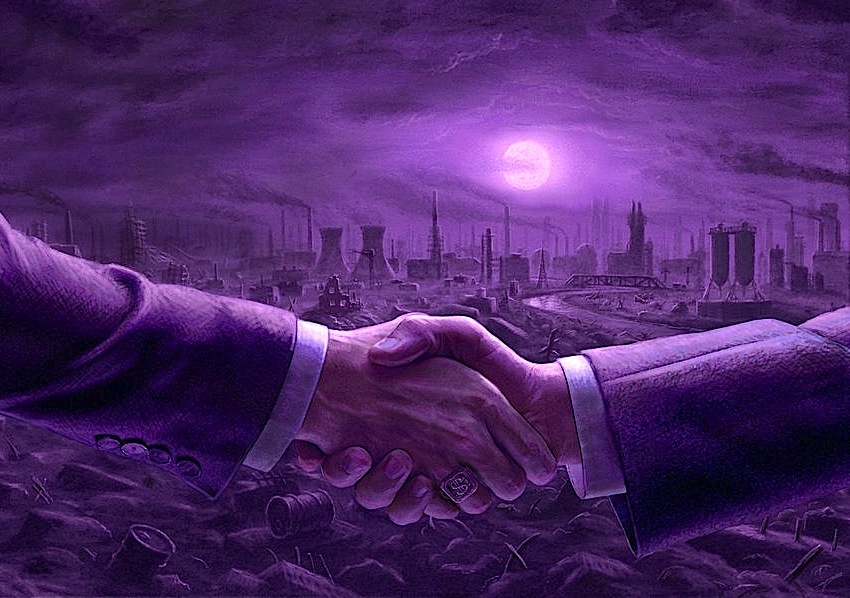
Professor David McNally has an insightful new essay spelling out the machinations of capitalism which the elite have and will continue to carry out in order to preserve the status quo and gross inequality of our political economy. Some excerpts:
…Of course it is better for businesses if there is lots of demand for their goods. But the purpose of a capitalist enterprise is not to make sales; it is to make profits. The ability of firms to accumulate, invest, grow and beat out their competitors depends on profitability. And once capitalism gets into a systemic crisis of the sort that broke out in 2008, profitability cannot be restored without enormous destruction. There are two key mechanisms by which this happens.
The first involves destroying excess or unproductive capital. If firms in one industry after another are forced into bankruptcy and/or gobbled up by the competition, those that remain will eventually restructure and reorganize themselves to produce at lower cost (and higher profits). Having bought up bankrupted assets on the cheap, and having taken over the market shares of failed companies, they will be in a position to invest again.
The second capitalist mechanism for exiting a crisis involves driving down working people’s living standards. Put simply, by devaluing human life and the costs of reproducing people – via lower wages and benefits and reduced “social wages” (the public services available by way of pensions, social assistance, health care and education) – capital reduces its costs of doing business. And it is the latter strategy, reducing the costs of reproducing people, that has dominated thus far.
The reason for this is simple. In addition to funneling trillions of dollars to bail out the financial sector, the world’s central banks, particularly those in the Global North, have lowered borrowing costs to just a hair above zero. This means that faltering companies can stay alive by borrowing money that is virtually free. That is why there has been nothing so far like the wave of corporate bankruptcies witnessed during the Great Depression or across the 1980s. And because such a wave of bankruptcies would once again rock the financial system, nothing like it should be expected in the short term.
That leaves austerity as the capitalist class’ principal strategy. Here, they have racked up considerable success. Not only have public services been drastically curtailed, so have living standards generally. In the U.S., median incomes contracted more than four percent during the “recovery” since 2010 and have now declined to where they stood in 1995. That represents the elimination of all wage gains in the past 17 years. In the U.K., meanwhile, living standards have been pushed 13 percent below their 2008 levels.[4] Now, all of this may be bad for “the economy” in the abstract: reduced incomes mean less spending and less employment. But we don’t live in an economy in the abstract. We live in a capitalist economy whose imperative is profit. And reduced incomes are highly functional for capital.
To that end, governments everywhere have embarked on programs designed to increase the precariousness of everyday life. They know that insecurity makes it harder for workers to fight back, and so they are using every weapon in their arsenal to render workers less comfortable, confident and secure. They are attacking labour rights, undermining job security, driving down wages, benefits and social entitlements, and relying heavily on migrant labourers. Indeed capital’s ideal precarious worker for the age of austerity is the migrant who enters a country bound to a single employer, with no rights to live and stay beyond the length of their employment contract. In Canada, the proportion of entrants admitted under the Temporary Foreign Worker Program is skyrocketing, and the same is true for similar programs elsewhere.
Not surprisingly, austerity and growing precariousness have done wonders for corporate profits, which have risen persistently since 2009. However, in the absence of significant destruction of capital, those profits are sitting idle rather than being invested in new means of producing wealth. By early 2012, U.S. corporations were sitting on nearly $2 trillion in cash, a record amount. European firms were doing the same, holding around two trillion euros. And that is the dilemma capital faces at the moment. Austerity has boosted profitability, but it has not made investment attractive. Moreover, the lack of a new investment boom sets limits to just how high profits can rise (indeed, by mid-2012 corporate earnings seemed once again to be faltering). Consequently, the system keeps spinning its wheels unable to acquire the traction required for a sustained recovery and expansion.
And so, the capitalist class and their governments continue to do what they know best: enforce ever-greater sacrifices on working people. Greece, of course, is the center of the austerity storm. Pensions there have been cut in half, wages slashed by a third. Homelessness is soaring and soup kitchens struggle to keep up with those in need of food. Suicide rates have risen alarmingly. Notwithstanding all that, the “troika” – the European Central Bank, the IMF and the European Commission – demand more blood. Already, the Greek government has tabled a budget for 2013 that will cut billions more from pensions, wages and social benefits, notwithstanding their own forecast that the Greek economy will contract once again by nearly five percent. The whole purpose of these cuts is to prove to international capital that Greece will abide by the discipline of financial markets and that, should it receive new “loans” from the troika, it will use this money only to pay back global banks. Perish the thought that some of these funds might find their way to teachers, nurses or pensioners. Indeed, to say the money is “loaned” to Greece is entirely false: these funds enter a special account through which they are channelled directly to banks. And for that purpose the Greek people are being bled dry.[5]…
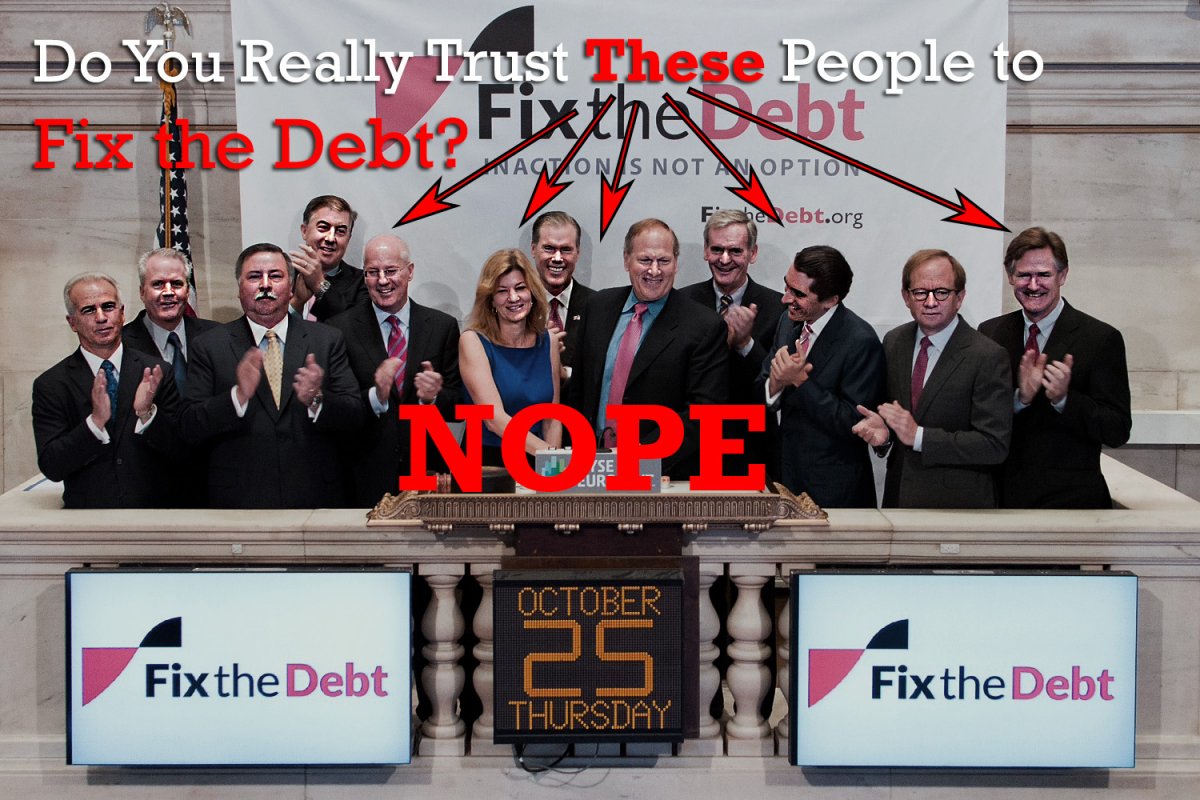
We now see the corporate elite in America, the beneficiaries of taxpayer bailouts, off-shore tax havens, government contracts, as well as near zero Fed loans, sharpening their blades to cut the throats of the American people:
The corporate CEOs who have made a high-profile foray into deficit negotiations have themselves been substantially responsible for the size of the deficit they now want closed.
The companies represented by executives working with the Campaign To Fix The Debt have received trillions in federal war contracts, subsidies and bailouts, as well as specialized tax breaks and loopholes that virtually eliminate the companies’ tax bills.
The CEOs are part of a campaign run by the Peter Peterson-backed Center for a Responsible Federal Budget, which plans to spend at least $30 million pushing for a deficit reduction deal in the lame-duck session and beyond.
During the past few days, CEOs belonging to what the campaign calls its CEO Fiscal Leadership Council — most visibly, Goldman Sachs’ Lloyd Blankfein and Honeywell’s David Cote — have barnstormed the media, making the case that the only way to cut the deficit is to severely scale back social safety-net programs — Medicare, Medicaid, and Social Security — which would disproportionately impact the poor and the elderly.
Yet the CEOs are not offering to forgo federal money or pay a higher tax rate, on their personal income or corporate profits. Instead, council recommendations include cutting “entitlement” programs, as well as what they call “low-priority spending.”
Many of the companies recommending austerity would be out of business without the heavy federal support they get, including Goldman Sachs and JPMorgan Chase, which both received billions in direct bailout cash, plus billions more indirectly through AIG and other companies taxpayers rescued.
Just three of the companies — GE, Boeing and Honeywell — were handed nearly $28 billion last year in federal contracts alone. A spokesman for Campaign To Fix The Debt did not respond to an email from The Huffington Post over the weekend…
Now this brings me to Chris Hedges’ last essay which I just read tonight. He’s becoming more apocalyptic as time goes on. Chris knows what I know: we are headed towards a hellish future in which a tiny elite will try to hang on to their wealth and power at the expense of everyone else, including the planet. High tech weaponry and surveillance technology will be used to enslave and control the masses while maintaining capitalism’s grip on society:
…The impending collapse of the international economy, the assaults on the climate, the resulting droughts, flooding, precipitous decline in crop yields and rising food prices are creating a universe where power is divided between the narrow elites, who hold in their hands sophisticated instruments of death, and the enraged masses. The crises are fostering a class war that will dwarf anything imagined by Karl Marx. They are establishing a world where most will be hungry and live in fear, while a few will gorge themselves on delicacies in protected compounds. And more and more people will have to be sacrificed to keep this imbalance in place…
…As the world breaks down, this becomes the new paradigm—modern warlords awash in terrifying technologies and weapons murdering whole peoples. We do the same in Afghanistan, Iraq, Pakistan, Yemen and Somalia.
Market forces and the military mechanisms that protect these forces are the sole ideology that governs industrial states and humans’ relationship to the natural world. It is an ideology that results in millions of dead and millions more displaced from their homes in the developing world. And the awful algebra of this ideology means that these forces will eventually be unleashed on us, too. Those who cannot be of use to market forces are considered expendable. They have no rights and legitimacy. Their existence, whether in Gaza or blighted postindustrial cities such as Camden, N.J., is considered a drain on efficiency and progress. They are viewed as refuse. And as refuse they not only have no voice and no freedom; they can be and are extinguished or imprisoned at will. This is a world where only corporate power and profit are sacred. It is a world of barbarism…
Evil unencumbered by the slightest conscience seems to me to be what has been described above. By comparison, the droogs in ‘A Clockwork Orange’ appear quaint.
In my previous post I quoted Professor Charles Hall’s assertion that the current economic paradigm is ill-equipped to account for and address externalities such as resource depletion and environmental degradation. Peak oil as well as climate change/global warming are just two in a long list of biophysical constraints which neoclassical Keynesian economics, i.e. mainstream economics, overlooks:
…the crisis looming before us is likely to be, if anything, more terrible than the Great Depressions of 1873-93 and 1929-39. The continuing industrialization of agriculture and urbanization of population—by 2010, it is estimated, more than half the earth’s inhabitants lived in cities—has made more and more people dependent upon the market to supply them with food and other necessities of life. The existence on or over the edge of survival experienced today by the urban masses of Cairo, Dhaka, São Paulo, and Mexico City will be echoed in the capitalistically advanced nations, as unemployment and government-dictated austerity afflict more and more people, not just in the developed world’s Rust Belts but in New York, Los Angeles, London, Madrid, and Prague.
Left to its own devices, capitalism promises economic difficulties for decades to come, with increased assaults on the earnings and working conditions of those who are still lucky enough to be wage earners around the world, waves of bankruptcies and business consolidations for capitalist firms, and increasingly serious conflicts among economic entities and even nations over just who is going to pay for all this. Which automobile companies, in which countries, will survive, while others take over their assets and markets? Which financial institutions will be crushed by uncollectible debts, and which will survive to take over larger chunks of the world market for money? What struggles will develop for control of raw materials, such as oil or water for irrigation and drinking, or agricultural land?
Gloomy though such considerations are, they leave out two paradoxically related factors that promise further dire effects for the future of capitalism: the coming decline of oil—the basis of the whole industrial system at present—as a source of energy, and the global warming caused by the consumption of fossil fuels. Even if continuing stagnation should slow greenhouse gas-caused climate change, the damage already done is extremely serious. Elizabeth Kolbert, a journalist not given to exaggeration, called her soberly informative account Field Notes From a Catastrophe. The melting of glaciers threatens not only Swiss views but the drinking supplies of whole populations in such areas as Pakistan and the Andean watersheds; droughts have ravaged Australian and Chinese agriculture for years now, while floods periodically devastate the low-lying South Asian homes of tens of millions of people. The rolling parade of disasters is, unfortunately, only getting started. It will accompany a stagnant economy and only be exacerbated by the increased greenhouse-gas emissions that a return to true prosperity would bring… – essay adapted from Paul Mattick’s book ‘Business as Usual: The Economic Crisis and the Failure of Capitalism‘
The mandatory growth requirement of mainstream economics also precludes the concept of sustainability. I have not yet read the above referenced book ‘Business as Usual: The Economic Crisis and the Failure of Capitalism’, but a prominent socialist speaking of peak oil and global warming in the same paragraph is always intriguing. However, a brief critique of the book by a reader finds that Mattick does not go nearly far enough in incorporating these two realities into his analysis of our current crisis:
All mainstream institutions have subscribed to the near religious belief of the infallibility of the capitalist economy which itself is considered a self-regulating system governed by the “invisible hand” of the free market as explained by Adam Smith in The Wealth of Nations. Market ‘value’ is produced by the optimal use of capital, labor, and production. Mainstream economics operates under the assumption of a world with freely available and unlimited resources. It divides and reduces all resources into units of monetary value, not taking into consideration the value such resources hold in maintaining the ecological balance of the planet.
Isn’t it the height of hypocrisy that those wealthy nations trumpeting the superiority of the free market are also the same countries which dominate global resources and world markets by military superiority as well as the subversive and coercive tactics of their economic hitmen?
…war is integral to imperialism. Imperialism – and especially the imperialist powerhouse, the USA – needs the threat of war to sustain itself: ideologically, militarily, geo-politically and also financially. The arms and defence industry is a major part of the US economy. In 2011, the defence budget was a staggering $698 billion, or 4.8% of the US GDP (link). Add to that the cost of increased security concerns – for example, to combat the ‘terrorist threat’ within imperialist countries – and you have a major chunk of the economy being reliant on the continued existence of enemies within and without.
It’s a form of military Keynesianism to keep a faltering economy going. The further capitalism sinks into decline, the more irrational the drive to war becomes and the more ludicrous are the reasons presented by imperialism (weapons of mass destruction, nuclear capability, etc).
…a very naive view of how the world is run [is to hold the belief that] David Cameron, Barack Obama and Benjamin Netanyahu just ‘happen’ to be spending ‘too much’ on military, which on the surface seems deeply illogical at a time of official austerity. But, of course, the opposite is true: it is their way of staying in power.
Of course, we should fight against such ridiculous spending on increasingly refined machinery to exterminate humanity. But we should be clear why. – link
Moreover, America’s military has become a self-perpetuating industrial complex for profiting from war and instability.
Another problem with the world’s dominant economic system is that GDP is a misguided and inaccurate gauge for measuring the standard of living and well-being of the general populace:
…History shows that democratic forms are no proof against a slide into repressive forms. In Germany in the 1930’s, a declining standard of living contributed to the rise of the Nazi party; Hitler was democratically elected to the office of Chancellor (and then proceeded to establish himself as Fuehrer).
As America’s perpetual-growth economy faces the reality of ecological limits, as climate change imposes costs and decreased well-being on us, as food and energy and other resource prices increase because of the inexorable logic of a declining Energy Return on Energy Invested at the physical foundation of our economy, we face the prospect of a widespread decline in our standard of living. This dynamic lies at the root of this fact: Americans coming of age today are among the first generation who can’t be confident that they will be better off than their parents. By one widely used measure of well-being (the genuine progress indicator, which deducts loss of ecosystem services and other “disamenities” from the national accounts), the American standard of living has flatlined since the 1970s, despite continued strong growth in GDP.
Thus the cautionary lessons from Egypt and Tunisia. GDP is a measure of the commotion of money in an economy, not a measure of delivered well-being. If sustained or rising well-being is what is economically and politically desirable, we should measure it directly, instead of counting on GDP to do the job. And if we accept the idea of popular sovereignty—that governments rule with “the just consent of the governed,” as Jefferson put it in our Declaration of Independence—we must recognize that as the middle class goes, so goes the legitimacy of the regime in power. No system of government—despotic or democratic—fares well when the majority of its citizens experiences a declining standard of living… – link
For those who have not read Darbikrash’s last post, A Nation of Hustlers and Swindlers, it lays bare the big con game of capitalism. Similarly, the mechanic scenes in Oliver Stone’s U-Turn represent, for me, capitalism’s exploitive process of getting something for nothing:
Things have been getting quite dark here lately with all the collapse scenarios casting an ever-growing shadow into the increasingly hard-to-believe fairy tale world of carbon man. As Jb said:
…All around me I see people desperately trying to satisfy their self-worth through consumption. I keep telling myself that I should stop trying to explain the connection between petroleum and the mirage of western civilization, but the headlights keep getting bigger and brighter…
So to lift the spirits of myself and other fellow collapsitarians, a few funnies are in order. The first one is billed as “one of the funniest GIF’s you’ll ever see“, and I must admit I busted my gut when I saw it this evening. What with all that Super PAC dark money rounded up by Karl Rove and his plutocratic cronies, King Romney was convinced he had bought his way into the White House:
It makes sense that Mitt Romney and his advisers are still gobsmacked by the fact that they’re not commandeering the West Wing…
…Team Romney has every reason to be shellshocked. Its candidate, after all, resoundingly won the election of the country he was wooing.
Mitt Romney is the president of white male America.
Maybe the group can retreat to a man cave in a Whiter House, with mahogany paneling, brown leather Chesterfields, a moose head over the fireplace, an elevator for the presidential limo, and one of those men’s club signs on the phone that reads: “Telephone Tips: ‘Just Left,’ 25 cents; ‘On His Way,’ 50 cents; ‘Not here,’ $1; ‘Who?’ $5…
…Romney and Tea Party loonies dismissed half the country as chattel and moochers who did not belong in their “traditional” America.
The next one up is a Romanian TV ad for gasoline. Sorry for being sexist, but I thought it was humorous. Apparently French maids are a universal fixture in the male libido. From the Business Insider:
American gasoline brands tend to advertise their products with images of cars driving on the open road, stats about mileage, and CGI animations of pumping pistons.
That wouldn’t fly in Romania, judging by this new ad for Eastern European petrol brand Rompetrol. In the Romanian imagination, Rompetrol unleashes a bevvy of dancing French maids who clean out your firing chambers.
Now you would think that the most powerful four-star bureaucrat and top spy in the American military industrial complex would know that he might come under scrutiny at any time and therefore keep his missile under lock and key, only to be deployed in the proper circumstances. But apparently his trigger is no more restrained than that of America’s bloated and bomb-happy war machine:
The book title is perfect…now that we know the general was “all in” Ms. Broadwell. Kinda casts a questionable light on the objectivity of the author, don’t you think?
Bloomberg Businessweek’s rendition of the toll taken on the President dealing with the stress of the next four years. King Romney was the alternative cover:
…the road ahead for President Obama as he faces the fiscal cliff and crucial decisions for the future of the economy, business, and defense,” writes Businessweek. “The opposition remains considerable, and no matter how successful he is, the hardest job in the world will take its toll.
…and the fate of the human species (you wouldn’t expect Bloomberg Businessweek to mention this, would you?):
Train wrecks, even one that appears to be happening in slow motion, usually are ‘shocking’. Great speech by Chomsky, especially the climate change segment:
…maybe humans are somehow trying to fulfill a prediction of great American biologist who died recently, Ernst Mayr. He argued years ago that intelligence seems to be a lethal mutation. He—and he had some pretty good evidence. There’s a notion of biological success, which is how many of you are there around. You know, that’s biological success. And he pointed out that if you look at the tens of billions of species in human—in world history, the ones that are very successful are the ones that mutate very quickly, like bacteria, or the ones that have a fixed ecological niche, like beetles. They seem to make out fine. But as you move up the scale of what we call intelligence, success declines steadily. When you get up to mammals, it’s very low. There are very few of them around. I mean, there’s a lot of cows; it’s only because we domesticate them. When you get to humans, it’s the same. ‘Til very recently, much too recent a time to show up in any evolutionary accounting, humans were very scattered. There were plenty of other hominids, but they disappeared, probably because humans exterminated them, but nobody knows for sure. Anyhow, maybe we’re trying to show that humans just fit into the general pattern. We can exterminate ourselves, too, the rest of the world with us, and we’re hell bent on it right now…
…organisms that do quite well are those that mutate very quickly, like bacteria, or those that are stuck in a fixed ecological niche, like beetles. They do fine. And they may survive the environmental crisis. But as you go up the scale of what we call intelligence, they are less and less successful. By the time you get to mammals, there are very few of them as compared with, say, insects. By the time you get to humans, the origin of humans may be 100,000 years ago, there is a very small group. We are kind of misled now because there are a lot of humans around, but that’s a matter of a few thousand years, which is meaningless from an evolutionary point of view. His argument was, you’re just not going to find intelligent life elsewhere, and you probably won’t find it here for very long either because it’s just a lethal mutation. He also added, a little bit ominously, that the average life span of a species, of the billions that have existed, is about 100,000 years, which is roughly the length of time that modern humans have existed.
With the environmental crisis, we’re now in a situation where we can decide whether Mayr was right or not. If nothing significant is done about it, and pretty quickly, then he will have been correct: human intelligence is indeed a lethal mutation. Maybe some humans will survive, but it will be scattered and nothing like a decent existence, and we’ll take a lot of the rest of the living world along with us.
So is anything going to be done about it? The prospects are not very auspicious. As you know, there was an international conference on this last December. A total disaster. Nothing came out of it. The emerging economies, China, India, and others, argued that it’s unfair for them to bear the burden of a couple hundred years of environmental destruction by the currently rich and developed societies. That’s a credible argument. But it’s one of these cases where you can win the battle and lose the war. The argument isn’t going to be very helpful to them if, in fact, the environmental crisis advances and a viable society goes with it…
By all accounts, we appear to be racing toward our own expiration date.
…So, with the most recent BLS data, 20% of the popular vote would be less than 48 million people. Of course, let’s be frank. Neither political party wants every American to vote. Voter suppression in both parties is as American as apple pie. The Republicans don’t want all of those people they have thrown under the bus to come to the polls. And, the Democrats don’t want all of those voters showing up that they endlessly lie to with empty promises. If one person-one vote democracy was really an intent under a system controlled by political parties, money couldn’t buy a politician, we would have a national voting day where everyone had the day off, we would have a system that truly educates people on issues rather than one of demagogy and lies, we would provide free public transportation to those unable to get to the polls themselves and numerous other incentives for people to vote. The smaller the turnout, the more the status quo benefits in a system of looting, pillaging, exploitation and corruption. Or so their perception goes… – link
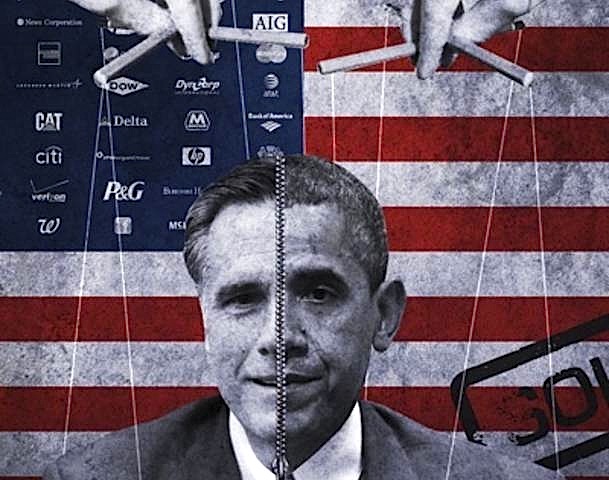
One thing is certain – both corporate puppets support the system that is killing you:
Post Script:
An important point was brought up by Alex Smith of EcoShock Radio about the numbers in this post. The list of top campaign contributors by Opensecrets does not include the dark world of Super PACs and other tax-exempt groups which can shield the identity of their donors – a billion spent on the presidential race. See the comments section of this post for further details.
Paul Street is one of the more insightful writers I follow and he has a new essay out which lists his version of the top threats to modern civilization. The conspicuous absence of these grave dangers from our political discourse prompts him to start off his article as follows:
The content and character of the 2012 U.S. presidential election does not bode well for the human race and other life on Earth. If the American people do not broaden the sphere of public concerns that matter far beyond the ones being discussed in this the latest big money-big media -major party-narrow spectrum-corporate-managed candidate-centered “electoral extravaganza” (Noam Chomsky’s phrase[2]), then there is not going to be a decent, desirable, or democratic future worth inhabiting. If we accept this and other such periodic U.S. elections as an adequate expression and spectrum of democratic politics and popular voice, we’re done for.
Well Paul, it is all corporate-funded theater and bread & circus for the mesmerized and pacified masses. What more would you expect from a society whose governing institutions and news media have been usurped by the greed of monied interests? Both mainstream parties are on the corporate dole, a situation best summed up by the following comment:
…America’s history has always been about the battle between plutocracy and democracy. Since WWII, we’ve built the military-industrial complex, we’ve allowed campaign funding to reach insane proportions, we’ve introduced the most effective means of propaganda ever created (the TV) into every home, and we’ve de-regulated Wall Street into a behemoth. We’ve allowed the corporate structure to infect our democracy at the deepest levels as well as most people’s personal lives in a fundamental way (health care and pharmaceuticals, banking and debt, the fact that most of the country has to shop at Walmart to be able to break even each paycheck, etc.).
The plutocrats have been routing democracy in a steady succession the past 50+ years. Our democracy is now a hollowed-out shell completely subservient to corporate interests at all levels. This is not crazy liberal talk – it’s simple reality. Citizens United was just the icing on the cake…
Number one on Paul Street’s list cannot be denied – climate change. Here’s what he writes about this civilization-ending problem which has been avoided at all costs by the mainstream media even after the devastation in New York:
Climate change is a threat multiplier. It will make unstable states more unstable, poor nations poorer, inequality more pronounced, and conflict more likely,” Huhne is expected to say in a speech to defence experts. “And the areas of most geopolitical risk are also most at risk of climate change.”
He will warn that climate change risks reversing the progress made in prosperity and democracy since the industrial revolution, arguing that the results of global warming could lead to a return to a “Hobbesian” world in which life is “nasty, brutish and short”.
And the U.S. military already acknowledged the threat of human-induced climate change to the stability of nation states in a 2007 report, National Security and the Threat of Climate Change. In recent years, congressional witnesses speaking on the dangers that climate change poses have been unequivocal in their warnings:
· On October 15, 2009, retired USAF General Charles F. Wald testified before the Senate Foreign Relations Subcommittee, reiterating the CNA finding, saying that “we must… now prepare to respond to the consequences of dramatic population migrations, pandemic health issues and significant food and water shortages due to the possibility of significant climate change” and that “Energy security and a sound response to climate change cannot be achieved by an increased use of fossil fuels.”
· In May, 2009, retired USN Vice Admiral Dennis McGinn in testimony before the Senate Foreign Relations Committee pointed to an “over reliance on fossil fuels” and said that “climate change has the potential to create sustained natural and humanitarian disasters on a scale and at a frequency far beyond those we see today.
So we should expect that a future of unstable climate which increasingly puts our food production in jeopardy will also lead to an increased risk of weapons of mass destruction being used by failing countries – desperate and angry fingers on the trigger of nukes. Homer-Dixon’s scenario on climate change and armed conflict is prescient. An article from 2007 reveals the inevitable truth about the energy-water-food-climate nexus and social breakdown:
…Homer-Dixon was writing more than 15 years ago about climate change leading to a rise in violent conflict and state failure.
Then, his pronouncements found only a small audience, and held little sway in the halls of power in Washington or New York.
Now, he is briefing UN Security Council members about his theories of “synchronous failure”, a much in-demand author of a bestseller warning of impending catastrophe, The Upside of Down.
…Homer-Dixon believes “major volatility” in nation-states and in the international order is the inevitable outcome of climate change. His theory rests on the premise that many nation-states are highly stressed and hopelessly addicted to energy, what he terms the “master resource”.
Climate change will be the factor that pushes many vulnerable states to the edge, and over it.
Some nations will find their resources overwhelmed as they struggle to cope with massive internal movements of people displaced as fertile land becomes unproductive and water shortages emerge.
…a rise in the Earth’s temperature of one to two degrees – will have significant impacts.
He says modern states are in a similar predicament to the declining Roman Empire.
The massive cost to Rome of maintaining and feeding its subjects, bureaucracy, militaries and cities required more and more energy. In the end, the energy could not be found, leading eventually to the collapse of a great empire.
Similarly, a “complex” globalised world is expending more and more energy to underpin societies reliant on relentless economic growth.
In what Homer-Dixon describes as an “astonishing statistic” he notes that the energy consumed in producing and transporting food around the world has risen 80-fold in the past century while the population has quadrupled to 6 billion over the same period.
Using a measure he called the “energy return on investment”, Homer-Dixon finds the search for energy is requiring an ever-increasing amount of resources at a time when demand for it is rising rapidly.
It is a situation that he says is fast becoming unsustainable. Oil will become too expensive, while nuclear energy requires a massive investment in money and energy, just to get it off the ground.
And he notes another dilemma. Fixing the effects of climate change will require massive amounts of energy in itself.
“Building sea barriers, moving huge numbers of people displaced by changing weather, building new infrastructure … all these types of things, the solutions to climate change, require lots and lots of energy.”
And as governments become incapable of discharging their basic responsibilities of statehood, the vacuum will be filled by chaos and conflict…
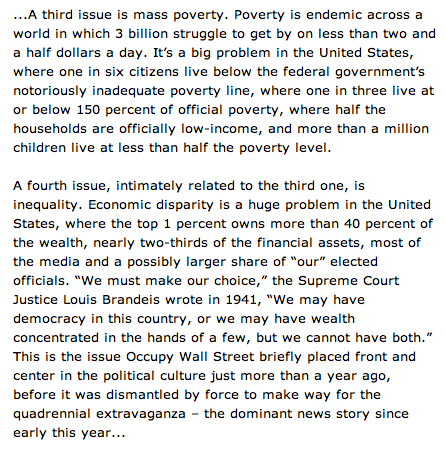
Number three and four on Paul’s list is mass poverty and inequality. He writes:
Perhaps we should mention that mass poverty and inequality stem from unfettered capitalism which has reached its full fruition in the buy-off of our government and the total corruption of regulatory, judicial, and legislative institutions by the profit-driven interests of multinational corporations. The social contract has been broken; the political discourse for the public has degenerated into meaningless wedge issues; and society has been atomized and isolated into ‘individual consumers’, a mere member of a marketing demographic whose only voice is to choose between product X or Y.
Number five on Paul’s list is the likelihood of another epic financial crisis. Our financial system is limping along, but its demise is written in stone. Without cheap energy, the underlying backbone of our economy, our growth-oriented system cannot survive for very much longer. As I said before, money is simply a token of energy exchange and has no intrinsic value of its own. If we now take into account our fossil fuel energy system’s external costs (environmental damage, ill-health costs, climate change destruction, resource wars such as Iraq, etc), then we’d be in debt up to our eyeballs. As I explained in this post, the net benefits of burning fossil fuels will eventually be negated by the net costs.
Number six on Paul’s list is “long-term structural employment and enforced obsolescence of tens of millions of formerly middle and working class Americans.” The worker is disposable, and long-term unemployment is endemic to capitalism. The corporate drive for maximizing profits is the primary goal and thus follows the policy of keeping worker numbers and their wages as low as possible. Automation, outsourcing of jobs, and employing part-time workers are some of the ways corporations suppress labor.
Paul lists number seven as “racism and racial inequality.”:
…Nobody raises a peep about racially disparate mass incarceration or segregated schools or black inner city neighborhoods with unemployment and poverty rates over 40 percent…
Looking back in history to the genocide of Native Americans and now to today with the ‘War on Terror’ and its related racism towards Muslims, the U.S. empire has always demonized anyone who stands in its way. Nationalism, racism and xenophobia always rise in times of economic downturns, no matter the country, when scapegoats are created to vent people’s anger and frustration as well as shift blame. Today is no different:
And the last one is U.S. militarism. I would rank this one much higher on the list and I’ve posted on this subject extensively, but the following video does a nice job of summing things up:
What was that Einstein quote again?…”Insanity is doing the same thing over and over again and expecting different results.”
Another blogger, the Conflicted Doomer, posted a write-up of why she was voting for Obama this November:
…I’ve thought about voting for one of the third party candidates – either the Peace and Justice Party or the Green Party – but, quite honestly, neither has a chance in hell of winning and by the time either gained enough strength to have a viable chance, the party will likely be over (though that wouldn’t preclude me from voting for them for Congress or at the local level). If there is any chance of enough change coming to at least hold a nation together while the Empire goes down, it will have to come from the Empire’s rulers because they think it will save the Empire. It won’t, of course, but it might save the nation.
You may see that as compromising my principles. I see it as pragmatic. I’m not telling you how to vote here, only why I am voting for the person I will vote for in November. You have already, I hope, done your own wrestling and come to your own conclusions as I write this.
I’ve often said here, there’s not a dime’s worth of difference between the two parties when it comes to running the country, because neither party can let go of the illusion that the Empire is the nation. For the most part, I believe that, although I do think that if you stand that dime on its edge, you might find such a difference. And in the end, it’s that slim, dime’s edge of a difference I see that finally decided which way I’ll cast my vote…
While I understand her logic, I don’t agree with her conclusion. Casting your vote with one of the two parties is what the establishment wants the populace to do. It keeps the oligarchic powers in place and preserves the ongoing corruption. Thinking that change will have to come from the figureheads of status quo is a naive and dangerous belief, and it’s this foolish mindset that has gotten us the “elections” we have today – a corporate-funded reality TV series that runs every four years with the same results…
Voting pragmatically is what keeps the indistinguishable and corrupt two-party system in place. Wedge issues are simply red meat for the populace to fight over and keep voting for “the lesser of two evils.” Core issues like U.S. militarism, the security and surveillance state, wealth inequality and the destruction of the middle class, monied interests controlling government, climate change and a fossil fuel-based economy, as well as other environmental issues, etc. will stay the same between the two parties.
M. G. Piety explains why voting within the confines of a morally bankrupt system only leads to further entrenchment of corporate rule and a deeper grave for the long-dead liberal class.
…There’s been a lot of angry posturing from Americans who think of themselves as progressive about how the purported political center in this country has been moving inexorably to the right, yet it’s these very people who are directly responsible for the shift. If you vote for a candidate whose farther right than you would prefer, well, then you’re shifting the political “center” to the right. Republicans aren’t responsible for the increasingly conservative face of the democratic party. Democrats are responsible for it. Democrats keep racing to the polls like lemmings being chased by the boogeyman.
“This is not the election to vote for real change” runs the democratic refrain. We’re in a crisis! We must do whatever it takes to ensure that the republicans don’t get in office even if that means voting for a democrat whose policies we don’t really like and which are only marginally distinguishable from those of the republican candidate. That “margin” is important, we’re reminded again and again. That little difference is going to make all the difference.
Even if that were true, which it ought to be clear by now it is not (see Bart Gruzalski’s “Jill Stein and the 99 Percent”), it would still offer a very poor justification for voting for a candidate one doesn’t really like. Why? Because it is an expression of short-term thinking. Thomas Hobbes argued that privileging short-term over long-term goals was irrational, and yet that’s what we’ve been doing in this country for as long as I can remember. Americans are notoriously short-term oriented. As Luc Sante noted in a piece in the New York Review of Books, America is “the country of the perpetual present tense.” Perhaps that’s part of the anti-intellectualism that Richard Hofstadter wrote about. “Just keep the republicans out of office for this election!” we’re always commanded. “We can worry about real change later!”
Of course anyone who stopped to think about it ought to realize that that mythical “later” is never going to come. Our choices are getting worse not better, and if we keep invoking the “lesser of the two evils” to justify them, we are in effect, digging our own graves…
Voting with your conscience is the right thing to do despite the belief that a third party has no chance. Registering your disgust with the system is the best action you can take in our faux election process that amounts to nothing more than a corporate auction.
Some other thoughts on the subject…
“The lesser-of-two-evils argument is morally obtuse, and dangerous, the first, because it means complicity with policies ultimately destructive, the second, because it induces an undeserved self-righteousness which next time around would yield further compromise. If the people are gulled and lulled into the acceptance of mock-democracy, courtesy of Goldman Sachs and waterboarding apologist Brennan, with Obama presiding over the bread-and-circuses routine, heaven help us.”
~ Norman Pollack
“The only people who will benefit from the election of either Romney or Obama are those associated with the private oligarchies that rule America.”
~ Dr. Paul Craig Roberts
“As the Republicans get more right-wing, the Democrats follow them, staying just one step behind. That will continue as long as right-wing Democrats can get elected by saying that the Republicans are worse.”
~ Richard Stallman
For those who continue to fall back on the comforting excuse of “voting for the lesser of two evils” in the morally ambiguous and desperate hope of receiving some social bread crumbs, you are complicit in supporting America’s inverted totalitarianism and the strengthening of a Corporate Fascist State.
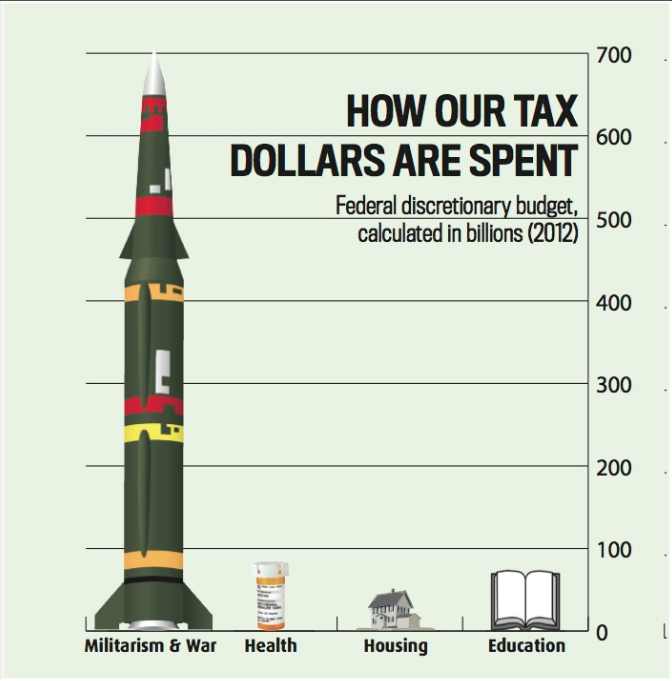
The U.S. military industrial complex is the single biggest leech upon society. Both parties unquestioningly support it. While many view a Romney in the White House would be like adding an accelerant to the flame of U.S. militarism, Obama has proven himself one of the most militarily aggressive American leaders in decades. The military industrial complex sucks up more than half of every tax dollar and enriches weapons manufacturers at the expense of this country’s citizens. If you look back in history and read some of the essays of William Blum, you’ll have all the proof you need that the capitalists of America are not a stabilizing force in the world, but a destabilizing one. As others have noted, empires collapse from within. While they continue expanding outward and investing in their reach of hegemony, the needs of the citizens back at home are overlooked and neglected. We have an empire at the expense of democracy:
…In the first minutes of the debate, Biden gloated about how the economic blockade of Iran orchestrated by Washington had devastated the Iranian economy and caused widespread suffering among the people. He boasted of the US role in aiding the Syrian forces seeking to overthrow the Assad regime. And he repeatedly defended the administration by declaring that it had the full support of the Pentagon brass—accepting Ryan’s premise that the generals should have veto power over foreign policy.
The questions offered by debate moderator Martha Raddatz—an ABC News foreign correspondent with close ties to the US military-intelligence apparatus—took as their point of departure the unchallengeable legitimacy of the operations of American imperialism abroad and the profit system at home.
Many of them touched on foreign and military policy, in every case tacitly assuming that the United States has the right to bomb, invade and conquer any country it chooses. The discussion between the candidates dealt with the expediency of such military actions, not whether they were legally or morally justifiable.
Similarly, the parts of the debate that touched on domestic policy—the economy, health care, taxes and social issues like abortion—took for granted the existing division of the wealth of society between the tiny minority that controls nearly all of it and the large majority who are struggling to survive.
In the entire 90 minutes, there was not a single question or answer about the conditions of life of the working class—about cuts in wages, pensions and other benefits; the growth of poverty, homelessness and hunger; the spreading plague of evictions and foreclosures; the deterioration of public services such as education; the collapse of the social infrastructure…
Do you see a problem with this picture of the U.S.?
Other threats loom larger than the boogeyman terrorist. While we create enemies to fight, real manmade dangers like global warming and climate change are growing, threatening to wipe all of humanity off the face of the Earth. Humans don’t have that much time left on this planet, so it would probably be a wise decision to ratchet back all the war mongering, move away from a war-based economy, and try another approach to how we interact with the rest of the world before it all ends in more and more resource wars and the plume of a mushroom cloud.
Iran appears to be next on our bombing agenda. If we had not covertly overthrown their democratically elected leader, Mohammad Mosaddegh, in 1953 because he wanted to nationalize their oil resources, could we have averted this impending war?…












 Collapse of Industrial Civilization