The decades of escalating heat and dryness, which inevitably returned with a vengeance after some years of waning, had reduced the world’s food production to a mere shell of its former glory. The grocery stores, whose well-stocked shelves city dwellers had grown accustomed to, were now all boarded up and abandoned after being ransacked for their remains – expired cans of food. Industrial agriculture could only be subsidized for so long by an over-exploited and abused environment, but nobody ever really thought that day would come. The green revolution was supposed to be the answer to feeding the world’s growing population. Unfortunately it turned out to be yet another Ponzi scheme built on a finite, dwindling energy source, the burning of which was destabilizing the climate. Nearly all the mega cities and great metropolises had turned into death traps and were quickly emptied of their human inhabitants after a series of violent riots sparked by starving populations. Areas where water was still plentiful were inundated with refugees. Nonetheless, a small population of human scavengers had remained in these great ghost cities of the Post Industrial Age and managed to eke out a life while enjoying the somber solitude of decaying edifices and vacant streets.
A few of these remnant city-dwellers frequented the dust-laden corridors of old libraries. Television and other electricity-depenedent digital devices, which had once been so pervasive and addictive, were no longer available after the heat engine of carbon-based civilization broke down. Thus books and the written word were the surviving medium for amusement and escapism. Even in these desperate times, people found time to dream and wonder. When the grid flickered and finally blinked out for good, much of what had passed for entertainment was now viewed in retrospect as a widespread collective mental illness. The citizenry of the fossil-fuel crazed civilization had retreated further and further into an artificial world of digital bytes and glowing computer screens while the natural world had disintegrated around them.
The recent past leading up to the final days of industrial civilization was looked upon as an age of irony. Science and technology had created miraculous abilities to save lives while at the same time enabling the wholesale destruction of mankind through hi-tech weaponry. Knowledge and wisdom were available at the touch of a keystroke, while mass death and misery hinged on the push of a button. People appeared on the surface to be free, yet their thoughts and actions were carefully manipulated by a veil of infotainment; people’s lives were affected much more by things left unspoken. The pursuit of “happiness” became the law of the land; the pursuit of truth was criminalized and viewed as the deviant behavior of malcontents and miscreants. Questioning the dominant paradigm was obstructive to progress; solutions to the world’s problems were entrusted to ideologues of free-market capitalism and worshippers of endless technological advancement.
A reduction in complexity was inevitable, but did it have to come at the expense of a bankrupt planet? Cheap and abundant energy slaves no longer existed, and even if they did, there was nothing to transition to on a planet plagued with a destabilized climate for the next millennium. The human population would never again reach anything like the 9 billion at the zenith of the fossil fuel age, and this was a welcome thought for those few who remained. Quoting from a dog-eared book found by one of the humans scavenging in a library, or “book cemetery” as it was now known:
What is the greater danger – nuclear warfare or the population explosion? The latter absolutely! To bring about nuclear war, someone has to DO something; someone has to press a button. To bring about destruction by overcrowding, mass starvation, anarchy, the destruction of our most cherished values-there is no need to do anything. We need only do nothing except what comes naturally – and breed. And how easy it is to do nothing…
…Democracy cannot survive overpopulation. Human dignity cannot survive [overpopulation]. Convenience and decency cannot survive [overpopulation]. As you put more and more people onto the world, the value of life not only declines, it disappears…
And not much did survive. But for those last vagabonds of humanity, the tragedy of the Great Collapse and mankind’s downfall were the grist of post-apocalyptic folklore, never to be forgotten.
…a second Dark Age had fallen on Western civilization, in which denial and self-deception, rooted in an ideological fixation on “free” markets, disabled the world’s powerful nations in the face of tragedy. Moreover, the scientists who best understood the problem were hamstrung by their own cultural practices, which demanded an excessively stringent standard for accepting claims of any kind–even those involving imminent threats. Here, our future historian, living in the Second People’s Republic of China, recounts the events of the Period of the Penumbra (1988–2073) that led to the Great Collapse and Mass Migration (2074)…
The paper starts off with a brief history of industrial civilization’s chemical and material pollutions overloading the Earth’s environmental sinks. The sheer volume of mankind’s activities, from the Ozone Hole created by CFC’s to the resource-depleting diet of industrial cattle-farming, became a force of nature unto itself threatening the very habitability of the planet. The scientific community began to recognize that man’s industrial activities were upending the earth’s life support systems; various organizations and institutions were created to try to ‘protect the environment’, but the interests of free market capitalism with its high-consumption lifestyle created a backlash against any restriction and attempts to recognize the limits of the human economy’s unending growth. The party had to continue no matter how dire the consequences. 1988 is said to have marked the beginning of the “Penumbral Period”, perhaps meaning a time of partial illumination where the threat was seen, but no effective action was taken. Indeed, we dug our grave faster with the building of evermore coal-fired plants and the destruction of the remaining ecosystems in the face of a series of extreme and ominous weather events which had the earmarks of manmade climate change.
By the early 2000s, dangerous anthropogenic interference in the climate system was under way. Fires, floods, hurricanes, and heat waves began to intensify, but these effects were discounted. Those in what we might call active denial insisted that the extreme weather events reflected natural variability, despite a lack of evidence to support that claim. Those in passive denial continued life as they had been living it, unconvinced that a compelling justification existed for broad changes in industry and infrastructure. Scientists became entangled in arcane arguments about the “attribution” of singular events; however, the threat to civilization inhered not in any individual flood, heat wave, or hurricane, but in the overall shifting climate pattern, its impact on the cryosphere, and the increasing acidification of the world ocean…
…what was anomalous in 2021 soon became the new normal. Even then, political, business, and religious leaders refused to accept that the primary cause was the burning of fossil fuels. A shadow of ignorance and denial had fallen over people who considered themselves children of the Enlightenment. For this reason, we now know this era as the Period of the Penumbra.
If you don’t like reality, then withdraw into fantasy and rewrite history; “we’re an empire now, and when we act, we create our own reality,” said Karl Rove.
In the early Penumbral Period, scientists were accused of being “alarmist” in order to increase financial support for their enterprise, gain attention, or improve their social standing. At first, the accusations took the form of public denunciations; later they included threats, thefts, and the subpoena of private correspondence. Then legislation was passed (particularly in the United States) that placed limits on what scientists could study and how they could study it, beginning with the notorious “Sea Level Rise Denial Bill,” passed in 2012 by the government of what was then the U.S. state of North Carolina (now part of the Atlantic Continental Shelf ) and the Government Spending Accountability Act of 2012, which restricted the ability of government scientists to attend conferences to share and analyze the results of their research.
Though ridiculed when first introduced, the Sea Level Rise Denial Bill would become the model for the U.S. National Stability Protection Act of 2022, which led to the conviction and imprisonment of more than three hundred scientists for “endangering the safety and well-being of the general public with unduly alarming threats.” By exaggerating the threat, it was argued, scientists were preventing the economic development essential for coping with climate change. When the scientists appealed, their convictions were upheld by the U.S. Supreme Court under the Clear and Present Danger doctrine, which permitted the government to limit speech deemed to represent an imminent threat.
…robust evidence shows that people systematically overestimate the probability of positive future contingencies, and underestimate the probability of negative ones — only those who are depressed or dysphoric come to accurate assessments…
Diogenes of Sinope must have practiced a sort of philosophical dysphoria.
Another cause for modern man’s downfall was the adoption of an excessively stringent standard for accepting causal links between climate change and human industrial activities:
…Historians have long argued about why this standard was accepted, given that it had no substantive mathematical basis. We have come to understand the 95 percent confidence limit as a social convention rooted in scientists’ desire to demonstrate their disciplinary severity. Just as religious orders of prior centuries had demonstrated moral rigor through extreme practices of asceticism in dress, lodging, behavior, and food–in essence, practices of physical self-denial–so, too, did natural scientists of the twentieth century attempt to demonstrate their intellectual rigor through intellectual self-denial. This practice led scientists to demand an excessively stringent standard for accepting claims of any kind, even those involving imminent threats…
CO2 emissions continued to rise not only in developing countries, but also developed countries as fossil fuel production accelerated with shale gas extraction and Canadian oil-sand processing. The world was firmly in the grasp of the fossil fuel energy trap.
…How did these wealthy nations–rich in the resources that would have enabled an orderly transition to a zero net-carbon infrastructure–justify the deadly expansion of fossil fuel production? Certainly, they fostered the shadow of denial that obscured the link between climate change and fossil fuel production and consumption. They also entertained a second delusion: that natural gas from shale could offer a “bridge to renewables.” Believing that conventional oil and gas resources were running out (which they were, but at a rate insufficient to avoid disruptive climate change), and stressing that natural gas, when combusted, produced only half as much CO2 as coal, political and economic leaders persuaded themselves and their constituents that promoting shale gas was an environmentally and ethically sound approach.
This line of reasoning, however, neglected three crucial factors. First, fugitive methane emissions–CH4 that escaped unburned into the atmosphere–greatly accelerated warming. (Again, scientists had foreseen this phenomenon, but their predictions were buried in specialized journals.) Second, the argument presupposed that net CO2 emissions would fall, which would have required strict restrictions on coal and petroleum use. Third, and most important, the sustained low prices of fossil fuels, supported by continued subsidies and a lack of external cost accounting, undercut efficiency efforts and weakened emerging markets for solar, wind, and biofuels (including crucial liquid biofuels for aviation). Thus, the bridge to a zero-carbon future collapsed before the world had crossed it. The bridge to the future became a bridge to nowhere.
The following scenario seems to me to be our most likely future under the current path of business-as-usual:
…The net result? Fossil fuel production escalated, greenhouse gas emissions increased, and climate disruption accelerated. In 2001, the IPCC had predicted that atmospheric CO2 would double by 2050. In fact, that benchmark had been met by 2042. Scientists had expected a mean global warming of 2 to 3 degrees Celsius; the actual figure was 3.9 degrees. Though originally merely a benchmark for discussion with no particular physical meaning, the doubling of CO2 emissions turned out to be significant: once the corresponding temperature rise reached 4 degrees, rapid changes began to ensue.
By 2040, heat waves and droughts were the norm. Control measures such as water and food rationing and Malthusian drills had been widely implemented. In wealthy countries, hurricane- and tornado-prone regions were depopulating, putting increased social pressure on areas less subject to those hazards. In poor nations, conditions were predictably worse: rural portions of Africa and Asia were already experiencing significant depopulation from out-migration, malnutrition-induced disease and infertility, and starvation. Still, sea level had risen only 9 to 15 centimeters around the globe, and coastal populations were mainly intact.
Then, in the Northern Hemisphere summer of 2041, unprecedented heat waves scorched the planet, destroying food crops around the globe. Panic ensued, with food riots in virtually every major city. Mass migration of under-nourished and dehydrated individuals, coupled with explosive increases in insect populations, led to widespread outbreaks of typhus, cholera, dengue fever, yellow fever, and, strangely, AIDS (although a medical explanation for the latter has never been forthcoming). Surging insect populations also destroyed huge swaths of forests in Canada, Indonesia, and Brazil. As social order broke down, governments were overthrown, particularly in Africa, but also in many parts of Asia and Europe, further decreasing social capacity to deal with increasingly desperate populations. The U.S. government declared martial law to prevent food riots and looting, and the United States and Canada announced that the two countries would form the United States of North America in order to begin resource-sharing and northward population relocation. The European Union announced similar plans for voluntary northward relocation of eligible citizens from its southernmost regions to Scandinavia and the United Kingdom…
World leaders convened to hastily put together a climate geoengineering scheme in an effort to halt the collapse, but unforeseen side effects occurred and the project was immediately stopped, resulting in even more dire consequences. Various feedback loops unleashed a “Venusian death” on planet Earth:
…This massive addition of carbon led to what is known as the Sagan effect (sometimes more dramatically called the Venusian death): a strong positive feedback loop between warming and CH4 release. Planetary temperature increased by an additional 6 degrees Celsius over the 5 degree rise that had already occurred…
The rapid melting of the West Antarctic Ice Sheet and the Greenland Ice Sheet resulted in massive sea level rise and more apocalyptic human and non-human suffering:
…Analysts had predicted that a five-meter sea level rise would dislocate 10 percent of the global population. Alas, their estimates proved low: the reality was closer to 20 percent. Although records for this period are incomplete, it is likely that 1.5 billion people were displaced around the globe, either directly from the impacts of sea level rise or indirectly from other impacts of climate change, including the secondary dislocation of inland peoples whose towns and villages were overrun by eustatic refugees. Dislocation contributed to the Second Black Death, as a new strain of the bacterium Yersinia pestis emerged in Europe and spread to Asia and North America. In the Middle Ages, the Black Death killed as much as half the population of Europe; this second Black Death had similar effects. Disease also spread among stressed nonhuman populations. Although accurate statistics are scant because twentieth-century scientists did not have an inventory of total global species, it is not unrealistic to estimate that 60 to 70 percent of species were driven to extinction…
This doomsday narration then ends with a sort of “happy note” which seems to me to be wishful thinking, an improbable turn of events which saves mankind from total extinction. The last few pages discuss more the pitfalls that mankind fell into leading to such a dire fate: positivism or Baconianism and market fundamentalism.
…power did not reside in the hands of those who understood the climate system, but rather in political, economic, and social institutions that had a strong interest in maintaining the use of fossil fuels. Historians have labeled this system the carbon-combustion complex: a network of powerful industries comprised of primary fossil fuel producers; secondary industries that served fossil fuel companies (drilling and oil held service companies, large construction firms, and manufacturers of plastics and other petrochemicals); tertiary industries whose products relied on inexpensive fossil fuels (especially automobiles and aviation); and financial institutions that serviced their capital demands. Maintaining the carbon-combustion complex was clearly in the self-interest of these groups, so they cloaked this fact behind a network of “think tanks” that issued challenges to scientific knowledge they found threatening…
…When scientists discovered the limits of planetary sinks, they also discovered market failure. The toxic effects of DDT, acid rain, the depletion of the ozone layer, and climate change were serious problems for which markets did not provide a spontaneous remedy. Rather, government intervention was required: to raise the market price of harmful products, to prohibit those products, or to finance the development of their replacements. But because neoliberals were so hostile to centralized government, they had, as Americans used to say, “painted themselves into a corner.” The American people had been persuaded, in the words of President Reagan, that government was “the problem, not the solution.” Thus, citizens slid into passive denial, accepting the contrarian arguments that the science was unsettled. Lacking widespread support, government leaders were unable to shift the world economy to a net carbon-neutral energy base. As the implications for market failure became indisputable, scientists came under attack, blamed for problems they had not caused but merely documented…
Watching the following video, we can see such a future, as describe above, being played out before our very eyes:
Real Time episode with Bill Maher – aired April 5, 2013: Bill Maher led an intense panel discussion on the reliability of science on his show tonight, with Maher, Abby Huntsman, Senator Bernie Sanders, and 19-year-old science education activist Zack Kopplin arguing with Wall Street Journal columnist Steve Moore over scientific consensus on global warming. Moore continually insisted the debate is not over, but Maher repeatedly explained how sound science is not up for debate and that Moore should “have the humility” to defer to actual scientific experts on the issue…
Like a meth addict whose gums are dissolving, muscles deteriorating, skin abscessing, and behavior becoming psychotic, industrial civilization is deteriorating, the social fabric is getting threadbare, and leaders of rogue countries are spouting off nuclear threats. I believe we would all agree that a radical change to society is in the best interest of the long-term survival of Homo sapiens. So to break our current self-destructive path which is not unlike that of cancer cells killing off its host, what obstacles are in our way preventing us from achieving mass consensus. Some call it the ‘wall of propaganda’ which our current economic system has constructed to protect its interests, namely the almighty profit margin, at literally all costs. Media Lens has an excellent article out discussing this ‘wall of deceit’ which corporate capitalism surrounds itself with in order to maintain the unsustainable business-as-usual.
The article starts out:
The systematic propaganda of the corporate media – its deep-rooted antipathy towards upholding proper journalistic standards in the public interest – extends to its coverage of human-induced climate change. The Independent recently delivered a masterpiece of headline obfuscation with:
‘World cools on global warming as green fatigue sets in.’
The news report said:
‘Only 49 per cent of people now consider climate change a very serious issue – far fewer than at the beginning of the worldwide financial crisis in 2009.’
As usual, there was no mention of the role of the corporate media as a leading cause of why ‘green fatigue’ has supposedly set in. No mention of the media’s shameful failure to explore root causes of the climate crisis, not least the elite-serving corporate globalisation that has taken humanity to the brink of disaster. Chris Shaw, a social sciences researcher at the University of Sussex, noted on Twitter that nor was there ‘any mention of the work of the merchants of doubt, paid for and acting on the behalf of corporate interests’.
We’ve discussed this before and it continues to be the case – mass media in the hands of corporations is a pillar of inverted totalitarianism. In addition, the corporations also make use of the state’s security and surveillance apparatus in order to stifle any grassroots movements which threaten the status quo. Thusly, we are enthralled to the corporate state. The article then goes on to quote important rebuttal points made by Joe Romm to the corporate media’s claim of the public suffering from a ‘green fatigue’:
• ‘There is not one single TV show on any network devoted to this subject [climate change], which is, arguably, more consequential than any other preventable issue we face.’ • ‘The public is exposed to constant messages promoting business as usual and indeed idolizing conspicuous consumption…’ • ‘The major energy companies bombard the airwaves with millions and millions of dollars of repetitious pro-fossil-fuel ads. The environmentalists spend far, far less money.’
The popular mantra of keeping the global temperature below a 2ºC increase is another misleading idea put forth and circulated in the mass media:
‘The chances of the world holding temperature rises to 2C – the level of global warming considered “safe” by scientists – appear to be fading fast.’
Here, Vidal uncritically relayed the dangerous and discredited notion of a 2ºC ‘safe limit’ for global temperature rise. Climate change has been hereby reduced to a phenomenon defined by a single global dangerous number. This is a simplistic and damaging view of climate which, in reality, varies widely in time and space with multiple, overlapping impacts and feedbacks including ice melt, sea level rise, increasing storms and devastating droughts. Social scientist Chris Shaw, whom we mentioned above, has studied how this skewed ‘safe limit’ framing of the climate change debate arose, and how it has become a stranglehold on climate policy and even on progressive voices who should know better. Shaw warns that ‘falsely ascribing a scientifically derived dangerous limit to climate change diverts attention away from questions about the political and social order that have given rise to the crisis.’ He notes:
‘The oft quoted quip attributed to Einstein, that the definition of insanity is to keep doing the same thing, even after it has failed, seems particularly apposite for the “dangerous limits” framing of climate policy.’
Rapid and dangerous climate change is already underway, with little chance now of keeping global temperature rise to under 2ºC …
…switch on the television or the radio, or open up a newspaper, and – bar a few items in passing – it’s as if none of this is happening. Instead, the public is being force-fed a diet of celebrity gossip, huge advertising campaigns to consume more and more, and tedious ‘news’ and ‘debates’ that elucidate almost nothing about the real world.
Journalists and editors at all levels of the major news organisations must be aware, to some extent, that the glorious vision of the media ‘holding power to account‘ is more myth than reality. But very few media professionals have the honesty, bravery and decency to speak out. We understand that it is not easy; one’s hopes of a stellar media career or even the prospect of continued employment might be on the line. In the early days of Media Lens, we used to entertain the very slim possibility that – if anyone – the environment editors of the major newspapers might do so. But signs of media sanity from even these quarters are scarce…
The Article then illustrates a few examples of media outlets like the BBC and The Guardian who are cobbled by the corporate need to downplay the catastrophic effects of human-induced climate change. The ever pervasive regime of business interests holds sway over public discourse:
Locked Inside A Box
…Take one report on the BBC News at Ten last month (February 19, 2013), for instance, by John Moylan, the BBC’s employment and industry correspondent. On the flagship television news programme, watched by millions around the country, Boylan spoke of the rising demand for energy and the cost of fuel. He stood in front of impressive high-tech graphics and he eloquently made his points. And he referred, briefly, to EU environmental targets on closing ‘dirty polluting power plants’.
But Moylan did not once mention climate change. In an era when leading scientists are warning of the catastrophic dangers of climate instability under global warming, how could the BBC correspondent possibly justify this omission from his report? We asked him, twice, but did not receive an answer…
…But what about the Guardian? It has long been considered by many greens as a sort of ‘flagship’ newspaper for the environment movement. This has never been an accurate picture. But even more so in recent years when, notes Haaretz columnist Zafrir Rinat, the paper has been avidly:
‘developing business ties with corporations leading to the creation of the websites such as Global Development Professionals, which received financing from the Bill and Melinda Gates Foundation and a host of corporations. The Guardian is also involved in several environmental ventures that are expected to yield profits.’
Rinat spoke with Joe Confino, an executive editor of the Guardian, and the chairman and editorial director of Guardian Sustainable Business. This is a Guardian-corporate partnership which promotes the notion of ‘corporate social responsibility’, a public relations oxymoron that should be exposed repeatedly.
Confino said:
‘We are partners in ventures with businesses that we are convinced are going in the right direction on sustainability. The condition for all cooperation is preserving complete editorial independence.’
But high-ranking newspaper professionals always assert that there is a ‘firewall’ between advertising and editorial content, a claim that does not withstand scrutiny. Moreover, as Haaretz’s Rinat rightly points out:
‘Behind this [Guardian and corporate business] cooperation lies a pretentious worldview that it is possible to convince corporations to operate differently along the entire production chain, from the raw materials stage up through handling the refuse from the final products that are sold.’
Rinat added that ‘the media is still part of the problem because it continues to promote in its reports the culture of consumerism that depletes the planet’s resources.’ He noted that Confino ‘doesn’t deny’ this crucial point but, disappointingly, the Haaretz columnist did not press the Guardian executive about it.
Consider that a major imperative for corporate newspapers like the Guardian, struggling with dwindling advertising revenue, is to boost the numbers of people exposed to online ads by visiting their websites. Chris Elliott, the Guardian readers’ editor, was upfront about this in a recent column when he said that this was ‘essential’ to ‘secure the future’ of the paper.
But there are flickerings of internal dissent:
‘in the last six months three colleagues have written or spoken to me to express concern that the entirely reasonable desire to attract people to the site may be skewing news and features agendas.’
One ‘conflicted colleague’, as Elliott put it somewhat pejoratively, said:
‘There have been occasions recently where stories have been commissioned by editors who have talked about how they hope it will “play well” online – this appears to have been at the very forefront of their mind when commissioning. Certainly this is the prime driver of many online picture galleries. Obviously … we want to be well-read and popular, but it is a slippery slope, and it now appears that in a few cases we are creating stories purely to attract clicks.’
Given that Elliott’s piece was likely a sanitised, for-public-consumption version of the reality, one wonders what Guardian staff are really thinking, and how widespread is the concern, perhaps even direct opposition, inside their plush corporate offices…
Then we get to the crux of the whole matter, a life or death decision that modern society must work out before it is far too late:
…Covering dangerous climate change […] means not just reporting the science of climate change responsibly – a task too far for the Daily Mail and Mail on Sunday. But it also means investigating the systemic reasons for global warming. That must include a critical appraisal of corporate-driven capitalism and unrestrained consumerism. And, finally, it must also mean full and open public debate about alternative ways of organising society to benefit human well-being and the climate stability of the planet.
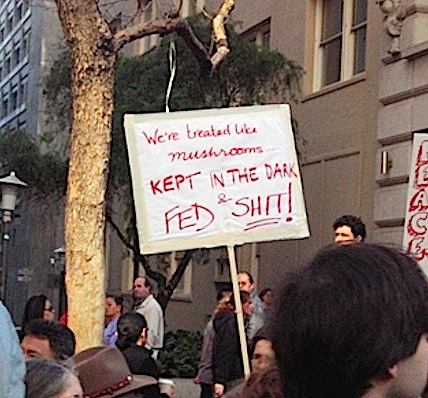
There you have it in that last quoted paragraph. In order to move ahead and avert disaster, we must be given the unvarnished truth rather than be kept in the dark and fed shit. In order to do that, we have to get at the root of the problem – capitalism.
I almost never watch MSM news, but the other day a preview of a show with Dan Rather about the die-off of bees caught my attention. People were horrified that their business would be hurt, profits would be eviscerated, livelihoods would be irreparably damaged. It’s all about the humans and their economy, not the ecological balance of the planet or what humans have done to push all these non-human species into extinction, in turn threatening homo sapiens’ existence.
Everybody’s livelihood is at stake here over a little flying bee.
Mother Nature thinks the same thing of us: “The Earth is being forever defiled by these arrogant, self-centered bastards and all they can think about is their profit margin.”
Guess what. The Earth doesn’t care about human wants or needs. A misused and abused Earth does not consider the inconveniences to the human economy posed by climate chaos and environmental collapse. The other creatures inhabiting this planet are being silently driven off the face of the Earth to make way for humankind’s insatiable appetite for domination and control. A creature which sees itself as a force of nature to be reckoned with, separate and superior to the planet that spawned it, will soon be brought down by such conceit. I hope we can handle being the only thing left on the planet. We can pollinate our own crops like the Chinese, and bring back extinct species at will to be placed in zoos for our amusement. We can geoengineer the Earth ‘s atmosphere to fix what we’ve destroyed in a vain effort to maintain this colossal edifice of industrial civilization. We can genetically modify crops so as to try to adapt to the drastically altered environment we’re handing down to future generations, human and non-human. Better yet, we can genetically modify ourselves to survive within this toxic world we’ve created. There is no fucking end to our God Complex.
Connection with the outside world has been replaced by a virtual world of electronic devices – TV’s, computers, video games, iphones, blackberries, and other assorted digital devices – filling every public and private space with the latest infotainment news and gossip of a throwaway pop culture. The masses watch reality TV shows to escape from their own hollow reality of slave wages, deadend jobs, a collapsing environment, and the faux democracy of corporate rule.
Driven into the military as the only avenue out of poverty, many soldiers commit suicide to escape the clutches of an industrial war machine that chews up foreign countries and cultures in order to extract resources onto the chopping block of the global marketplace. Blood for oil; souls for dollars. The last remaining vestiges of a living planet get pulled into the marketplace to be commodified, priced, and privatized. Damaged soldiers come home to a jobless economy while their leaders who sold them these wars travel the country doing book signings and lauding their war crimes as accomplishments.
How can such a system survive when the only thing it knows how to do is treat everything as inanimate objects whose only real value is to serve the desires of a self-absorbed species? Humans are amusing themselves to death in their fabricated world of alsphalt, concrete, and steel while the real world burns under the slow-motion detonation of climate disruption and mass extinction. The scientists think they can save the world with new technology even while prior technology is ripping the world apart. Rather than add yet another layer of unsustainable complexity, perhaps it’s time to escape this technology trap and simplify our way of life before becoming victims of our own perceived success.
The following is a comment left by Rhiter a couple of months ago (his last comment in fact) on a now defunct thread at the ‘prepping-for-profit’ site Peak Prosperity. It’s food for thought when we think about the non-viability of capitalism, an economic system dependent on growth and infinite resources.
For those not familiar with Steve Keen, the following interviews from last month are a good introduction for the layperson:
[youtube:https://www.youtube.com/watch?v=Fl4LPeQGnJo%5D
I’ll leave the post there because my internet sucks right now. Thank you Hughesnet. I’ll be switching this Friday to another internet provider.
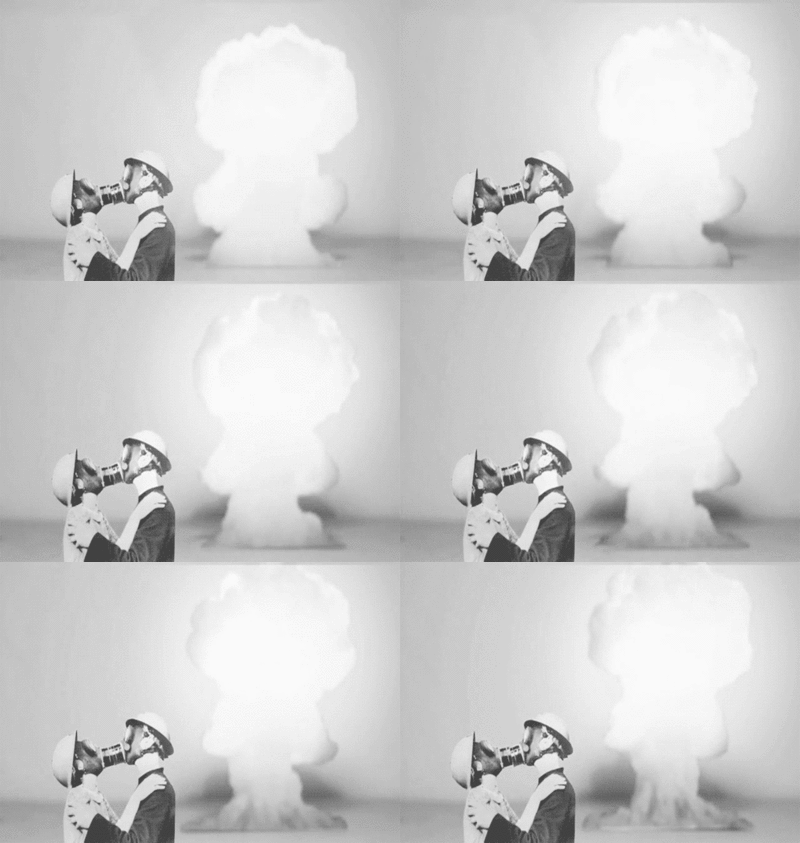
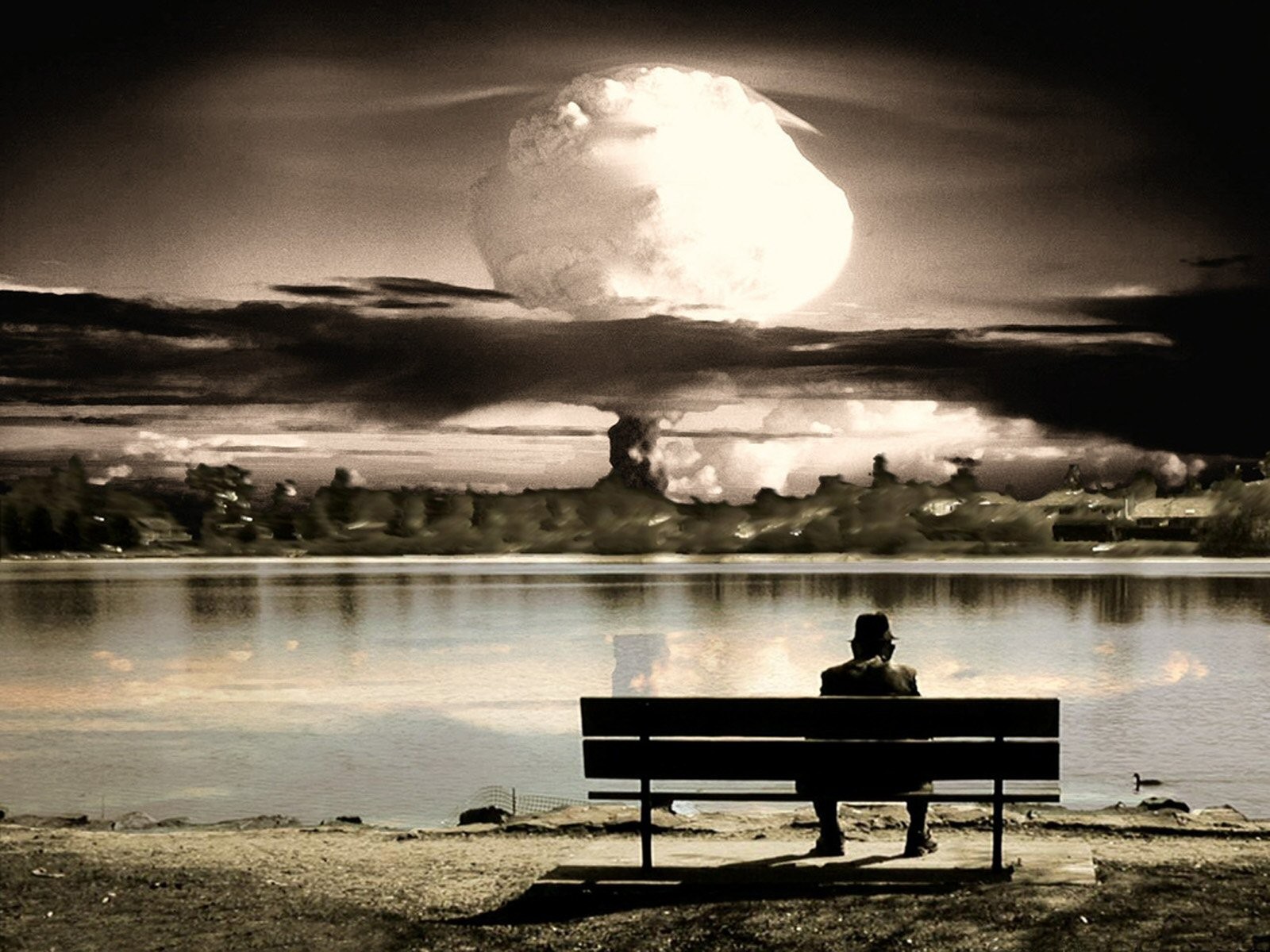
Climate Change is like a slow motion nuclear bomb. Both destroy the world, but one is instantaneous while the other is slow, insidious, and under the radar of everyday human perception.
…Brown hopes to shatter ideological assumptions cultivated during the Cold War by exploring remarkable similarities between the American and Soviet plutonium cities.
Top secret, highly restricted and socially engineered, these government-run communities developed on parallel paths into model cities. Each received awards for planning, community development and education. At the height of Cold War tension, some politicians feared Richland was too “socialisitic”, while some Soviet officials called Cheliabinsk-40 too “materialisitic” and “bourgeois.” Both suffer a deadly legacy of radioactive contamination.
“I will argue that in creating the means to destroy each other, the two cities came to resemble one another,” Brown said…
From the blurb of the book…
I’ll have to do a book review of Plutopia as well. Getting back to my recent obsession with nukes, I also ran across a website called My Nuclear Life which is run by a college student studying environmental health. Her site is a sort of depository for all things nuclear. Here are a few of the interesting images from her vast collection:
‘Da Bomb’ Hair Style…
Good, wholesome family outing…
‘Till radioactive contamination and death do us part…
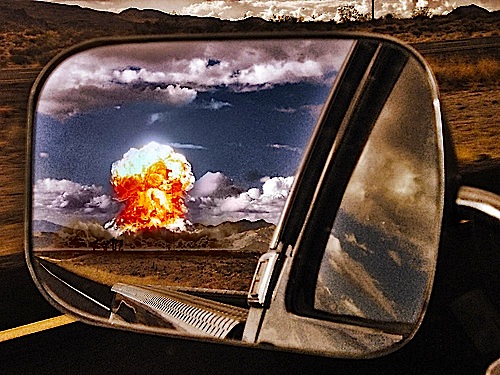
Rear view mirrors are helpful in eliminating ‘nuclear’ blind spots…
The learning curve for mankind to fully appreciate the damage he is doing to the planet, effectively altering his doomsday trajectory in a timely fashion, is long past due. Knowing that mankind has set in motion a series of climate tipping points whose lethal effects will spare no living organism over the next several decades, I find little amusement in the continued display of ignorance by my fellow humans. These people will refuse to see reality even after global food productivity crashes, leaving mountains of bodies on every continent. I’m sure these people will try to tap into the methane from these piles of rotting corpses rather than contemplate a different way of life right now to avoid such a fate.
Here are a few recent examples of the obstructionists to our survival:
The best thing about the Earth is if you poke holes in it oil and gas come out.
I’ve heard elementary school children with more eco-awareness and appreciation for planet Earth than from this so-called representative of the American people. Actually, it would be more accurate to call Stockman a representative of the fossil fuel industry and corporate heads, rather than someone interested in the habitability of the planet and continued existence of any sort of “civilization”.
Natural gas and oil give us cheap, clean energy and life-saving plastics, petrochemicals. Environmentalists want to turn back human progress.
The possibility of running out of these resources, filling the oceans with country-sized gyres of plastic, or irreparably altering the Earth’s weather to the point that it undermines our very survivability are all thoughts which never enter the mind of a person like Stockman. His thinking revolves solely around propping up an unsustainable system which will soon come to a rude ending.
Or consider the beliefs of Calvin Beisner, representative of an evangelical group:
That[human-caused global warming] doesn’t fit well with the biblical teaching that the earth is the result of the omniscient design, the omnipotent creation and the faithful sustaining of the God of the Bible. So it really is an insult to God.
If we pray more and ‘believe’, this man-made ecological wreckage will all just go away, cleaned up by the eco-friendly hands of a green-conscious God.
…Beisner said that Genesis dictates humans should “Be fruitful and multiply, fill the earth and subdue it.” This disproves the opinion of the “anti-population growth” activists, according to Beisner, who adds that pollution is a natural byproduct of reality.
Subdue and destroy sounds more like it. The unfolding eco-apocalypse must also be a “natural byproduct of reality.” Such pronouncements sound more like the ramblings of a Jonestown cult leader, only this time it will lead to the extermination of the globe.
And lastly, we’ve put in place our top minds to look after the problem…
Red spikes like this must mean we are ascending to heaven and getting closer to God…
Ever since the dawn of the nuclear age, mankind has been living with the ever-present threat of mass annihilation. From the naive ‘duck and cover’ days of the Cold War to the present-day threat of a terrorist cell sneaking a nuke into a city on a truck, perhaps no single invention has affected the psyche of mankind. Nuclear weapons have only been used twice thus far, Hiroshima and Nagasaki. Contrary to the popular myth that the bombing of those two Japanese cities helped end the war, America used the already defeated Japan as a nuclear sacrificial lamb in order to intimidate Russia and limit Soviet expansion into Asia. So we have set the stage whereby any country, if it wants to gain respect and not face the threat of regime change, must strive to join the nuclear club. Nuclear proliferation cannot be stopped when nations see the power and status they can attain by becoming part of the club.
…For nuclear newcomers, the bomb is both a product of and an instrument for nationalist aspirations. Moreover, in this new, dangerously complicated world, nuclear weapons, while they may not be exploded, are assuredly used in many ways: to bluff, to intimidate, to rally the populace, to throw opponents off balance. “Anyone who says that nuclear weapons aren’t usable should take a look at North Korea,” Bracken writes. “Nuclear weapons are used every single day to extort food and oil from the rest of the world to keep the regime going.” Disarmament, he would say, is a sweet fantasy. The best we can hope for is to “manage” the nuclear menagerie — and we cannot be confident of success… –source
Below is a great interactive infographic showing who is in the nuclear club, who has nuclear plants as part of their energy mix, and who has both. As everyone should know, nations striving for nuclear energy also get on the fast track to obtaining nuclear bombs, if they so choose.
click on the image to use the infographic…
Lately, North Korea has once again been using its nukes as a political tool. The public opinion in South Korea has now fully swung toward the belief that they too must acquire the big stick of nukes in order to counter their neighbor’s threats.
…We, the Korean people, have been duped by North Korea for the last 20 to 30 years and it is now time for South Koreans to face the reality and do something that we need to do,” said Chung Mong-joon, a lawmaker in the governing Saenuri (New Frontier) Party and a former presidential conservative candiate. “The nuclear deterrence can be the only answer. We have to have nuclear capability…
…According to a February poll conducted by South Korea’s private think tank, Asan Institute, 66% of South Koreans said they support developing a nuclear weapons program. The poll suggests that just under half of South Koreans in 2012 believed that the United States would provide South Korea with what’s known as the “nuclear umbrella” in the case of a North Korean nuclear attack, indicating a 7% decrease from 2011…
Having 23 commercial reactors in operation makes South Korea one of the world’s top five commercial nuclear powers and gives it the ability to produce uranium or plutonium for nuclear weapons. South Korea could have nukes within 6 months.
We know that despite the setback Iran faced with the Stuxnet virus, it is only a matter of time before it develops nukes as well.
Now we get to the age of resource scarcity and climate destabilization, both of which have proven to be conflict multipliers. The grotesquely named Operation Iraqi Freedom was about nothing more than freeing up that country’s oil resources. Ten years later the country is in ruins, but Big Oil is benefitting (I’m surprised CNN ran this story):
…Oil was not the only goal of the Iraq War, but it was certainly the central one, as top U.S. military and political figures have attested to in the years following the invasion.
“Of course it’s about oil; we can’t really deny that,” said Gen. John Abizaid, former head of U.S. Central Command and Military Operations in Iraq, in 2007. Former Federal Reserve Chairman Alan Greenspan agreed, writing in his memoir, “I am saddened that it is politically inconvenient to acknowledge what everyone knows: the Iraq war is largely about oil.” Then-Sen. and now Defense Secretary Chuck Hagel said the same in 2007: “People say we’re not fighting for oil. Of course we are.”
For the first time in about 30 years, Western oil companies are exploring for and producing oil in Iraq from some of the world’s largest oil fields and reaping enormous profit. And while the U.S. has also maintained a fairly consistent level of Iraq oil imports since the invasion, the benefits are not finding their way through Iraq’s economy or society.
These outcomes were by design, the result of a decade of U.S. government and oil company pressure. In 1998, Kenneth Derr, then CEO of Chevron, said, “Iraq possesses huge reserves of oil and gas-reserves I’d love Chevron to have access to.” Today it does…
…Iraq’s oil production has increased by more than 40% in the past five years to 3 million barrels of oil a day (still below the 1979 high of 3.5 million set by Iraq’s state-owned companies), but a full 80% of this is being exported out of the country while Iraqis struggle to meet basic energy consumption needs. GDP per capita has increased significantly yet remains among the lowest in the world and well below some of Iraq’s other oil-rich neighbors. Basic services such as water and electricity remain luxuries, while 25% of the population lives in poverty…
…a leading coalition of Iraqi civil society groups and trade unions, including oil workers, declared on February 15 that international oil companies have “taken the place of foreign troops in compromising Iraqi sovereignty” and should “set a timetable for withdrawal.”…
In an age of mass delusion, inverted totalitarianism, and scapegoating, will the logic of MAD (mutually assured destruction) be enough to prevent a nuclear war? The energy skeptic sums up the failure of such thinking in the following quote:
And what of the odds even in a world not facing peak everything and climate chaos?
…The inevitability concept can best be understood by analogy to finance. It does not make sense to talk of an interest rate as being high or low, for example 50 percent or 1 percent, without comparing it to specific period of time. An interest rate of 50 percent per year is high. An interest rate of 50 percent per century is low. And the low interest rate of 1 percent per year builds up to a much larger interest rate, say 100 percent, when compounded over a sufficiently long time.
In the same way, it does not make sense to talk about the probability of nuclear war being high or low — for example 10 percent versus 1 percent — without comparing it to a specific period of time — for example, 10 percent per decade or 1 percent per year.
Having gotten the units right, we might argue whether the probability of nuclear war per year was high or low. But it would make no real difference. If the probability is 10 percent per year, then we expect the holocaust to come in about 10 years. If it is 1 percent per year, then we expect it in about 100 years.
The lower probability per year changes the time frame until we expect civilization to be destroyed, but it does not change the inevitability of the ruin. In either scenario, nuclear war is 100 percent certain to occur….
The ever-dwindling numbers of wild animals on planet Earth has always been a gnawing and depressing awareness I’ve carried with me since childhood. Even if mankind were not committing mass extinction by disrupting the planet’s climate equilibrium, the idea of living in a manmade world filled with concrete, steel, and asphalt and denuded of any wilderness all but deadens my spirit. In a recent report, Africa’s lion population is expected to be reduced by 50% if no “conservation efforts” are employed. And the most effective method appears to be fencing the lions off from the human population:
“I would hate to see more of Africa fenced,” Hunter said. “It just takes away from a sense of wilderness.”
Fencing can disrupt the great migrations of herbivores and the movements of free-roaming animals such as the African wild dog or the cheetah, he said. But it may be the most effective way to save lions, he said.
“Whether it’s a fence or some other form of barrier it’s really clear that lions need physical separation from people if we’re going to save them.”
Isn’t that last sentence the tell-all statement about the human species? Habitat destruction by human encroachment is the number one reason for the 6th mass extinction currently taking place. Predators from the animal world are revered in human culture. We name football teams, cars and military aircraft after them, but wipe them off the face of the Earth to build more stadiums, parking lots, and airports.
Did you hear the last sentence in the above video:
If you look at it[deforestation] in the bigger picture as landsat allows us to do, you can see that it is not something we can do forever.
And nothing is going to stop this destruction of the natural world at the hand’s of man until he is forcibly restrained by nature, i.e. climate chaos and resource depletion.
…Over the course of the last two centuries, animals have become all but invisible in the American scheme of things, drummed out of the society of their myth-making companions, gone from the rural as well as the urban landscape. John James Audubon in 1813 on the shore of the Ohio River marveled at the slaughter of many thousands of wild pigeons by men amassed in the hundreds, armed with guns, torches, and iron poles. In 1880, on a Sioux reservation in the Dakota Territory, Luther Standing Bear could not eat of “the vile-smelling cattle” substituted for “our own wild buffalo” that the white people had been killing “as fast as possible.”
And as observers, they were not alone. Many others have noted the departure of animals from our human world and culture. Between 150,000 and 200,000 horses could, for example, be found in the streets of New York City in 1900, requiring the daily collection of five million pounds of manure. By 1912, their function as a means of transport had been outsourced to the automobile.
As with the carriage and dray horses, so also with the majority of mankind’s farmyard associates and nonhuman acquaintances. Out of sight and out of mind, the chicken, the pig, and the cow lost their licenses to teach. The modern industrial society emerging into the twentieth century transformed them into products and commodities, swept up in the tide of economic and scientific progress otherwise known as the conquest of nature.
Animals acquired the identities issued to them by man, became labels marketed by a frozen-food or meat-packing company, retaining only those portions of their value that fit the formula of research tool or cultural symbol — circus or zoo exhibit, corporate logo or Hollywood cartoon, active ingredient in farm-fresh salmon or genetically modified beef…
…The Renaissance scholar and essayist Michel de Montaigne […] ask[ed] himself, “When I play with my cat, who knows if I am not a pastime for her more than she is to me?” The question placed Montaigne’s customary pillow of doubt under the biblical teaching that man had been made in God’s image, and thereby granted “dominion over the fish of the sea and over the birds of the air and for every living thing that moves upon the earth.”
The environmental casualty reports filed from the four corners of the earth over the last two hundred years don’t leave much ground for argument on Montaigne’s question as to who is the beast and who is the man. Whether attempted by men armed with test tubes or bulldozers, the conquest of nature is a fool’s errand. However it so happens that the beasts manage to live not only at ease within the great chain of being but also in concert with the tides and the season and the presence of death, it is the great lesson they teach to humanity. Either we learn it, or we go the way of the great auk.
Michel de Montaigne also said, “Every other knowledge is harmful to him who does not have knowledge of goodness.” I take this to mean that a technologically advanced civilization which has no respect for his fellow-man, nature, and the sanctity of a healthy environment, is doomed to the fate of omnicide. In today’s end-stage capitalism, money fetishism rules mankind; technology is used to keep the unruly masses in check; and nature is a doormat for industrial civilization. We have evolved in science and technology, but devolved in terms of social and environmental consciousness.
A few noteworthy news stories came across my desk. If anyone still believes the human race will suddenly become endowed with a collective enlightenment to stop throwing its fossil fuel garbage into the air and avert climate chaos, theses recent news articles should put that pipe dream to rest. The first two are further confirmation that we are on a fast track to nowhere with human-induced climate change. 2012 CO2 levels increased by 2.67 parts per million and marked the second biggest jump since records began in 1959, bringing the planet to just under 395 parts per million (ppm). 1998 has the record with a CO2 jump of 2.84 ppm.
A widely reported study recently confirms that the Earth has not been this warm in 11,300 years. See the spike at the end of the graph up above; that’s from man’s frantic industrial activities over the last few hundred years which have actually reversed what should have been a continued cooling trend. Plants are responding to this aberrant spike in global temperature by migrating northward.
Some major institutions of industrial civilization are taking note of this reality while others are not. Firstly, the U.S. military is reaching out to foreign governments in order to prepare for what will be a humanitarian catastrophe:
…when it comes to pragmatic military planning, Locklear said he is increasingly focused on another highly destabilizing force.
“The ice is melting and sea is getting higher,” Locklear said, noting that 80 percent of the world’s population lives within 200 miles of the coast. “I’m into the consequence management side of it. I’m not a scientist, but the island of Tarawa in Kiribati, they’re contemplating moving their entire population to another country because [it] is not going to exist anymore.”
The US military, he said, is beginning to reach out to other armed forces in the region about the issue.
“We have interjected into our multilateral dialogue – even with China and India – the imperative to kind of get military capabilities aligned [for] when the effects of climate change start to impact these massive populations,” he said. “If it goes bad, you could have hundreds of thousands or millions of people displaced and then security will start to crumble pretty quickly.’- source
While on Wall Street, investors are accepting the mindset that climate change is inevitable and instead of investing in “green energy”, they are taking a more catastrophic approach:
Working under the assumption that climate change is inevitable, they’re investing in businesses that will profit as the planet gets hotter. (The World Bank says the earth could warm by 4C by the end of the century.) Their strategies include buying water treatment companies, brokering deals for Australian farmland, and backing a startup that has engineered a mosquito to fight dengue, a disease that’s spreading as the mercury climbs…
…When investors think about global warming, “there is an overemphasis of its negative impacts,” says Michael Richardson, head of business development at Land Commodities, which advises rich individuals and sovereign wealth funds on purchases of Australian farmland. The company’s pitch: The gloomy prospect of hotter temperatures, scarce arable land, and rapidly rising populations will make inland cropland Down Under—far from rising seas yet close to Asia’s hungry customers—more valuable…
To which a reader makes the following comment about this shameless profiting from doom:
…This could be disastrous for the global economy. As Ceres notes, the global economy would be paralyzed without insurance lubricating commerce. And since the insurance industry is also a major institutional investor-to the tune of $5 trillion-bad bets on companies exposed to climate change risk could erode insurers’ own balance sheets and their ability to cope with multiple Sandy’s in the years to come. Not to mention liability from litigation arising from customers such as power plant operators whose emissions contribute to climate change. “A substantial proportion of the revenue generated by insurers is derived from investment returns,” the Ceres report notes. “Just as climate change may substantially increase insured losses, it may also adversely affect the investment performance that insurers rely on to meet their liabilities.’
In his latest post, scientist Brad Jarvis talks about a “hard shutdown” versus a “graceful shutdown” of industrial civilization:
I have not read the book “Lights Out,” but I imagine one of the devastating consequences of a “hard shutdown” would be the loss of energy to nuclear plants and those unspent fuel rods sitting there like ticking time bombs.
U.S. reactors have generated about 65,000 metric tons of spent fuel, of which 75 percent is stored in pools, according to Nuclear Energy Institute data. Spent fuel rods give off about 1 million rems (10,00Sv) of radiation per hour at a distance of one foot — enough radiation to kill people in a matter of seconds. There are more than 30 million such rods in U.S. spent fuel pools. No other nation has generated this much radioactivity from either nuclear power or nuclear weapons production…
Even though they contain some of the largest concentrations of radioactivity on the planet, U.S. spent nuclear fuel pools are mostly contained in ordinary industrial structures designed to merely protect them against the elements. Some are made from materials commonly used to house big-box stores and car dealerships…”






















 Collapse of Industrial Civilization