
Tags
Capitalist Externalities, Catastrophic Risk, Civilizational Overshoot, Climate Breakdown, Climate Justice, Climate Tipping Points, Democratic Resilience, Ecological Limits, Energy Descent, Energy Security, Fossil Capitalism, Industrial Civilization, Long Emergency, Planetary Boundaries, Political Ecology, Population Dynamics, Reproductive Autonomy, Resource Depletion, Systems Collapse, Unequal Collapse
The Question Beneath the Crisis
Jack Alpert, PhD, is the director of the Stanford Knowledge Integration Laboratory, or SKIL, an independent systems-analysis project concerned with what he calls “civilization viability.” For decades, Alpert has examined the relationship among population, energy, material depletion, food systems, technological complexity, ecological limits, and social conflict. His work is not conventional environmental advocacy. It treats civilization as a physical system: energy and materials flow through machines, farms, grids, mines, infrastructure, and institutions; when those flows fail, the systems dependent on them fail as well.
In Civilization’s Predicament and Its Unwinding Behavior, Alpert argues that modern civilization rests on a one-time bonanza of concentrated energy—coal, oil, gas, uranium, and the mineral resources industrial energy makes accessible. These flows made possible the extraordinary expansion of food production, public health, infrastructure, technological capacity, consumption, and global population over the last several centuries. But they also created a civilization structurally dependent on forms of extraction and throughput that cannot continue indefinitely.
Alpert’s central concern is not climate change, oil depletion, or population growth considered separately, but their interaction. As resource flows diminish and ecological systems deteriorate, he argues, food and essential services become scarcer; scarcity increases hierarchy, exclusion, and conflict; conflict further reduces productive capacity; and a self-reinforcing “Scarcity-Conflict-Death Spiral” begins.
His first question is therefore the right one:
“Who gets injured, and when?”
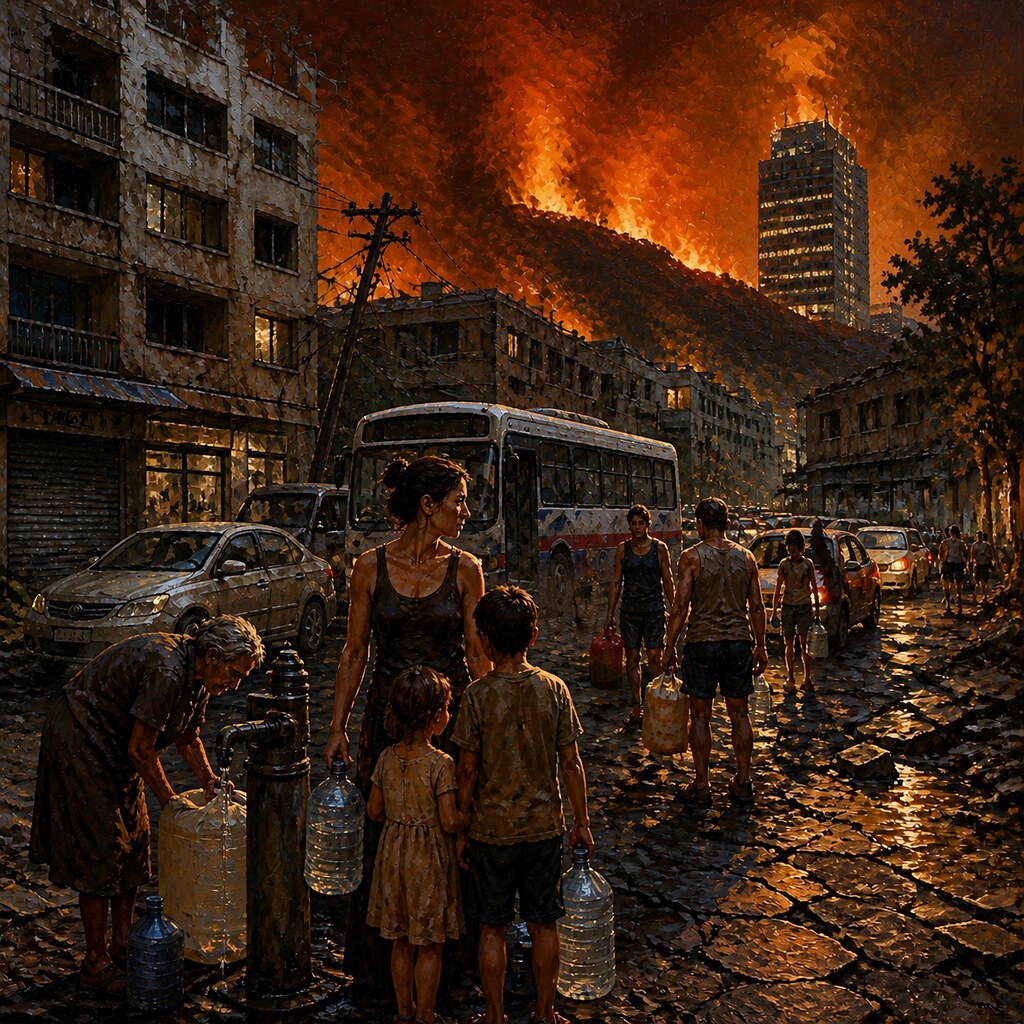
It is the question beneath every oil shock, food shortage, flood, drought, blackout, heat wave, crop failure, migration crisis, and argument about energy security. It also exposes the moral weakness of nearly every proposed solution. When a system is under strain, someone pays. The uncertainty is whether the costs are shared, reduced, and democratically governed—or transferred downward until the vulnerable break first.
Alpert is right to insist that ecological limits cannot be negotiated away by rhetoric, market optimism, or the promise of better technology. But his warning becomes more powerful—not less—when it is joined to an account of the economic system that has treated those limits as expendable.
The modern world has expanded by drawing down concentrated stores of fossil energy, minerals, soils, forests, aquifers, fisheries, and atmospheric stability. It has treated these living and nonliving systems as inputs without end, and their degradation as somebody else’s expense. The apparent success of industrial civilization has therefore always contained an accounting fraud: gains are counted as wealth while exhausted soil, poisoned water, destabilized climate, extinguished species, damaged bodies, and future losses are treated as externalities.
Corporate capitalism did not accidentally develop this blindness. It institutionalized it.
A company that slows extraction, absorbs environmental costs, pays for restoration, designs products to last, or refuses profitable expansion may be outcompeted by one that does not. Governments dependent on employment, tax revenue, debt, political donations, and economic growth are pressured to subsidize the same destructive activity. Financial institutions seek returns in the present while consequences accumulate in the future. The result is a system whose ordinary operation converts ecological stability into private profit and leaves the damage for others to absorb.
The climate crisis makes the pattern visible. The world has known for decades that fossil-fuel combustion destabilizes the conditions under which agriculture, cities, coastlines, public health, and complex infrastructure function. Yet fossil investment and dependence persist, while institutions meant to regulate them remain constrained by wealth, political capture, unequal development, and fear of economic disruption. The IPCC finds that institutional barriers limit mitigation at scale and that financial flows remain misaligned with climate goals. Its assessment of climate impacts also finds that, as warming increases, adaptation options become more constrained and less effective, losses and damages rise, and additional human and natural systems reach adaptation limits.
In that sense, Alpert’s indictment lands: a civilization organized around endless material expansion cannot be expected to stop voluntarily at the boundary of ecological safety.
Humans Are Not Exempt From Ecology
Nor are human beings exempt from the dynamics that govern other populations.
When a species gains access to an unusually abundant resource, loses constraints, or enters a new habitat, its population can expand rapidly. If that growth exceeds the long-term carrying capacity of its environment, the resource base is degraded. Food becomes scarce. Disease, predation, conflict, or reduced fertility follow. Population falls—sometimes gradually, sometimes violently. The removal of a predator from an ecosystem can create precisely this pattern: abundance, expansion, habitat degradation, then correction.
Humanity’s extraordinary resource pulse was fossil energy.
Fossil energy was not merely another commodity within industrial civilization. It was the temporary metabolic subsidy that enabled modern civilization’s massive scale. Coal, oil, and gas multiplied the scale at which human societies could farm, pump water, manufacture fertilizer, move goods, refrigerate food, build cities, practice medicine, mine materials, and wage war. They enabled a population surge and a consumption system that would have been impossible under earlier energy systems. But fossil energy was never simply a gift. It was a drawdown of ancient sunlight, spent at industrial speed.
The danger is therefore not only that individual oil fields decline. It is that a vast civilization has been built around high-throughput flows that are physically finite, environmentally destructive, geopolitically fragile, and unequally controlled. The climate consequences of those flows now threaten the agricultural, water, coastal, and infrastructure systems on which industrial civilization depends.
This is the strongest part of Alpert’s warning. Growth does not continue indefinitely because a society wishes it to. A population, economy, or technological system can overshoot the conditions that support it. And a correction imposed by climate disruption, depleted resources, war, disease, or institutional failure is likely to be harsher than a correction chosen in advance.
But ecology supplies a warning, not a license for prophecy.
The Danger of False Precision
From this systems framework, Alpert reaches his most consequential conclusion: that 13.4 billion people alive during this century will die from starvation or conflict. That conclusion does not follow with scientific certainty from the fact of overshoot.
It depends on specific assumptions: that usable energy delivery from the Earth’s crust will effectively collapse this century; that the sustainable human population is fixed near 600 million, or ultimately 50 million; that technological and institutional adaptation cannot materially change the outcome; and that scarcity will become a self-reinforcing spiral of conflict and death.
Any one of these assumptions may contain part of the truth. The problem is not that the model is too grim. The problem is that, together, they generate a near-worst-case outcome by treating several uncertain and contingent pathways as though they must converge in the same direction.
Human carrying capacity is not a single timeless number inherited from 1700. It is shaped by energy systems, land use, food waste, diets, public health, irrigation, soil practices, climate conditions, material consumption, technology, and—above all—how resources are distributed.
That does not mean technology will save us. It means a model that excludes institutions, class, power, waste, social design, and democratic choice cannot tell us what must happen.
There is a critical difference between these two claims:
Industrial civilization faces severe overshoot and breakdown risk.
and
Humanity is mathematically fated to lose nearly everyone alive this century.
The first is a grave and evidence-based warning. The second is a forecast presented with a precision the evidence cannot sustain.
Alpert does not merely describe coercive population control as a danger that may accompany collapse. He presents it as a conceivable means of preventing the collapse he predicts. In the talk’s final scenario, after arguing that near-zero births would be required and that conventional authoritarian or consensual coercion would fail, he imagines a biogenetic student releasing a contagious virus that sterilizes the global population, with laboratory births later managed to stabilize humanity near 50 million. He presents this as a stark choice between such an act and the mass starvation and conflict deaths he predicts.
Whether intended as provocation, thought experiment, or proposal, the scenario places a global violation of bodily autonomy among the conceivable routes to civilizational survival. It is therefore not only ethically indefensible; it would also require or produce exactly the apparatus of fear, secrecy, mistrust, resistance, and domination that makes cooperative survival impossible.
The fact that voluntary reform has failed does not make atrocity rational.
Three Degrees Is Not a Civilization Plan
The climate evidence does, however, demand that catastrophe no longer be treated as a distant abstraction.
At around 3°C of global warming, the IPCC assesses that risks across many sectors and regions reach high or very high levels, with widespread systemic impacts, irreversible changes, and further hard limits to adaptation. This is not merely a world of hotter summers. It is a world of escalating pressure on food production, water availability, health, coastal settlements, ecosystems, infrastructure, labor, and governance—often in the same places and at the same time.
We are not yet locked into the most extreme warming imagined by older high-emissions scenarios. But under policies already in place, the world is still headed toward roughly 2.8°C of warming this century. Other current-policy assessments place the figure near 2.6°C, with an estimated range of roughly 2.1–3.3°C. That is not the absolute worst case. It is the near-worst case that existing institutions have made normal.
Research on tipping elements adds another disturbing dimension. Current warming already lies within the lower uncertainty range for some climate tipping points. At 1.5–2°C, several large-scale thresholds become likely or possible, including severe warm-water coral reef loss, abrupt permafrost thaw, and irreversible processes involving the Greenland and West Antarctic ice sheets. The 2025 Global Tipping Points assessment reports that warm-water coral reefs are already passing a thermal tipping point, with grave consequences for marine biodiversity and the human communities dependent on reef systems.
None of this permits anyone honestly to name a near-future calendar date when “modern civilization” will cease to exist. Climate systems do not offer that kind of stopwatch, and civilization is not a single object that either exists or disappears everywhere at once.
But something more sobering can be said:
A world at or near 3°C cannot be assumed to sustain industrial civilization at its present scale, distribution, and material intensity. At that level of warming, the IPCC assesses high or very high risks across its major categories of concern; scholars writing in PNAS have therefore identified 3°C or more as a threshold for “extreme climate change,” carrying underexamined but plausible risks of cascading failure, mass mortality, political instability, and worldwide societal collapse.
Some states, corporations, and wealthy enclaves may preserve access to advanced technology, medicine, communications, renewable electricity, and material security. Others may experience repeated state failure, food emergencies, mass displacement, infrastructure abandonment, political violence, or chronic disaster governance. The outcome will not be one synchronized apocalypse. It will be a widening geography of unequal collapse.
That distinction matters because civilization continuing somewhere is not the same as civilization remaining intact for most people.
The Most Likely End Result
If present institutions continue delaying meaningful change, the likeliest outcome is neither painless green modernization nor an immediate worldwide die-off. It is a long emergency: uneven, compounding, and politically contested.
It will likely include:
- More frequent food-price shocks as heat, drought, floods, soil loss, fertilizer dependence, conflict, and transport disruptions affect harvests.
- Expanding water stress, especially where aquifers, snowpack, rivers, and rainfall patterns are already under pressure.
- Higher mortality from heat, disease, smoke, disasters, and disrupted health systems, concentrated among people with the least protection.
- Retreat from exposed coastlines, repeated rebuilding after storms and fires, and expanding areas that become uninsurable or unaffordable to maintain.
- Greater migration, border militarization, nationalism, ethnic scapegoating, and conflict over land, water, and energy.
- More brittle electricity, transport, insurance, housing, and food systems, especially where governments have privatized maintenance and made basic services dependent on continuous growth.
- A widening division between fortified, energy-secure enclaves and regions managed through abandonment, debt, extraction, policing, or emergency aid.
This is not a prediction that every country becomes a wasteland. It is a prediction that the ordinary reliability on which modern life depends will become increasingly expensive, unequal, and difficult to preserve.
The decisive variable will be politics: not simply how much hardship people endure, but whether states retain legitimacy and capacity while elites remain cohesive enough to govern the crisis rather than weaponize it against one another.
Societies can use their remaining energy and material capacity to protect essentials—water, food, public health, housing, transit, local grids, emergency systems, repair capacity, and ecological restoration—or they can spend it protecting luxury consumption, asset values, militarized borders, fossil infrastructure, and elite insulation.
Collapse Requires a Split Above
The political pathway from hardship to systemic breakdown is not automatic. Ecological stress and mass deprivation do not automatically produce revolution. Hunger can create rage, protest, migration, crime, and local disorder; it does not by itself create the organization, strategy, communications, armed capacity, or institutional defections required to overthrow a state. A regime can survive extraordinary suffering when its ruling coalition remains cohesive, its fiscal machinery functions, and its security institutions continue to obey; revolutions become much more likely when security elites defect.
The more dangerous condition is the convergence of pressure from below with fracture from above. Peter Turchin’s structural-demographic theory identifies a recurring pattern in historical instability: wealth concentrates, ordinary living standards erode, state finances deteriorate, and the number of wealthy or credentialed people competing for power grows faster than the number of positions available to absorb them. The result is an expanding class of frustrated aspirants—counter-elites—who possess education, money, status, networks, and political ambition but are excluded from the power they expected to wield.
Counter-elites can supply capacities that an angry population, by itself, often lacks: organizers, ideologues, funders, lawyers, media figures, commanders, defecting officials, and alternative claims to legitimacy. Mass participation supplies scale and moral force; factions of the elite provide coordination, access, and a pathway through the state. The risk of historical breakdown rises sharply when these forces align while a government can no longer finance its obligations, manage competing claims, or rely on a unified military and security apparatus.
This is not a mechanical formula. Revolutions have multiple causes, and their tipping points are difficult to predict. But scholarship on regime collapse consistently treats changes in elite cohesion and the behavior of the security establishment as decisive variables. Moghaddam’s account identifies long-term social change, fragmentation within the ruling elite, and the emergence of leadership capable of directing a revolutionary movement as conditions that prepare the ground for regime collapse. The relevant question, then, is not merely whether climate stress makes people desperate. It is whether climate stress, falling real living standards, and failed public systems intensify existing elite conflict—and whether excluded but capable actors decide that the existing order is no longer worth defending.
That is why a Pan-American energy alliance could be either useful or disastrous. If it becomes a regional cartel designed to secure more extraction for economic growth, it merely extends overshoot beneath a different flag. If it becomes a framework for mutual aid, distributed power, public ownership of essential systems, demand reduction among affluent consumers, durable goods, public transit, regional repair capacity, and protection for people most exposed to climate shocks, it may reduce the violence of contraction.
What Planned Contraction Requires
Planned contraction is not a slogan for voluntary simplicity, nor a promise that local gardens and mutual aid can substitute for a functioning state. It is a political program for deciding what must be protected, what must be reduced, and who has the authority to make those decisions before markets and emergencies make them by force.
Its first principle is not equality of sacrifice. It is the protection of life-support systems. Food production and distribution, clean water, public health, housing, sanitation, electricity for essential services, local transport, communications, and emergency response must be treated as public utilities rather than as commodities available only to those able to pay. This requires public ownership or strict public direction where private ownership has made essential systems brittle, extractive, or inaccessible.
Its second principle is that contraction must begin where throughput is least necessary and political power is most concentrated. Luxury energy use, private aviation, oversized vehicles and homes, speculative construction, planned obsolescence, militarized consumption, fossil subsidies, and extractive projects designed chiefly for private profit cannot be protected while ordinary people are asked to accept less food, heat, mobility, health care, or security. A transition that imposes austerity below while preserving excess above will not be perceived as collective survival. It will be recognized, correctly, as class rule under emergency conditions.
Its third principle is democratic constraint on emergency power. Climate shocks will create demands for rapid centralized action. Some coordination is unavoidable: rationing in a fuel crisis, evacuation during disaster, water restrictions in drought, and priority allocation for hospitals, food systems, and public transit. But emergency powers must be defined in advance by law, narrowly tied to demonstrable conditions, automatically subject to short expiration dates, and renewable only through recorded legislative approval. Their use must be reviewable by independent courts, public auditors, and locally elected bodies with access to the underlying data. Emergency measures must also preserve non-discrimination, due process, and the ability of workers, journalists, civil-society organizations, and affected communities to challenge abuse.
These safeguards do not guarantee freedom. History shows that sunset clauses and formal review can become rituals that legitimate permanent exception when oversight is weak. The point is not to imagine a crisis government that can be trusted. It is to disperse authority, preserve organized opposition, and make emergency power costly to extend, visible to the public, and difficult to convert into a permanent structure of rule. Traditional legal frameworks likewise emphasize declared crisis, transparency, time limits, necessity, proportionality, and non-discrimination as conditions for legitimate emergency action.
Its fourth principle is distributed capacity within a common public system. Mutual aid, local food networks, repair cooperatives, neighborhood cooling centers, microgrids, municipal water systems, and regional emergency reserves matter not because they eliminate the need for national coordination, but because they prevent every failure from becoming a total failure. A society able to feed, cool, repair, communicate, and care locally has more room to resist abandonment when national institutions falter.
None of this guarantees success. It would require confronting concentrated wealth, fossil interests, creditor power, militarized borders, and political institutions built to preserve growth. It would provoke resistance from the same elites whose competition can turn crisis into collapse. But that is precisely why planned contraction must be described as conflict, not consensus: a struggle over whether remaining energy and material capacity are used to preserve life or preserve existing hierarchies.
Principles without an organized force capable of defending them are not a transition strategy.
Who Can Force the Transition?
The agent capable of forcing planned contraction will not be a single virtuous class, party, or government. No existing institution is pure enough, strong enough, or trusted enough to carry such a transition alone. A revolutionary party can become a new administrative elite. A national government can invoke emergency to centralize power. Local networks can provide care and resilience but cannot, by themselves, defeat fossil capital, cancel debt, redirect industrial production, or restrain a militarized state.
The most plausible political agent is therefore a contested coalition: organized labor in the systems that keep society alive; public-sector workers; tenants; farmers; Indigenous and frontline communities; municipal and regional governments; public-health and emergency workers; climate and environmental-justice movements; repair, food, energy, and care cooperatives; and dissident fractions of the professional, bureaucratic, financial, technical, and political classes. Such a coalition would not arise from moral agreement. It would arise because each constituency has a material interest in preventing essential systems from being sacrificed to asset values, fossil rents, debt claims, and elite insulation.
The role of counter-elites is not to rule on behalf of a passive public. It is to bring legal knowledge, organizational skill, technical expertise, institutional access, and resources into a broader democratic struggle. Their usefulness depends on whether they can be bound to public institutions and accountable constituencies rather than becoming a replacement ruling class. The issue is not whether counter-elites will exist—they already do—but whether their conflict with established power is directed toward democratizing essential systems or merely redistributing privilege within the elite.
The practical struggle would occur at several levels simultaneously. Municipalities can municipalize water, housing, energy, transit, and emergency services; unions can fight for public transition plans, worker control, and guaranteed livelihoods; regional coalitions can build public food reserves, repair networks, microgrids, and mutual-aid infrastructure; national movements can demand public investment, debt relief, fossil phaseout, anti-monopoly action, and democratic control of essential systems. None of these measures is sufficient alone. Together, they create institutions through which a society can defend life while reducing destructive throughput.
This is not a promise of peaceful convergence. Fossil interests, creditors, security institutions, and entrenched wealth will resist. The political task is not to wait for an ideal coalition, but to make the defense of ordinary survival—food, water, housing, health, energy, mobility, and care—the common ground on which otherwise divided groups can act. A transition becomes more politically possible when the people who operate, repair, feed, house, heal, and govern society can recognize themselves as a power capable of withholding cooperation from an order that treats their survival as expendable.
Power Is More Than Protest
The force capable of advancing such a transition is not reducible to a march, an election, or a vanguard seizure of the state. It is the organized capacity to interrupt business as usual while making an alternative order governable: workplace organizing and strikes in essential systems; tenant and debt organizing; campaigns to block new extraction; divestment, litigation, and public exposure of fossil interests; electoral organization; municipal action; and the creation of public institutions capable of keeping people housed, fed, cooled, transported, and cared for.
No single tactic defeats entrenched power. The point is to combine pressure that raises the political and economic cost of obstruction with material guarantees that reduce fear of transition. A worker in the fossil-fuel sector who is asked to accept job loss and economic insecurity is likely to resist; a worker guaranteed income, pensions, retraining into real unionized work, and a voice in the transition has reason to join. The same principle applies to communities whose land, air, water, and health have long been treated as expendable.
The aim is neither purity nor a fantasy of instant rupture. It is to build enough organized power that governments, firms, and security institutions face a choice: accept democratic redistribution and planned phaseout, or attempt to govern through increasingly visible coercion and abandonment. The outcome is not assured. But without independent organizations capable of disrupting extraction, withdrawing consent, and administering essential services, no coalition can turn moral argument into durable political power.
Coalition Does Not Mean Consensus
A coalition for planned contraction would not eliminate conflict among those it brings together. Fossil-fuel workers may reasonably demand income, pensions, and secure employment while communities living beside refineries, mines, pipelines, power plants, and waste sites may reasonably demand rapid closure, cleanup, health protection, and authority over the land on which they live. Municipal governments may seek revenue and stability; technical experts may seek discretion; frontline communities may resist being asked once again to bear the risks of a transition designed elsewhere. These are not secondary disagreements. They are the conflicts that any serious transition must be able to face.
The answer cannot be to preserve harmful production indefinitely in the name of jobs, nor to impose closure on workers and communities without material security or democratic power. A just phaseout requires enforceable guarantees: income and pension protection, retraining connected to actual unionized jobs, public investment in affected regions, remediation funded by the firms that profited, and no closure or replacement project planned without meaningful decision-making power for affected workers and frontline communities. Transition policy should not ask workers to choose between dignity and survival, or ask frontline communities to choose between clean air and economic abandonment.
Nor can technical or professional counter-elites simply be trusted to arbitrate these disputes. Their authority must remain limited, contestable, and subordinate to institutions in which affected people can organize, see the relevant information, challenge decisions, and withhold consent. Public ownership matters not because every public institution is democratic, but because it creates a terrain on which democratic control can be fought for. The purpose of coalition is not to abolish conflict. It is to give conflicts short of violence public, material, and democratic means of resolution.
The Real Choice
Alpert is correct that the future is no longer a choice between continued expansion and no change. The physical world has already imposed limits. Climate damage is already irreversible in some respects, and adaptation limits have already been reached in some sectors and regions.
We can permit markets, scarcity, climate shocks, and militarized states to perform the correction. That path produces a brutal hierarchy in which poor, colonized, displaced, elderly, disabled, and politically marginal people are injured first and worst.
Or we can choose planned contraction of destructive throughput: reduced fossil use, reduced luxury consumption, reduced waste, fewer resource-intensive goods, less militarism, less planned obsolescence, fewer extractive megaprojects, and a transfer of remaining capacity toward public survival.
Population is part of the predicament. It cannot be removed from any honest accounting of food, water, energy, land, climate, and material demand. But the failure of societies to restrain population growth does not establish that reproductive coercion is an effective solution. Coercion does not occur in a vacuum. It requires institutions capable of surveillance, enforcement, classification, punishment, and control over bodies at a planetary scale. Those are precisely the institutions most likely to become authoritarian, unequal, corrupt, and violent under conditions of scarcity.
A program that gives some authority the power to decide who may reproduce does not abolish hierarchy; it makes hierarchy biological. It does not prevent the scarcity-conflict spiral; it supplies that spiral with its most intimate and explosive grievance. It would generate resistance, concealment, black markets, persecution, sabotage, ethnic targeting, political repression, and possibly conflict on a scale sufficient to destroy the social trust and public-health capacity required for any orderly transition.
The ethical objection is therefore also a practical one. A civilization cannot preserve itself by destroying the conditions of legitimacy, cooperation, and mutual trust on which civilization depends. The question is not whether population restraint is difficult. It is whether the proposed means of imposing it would create a machinery of domination more destructive than the problem it claims to solve.
The question is not whether a reckoning is coming. It is already here, distributed through heat, hunger, debt, displacement, illness, and the slow failure of systems once taken for granted. The question is whether that reckoning will be administered by markets, militarized borders, and those rich enough to purchase temporary safety—or whether the remaining wealth, energy, and human capacity of this civilization will be used to protect food, water, shelter, health, and public order before it protects fossil assets, luxury consumption, private wealth, and the political power built around them.
Who gets injured, and when? That is not a question for the future. It is the question by which the present must be judged.

