A recurrent theme in the reality based community is the continued assertion that infinite growth cannot happen on a finite planet. This simple statement seems to be quite self-evident to those announcing it, yet the powers that be cannot seem to be able to wrap their head around it. We live in a society awash with advertisements that seek to sell you something at some price. Capitalism commodifies everything and its ethos of mandatorily attaching some arbitrary, imagined worth to all things has permeated every aspect of our lives, our ethics, and our value system. We are a society that projects a cost/price analysis on everything, including relationships with fellow humans. According to ‘Save the Children’ charity chief executive, Justin Forsyth, half a billion children over the next 15 years will suffer long-term mental and physical harm due to stunted growth by malnutrition. Surely if we valued the future life of our grandchildren more than profit, then we would not allow such a thing to happen. If our own children’s future is not valued enough to save them from our greed and shortsightedness, then why would the environment be treated any differently, despite its importance to the survival of every living thing on the planet. The scientist James Lovelock once said that Green is the color of mold and corruption. If we cannot separate the needs of capitalism from the needs of our planet, then every last bit of resources and life-sustaining gift from the earth will be chopped up into tradable, sellable units and thrown into the gaping jaws of the free market. Philosopher Leonardo Boff notes:
The fundamental defect in the UN’s document for Rio+20 is the total absence of a new vision or new cosmology that would create the hope of the «future that we want», the motto of the great gathering. As such, it belies a promising future.
To those who drafted it, the future depends on the economy. There is little value in the adjectives they attach to it: sustainable or green. The green economy in particular constitutes a great assault on the last bastion of nature: transforming into merchandise and putting a price on everything that is common, natural, vital and indispensable to life, such water, the soil, fertility, jungles, genes, etcetera. That which pertains to life is sacred and must not be passed to the sphere of business. Instead, it becomes part of the market place, under the categorical imperative: take all you want, make business with everything, especially with nature and with her goods and services.
This is the supreme egocentrism and arrogance of the human being, or, as it is also called, anthropocentrism. Human beings see the Earth as a warehouse of resources only for them, without realizing that we are not the only ones who inhabit the Earth, nor do we own her; we do not feel that we are part of nature, but outside and above her, as her «lords and masters». We forget, however, that there exists a whole visible community of life (5% of the biosphere) and quadrillions of quadrillions of invisible microorganisms (95%) that guarantee the vitality and fecundity of the Earth. They all belong to the Earth/condominium and have the right to live and coexist with us. Without interdependent relationships with them, we could not even exist. The Rio+20 document does not take any of this into account. We can then safely say that with that document there is no salvation. It opens a path towards the abyss…
This straitjacket of capitalism will not release its grip on civilization until the needs of this ever-consuming, ever-growing, ever-alienating economic system kills its host. Gil Smart gives insight into this dead-end thinking taking us all over the cliff in his short writing called Faith of our fantasies:
…we face a coming era of constrained resources. Fiscal resources; energy; environmental resources. Continual growth, the type we have conditioned to believe as natural and inevitable, is neither.
I read Megan McArdle’s stuff in the Atlantic, where recently she opined about Europe’s changing demographics (i.e. fewer births, more oldsters) and how this makes robust growth more difficult. She got a letter in return from someone questioning the premise – saying that perpetual growth isn’t possible. This was her response:
Whether or not continuous economic growth is possible, or desirable, the fact remains that modern economies are predicated on the assumption that it will happen. Both individuals and governments have planned for a future in which incomes steadily rise, allowing people to enjoy lengthy retirements, advanced health care, independent living, and of course, repayment of the massive debts that almost everyone has accumulated over the past few decades.
If that growth doesn’t materialize, the shock will be enormous. Generational battles over things like pensions have occurred in the context of rising incomes; they will become bitter indeed if young and old are fighting over a shrinking economic pie. The most brutal shock will of course be over debt. If incomes fall, debt will become an ever larger burden. But if countries default, they will merely shift the shock to someone else — too often, to pensioners at home or abroad.
However laudable Europe’s demographic decline may be from an environmental point of view, it will be an economic disaster for many who expected a stable, prosperous future.
Get it? This is the idea on which we’ve staked our future. And if the idea’s wrong?
Well. I guess that means you’re up shite creek, then.
If we plow blindly down this path, infused with the faith that what we want is what will actually happen – we’re doomed. But not charging down this path requires a fundamental restructuring of the way we think – not bloody likely in this society. Or maybe any society.
Well, Mr. Smart, along with a restructuring of our way of thinking will also be required a restructuring of society. And the elite who sit atop our current social hierarchy of capitalism, benefiting the most from its exploitation and theft, will not let go of the power they hold until it’s ripped from their cold, dead hands, whether by an angry mob or the wrath of an abused and ravaged Mother Earth.
The above montage of clips from the satirical movie ‘The Distinguished Gentleman‘, in which Freshman Congressman (and con man) Thomas Jefferson Johnson (Eddie Murphy) is schooled in the ways of Washington by legendary lobbyist Terry Corrigan (Kevin McCarthy), is as true today as it was back when that movie was made more than twenty years ago, so says Marty Kaplan. The following excerpts from the transcript of Bill Moyer’s latest report – Big Money, Big Media, Big Trouble – tells the sorry and sordid tale of our political economy/society. This Moyer’s interview with Kaplan, a true insider to our political and media complex, is quite extraordinary. He affirms what the general populace is unable to comprehend… that we live in a society in which the news media and government institutions are entirely owned by the corporate oligarchs. The government regulators are owned by the very companies they are charged with over-seeing by way of Wall Street’s army of lobbyists and the revolving door that exists between government and private sector positions. Actual news to inform the public on the state of affairs and issues affecting them is virtually nonexistent on the media airwaves.
…what’s really driving it, if you think of this as a symptom and not a cause, I think what’s really driving it is the absolute demonization of any kind of idea of public interest as embodied by government. And at the same time, a kind of corporate triumphalism, in which the corporations, the oligarchs, the plutocrats, running this country want to hold onto absolute power absolutely. And it’s an irritant to them to have the accountability that news once used to play.
…the notion of spectator democracy has, I think, extended to include the need to divert the country from the master narrative, which is the influence and importance and imperviousness to accountability of large corporations and the increasing impotence of the public through its agency, the government, to do anything about it. So the more diversion and the more entertainment, the less news, the less you focus on that story, the better off it is.
And the self-serving triviality of corporate-run ‘news’ media has become a self-reinforcing mechanism whereby stats are being kept of what is the most popular story which then gets kicked up to the top and influences what that corporate news channel reports on in the future. It’s all driven by ratings and profit rather than educating and informing people on facts and real issues. So Neil Postman was right… We are being entertained to death, literally. This nihilism plays right into the hands of those controlling the levers of power who would not benefit from a well-informed, well-eduated public. The vast majority of public discourse has been reduced to an echo chamber of the crap (divisive ‘wedge issues’, celebrity gossip, sensationalist stories, corporate propaganda, consumerist materialism, valorization of the predatory skills of the modern competitive capitalist, etc.) that fills the corporate-controlled airwaves.
…
BILL MOYERS: You wrote The Distinguished Gentleman 20 years ago. Could you write it today?
MARTY KAPLAN: Oh God, it still is the same. All you have to do is add a couple of zeros to the amount of money. And the same laws still apply. It is fabulous and miserable at the same time.
BILL MOYERS: Was Washington then, and is it now, the biggest con game going?
MARTY KAPLAN: It is the biggest con game going. And the stakes are enormous. And the effort to regulate them is hopeless, because the very people who are in charge of regulating them are the same people who are wholly-owned subsidiaries of the lobbies that run them.
BILL MOYERS: I have it on very good authority that a prominent Washington senator recently told a group of lobbyists in Washington, a room full of lobbyists, that they are the lifeblood of the city. And I thought, “Kaplan has to do a vampire movie now.” Right?
MARTY KAPLAN: Exactly. The connection between the legislators and the lobbyists is so intimate that it’s not even embarrassing for a senator to say that in front of a room. The culture is so hermetically sealed from the rest of the country that it doesn’t occur to them that there is something deeply outrageous and offensive and corrosive of democracy to admit that the money side of politics and the elected side of politics belong to each other.
BILL MOYERS: You wrestle with this, you and your colleagues at the Norman Lear Center, and all the time, on how, on what the system is doing to us. So let me ask you, “How did this happen in America? How did our political system become the problem instead of the answer?”
MARTY KAPLAN: Part of it is the nexus of media, money, and special interest politics. The citizens have given the airwaves to the station. We own the electromagnetic spectrum and for free we give out licenses to television stations. Those stations, in turn, use that spectrum to get enormous amounts of money from special interests and from members of Congress in order to send these ads back to us to influence us. So we lose it in both ways. The other day, the president of CBS, Les Moonves, was reported by “Bloomberg” to have said “Super PACs may be bad for America, but they’re … good for CBS.” I mean, there it is. This is a windfall every election season, which seems not to even stop ever, for the broadcast industry. So not only are they raking it in, they’re also creating a toxic environment for civic discourse. People don’t hear about issues. They hear these negative charges, which only turn them off more. The more negative stuff you hear, the less interested you are in going out to vote. And so they’re being turned off, the stations are raking it in, and the people who are chortling all the way to Washington and the bank are the ones who get to keep their hands on the levers of power. So one of the big reasons that things are at the pass they are is that the founders never could have anticipated that a small group of people, a financial enterprise and the technology could create this environment in which facts, truth, accountability, that stuff just isn’t entertaining. So because it’s not entertaining, because the stations think it’s ratings poison, they don’t cover it on the news.
BILL MOYERS: They don’t cover the news.
MARTY KAPLAN: They don’t cover politics and government in the sense of issues. They’re happy, occasionally to cover horse race and scandal and personality and crime and that aspect of politics. But if you look at a typical half hour of news, local news, because local news is one of the most important sources of news for Americans about campaigns. A lot—
BILL MOYERS: You and your colleagues have done a lot of research on local news.
MARTY KAPLAN: Yes, we’ve been studying it now since 1998. And each year it gets more depressing and it’s hard to believe. We, not long ago, did a study of the Los Angeles media market. We looked at every station airing news and every news broadcast they aired round the clock. And we put together a composite half hour of news. And if you ask, “How much in that half hour was about transportation, education law enforcement, ordinances, tax policy?” everything involving locals, from city to county. The answer is, in a half hour, 22 seconds.
BILL MOYERS: Twenty-two seconds devoted to what one would think are the serious issues of democracy, right?
MARTY KAPLAN: Yes. Whereas, in fact, there are three minutes about crime, and two and a half minutes about the ugliest dog contest, and two minutes about entertainment. There’s plenty of room for stuff that the stations believe will keep people from changing the dial.
BILL MOYERS: What is the irony to me is that these very same stations that are giving 22 seconds out of a half hour to serious news, are raking— and not covering politics, are raking in money from the ads that the politicians and their contributors are spending on those same papers.
MARTY KAPLAN: Yes, they’re earning hundreds of thousands and millions of dollars from the ads that they are being paid to run. And not even risking running a minute of news, which might actually check on the accuracy of an ad. Truth watches, they’re almost invisible now.
BILL MOYERS: So they will tell you, however, that they’re in the entertainment business. That they’re in the business to amuse the public, to entertain the public. And if they do these serious stories about the schools or about the highways or about this or that, the public tunes out. That the clicks begin to register as—
MARTY KAPLAN: It’s one of the great lies about broadcasting now. There are consultants who go all around the country and they tell the general managers and the news directors, “It is only at your peril that you cover this stuff.” But one of the things that we do is, the Lear Center gives out the Walter Cronkite award for excellence in television political journalism every two years. And we get amazing entries from all over the country of stations large and small of reporters under these horrendous odds doing brilliant pieces and series of pieces, which prove that you can not only do these pieces on a limited budget, but you can still be the market leader.
…
MARTY KAPLAN: Well, what’s really driving it, if you think of this as a symptom and not a cause, I think what’s really driving it is the absolute demonization of any kind of idea of public interest as embodied by government. And at the same time, a kind of corporate triumphalism, in which the corporations, the oligarchs, the plutocrats, running this country want to hold onto absolute power absolutely. And it’s an irritant to them to have the accountability that news once used to play.
BILL MOYERS: What do you mean by that? News challenges their assumptions, challenges their power?
MARTY KAPLAN: It used to be that the news programs that aired, believe it or not, had news on them. They had investigative stories.
But then somewhere in the 1980s, when 60 Minutes started making a profit, CBS put the news division inside the entertainment division. And then everyone followed suit. So ever since then, news has been a branch of entertainment and, infotainment, at best.
But there was a time in which the press, the print press, news on television and radio were speaking truth to power, people paid attention, and it made a difference. The— I don’t think the Watergate trials would have happened, the Senate hearings, had there not been the kind of commitment from the news to cover the news rather than cutting away to Aruba and a kidnapping.
BILL MOYERS: What is the basic consequence of taking the news out of the journalism box and putting it over into the entertainment box?
MARTY KAPLAN: People are left on their own to fend for themselves. And the problem is that there’s not that much information out there, if you’re an ordinary citizen, that comes to you. You can ferret it out. But it oughtn’t be like that in a democracy. Education and journalism were supposed to, according to our founders, inform our public and to make democracy work.
You can’t do it unless we’re smart. And so the consequence is that we’re not smart. And you can see it in one study after another. Some Americans think that climate change is a hoax cooked up by scientists, that there’s no consensus about it. This kind of view could not survive in a news environment, which said, “This is true and that’s false.” Instead we have an environment in which you have special interest groups manipulating their way onto shows and playing the system, gaming the notion that he said she said is basically the way in which politics is now covered.
It’s all about combat. If every political issue is the combat between two polarized sides, then you get great television because people are throwing food at each other. And you have an audience that hasn’t a clue, at the end of the story, which is why you’ll hear, “Well, we’ll have to leave it there.” Well, thank you very much. Leave it there.
BILL MOYERS: You have talked and written about “the straightjacket of objectivity.” Right? What is that?
MARTY KAPLAN: Well, the problem with telling the truth is that in this postmodern world, there’s not supposed to be something as truth anymore. So all you can do if you are a journalist is to say, “Some people say.” Maybe you can report a poll. Maybe you can quote somebody. But objectivity is only this phony notion of balance, rather than fact-checking.
There are some gallant and valiant efforts, like PolitiFact and Flackcheck.org that are trying to hold ads and news reports accountable. But by and large, that’s not what you’re getting. Instead the real straightjacket is entertainment. That’s what all these sources are being forced to be. Walter Lippmann in the 1920s had a concept called “spectator democracy” in which he said that the public was a herd that needed steering by the elites. Now he thought that people just didn’t have the capacity to understand all these complicated issues and had to delegate it to experts of various kinds.
But since then, the notion of spectator democracy has, I think, extended to include the need to divert the country from the master narrative, which is the influence and importance and imperviousness to accountability of large corporations and the increasing impotence of the public through its agency, the government, to do anything about it. So the more diversion and the more entertainment, the less news, the less you focus on that story, the better off it is.
BILL MOYERS: Are you saying that the people who run this political media business, the people who fund it, want to divert the public’s attention from their economic power? Is that what you’re saying?
MARTY KAPLAN: Yes.
Let us fight about you know, whether this circus or that circus is better than each other, but please don’t focus on the big change which has happened in this country, which is the absolute triumph of these large, unaccountable corporations.
This is about as dismal and effective a conspiracy, out in plain sight, as there possibly could be. So I don’t say that this is going to be solved or taken care of. What I do say is the first step toward it is at least acknowledging how toxic the situation has become.
…
BILL MOYERS: What you’re saying is that the political square is now a commercial enterprise, owned and operated for the benefit of the brand, CNN, Fox, all of those, right?
MARTY KAPLAN: That’s correct.
BILL MOYERS: How did it happen? How did we sell what belonged to everyone?
MARTY KAPLAN: By believing that what is, is what always has been and what should be. The notion that what goes on is actually made by people, changes through time, represents the deployment of political power. That notion has gone away. We think it’s always been this way. People now watching these CNN and Fox. They think this is how it works. They don’t have a sense of history. The amnesia, which has been cultivated by journalism, by entertainment in this country, helps prevent people from saying, “Wait a minute, that’s the wrong path to be on.”
BILL MOYERS: Amnesia, forgetfulness? You say that they’re cultivating forgetfulness?
MARTY KAPLAN: Absolutely.
…
BILL MOYERS: You made a very important speech not long ago at a media conference in Barcelona. And you tried and did draw the distinction between— you said the battle of the future is between big data and big democracy. In layman’s language, what is that?
MARTY KAPLAN: Big data, the age of big data that we’re supposed to be in, refers to the way in which, as we go on the internet, as we do all these media activities, watching television, which are at the center of our lives, we’re leaving a trail behind. We’re giving bits of ourselves up. And that set of bits is being collected and mined relentlessly.
So every time we buy a product or send an e-mail or vote how many stars to a restaurant, all this stuff creates a profile that companies buy and sell to each other. And that stuff is being used currently not only to market to us, to target ads toward us, but it’s also being used to profile us. There’s something called “web lining.” Which is similar to what used to be called “red lining.” The— that phenomenon, which is now illegal, in which people who were discriminated against because of the neighborhoods they live in. Right now—
BILL MOYERS: Banks drew a red line around impoverished neighborhoods that they would not then serve.
MARTY KAPLAN: Exactly. And so today imagine if you were to permit a private detective to follow you as you went to your drug store and bought a medication to help you with depression or as you made a phone call to a bankruptcy lawyer, because you needed one. Imagine if that kind of information could be put together and used against you to decide that you’re a bad credit risk or that maybe your insurance company should turn you down, because you suffer from this problem.
That kind of information, that kind of digital profiling is something which is emerging as a huge industry. And unless there are controls on it and constraints, as they have to some degree in Europe but not nearly enough even there, we are about to kiss goodbye our ownership of our privacy and also even the ownership financially of our information. We are the people who make Facebook and Twitter worth the billions of dollars that they’re worth, because we are giving up our information to them, which they are then selling and raising capital around.
BILL MOYERS: But in a libertarian era, what are the restraints and constraints against that? Where are they going to come from?
MARTY KAPLAN: Well, right now, the constraints in this country are voluntary. The Obama White House not long ago issued a digital code of conduct, which included privacy. In which they asked companies and companies did step up to it to say, “We’re not going to track people if they don’t want to be tracked.” And other such efforts to get people in control.
But what we do know, the record of just the past couple of months, is that company after company was doing stuff to us that’s astonishing, that we didn’t know about. The ways in which the apps that you use on your smartphones were vacuuming up information about you, your address book and all your pictures.
Stuff that you had no idea you had consented to, which in fact usually you had not, suddenly was all owned by other people, as well. You have not given permission, but that essential part of you is now not yours. That’s the name of the game now. This is baked into the business model of data mining, which is at the heart of so much of the digital economy.
BILL MOYERS: But that’s big data. You talked about big democracy.
MARTY KAPLAN: So at the same time as our data is being mined, there is this movement to protect people using technology to give them the power to say, “I’m not going to opt into this stuff.” We’re still at the beginning of this industry. And there has to be rules of the road. And part of those rules include my attention rights. My rights to control my identity, my privacy, and my ownership of information.”
BILL MOYERS: In your speech in Barcelona, you pointed to two simultaneous covers of TIME Magazine appearing the same week. One for the editions in Europe, Asia, and South Pacific, and it was about the crisis in Europe. The other, which appeared in the American edition, featured a cover about animal friendships. You use these two covers to illustrate the difference between what you call “push journalism” and “pull journalism.” What’s the difference?
MARTY KAPLAN: Push journalism is the old days, which seem no longer to apply in the era of the internet, in which an editor, a gatekeeper, says, “Here’s the package which you need to know.” All of that is ancient history now.
Instead, now, it’s all driven by what the consumer is pulling. And if the consumer says, “I want ice cream all the time.” And whether that ice cream is Lindsay Lohan, or the latest crime story, that’s what’s delivered. And as long as it’s being pulled, that’s what is being provided. So it’s quite possible that in the U.S., the calculation was made that the crisis in Europe and the head of Italy would not be a cover that one could use. But that pet friendships would be the sort of thing that would fly off the newsstand.
BILL MOYERS: So the reader is determining what we get from the publication?
MARTY KAPLAN: On a minute by minute basis, stories that the reader’s interested in immediately go to the top of the home page. There are actually pieces of software that give editorial prominence to stuff that people by voting with their clickers have said is of interest to them. No one is there to intervene and say, “Wait a minute, that story is just too trivial to occupy more than this small spot below the fold.” Instead, the audience’s demand is what drives the placement and the importance of journalistic content.
BILL MOYERS: So George Orwell anticipated a state as big brother, hovering over us, watching us, keeping us under surveillance, taking care of our needs as long as we repaid them with utter loyalty. Aldous Huxley anticipated a Brave New World in which we were amusing ourselves to death. Who’s proving the most successful prophet? Huxley or Orwell?
MARTY KAPLAN: Well, I think Huxley is probably right, as Neil Postman said in—
BILL MOYERS: The sociologist, yes.
MARTY KAPLAN: —in Amusing Ourselves to Death. That there’s no business but show business. And we are all equally guilty, because it’s such fun to be entertained. So you don’t need big brother, because we already have big entertainment.
BILL MOYERS: And the consequences of that?
MARTY KAPLAN: That we are as in Brave New World, always in some kind of stupor. We have continual partial attention to everything and tight critical attention on nothing.
…
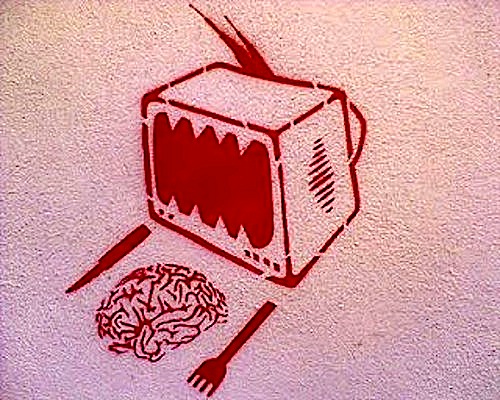
According to stats from 2010 for TV viewing by adult Americans, we’re glued to the boob tube in our waking hours. This explains why having an intelligent conversation with most Americans is an impossible task. All they can do is regurgitate what has been constantly programmed into their heads.
• The average American watches 35:34 (hours/minutes) of TV per week
• Kids aged 2-11 watch 25:48 (hours/minutes) of TV per week (Q1 2010)
• Adults over 65 watch 48:54 (hours/minutes) of TV per week (Q1 2010)
And according to the latest Nielsen study, TV viewing is on the increase, notwithstanding a tiny drop in the number of households who own a TV:
…despite all the competition from cable TV, videogames, and the Internet, the average household watched 59 hours, 28 minutes of broadcast TV per week during the 2010-2011 season, setting a new record. Lanzano drew particular attention to the competition — or lack of it — from Facebook, noting that while the average person spends about 13 minutes a day on Facebook, they spend 297 minutes watching TV. “No wonder our friends at [General Motors] are making some changes,” he said. [Last month GM announced that it will stop placing ads on Facebook, after determining that they had little impact.]
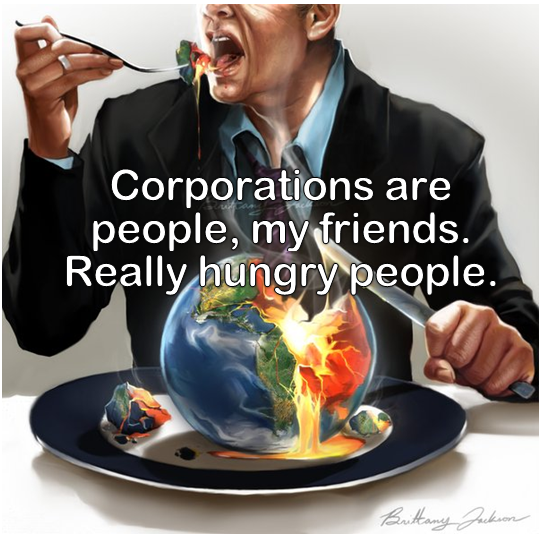
It’s important to keep in mind that at the root of industrial civilization’s problems is an economic system called capitalism which requires infinite growth at the expense of our global life support system, the earth. The end game is a spent and destroyed environment in which a small global elite control the overwhelming percentage of the planet’s extracted wealth while the vast majority of the world’s population exist in squalor and debt peonage. The social hierarchy of our system can be visualized as a large pyramid with the wealthiest of society represented as the eye of a thin needle sitting atop the massive base that represents the rest of humanity. It seems the only impediment to capitalism is its own unstoppable path to self-destruction. For the power that accumulated capital wields has taken over all aspects of societal behavior – cultural, spiritual, political, legal, and analytical – to the detriment of us all.
“…About two years ago, WWF, the international organization involved in the area of ecology, said in its Living Planet report: A second planet will be required by 2030 to meet our needs as over-use of Earth’s natural resources and carbon pollution have become critical. If all human being in this world used resources at the same per capita rate as the US or the UAE, four and a half planets would be needed. More than 70 countries were exhausting their freshwater sources at an alarming, unsustainable rate. About two-thirds of these countries experience water scarcity ranging from moderate to severe. In 2007, the world’s 6.8 billion humans were living 50% beyond the planet’s threshold of sustainability. The report highlighted the rich-poor ecological gap. In 1970-2007, an index of biodiversity showed a world decline of almost 30%. In the tropics, it was alarming: 60%.
No brain with logic will claim that the acts are isolated from the world economic system: capitalism. “From the outset,” Joe Bageant, author of the book about working class in America Deer Hunting with Jesus: Dispatches from America’s Class War , writes, “capitalism was always about the theft of the people’s sustenance. It was bound to lead to the ultimate theft – the final looting of the source of their sustenance – nature.” (“Our Plunder of Nature will End up Killing Capitalism and Our Obscene Lifestyles”, Countercurrents , July 13, 2010 )
“The main feature of capitalism is the seductive assertion that you can get something for nothing in this world.” (ibid.) Owners of this system, the capitalists, Joe continues, “hate any sort of cost.” They, he describes, “remain unimpressed by global warming, or melting polar ice caps, or Southwestern desert armadillos showing up in Canada , or hurricanes getting bigger and more numerous every year.”
These are the elites in control of the world environment in continents and countries. “Just before the economy blew out,” according to Joe, “these elites held slightly less than $80 trillion. After the blowout/bailout, their combined investment wealth was estimated at a little over $83 trillion. To give some idea, this is four years of the gross output of all the human beings on earth.”
This massive money power takes hold of political power. Owning this unimaginably monstrous money-political power system they put their footprint on ecology that is changing the planet’s environment irreversibly.
This system, the masters of the system in the center, in the periphery, in between the center and the periphery, try their best to maximize profit by minimizing cost, by appropriating labor, robbing nature, grabbing everything within their reach, putting costs on public. Pollution, destruction of ecology and ruination of nature thus creep into public domain – a human concern.
Acts of the masters are turning into crime, crime against the planet, against posterity, against humanity.
The World Future Council leaders said: “These are crimes against the future … These are crimes that will not only injure future generations, but destroy any future at all for millions of people.”
The Council has called for appointing “ombudspersons for future generations”, “guardians appointed at global, national and local levels whose job would be to help safeguard environmental and social conditions by speaking up authoritatively for future generations in all areas of policy-making. This could take the shape of a parliamentary commissioner, a guardian, a trustee or an auditor, depending on how it best fits into a nation’s governance structure.”
But questions are there: How far the ombudspersons can act where power structure, economy and political power is of, by and for polluters, grabbers, eco-murderers? If they can act, then, why do environment law/court/ministry/inspectors, depending on arrangement in countries, can’t act? What will happen if polluters grab that proposed holy post as have happened in countries by different lobbies/interests/gangs? What’s the guarantee that the proposed holy persons’ observations/edicts/verdicts will be implemented? Are not there instances of trampling/violation of all basic, fundamental, moral, ethical, human, natural, principled rights/practices/conventions/laws/rules around the world, in countries?
Out of their sense of urgency the WFC leaders’ suggestion sounds nice, but not functional. It’s detached from reality, the socio-economic-environmental -political reality.
What’s the reality?
An answer is provided by Fred Magdoff and John Bellamy Foster in their seminal analysis What Every Environmentalist Needs to Know about Capitalism: A Citizen’s Guide to Capitalism and the Environment (2011): Capitalism is a system that must continually expand, a system that, by its very nature, will eventually come up against the reality of finite natural resources, a system geared to expansionist growth in the search for profits that will inevitably transgress planetary boundaries.
By its very nature the system stands against ecology and environment as its only concern is profit, nothing else. Standing for environment will lead to questioning the ever hungry system.
Pushing 1 billion persons down to extreme poverty, and enriching a few, whose consumption is threatening the planet is one of the major “contributions” of the system. Other than the hungry and starved, there are energy poor, electricity poor, water poor, information poor, basic rights poor, safety poor, they are the poor masses deprived of honor and dignity, and there are the food rich, energy rich, electricity rich, water rich, information rich, luxury rich, power and privilege rich, resource rich, consumption rich, the rich few controlling everything.
Imbalance and inequity at this level can’t sustain environment and ecology. The first one, imbalance and inequity, is linear, ever expanding while the later one, environment and ecology, demands diversity, tolerance, consideration, accommodation. Observance related to environment turns hollow and chattering if this aspect of political economy is ignored…
I was looking for an analysis of the Wisconsin recall election results of Scott Walker, and the best, most incisive one I found is reprinted with permission below. The bold emphasis and links in the article are mine. The Big Money behind Walker controlled the narrative of the recall election by framing the problem of the economy as a choice between costly, corrupt and selfish unionized state workers versus a wasteful state government attempting to streamline itself and cut costs for the taxpayer. Absent in that polarizing message by the Corporatists was their real agenda of dismantling worker’s rights at the altar of the free market, shipping jobs oversees to exploit the cheapest of labor pools. Also absent was the Corporatist’s agenda of cutting the taxes on the wealthiest of society’s elite while dismantling and privatizing social/public services. Interestingly, the only two unions that backed Walker, the fire fighters and the police, were exempted from Walker’santi-collective bargaining law. Also of note is Obama’s absence from supporting the workers in Wisconsin. As explained in my post, Obama: Figurehead for the Corporatocracy, this betrayal should come as no surprise. Divide and conquer is a very effective strategy to destroy the workers who have been subject to indoctrination of Neoliberal policy since Ronald Reagan. The myth of the wealthy being job creators still works, and the public doesn’t have a clue about the evils of privatization. The class war continues with the wealthy effortlessly manipulating the levers of power and mainstream media to their advantage…
Gov. Scott Walker’s anti-recall campaign sold the lie that greedy public sector workers and their unions were costing the taxpayers exorbitant amounts for high wages and lavish pensions.
The recall election in Wisconsin was won by organized Big Money. Lots will be said by many pundits about various aspects of the election, but the most important issue is how Big Money or the 1 percent were able to shape the electoral environment. Looking at that question exposes how capitalist democracy operates.
It also helps to answer the question being asked by many—why do people vote against their own interests?
In his victory speech, Wisconsin Gov. Scott Walker said he wanted to first of all thank God for his abundant gifts. This was not only an appeal to the religious right-wing but also an attempt to give praise to the billionaires whose gifts brought him the election victory.
On Jan. 18, 2011, Walker told billionaire Diane Hendricks that his strategy was to go after collective bargaining rights for public employees first and then get a Right to Work for Less law, in a strategy which he explicitly described as divide and conquer. She gave him over $500,000 during just a three month period in 2012. Hendricks’ ABC Supply Inc., the nation’s largest wholesale distributor of roofing, windows and siding paid no state income taxes in 2010.
Although pay for teachers had been capped since 1993 and public sector unions were not on the offensive, the goal of Walker and his backers in 2011 was to eliminate these unions. Unions for public employees are the last sources of significant power for organized labor as well as for the interests of unorganized workers.
Tens of millions of dollars were pumped into Walker’s campaign to win the recall election. Much of it came from the super wealthy outside of Wisconsin. This money created the slick right-wing Madison Avenue ads that inundated every household.
The rich put their money into this fight because they saw it as part of their class war against the workers. This was a referendum on slashing workers’ rights, especially public workers. It was played out in Wisconsin but finance capital saw that it would have national ramifications.
Role of the Democratic Party
The recall effort itself was the result of the efforts of hundreds of thousands of workers who gathered one million signatures to recall Walker. When they filed those petitions on Jan. 17, it was crystal clear that they wanted this election to be about basic labor rights—the right to bargain, the right to have a contract and the right to have union recognition including long established union security clauses providing for dues.
The Democratic Party took over the message and shifted it to a blander mixture with a focus on corruption. The national Democratic Party essentially ran away from the Wisconsin battle in a way that once again shows that they have no interest in supporting labor’s cause. President Obama did not come to the state to support the fight for basic rights. His absence served as another example from a long list of unfulfilled campaign promises—that he would walk on union picket lines after he became president and that he would fight to get labor laws passed with fairer terms for union elections—the Employee Free Choice Act—and more.
Role of labor
The ranks of labor were pushing for a battle in the electoral arena. Public unions put significant money and organizational resources into the fight. These unions included the teachers unions, firefighters, AFSCME (state city and county workers), SEIU and others.
However, two locals in Milwaukee—police and fire unions—endorsed Walker in the recall, while no statewide unions did. It is important to remember that Walker exempted these unions from any of the negative effects of his anti-collective bargaining law. Firefighters, of course, are workers that all of labor should support, and this local union betrayal was especially odious because an African American firefighter and union leader was a candidate for lieutenant governor. Instead of a message that public workers have rights that everyone should have, the anti-labor story is that if anyone has a wage, a right or a pension that others do not have, then we should take it away from them.
While Walker is most known for his initial attack against the public sector unions, the construction trades also joined the recall effort in a more significant way than in almost any other previous fight. The statewide Operating Engineers Local 139, with about 9,000 members, previously had endorsed Scott Walker for governor in 2010 on the promise that he would not support Right to Work legislation while delivering a larger budget for bridges and infrastructure. Walker’s flip on that overcame reservations about the Democratic candidate who, as a Mayor of Milwaukee, bargained hard against them on major contracts.
Union leaders had come together as a coalition and chosen Democratic Party politician Dane County Executive Kathleen Falk as their candidate in the recall primary. The time limits imposed by the state’s election process required quick action, but the union leaders’ lack of involvement among the hundreds of thousands of activists who had put the recall on the ballot was a signal of things to come. Falk was defeated in the recall primary by Milwaukee Mayor Tom Barrett (who had previously been defeated by Walker in 2010).
No thought was given to having a truly independent candidate with a real program addressing workers’ needs. Eventually, the labor leaders deferred to the regular Democratic Party pundits and confined the campaign to a shifting message that did not resonate with people.
Support for labor from the most oppressed communities
Organizations and leaders in the African American and Latino communities—some of the most oppressed sectors of the population—campaigned hard to get rid of Scott Walker. Early reports reveal that record numbers were mobilized to vote.
SEIU had organizers working in poor communities for some time to help mobilize action and exert power on a number of issues.
Democrat Barrett’s concession speech
When Barrett took the podium to announce that he had lost the race, he stressed that now is the time to “work together” with Walker. This is typical “good form” for a Democratic Party leader but poison for labor. Now is not the time to work with union busters; now is the time to organize even more diligently against them.
He talked about “democracy”—but not workers democracy. He called on people to stay engaged with city and state politics.
Why did some workers vote for Walker?
Without a doubt some people are wondering: What were they thinking! Why did they vote for Walker?
The Walker campaign focused on taxes and make-believe figures on job creation. Their message was that greedy public sector workers and their unions were costing the taxpayers exorbitant amounts for high wages and lavish pensions that others don’t have.
Walker constantly refers to “union bosses” and his allies frequently refer to “union thugs” or “union goons”. These terms turn reality on its head. If he were speaking the truth, he would be talking about the captains of finance who are his bosses and who are financing and directing his actions.
When Walker’s Wisconsin budget bill was passed, it increased spending in FY 2013 on prisons while imposing $792 million in aid cuts to school districts, $250 million in cuts to the university system and $71.6 million in cuts to technical colleges. In addition, nearly $500 million was cut from Medicaid programs, eliminating necessary important components of health care. At the same time, these financial bosses have gotten Walker and the legislature to approve $1.6 billion in corporate tax breaks over the next 10 years. Profits have increased—but not jobs.
That is their program, and they sell it by vilifying labor. In areas reached mostly by right-wing radio and governed by right-wing elites from the pulpit to the County Board, the Big Lie works. It is a Big Lie that has been in development since the 1940s and especially since the 1960s. As corporations move production overseas, the ruling class spins the story in a way to blame unions here for “pricing themselves out of the market.” They spin the story to divide workers in the United States from workers abroad.
In 2012 so far, General Electric has moved its medical equipment division headquarters from Waukesha, Wisconsin to Shanghai, China. The Thermo-Fisher Corporation is planning to move nearly 1,100 jobs from Wisconsin to Mexico.
In the race for maximum profits at any cost and the race to shove workers down to the lowest level of rights and pay on a world scale, they have refined the Big Lie technique and used it on a mass scale.
The truth about public services such as education, health care, child welfare and transportation is never told. These services are rights that were won through struggle—and which would never be provided by private companies that only care about profit.
The truth about public workers is never told—that their pay is modest, that most do not qualify for social security and their only pension is what the union has been able to win in a contract or through legislation.
Instead of a message that public workers have rights that everyone should have, the story is that if anyone has a wage, a right or a pension that others do not have, then we should take it away from them. And at the same time ignore the vast wealth of the CEOs. Ignore the vast profits made by the banks and the holders of state and local government bonds who get their interest payments first from every state budget while programs for the people get cut.
The principal blame for the election result in Wisconsin is not with the workers of Wisconsin but with the rich who spin this message and who control the levers of power in that state and around the country.
The road not taken: This is what democracy could have looked like
In March of last year, when Walker threw down the gauntlet and signed the “Budget Bill” killing many collective bargaining rights, labor leaders opted to move the struggle from the streets into the electoral arena.
Many experienced labor activists, including some leaders in the Madison area, know that workers have greater power in the streets because of the way money controls elections. On Feb. 22, 2011, the 97 unions of the South Central Federation of Labor of Wisconsin, representing 45,000 workers, unanimously passed a resolution calling for the preparation for a general strike.
A general strike would have electrified workers everywhere. It could have begun as a one day strike in Wisconsin cities with the greatest union strength and then expanded in terms of both days and areas covered. Millions of workers across the country who were upset with cutbacks, layoffs, privatization and more would have been inspired to take action.
Shutting down the state would have been a quicker and more definite blow to Walker and could have resulted in a defeat for Walker as compared to the defeat for labor experienced in the recall election.
General strikes are feared by the ruling class. In reference to a Philadelphia teachers strike—Jan. 8 to Feb. 28, 1973—William Usery, director of the Federal Mediation Service, said that “We came within an eyelash this year of having a test of the effectiveness of the general strike as a weapon in the United States—a weapon that has at times paralyzed the economies of France and Italy.” He went on to say that if labor had engaged in the general strike that many had called for—and if they had won—then “there would have been enormous pressures to do it again—and again—and again.”
That is the fear of the ruling class. If workers exercise their power, there could be no stopping them. No rights would be out of reach.
The Democratic Party is doing all it can to orient people to the November presidential election and away from struggle. Almost without exception labor leaders are focused on that election.
Rank-and-file members can learn a lot from this experience in Wisconsin. Labor’s hope lies not in the electoral arena but in solidarity and action on the job and in the community.”
You better believe that the financial elite who run this country do have OWS and any other social movement under 24/7 surveillance. Anything that strives to change the status quo of neoliberal capitalism will be undermined and crushed, whether through covert actions or co-optive schemes. Social justice, the environment, and the very habitability of planet earth are not on the agenda of the 1%’ers.
Michael Parenti’s son, Christian, gives the methods by which the capitalist power structure controls rising social movements:
Parenti starts by noting a paradox within the capitalist system. “Capitalism needs poverty,”(2) states Parenti unequivocally, arguing that without enough poor people around workers start demanding better conditions and higher wages. However, at the same time, capitalism is threatened by too much poverty. Poverty, he argues, tends to breed dissatisfaction, which makes revolt more likely. The question is “How do you have poverty and manage the threat of poverty?”(3) The answer, for Parenti, is by expanding social control mechanisms through the criminal justice system. The buildup of prisons and policing in the last two decades is not a result, as some might have it, of corporations expanding into the criminal justice system for profits.(4) Rather, the growth comes from an increasing need by the capitalist class (in collusion with the state) for greater social control, a growth necessary to keep the poor from revolting. Prisons, mandatory sentencing, and the “war on drugs” become the means by which the state is able to subdue the working class and keep poverty at a level that maximizes profits while minimizing dissent. Here we see a clear example of “hard-line” social control.
Parenti also describes a second, softer tactic of social control, mainly co-optation. He briefly describes the way that workers’ movements in the 1960s were co-opted by turning their leaders into administrators of low income housing and social services. This co-optation happened at a time when the Unites States was economically strong enough to absorb the poor in order to legitimize the system. However, the economic crisis in the 1970s put an end to this tactic and brought with it the harder modes of social control. Parenti concludes that, “In a class society, rule comes down to two things, as Machiavelli said. The prince has two choices. He can either treat men [sic] well or crush them. . . . Sometimes economic conditions are plush enough that people can be treated well, but more often then not, in a capitalist society, the ruling class, through the state, must crush and intimidate people to reproduce their system. And that is what the criminal justice system is all about.”(5)
And tying together the previous post about Drones and the earlier post about the State’s oppressive security and surveillance apparatus, we have this essay which contains a perfect example of how the Corporate State crushes dissent:
“…I see other things coming even sooner, caused by the same ruling elite’s insatiable greed and lust for power, and by the same political system’s actions in support of their goals.
First there is the accelerating march towards a police state, which began in earnest during the first year of the Bush/Cheney administration with the attack on the World Trade Center and the Pentagon, the passage of the cynically named USA PATRIOT Act, and the launching of the so-called War on Terror, but which has been carried forward to a place I could never have imagined by Bush’s successor, Barack Obama. Today, police in America ride around with fully automatic M-16s in their squadcars, routinely taser people, including children, the elderly and the disabled, for minor offenses, and when confronted with a peaceful and permitted political demonstration, respond in full military SWAT gear, complete with guns, pepper spray, clubs, tear gas, and undercover agents who deliberately try to incite violence.
Just yesterday, long-time Latino activist Carlos Montes, 64, was arrested in Los Angeles during a joint LAPD/FBI SWAT-team midnight raid on his house. The charge: possessing illegal weapons. But Montes possessed only licensed guns in his home. The catch was, the FBI, which was clearly after Montes, a retired Xerox salesman, for political reasons, conveniently told local police that he was not allowed to register firearms because of a (get this!) 1969 felony conviction for allegedly throwing a coke can at a cop (Montes says he never threw such a can). Note that the police knew all about that conviction when Montes first registered his guns. He has not been in trouble with the law since then. Clearly he could have simply been informed that his gun registrations were invalid, and the guns had to be turned in. Why Montes, who has remained politically active and a critic of the government, was really arrested in this Gestapo-like manner became clear when an FBI agent hopped in the car with him right after he was picked up, and said, “I am from the FBI and I want to talk to you about the Freedom Road Socialist Organisation.” Montes is now facing a possible 22 years in jail for possessing legally registered guns that the LAPD has known for years that he had in his home, and that nobody ever cared about before. (I had to learn about this from the British newspaper the Guardian. The corporate media in America have covered up this outrageous political bust.)
America today is crawling with secret police–local, state and federal. They’re all connected too, through 72 so-called Fusion Centers that receive federal funds, but remain insulated from any kind of public oversight. Our phones and our internet communications are monitored automatically by National Security Agency super-computers that look for key words like “airport, exercise, flu, blizzard, bridge, or fundamentalism,” any of which prompt closer attention to what we are saying or writing.
Meanwhile, the president has claimed the right to detain–in secret, without charge–any American he deems to be a threat, and to hold such people indefinitely, without any recourse to lawyer or trial. He is even claiming the right to execute such captives. So much for the Fourth Amendment, as well as the First, Second, Fifth, Sixth, Seventh and Eighth!
While I don’t think we live in a police state yet (having lived in China for two years, and visited there as a journalist over four other years, I know what a real one looks and feels like), but all the elements for one have been put in place and await only the throwing of a switch.
In the vision I clearly have, I feel strongly that someone, whether Obama or Romney, or whoever follows him, will throw that switch. When power is available to political leaders, they inevitably avail themselves of it. It’s just a question of time.
But there is another vision I have too. It has to do with America’s increasing international lawlessness and bellicosity. As the nation turns increasingly to technology for its aggressive purposes, through the use of armed robotic drones, and through internet attacks on purported “enemies,” it not only opens the door to others to do the same to us; it virtually assures that we will be attacked ourselves in like manner to what we are doing.
It was one thing to be the world’s superpower when being a superpower meant having the biggest ICBMs and the most nuclear warheads — weapons that required an enormous military budget and a massive industrial base. Drone technology and internet “weapons” are something else altogether. As Israel has demonstrated with its Stuxnet virus, a very small nation can easily construct a weapon of tremendous destructive power. Iran demonstrated its own capability in that area by using computer savvy to take control of a sophisticated US surveillance drone flying over its airspace, actually stealing it electronically, landing it, and now, apparently, back-engineering it. And remotely-piloted drones are not particularly complex technologically. Basic ones can be purchased off the shelf in any hobby shop.
How long will it be before foreign predator drones begin flying over US airspace, taking out targets without leaving any clue as to who was the attacker? How long before other countries begin destroying American power systems, industrial sites or military command centers using internet-based computer viruses?
This is a game that many people can play, and I predict that it will not be long before we Americans will rue the day this country began playing it….”
TED curator Chris Anderson seemed most concerned that “business managers and entrepreneurs would feel insulted” by some remarks about income inequality.
We’ve long heard complaints that TED is elitist. The annual conference in California costs $7,500 to attend and is nearly impossible to get into, even for those who can afford the price tag; it is widely considered to be “unofficially invite-only.”
Still, you’d be hard pressed to find someone who hasn’t gone down a TED video rabbit hole at least once. Snobby as they may be, those TED folks sure know how to pull together some fascinating speakers and share their talks online in a compelling way. [Continues at website…]
Yeah the wealthy create jobs… for the slave-wage labor in China and Mexico.
Yeah the wealthy create jobs… for the army of lobbyists who secure the elite’s interests by buying the politicians.
Yeah the wealthy create jobs… for the army of Security State goons who lock up the debt-ridden and unemployed former members of the now defunct Middle Class.



 Collapse of Industrial Civilization