The Reality of Climate Change

Tags

, , , , , , , , , , ,

The following is recent information from the National Oceanic and Atmospheric Administration (click on graphs to enlarge):

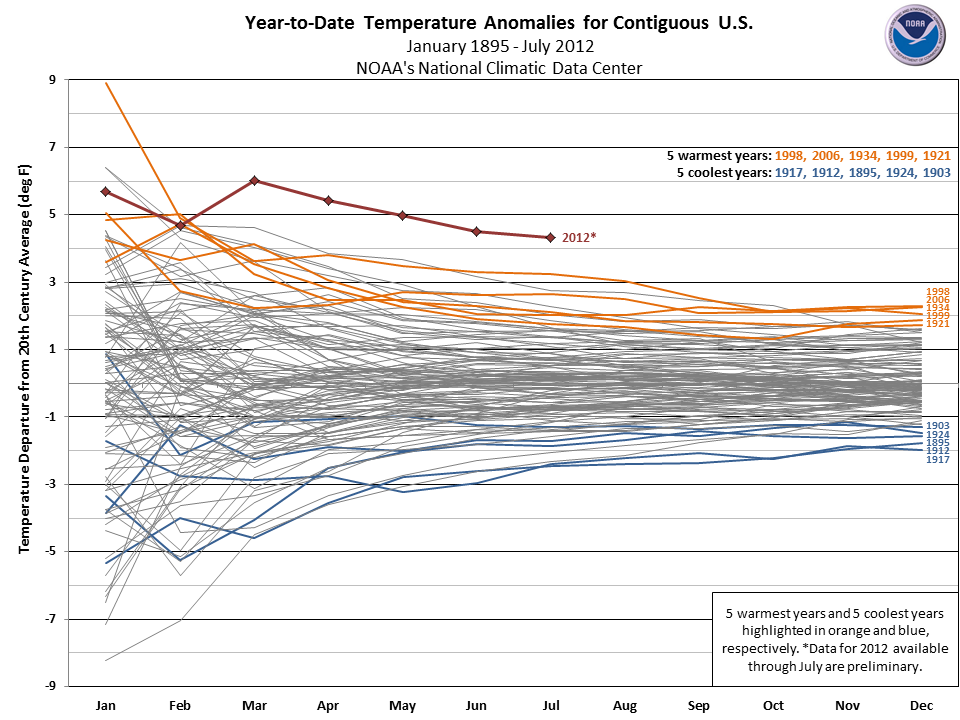
Year-to-Date Temperature Evolution

“This time series shows the 2012 year-to-date temperature through July, which was the warmest first seven months of any year on record for the lower 48. The year-to-date evolution of the contiguous U.S. temperatures for each year back to 1895 are also shown, with the five warmest and five coolest years highlighted. The January-July 2012 contiguous U.S. average temperature was 56.4°F, 4.3°F above average. The data for 2012 are preliminary.”


“This time series also shows the 2012 year-to-date temperature through July. Outcome scenarios based on persistence of temperature from August through December, the remaining five months of 2012, are shown. The January-July 2012 contiguous U.S. average temperature was 56.4°F, 4.3°F above average. The data for 2012 are preliminary.” And the following is a map of extreme global weather for July 2012(click to enlarge): At this point, even if you don’t believe humans have anything to do with these extreme weather events which have grown progressively worse, the fact is that the climate is no longer falling within historic parameters from the records that have been kept over the last 116 years. An epic climate event is underway and there are 7 billion people in its path. Our leaders and the ‘captains’ of industry act as if they are powerless to do anything about it, much less alter our dependance on fossil fuels. In fact, we’re scrambling to the thawing Arctic to exploit more carbon-rich resources to cook. Nearly all scientists acknowledge that the release of CO2 from humankind’s burning of fossil fuels since the industrial revolution is the primary factor in today’s abnormal weather events. And recently, even former Koch-funded climate scientist deniers are changing their tune on the reality of anthropogenic climate change. It’s worth repeating the mind-blowing computation that we, the industrialized world, burn more than 100,000 tons of fossil fuel every hour. Certainly this has caused the acidification of the world’s oceans. A startling report from late last year stated:

The acidification of the world’s oceans from an excess of CO2 has already begun, as evidenced recently by the widespread mortality of oyster larvae in the Pacific Northwest. Scientists say this is just a harbinger of things to come if greenhouse gas emissions continue to soar.

And you can’t find fish from our waterways that is not contaminated with mercury:

Aug. 19 (Bloomberg) — Mercury contaminated every fish studied in 291 U.S. streams and rivers tested by scientists, and one in four had levels unsafe for people who eat average amounts of fish, a government report said today.

And in July a confrontational piece in the New York Times, written by marine ecologist Roger Bradbury, states rather bluntly:

IT’S past time to tell the truth about the state of the world’s coral reefs, the nurseries of tropical coastal fish stocks. They have become zombie ecosystems, neither dead nor truly alive in any functional sense, and on a trajectory to collapse within a human generation.

And:

Overfishing, ocean acidification and pollution have two features in common. First, they are accelerating. They are growing broadly in line with global economic growth, so they can double in size every couple of decades. Second, they have extreme inertia — there is no real prospect of changing their trajectories in less than 20 to 50 years. In short, these forces are unstoppable and irreversible.

And:

Coral reefs will be the first, but certainly not the last, major ecosystem to succumb to the Anthropocene — the new geological epoch now emerging.

As blogger it’ll-all-end-in-tears puts it, “The naming of the epoc feels like an appropriately hubristic climax to our age. The consequences of our prolonged war on the ecosystems that support (not serve…) us might well be coming around to extract their own price.”

Funny thing about the environment that we abuse and take for granted on a daily basis…Everything seems OK, until it suddenly isn’t.

I don’t know about you, but I like things to be somewhat predictable and dependable. It appears, however, that we have transgressed Mother Nature one too many times. Consider that at a one degree celsius increase, marked changes to the climate include the USA midwest becoming a desert with the remaining topsoil blowing away. The thinning polar ice caps and melting permafrost will release methane which is twenty times more potent than CO2:

Two new research papers published today improve our understanding of the planet’s methane emissions, and might raise worries about the role of the gas in warming the planet. The first suggests that there may be extensive methane deposits under the Antarctic ice sheets. Meanwhile, the second concludes that emissions of the gas from Arctic permafrost have been underestimated.

Island nations will flood. Forest fires will be more frequent. The frequency and intensity of storms will increase. Between a 1 and 2 degree increase, the albedo effect is diminished at the poles where sunlight reflects back into the atmosphere. Trees stressed from drought will also add more CO2 than O2. The world’s rivers will shrink. Countries will become destabilised and unleash waves of ecological and political refugees in search of H20, food, and fuel. Between a 2 and 3 degrees increase, life becomes unbearable as soils emit more CO2, forests such as the Amazon burn away and release vast amounts of stored carbon, and the basic essentials of life (water, food, and fuel) become scarce. Nations wither and disappear.

And yet there will still be people who think it’s all a conspiracy.


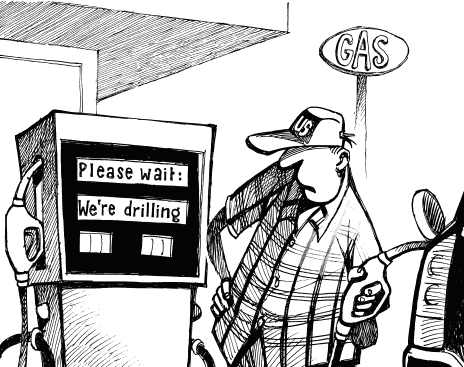
Cartoon illustration by Horsey.

Throwing in the Towel

Tags

, , , , , , , ,

OK people,

Guy McPherson has thrown in the towel

…we’ve triggered five positive-feedback events, any one of which leads to near-term human extinction. Each of the five has been reported in the refereed journal literature, as a quick search will reveal: reduction of Arctic sea ice, rapid decomposition of boreal peat, release of Siberian methane, release of ocean methane hydrates, and the drought in the Amazon basin.

I suggested we look into the SurvivaBall:

“We’ve done all we could to show these people what sucked about letting greed run our future, but instead of freaking out, they just took our business cards.”

Free Market Blinders and the Coercion of Industrial-Corporate Capitalism

Tags

, , , , , , , , , , , , ,

I think many of us intuitively understand that free market ideologues have a narrow path to walk in order to keep afloat their construct of a world that is best run by the omnipotent and omniscient capitalist market system. Perhaps the idea that our globalized capitalist economy knows best is as damaging to society as the teachings of a fanatical cult urging all its members to drink from the poisoned chalice. Certainly the needs of the global capitalist economic system, currently propped up by money printing, supersedes all other considerations, including compassion for our fellow man and the well-being of the environment which is the forgotten lynchpin of the economy, not to mention the crucial factor in determining whether or not humankind continues to survive on this planet.

In the realm of the worker and the capitalist elite(the ones who own the means of production), the exploitation of humans on such a large-scale amounts to a society of wage-slave toiling zombies:

The distinguishing feature of a capitalist society is the commodification of human labour—and it is this that differentiated early modern England from any other nation. England was not the first country to develop long-distance trade or to plunder other parts of the world; throughout the fifteenth, sixteenth and seventeenth centuries, countries like Portugal, Spain and Holland exceeded England in these regards. What set English society of the time apart from its European rivals, however, was that it alone established an extensive labour market, the key to capitalist development. […]

On the labour market, every economic transaction touches directly on essential qualities of human life—material, social and moral. In exchange for wages, those who sell their labour power surrender to the capitalist ultimate control over the work to be done, its conditions, pace and organization. Rather than treating our creative energies as a unique source of personal identity, “the owners of the conditions of production treat living labour-power as a thing” (Marx, Capital, v. 1, trans. Fowkes, 1976, p. 989). The result is a profound personal alienation, a hollowing out of the meaning of life. This is why the poor, as we shall see, have historically resisted being driven into the labour markets as their only means of survival.

Reflecting on this relationship, Karl Marx described work under capitalism as alienated labour: Relinquishing control over her labour, the worker suffers an estrangement from an essential part of her humanity. As Marx (Wage Labour and Capital, Progress Publishers, 1952, p. 20) put it in one succinct passage:

“But the exercise of labour power, labour, is the worker’s own life-activity, the manifestation of his own life. And this life-activity he sells to another person in order to secure the necessary means of subsistence. Thus, his life-activity is for him only a means to enable him to exist. He works in order to live. He does not even reckon labour as part of his life, it is rather a sacrifice of his life. […]”

For the worker, in other words, work is a means to life, but not life itself. Real life begins after work, during “free time”. The familiar expression, “Thank God It’s Friday”, is a depressing acknowledgement that work for the majority is oppressive, alienating, boring and dehumanizing. Of course, things look very different from the vantage point of the capitalist.

Since the worker alienates control of her labour to the employer, the capitalist is in a position to exploit that labour—to force the labourer to perform an amount of work that exceeds the value of the wages paid. Indeed, this is the whole point of the transaction for the capitalist: to make a profit on the purchase of labour by getting workers to produce more value than what they are paid. And this difference between labour’s output and the wages paid—called surplus value—is the secret to the massive inequalities of capitalism: enormous amounts of the wealth produced by workers accumulate in the hands of the owning class.

And our economic system labels everyone the cold and dehumanizing term of “consumers”. Your behavior is methodically studied and cataloged so that the system can exploit your consumerist tendencies:

When you accept the label of ‘consumer’, you accept that you have become a financial object, willing to be manipulated by whatever marketing tricks abound. Consumer choice would be far better entitled ‘Conchoice’, a term describing the true level of choice that individuals are provided with, should they find themselves within the consumer culture.

Here is an email from Darbikrash, entitled ‘Buy or Die’, which illustrates the mind-numbing, invasive nature of corporations and the consumer culture:

…As there are too many goods chasing too few consumers (with any money left) the end game is to invent markets, to cajole and hoodwink people into believing they need something that they really don’t, and then to create products to port into this fabrication, rotating through product ideas at high speed to “see what sticks”.

What is really laughable is the degree of planning, co-ordination and control that exists in a typical retail outlet, say for example, Bed, Bath and Beyond. Every square inch of that jumbled, packed to the rafters collection of junk and useless assorted trinkets is planned. The product lineout is planned seasonally, and rotated to reflect the calendar quadrant. Each product, each one, is placed at the precise height, shelf location, and aisle location to optimize traffic and elicit the best response to a shoppers’ buy signals. The orientation of the aisles, the sequence to which high demand products are placed to maximize traffic to get to that product is profound. They know with statistical certainty which direction you will turn your shopping cart when you enter the store and when you reach the end of a given aisle.

They run full scale mock-ups or “focus groups” to optimize traffic patterns to increase the sales volume of the highest margin items. Shelf placement is determined by the highest margin. Products with lower margins are back charged to the manufacturers with “slotting fees”, bribes in effect to obtain higher shelf placement in a more lucrative aisle.

The store locations and real estate acquisition decisions are made with greater precision than a military invasion of a foreign country, and in many ways it is just that. They know to 6 significant digits the average household income within a 40 mile radius of each store location. They know how many times you leave the house to buy a product, and how far you are willing to drive to get it. They know if you’re male or female, married or single, and they know the preference curves of your demographic. They know how close to the entrance you will want to park before you drive off in disgust, and they know what type of music to play over the loudspeaker to increase your propensity to buy. They know how many visits you’ll make (on average) per calendar quarter, and the average amount of money you’ll spend at each visit, to incredible accuracy.

But just try and pass a law that restricts a multi-national from acting as a sovereign state. Just try to pass something that will put consumer protections in place. Imagine the uproar if there was an initiative to place healthy food in the front of a store and unhealthy food in the back, for example. There would be riots in the streets, with calls of Communist and Police state tactics shouted from every corner.

Who runs this country?

A Few Apocalyptic Headlines and a Moment of Clarity With a Glass of Wine

Tags

, , , , , , , , , , , , , , ,

Apocalyptic headlines seem to be daily occurrences now. Here’s just a few headlines that grabbed my attention over the last week(click on them to go to the original article):

Form the article:

Why do we care?,’’ Abdalati, an ice scientist, asked. ‘‘This ice has been an important factor in determining the climate and weather conditions under which modern civilization has evolved.’’

Scientists sometimes call the Arctic the world’s refrigerator and this is like leaving the fridge door open, Scambos said.

‘‘This is kind of a knob on global weather,’’ Wagner said. ‘‘We don’t know the impact yet of fiddling with it.

When people in my house leave the fridge door open, I get pissed and close it. The electric bill goes up due to an overworked fridge trying to cool the food. The Earth, unfortunately, has no ability to shut the door that the human species has permanently torn off its hinges, irreparably destroying the thermostat. On the other hand, the Earth doesn’t really care that we have doomed ourselves to extinction.

Back in 2009, a Lieutenant Vasquez of the U.S. Navy made the following comments which sum up how industrial civilization is perpetuating its own demise:

“It makes me uneasy anyway to think that we’re going to let a trend caused by global warming – the melting of the ice – allow us to explore and exploit more fossil fuels, which led to the warming in the first place.

“That seems wrong-headed to me, but nevertheless it’s likely to happen and there’s already a debate about exactly who’s got the rights to the minerals and the oil that’s there under the Arctic continental shelf, and how to go about exploiting it.

“It’s unfortunate, from a broader view, understanding the science of what the future holds, but I think it’s inevitable because oil and gas are going to be extremely valuable in the coming century as supplies dwindle.”

~~~~~~

From the article:

Tree-ring chronologies from long-term climate records show the western U.S. drought is already the most severe of the past 800 years. It will exceed the 1930s-era Dust Bowl with more consecutive dry years.

Less rainfall is expected in the U.S. West in each of the next 80 years than the annual average level during the drought of 2000 through 2004, the op-ed continues. Schwalm (an earth scientist), Williams (a geographer) and Schaefer (a National Snow and Ice Data Center scientist) analyzed that extreme drought in a new study in the journal Nature Geoscience.

Climatologists say we will experience reduced agricultural productivity, scarcer water resources and carbon sequestration (plants turning carbon into oxygen). The climatologists previously reported in a scientific journal that drought already has halved the amount of carbon dioxide they normally photosynthesize.

OK, that’s enough to scare any of us who studied biology out of our wits. But there’s more.

Major river basins show flow reductions of 5 to 50 percent. Western crop yields are down by 13 percent, with many local cases of crop failure….

Right now we are living in the glory days known as the “wet years”. Our descendants, if there are any, will look back in anger at their forefather’s myopic and self-destructive worship of economic growth and profit at the altar of an economic system they proclaimed to be the greatest the world has ever seen – capitalism. As has been said by a few wise people, “We can either save ourselves, or we can save capitalism.”

The above article is in reference to a detailed scientific report covered in the NT Times.

~~~~~~

From the article:

…Climate change is projected to increase the frequency, intensity, and duration of droughts, with impacts on many sectors, in particular food, water, health and energy,” WMO secretary general Michel Jarraud said. “We need to move away from a piecemeal, crisis-driven approach and develop integrated risk-based national drought policies.”

Mannava V K Sivakumar, director of WMO’s climate prediction and adaptation branch, says only Australia has a national policy toward drought and the advantage of a policy – rather than a disaster management, which some countries have – is that national action is required no matter who is in political power.

Australia’s government says its 2004 policy is no longer sufficient to deal with climate change, however, and over the past two years it has tried a pilot programme in western parts of the country aimed at shifting from a crisis-oriented approach to risk management.

Sivakumar said the agency is also encouraging more continuing support especially for “the poorest of the poor”, small farmers whose daily wages determine whether they and their families will eat on any given day.

If you’ve been paying attention, our system of transnational capitalism and globalization has ushered in a global land grab which I blogged about here. From where I’m sitting, there appears to be no concern for what’s really sustainable or socially just, but what the monied interests can steal from the weakest and most impoverished living on our planet.

~~~~~~

The spread of exotic diseases is a well-known effect of climate change, which is playing out before our very eyes in real-time today.

~~~~~~

From the article:

Leading water scientists have issued one of the sternest warnings yet about global food supplies, saying that the world’s population may have to switch almost completely to a vegetarian diet over the next 40 years to avoid catastrophic shortages.

Humans derive about 20% of their protein from animal-based products now, but this may need to drop to just 5% to feed the extra 2 billion people expected to be alive by 2050, according to research by some of the world’s leading water scientists.

“There will not be enough water available on current croplands to produce food for the expected 9 billion population in 2050 if we follow current trends and changes towards diets common in western nations,” the report by Malik Falkenmark and colleagues at the Stockholm International Water Institute (SIWI) said….

…”Nine hundred million people already go hungry and 2 billion people are malnourished in spite of the fact that per capita food production continues to increase,” they said. “With 70% of all available water being in agriculture, growing more food to feed an additional 2 billion people by 2050 will place greater pressure on available water and land.

As George Dvorsky points out: “…it’s not enough for the researchers to suggest that switching to a non-meat based diet is the solution. Agriculture in general takes a tremendous toll on the environment and is a major contributor to the ongoing depletion of water reserves. It’s estimated, for example, that in the US, withdrawn surface water and groundwater use for crop irrigation exceeds that for livestock by about a ratio of 60:1. The issue, therefore, would seem to be one about the production of potable water and the development of more sustainable agricultural techniques…”
But I really don’t think we’ll be able to pack in a few more billion people on this planet at our current rate of destruction. Cannibalism might be how some get their allowance of meat in the future.

~~~~~~

from the article:

Life in the world’s oceans faces far greater change and risk of large-scale extinctions than at any previous time in human history, a team of the world’s leading marine scientists has warned.

The researchers from Australia, the US, Canada, Germany, Panama, Norway and the UK have compared events which drove massive extinctions of sea life in the past with what is observed to be taking place in the seas and oceans globally today.

Three of the five largest extinctions of the past 500 million years were associated with global warming and acidification of the oceans – trends which also apply today, the scientists say in a new article in the journal Trends in Ecology and Evolution.

Other extinctions were driven by loss of oxygen from seawaters, pollution, habitat loss and pressure from human hunting and fishing – or a combination of these factors….

…“It is very useful to look back in time – because if you forget your history, you’re liable to repeat it.”…

…“We need to understand that the oceans aren’t just a big dumping ground for human waste, contaminants and CO2 – a place we can afford to ignore or overexploit. They are closely linked to our own survival, wellbeing and prosperity as well as that of life on Earth in general.

“Even though we cannot easily see what is going on underwater, we need to recognise that the influence of 7 billion humans is now so great it governs the fate of life in the oceans. And we need to start taking responsibility for that.”…

…we need to stop releasing the CO2 that drives these massive extinction events, curb the polluted and nutrient-rich runoff from the land that is causing ocean ‘dead zones’, manage our fisheries more sustainably, and protect their habitat better….

I recall a quote from Philippe Cousteau Jr., the grandson of world-renowned environmentalist Jacques Cousteau:

“I could cut my leg off, I could cut my arm off, I could gouge my eye out, I’d still probably survive, but not very well, and that’s what we’re doing to the ocean.

“It’s the life support system of this planet. We’ve been dumping in it, we’ve been polluting it, we’ve been destroying it for decades, and we’re essentially maiming ourselves… It’s not a question of whether the oceans can take anymore. The ocean can’t take any more. They couldn’t take any more fifty years ago. 

”The question is, ‘when are we going to stop?”

Yes, that is the question of the ages. And the answer is that we won’t stop until our economic system collapses.


~~~~~~

 
…And the above article near my own stomping grounds. You know things are going haywire when flood insurance is needed for a suburban neighborhood located in the desert.


King Romney’s Double Down Plan On What’s Left of Our Poor EROEI Pockets of Fossil Fuel

Tags

, , , , , , , , ,

This post is a sort of addendum to the last post about King Romney’s Energy Plan. Here’s the excerpt of what I said from that post which needs more elaboration:

…Overlooking the catastrophic externality of climate change, notice that Romney is heralding America’s energy independence through his plan of ‘Drill, Baby, Drill’ of fossil fuels. If you look at the following graph, you’ll see that there is no amount of drilling we could do within America to achieve fossil fuel energy independence:

As you can see, America hit peak oil around 1970 at 9.637 mbpd (million barrels per day), as predicted by Hubbert, and then in 1993 America’s domestic oil production was surpassed by consumption, a point from which we have never recovered. Even with the recent drastic drop in consumption due to an anemic economy, we are still importing around 10 to 11 MBPD while domestic production is somewhere between 7 to 8 MBPD. Domestic production would have to double from the current rate or total consumption, which sits currently at roughly 18 to 19 MBPD, would have to be halved while allowing for the requisite economic growth that we worship. That’s not going to happen. As Loren Steffy explains, “U.S. oil production gains are like water pumps on the Titanic“…

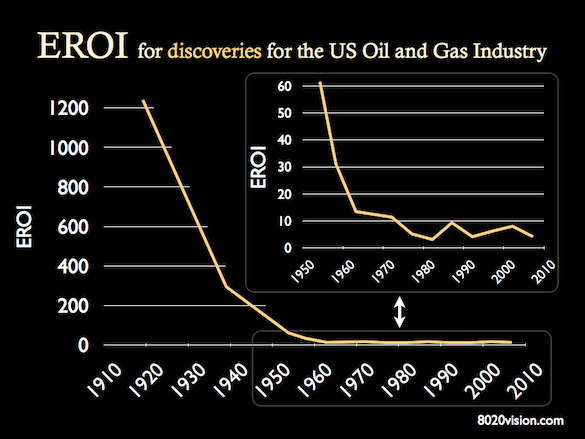
Of course EROEI should have also been mentioned in that discussion of King Romney’s frantic grab for what’s left of our bequeathment of the Earth’s ancient, high energy density, carbon-based fuel. A detailed report, entitled A New Long Term Assessment of Energy Return on Investment (EROI) for U.S. Oil and Gas Discovery and Production, was published last year which sheds some light on this subject of what we are getting back from the investment spent extracting today’s fossil fuels. Here’s an abstract from the paper:

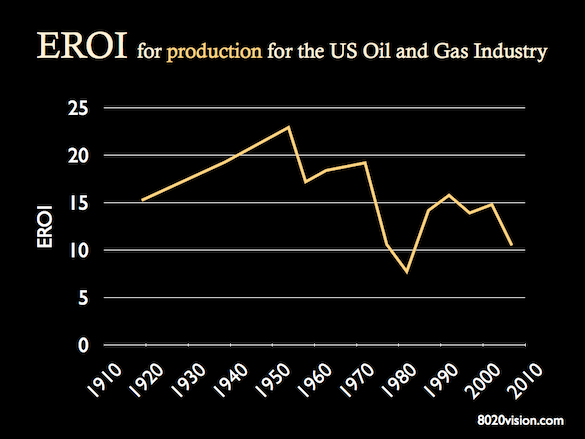
Oil and gas are the main sources of energy in the United States. Part of their appeal is the high Energy Return on Energy Investment (EROI) when procuring them. We assessed data from the United States Bureau of the Census of Mineral Industries, the Energy Information Administration (EIA), the Oil and Gas Journal for the years 1919–2007 and from oil analyst Jean Laherrere to derive EROI for both finding and producing oil and gas. We found two general patterns in the relation of energy gains compared to energy costs: a gradual secular decrease in EROI and an inverse relation to drilling effort. EROI for finding oil and gas decreased exponentially from 1200:1 in 1919 to 5:1 in 2007. The EROI for production of the oil and gas industry was about 20:1 from 1919 to 1972, declined to about 8:1 in 1982 when peak drilling occurred, recovered to about 17:1 from 1986–2002 and declined sharply to about 11:1 in the mid to late 2000s. The slowly declining secular trend has been partly masked by changing effort: the lower the intensity of drilling, the higher the EROI compared to the secular trend. Fuel consumption within the oil and gas industry grew continuously from 1919 through the early 1980s, declined in the mid-1990s, and has increased recently, not surprisingly linked to the increased cost of finding and extracting oil.

Now some graphs from the research:

eroi eroei discovery for US oil and gas

(source: Guilford, Hall, Connor, Cleveland “A New Long Term Assessment of Energy Return on Investment (EROI) for U.S. Oil and Gas Discovery and Production.” Sustainability 2011, 3, 1866-1887)

As you can see from the above chart, we’ve been bouncing along a tight EROEI corridor of between 3 and 10 compared to the glory days of the first half of the twentieth century when the low hanging fruit didn’t require taking great risks and enormous expense, ultimately resulting in such catastrophes as the Gulf Oil Spill. With Romney at the helm, do you think that risk will be diminished?

Additional charts from 8020 vision:

eroi eroei production for US oil and gas

(source: Guilford, Hall, Connor, Cleveland “A New Long Term Assessment of Energy Return on Investment (EROI) for U.S. Oil and Gas Discovery and Production.” Sustainability 2011, 3, 1866-1887)

The EROI for Production is trending lower too. Variations in any given year are largely dependent on how much drilling it takes to produce the oil.  Typically about 2 barrels of oil equivalent are consumed per foot of well drilled. In years where there was a lot of drilling, the EROI would be lower.

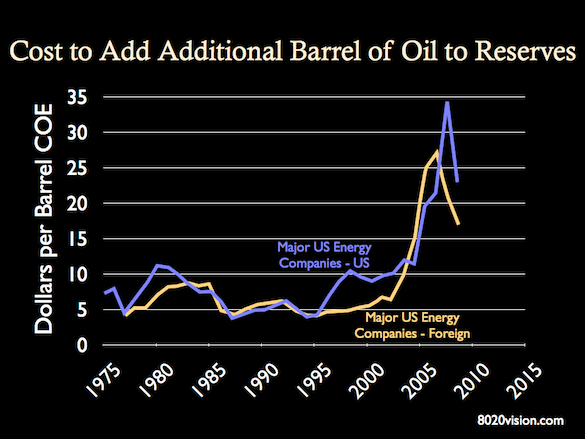
A more intuitive way to look at this trend is as dollars per barrel of oil. The chart below is from the Energy Information Administration (EIA) Annual Energy Review for 2011. It shows the cost to add each additional barrel of oil to US reserves.

expenditures per barrel of reserve additions, 1975 to 2008, cost per barrel of oil, chart

COE (crude oil equivalent) measures the cost of adding 5.8 million BTUs regardless of whether the resource is oil, natural gas, or natural gas liquids. (source: EIA, 2011 Annual Energy Review)

And analysis on Chris Nelder’s excellent blog further explains the cost of new oil today…

…Globally, Skrebowki estimates that it costs $80 – $110 to bring a new barrel of production capacity online. Research from IEA and others shows that the more marginal liquids like Arctic oil, gas-to-liquids, coal-to-liquids, and biofuels are toward the top end of that range.

My own research suggests that $85 is really the comfortable global minimum. That’s the price now needed to break even in the Canadian tar sands, and it also seems to be roughly the level at which banks and major exploration companies are willing to commit the billions of dollars it takes to develop new projects….

Globally, the cost of drilling a new oil well has gone parabolic:

Source: EIA

The cost of adding a new barrel of reserves — drilling to prove that the oil is there and economically recoverable, before actually producing it — has also jumped sharply:

Source: EIA

(It’s unfortunate that EIA doesn’t have more recent data than 2008 for this analysis, because the sharp downturn at the end of this chart owed mostly to the economic crash in the latter half of that year. Analogous recent data from the oil patch suggests that the curves in the above chart should have resumed their previous, pre-crash trajectory by now.)

As production costs push ever closer to the retail price ceiling, profit margins fall. Consider Canada as an example. Oil production there will likely turn a mere 5 to 8 percent annual return on equity for the next several years, according to analysis by ARC Financial. Under $60 a barrel, they note, “the industry is broadly unprofitable” and would not be able to attract reinvestment. Similarly, University of Alberta energy economist Andrew Leach noted this week that the average operating profit margin of Canadian-owned oil and gas assets is now 7.7 percent, while foreign-owned assets offer only a 5.5 percent margin. A far cry from the heady, ultra-profitable years of 2003 – 2005.

So while the press, ever-anxious to assign blame for high oil prices, highlights the enormous profits that oil companies are making, the fact is that much of those profits owe to producing oil from wells drilled in a much cheaper era and selling it in the new high-priced era.

This will not remain the case for many more years.

The 2014 – 2015 tipping point

Unconventional oil is currently just 3 percent of global supply. The IEA projects that it will make up 6.5 percent of supply by 2020, and 10 percent by 2035. As it gradually replaces cheap oil conventional oil, its real production costs will continue to push oil prices up. Eventually, those costs will cross with the pain tolerance limit of consumers.

Skrebowski sees rising costs outrunning the ability of economies to adapt to higher oil prices by 2014, producing an “economically determined peak” in oil production. After that point, prices will remain economically destructive, and render sustained economic growth impossible. At the same time, it will make new oil production harder to finance.

This matches well with numerous analyses of oil supply that project a major tipping point around 2014 – 2015. At that point, as I have reminded readers repeatedly, we will likely begin down the back of Hubbert’s Curve and see net losses in global oil supply every year.

“Unless and until adaptive responses are large and fast enough to constrain the upward trend of oil prices, the primary adaptive response will be periodic economic crashes of a magnitude that depresses oil consumption and oil prices,” Skrebowski concludes. “These have the effect of shifting consumption from incumbent consumers — the advanced economies — to the new consumers in the developing economies.”

As I detailed last month (”Oil demand shift: Asia takes over“) that is precisely what has been happening since 2005. The world’s emerging markets are buying their first cars and their first trucking fleets, and those vehicles have much better fuel economy than ours. They will be able to pay a price for oil that we cannot tolerate. From 2015 on into the future, fuel will become increasingly unaffordable for U.S. drivers…

The demise of America’s car culture is unavoidable and won’t be saved by the flag-waving, slogan-cheering rhetoric of any politician.

King Romney’s Dream for America: Slave Labor in Barb-Wired Factories & a Double Down on Fossil Fuels

Tags

, , , , , , , , , , , , , , , , ,


On the Labor front….

I came across the above video yesterday evening. It’s a recording of Mitt Romney recounting his days at Bain Capital when he was off-shoring U.S. manufacturing to slave labor camps in China. From the video I’m assuming that America’s gift to the world, as Romney refers to it, is neoliberal capitalism and the privilege that economic system brings to the masses who can enjoy working for pennies per hour in a sweatshop factory complete with dormitories holding “12 girls per room”, all of which is enclosed by barb-wired fencing. And as Romney relates, the fences are to keep the hoards of people out who are dying to fill a position in the factory as soon as someone falls over. For Romney and the typical vulture capitalist, this is a wet dream: endless numbers of cheap laborers ready to fill assembly-line positions which are unencumbered by unions, safety regulations, and basic rights for workers. In such factories humans are reduced to cattle in order to extract the maximum profit. A Foxconn executive expressed the general sentiment of corporate capitalists when he referred to his workers as “animals” earlier this year. Despite recent reports by the Fair Labor Association (FLA) on the heels of an eye-opening report on labor conditions, the reality on the ground, as Romney can attest to from his days at Bain, is the same as it ever was:

As reported here, China Labour Watch is claiming that bribery is undermining the audit system. China Labour Watch founder Li Qiang has not minced his words: “Although the working hours at Foxconn have been reduced to less than 60 hours per week, the intensity of the hourly work has been increased. According to our follow-up investigation, the workers have to complete the workload of 66 hours before within 60 hours now per week. As a result, the workers get lower wages but have to work much harder and they are not satisfied with the current situation. The harsh working conditions are by no means isolated to just Foxconn but exist throughout Apple’s supply chain. However, that report only focused on Foxconn factories. It is Apple’s entire supply chain system that should be responsible for the squeezing of workers.”

On the Energy Front:

King Romney is going to double down on fossil fuels in America, further dismantling regulations and awarding more tax breaks for Big Oil:

Romney unveiled his energy plan, which makes no mention of climate change and focuses on reaching energy independence by 2020 through increased extraction and use of oil, gas and coal, accompanied by reduced regulation for these industries.

The plan underlines the fact that the Republican Party and the oil, gas and coal industries, long in agreement on policy and ideology, have grown closer than ever before. Romney, whose top energy adviser is the wealthiest oilman in the country, is on pace to raise more money from these industries than either George W. Bush or Sen. John McCain (R-Ariz.) did when he ran for president. The industries are also pumping millions into the new unlimited money vehicles, super PACs and dark money nonprofits, that are spending tens of millions of dollars per month to influence the election…

…A central part of the plan is taking the power to permit and license new onshore drilling on federal lands out of the hands of the federal government and putting it into the hands of the states. That means that states like Alaska or North Dakota, which is enjoying a massive oil boom under the current regulatory regime, would be able to allow drilling on federal lands with no oversight from Washington.

North Dakota stands out, in particular, as it is where Romney’s top energy adviser, oil billionaire Harold Hamm, is making his fortune. Hamm, whose stump speech is only three words, “Beat Barack Obama,” has given $985,000 to Restore Our Future and raised money for the Romney campaign. He would profit greatly from this change in policy as his company, Continental Resources, would be freed to drill beyond the Bakken fields in North Dakota using techniques including hydraulic fracking and horizontal drilling….

…Among many other policies supporting the industry, Romney calls for a repeal of regulations limiting the amount of mercury, a hazardous pollutant, that can be emitted from coal and oil power plants…

Overlooking the catastrophic externality of climate change, notice that Romney is heralding America’s energy independence through his plan of ‘Drill, Baby, Drill’ of fossil fuels. If you look at the following graph, you’ll see that there is no amount of drilling we could do within America to achieve fossil fuel energy independence:

As you can see, America hit peak oil around 1970 at 9.637 mbpd (million barrels per day), as predicted by Hubbert, and then in 1993 America’s domestic oil production was surpassed by consumption, a point from which we have never recovered. Even with the recent drastic drop in consumption due to an anemic economy, we are still importing around 10 to 11 MBPD while domestic production is somewhere between 7 to 8 MBPD. Domestic production would have to double from the current rate or total consumption, which sits currently at roughly 18 to 19 MBPD, would have to be halved while allowing for the requisite economic growth that we worship. That’s not going to happen. As Loren Steffy explains, “U.S. oil production gains are like water pumps on the Titanic“:

…The much-ballyhooed increase in U.S. production simply isn’t enough to have a meaningful effect on global oil prices, which doubled from 2005 to 2011. That ultimately is the biggest factor in setting prices for retail gasoline.

U.S. production gains look impressive, but much of it offsets declines earlier in the decade because of major hurricanes that disrupted offshore and Gulf Coast facilities. Domestic production was 7.5 million barrels a day in 2010, according to the Energy Information Administration, and that number probably increased to about 7.7 million barrels last year, estimates Jeffrey Brown, an independent petroleum geologist in Fort Worth who writes frequently on oil issues.

In 2004, before the spate of hurricanes, production was 7.2 million barrels. That means domestic production hasn’t increased more than about 500,000 barrels a day despite the fracking binge and other efforts to encourage drilling. During the same period, net exports for all countries in North America — including Canada, Mexico and Venezuela, some of our biggest suppliers — fell by 1.4 million barrels, or 23 percent, according to Brown’s analysis.

Brown compares the situation to water flowing into the Titanic after it hit the iceberg.

“Let’s assume that water is pouring into the ship 10 times faster than than water is being pumped out,” he said. “The water being pumped out is analogous to the slow increase in U.S. crude oil production. The water flowing in is analogous to declining annual net exports. Guess which metric most people seem to be focused on?”

That doesn’t even account for China, India and other rapidly developing countries, whose oil imports are rising sharply, increasing the competition for oil with countries like the U.S.

“So, while slowly increasing U.S. crude oil production is very important, the dominant trend we are seeing is that developed oil importing countries like the U.S. are being gradually priced out of the global market for exported oil,” Brown said…

King Romney, nevertheless, will use the rallying call of his energy plan to increase domestic oil production, with its attached gifts of even more environmentally destructive deregulation and kleptocratic giveaways to Big Oil from the taxpayer, as a reason for voters to put him into the White House. But as pointed out at Fair.org, this is all a smokescreen manipulating public perception:

In a New York Times story (8/24/12) about Mitt Romney’s energy proposals, reporters Eric Lipton and Clifford Krauss make this observation:

With gasoline prices again approaching $4 a gallon, Mr. Romney, the presumptive Republican nominee, is also trying to merge energy and economic policy in a way that will make voters see increased energy production as a pocketbook issue.

Note that Lipton and Krauss don’t say that increased U.S. energy production will actually affect the $4-a-gallon price of gas and hence the voters’ pocketbooks; that would be inaccurate, since oil is a global commodity and it’s impossible for the U.S. to increase its production enough to change it substantially. In fact, with the formulation “in a way that will make voters see,” the Times  reporters suggest that they are well aware that increased oil drilling will not actually alter gas prices–that this is a matter of changing public perceptions, not economic realities.

But then, Lipton and Krass don’t do anything in their piece to let the reader know that the implied connection between increased drilling and lower gas prices is fraudulent…

The doublespeak used by politicians of all stripes to bend reality is the same as it ever was.

Zen and the Art of Motorcycle Maintenance

When I agreed with Mike that I’d run with the baton for a lap or two on his website, I began to think of a way to conjure up a good reason why so many world ills could be written of to an audience in mute silence, even if provoked.

And so, here is my take on why too few understand, and why too many would stop reading this article at this point to find their entertainment elsewhere:

In his 1869 book The Man Who Laughs, Victor Hugo wrote:

In China, from time immemorial, they have possessed a certain refinement of industry and art. It is the art of molding a living man. They take a child, two or three years old, put him in a porcelain vase, more or less grotesque, which is made without top or bottom, to allow egress for the head and feet. During the day the vase is set upright, and at night is laid down to allow the child to sleep. Thus the child thickens without growing taller, filling up with his compressed flesh and distorted bones the reliefs in the vase. This development in a bottle continues many years.

After a certain time it becomes irreparable. When they consider that this is accomplished, and the monster made, they break the vase. The child comes out — and, behold, there is a man in the shape of a mug!

Give me the child under the age of seven, and I care not what you do with him after, has rung true with me for some time. I’ve written previous articles elsewhere to such effect. But after finding my own conclusions with the support of the author and school teacher John Taylor Gatto, whose article The Six Lesson Schoolteacher led me to his book Weapons of Mass Instruction, it appeared that even though it is a revelation, again, only a handful paid attention.

I had put the books down and was hoping to leave them be a while longer, becoming a people watcher and bystander, viewing the world and defining an answer, and I’d near given out.
Then, in June, BBC Radio 4 aired a radio play of Robert M. Pirsigs Zen and the Art of Motorcycle Maintenance, dramatized by Peter Flannery. I sat in my car in the UK for the full hour of the play, completely rapt with the broadcast, and afterward – aware that there is a limited time the BBC chooses to allow hearing it again on-line, I transcribed a salient part of it, hoping some day soon I’d find a place to post it:

Phaedrus arrived at the university of Chicago already in a world of thoughts so different from mine or yours I doubt we could understand it. He decided to write a doctorate or thesis on the meaning of Quality; but in which discipline? It would take quite a program to accept a PHD in which the candidate refused to define a central term. And then he found the Chicago Inter-disciplinary Program in analysis of ideas and study of methods.

Phaedrus – Professor?

Professor – Yes?

Phaedrus – I was told you wanted to see me about my application for a scholarship?

Professor – Aah, you are the gentleman who’s going to tell us all about quality.

Phaedrus – Well, I’d like to try.

Professor – Yes. I’m sure you would. There’s something I’m not clear about. What is your substantive field?

Phaedrus – English composition.

Professor – English composition is a methodological field, not a substantive one – (laughs) – I’m afraid I cannot recommend a scholarship. In fact, I cannot for the dear life of me understand how the university has admitted a candidate who is ignorant of the difference between method and substance. If you’ll excuse me.

Phaedrus – I do-not accept the division of method and substance. I think this is maybe where you’ve all been going wrong.

Professor – I beg your pardon?

Phaedrus – It is just an outgrowth of Aristotle’s ideas about form and substance. What I intend to show is that the concept of quality drops away with this dichotomy.

Professor – Oh! I See! You’ve managed to prove Aristotle wrong?

Phaedrus – I’m working on it. And where better to present this thesis than a great university like this?

Professor – Perhaps because it contradicts everything ‘we’ believe in?

Phaedrus – A university that can’t accept a thesis that contradicts its fundamental beliefs is in a rut, don’t you think?

Professor – A rut?

Phaedrus – Look at it this way; you want some other university to come up with an historic break-through between eastern and western philosophy? You want to be behind the game here? Besides, this is Chicago. This is where guys get rubbed out. It’s time Aristotle got his.

Megalomania. Delusions of grandeur. Though they couldn’t stop him from writing his thesis, Phaedrus was already done for. He had declared war on the ancient Greeks because they had invented reason. The analytical tool with which to understand and classify life and set it up over quality; the instinctive response to life that creates beauty and goodness and allows you to experience them.

In circus trapeze terms, everybody in life is either a catcher or a fly-er. In Greek philosophy terms, everybody is either a Platonist or an Aristotelian. Plato is the fly-er – the essential Buddhist seeker – soaring ever upward toward the ‘One’, and Aristotle is the catcher – the eternal motorcycle mechanic, endlessly sorting the things of life into piles and putting labels on them. It was ironic that Phaedrus – the teacher of rhetorical Greek soon revealed Plato’s hatred of all rhetoricians – especially those known as Sophists.

The Sophists were teachers of wisdom. But they didn’t teach fixed principles – truth for instance – they taught about the improvement of man – the good. A ready excellence. The duty of man to himself to be the best he could be. So a thousand years before Aristotle’s mind and matter, there had been a thing called ‘Excellence’, which sounded awfully like ‘Quality’.

He read it again. A ready excellence – duty of man towards himself – and saw this was an exact translation of the Sanskrit word ‘Dharma’ – sometimes described as ‘The One’. He stood for a moment – totally still – then lightening hit all around him. Quality and Excellence – Dharma – that’s what the Sophists had been teaching before the church of reason – before substance, before form – before mind and matter – a thousand years before dialectic itself. ‘Quality’ had been absolute.

Rain hits us like pellets. The twentieth century – that’s all around us now. The mediocre built-in towering edifice over the dust of the good. Time to finish this twentieth century Odyssey of Phaedrus the madman and have done with it.

The next time the class in Ideas on Methods met, they’d been assigned another Platonic dialogue which went by the name of Phaedrus. The young man Socrates is talking with. Our Phaedrus had read the dialogue so thoroughly, he practically knew it by heart.

He was ready.

Professor – – Well then, today we are to discuss the Phaedrus dialogue. Who would like to begin – Mr Quality, how would you characterize Phaedrus here?

Phaedrus – He prefers solitude – he is an outsider – he is aggressive.

Professor – He is indeed aggressive. Does he not threaten his master Socrates with violence at one point? I trust we’ll be having none of that? Phaedrus means what?

Phaedrus – Wolf.

Professor – Wolf.

Phaedrus – Umm hmm.

Professor – Indeed it is so. And with your long beard and your rather piercing eyes Mr Quality, there is something of the wolf in you. I will ask you to take us through the dialogue, if you’ll please, Mr Phaedrus.

Phaedrus – Plato was using his dialogue to allow Socrates to describe to us the soul – the One. What I have been referring to as Quality. The source of all things including reason – and therefore not something that can be understood or defined – or reached by reason.

Professor – Then it doesn’t exist. This is tiresome. But well done Socrates and Plato for somehow managing to agree with you three thousand years before you were born.

Phaedrus – No, I am simply pointing out that the ‘One’ in India and the ‘One’ in Greece must be the same entity, otherwise there would be Two. But though it cannot be defined, it can be described; approached, as it were. And in this dialogue Plato lets Socrates approach the idea of Quality by using the notion of two horses pulling a chariot. In the chariot is the seeker. His goal is the soul – the ‘One’ – Quality. The two horses are the white horse of reason and the black horse of passion. The dialects suggest that reason will be the truer guide to finding the ‘Oneness’ of existence, but of course all this is just an opinion …

Professor – Stop! Plato was not suggesting anything, and this is not simply Socrates opinion. Socrates has sworn to the gods that this is the truth. That reason – rational thought – is the only way to understand existence. If what he says is not the truth, then he is forfeiting his own soul.

Phaedrus – Well, ahh, no.

Professor – Socrates does not say it is the literal truth?

Phaedrus – Well, yes.

Professor – Thank you.

Phaedrus – But, two pages earlier he also tells us that it is all just an analogy; a way of describing the journey towards the ‘Oneness’ of existence. The white horse of reason is just an analogy; a figure of speech – therefore we are not being told that reason stands above everything, so why, I wonder, do you teach that when it isn’t true?

Professor – My Goodness – I thought all the Sophists were long dead.

Phaedrus – So did I, but there you sit, using the power of your words and of your authority in the church of reason to defend a palpably untrue position – that reason is everything – is a lie! But of course, it is a lie that keeps the world in the hands of guys like you.

Professor – Guys like me?

Phaedrus – Yeah. Intellectual bullies. Guys who can only function in a system based on weakness. What you really want from us here today isn’t ability, it’s inability. A truly able student is a threat to you. The perfect student in this institution is the one who is willing to accept the bowing and scraping and the intellectual prostration you need from us to maintain your power. Sheep is what you want. But mark what I’m saying here: sometimes the shepherd goes above the timber-line, and he calls and he calls for his sheep to come but he doesn’t find himself looking in the eyes of his sheep – he finds the eyes of a wolf – staring right back at him. So by all means, call me Phaedrus, if you’d like to.

Phaedrus looks at the professor struggling to make brave face of it but lost for words. When the bell rings to end the class, he walks out and leaves the university for ever.

Books and plays are likened to incendiary bombs. Sometimes when they are written and published they can change a world from a status where the sun goes around it as a flat earth held up on pillars, to a globe third in line from a sun that it orbits. A book can invert and disprove a lie with a truth, as much as it can conjure a proof in a lie as a truth. It is up to every reader to fight with facts over falsehood – then act – which requires inordinate energy to stand for a conviction, as those without proof defend as argument without basis of fact.

Many an ideology come and go. It is which that is fertile and which that is barren that can prove which is mankind’s sustainable path. That chosen path is the one instilled in our children of today who are the future generation, and our legacy of tomorrow.

The System Has Reached Entropy

Tags

, , , , , , , , , , , , , , ,

Click to Enlarge…

Getting It Wrong on Natural Gas

Tags

, , , , , , , , , , , , , , , ,

This guy Friedman sparked my interest from the last post on America’s corporate talking heads, so I looked to see what Tom has been writing about recently (Get It Right on Gas) and thought I’d dispel Tom’s delusional corporate-funded views about natural gas in America. But before I do that, I little history on Tom:

Thomas L. Friedman won the 2002 Pulitzer Prize for commentary, his third Pulitzer for The New York Times. He became the paper’s foreign-affairs Op-Ed columnist in 1995. Previously, he served as chief economic correspondent in the Washington bureau and before that he was the chief White House correspondent. In 2005, Mr. Friedman was elected as a member of the Pulitzer Prize Board.

In a recent essay, Glenn Greenwald, who by the way is now writing for the UK Guardian, described Friedman in the following manner:

If I had to pick just a single fact that most powerfully reflects the nature of America’s political and media class in order to explain the cause of the nation’s imperial decline, it would be that, in those classes, Tom Friedman is the country’s most influential and most decorated “foreign policy expert.”

Now on to Friedman’s misinformed article about natural gas in America, Get It Right on Gas, which gets it totally wrong on natural gas. In the article, Friedman calls America’s natural gas deposits a “potential game changer” and that it “may soon be powering cars, trucks and ships as well.” It’s the usual spiel we’ve been hearing for several years now. The reality is that the supposed natural gas boom is indeed a financial Ponzi scheme on a grand scale based on false claims of economically recoverable reserves. Remember last year the news story about internal documents from financial insiders and experts of gas drillers that surfaced? Various internal memos said the following:

An August 2009 memo from the firm IHS Drilling Data says, “The word in the world of independents is that the shale plays are just giant Ponzi schemes and the economics just do not work.” Earlier this year, an analyst at PNC Wealth Management compared natural gas projects to the dot-com boom, saying, “money is pouring in” even though drilling is “inherently unprofitable.” In another memo, a retired geologist for a major oil giant writes, “These corporate giants are having an Enron moment… They want to bend light to hide the truth.”

Off the back of that news story from last year comes the following revelation from business insider Wolf Richter, as quoted in an Automatic Earth article:

…thanks to the Feds zero-interest-rate policy and the trillions it has handed over to its cronies since late 2008, the sweeps of creative destruction have broken down. Instead, boundless sums of money have been searching for a place to go, and they’re chasing yield when there is none, and so they’re taking risks, any kind of risks, in their vain battle to come out ahead…

…But the money has dried up. And drilling for natural gas is collapsing. Last week, there were only 562 rigs drilling for dry natural gas, the lowest number since September 1999…

…At $2.53 per million Btu at the Henry Hub, the price of natural gas is up 33% from the April low of $1.90 per million Btu, a number not seen in a decade.

…even if it doubled, it would still be below the cost of production. And if it tripled, it might still be below the cost of production for most producers. That’s how mispriced the commodity has become.

The economics of fracking are horrid. All wells have decline rates where production drops over time. But instead of decades for traditional wells, decline rates in horizontal fracking are measured in weeks and months: production falls off a cliff from day one and continues for a year or so until it levels out at about 10% of initial production. To be in the black over its life under these circumstances, a well in the Barnett Shale would have to sell its production for about $8 per million Btu, pricing models have shown….

…Drilling is destroying capital at an astonishing rate, and drillers are left with a mountain of debt just when decline rates are starting to wreak their havoc. To keep the decline rates from mucking up income statements, companies had to drill more and more, with new wells making up for the declining production of old wells. Alas, the scheme hit a wall, namely reality…

It’s interesting to note that the Russian gas company, Gazprom, hired an American consulting firm just 20 miles from the White House in Fairfax, Virginia to analyze the economic viability of the natural gas “boom” in America. With the data collected by Pace Global Energy Services, Gazprom concluded the following:

“We think the current US gas market model is unsustainable in the medium and long term,” Komlev told Platts via email. “We forecast that soon, the disparity between the shale gas costs and sales price will disappear. When it happens, it will make the US plans to become a major gas exporter economically unviable.”

…Based largely on Pace’s review of quarterly earnings reports and other financial data from US gas companies, Gazprom says the true costs of shale-gas production are upwards of 150% higher than the revenues its practitioners have been reaping in the last few years. But companies are continuing to use the approach for now, Komlev says, because they are also producing some higher-priced gas liquids in the process.

Gazprom also believes that shale-gas drillers will incur additional costs to ensure that the chemicals they use in the fracking process will not contaminate underground sources of drinking water.

In a May 2012 article, Dmitry Orlov quotes Gazprom’s chairman, Alexei Miller:

“Shale gas is a well-organized global PR-campaign. There are many of them: global cooling, biofuels.” He pointed out that the technology for producing gas from shale is many decades old, and suggested the US turned to it out of desperation.

In addition to the poor or nonexistent EROEI and short life of shale gas wells in the U.S., Orlov also brings up a problem I was not aware of with Marcellus Shale, and that is its radioactivity:

Thanks to Marcellus shale gas, radioactive radon gas is being delivered directly to your kitchen, via the burners of your stove, or to a power plant smokestack upwind from where you live. This is expected to result in increased lung cancer rates in the coming years.

Michael Miller, writing an article for the Anton News of New York, had this to say about the natural gas bubble:

Last week, three Bradford County families reached a $1.6 million settlement with Chesapeake Energy of Oklahoma City (“America’s Champion of Natural Gas”), compensation for the ruination of their water wells by methane gas migrations from nearby high volume hydraulic fracturing (“fracking”) operations. This is the first time ever that details of a Marcellus Shale settlement have been revealed to the public, at the insistence of the families…

…Gas companies sold large chunks of futures last year at more than $5 per million BTU. Even if they’re still doing well on paper, these prices are far below the cost of production. Chesapeake Energy now leases drilling rights on over 15 million acres of land (more than eight times the area of Nassau and Suffolk Counties) and makes its profits mostly by flipping properties. In 2010, the company sold land it had purchased in Texas for $2,000 an acre to a large Chinese oil company for $11,000 an acre, making a profit of $2.2 billion…

Natural gas wells can’t compete for investment capital with oil wells, which have a much higher “Energy Returned On Energy Invested” ratio (after only several months, sometimes only several weeks, production from fracked wells falls off the table and levels off at about 10 percent of initial production). That’s why gas companies are flooding daytime television and the halls of the State Capitol in Albany with millions of dollars in advertising and lobbying power, trolling for small investors and warning off politicians who might be tempted to meddle. And this has been working.

Many of us, exposed to the incessant propaganda, think that America is poised to become the energy-exporting powerhouse it once was, if only the government would get out of the way. In fact, the natural gas industry as we know it wouldn’t exist without massive subsidies and tax breaks. Last week, it was reported that since its founding 23 years ago, Chesapeake Energy has paid only $53 million on its $5.5 billion in profits.

The U.S. Department of Energy has cut its estimate of gas available in the Marcellus Shale by nearly 70 percent. A Colorado School of Mines report estimates that the U.S. has a recoverable gas supply of 23 years, not the “near 100-year supply” that President Obama still talks about as a centerpiece of his energy plan.

Recently, a coalition of 55 institutional investors with over $1 trillion in assets called on companies involved with shale gas fracking to police themselves and reign in the tactics that are turning off America and putting everybody’s money at risk. T. Boone Pickens, the billionaire who toured the country promoting natural gas as the answer to our country’s energy problems, announced in May that he was “out of the natural gas stocks…We didn’t like natural gas.”

The money is talking.

There are no easy answers to our energy, climate and fiscal situations, and fossil fuels are made mostly of carbon, not magic.

I contacted Michael Miller by email and asked for his sources which he emailed me, also telling me other sources included personal contacts of “people in government, particularly Albany.” So there you have it. The natural gas boom is pretty much a bust egged on by low-interest loans by the Fed, financial shenanigans of energy corporation executives, and America’s desperation for energy in the age of peak oil. I did not get into the other major environmental disasters of gas fracking in this post, but I have talked about them in Profiting Off Acts of Desperation, and I posted the mini-documentary “The Sky is Pink” here. I noticed that Josh Fox, producer of the aforementioned documentary, made a comment on Tom Friedman’s article:

Recently, politicians and publications have conditionally endorsed so-called “safe fracking” as a part of the nation’s energy mix. But safe fracking is an impossibility, and the industry’s claims for it are knowingly based on false premises.

Chief among them is the notion that a “leakproof well” is possible. We’ve heard time again that strict regulation is the key to moving forward on fracking, and that new regulations should make sure that industry constructs leakproof wells that do not pollute the water table. There is no such thing as a leakproof gas well. The gas industry knows this; in fact, it has known it for decades.

I recently made a short film addressing the well casing failure issue called THE SKY IS PINK and you can watch it here: www.pinkskyny.com.

A 2003 joint industry publication from Schlumberger, the world’s No. 1 fracking company, cites astronomical failure rates of 60 percent over a 30-year span. To imagine gas companies voluntarily committing to an eternity of costly maintenance on wells failing at ever-increasing rates is beyond credulity. “Safe fracking” is a contradiction in terms.

Leaking gas wells at these rates mean thousands across the nation have enough contaminants in their water and land to render them unfit for residential use.

It’s not only the gas wells that have integrity problems; it is the oil and gas industry itself. We can believe in their self-interested assertions of leakproof wells about as much as we can expect pigs to fly.

In addition to what Josh mentioned above, a 2009 Cornell University study suggests that Shale Gas may be worse than coal as far as greenhouse gas emissions are concerned, with substantial levels of methane leaks traced back to underground Shale Gas operations. Will America’s natural gas reserves make it energy independent? I’ll believe that when pigs fly.

Post Script: I just noticed that the other major corporate mouthpiece, Fareed Zakaria, is also singing the praises of America’s wondrous bounty of natural gas…

As long as there’s sheople to fleece, you’ll have people like Thomas Friedman and Fareed Zakaria filling the corporate airways.

Also see:

Is Fracking DOA in NYS