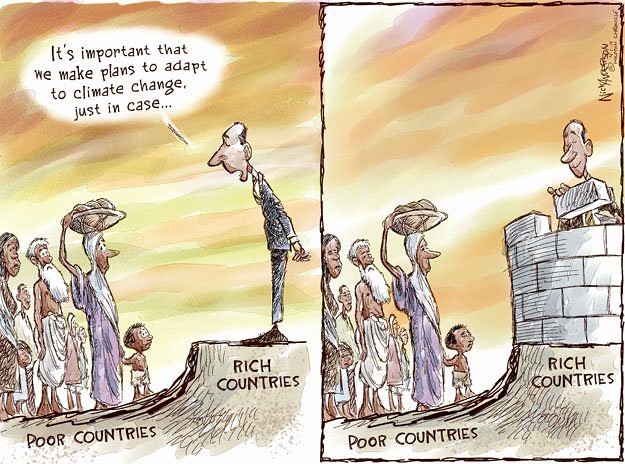
Hollow Promises and Ugly Unspoken Realities

Tags

, , , , , , , , , , , , , , , , , , , , , , , , , , , , , , , , , ,

dettaglio-blu1

Another climate conference has once again come and gone, echoing hollow promises and ugly unspoken realities. I won’t waste anyone’s time analyzing the verbiage of this so-called agreement which failed to even mention the term fossil fuels, probably at the behest of those who financed the entire farce, i.e. the carbon-extraction companies. Suffice it to say that countries were approving fossil fuel exploration projects before the ink of the global climate agreement had fully dried. As long as corporations are able to push environmental and social costs off their balance sheets and onto the backs of the weak and defenseless, dirty coal will be burnt and the cheapest slave labor will be employed. Questioning root causes like our inherently unsustainable way of life is still very much taboo and will remain so even after our descendants are sifting through the wreckage. Sure, mainstream publications have expanded their coverage of man-made climate change and global warming, but these existential threats to life on Earth remain an enigma to the vast majority, a footnote in some obscure textbook.

Retailers on the East Coast talk about a crisis for winter clothing sales because the weather has been too unseasonably warm to attract buyers, but nary a mention of man’s role in influencing these abnormal events, such as a super El Niño amplified by global warming. As the developed world continues to roll the climate chaos dice, we now face a higher chance of turbo-charged El Niños every 4 to 12 years and all the destruction that they bring —mass coral bleaching events, die-offs of marine mammals, record flooding and drought, crop failure and famine, refugee crises, etc. This year’s El Niño is on track to becoming the strongest on record with meteorologist Eric Holthaus exclaiming, “Our planet’s climate has undergone a step-change this year.”:

horserace-201511

This climate “step-change” may also be indicative of a considerable underestimation of the Earth’s climate sensitivity. What should be painfully obvious by now is that the carbon footprint for everyone will have to decrease dramatically and quickly in order to slow emissions. In other words, the world’s richest will have to radically alter their lifestyles. That’s never going to happen in any variant of capitalism, a system so entrenched that it is inconceivable to imagine anything substantially different taking its place. Instead we get things like corporate greenwashing, carbon trading, decades of climate conferences, First World offshoring of manufacturing emissions into the Third World, and out-and-out fraud like the VW auto emissions scandal. The problem has been identified for nearly half a century, yet we continue to deceive ourselves with half-baked solutions and hypocritical indignation. The inertia of the system is simply too great and the dominant culture has a tendency to kill the messenger of bad news, so there is a strong incentive to sugarcoat things, but a deus ex machina is nowhere on the horizon. We’ll only change in response to the hard realities from an increasingly inhospitable planet. Sunken costs and material incentives built into our socio-economic system prevent radical change and fetishize the myth of the easy techno-fix, a yet-to-be-invented technology that will magically sustain modern civilization while at the same time keep the wolves of ecological collapse at bay. Even more delusional, a prominent tech magnate has urged humanity to pursue interstellar colonization before we render the Earth uninhabitable, but as an internet commenter quipped, “A post-nuclear war, global warming-baked and hyper polluted Earth will still be paradise compared to Mars.” Some technophiles admit the future actually looks rather grim:

…But the most worrisome threats are not merely anthropogenic, they’re technogenic. They arise from the fact that advanced technologies are (a) dual-use in nature, meaning that they can be employed for both benevolent and nefarious purposes; (b) becoming more powerful, thereby enabling humans to manipulate and rearrange the physical world in new ways; and (c) in some cases, becoming more accessible to small groups, including, at the limit, single individuals…

Just as technology is not neutral, so too is the economic system driving this technology. The institution of capitalism, which has been copied and exported all over the world since WW II, has established widespread acceptance for the condition of mass production, mass consumption, and waste at an ever accelerating rate, pushing the world deeper and deeper into ecological crisis. For example, the ubiquity of plastics now exhibits itself as microscopic pieces on every beach in the world and in our dinner with trillions more pieces in the oceans than previously thought. Scientists estimate that nearly all sea birds will be ingesting some sort of plastic by 2050. In spite of this growing evidence of a plasticised planet, the production of plastics has only increased while recycling remains an effort in futility:

For more than 50 years, global production of plastic has continued to rise. Some 299 million tons of plastics were produced in 2013, representing a 3.9 percent increase over 2012’s output. With a market driven by consumerism and convenience, along with the comparatively low price of plastic materials, demand for plastic is growing. Recovery and recycling, however, remain insufficient, and millions of tons of plastics end up in landfills and oceans each year – link

There’s no going back from this global complexity trap we’ve built around ourselves. All those bits of plastic will end up in the sedimentary layer of the Anthropocene along with elevated concentrations of CO2, radionuclides from nuclear fallout and waste, as well as novel metals and pollutants never before seen. Once underway, mass extinctions cannot be reversed, especially when driven by over seven billion pleasure-seeking, individualistic “consumers”. Materialism and greed, we are told, are natural human instincts, and they are all too eagerly rewarded by an economic system which reduces everything to a financial object and monetizes every aspect of the natural world. Today’s environmentalism is, as Derrick Jensen pointed out, similar to the palliative care given to prisoners in Nazi Germany death camps. The emaciated ecological ghosts of so many species are right before us, yet nearly everyone is blind to the unfolding catastrophe of the 6th mass extinction:

…we lose a huge chunk of the world’s diversity that will never come back. We lose the potential for communication with other lifeforms, with the only remaining ones eventually whittled down to domesticated animals or weed species that thrive in civilized man’s destructive footsteps. The conversation of life itself is turning into small talk, but the only recognition that seems to be made by this culture is how [biodiversity loss] “reduces carbon storage”. How trees and animals can provide “ecosystem services”, as if they existed for nothing more than to continue the existence of the mad king ape. – pathofraven

blu-1 3

Yes, we are pretty far gone when a four minute comedy routine makes more sense than anything broadcasted on the evening news. Corporate mass media-controlled public debates have degenerated into infomercial sound bites. In a society where success is measured by the key metrics of money and profit, it should be no surprise that a wealthy, xenophobic businessman is able to garner mass appeal by hogging publicity and playing on the fears and base desires of the populus. “Make America Great Again” is a catchy slogan for a society ignorant of the collapsing world around them and oblivious to the over-consumptive, profligate way of life that is proving to be their undoing. For a celebrity-obsessed culture whose world is falling apart, the next logical choice for its leader would seem to be a reality TV show star who says he can restore the illusion of the American dream and build a great wall to keep all the riff-raff out.

Snap 2015-12-21 at 12.43.45

A fascist right-wing administration might just provide that extra push that takes us all over the edge into collapse. With the Presidency largely serving as a figurehead position for the Deep State, I’m not convinced a different candidate would make a measurable difference in the grand scheme of things anyway. Our “democracy” is, after all, just one more illusion in a bread-and-circus election cycle:

“Today, we must look to the city of Las Vegas, Nevada, as a metaphor of our national character and aspiration, its symbol a thirty-foot-high cardboard picture of a slot machine and a chorus girl. For Las Vegas is a city entirely devoted to the idea of entertainment, and as such proclaims the spirit of a culture in which all public discourse increasingly takes the form of entertainment. Our politics, religion, news, athletics, education and commerce have been transformed into congenial adjuncts of show business, largely without protest or even much popular notice. The result is that we are a people on the verge of amusing ourselves to death.” – Neil Postman, Amusing Ourselves to Death: Public Discourse in the Age of Show Business

image5

So while terrorism takes center stage in the overstretched Empire of Amnesia, remember this simple fact: 303 Americans were killed in terrorist attacks worldwide in the last decade while 320,523 Americans were killed because of gun violence in that same time period. Random mass shootings, capitalism’s “free market” genocides, the disruption of the Holocene’s stable climate regime by anthropogenic climate disruption, tipping points in the earth’s biosphere, terminal industrial disease, and many other things come to mind that pose a much bigger danger to the average American, but the War on Terror, conceived as open-ended, serves as a conveniently omnipresent boogieman for jerking the chain of the taxpayer and justifying the growth of an intrusive security state. What better way to control the masses as the wheels continue coming off the global economy and the biosphere becomes evermore threadbare. The rich will retreat into their luxury spider holes until the coast is clear.

https://vimeo.com/46623567

Incantations of Gratitude

From Prayforcalamity.com
By TDoS

He said that men believe the blood of the slain to be of no consequence but that the wolf knows better. He said that the wolf is a being of great order and that it knows what men do not: that there is no order in this world save that which death has put there.
Cormac McCarthy, The Crossing

She gave me leather gloves and said, “They’ll scratch the shit out of you.” A size too small, I pulled her tight gloves onto my hands. By the tuft of the rabbit’s neck, I pulled him through the opening of the wire hutch. As I walked toward the post, I tried holding him by his back legs, upside down, so that the blood would rush to his head an he would drowse. The rabbit screamed.

“They don’t like to be upside down,” she said.

I righted him. “It works with chickens,” I offered. Then I raised the rabbit, almost like an offering to the gray morning sky, so I could gently lower him into the steel breaking bar. He kicked a bit, then calmed. “It’s your death. Meet it how you choose. I’d probably kick and scream too.” Through the trees the pond was visible down the slope before us. My wife stood with my daughter on the dock, looking at the turtles and the fish as they moved in the cold black water.

“It’s OK. It’s OK.” I was gently stroking the rabbit’s plush fur. “Look at the trees. See the sky. It’s a beautiful day.” My voice was hush. My intention was to keep the rabbit calm. But still I wondered if my human touch was repugnant to the rabbit. Is the sound of my voice wretched to his mind? Is there such a thing as a tender executioner? When I said, “travel well,” might it have been better to say nothing it all?

With a firm hold of the rabbit’s rear legs and then a thrust, I pulled down and back towards my knees. The process repeated, five in all, each neck broken as decisively as I could offer, each rabbit given a moment of calm, each life acknowledged before each death delivered.

“Thank you for being nice to them,” she said.
“Of course.” My God, of course.

Five rabbits for twenty dollars and a handful of butternut squash. Her freezer full of meat, she didn’t want to kill anything else this year. Killing isn’t easy. It leaves a stain, and I hope it always does. My family is still without a deer. Five rabbits do not add up to a lot of meat, but they will carry for now. With two hands I carefully lifted each dead rabbit and placed them in a cardboard box. My wife and daughter climbed the hill. We made pleasantries. The box was warm when I loaded it into the trunk.

December is not usually this warm. This fall has been the warmest in the lower fourty-eight United States since record keeping began. Deluges of rainfall have flooded Chennai in India, as well as Ireland and the UK. Seven-hundred-thousand people are evacuating in advance of a typhoon in the Philippines. Meanwhile, winter rains are failing to materialize in Africa, portending drought conditions next year. Representatives of the global elite have once again walked away from an international climate summit with nothing to show but a palisade of words constructed to deflect real conversation about turning off the killing machine of industrial capitalism. They boarded jet planes to return home, and I stood outside in a sleeveless shirt two weeks before the winter solstice as my daughter and I pulled green onions from our garden that we could lay over the rabbit as we cooked it over a pit fire.

In the circles of power, I am sure there are back pats and hand shakes to accompany the praise of a job well done in Paris. To be sure, I imagine there are plenty of western liberals who believe some form of progress was made at the COP 21. Conversely, those of us on the fringes probably expected just such a result. No hard lines, no painful cuts, no discussion of deindustrialization or plans to decrease the consumption rates of the first world or the financial largesse of the wealthy. The fact that an international conference on climate change has official corporate sponsors from automobile companies to airlines and banks should be a blood red flag to anyone with even the most beta of bullshit detectors. Growth was still the order of the day. This is a system that cannot see itself, let alone confront itself. This is a system that completely lacks the ability to stop itself from destroying the habitat of the Earth. Is there any word more applicable to such a system than psychopathic? Maybe omnicidal? Watching at the neoliberal attempt to address climate change is like watching a serial killer at the end of their career; they are getting sloppy because they want to be caught, they want to be stopped, they know they have zero control of their death urge. They won’t turn themselves in, but they will leave abundant clues as to their identity.

Advertisements for AirFrance plastered on a Parisian bus stop are the killer’s semen stain left on the victim’s bedsheets. Please catch me. I cannot help myself. Stop me before I kill again.

An inability to confront ourselves seems to be a defining characteristic of our age. Examples abound on the macro and micro level. The social media obsession highlights the trend nicely, as millions upon millions of people spend hours a day meticulously crafting an image of themselves that they want to convince the world is genuine. From Facebook to Instagram, the obsession du jour is taking photos of oneself and then sitting back and waiting for other humans, also likely obsessed with taking photos of themselves, to tell you how fantastic you look or how interesting to appear to be. After harvesting “likes,” the high of such fickle and ephemeral attention fades, and it’s back to the bathroom mirror.

On a grander stage, we in the United States are now forced to endure the asinine behavior of a man-child braggart whose particular appeal as a potential presidential candidate appears to be the fact that he is perfectly comfortable being cruel to others, and that he has made a personal commitment to being as inconsiderate in his speech and action as possible. Of course, his defenders describe this behavior as a positive salvo against those who force us to all be “politically correct.” It requires very little effort to dismantle such an argument. What is really happening is that in recent years, challenges to society’s entrenched and predominantly unspoken white and male supremacy have been vocalized more frequently and with more support. These challenges make the beneficiaries of systemic racism and misogyny uncomfortable primarily because they were never cognizant of the leg up they have always received by being the “default” person, and they thusly feel that they are personally under attack for crimes they never committed.

Then along comes a powerful white man who tells his supporters he won’t cow to social justice warriors. Naturally, a lot of white men line up to carry his banner. The grand irony, is that this man is very wealthy. The declining standard of living amongst the middle class is a direct result of neoliberal economic policies enacted by the rich. Rich white men want poor white men to think it is foreigners who have undermined their economic viability, when in all reality, it was Wal-Mart. It was NAFTA. It was cheap labor abroad and cheap oil to ship goods around the globe. How the rich are able to convince the middle class that the poor are their greatest threat is a feat so counter intuitive that you almost want to applaud their ability to craft an illusion. How a billionaire has been able to convince millions of Americans that he can protect them from the machinations of politicians who have been bought by wealthy donors is downright stupifying.

Bravo, America. You have the political savvy of a goldfish.

But this is what happens. Vonnegut might just say, “and so it goes.” Nothing should surprise us now. We are in an age of consequences. An inability to look at ourselves and take stock of who we truly are and what our context actually is will lead to a world of a myriad of conflicting narratives. We cannot build a cogent society if even agreeing upon the nature of the basic building blocks of that society has become impossible. We stand along the road to greater social fracture. Indeed, we have been walking this path for a long time. Without the ability to synthesize healthy communities autonomously, we have been cordoned in by artificial borders. The rich have become startlingly rich, and as they have done so they have created various high pressure systems that are directly adjacent to low pressure systems, and the joinery of this impending disaster has consistently been state force, police violence, and a non-stop torrent of propaganda and myth to convince the masses that it is all for their benefit, for their protection, and further, that this state of affairs is exceptional, so exceptional in fact that the heathen hordes about the globe are frothing mad in their desire to take it from them.

It is said that “Hell hath no fury like a woman scorned.” I would suggest that such fury is outmatched by the violent potential of a man entirely convinced of his righteousness. Keeping apace with the decline of civilization often has us looking at economic indicators, energy returns, political turmoil, and the quickening rate at which the climate is destabilized and species are driven into extinction. All fair sign posts, to be sure. But on the day to day, one of my greater concerns is the absence of humility, grace, and self reflection which as a trend seems to inversely correlate with a spike in the abundance of self righteous vitriol. The outsizing and emphasizing of ego is a decline in spiritual quality, for lack of a better term, and it is the hand maiden of our global crises; affected by and then re-effecting.

John Michael Greer on his blog, The Well of Galabes, defined magic as “the traditional craft of causing changes in consciousness in accordance with will.” Whether or not you believe in magic of any kind, it is clear that the human consciousness and will are the fore-horses of human action, and when hundreds of millions, if not billions, of humans are at a time collectively convinced to perpetuate the premises and trends of civilization, be it the infallible nature of capitalism, the primacy of the western “way of life,” white supremacy or that Allah would want you to throw a person off of a building because that person is homosexual, the power we possess is manipulated into feeding the furnaces of a death cult.

Of course, it is easy to highlight this trend when it manifests amongst the most visibly powerful or violent groups. Truly, it is prevalent too amongst people who claim to fight for the oppressed, the poor, and the vulnerable. Even those who claim no desire to conquer or to control become so convinced of their position, so damn sure that they are right, that furious anger and venom is let fly horizontally even at the bottom of the barrel. Warriors for the working class so entrenched in their analysis about race, or sexuality, or gender, that it seems impossible to think they have ever spent time with the people they wish to help liberate. Fall in line with my thinking, or line up against a wall.

It is a long wall indeed, with room for all of us, and so many willing executioners.

Our power as humans is vast, possibly boundless. On the whole, our wisdom is not commensurate with this power. Knowing when not to apply power is central to using it intelligently. Can you hold a gun and not point it someone? Can you be given a chainsaw and not clear cut a forest for profit? Can you unlock the petroleum from its deeps but choose to leave it there? Can you have a voice, but not speak until you are sure that doing so is appropriate; is necessary? Every day we apply our intention to the world, and the vast majority of this application is as thoughtless as flicking a cigarette butt out the car window. Then we wonder why the world burns.

The unforgiving pace of capitalism exponentially exacerbates this problem. Nothing can be slow. Not movement, not communication. How can an instantaneous world be a thoughtful world? How can a twenty four hour civilization with light speed demands for your attention and response court the deliberate hand, the calm voice, or the well crafted response? Eight billion humans all living in a lightning round, shouting, responding, and firing their intentions into a storm of chaos and collision. Then consequence, response, repeat, and the storm grows.

Here we are on the precipice of global ecological calamity, frail worlds dancing on a razor blown back and forth by the whims of mad men, and I fear that the wisdom the situation requires is not only not present, it is not welcome.

Salt falls to the Earth as I drag the dull knife across the hide. Bits of remaining meat and fat collect on the edge of the blade, and I pick off the pink wads that gather there and flick them to the ground. Fleshing a hide is time consuming and skill intensive. My back aches a bit as I lean over the plywood the hides are nailed down to. The world is made of blood and bone and I am so grateful to be a part of it.

Cold wind blows. I massage egg yolk into the skin. If these rabbit hides tan well, my wife wants to use them to create a cloak for our daughter. I just want to get better at the process.

Viscera has been given to the chickens. In the compost pile I buried the rabbit’s heads. Before pulling the decaying plant matter over them, I placed lettuce leaves and turnip greens in the hole. An offering. Gratitude. There are surely people who think it is superstitious or perhaps merely self serving to do so. I don’t give a good God damn. It feels right. I

In Centuries and Seconds

Tags

, , , , , , , ,

From PrayforCalamity
By TDoS

She was a yearling. Not very large, maybe one hundred pounds I would guess, as I was able to easily hoist her body into the back of my Jeep. Gauging by the blood leaking from her ears and mouth and lack of any other visible wounds, I assumed the car that killed her struck her in the head, possibly breaking her neck. What I could not gauge was how long she had been lying dead on the side of the highway. Her eyes were open and not yet eaten by birds, and her anus was also free of any infestation. I chuckle to myself when I imagine the reaction more domesticated individuals might have if they knew that there are people like myself who assess the edibility of roadkill by the presence of uncorrupted eyes and assholes. To be fair, I also took stock of the stiffness of her body and the lack of any immediately offensive odors emanating from it. She was worth taking home for a greater look, anyway.

From a cross beam of the carport I anchored a carabiner, and I fastened another to the yearling’s hind legs so I could create a “z-rig” pulley system, effectively halving her weight so that I could hoist her body into the air and tie of the cordage without help from a second person. My partner was going to come outside and watch the dressing so she could have a greater understanding of the process, and she bundled up our daughter too, who showed no fear or anxiety concerning the large animal hanging dead before her. Gently, I explained that the deer had died, and I was going to harvest its meat for us to eat. Not yet two, she stood looking at the yearling and said, “Deer, off.”

“Yes honey, the deer is off.”
“Deer, on?”
“She can’t be turned back on. Once something dies, it cannot come back to life. But her spirit and her flesh return to the Earth.”
“Deer, off.”
“Yes baby.”

The year is closing as we approach the winter solstice. From the corners we inhabit, we watch the fallout from terrorist attacks in Paris and the downing of a Russian war plan by the Turkish military. Those who tally the climate statistics are telling us that 2015 is set to be the warmest year on record, globally. South Africa grapples with drought, the rainforests of the Amazon are burning, and world leaders sent to negotiate climate deals are converging on a Paris conveniently locked down by security forces preventing mass demonstrations under emergency restrictions imposed due to the aforementioned terrorist attacks. Not that it matters. Floats and puppets are fun to look at, but only a complete restructuring of society could address the challenge of climate change, and that restructuring begins with erasing existing borders and property lines, canceling existing debts, dismantling industrial infrastructure, and of course, toppling the standing systems of power. The puppets and street theater capable of such feats, I would love to see. As I have previously stated (and my blog name continually hints at) I do not believe humans capable of achieving such goals, at least, not without a little help from our friends calamity and chaos. The gatekeepers are just too well equipped to stave off conscious revolution. If you want to get into the citadel, you will just have to wait until a tornado throws a bulldozer through the wall, or a plague kills most of the guards.

Until then we watch, we wait, and we endure. We keep repeating the conventional wisdom of collapse; that which cannot be sustained, will not sustain. Rome wasn’t built in a day, and it didn’t collapse in a day, either. The collapse of a civilization is not one event, but the consummation of many events that eventually birth a catastrophe that overwhelms the ability of that civilization’s people to rebuild what has been destroyed, whether material or social.

Fast collapse and slow collapse are really the same thing, looked at from different vantage points. What is built over centuries can end in seconds.

November 16, 1532. Francisco Pizarro has one hundred and sixty eight men laying an ambush in the Inca city of Cajamarca. Atahualpa, the emperor of the Inca empire, arrives for a meeting with the Spanish backed by an unarmed cadre of six thousand. A friar and barely competent translator tell Atahualpa they are there, in essence, to bring the Inca into the fold of the Catholic church and the Spanish empire, and they offer him a bible as a seal of their truth. As was to be expected, and likely, the intention of the Spanish, Atahualpa rejects what he is being offered. This rejection of the bible and the truth of the Catholic church gave the Spaniards what they considered to be legal grounds to attack the Inca who had amassed there. A century of empire with its conquest, expansion, and grandeur, could be said, to have ended in the following seconds.

Those seconds, however, were the ripe culmination of years of internal strife concerning who the rightful heir to the imperial throne was, a waning ability of the empire to effectively control far flung principalities, and a plague of smallpox brought to Mesoamerica by Europeans that advanced faster than conquistadors on horseback. Political turmoil and disease were eating away at the Inca empire, and the Spanish arrived just in time to add the critical pressure necessary to break it. And they had guns.

History, of course, is complex, and the fall of the Inca empire extended beyond the massacre at Cajamarca, as Pizarro played disaffected Inca regions against the center, installed puppet emperors, and fought rebellions. As the colonization of the Inca proceeded, European diseases continued to decimate the indigenous population as well. The Inca actually learned how to effectively defeat the advantage of firearms, but the viruses ravaging their insides were too much.

Depending on where we stand, we can focus on the centuries or the seconds.

If tomorrow the Dow Jones Industrial plummeted by seventy percentage points or NATO declared war on Russia, we would likely see those seconds as the critical break between the past and the future, the old world and the new. But of course, years of maneuvering by humans and the consequences of those movements all came together to generate just the specific combination of factors required to outflank the established firewalls civilization has established to protect itself, and to outpace the efforts at rebuilding that are guaranteed in the aftermath of catastrophe. Resource scarcity primarily in the sphere of fossil fuel energy, the manipulation of capital to the point of diminishing returns by the global ultra-wealthy, the decimation of ecosystems around the world; all have played their part in dressing the set for those critical seconds that seem to hang over us like a sword.

How does an organism die? If you magnify the death of any given being, presumably you can find one second, one still frame in time that separates living from dying. When we die of old age in the most quintessential of circumstances – our heads atop a fluffed down pillow as we lie repose in a king-sized bed replete with Egyptian cotton sheets and a mahogany headboard, family and adorers walling in our bedside and wishing us fair travels as we draw a final breath, smile, and say something childishly simple yet agonizingly profound – a critical second passes when our heart ceases to beat, electrical impulses in our brain fade, and we’re gone. The room exhales.

But we were dying for so long. How many years had it been since our body’s ability to repair cellular breakdown was outpaced by the aging process? We had peaked decades before. From that point forward, despite every adventure, every new idea, every material acquisition, we were hurtling ever forward toward our imminent demise. Our vision blurred, so a doctor prescribed us glasses. Our heart stuttered, so we began taking pills. Our mobility waned so we got a Hov-R-Round from the Scooter Store thanks to the endless advertisements targeted towards we septuagenarians aired on day time TV. We pressed on.

Our bodies contain countless living beings and units; cells, tissues, and bacteria that all comprise the whole of what we perceive as our self. A veritable civilization that is born and advances through stages of growth and maturation until the energy necessary to maintain integrity is outpaced by diminishing returns. We insert techno-fixes of every imaginable stripe to stem the twin tides of time and entropy, buying what time we can until the inevitable enters stage left to take us by the hand and demurley return us to the soil.

Civilizations are no different. Shaped in centuries, defined in seconds, feeding the fertile soils of time. Billions of human hands and minds carving, digging, screaming, warring, building, repairing, maintaining until it just isn’t enough and the center can no longer hold. Hydraulic fracturing, negative interest rates, solar arrays and soyburgers all applied to patch the holes and to bail the bilge water. Industrial civilization passed its peak decades ago, sometime around the time when women in skirts freely attended University in Kabul and the United States didn’t need to stand guard over Wahhabist Monarchs in the House of Saud in order to keep the game of growth afloat. Selfie sticks and social media stock options are your glasses and nitroglycerin. The internet is your Hov-R-Round. Do not kid yourself into thinking this is a civilization still in the wild throws of maturation and bloom. The billions of organisms that make this civilization possible are under threat, from phytoplankton to pollinating insects and carbon sequestering trees, all of whom feed the the billions of humans who swing hammers and pour concrete and fit pipes and string lines and who somehow, by some curse of the lottery of birth, drag themselves to the factories and cubicle farms day in and day out, all to keep this storm born Galleon afloat. Shaped in so many of our precious seconds, defined in the roil of faceless centuries, feeding the fertile soils of time.

The car struck her head, I had guessed. Her life probably ended quickly in a split second of sound and light. Without any abrasions on the body, I assumed the meat would be well preserved by the cold evening air. With only a beam of light to guide my hands under the dark of night, I gently separated her hide from her flesh, using light strokes of my knife to cut away at the membrane that held her skin to her flesh. Something was wrong. Her skin had a green tone in places around her ribs. I cut away more, examining the muscle as I worked. The green hue, almost an electric blue really, blotted here and there on her leg muscles, like watercolor oceans on an aging map. Hoping the backstrap was untainted I continued to skin the deer, but it was hopeless. On her left hind leg a subcutaneous tear in the protective membrane had likely allowed the passage of bacteria. She must have been spun or thrown by the vehicle in some fashion that impacted her rear leg with a substantial force.

The meat was inedible. I sighed in the night. Fog from my mouth drifted upwards as I set my knife down, and lowered her body. Walking beneath the stars I carried the yearling downhill, briars grabbing at my boots, twigs snapping underfoot. I thanked her and apologized while burying her under a light blanket of leaves. Coyotes, buzzards, someone would eat her. Someone with an enviable array of gut flora. I plodded and crunched my way home to wash the blood from my hands and wrists. The smell would last for days.

Your Worst Enemy

Tags

, , , , , , , , , ,

By TDoS
Cross Posted from: Prayforcalamity.com

Cold northern air pushed south for a few days granting us the slight chill we have come to expect on a November morning. Heavy winds rattled the bare fingers of oak and hickory like blades of prairie grass. Woodsmoke seasoned the air and warmed my soul as I walked the compost toilet bucket out to the pile to be dumped and covered. Two days later temperatures were right back up again as firearm deer hunting season opened. I wanted to spend my Sunday morning waiting quietly in a tree, scanning the ridge line for a sizable white tail, but decided against it when I saw that the high for the day would be seventy degrees. The forecast calls for the cool air to return, so for now, I postpone the hunt, and cross my fingers in the hope that driving home from work late at night I will see a freshly hit roadkill deer that I can harvest instead. Their habitat long converted to highway, I honestly prefer making use of a collision killed deer than pulling the trigger anyway.

The collapse blogs and forums are often rife with talk of such things. There are those who suggest that in a world where grocery stores are shuttered or where there is no money to purchase what they might still contain, people will need to return to hunting and foraging where possible. At such suggestions, there are those who counter that the skill to harvest and process and meat is lost of the vast majority of the population. There are others who then counter that actually, in such a scenario the fields and streams would quickly be stripped bare of any game or fish as hordes of people begin shooting at anything that moves, whether they know how to properly process and preserve the meat or not. After years of collapse minded discussion on the internet, I think it is fair to say that there are many pockets of cliches and conventional wisdoms that have taken root and found their loyalties. Fast collapse, slow collapse, hyper inflation, deflationary depression, bug out, bug in, long slow die off, near term human extinction, etc. ad nauseam. Flow charts of collapse hypothesis each complete with their experts and their laundry list of survival purchases.

Over the years I have found myself settling in the realm of thought promoted by the Dark Mountain Project. I do my best not to make a lot of predictions that don’t go beyond vague guesses at trends, and I primarily try to push the notions of personal and communal endurance, adaptability, and dignity. History’s arc is very long, and it is easy to find ourselves as individuals belonging to a time that we believe from where we stand to be of particular importance or meaning. Such assumptions are vanity. The decline of industrial civilization, yes, will result in the creation of miserable conditions for most of humanity, and as we live through and beyond such times, we shall be tested. We are not going to solve the major crises. We are going to be called upon to endure them. Such endurance is likely beyond many in the western world who have never imagined, let alone suffered true hardship. The age of fossil fuels has not only softened rich bodies, but it has softened rich hearts and minds. It has convinced many that death and pain are an unfairness, one that we could, and should, banish from existence. More vanity. More hubris. To be sure, more blindness, as such soft minds are closed off to the suffering and death that formed the foundation of their very comfort to begin with.

Banish your vanity now. Welcome the dirt under your fingernails. Accept that you are not, nor your culture, the protagonist in a meaningful drama. Visions and stories you have created in your mind in which you are a central performer are phantoms of your own amusement. Dispel them. Be here. Take a good stock of who you actually are.

Mutant zombie bikers (MZB’s for short) are the foil of those who monitor collapse. MZB’s are the unwashed masses. Unprepared for collapse, they don their truck tire armor and necklaces strung with the teeth of their victims and then move over the suburbs and hinterlands seeking families and farmers to massacre in their grand quest for canned peaches, gasoline, and murderous skin harvesting glory. They are the primary enemy portrayed in the dystopian future sketched out in most collapse related conversation.

I would like to offer a counter notion; your worst enemy will be yourself. This suggestion, I hope, can steer us from the primacy of the notion that navigating social collapse is going to be best achieved by those who most willingly point guns at everyone else.

If in fact, a grand collapse of sorts occurs and the social and economic systems that the vast majority of people rely upon fail, it will not likely be a man built like a WWE wrestler riding a tricked out Harley and brandishing a flaming nail bat who kills you. It will be your own inability to work with a group. It will be your own lifetime of poor health choices. It will be all of the ebooks about wild edible plants that you downloaded and never read. It will be your hubris, your panic, your depression, your anger, and primarily your inability to adapt to unpredictable and ever changing conditions.

For what it is worth, this is the concept I would like to toss into the gyre of collapse discussion. How self improvement now not only increases one’s chances of survival in the event of any emergency, short or long, but further, how such improvement greatly benefits one’s life even in the absence of societal breakdown. Successfully navigating dire circumstances that present physical, mental, and emotional challenges requires fortitude on all fronts – body, mind, and soul. Doing the work to improve oneself on these fronts is not likely to be a waste should calamity never strike, in the same way that “prepper” purchases of five years worth of EZ Mac and banana chips might be. Mice will never eat your improved physical stamina. A flood will not wash away your uncluttered mind.

Let’s face it, life in the modern era in western nations has shaped most of our interactions to flow along the patterns and dictates of the economic system; capitalism. Short, shrift transactions where one exchanges paper notes for food do not establish a bond between buyer and seller. More often than not, the owner of such food is not even present, and we interact with low wage workers who operate cash registers, and the bulk of our acquisitions of necessities is at the behest of a system which at times even generates resentment of all the other humans around us. We are infuriated by traffic, long lines, and crowded spaces. Community bonds are threadbare. True reliance on one and other that flows equally back and forth is rare. So what happens when this social and economic paradigm crumbles? Do you have the ability to work well in a group? Can you keep from yelling or being over bearing? Do you dominate conversations and interrupt others? Do you dismiss women or people who aren’t white? Do you even notice if or when you do these things? When the humans around you become a de facto band that must cooperate to survive, can you set your ego and your ideology aside? Can you be the first to give before having received? Can you politely disagree? It may seem silly to present such concerns, but truly, communication has been so degraded by generations of commercial transaction replacing communal reciprocity, not to mention newly invented forms of abbreviated, faceless, eye-contactless device to device texting, that I think a focus on just being able to talk to one another in order to effectively organize crisis response should be a priority. Do you really want to find yourself outcast because everyone around you thinks that your a blowhard asshole?

Of course, habits that trend in the opposite direction could be just as deadly. Are you a doormat? Do you speak up for yourself? Are you easily manipulated? Do you fear speaking your mind when your opinion is unpopular? Can you say “no” and mean it? An ability to judge when to defer to group dynamics and when to pull back from activities you believe to be foolish, dangerous, or a waste of energy is crucial. Of course, navigating the emotions and egos of others is a delicate matter, and doing so forms the basis of politics. When your life is on the line, you will need to swallow your pride one day, draw a line in the sand the next, and hopefully make the right choice as to the when and why for both.

Meanwhile, our habits and addictions will haunt us when all of the usual patterns change, and then change again. If right now you are a smoker, a drinker, if you are addicted to sugar, to caffeine (my personal drug of choice) or just happen to need a particular anti-depressant or antipsychotic to get out of bed, how will you fare when the chemicals your brain requires to function are not available? What is your current physical status? Here in the US, the lion’s share of the population travels by some form of petroleum powered vehicle on a regular basis. Has this made you a bit soft around the middle? Or has a steady diet of sugar softened you sort of all over? The ability to walk long distances over varied terrain while carrying a load, perhaps water, perhaps wood, perhaps a child, would probably serve well. The ability to defend yourself without a weapon, would probably serve well. The ability to live two weeks on nothing but mashed turnips without flipping out on everyone around you at the slightest annoyance because your body is craving a Diet Coke and a Parliament Light might just serve you well.

And I am not pitching machismo. I know too well that a smile, a nod, a low calm voice, can in the right circumstances carry more power than a grounded right cross. Well rounded and adaptable, clear headed and resourceful, that is what I am pitching.

This is why I decry the prepper mentality of stockpiling large caches of goods. That is just consumerism. That is just altering a bad habit to feel like a good habit. Sure, having food in the house, useful tools, toilet paper and jumper cables does make sense. Twenty-Five buckets of mylar sealed white sugar is an absurdity. No matter what emergency you encounter, be it a car accident on a stormy evening, a house fire, or full on “the-grid-went-down-thanks-to-Chinese-hackers-cracked-out-on-energy-drinks-and-promises-of-state-provided-communist-love-girls,” the one thing you will always have on you, is you. Your mind, your body, and your spirit are primary. If these are out of balance or in a dysfunctional state, why would you assume that a Rubbermaid Tub full of Pepto-Bismol would be of any use?

You need to fill your mind, hone your body, and steel your spirit. This is a constant as we live. The work never stops. But as we travel, and work at our wisdom, our knowledge, and our fitness, we must also learn how to successfully integrate this blossoming self with others. Communities don’t just happen, because trust doesn’t just happen; communication doesn’t just happen.

Tribe is hard. Manufactured tribe, anyway. I have never experienced a true tribe; a family linked through time and space, culture and common cause. What I have experienced are groups of people who came together with grand purpose. The torment of hours long meetings with Occupy, the drama of interpersonal conflicts with pipeline blockades, the sheer inability to commit to the work required at failed communes and intentional communities; I have seen it all. In each case, there was success and their was failure. In each case, good intentions ran head first into fatigue, a lack of resources, and at times, post traumatic stress. And in each of those cases, the greater support system of society still existed as a fall back. Dirty, cold and hungry, I watched people do unexpectedly amazing things, no doubt. But stores still had food, even if the only food we could afford was in the dumpster. We could check out, step back, any time we wanted. When the stress of it all was too much to bear, one could return to the “real world” and level out. A collapse scenario will offer no such quarter.

It is said that tough times don’t last, but tough people do. I am not trying to sell some notion of myself as complete or without flaw. I am just as guilty of seeing myself not as I am, but as I have imagined myself to be. I possess plenty of traits and habits which I need to work to better, starting with my ability to calmly and accurately communicate. If I were slower to frustrate and to anger, that would likely be a boon. Despite the constant work that living in a post collapse world would require, I could personally benefit from a greater ability to slow down, to sit still, and to meditate. To just breathe and exist. I think it would strengthen my spirit, even if only by allowing me to take in more beauty and joy that I currently let pass me by in favor of tending to endless tasks. We talk tirelessly about survival, but forget sometimes that without attention to the things that make life worth living, we can never truly thrive.

The time to work on ourselves, is now. Your communication, your patience, and your tolerance, all are best improved now while daily caloric intake doesn’t necessarily rest upon them. The time to break habits of sloth, or poor diet, or of resistance to any work that makes muscles sore and brow sweat, is now. The time to take self dense classes and to increase your self confidence and endurance, is now. The time to abandon phantom notions of your protagonist self in favor of honest assessment of your strengths and weaknesses while simultaneously relieving yourself of your doughy first world comfort requirements, is now. Take cold showers. Eat more vegetables. Forgive small debts. Compliment and be patient with others. Walk.

Of course, the hard part is that the pizza is still hot, the beer still cold, and the new season of Game of Thrones is on, and all of it is available twenty-four seven and you wouldn’t even have to speak to another human being, let alone be kind to them, to get any of it. And there is work. And there are bills to pay. Maybe next month when I get a little further ahead. I’ll quit smoking. I’ll quit drinking. I’ll spend less time on the internet and more time with other people. Next month.

You are your worst enemy, but you don’t have to be.

The Autumn Breathes

Tags

, , , , , ,

By TD0S at PrayforCalamity.com
___

Deep in the hardwood forest I watch the first orange light crest over the eastern ridge as dawn unfolds casting its warmth on the surface of the yawning Earth. Poplar trunks stand firm above the gold and brown leaf cover that now mulches the hopeful seedlings while granting the white tail deer an auditory advantage over those who would stalk them through the hollers. At this time of year the forest exhales and retreats from the above ground toil of photosynthesis to a season of focus within the dense and teeming skin of the planet. Without the brush and laden bough, one can see for miles across the waves of ridge and ravine. Sound is without obstacle, and seems almost propelled by the chill wind when it punctures the otherwise heavy silence. The feeling is one of calm, of that restfulness that comes when one crawls into bed and their leg muscles finally release the day’s tension. Autumn contains a library of lessons, none of which can be learned until one is still, patient, and not fucking talking.

My year was not what I had planned for it to be. Many tasks remain undone. Our family was interfered with by a local government body, and we are now in the process of installing an overpriced septic system for our cabin. It is a headache, to be sure, dealing with puffed up bureaucrats and their ad hoc adherence to antiquated and at times contradictory laws. As is often the case in this society, compliance is cheaper and faster than justice. Proving to a judge my case that I should not be required to acquire such a system would find me spending more money, time, and personal energy than just going along with the racket that the good old boys and connected families have established in these parts. I have made my peace with the conflict, and am calmly dancing through the hoops laid out for me. When all is said and done, the cabin I built with my two hands will be a legal residence in the event that we ever decide to move and to sell our land. Property value and all that, right?

Here we are again, dear readers, staring down another winter in which we can together reflect on the state of the world, both the portion that modern humans point their attention at, as well as to the far larger portion where, as Cormac McCarthy wrote, “Storms blow and trees twist in the wind, and all of the animals that God has made go to and fro.” Despite a massive downturn in the global economy, money moves and the smokestacks belch their poison. To be sure, man’s world of markets and digital notations percolates. An event is brewing that portends itself in plummeting rig counts and commodity prices. What grand show this event will perform for people rich enough to have a stake in it is to be seen. The rest of us will scrape by like the peasants that we are until even scraping fails, and only bloodletting remains.

Superstorms and hurricanes ravage from Texas to Yemen. Starved and hopeless human beings are playing the only card they have and abandoning the sure death that awaits their children in the war ravaged and drought plagued middle eastern and north African regions. Rich white people who are to blame for such wars, droughts, and famines are bellowing from the America’s, clear across Europe, and down to Australia about the brown victims of centuries of Anglo-capitalism and how they are not supposed to do anything but suffer their circumstances in place. Where these white adherents to national boundary and culture were as the US, UK, and other global powers were setting about to wage war and destabilize governments in these now uninhabitable places, I’m not exactly sure.

This is the crisis unfolding. This is what it looks like. Real life plays out a lot more slowly than the Hollywood scripts that have to crunch collapse adventures into one hundred and twenty minute films complete with explosions, comeuppance, and a love story for the girls. Tracking the decline of global industrial civilization is seemingly gaining in popularity, and it is all too common for those new to such a curiosity to expect an impending grand finale in which all bets are off; the power grid fails, store shelves empty, gas pumps get bagged, and all hell breaks loose in suburban cul-de-sacs where soccer moms in body armor pump 7.62 into hordes of urbanites (read: blacks and latinos…OK, and maybe a few white guys with neck tattoos get plugged for good measure) who are scouring the once idyllic portions of America in search of condensed soup and cheerleaders for their rape rooms.

Instead another year grinds by in which forest fires destroyed more than they ever had in North america, heat waves killed thousands in Pakistan, sea levels continued their upward march, and political institutions seemed ever more and more inept in the face of all the compounding emergencies that industrial civilization faces. Even my own humble region was affected by unseasonable levels of rain this July which were punctuated by a night of flash flooding that tested my mettle and resolve as I spent hours trying to find an unblocked path home.

Of course, we know that there are no solutions, not for the major crises. There is no putting back what is broken, and limits to growth are not optional. They are not suggested daily values. Sustainability isn’t a lifestyle choice. That which cannot be sustained will not be. For us as individuals, families, tribes, and communities, there is only endurance. How do we get by, and not just with the calories in our gut to labor forth, but with the joy in our hearts to make us want to carry on? Times of decline are times of darkening in the human heart and soul. Atrocity follows shortage. A world of hunger, hate, and blood is a world in which human conscience is called upon to rise, to shield, to burn brightly, despite less and less obvious motivation to do so.

The year draws down and grants us all yet another season to breathe. Let us use the time wisely.

And you thought Greece had a problem?

Tags

, , , , , , , , , , , , , , , , ,

Author: Norman Pagett (The End of More)

Petroleum-Highway

While we might think of money as supporting our economy, only energy can support the solvency of a nation, and only surplus energy can fulfill the aspirations of its rulers and the desires of its citizens. Until the advent of the industrial revolution, and in particular the universal availability of cheap oil, that energy could only come from territory that could produce sufficient food and other essentials for any level of civilized living. We might ‘demand’ that our leaders provide new hospitals, schools, roads and all the other things that make life comfortable, but without the necessary surplus energy to do it, it is impossible. No political posturing or promises or taxation can change that.

Most deny it, but we live in an energy economy, not a money economy. Without the continually increasing forward thrust of energy input, no economy can exist in the context that we have become used to.

Not just the Greeks, but those charged with governing every nation on Earth, have lost sight of the fundamental law of collective survival: if a nation doesn’t produce enough indigenous surplus energy to support the demands of its people, they must beg, buy, borrow or steal it from somewhere else, or face eventual collapse and starvation until their numbers reach a sustainable level.

Our lifestyle support system has been based on that premise since prehistory. Nomadic tribesmen, probably in the region of present day Iraq, had the bright idea of fixing borders around land, then growing their food supply instead of chasing after it. Fences and borders meant land could be owned and given value that could be measured in energy terms.

What we know as civilization is based on that simple concept. Land and its potential energy became capital, and our genetic forces ensured it was exploited to the full. Primitive farmers knew nothing of calorific values, or capitalism; only that too little food meant starvation, sufficient food averted famines, and surplus food offered prosperity. No one wanted to starve, few were content with sufficient, so the drive for surplus became relentless. It still is; only the scale has changed, it has become the profit motive in everything we do. Everybody wants a payrise, few refuse one. We are all capitalists, we differ only by a matter of scale.

Enclosed land needed strong control and the will to fight for it. Strength prevailed while weakness went under as resource competition ebbed and flowed across tribal territories. If land produced enough spare food and other necessary commodities, it was possible to equip and feed an army, and use it to occupy more territory. In that way collective energy could rapidly roll up small territories into a nation or an empire, create warlords and kings, and give credence to gods who were invariably on the winning side.

cool-oil-gas-war-graffiti

Possession of land and what it produces is the hidden support of what we now understand as our economy and the viability of our infrastructure. Conflict makes that economy even more profitable and one that is built on power and aggression provides the potential for endless resource warfare, whether bloody or political. In 1941 Germany invaded Greece using the bloody version. In 2015 Greece is experiencing the political version. As a small weak country Greece lacks the resource strength to resist.

The more land that could be held and ruled, the more food-energy could be produced. Surplus energy that came in the form of meat and grain and timber was too big to carry around, so tokens of gold and silver became an accepted measure of energy value.

Different civilisations arose and used different monetary systems, but all broadly followed the pattern we are locked into now: those who controlled the land controlled the energy that supported the prevalent economy, whether primitive or sophisticated, warlike or peaceful. With sufficient surplus and a big enough labour force held in some kind of serfdom or dependency, tokenized energy could be diverted to pay for the construction of cities, castles and cathedrals. While the labour of men to build them, the allegiance of soldiers to guard them, and the faith of priests to pray over them might be bought with gold and silver, the system depended on a supply of food and basic commodities well above subsistence level, ultimately provided by the heat of the sun. That’s why the great early civilisations and empires began in the warm tropical and sub tropical regions of the world. And why Eskimos did not field armies, build cities, or inflict the hysteria of mass religion on themselves; they didn’t get enough sunshine to provide the energy resources.

That gave rise to the factors we still live with today: warm productive stable land sustains a bigger healthier population. People eat and procreate, need more sustenance, and demand that their leaders provide it, so the thrust of constant expansion is inevitable in order to feed them. This was as true for small farming settlements between the Tigris and the Euphrates, as it was for the Roman Empire. It was the force that drove the European industrial powers outwards to carve up Africa, the Americas and the Far East to give a privileged section of humanity a prosperity that has been unique in our history. Those of us who enjoy those privileges have lost sight of where they came from, and how fragile they are.

Consequently we are still locked into the same energy-hungry capitalist dynamic, only now we believe that money has not only been substituted for the energy that created it, it has replaced it. In most people’s minds, the illusion of money has supplanted tangible, hard resources. Energy is no longer regarded as necessary to sustain prosperity; we can print it, or better still, make it appear electronically.

OLYMPUS DIGITAL CAMERA

Who needs oil? Keynesian economics says that perpetual growth will come through passing bits of coloured paper or plastic from hand to hand at an ever-faster rate.

The leaders of every advanced industrial nation are driven to promise this kind of ‘growth’ to their people, for no better reason than because there has always been growth, so our future will be growth driven too; they and we know no other way. We believe the lie that money itself has taken on an intrinsic worth of its own.

The Greeks fiddled their accounts, joined the EU and accepted the common currency of the Euro and the collective certainty of the money-driven nature of growth, at a time when oil was $25 a barrel. With oil so cheap, any concern about indigenous energy sources was irrelevant. They had a world class (oil dependent) shipbuilding and sea transport industry, and (oil dependent) tourism was booming. In the late 90s, when oil had fallen to $18 a barrel, they borrowed $11 billion to buy still more energy to burn in order to stage the 2004 Olympic games. Greek prosperity depended on infinite supplies of hydrocarbon fuel, but they followed the common belief in infinite money.

When the price of oil peaked in 2008, the crash was inevitable. The certainty that money represented wealth was destroyed by the price of oil, but they borrowed billions more to try to prove it hadn’t. Any reason was better than reality: that you can’t run a cheap energy economy on expensive energy.

The latest clutch of Greek politicos got themselves voted into office because they told the Greek people what they wanted to hear: that prosperity could be voted into office, as if the availability of indigenous energy within their borders was a matter of political choice. Alexis Tsipras believed the Keynesian fantasy and convinced himself that borrowed money put into endless circulation will generate wealth and ‘growth’. $11 billion spent on the now derelict Olympic stadium should have served as a warning, but it didn’t.

070795-eb65ca3e-2347-11e4-b035-3276a1bc3645

More ‘bailouts’ have been agreed; the Greeks will now settle back into their soporific lifestyle and the headline writers will find something more newsworthy. But the hammer of reality has only been lifted temporarily from the anvil of their economy. In a year or so, when the Greeks have spent their latest loan, it will crash down again, harder.

The Greeks are not money-bankrupt, they are energy-bankrupt.

But so is every other nation, to a greater or lesser degree. Saudi Arabia is in a worse state of energy bankruptcy than the poverty stricken Greeks, they just don’t know it yet.

A century ago, Greece had a population of around 5 million, and had only partially freed itself from control by the Ottoman Empire. Despite wars, revolution, hyperinflation and foreign occupation during the 20th century, it remained poor but largely self sufficient as a pastoral country. During that period, the population doubled, due in a large extent to reclaiming Turkish held territories in the early 20th century. In a worst-case scenario, if Greece defaults on its debts, and drops out of the EU and the European currency, 11 million Greeks will be left to feed themselves at a very basic level. They will have no choice but to fall back on a more primitive lifestyle, forgo the luxuries bought by oil consumption and live on the energy sources within their own borders. When they do that, their energy bankruptcy will disappear.

100 years ago, Arabia had a population of 1.5 million, and was also a region of the Ottoman Empire. The term Saudi had not been prefixed to it and the Gulf States did not exist. Their people were basically nomadic, with no concept of national identity, or civilization approaching the Greek level. Though under nominal control of the Turks, they were effectively protected by their hostile desert. Living was primitive, but like the Greeks, self sufficient on their terms.

Then in 1938 oil was found in Arabia, now the population is over 30 million. The current excesses of Saudi Arabia are too familiar to need recounting here. We’ve all watched the Saudis use their oil to build unsustainable cities in deserts, where previously there had been none. They have used their oil to suck finite water out of aquifers and desalinate seawater to maintain the fantasy of endless prosperity. They buy in every conceivable luxury and try to outdo each other with meaningless towers of vanity that they see as expressions of wealth and status. They build because they can, believing the economic nonsense that spending energy-based tokens, i.e. money, creates profit and wealth. Just like the vanity of the Greek Olympic venues, the glittering towers of Riyadh and Mecca and Jeddah are seen as a source of commercial prosperity that will deliver and provide cashflow long after the oilflow has dried up.

Vertropolis-3

As the Greeks discovered when the energy flow stopped going into their arenas, they began to disintegrate. Without constant energy input, money embedded in concrete, glass and steel can only show a return if more money (energy) is constantly added to resist the ultimate certainty of entropy. No one has pointed out that while Saudi towers may be designed to last 100 years, the oil-energy that supports them will run out in less than 30, maybe as few as 20 years. (It has been suggested that Saudi might become an oil importer by 2030, though exactly where the imported oil will come from, or how it might be paid for, is not clear). Then the towers will start to fall apart just as the Saudi economy will fall apart because the oil-energy they use to fuel such vanities is borrowed from their own future. And they will have no means of repaying it; their creditors are not foreign bankers, but their own young and dispossessed. They will violently reject the certainty of a life as goat herders and camel traders if only for the reason that they wouldn’t know how.

Just like the Greeks they will demand that the lifestyle they know carries on unimpeded by the reality of energy shortage. They will try to borrow money to maintain it, with the same result. Bankruptcy on the Saudi scale will make the Greek version look like a small bank overdraft. Unlike Greece, the desert is hostile to human life at the current Saudi density, and needs constant input of food, water and air conditioning to survive 50o C summer heat.

11 million Greeks can feed themselves from their own land. 30 or 40 million Saudis are going to have to face the brutal truth that they can’t. The Saudis currently produce about 10 million barrels of oil a day, and they have to use one third of that to keep themselves alive and in the luxury they think they need. They have created an artificial existence entirely dependent on trading oil for food, and face a future of actual starvation, because there will not be sufficient surplus food energy available anywhere in the world to prevent it once the oil has gone. At current rates of growth their population is projected to reach 60 million by 2050 so between now and then a sudden and catastrophic end to the oil-excess is certain. That life-subsidy of one barrel of oil in three will rapidly disappear, with Saudi using constantly depleting oil to buy food at constantly increasing prices in a race to stay alive. Unemployable young men face a non-future where their luxurious privileges are stripped away by forces beyond their control and understanding. With the oilwells sucked dry, the US fleet will sail away from Bahrain, and discontent will manifest itself into riot. In perhaps only 10 or 15 years, Saudi Arabia as a viable nation will not have sufficient indigenous energy to prevent collapse. There will be nowhere to buy, beg, borrow or steal it from, and no oil for export. Which is where Greece is right now.

Since the oilwealth kicked in and the population exploded, Saudi now has a youth bulge in their population. 37% are under 14, 51% are under 25. Already the unemployment rate in the 16 to 29 age range is reported as 29%, possibly much higher. Of those with graduate level jobs, most have been absorbed by the public sector, with Shias being actively discriminated against by the dominant Sunnis. Jobs requiring technical skills are filled by foreign workers. Effectively this means that virtually all wages and unemployment benefits are paid out of oil revenues. This is where violent unrest will come from when the oil flow begins to dry up. Already Saudi has paid out $billions in freebies to pacify their unemployable young men, while maintaining the unreality of gasoline at 16c a liter, effectively using oil to subsidise itself.

With its oil wealth diminishing, Saudi is a ticking time bomb, split by religious factions and sectarianism, confined by repression at a medieval level and surrounded by religious zealots who see infidel industry being supported by the holy oil that rightfully belongs in the land of the prophet. Compared to that, Greece is an oasis of tranquility.

Masked Sunni gunmen pose for a photo during a patrol outside the city of Falluja April 28, 2014. Iraqi soldiers say they have been trapped in and around the western city of Ramadi. They say they have run low on tank shells, lack aerial cover and armoured vehicles, and have been hit by high casualties and desertion rates. In March and April, ISIL seized a dam in Fallujah, flooded farmland on the outskirts of Baghdad in Abu Ghraib, and drained offshoots of the Euphrates river; the Iraqi government evacuated the main prison for Sunni detainees in Abu Ghraib because of the ongoing clashes; and militants, thought to be from ISIL, bombed the country's oil pipeline to Turkey.  REUTERS/Stringer (IRAQ - Tags: CIVIL UNREST POLITICS CONFLICT) - RTR3MZIX

For a different energy/economy collapse scenario, move on to China.

There, energy is being locked into unusable real estate on a truly colossal scale, concentrated on building cities in places where there are no people to live in them. City after city is being constructed right across the country, creating an illusion of ‘Gross Domestic Product’, where officials can only achieve recognition by the rate at which infrastructure is built. A building without people in it is disregarded as irrelevant. 6 million people enter the Chinese job market every year. Construction creates employment, GDP means everything and urbanization targets must be reached.

Employment is the biggest thing for well-being. The government must not slacken on this for one moment … For us, stable growth is mainly for the sake of maintaining employment. Prime Minister Li Keqiang, November 2013

If an apartment block or shopping mall costs $10 million to build, then that is the ‘value’ of the building on the ledger of national prosperity. If it stands empty for years, the ‘value’ is somehow retained. In China, the motivation is different to that in Saudi Arabia or Greece, but there is the same determination to spend money on projects that are intended to deliver infinite commercial prosperity based on the imagined value of the building itself.

They are building dozens of fully functioning cities on the assumption that workers will show up to fill them. But of course those workers will need food as well as ongoing and permanent employment, which isn’t going to be there, so the ghost cities will not have the means to exist. The cities are where people are supposed to live, the countryside is where food is supposed to be produced.

OB-ZA324_0924gh_G_20130924011534

But both need vast quantities of oil to function. At the current rate of growth of around 8% a year, by 2035 China will (in theory) be using the same volume of oil currently consumed in the world now. That won’t happen of course, because the world oil supply is the same for China as it is for Saudi Arabia, twenty years, maybe much less, no matter how much they buy in and hoard. The Chinese desperation for oil will become critical, just as Saudi exports begin to become unavailable. As supply tightens, so conflict over it will increase, thus restricting supply still further until conflict brings oil production to a virtual standstill. But the Chinese ‘ghost cities’, just like Saudi towers, are intended to last a hundred years.

The figures don’t add up; it’s arithmetic too frightening for most to contemplate. China is dependent on its ever increasing production system to generate new jobs. That drives suicidal pollution and insatiable resource consumption because like capitalist governments everywhere, growth must be prioritized over the environment. Growth without oil is impossible so while the ghost cities of China have a value according to government statistics, they produce nothing; and until they do, will have no value at all. Even if some workers do manage to occupy parts of the ghost cities, without oil there won’t be sufficient power to keep them functioning. Under the inflexible second law of thermodynamics, without constant energy input, entropy takes over and buildings begin to deteriorate from the moment they are completed.

Detroit has followed a different path to bankruptcy.

Detroit Ruins

Ruins at the abandoned Packard Automotive Plant (September 4, 2013 in Detroit, Michigan) serve as canvas for graffiti artists. 78,000 abandoned buildings are strewn across Detroit’s 142 square miles.

Whatever the causes of Detroit’s demise, and there can be said to be many, the overall picture is one of declining energy input. People moved out and no longer spent money on making the city a viable entity. The car plants closed, removing the need for people to be there, the loss of inhabitants removed their collective energy, and the city began to fall apart. The result is unequivocal: remove energy input, and any artifice declines, decays and collapses at an accelerating rate.

Detroit is a bankrupt microcosm of the USA: a nation of 330 million people built entirely on the capitalist system needing infinite expansion, drawing on finite energy borrowed from a future that is unsustainable.

America differs little from the disaster scenarios of Saudi Arabia and China. Finite water is being relentlessly pumped out of depleting aquifers, and finite hydrocarbon is being turned into fertilizer to produce food while cities are forced to grow in hostile deserts. The products of Detroit and cheap fuel allowed suburban sprawl to spread 50 miles out from city hubs across the nation because food and water could be delivered, sewage disposed of and climate altered to personal taste. Declining oil supply will render suburbia hostile to modern living as we know it; the local environment may look different, but the effect on human existence will be the same as the excesses of Saudi or China.

Saudi Arabia, China and America are examples of what our future is going to be. But every nation is promising itself a prosperous future while borrowing from it at an ever-increasing rate, making certain that it cannot exist.

The input of oil into national economics has not exempted humanity from the laws of physics. The trappings of civilization have not altered our fundamental rule of existence: whether your station in life is humble or exalted, if you don’t produce food from the earth on a personal basis, your life depends on someone, no matter how many stages removed, converting sunlight into food on your behalf. Not only that, it must be sold at a price you can afford within a stable environment. Essentially, civilization is just that. Remove it and most will starve while those with enough personal resilience will have no option but to revert to hunter gathering or even scavenging, because what we call civilization is as fragile as the oil it sits on. For the millions of homeless people living on the streets in our ‘civilised’ cities, civilization is over. For them there is little hope of a return to prosperity, with a good job, a warm home and security.

History shows that a radically destabilized environment results in war, famine, disease and death. Any one of those four can and will exacerbate the other three.

Our civilization is becoming increasingly unstable, and right now the four horsemen are getting restless.

In one hundred years time, would you prefer to be living in the United States, China, Saudi Arabia…..or Greece?

The End of the Oil Age.

Tags

, , , , , , , , , , , , , , , , , , , , , , , , , , , , , ,

Author: Norman Pagett (The End of More)

imageedit_5_4307012774

But how can we define an oil age? It has been about 150 years since the first deep oilwells were sunk, and just over 200 years since the viable steam engine was developed. The two are linked, because the steam engine made deep drilling of oilwells possible and gave us access to a hundred million years worth of fossilized sunlight. Perhaps we have not strictly had an oil age, but rather the first and only age where we enjoy vast amounts of surplus energy that we have extracted from hydrocarbon fuels, of which oil is the most energy dense. It has brought us material wealth, and the means to indulge in wholesale killing of each other and all other species. It gave excesses of food and a population that consumed that food and grew to five or six times the sustainable level of the planet. In the timespan of human existence, the ascendance of modern industrialised man has been a short flash of light and heat that has briefly lifted us out of the mire of the middle ages, but at a considerable cost to the environment.

Our mistake has been to think of that elevation as both divine and permanent. That certainty of permanence explains the mad scramble to come up with ‘alternatives’ and ‘renewables’ in the last decade or two. Something to keep current politicians in office and the masses pacified. It is important that we accept the seductive indoctrination that prayers will be answered and technology will continue to deliver all that can be imagined. The majority have come to believe in the economics of cornucopianism, where wishing for something will make it happen, while ignoring the reality that everything we have is derived from finite hydrocarbon fuels. If we spend enough money, alternatives will always be found to sustain our lifestyle. They won’t of course, and the conflicts that have been fought over oil are proof that they won’t. The pivot of world oil economy is Saudi Arabia, (the concept of ‘Saudi America’ is too ludicrous for discussion here), but that fantasy land of sand dunes and tall towers is being encircled by fanatics who know that when the jugular of global oil is cut, the industrial complexity of the developed west will die.

When (not if) that happens, we might be lucky to hold onto an existence akin to that of the 14th century, which is what the religious zealots want to inflict on all of us. If we’re unlucky, then we must expect something that will be much darker and as yet inadmissible to modern minds that do not have the scope to deal with its implications. That infers an unpleasant imagery of pre-history that we prefer to ignore. Understandably, most think the same way; this is why we cling to the comforting promise of ‘infinite growth’. The alternative is just too awful. Instead we have been encouraged to believe that we can do without oil and not only still run around on wheels, but have a purpose for doing so. And by some means yet to be invented, keep our wings as well.

Our oil age will not end through lack of it, but by fighting over what’s left. So choose your luck‐factor and take that thought where you will, you are on your own with it. Many reasons are given for starting wars, but ultimately there is only one: the pursuit of (energy) resources. Human greed drove improvements in weaponry, and the means of destruction and acquisition became more deadly over thousands of years even though there was more than enough for everyone. The input of oil was the game changer of warfare; history over the last century has shown that conflict was not diminished, but amplified, by the prosperity and technology created by oil. Since the 1860s when black gold gushed from the earth, the economic and political thinking of the pre‐oil era was seamlessly grafted onto the industrial potential of the 19th century, thereby enabling Rockefeller, Ford, Carnegie, Vanderbilt and many others to accumulate fabulous wealth. Their business acumen was undeniable, but none of it could have been brought into existence without energy-rich oil. The use of fossil fuels in our military machines industrialised our methods of killing while at the same time becoming synonymous with progress and commerce. War became a business, the purpose of which was the acquisition of more energy in the pursuit of profit. Battlefield deaths on an industrial scale were an unlisted debit on balance sheets.

1406583304721_wps_2_FILE_PHOTO_Today_marks_th

WWI started with the muscle power of horses and ended with tanks, demonstrating the murderous scope of mechanized warfare. Recognizing the critical value of oil and its sources, leaders carved up the Middle East to ensure its supply. An exercise in map making in the 1920s by the English and French civil servants Sykes and Picot set the scene for carnage that has raged throughout the Middle East ever since. Arbitrary lines in the sand were drawn, artificial oil states in the Persian Gulf region were created without regard to tribal affiliations, and a quarrelsome orphan Israel was dumped into the lap of unwilling Bedouins. As the quantity of oil there became apparent, all the major nations were drawn into the race for it because those who controlled this key resource were certain to subjugate those who did not.

The critical nature of oil made WWII inevitable. To sustain their empires, the Germans and Japanese slaughtered their way across Europe and Asia in a grab for resources, primarily oil. They promised infinite prosperity and their peoples cheered them on while deaths elsewhere were being counted in millions. With most of the world’s known oil supplies in the hands of his enemies, Adolf Hitler knew he had to have the oilfields of southern Russia and the Middle East to sustain his war machine. He failed, and his dream of a ‘Greater Germany’ collapsed not because of inferior soldiers but because there was insufficient energy input to sustain his plan for world domination. Hitler’s perception of infinite growth in his ‘thousand year Reich’ mirrors our present-day view of ‘permanent affluence’: vast quantities of oil had to be burned to sustain his fantasy. In our desperate scramble for ever-diminishing energy resources, we are in the same mad race to perpetuate the delusion of infinite economic growth. The oil pendulum has swung the other way with roughly 85% of world oil now outside the borders of the USA and Canada in countries not always of a friendly disposition. And just like the Fuhrer, political leaders of today are promising that which is beyond their means to provide. To mask this reality, they have invaded oil-producing nations in the name of ‘freedom’, claiming ‘victories’ which have left only wreckage and simmering animosity behind. So too did Hitler spread a similar line of propaganda that he was liberating other nations from the threat of communism. The second world war that left Europe and Japan flattened in 1945 might be seen as history, but it was just the first of many oil wars, and the politics of it were a side issue. WWII serves as a grim reminder of how violent and destructive humans can be in their ruthless pursuit of energy resources. Hitler’s own ‘oil age’ lasted just twelve years, and it set the pattern for the world oil age that is now in terminal decline.

Hitler

Don’t be deceived by the democratic righteousness that defeated Hitler’s fascism. 150 years earlier the American empire was created with the same kind of energy grab. The European immigrant peoples who forced their way across America from the 1700s onwards needed resources on which to survive and to sustain the prosperity of an expanding nation just as the Germans and the Japanese did in 1940. The native inhabitants of the American continent were in the way of civilization and progress; their subjugation was a precursor to what happened later in Europe and Asia. Expansive prairies had to be cleared to convert the energy locked in grain and meat to feed the invaders and provide negotiable currency. This self-perpetuating process went into overdrive with the discovery of oil, and the ultimate conversion of that oil into more food resources and hardware added to the wealth of the growing nation. An expanding population needed employment, and the raw energy from oil, coal, and gas supplied it. America and the rest of the industrialised world had the means to build bigger, better, faster machines in endless succession, and created the most powerful country on earth. Everybody was going to be rich, forever. The universal law of consumption was relentless: more demanded more.

Meat and grain grew with relatively little human intervention, but other crops needed to be worked with human muscle. So the slave trade came into being. Slavery might be given many unpleasant names, but essentially it is the acquisition of one energy form to convert it into another for profit. Buy and feed the slave, use slave labour to do work, sell the product of that work. By the time the slave is worn out, several more will have been produced. This was simple economics by 18th century standards but the human consequences were again horrific, costing more millions of lives. It also brought on the American civil war where the slave‐muscled South was overwhelmed by the industrialised muscle that drove the armies of the North.

All the European empires forged out of so-called ‘empty lands’ across the world followed a similar pattern of resource acquisition and an absolute disregard for weaker peoples. It is an unpleasantness that we choose to ignore, but it confirms the killing force that drives us to acquire and convert energy to our own use. The seemingly limitless amount of oil and its energy density appeared to be the answer to all our labour problems. Oil became our ultimate slave. Or so we thought.

We now have maybe 20 years worth of usable oil left. There are certainly no more than 30, perhaps as little as 10. If one of the crazy sects running loose in the Middle East managed to get hold of a nuclear device, setting it off on the Gharwar oilfield of Saudi Arabia, it would be endgame overnight. That is perhaps too bleak a prospect, but we should not discount that notion entirely.

Burning oil field, Ahmadi Oil Fields, Kuwait, 1991, Phaidon, Iconic Images, final book_iconic

Before our oil to food arrangement, the planet supported something over one billion people. We now have over seven billion, and the mothers of the next two billion are alive now and approaching the age of reproduction. Preachers, scientists and politicians will not stop the basic human function of eating and procreation, so if unchecked nine billion people will be here by 2040/50, and set to go on rising after that. Every new arrival expects to be fed, watered, clothed and housed, but by no stretch of the imagination will the global food system be able to feed that number let alone sustain them with what would be expected by way of the most basic material comfort. No one dares to stand up and make the rather obvious point that we are not going to reach 9 billion. Something has to give, and that giving is going to be very unpleasant.

In the first decade of the 21st century, numerous wars have been fought over oil, and are being fought now. Wars are fought over resources because on nature’s terms, gentle contentedness is not a good strategy for survival; we are collectively powerless against genetic forces that dictate our lives no matter how much we protest otherwise. Downsized to whatever level, nature will ultimately force the choice of survival or death, and the outcome will be of no consequence other than to you and yours. To expect humankind to change within a single generation is stretching credibility beyond breaking point. Those who look forward to a life of bucolic bliss in a downsized oil‐less world might do well to think about that. Whether killing and butchering an animal to eat it, or invading another nation to secure oil supplies, we must appropriate energy sources to facilitate survival. You may think there’s a choice about doing that, but there isn’t, other than in the matter of scale. Whether paying a butcher to cut and wrap your steak, or paying soldiers to invade Iraq, securing sufficient energy to live is what we have to do to survive.

war&oil.0

For the moment, nature keeps us supplied with oil, and we’ve pulled off the neat trick of converting it directly into food. Not knowing when our oil is finished and our food supply will run out is the little teaser for the early 21st century. Right now, most people think that food comes from supermarket shelves and freezers, which is just as well. The food trucks moving around the country are basically mobile warehouses, delivering food just in time for it to be consumed. When the realization dawns that the food trucks have stopped, the food held in stock by retailers will be stripped bare in hours. The oil age for everyone will have come to an end.

But oil carries man’s destiny in far more subtle ways than food supplies. It holds nations together. The USA is a vast territory of disparate peoples and ideas, held together by a common bond of prosperity and a basic consensus that government and law generally works for the good of all. And the inhabitants of empires are always convinced that theirs is permanent and protected by gods. That definition would apply to many large nations to a greater or lesser degree. But the bonds that hold it together, godly or otherwise, are entirely subject to availability of affordable oil. Empires (and the USA is an empire) remain whole so long as the means exists to maintain them. Oil has become that means.

Without oil, the nation will begin its decline into disparate regions. Without interconnecting transport, the United States of America cannot remain united. The force necessary to prevent a breakup will not be there, so within a decade (probably far less) of oil supply failure, the USA will cease to exist. The cracks are already there along linguistic, economic, racial, political and geographic lines. Even now it would be possible to take a pretty good guess at where those regions will split off.

This will be denied and resisted of course, but armies and police forces have power only as long as their fuel lasts. They will be unable to prevent secession in whatever form it takes. It might just be that Washington will come to govern not much more than the original colonies. Given a suitably deranged political leader and prayers to the right god, fully armed groups are ready to believe that the ‘American Dream’ can be restored. Such demagoguery sets the stage for years of regional violence over the basics of life, particularly food and water. The horror of it will be justified by warped views of right and wrong, clinging to a denial mentality magnified beyond any imagining by the privation that an oil-less society will bring.

tumblr_njyw5nw7LJ1u5vyvmo1_500

This scenario is not exclusive to the USA. The British Empire was built on coal. When the coal was gone the empire faded away. Then in the 80s and 90s the UK became awash with cheap oil from the North Sea, and everyone was reasonably prosperous, particularly Scotland. Now the oil surplus has gone, and the UK is in decline again as a net importer. The ‘oil prosperity’ is fading away. Scotland is losing its main source of income and wants to secede from the United Kingdom, convinced that independence will somehow restore their wealth. Things will get very unpleasant when they realize that an independent Scotland will eventually be reduced to the economic level of Greece. The link between oil and the ability to eat is clear. The UK has to import 40% of its food, and much of the rest depends on oil to produce it, which also has to be imported. It is the end of the UK’s oil age, but few admit to it being the end of a food age as well. The same problem is being revealed in the current fiasco of the European union, but a little more advanced than the USA and UK. Oil-fueled prosperity is falling dramatically in the poorer southern countries. Greece, Spain and Portugal and a swathe of smaller nations have to import all their oil which only worked when oil was cheap. Now it’s expensive, and they are facing bankruptcy. 50 years of ‘unity’ is dissolving like a mirage in the face of the difficulties that smaller states are suffering. Without cheap oil, their economies cannot function, and so are disintegrating. United Europe needs oil to stay united just as the USA does. Russia’s oil dependent economy is crumbling, and Putin is having to make threatening postures to divert attention from his problems. His oil age is ending in a different way and yet we cannot tell if his posturing is just that, but a shortage of resources in the past has invariably brought conflict.

Move to the Far East and the nations around the South China Sea are all threatening one another, again the focus of the argument being the oil and gas fields of the region. They all know that without oil they cannot survive, and are prepared to fight for every last drop of the stuff, no matter what the cost. As a measure of what the dispute is about, the volume of oil in question is 11 billion barrels. One billion barrels is less than a month of world consumption. They are preparing to fight over the last dregs in confirmation of man’s desperation over oil shortages. Eventually, this problem will hit every nation and individual on earth as our oil‐crutch is kicked away. And with the oil age fading into history for us all, there will be no shortage of violent resistance to this inconvenient truth.

Will technological innovation save us?…

Canticle of the Sun

Tags

, , , , , , , , , , , , , , , , , , , , , , , , ,

As a young boy raised in the rigid catechism of the Catholic Church, I was no stranger to contradiction and non sequitur.

The high, arching vaults of cathedral whose vertical volume is designed to put man in his place among the towering edifice of the saints, the superimposed almost miniature scale of the pews, the oppressive silence of a vast and empty church.

The looming spectacle of towering oak confessionals, hushed inside with heavy curtain, and black, pitch black, it takes a few moments to find the kneeling pad and to position yourself near the thin fabric partition panel, a wooden core perforated with small holes from which movement and shadow emerge.

A rustling ensues and an invisible door slides open, exposing the partition to the priest’s chamber on the other side. You cannot see but you can hear.

The priest speaks in a thick Irish brogue, first in Latin then after an appropriate incantation, in English. I tremble in the darkness as the sins of a 12 year tumble out, slowly and haltingly at first, then uncontrollably. A tidal wave of transgressions, the bad words spoken, the stolen candy, the parental disrespect, the poor scholastic performance, all of it comes out. There is no consolation, no hope of salvation, the depths of hell soon to open up and engulf me, the oxygen is gone and I begin to suffocate, the pregnant pause and heavy silence of the invisible priest validates the certainty of my demise.

The priest pauses, taking it all in, his mind weighing the calculus of just penance for such sins of the living. Venial and mortal are weighed against gravitas and malign, the 20 century old calculator passed through the ages whirrs and crackles, and the penance is announced: 

“Two laps around the rosary beads and six Hail Mary’s will settle the accounting nicely. To be completed immediately.” 

I emerge from the dank confessional into a beam streaming from stained glass clerestory windows, light in step and free of heart, the banality of the exchange from sinner to winner lost in the eager imagination of a 12 year old.

For this is the story of a centuries old institution, full of hypocrisy and theology squandered through the millennia, as it attempts to rehabilitate itself.

*********************************************************************

Handwritten sign on farm fence during Texas drought.

The Church occupies a precarious space between irrelevance and populist hypocrisy on the one side, and the frothy wrath of conservative thinking, chaired by Capital on the other. Chastened by its post-Enlightenment fall from grace, the Church tentatively sought out the meager ground of allowable existence bifurcating these two forces.

As a result, the Church’s positions are filtered to maintain an uneasy equilibrium between these opposing dictates.

The Church long ago decided that a post Enlightenment bias toward hypocrisy and irrelevance was preferred, as at least survival was possible. Tangling with the forces of Capital in its unwavering march of exploitation, both of labor and of environment, was clearly a more ominous undertaking than offending suburban church ladies by turning a blind eye towards meaningful social commentary.

But the fetters of Capital were but a primer for the existential challenges the Church has always faced since time immemorial. The conservative Church has millennia of expertise at a very deep level in not only understanding external threats, but in countering them- effectively.

These existential threats come in several forms, but one of the most damaging comes from the positioning of Man within Nature.

The essential premise is the concept of Dominion, a stated Church philosophy that Nature is under the dominion of Man, entirely subservient to and dictated by Man. Dominion taken literally asserts mastery or control over a subject, the fundamentalist view takes this further into (theological) Dominion of government and other religions not compliant with Christianity. Taken in this form, Dominion reflects a dangerous authoritarian system- even fascist- means of societal structure.

The Roman Catholic interpretation allows for Dominion in the context of the greater good, a collectivist view which is not absolute. This is drastically different than the fundamentalist view which has no room for greater good considerations.

We can see the slippery slope emerge and morph through the ages until the intersection with Capital and its attendant system of value production. Herein we see a definition of the “greater good” that becomes increasingly influenced by Capital until it becomes entirely subsumed to represent any conceivable exploitation of the environment in the pursuit of profits.

The Church’s liberalized interpretation of Dominion becomes its own worst enemy.

Another significant factor in the theological scrum of ideologies is the notion of monotheism, versus pantheism and polytheism.

These concepts juggle the position and relationship of Man to the Environment, and a central objective of Christianity in general and Catholicism in particular is displacing these alternative theisms by a singular omnipotent and externalized God.

This displacement is essential to establish Christian dominance in all matters-science, and sociology included. Christianity wants no competitors, no sharing of power, no interference from pagan idolatry, it insists on a zero tolerance policy.

Pantheism in particular has a much more integrated understanding of the relationship of Man and Nature by deifying aspects of nature, a position considered heresy by the mainstream Church.

Acknowledging that elements of Nature are sacred is a concession to neo-paganism- an existential threat to the Church which has spent millennia trying to unravel these alternative belief systems.

The Church systematically dismantled these pluralistic options to establish, maintain, and control theological dominance- a strategy that remained effective for 1600 years, notwithstanding a few religious wars and dust-ups along the way.

But what we are left with is a dismissal of Nature, and enforced subservience, and an attack stance towards any belief system that suggests any outsized importance for Nature beyond relying on an externalized God.

These manifestations are relatively benign in a pre-Capitalist world with insignificant populations, but an explosion in population coupled with the intersection of Capital proves to be a poisonous elixir.

*********************************************************************

Merger of Capitalism and Christianity

money-920x3801

The constraints of dominion and a subservient Nature pass through the millennia, benign at first with (relatively) small numbers of humans embedded in a vast tableau of Nature, then exploding into crisis with the intersection of Capital and the Industrial Revolution.

Against the backdrop of the Industrial revolution, the ascendancy of Capitalist value production, and importantly, the tectonic shift from an agrarian lifestyle of self-sufficiency to a wage labor economy, there arises an increasing and profoundly powerful exploitation of the environment.

This manifests in two dimensions, firstly, on the input side as natural resources are extracted at an increasing rate in support not just of an exponentially increasing population, but of the added and significant burden of creating profit for profit’s sake, for which there is no end and no demand limits.

On the output side, the waste products of unlimited value production are unleashed on the environment as recklessly and wantonly as possible, so as to avoid any reduction in surplus value. Controls and environmental regulations are criticized as “job killers” and discarded, a not so subtle reminder that your ability to eat is dependent on their ability to profit.

But the cognitive dissonance of these conditions are painfully obvious, and Capital needs a compelling narrative that will support its ceaseless plunder.

It finds a willing if unlikely partner in the nascent American Christian movement that arose during the early to mid-20th century.

While Catholicism held back from full throated endorsement of the robber baron business model, the Christian fundamentalist and Evangelical movements exploded onto the scene with full endorsement.

In retrospect, the alliance between Christian fundamentalists, Evangelicals, and Capitalists should have been easy to foresee as inevitable. The Catholic Church’s long standing focus on the plight of the poor, and its ascendancy in American society became troubling to many on the Right. The size of the Catholic constituency began to grow within American culture to the extent that the dream of a parallel, Catholic society become feasible to implement, and in fact the Catholic Church did just this, with thousands of Catholic schools built and staffed by (mostly) clergy and nuns.

In and of itself this parallel culture of a differing and more restrictive moral fabric was not especially concerning to conservatives, the focus on the plight of the poor however was very disturbing.

After all, several hundred years of caring for the poor, providing sanctuary within Church buildings, sheltering refugees, etc., one might begin to ask why are these people here, and what conditions exist to precipitate this plight.

And there are more than a few folks who would very much like that these questions not be asked- because they are very afraid of the answers.

In response, the Right girded its loins to prepare for a campaign of discrediting and aggressive preventative measures, posturing against recognizing systematic exploitation of the poor, and eventually, applying the same tactics to environmental exploitation as well. In this fashion, fundamentalist and Evangelical Christians founded a counter offensive against the as yet unspoken undercurrent of Marxist underpinnings buried deep within Catholic theology.

As chronicled in Princeton professor Kevin Kruse’s book “One Nation under God, How Corporate America invented Christianity”, Capital, fearful of the burgeoning support for New Deal policies, began to associate itself with Christianity to establish a moral imperative for so-called free market business practices.

Back in the 1930s, business leaders found themselves on the defensive. Their public prestige had plummeted with the Great Crash; their private businesses were under attack by Franklin D. Roosevelt’s New Deal from above and labor from below. To regain the upper hand, corporate leaders fought back on all fronts. They waged a figurative war in statehouses and, occasionally, a literal one in the streets; their campaigns extended from courts of law to the court of public opinion. But nothing worked particularly well until they began an inspired public relations offensive that cast capitalism as the handmaiden of Christianity.

The two had been described as soul mates before, but in this campaign they were wedded in pointed opposition to the “creeping socialism” of the New Deal. The federal government had never really factored into Americans’ thinking about the relationship between faith and free enterprise, mostly because it had never loomed that large over business interests. But now it cast a long and ominous shadow.

Every Christian should oppose the totalitarian trends of the New Deal.

It wasn’t until Billy Graham mobilized the Evangelical right in the early fifties that the movement really took off.

They all believed religiosity, if widely and officially deployed, would be a mighty weapon in the battle against collectivist liberals at home and Communists abroad. As their ally, Billy Graham, preached in 1951 at one of his ever popular crusades, Americans urgently needed to rededicate themselves to “the rugged individualism that Christ brought” to the world.

Accordingly, throughout the 1930s and ’40s, corporate leaders marketed a new ideology that combined elements of Christianity with an anti-federal libertarianism. Powerful business lobbies like the United States Chamber of Commerce and the National Association of Manufacturers led the way, promoting this ideology’s appeal in conferences and P.R. campaigns. Generous funding came from prominent businessmen, from household names like Harvey Firestone, Conrad Hilton, E. F. Hutton, Fred Maytag and Henry R. Luce to lesser-known leaders at U.S. Steel, General Motors and DuPont.

Rev. James W. Fifield, pastor of the elite First Congregational Church of Los Angeles, led the way in championing a new union of faith and free enterprise. “The blessings of capitalism come from God,” he wrote. “A system that provides so much for the common good and happiness must flourish under the favor of the Almighty.”

Christianity, in Mr. Fifield’s interpretation, closely resembled capitalism, as both were systems in which individuals rose or fell on their own. The welfare state, meanwhile, violated most of the Ten Commandments. It made a “false idol” of the federal government, encouraged Americans to covet their neighbors’ possessions, stole from the wealthy and, ultimately, bore false witness by promising what it could never deliver.

This malignant coupling of commerce and Christianity was hugely successful, culminating with the addition of the words “In God We Trust” on all US paper currency in 1957. The stage was set for the usurpation of Christian principles with Capitalist principles, as the saints and martyrs of Christendom were exchanged for the imprint of US president’s faces on US currency.

A new religion was born.

******************************************************************** Liberation theology

che

The problem with focusing on the plight of the poor is that sooner or later, the threads of class consciousness begin to emerge.

The rise to prominence of Latin America within the Catholic Church in the ’60’s and ’70’s brought forward a disruption to the fundamentalist juggernaut operating at full steam in North America.

Led by Gustavo Gutierrez and other Catholic intellectuals, the nascent movement of liberation theology emerged, informed by the subtle undercurrent of Marxist class struggle embedded in Orthodox Catholicism.

At its core, liberation theology re-emphasizes Catholicism from the perspective of the poor.

A more detailed examination of the principles of liberation theology nets some surprising tenements. It turns out much of the first few centuries of Church teaching viewed the poor in a much more sympathetic light, and directly associated exploitation as causality for the condition, and further, assigned a series of accusations of sinfulness at to those who were doing the exploiting.

Hence, one of the primary missions of the Catholic Church was not just to eradicate sin, and to provide recompense for those that succumb, but importantly, to side with and defend the exploited.

The underpinnings of this renewed focus on the poor from early Church teaching reveals that the response to poverty from those more fortunate, should not be just charity giving from surplus, but giving from sustenance as well. In other words, personal sacrifice, but also a rejection of material possessions even to the point of personal suffering.

Further, liberation theology makes a significant breakthrough in our understanding of right and wrong, it legitimizes the concept that sin is not just an act of individual moral failure, it can also be an act of organizational failure, e.g. not only can people sin but institutions, governments, and economic systems can also be sinful in their very existence and practice.

These points may seem obvious, but they represent a profound contradiction within the mainstay of Christian Conservativism off all stripes, which demands fealty to the rigid dictates of individuality, only individuals can sin and therefore only individuals have accountability.

This represents an existential threat to right wing Christianity, and as easily anticipated, the full court propaganda press goes into warp drive to head off any traction that may be had by such musings. These arguments are particularly troubling to American Christians in general, and Catholics in particular, as these types of viewpoints obliterate and contradict the central thesis of America’s religious consolidation with Capitalism. Indeed, the National Review published an article “The secret roots of liberation theology” which claims this was concocted by the Russian KGB. We just can’t have this gaining any momentum, so one should expect a flurry of these types of smear articles as the Pope’s encyclical becomes more widely distributed.

This does symbolize a renewed battle of ideologies chaired by strange bedfellows, now apparently led by a new champion, the Catholic Church

Is the Church struggling for relevancy? Is an activist posture forthcoming that activates 1 billion lumpen proletariat into the vanguard, through a coupling of class consciousness, ecological destruction, and limits to growth?

********************************************************************

The Red Pope

nicki-minaj-grammys-pope

Nikki Manaj’s preposterous attire symbolizes the tongue and cheek rebuttal of a “Red Pope”, as a communist sympathizer who embodies in his recent encyclical, a call to “un-American” action theories, a Pope who overextends his position and segues into science, economics, and other topics far afield of his domain expertise.

After all, he calls for an end to endless growth, rampant consumerism, excessive consumption by the wealthy, and cessation of environmental destruction.

How dare he!

Everyone knows the American dream, that indefatigable strain of individuality, the boot strap mentality to step over every obstacle at any and all costs, that deepest reliance and valorization on the individual, this as anyone knows, is the very cornerstone of spirituality, after all God wants you to be strong and rich!

But the Pope, in the encyclical ‘Laudato Si’ says not so much.

In the meantime, economic powers continue to justify the current global system where priority tends to be given to speculation and the pursuit of financial gain, which fail to take the context into account, let alone the effects on human dignity and the natural environment. Here we see how environmental deterioration and human and ethical degradation are closely linked. Many people will deny doing anything wrong because distractions constantly dull our consciousness of just how limited and finite our world really is. As a result, “whatever is fragile, like the environment, is defenseless before the interests of a deified market, which become the only rule”.

A challenge to the free market ideology? Why, this is blasphemy. But we have seen similar observations in the previous exhortation, wherein the consumerist free markets were challenged for the first time with papal authority. This encyclical, however, goes much, much further.

To be sure, most of the controversy and commentary on ‘Laudato Si’, is focused on the destruction of the environment. Readers of this blog will find nothing new or interesting in these claims, as they are self evident, and although they are a strong and recurring theme of the encyclical, I find other elements much more interesting.

Perhaps the most powerful thrust of this Pope’s directive is the restating of Christian priorities from social to economic. The Christian right has seized on the culture wars of women’s reproductive rights, same sex marriage, women in the priesthood, etc. as not only central issues, but the very backbone of a ideological spectrum that extends to denial of racism and denial of climate change. These superficial cause celebres, distract and deflect attention away from critical issues and rely on principles of substitution to activate fundamentalist solidarity.

In contradiction to these movements, the current Papal encyclical as well as the previous exhortation resets the priorities to elevate inequality, climate change, and ecological destruction as a by-product of value production, as the key topics of concern.

This substantially deflates the Christian Right’s standing and values, and sets into motion a conflict and dialogue that ultimately may not end well.

These top level contradictions quickly devolve into further disagreement, especially in subjects such as property ownership.

We are not God. The earth was here before us and it has been given to us. This allows us to respond to the charge that Judaeo-Christian thinking, on the basis of the Genesis account which grants man “dominion” over the earth (cf. Gen 1:28), has encouraged the unbridled exploitation of nature by painting him as domineering and destructive by nature. This is not a correct interpretation of the Bible as understood by the Church. Although it is true that we Christians have at times incorrectly interpreted the Scriptures, nowadays we must forcefully reject the notion that our being created in God’s image and given dominion over the earth justifies absolute domination over other creatures. The biblical texts are to be read in their context, with an appropriate hermeneutic, recognizing that they tell us to “till and keep” the garden of the world (cf. Gen 2:15). “Tilling” refers to cultivating, ploughing or working, while “keeping” means caring, protecting, overseeing and preserving. This implies a relationship of mutual responsibility between human beings and nature. Each community can take from the bounty of the earth whatever it needs for subsistence, but it also has the duty to protect the earth and to ensure its fruitfulness for coming generations. “The earth is the Lord’s” (Ps 24:1); to him belongs “the earth with all that is within it” (Dt 10:14). Thus God rejects every claim to absolute ownership: “The land shall not be sold in perpetuity, for the land is mine; for you are strangers and sojourners with me” (Lev 25:23).

I’m guessing John Locke missed this part.

But the real issue, long since lost in Capital’s co-opting of biblical principles is the notion of an equity position for all inhabitants.

One of the more interesting comments in the encyclical, although not covered extensively, is the concept of a Jubilee, a long standing biblical reference to a resetting of the ownership economy approximately every 50 years.

……. Finally, after seven weeks of years, which is to say forty-nine years, the Jubilee was celebrated as a year of general forgiveness and “liberty throughout the land for all its inhabitants” (cf. Lev 25:10). This law came about as an attempt to ensure balance and fairness in their relationships with others and with the land on which they lived and worked. At the same time, it was an acknowledgment that the gift of the earth with its fruits belongs to everyone. Those who tilled and kept the land were obliged to share its fruits, especially with the poor, with widows, orphans and foreigners in their midst: “When you reap the harvest of your land, you shall not reap your field to its very border, neither shall you gather the gleanings after the harvest. And you shall not strip your vineyard bare, neither shall you gather the fallen grapes of your vineyard; you shall leave them for the poor and for the sojourner” (Lev 19:9-10).

Yet it would also be mistaken to view other living beings as mere objects subjected to arbitrary human domination. When nature is viewed solely as a source of profit and gain, this has serious consequences for society. This vision of “might is right” has engendered immense inequality, injustice and acts of violence against the majority of humanity, since resources end up in the hands of the first comer or the most powerful: the winner takes all. Completely at odds with this model are the ideals of harmony, justice, fraternity and peace……….

Whether believers or not, we are agreed today that the earth is essentially a shared inheritance, whose fruits are meant to benefit everyone. For believers, this becomes a question of fidelity to the Creator, since God created the world for everyone. Hence every ecological approach needs to incorporate a social perspective Catechism of the Catholic Church, which takes into account the fundamental rights of the poor and the underprivileged. The principle of the subordination of private property to the universal destination of goods, and thus the right of everyone to their use, is a golden rule of social conduct and “the first principle of the whole ethical and social order”. The Christian tradition has never recognized the right to private property as absolute or inviolable, and has stressed the social purpose of all forms of private property. Saint John Paul II forcefully reaffirmed this teaching, stating that “God gave the earth to the whole human race for the sustenance of all its members, without excluding or favoring anyone”. These are strong words. He noted that “a type of development which did not respect and promote human rights – personal and social, economic and political, including the rights of nations and of peoples – would not be really worthy of man”. He clearly explained that “the Church does indeed defend the legitimate right to private property, but she also teaches no less clearly that there is always a social mortgage on all private property, in order that goods may serve the general purpose that God gave them”.

Consequently, he maintained, “it is not in accord with God’s plan that this gift be used in such a way that its benefits favor only a few”. This calls into serious question the unjust habits of a part of humanity.

This would appear to be a pretty straightforward indictment of the rentier class, again with disruptive conclusions regarding property rights.

The natural environment is a collective good, the patrimony of all humanity and the responsibility of everyone. If we make something our own, it is only to administer it for the good

If we do not, we burden our consciences with the weight of having denied the existence of others. That is why the New Zealand bishops asked what the commandment “Thou shalt not kill” means when “twenty percent of the world’s population consumes resources at a rate that robs the poor nations and future generations of what they need to survive”.

Clearly there is a pattern emerging centering on strong critique of our socially accepted concept of property rights, linkage to ecology and use for the greater good, and the continuing acceleration of vast inequality.

With this linkage established, the encyclical moves into discussion of root cause responsibility, which is named generally as “consumerism” but when explored in more detail we see commentary specific to excessive consumption and overproduction.

Politics must not be subject to the economy, nor should the economy be subject to the dictates of an efficiency-driven paradigm of technocracy. Today, in view of the common good, there is urgent need for politics and economics to enter into a frank dialogue in the service of life, especially human life.

Saving banks at any cost, making the public pay the price, foregoing a firm commitment to reviewing and reforming the entire system, only reaffirms the absolute power of a financial system, a power which has no future and will only give rise to new crises after a slow, costly and only apparent recovery. The financial crisis of 2007-08 provided an opportunity to develop a new economy, more attentive to ethical principles, and new ways of regulating speculative financial practices and virtual wealth. But the response to the crisis did not include rethinking the outdated criteria which continue to rule the world. Production is not always rational, and is usually tied to economic variables which assign to products a value that does not necessarily correspond to their real worth. This frequently leads to an overproduction of some commodities, with unnecessary impact on the environment and with negative results on regional economies.

In perhaps one of the most powerful passages in the encyclical, the endless cycle of consumerism, inequality, and environmental destruction is laid bare:

Since the market tends to promote extreme consumerism in an effort to sell its products, people can easily get caught up in a whirlwind of needless buying and spending. Compulsive consumerism is one example of how the techno-economic paradigm affects individuals. Romano Guardini had already foreseen this: “The gadgets and technics forced upon him by the patterns of machine production and of abstract planning mass man accepts quite simply; they are the forms of life itself. To either a greater or lesser degree mass man is convinced that his conformity is both reasonable and just”.

This paradigm leads people to believe that they are free as long as they have the supposed freedom to consume. But those really free are the minority who wield economic and financial power. Amid this confusion, postmodern humanity has not yet achieved a new self-awareness capable of offering guidance and direction, and this lack of identity is a source of anxiety. We have too many means and only a few insubstantial ends.

The current global situation engenders a feeling of instability and uncertainty, which in turn becomes “a seedbed for collective selfishness”. When people become self-centred and self-enclosed, their greed increases. The emptier a person’s heart is, the more he or she needs things to buy, own and consume.

It becomes almost impossible to accept the limits imposed by reality. In this horizon, a genuine sense of the common good also disappears. As these attitudes become more widespread, social norms are respected only to the extent that they do not clash with personal needs. So our concern cannot be limited merely to the threat of extreme weather events, but must also extend to the catastrophic consequences of social unrest. Obsession with a consumerist lifestyle, above all when few people are capable of maintaining it, can only lead to violence and mutual destruction.

I believe the encyclical has touched on some critical founding principles in its pursuit of re-establishing relevance to the Catholic Church. First, considerable text has been devoted to the walking back, rehabilitating even, the concept of Dominion over Nature. Much of the previous definition had been exclusionary of any meaningful deification of Nature as noted earlier, and was ultimately co-opted by Capital to allow a profit driven land and resource grab with appalling veracity. Coupled with Evangelical and fundamentalist Christian support, this was cemented into American thinking and remains a formidable intellectual obstacle.

Will the encyclical succeed in resetting environmental priorities to a restorative, rather than profit driven cycle? Of course the answer is no, and even if it could, it is likely too late.

Considerable text has also been allocated to the discussion of the integration of science and technology into Church teachings. This represents a good step forward, although it took quite some time (400 years!) to come up with a way to reconcile science with the necessary mysticism of a religion. Rather than considering science as the enemy (with apologies to Galileo) the pope has instead embraced science to ultimately support a morality statement in mobilizing against climate destruction. I think this is a pretty clever way to take the position.

If I permit myself a bit of altruism, one might see in the encyclical a roadmap to a different world, a different place and a different outcome. Surely if this prescription were followed as suggested for 21 centuries we would have a better place? I think the answer to this is yes, but it requires a revisionist perspective, to overlook the 16 centuries of power dominance and various and sundry atrocities of the Church, the take-no-prisoners approach to leadership which contributed greatly to the world we have now.

But I suspect the greatest impact of the message is not directed to the 20% of the world participating in excessive consumption, who will likely never change of their own volition.

Perhaps it is meant for the 1 billion who are not. The 1 billion who will bear the brunt of the effects of climate change. What might they do with this information?

*******************************************************************

The dawn of the second day of the Easter Triduum came for me with a strange mission- stewardship of the Vigil Candle. As a 12 year old altar boy, I had been bestowed the symbolic responsibility of insuring the lighted Vigil candle remained that way during my shift.

The lighted paschal candle symbolizes the presence of the Holy Spirit, in that darkest of days between Crucifixion on the cross (Good Friday) and the Resurrection (Easter Sunday). As a lay person one might conjure this a period of instability, indeterminate, a body lying in state with no clear connection to either world, an ethereal space between the earthly bounds of sin and exploitation and the soul cleansing transition to afterlife.

The fragility of the flickering candle light represents that it can go either way.

In the pre-dawn hours I walked alone the familiar route from my house to the church. Alongside the church was the entrance to the priest’s chambers, down a long path bordered by Calla lilies and lush elephant ferns to the rear of the church. Inside chambers was a veritable forest of dark baroque woodwork, neatly organzied apothecaries, hanging vestments and the strong lingering odor of incense. There was a small closet with altar boy gowns, it was first come/first serve to find a usable size, and I was fortunate enough to find one that fit.

I was noticed by the poor sap with the earlier shift, he needed no encouragement to leave his post on the altar, shed his gown quickly and head for the door.

I took his place on the altar, kneeling for what promised to be a long three hours with my eye on the flickering candle.

For a 12 year old, spending the pre-dawn hours alone in a darkened church, lit only by flickering candles under the watchful eye of various saints and church luminaries, is not an assignment that one relishes. The mind wanders, reflecting first on memorized phrases from ritualized catechism, from other worldly repose the minutes and hours while away to more traditional boyhood daydreaming- anything to stave off the fear of impending doom.

Shocked from my reverie by a sharp jab, I turned to see an elderly woman poking me frantically. There was no speaking allowed on the altar, she was no doubt one of a small army of lay persons that brought flowers and attended daily early mass- apparently from lack of anything better to do. She gestured emphatically towards the vigil candle.

The flame had gone out.

Say Goodbye to the Holocene Epoch

Tags

, , , , , , , , , , , , , , , , , , , , , ,


lifestyle_banksy-500x332

Mankind’s exothermic machine of industrial civilization recently blew past the 400ppm CO2 mile post, causing a few passengers to exclaim, “Homo sapiens have never existed at these levels of heat-trapping gases!” Hundreds and even thousands of years will pass before the full aftermath from our fossil fuel orgy plays out, but we’ll see plenty of nasty surprises in feedback loops and tipping points this century, perhaps most notably sea level rise. Another area of glaciers once thought to be stable has fallen to the human CO2 spike which is occurring 14,000 faster than natural processes and 10-200 times faster than the PETM extinction event. Every so often I feel the need to try to wrap my mind around these horrific statistics and re-examine our place in time as we continue whistling past the graveyard. Keeping in mind that we have yet to take our foot off the gas pedal of economic growth, I’ll try to make sense of what we are doing to the earth by looking back at paleoclimate records when such atmospheric conditions did exist:

The last time carbon levels reached 400 ppm, and “mean global temperatures were substantially warmer for a sustained period,” was probably 2-3 million years ago, in the Mid-Pliocene era.
Sedimentary cores taken from a Siberian lake north of the Arctic Circle shows that mid-Pliocene atmospheric CO2 measured between 380 and 450 parts per million. Those same cores contain fossil pollens from five different kinds of pine trees as well as numerous other plants we don’t find in today’s Arctic.
Temperatures were 2-3 ˚C higher—about 4-6 ˚F—above pre-industrial levels.
Arctic temperatures were between 10-20 ˚C hotter.
Sea levels were, on average, between 50 and 82 feet higher.
A warmer Arctic saw the spread of forests and forest biology to the far reaches of the north.
Many species of both plants and animals existed several hundred kilometers north of where their nearest relatives exist today.
The Gulf Stream and North Atlantic Current experienced enhanced heat transport pushing warm water further to the north. Similar heating in the Pacific impacted the areas as far north as the Bering Sea.
Arctic ice was “ephemeral”, as in, not permanent, and melted in the warm season.
North Atlantic regions warmed considerably.
– Australopithecus afarensis, an early hominid at the time, roamed East Africa and slept in trees, eating mostly fruit, seeds, roots, and insects with the occasional lizard and scavenged meat.
(sources: Motherboardwfs.org, and yalescientific.org)

australopithecus_afarensis2

Until this prehistoric hominid changed its diet to high protein,
expanding its brain to enable complex tool and weapon-making,
it was easy prey for the saber-toothed tiger.

The prehistoric environment described above is not compatible with modern-day civilization and its billions of infrastructure and supply chain-dependent people. Billions will perish without the technological exoskeleton that houses, feeds, and nurtures them. Nearly all are under the spell that our money system, economy, and energy resources are somehow more vital to us than the environment upon which those manmade structures were built. What they don’t realize, or appreciate, is that nature’s ecosystems are what provide the foundation for any civilization if we want breathable air, potable water, arable land, and a planet hospitable to humans. We have gone a long way in undermining this foundation and now hold the dubious honor of being this planet’s first sentient beings to predict, document, and witness their own self-inflicted demise. This was the Holocene, as discussed here. Notice the red “temperature anomaly” spike at the very end of that era. Put in context with other geologic eras, it looks like this. See the difference? The Holocene was a very stable period compared to any other time in the deep past, but we wrecked it with our greenhouse gases. The climate system’s lag time prevents us from seeing the full effects just yet, but changes in the earth’s hydrologic cycle and weather patterns are already apparent. In response to such changes, trees are adjusting the speed at which they cycle water.

I peg the dawn of the Anthropocene at the mid 19th century when fossil fuel consumption began to take off, ramping up anthropogenic climate change:

william-rees-2012-boulding-award-speech-isee-11-728

If we expand our historic view of industrial civilization’s gargantuan appetite for energy, we see it as an aberrant blip in evolutionary time when Homo sapiens, fueled by hydrocarbon, disrupted all the major biochemical processes of the planet.

hsu1

We have a 10% chance that the earth will warm 6°C by 2100 according to scientists, but the fossil fuel industry is betting it’s a sure thing by planning its future business around magical, nonexistent technologies that would remove CO2 emissions. Notwithstanding the armchair technotopian dreams of a future world that includes driverless cars, zero-point energy, and asteroid mining, we are living at the peak of capitalist industrial civilization which produces a continual flood of products promising to improve and enhance our lives but which, in the end, only complicate them. We are trapped between mindless consumerism and the thoughtless destruction of the environment. Tim Garrett calls our dilemma a double bind. The only thing that will save us from a deadly warming of the planet is the very thing that will destroy most of us if it happens —the complete crash of the global economy and its CO2 emitting process of “building wealth.” Homo economicus is too busy converting his rich environment into monetary tokens to think about the consequences of what he is doing or perceive the impending crash of the earth’s biosphere that will take care of the human overshoot problem and all the transient material wealth that has been covetously accumulated and guarded. Rising oceans, floods, fire, drought, and various superstorms from a damaged biosphere will take it all back and destroy it. For a species that has created a throw-away society, such an end is fitting. With every loss we inflict upon biodiversity, extinction creeps ever closer toward us. The consequences of ignoring the hard laws of physics, chemistry, and biology will be dire:

Screen Shot 2015-05-24 at 3.43.24 PM

Countries once thought of as having relatively stable and developing economies like Brazil are now openly contemplating the use of their military in order to keep the megacity São Paulo from spiraling out of control in the face of severe climate change-driven droughts. And in the so-called First World country of America, president Obama’s science adviser is warning that “climate change could overwhelm California,” a state that grows a large percentage of what the country eats:

…The huge inertia built into the energy system — a $25 trillion worldwide investment in a mainly fossil-fuel infrastructure — is colliding with enormous momentum in the climate, which responds slowly to the buildup in greenhouse gases. The world is not even yet fully experiencing the results of emissions put into the atmosphere years ago, he said. It will take decades to turn both systems around.

“If we stopped emitting today, the temperature would still coast up for decades to come,” Holdren said.

He recalled sitting on a presidential science advisory panel during the Clinton administration.

“Quite a lot of folks were saying the impacts of climate change are uncertain and far away, the costs of dealing with it are large and close — therefore, we should wait and see what happens,” Holdren said.

“Well, like it or not, that’s pretty much what we did.”…

Wall Street investment fund guru Jeremy Grantham is predicting a “severe upheaval in agriculture as a result of climate.” I wonder if he still holds faith in mankind’s techno-fixes. Interestingly, the CIA is shuttering a secretive climate research program called Medea that studies how global warming could worsen conflict. Its closure to the public will end much of the access that climate scientists had to its data, leaving me to wonder if such information was becoming too sensitive for national security reasons. Perhaps it would be too hypocritical and cynical even for the CIA to be studying climate change as a conflict multiplier when the U.S. military, the planet’s single largest polluter, is exempt from auditing its own CO2 emissions and is drawing up plans to turn the Arctic into a war game zone. As with all nations’ militaries, The U.S. is not interested in protecting the Arctic, but exploiting this “new frontier.”

The mental traps and psychological defense mechanisms employed by the naked ape makes him a basket case of contradictions and ironies, simply adding more insurmountable obstacles to the insoluble problem of capitalist industrial civilization. That’s why we love dystopian operas that reflect our own twisted culture and capitalist society.

A sobering video…

Extreme weather events are rapidly increasing. Right now we are in the 6-sigma risk zone of climate change.

AGW Amplified Drought is Increasing its Destabilization of Countries Around the World

Tags

, , , , , , , , , , , , , , , , , , , , , , , ,

one

The town of Potosi, Venezuela was flooded in 1985 to expand the Uribante-Caparo Reservoir for a hydroelectric dam. For the next twenty-six years, the only visible trace of the town was the 85 ft tall steeple of the church, which usually poked above the surface and was used as the high water mark for the reservoir. Recent droughts starting in 2010 have caused the ghostly ruins of the church and town to reemerge.

Amid a continuing drought and persistent, intense heat waves afflicting South America, Venezuela is another developing country in the cross hairs of anthropogenic global warming. Like its neighbor Brazil, the country’s electrical needs are heavily dependent on hydropower which provides roughly two-thirds of demand. In recent days temperatures have climbed to 115 degrees Fahrenheit, making 2015 the hottest year on record for Venezuela in the last 60 years and forcing its citizenry to crank up their air conditioning. In response to a stressed electric grid, the government is now rationing electricity in order to avoid further blackouts. Scientists have known for some time that AGW would cause such blackouts due to hotter temperatures, more severe storms, as well as other factors of a warming atmosphere. In fact, such disruptions to the electrical grid have doubled since 2003 and 75% of heat waves are now attributable to climate change. Nevertheless, much of the population still thinks any serious effects of AGW are in the distant future even though today we are seeing the destabilization of weaker, marginal countries like Venezuela whose resilience to collapse was already compromised by long-standing mismanagement, corruption, and dependency on high oil revenue for government funding. Venezuela is estimated to suffer a 7% economic contraction due to the drop in oil prices. In The Middle East, climate change helped topple Syria and it looks like the 4,000 year old state of Iran is now in danger:

“Approximately 50 million people, 70% of Iranians, will have no choice but to leave the country.”…

Kalantari said that Iran and Egypt are two countries that due to excessive resource usage are currently “exposed to a serious crisis.” However, he said that Egypt’s water exploitation is only at 46%, a “big difference” from Iran’s 97%.

“To understand the depth of this tragedy, look at the water exploitation of other countries: Japan 19%, America 21%, China 29%, India 33% and countries such as Spain, which has geographical similarities to Iran; it’s only 25%,” he said. He added that according to international standards, surface water exploitation should not be more than 30%, and that most advanced countries have set maximum levels of 25%. – Link

Free-market ideologues believe Venezuela’s energy crisis is solely a problem of ‘isms’, socialism vs capitalism, and the improper pricing of commodities, but in a world of ecosystem collapse and resource scarcity, no type of ism that runs a fossil fuel-based civilization is going to work. Capitalist carbon man is incapable of monetizing the true value of the earth’s ecological systems because he operates within an economic paradigm that forces him to externalize costs at every turn, leaving the eco-costs of burning ancient carbon to present and future generations. As long as a good’s price signal fails to ‘internalize’ these eco-costs, then price signals will fail to alter social behavior on a scale necessary to avoid climate catastrophe and social collapse. There is no viable free market solution for irreversible glacial melt, acidifying oceans, exponential SLR, or the accelerated 6th mass extinction. Alternative energy will not stop what has already been set into motion. Climate change is market failure writ large for a bubble civilization that is so far off into overshoot that the marketing slogan of a “green, sustainable future” has become a cruel joke.

time off

Turning towards the so-called First World, Lake Mead registered its lowest water level in 78 years and Las Vegas will soon be sucking the dwindling waters of the lake bottom from a nearly completed third water intake pipe that cost roughly a billion dollars to construct. California’s air quality is deteriorating due to wildfires from bone dry conditions while Starbucks sells $1.95 bottles of spring water drawn from the state’s precious groundwater. Do we really know the value of water when we build megacities in the desert and irrigate crops on arid land? The UN reports that by 2025, 1.8 billion people will be living in countries or regions with absolute water scarcity, and two-thirds of the world’s population could be living under water stressed conditions.

I recently asked a real estate agent in Phoenix, AZ if she was aware of the looming water problem in the Southwest and she said she had recently attended a seminar on the topic and that state authorities were working hard on the water shortage because they anticipate problems within the next couple years. I then asked if any of her clients had brought this subject up with her and she stated, “Never, you are the only one.” We then went back to the business of finding me a home on the edge of town and overlooking the open spaces of the Sonoran Desert, a region I have lived my entire life and grown to love. This complete detachment from reality bothers me, but at the same time I feel a sort of comfort in letting go of my worries and getting lost in the madding crowd. I know the dangers are growing, but I’m at peace with the knowledge that nothing I do individually will make any real difference in the trajectory of the Anthropocene.

time off

I thought of moving to a place with ample water like the Pacific Northwest, but the California drought has crept into Oregon with nearly two-thirds of the state now affected and Gov. Kate Brown declaring drought emergencies in seven counties. Lots of drying firewood up in that tinderbox corner of the country. The water crisis is expected to spread across America. I think I’ll just enjoy the view from where I am rather than uprooting to far-flung places that are just as vulnerable to a rapidly changing planet. Better the Devil you know, right? There’s no escape for anyone except in our imaginations where we toy with the delusional thought that some sort of last minute techno-fix will come along to put the CO2 genie back in the bottle or that mankind will suddenly become enlightened and cooperate globally to rein in this growing cancer of capitalist industrial civilization.

In Native American culture, a ceremony is carried out when one comes back from war in order to cleanse the individual of the impurities and evil spirits that have polluted their mind. Spending time in the Sonoran Desert away from any human crowds and techno-crap gadgetry is the ritual I practice to cleanse my mind of the horrors we have unleashed on the world. How long before these little sanctuaries in the desert fall victim to urban sprawl, pollution, and a disfigured climate? I don’t know, but I’m willing to keep them secret and protect them with what little time we all have left on this planet.