Much more and devastating disasters is what will need to happen, so says David Attenborough, before any meaningful action is taken:
…Asked what was needed to wake people up, the veteran broadcaster famous for series such as Life and Planet Earth said: “Disaster. It’s a terrible thing to say, isn’t it? Even disaster doesn’t do it. There have been disasters in North America, with hurricanes and floods, yet still people deny and say ‘oh, it has nothing to do with climate change.’ It visibly has got [something] to do with climate change.”
But some US politicians found it easier to deny the science on climate change than take action, he said, because the consequence of recognising the science on man-made climate change “means a huge section from the national budget will be spent in order to deal with it, plenty of politicians will be happy to say ‘don’t worry about that, we’re not going to increase your taxes…’
The related article to the above video is here. In other words, we won’t act in time to avoid the worst consequences of climate change. He also says there is no need for scaremongering because the facts are frightening enough. Death by a thousand cuts will be how this ship goes down. The insurance industry predicts a future of increasingly destructive natural disasters due to climate change:
A couple of weeks ago, Munich Re, one of the world’s largest reinsurance firms, issued a study titled “Severe Weather in North America.” According to the press release that accompanied the report, “Nowhere in the world is the rising number of natural catastrophes more evident than in North America.” The number of what Munich Re refers to as “weather-related loss events,” and what the rest of us would probably call weather-related disasters, has quintupled over the last three decades. While many factors have contributed to this trend, including an increase in the number of people living in flood-prone areas, the report identified global warming as one of the major culprits: “Climate change particularly affects formation of heat-waves, droughts, intense precipitation events, and in the long run most probably also tropical cyclone intensity.”
Munich Re’s report was aimed at the firm’s clients—other insurance companies—and does not make compelling reading for a general audience. But its appearance just two weeks ahead of Hurricane Sandy seems to lend it a peculiarly grisly relevance. Sandy has been called a “superstorm,” a “Frankenstorm,” a “freakish and unprecedented monster,” and possibly “unique in the annals of American weather history.” It has already killed sixty-five people in the Caribbean, and, although it’s too early to tell what its full impact will be as it churns up the East Coast, loss estimates are topping six billion dollars.”
That’s right folks. The world’s largest and well established insurance companies are not only not in denial, they are pricing and operating with Climate Change firmly in mind. And their expertise seems to be yielding an accurate analysis. Which is important to them because their fortunes are at stake.
As Attenborough points out, all the different countries, races, and cultures of the world would have to agree to one plan of action in order to avoid certain disaster from the burning of fossil fuels. This has never happened in the history of the world. And the likelihood of it happening now is nil. No wonder Guy McPherson is so pissed off. The futility of our predicament has most certainly sunk in. What are the chances of anyone giving up fossil fuels when industrial civilization cannot continue without them? What was that famous saying of Derrick Jensen?…
If your experience is that your water comes from the tap and that your food comes from the grocery store, then you are going to defend to the death the system that brings those to you because your life depends on them…
And so industrial civilization will defend its growth-oriented, resource-depleting, environment-degrading way of life until a ravaged Earth pulls it from our cold, dead hands. The worldview of scientists like Lynn Margulis and Enzo Tiezzi would seem to be correct. We were one billion in 1802; 2 billion in 1927; 3 billion in 1961; 4 billion in 1974; 5 billion in 1987; 6 billion in 1999, and finally, in 2011, 7 billion. In 2025, if climate chaos does not exponentially accelerate, we will be 8 billion, and in 2050, 9 billion, and in 2070, 10 billion. Is this population acceleration a sign of the end of the human species, just like bacteria which multiply exponentially to consume the last bit of nourishment in their closed Petri dish, and then, suddenly, all die.
Sen. Bernie Sanders said corporate leaders should look in the mirror before lecturing the American people on ways to tackle the deficit. After the heads of more than 80 big companies issued a statement Thursday on deficit reduction, Sanders released a report detailing how many of the companies headed by the same CEOs have avoided taxes, sent American jobs overseas and took taxpayer bailouts. “There really is no shame,” Sanders said. “The Wall Street leaders whose recklessness and illegal behavior caused this terrible recession are now lecturing the American people on the need for courage to deal with the nation’s finances and deficit crisis. Before telling us why we should cut Social Security, Medicare and other vitally important programs, these CEOs might want to take a hard look at their responsibility for causing the deficit and this terrible recession.
Next we have Physicist Paul Beckwith’s open letter to the Canadian PM about the destruction of our food supply by way of human-induced eco-collapse. This letter should be sent to all leaders of industrialized nations.
Click to go to original…
And finally we have poetic justice in the form of what has been dubbed a ‘Frankenstorm’ bearing down on the seat of power in the U.S. As nature continues to drop hint after hint to those in charge, how much longer can the fossil fuel PR machine of climate change denialism continue to pull the wool over the eyes of the public?
Physicist Paul Beckwith explains here how this ‘Frankenstorm’ is a result of anthropogenic climate change:
All storms veer to the right in the northern hemisphere due to the spinning of the earth (1 revolution per day). Except when there is a tilted high pressure region northward and it has to go left and there is a massive low pressure region left that sucks it there as well. Why the high pressure ridge and massive low pressure? Because the jet stream is wavier and slower, a situation that is happening more and more often, because of massive sea ice decline this summer. Which is due to Arctic amplification feedbacks. Which in turn is due to rising greenhouse gases. Which is due to humans.
I noticed that reader Tall commented on this site’s ‘About’ section with a link to Charles C. Mann’s new article:
The crux of the argument is the following (from an audio interview with the author)…
…All species are the same at some fundamental level. They are all living creatures, and all species seek to increase, to multiply, and to fill the Earth… If we are serious as conservationists then we should recognize that human beings are just another species, and they have the same impulses that animate bacteria. And the natural course of events for us will be to fill up the Earth, consume all the resources, and then kill ourselves off. And that would be the normal thing for us to do. So that conservation, the idea that we should hold back, was in fact deeply unnatural, almost perverse from the point of view of biology, to imagine we would be doing this [conservation] …
This thinking goes along with the theme of ‘Are Humans Smarter Than Yeast?‘ From a purely primordial urge for survival, we are no different than other organisms. But we are intelligent enough to recognize that what we are doing will lead to our own extinction in the not too distant future. I don’t believe any other species has that ability to forecast the future and see dangers. So perhaps the battle for humanity is partly recognizing that we have these basic biological impulses to multiply and consume, but that such urges will eventually lead to our own extinction. This is where embracing climate and environmental science as well as biophysical economics will go a long way in halting our own self-destructive behaviors. It may well take a much greater materialization of our ongoing ecological crisis before the powers-that-be internalize that message.
Halloween is around the corner and it’s become a bit of escapism for me from the real monsters sitting at our doorstep. When I was a kid I never had any idea or warning from my peers that everyday life would be wrought with so many bloodcurdling terrors. Such realities as climate change and ocean acidification are ever-present boogeymen slowly and methodically stalking us. Compounding the fear was the revelation that the cause of such civilization-ending phenomena stemmed from our exploitation of energy sources serving as the very foundation for our economy. We were killing ourselves and no one could stop it! This is a scenario more frightening than anything dreamed up in a Hollywood horror movie.
Delving deeper into these subjects only brings more unease as we learn that our self-inflicted eco-collapse is happening concurrently with the depletion of our carbon-based energy sources. Good God! Our food supply is at risk! We’re running straight for a cliff! Surely if we turn on the television set we will be greeted with warnings of our impending calamity, and our leaders will be doing everything in their power to save us. Holy Christ! Television has devolved into a mere propaganda tool of corporations! The politicians are whores to big business! The democratic process and elections are no more than an ultra-expensive ‘reality tv’ series funded by monied interests! The Supreme Court, along with all other mainstream institutions, has become a puppet of the corporatocracy.
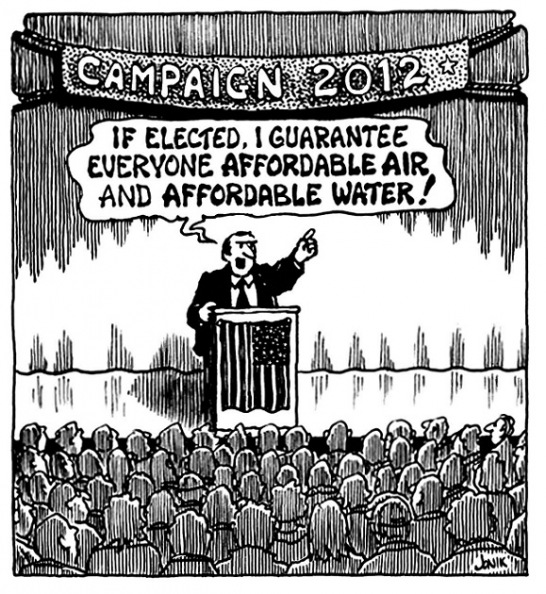
Well then certainly the captains of industry will be intelligent enough to steer us away from this approaching doom. For the love of God! They are corrupted as well! The masses are simply pawns in their game of profit accumulation and market domination! The purpose of the Security and Surveillance State is to protect the interests of the elite and crush dissent! The Earth is just another planet to be commoditized by the ‘Free Market’, a force looked upon as more tangible and important than anything in nature! We’ve constructed a dual reality in which money is more important than air, water, and soil! God help us!!!
My last hope is that I can talk to people about all this scary stuff and maybe get some consolation. For the love of God! They all think I’m a doomsday nut and don’t want to hear about any of it! They say that I’ll be locked up in a mental institution if I keep talking about such crazy things, or I’ll get caught up in the net of Homeland Security for rocking the boat! Everyone is going about their daily lives as if none of what I point out is real and that things will go on as they have in perpetuity! “Technology will solve everything,” they say. “Don’t worry about it!”
You see, I wasn’t kidding about the frights of Halloween being pretty lame when compared to what’s confronting us in the world of globalized industrial civilization.
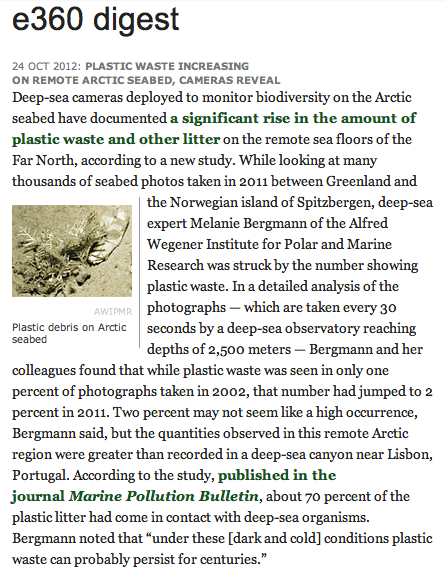
It’s late and I’m about to nod off, but a few headlines caught my eye. The first is on plastics and its growing ubiquitousness in the natural world. If you read an earlier post I did on this subject, then you’ll know that plastics may well be the one thing that will persist long after industrial civilization has passed into the ether of history. Plastics and nuclear waste will be the lasting reminders of carbon man. As the following article explains, this stuff is showing up in the dark, cold depths of the melting Arctic.
Click to go to original article…
In other news, the ominous threat of a cataclysmic global release of methane from ocean floors is continuing to develop, increasing the possibility of runaway climate change…
A changing Gulf Stream off the East Coast has destabilized frozen methane deposits trapped under nearly 4,000 square miles of seafloor, scientists reported Wednesday. And since methane is even more potent than carbon dioxide as a global warming gas, the researchers said, any large-scale release could have significant climate impacts.
Using seismic records and ocean models, the team estimated that 2.5 gigatonnes of frozen methane hydrate are being destabilized and could separate into methane gas and water.
It is not clear if that is happening yet, but that methane gas would have the potential to rise up through the ocean and into the atmosphere, where it would add to the greenhouse gases warming Earth.
The 2.5 gigatonnes isn’t enough to trigger a sudden climate shift, but the team worries that other areas around the globe might be seeing a similar destabilization.
“It is unlikely that the western North Atlantic margin is the only area experiencing changing ocean currents,” they noted. “Our estimate … may therefore represent only a fraction of the methane hydrate currently destabilizing globally.”
The wider destabilization evidence, co-author Ben Phrampus told NBC News, includes data from the Arctic and Alaska’s northern slope in the Beaufort Sea.
And it’s not just under the seafloor that methane has been locked up. Some Arctic land area are seeing permafrost thaw, which could release methane stored there as well.
An expert who was not part of the study said it suggests that methane could become a bigger climate factor than carbon dioxide.
“We may approach a turning point” from a warming driven by man-made carbon dioxide to a warming driven by methane, Jurgen Mienert, the geology department chair at Norway’s University of Tromso, told NBC News.
“The interactions between the warming Arctic Ocean and the potentially huge methane-ice reservoirs beneath the Arctic Ocean floor point towards increasing instability,” he added.
OK that’s enough information to put me soundly to sleep. Wake me up when the ‘Methane Time Bomb’ nightmare is over. The pot starts to boil, but the frogs are still comfortable…
Below is an interesting video documenting the issue of climate change over the last 25 years amongst our ‘talking head’ politicians. It amounts to a lot of lip service while global fossil fuel usage escalates. Could it be that our present way of life just isn’t possible without carbon energy? Without some unforeseen breakthrough in energy and a way to pull CO2 out of the atmosphere, the answer is yes. Current alternative energy sources won’t fill the gap. Can we power down from the globalized industrial economic model to a more sustainable, smaller human-scale economy? Yes, but it would be radically different from what we have now and social power would have to decentralized into the hands of local communities. Even with an environmentally benign energy source, we would still be running into other planetary barriers with our infinite growth economic model.
The “C” Word: Climate Change Goes Missing From 2012 Election:
In this short video, science historian Naomi Oreskes gets at the heart of why we fear withdrawal from our carbon-based way of life.
The price of inaction is obviously too great to ignore – possible runaway climate change, mass starvation, and the collapse of modern civilization. Yet the inertia of the system, corporate dominance of the global economy, and the self-interests of our elite prevent the steps required to avert disaster.
Commodification, economic growth, financial abstractions, corporate power: aren’t these the processes driving the environmental crisis? Now we are told that to save the biosphere we need more of them. ~ George Monbiot
Certainly building personal resilience and preparedness may help you in the short-term, but what about your children and grandchildren? We are all at risk from a global ecological collapse, no matter how big your food vault or how robust your off-the-grid homestead. Getting involved with those who want to change the system is not a waste of time.
Having lived in the Mohave desert for about a decade, I had the dubious pleasure of enduring its scorching summer temperatures which can push 130° Fahrenheit. Without the usual creature comforts of modern industrial civilization like air conditioning, refrigerated foods and drinks, and piped-in water, life is such inhospitable places would be brutal if not impossible. What if such desert heat was the norm across the land surface of the planet? Then extreme places of desert heat like the Mohave desert would become dead zones for any living plant or animal we have known. Instead of peaking at around 130° F, it would reach unthinkable, Venus-like temps of greater than 200° F. Depending on the source you use, the average land surface temperature that we humans have enjoyed is 13° to 17° Celsius or 55.4° to 62.6° Fahrenheit. For the ocean surface, the average is about 17 °C (62.6 F). According to new research concerning the time of the Permian-Triassic Mass Extinction or ‘mother of all extinction events’, there occurred yet another mass extinction within that time span called the Smithian-Spathian extinction in which lethal global warming developed. The average land temperature in the tropics was an unimaginable 122-140°F (50-60°C)with average sea surface temperatures of 104°F (40°C). Such intolerable temperatures resulted in a massive ‘dead zone’ belt around the Earth:
Plant and animal life had it rough 250 million years ago. As if to add insult to injury, the end-Permian mass extinction was quickly followed by yet another mass extinction, what’s called the Smithian-Spathian extinction. New research suggests that the Earth got excruciatingly hot during this period, creating a veritable ‘dead zone’ in tropical areas, what forced the remaining animal life to head to the poles. And it lasted for nearly 5 million years.
According to research done by Yadong Sun and Paul Wignall of the University of Leeds, UK, this was hottest era on Earth since it cooled down from its initial molten formation. Their study has reset notions of just how hot our planet can get — a disturbing bit of insight that could reset current models of climate change on Earth.
The Smithian-Spathian extinction was time that characterized the shift from the Permian era to the Triassic, just before the emergence of the dinosaurs. By this point, the mysterious Permian Extinction had reduced the life on Earth to a select group of insects, plants, marine life (like fish, coral, sea lilies, and ichthyosaurs), and terrestrial animals (like insects and the reptilian tetrapod).
Sun and Wignall’s research indicates that during this time, the heat at the tropical regions reached an astounding 50 to 60°C (122°F to 140°F) on land, while the waters at the surface reached 40°C (104°F). They were surprised to discover that the water could get that hot; previous estimates assumed that sea-surface temperatures could not surpass 30°C (86°F). Moreover, at 40°C, most marine life dies and photosynthesis stops…
…What happened? Essentially, the superhot Earth was caused by a breakdown in global carbon cycling. Normally, plants help regulate temperature by absorbing CO2 and burning it as dead plant matter. But without plants, the CO2 levels rose unchecked, causing a spike in temperatures. Specifically, the researchers estimate that at least 12×103 gigatons of isotopically depleted carbon as methane was injected into the atmosphere…
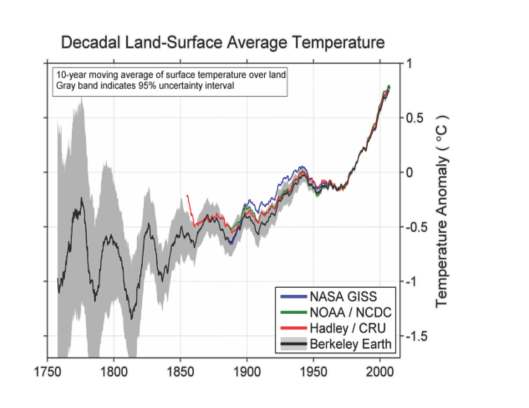
…My total turnaround, in such a short time, is the result of careful and objective analysis by the Berkeley Earth Surface Temperature project, which I founded with my daughter Elizabeth. Our results show that the average temperature of the earth’s land has risen by two and a half degrees Fahrenheit over the past 250 years, including an increase of one and a half degrees over the most recent 50 years. Moreover, it appears likely that essentially all of this increase results from the human emission of greenhouse gases.
These findings are stronger than those of the Intergovernmental Panel on Climate Change, the United Nations group that defines the scientific and diplomatic consensus on global warming…
Are we in the beginning phases of walking headlong into another mass extinction of our own creation, altering the chemistry of the oceans and atmosphere through the burning of fossil fuels? If you’ve been reading this blog, then you know about feedback loops and tipping points and their consequences if humans continue to force changes in the delicate ecosystems of this planet. Monthly reports from the NOAA are not very comforting:
…The average global temperature across land and ocean surfaces during September was 0.67°C (1.21°F) above the long-term 20th century average. This temperature ties with 2005 as the record warmest September in the 133-year period of record. The Northern Hemisphere tied with 2009 as second warmest on record, behind 2005. The Southern Hemisphere also ranked second warmest on record, behind 1997. It was also the highest departure from average for any month in the Southern Hemisphere since May 2010…
The difference between now and 250 million years ago is that profit-seeking corporations were not around to hoodwink the denizens of the planet into perpetuating their own extinction…
…despite its history and today’s unprecedented riches from science, the U.S. has begun to slip off of its science foundation. Indeed, in this election cycle, some 236 years after Jefferson penned the Declaration of Independence, several major party contenders for political office took positions that can only be described as “antiscience”: against evolution, human-induced climate change, vaccines, stem cell research, and more. A former Republican governor even warned that his own political party was in danger of becoming “the antiscience party.
Or the fact that the belief in an unfettered free market has become sacrosanct…
…In order to understand the fervor of this continued popular support for failed policies, it is important to grasp the utopian, quasi-theological nature of neoliberal ideology. In the neoliberal worldview, the self-regulating market is not a merely human construct, but a form of naturally-occurring “spontaneous order” that produces optimum outcomes and maximum individual freedom if left completely unfettered. (13) It is, as Karl Polanyi pointed out in “The Great Transformation,” a radically utopian vision that rests on a blind faith that markets are essentially part of the natural order. (14)
On the political right, this faith has reached its fullest expression, ultimately moving markets into the realm of the sacred, where their legitimacy cannot be questioned. In this utopian setting, regulation is not merely ill advised; it is a violation of natural law that is nearly sacrilegious…
We’re not wiser, just more manipulative and conniving…
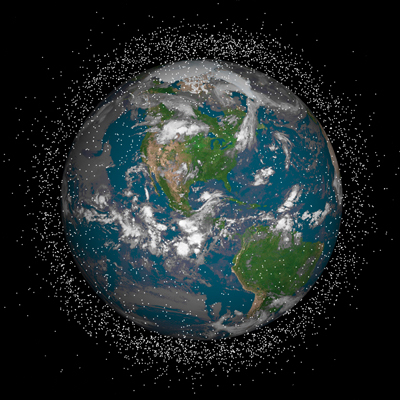
Locked within the Earth for millions of years was an energy source that fueled the rise of Humans and gave them dominion over every last inch of the planet. With traces of industrial chemicals and junk even finding its way into orbit around Earth, no corner of the planet escaped the tinkering hand of man.
His large brain gave him the ability to invent and build an army of machines to do his bidding. From their creation and until the last day of their operation, these fossil fuel-powered machines served man tirelessly in every conceivable manner, from personal transportation to food production.
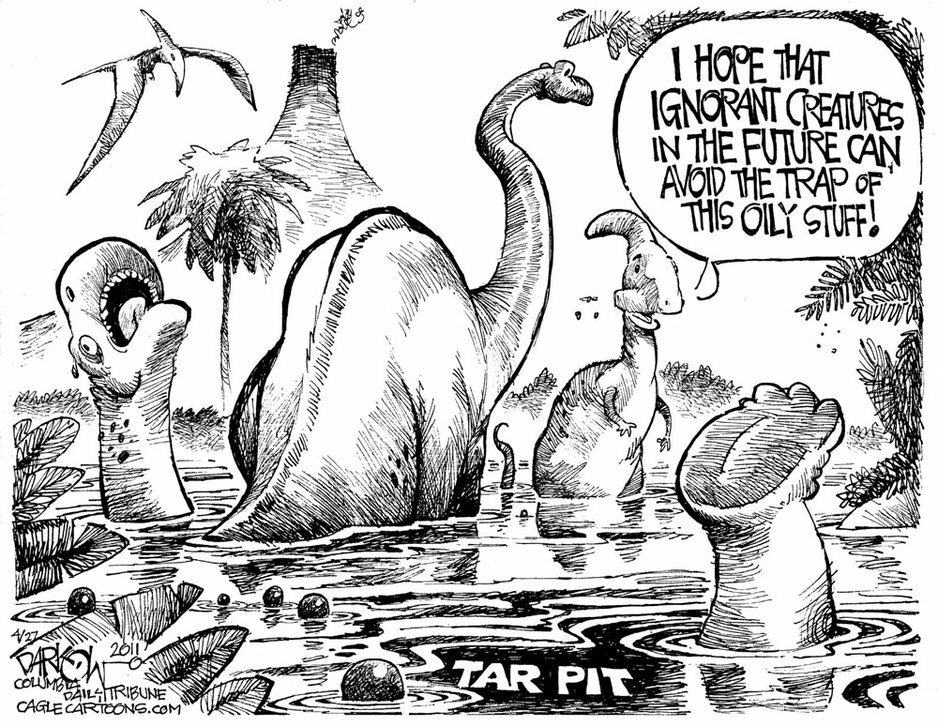
Soon the lifeblood of this automated empire began running short, driving man to evermore extreme measures of securing carbon energy in order to feed his world of machines. Water, air, and land were sacrificed to keep the system going.
But For every force, there is a counter force. For every positive, a negative. The counter weight to man’s unrelenting urge for carbon was the inexorable build-up of atmospheric CO2 as the rest of the world rushed to join industrial civilization. The world’s leaders flew to popular vacation spots and drank cocktails while discussing the growing menace of climate change:
Insanity is doing the same thing over and over again and expecting different results.” That is precisely what global leaders entrusted with the stewardship of the world are doing. Their lives revolve around glittering banquets and long and dreary conferences, where they listen to each other in endless process-driven negotiations – so far from the reality of the day-to-day hardships of more than half of humanity.
A domino of numerous climate tipping points was set into motion, upsetting a once-benign climate. At first, fire seasons grew longer with more frequent and intense conflagrations. Ocean corals turned white from warming waters. The Arctic melted with astonishing speed, unleashing a host of warming feedback loops. Small, imperceptible temperature changes that took decades to occur were now happening more rapidly.
A warming planet opened the door for exotic tropical diseases to spread northward and around the globe. Talk of adaptation to human-induced climate change became a cruel joke. Torrential floods and crop-withering droughts of biblical proportion occurred more regularly, propelling the hungry masses to riot. The food vaults of impoverished countries were the first to be raided, followed soon after by those of wealthy nations. Weaker nation states fell first as their resource-strapped and overwhelmed governments collapsed under the weight of climate-induced starvation and energy blackouts. Various desperate geoengineering schemes were carried out in a hail Mary attempt to save man and his fossil fuel-addicted way of life, but to no avail. The master had become the slave; servile devotion to an unsustainable mode of living turned around to bite us in the ass. An overdrawn Earth had come calling to collect on humanity’s debt and close the account. Within the blink of a geologic eye, the habitability of the planet for humans as well as most other creatures had disappeared.
The following excerpt is from a recent U.N. assessment on the state of the world and food production. It’s not a pretty picture, but despite alarm bells ringing, our trajectory of ecological collapse is still firmly on track…
Click to go to full letter:
The human rights of people and well-being of the planet first? Don’t make me laugh. There’s that oxymoron again – sustainable development. Given the track record of the U.N. on solving problems, rest assured there won’t be any radical ideas coming out of that institution that might threaten capitalism’s death grip on the planet. If there’s no money to be made, resource to be exploited, or economic growth to be had, then it won’t get done. Period.
…From the UK Guardian article discussing the above U.N. assessment:
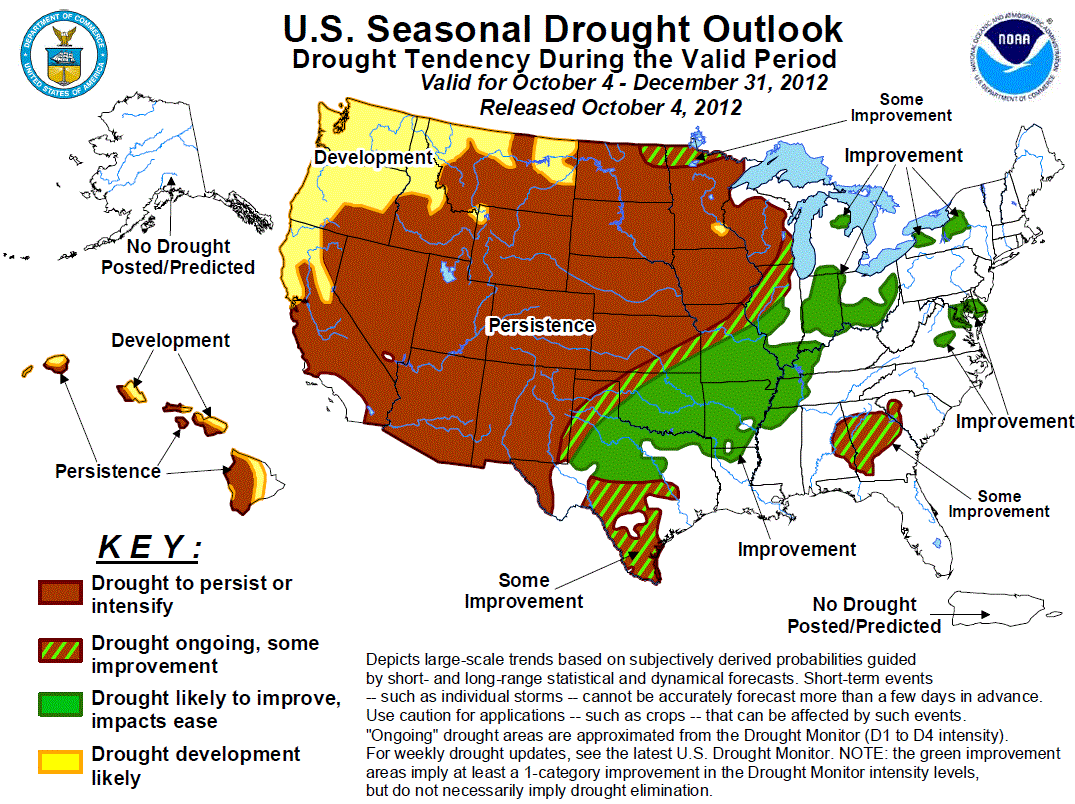
…Failing harvests in the US, Ukraine and other countries this year have eroded reserves to their lowest level since 1974. The US, which has experienced record heatwaves and droughts in 2012, now holds in reserve a historically low 6.5% of the maize that it expects to consume in the next year, says the UN.
“We’ve not been producing as much as we are consuming. That is why stocks are being run down. Supplies are now very tight across the world and reserves are at a very low level, leaving no room for unexpected events next year,” said Abdolreza Abbassian, a senior economist with the UNFood and Agriculture Organisation (FAO). With foodconsumption exceeding the amount grown for six of the past 11 years, countries have run down reserves from an average of 107 days of consumption 10 years ago to under 74 days recently…
…In a shocking new assessment of the prospects of meeting food needs, Lester Brown, president of the Earth policy research centre in Washington, says that the climate is no longer reliable and the demands for food are growing so fast that a breakdown is inevitable, unless urgent action is taken.
“Food shortages undermined earlier civilisations. We are on the same path. Each country is now fending for itself. The world is living one year to the next,” he writes in a new book.
According to Brown, we are seeing the start of a food supply breakdown with a dash by speculators to “grab” millions of square miles of cheap farmland, the doubling of international food prices in a decade, and the dramatic rundown of countries’ food reserves.
This year, for the sixth time in 11 years, the world will consume more food than it produces, largely because of extreme weather in the US and other major food-exporting countries. Oxfam last week said that the price of key staples, including wheat and rice, may double in the next 20 years, threatening disastrous consequences for poor people who spend a large proportion of their income on food…
…“The geopolitics of food is fast overshadowing the geopolitics of oil.”
…“The situation we are in is not temporary. These things will happen all the time. Climate is in a state of flux and there is no normal any more.
“We are beginning a new chapter. We will see food unrest in many more places.
“Armed aggression is no longer the principal threat to our future. The overriding threats to this century are climate change, population growth, spreading water shortages and rising food prices,” Brown says.
Further reading…
Food prices from 1990 to the present…
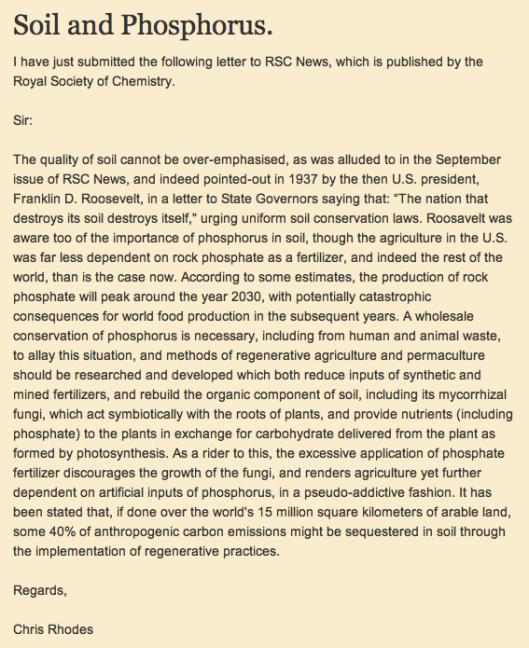
And an open letter(10-12-2012) by Professor Christopher Rhodes on our looming problem of Peak Phosphorus…
Our politicians should be running on a platform of issues concerning basic survival at this point.
Climate change is indisputably anthropogenic – human-made. The long deep-pocketed propaganda, public relations, and lobbying arms of the corporate carbon industrial complex have long insisted that global warming is a reflection of unalterable natural forces that operate independently of human control. But the preponderant majority of the climate-sentient world agrees with the overwhelming consensus finding of contemporary earth scientists that global warming is anthropogenic (“human made”) – that it reflects the visible hand of human practice, politics, and policy. It knows that the story of the world’s broken ecology is about the human release of greenhouse gases resulting from the uncontrolled extraction and use of carbon-based fossil fuels.[8]
The harsh reality has to be acknowledged in elite capitalist media. Reflecting its duty to provide its privileged readers with reasonably accurate information, even the neoliberal, arch-capitalist Anglo-American Economist magazine acknowledges the dominant role of human agency in a recent special supplemental report on “The Vanishing North.” According to The Economist last June, “The shrinkage of the sea ice is no less a result of human hands than the ploughing of the prairies. The cause is global pollution, and the risks it carries are likewise global. The Arctic, no longer distant or inviolable, has emerged, almost overnight, as a powerful symbol of the age of man.”[9]
“Accelerating the Catastrophe”
What do the two dominant U.S. business parties offer towards the goal of saving the planet – well, its living species – from the crisis of anthropogenic global warming? Less than nothing. An escalation of the assault, in fact, making the problem worse.
Writing about the drastic melting of “the earth’s air-conditioner,” Gillis notes a chilling lack of urgency in reacting to the problem the part of rich nation governments, whose “main response has been to plan for exploitation of newly accessible minerals in the Arctic, including more oil.”[10]
Instead of acting to limit greenhouse emissions, those governments see the retreat of the great northern ice cover as an opportunity “to accelerate the catastrophe…The reaction,” Noam Chomsky notes, “demonstrates an extraordinary willingness to sacrifice the lives of our children and grandchildren for short-term gain. Or, perhaps, an equally remarkable willingness to shut our eyes so as not to see the impending peril.”[11] …
…The Republicans and the Democrats both decline to take the great time bomb of climate change[18] with anything remotely like the seriousness it deserves since doing so would disrupt “the economy.” They both worship at the altar of growth and the notion that “a rising tide lifts all boats” – capitalism’s longstanding fake, eco-cidal answer to popular pressure for jobs, and end to poverty, and the downward redistribution of income and wealth.[19] They both refuse to let long-term considerations of livable ecology and human survival interfere with the short-term pursuit of material expansion and the bottom line, not to mention the short-term logic of the election cycle.
I often wonder why people, who know that climate change is real, refuse to discuss it. They refuse to discuss it because it will upset their regimen of making money and carrying along with business-as-usual.
Bill Mckibben was on some late night TV show and he mentioned that the executive of some oil company said that if we need to move our food production north, then we will. Here is why that won’t work. Climate change means widespread famine, wars for dwindling resources, the fall of States, and the final extinction of man. There’s no more pretending that economic growth is possible or even a sane path for us to follow. Yet the system continues on through coerced participation.
I wonder if our forebears from 100 years ago would alter their actions if they knew from scientific and observable evidence that their way of life would cause the extinction of their progeny. Do you think they were more sensible back then? At that time, Edward Bernays and the tools of mass media manipulation had not yet entered society. Are not climate change deniers and free market ideologues the flat-earthers or Salem witch hunters of the 21st century? Feel free to give me an answer if you have one.
If you destroy the oceans, the cradle of life, then they will overtake you, returning you from whence you came…
You don’t want to push the system past those kind of tipping points because, if we do, we leave a situation for our children and grandchildren that will be out of their control. They won’t be able to stop it.
This post is the second in the climate tipping points series. Part one is here. Before getting into some of the other tipping points, I want to mention an excellent new paper, Going to Extremes: Climate Change and the Increasing Risk of Weather Disasters, written by Dr. Jonathan Overpeck, Professor of Geosciences and Atmospheric Sciences at the University of Arizona. It encapsulates a lot of pertinent information explaining the new reality of extreme weather events which humans will have to contend with from here on out.
An excerpt:
Agriculture
Scientists warn that global warming may threaten global food security as the changing climate could fundamentally affect humanity’s collective ability to feed itself. Although an increase in the amount of carbon dioxide in the atmosphere may initially promote plant growth, it does not necessarily translate into more food. Crops tend to grow more quickly in higher temperatures, leading to shorter growing periods and less time to produce grains. However, a changing climate will bring other, more significant hazards for agriculture, including greater water stress and the risk of higher temperature extremes that can quickly damage crops.
Agricultural impacts will vary across regions and by crop. Moderate warming and changes in precipitation are expected to decrease yield in seasonally dry and low-latitude areas. In California, where half the nation’s fruit and vegetable crops are grown, climate change is projected to decrease yields of almonds, walnuts, avocados, and table grapes by up to 40% by 2050.
Scientists have determined that any benefits increased carbon dioxide for some crops will be largely outweighed by negative factors if global temperature rises more than 1.8°F (1.0°C) from late 20th century values. It is expected that for each degree of warming, yields of corn in the United States and Africa, and wheat in India, will drop by 5-15%. In addition, if temperatures rise 9°F (5°C), most regions of the world would experience yield losses and global grain prices would potentially double…
…[The] NOAA recently concluded, after looking through 50 years of weather data, that droughts like the record 2011 Texas drought was made “roughly 20 times more likely” because of global warming. Indeed, observations have shown that certain extremes—high heat, heavy precipitation and floods, duration and intensity of droughts and extremes related to higher sea levels—have increased over the last half of the century.
Continuing on the list of Lenton’s and Schellnhuber’s tipping points…
6.) The Sahara and Sahel in Africa could change dramatically, becoming either far more dry or far more wet, as ocean temperature and vegetation-climate feedbacks change within a decade or so. This is considered an “intermediately sensitive” tipping point with large uncertainty.
Desertification and lower rainfalls with infrequent torrential floods from a warming climate is the clear winner according to studies:
One of the most significant climatic variations in the African Sahel since the late 1960s has been the persistent decline in rainfall. The Sahel is characterized by strong climatic variations and an irregular rainfall that ranges between 200mm and 600 mm with coefficients of variation ranging from 15 to 30% (Fox and Rockström, 2003; Kandji et al., 2006). A rainfall decrease of 29-49% has been observed in the 1968-1997 period compared to the 1931-1960 baseline period within the Sahel region (McCarthy et al., 2001). The West Africa region has experienced a marked decline in rainfall from 15 to 30% depending on the area (Niasse, 2005). The trend was abruptly interrupted by a return of adequate rainfall conditions in 1994. This was considered to be the wettest year of the past 30 years and was thought to perhaps indicate the end of the drought. Unfortunately, dry conditions returned after 1994 (McCarthy et al., 2001).
The rainfall variability in Africa has been studied by numerous authors since the beginning of the recent drought period in the 1970s. Many studies focused on the Sahelian areas ( Farmer, 1988; Lamb & Peppier, 1992; Hulme, 1992). Others also compared Sahelian rainfall with rainfall over other West African and Central Afrcan rregions (Thompson et al. 1985; Buishand, 1984).
Eminent scientist, Sir Gordon Conway, the former chief scientific adviser to the British Department for International Development and the former President of the Rockefeller Foundation said that Africa is already warming up faster than the global average and that the continent will experience a greater amount of intense droughts, floods and storm surges as a result…
…While there are many facets to climate change in Africa, in the case of central Nigeria it is important to look at food, water and migration. The environmental concerns in the Delta region and rising water levels across the south coast present challenges in themselves and would require an article in themselves.
Food crisis
Climate change threatens the ability of West Africa to compete in the global food system. An increase in temperature will undoubtedly reduce yields in a region where the population is set to double within the next two decades. Some projections claim that crop production will drop by 50% within the same timeframe as this population boom.
Nigerian food producers do not have the capacity to deal with such climate or population fluctuations. Consequently food availability in many regions will be dangerously compromised leading to greater competition for resources.
Water crisis
In addition to the concerns of food production, the availability of water in the Sahel reached crisis levels several times in recent years. In 2010 the region suffered a widespread famine, partially as a result of water shortages, and is now in the midst of an ongoing drought that has affected 18 million people.
Debates continue to rage over the future of Sahelian water as some project a decrease in rainfall of 40 percent in a region beset by drought already. Others have posited that rainfall may increase the Sahel but that such a change would likely lead to an infestation of locusts the like of which have been destroying farmland in Mali and Niger in recent weeks. When the rains do arrive the cities in the region are often unable to deal with them, evidenced by yesterday’s lethal flooding in Jos which has killed at least 35 people.
While future projections of waterfall vary, there is no doubting the present and impending threats from desertification.
Desertification is the most egregious form the temperature increase has taken as much of the Sahel is already suffering from climate-induced drought. Approximately 1,350 square miles of Nigerian land turns to desert each year. To put it in perspective, that is over twice the size of Greater London becoming impossible to farm each year. This leads to both farmers and herdsmen having to abandon their homes to move to an area with more abundant resources.
Migration crisis and conflict
Encroaching deserts do not merely mean water scarcity and a threat to food security but also mass migration. The direct competition for resources has the potential to become more acute in several regions of Nigeria and beyond in West Africa.
An example would be the millions of Malians and Burkinabes in Cote d’Ivoire as a result of the Sahelian droughts of the 1970s and 1980s. When the use of migrant labour lost its appeal to Cote d’Ivoire amidst the conflicts of the 1990s it set the course for outside interests to have a major impact on internal conflicts. Migration disputes continue between the two countries to this day including a substantial impact upon the Ivorian crisis of 2010-11.
As the Sahel continues to dry up as a result of climate change, the land can no longer support the animal stocks required by herders to survive. Since the only useful land to the herders is to the south of the desert, they move their herds towards the agricultural regions populated by sedentary farmers. Naturally, the destruction of crops by the herds creates tensions between those moving the animals and those who struggle to grow enough food for themselves in an increasingly unforgiving climate.
The policy solutions up to this point have focused on short-term political factors leading to knee-jerk responses to the violence. Communities in Ghana, Burkina Faso and Nigeria have expelled Fulani herders. The existential threat is forcing the Fulani to fight back.
A refusal to acknowledge the role that climate change has played in the region has led to a failure of governance. Such forced relocations are merely postponing the problem for a future government rather than trying to fix it. In this sense the agricultural policies in Nigeria have become a microcosm for climate policy.
In the case of Nigeria poor governance as a result of political short-termism has exacerbated the food crisis, the catalyst for migration issues. Until the 1970s agriculture made up 60% of Nigeria’s GDP. Since then technological stagnation, myopic policies and corruption have turned the country into a net importer at a cost of $150 billion each year. The $500 million allocated to agriculture in the 2012 budget could be enough to facilitate the needs of the country if spent wisely. Some have even argued that Nigeria has the capacity to be the breadbasket for the whole of West Africa.
Politics of inaction
Political short-termism has blighted Plateau State both in terms of local politicians and the global response to climate change. The sudden explosions of conflict in the region have been predicted for decades. Despite the upsurge in brutal violence, the policies remain largely the same.
With roughly 40% of Africa now affected by desertification, solutions will have to come soon. One such solution is the ‘Green Wall’, a wall of trees 4,300 miles long and 9 miles wide stretching across the African continent from Senegal to Djibouti. The idea has been advocated by West African leaders for over 30 years but has only now been realised.
Erecting walls has rarely provided a long-term solution to conflict. It is unlikely to do so for climate change.
7.) The El Nino Southern Oscillation, occurring across the tropical Pacific Ocean roughly every five years, refers to patterns of warming and cooling in the Pacific Ocean that affect weather worldwide. It could within 100 years change to a persistent warm or cool pattern, or change so that warm El Nino patterns are more intense, leading to more intense droughts in some areas, and likelihood of flooding elsewhere. This is considered an “intermediately sensitive” tipping point with large uncertainty.
Kevin Trenberth, Senior Scientist in the Climate Analysis Section at the National Center for Atmospheric Research (NCAR), suggests that we are seeing changes in El Nino:
There’s another elephant in the room: the long-term influence of greenhouse gases. “In my view, El Niño and La Niña are very likely changing as a consequence of climate change, but such changes cannot be measured when you get only one event every three to seven years,” says Trenberth. “The natural variability is enough to make it impossible to determine a climate change signal.” Still, he adds, when it comes to El Niño and La Niña, it’s best not to assume that past performance is any guarantee of future results.
8.) The Atlantic thermohaline circulation (THC) is a global 3-dimensional belt of ocean currents that transports large amounts of heat and freshwater around the world. In the North Atlantic, it manifests in a meridional overturning circulation (AMOC) which, through its northward transport of warm tropical waters by the Gulf Stream and North Atlantic Current, ensures these warm waters reach Europe.
The THC could collapse within 100 years as warming of the oceans alters water density and disrupts the global circulation of the seas. This is considered a “lowly sensitive” tipping point, with intermediate uncertainty.
from ‘Abrupt Climate Change‘ (Lead Author: Thomas L. Delworth,* NOAA Geophysical Fluid Dynamics Laboratory, Princeton, NJ):
…AMOC and the likelihood of future changes in the AMOC in response to increasing greenhouse gases, including the possibility of abrupt change.
We have five primary findings:
• It is very likely that the strength of the AMOC will decrease over the course of the 21st century in response to increasing greenhouse gases, with a best estimate decrease of 25-30%.
• Even with the projected moderate AMOC weakening, it is still very likely that on multidecadal to century time scales a warming trend will occur over most of the European region downstream of the North Atlantic Current in response to increasing greenhouse gases, as well as over North America.
• No current comprehensive climate model projects that the AMOC will abruptly weaken or collapse in the 21st century. We therefore conclude that such an event is very unlikely. Further, an abrupt collapse of the AMOC would require either a sensitivity of the AMOC to forcing that is far greater than current models suggest or a forcing that greatly exceeds even the most aggressive of current projections (such as extremely rapid melting of the Greenland ice sheet). However, we cannot completely exclude either possibility.
• We further conclude it is unlikely that the AMOC will collapse beyond the end of the 21st century because of global warming, although the possibility cannot be entirely excluded.
• Although our current understanding suggests it is very unlikely that the AMOC will collapse in the 21st century, the potential consequences of such an event could be severe. These would likely include sea level rise around the North Atlantic of up to 80 centimeters (in addition to what would be expected from broad-scale warming of the global ocean and changes in land-based ice sheets due to rising CO2), changes in atmospheric circulation conditions that influence hurricane activity, a southward shift of tropical rainfall belts with resulting agricultural impacts, and disruptions to marine ecosystems.
9.) The Indian summer monsoon, which is needed to sustain crops, could collapse anytime as land-to-ocean pressure gradients change with pollution and warming patterns. That could lead to an “erratic” fluctuation that would “chaotically change between an active and a weak phase.” This is considered an “intermediately sensitive” tipping point with large uncertainty.
THE dizzying midday heat of India’s northern plains cracks the earth. Farmers slump on the charpoys on which they sleep outdoors. It should be raining, yet the sky is clear. Prithi Singh, lean and wrinkled, says his entire rice crop has withered, along with fields sown for fodder. After two summers of erratic and delayed monsoons, this year the rains simply failed…
The monsoon months, June to September, bring three-quarters of India’s annual rainfall. Official studies show it to be erratic in four out of every ten years. Yet farmers rarely get any useful warning of shortfalls. As recently as late June, India’s meteorologists were predicting a normal monsoon. Punjab and Haryana, two north-western agricultural states, now say rains are about 70% below average.
Six western states have issued drought warnings.
The government in Delhi says it may soon offer emergency help. The country remains predominantly rural: over 600m out of 1.24 billion Indians rely directly on farming. Nearly two-thirds of Indian fields are fed only by rain. A one-off drought is tolerable. Rural job-creation schemes have lifted incomes for the poorest. Food prices have only started to creep up. Granaries are overflowing, thanks to recent bumper crops.
What is disturbing, though, are tentative signs of long-term change to the summer rains. A less stable monsoon pattern would be harder to predict. It would arrive late more often, yield less water, become more sporadic, or dump rain in shorter, more destructive bursts (which happened two years ago in Pakistan, where the Indus basin disastrously flooded). The concerns of experts about the monsoon long predate today’s dry spell.
Too little is known about summer weather systems on the subcontinent. India is short of observation stations, weather planes, satellites, climate scientists and modellers. The government and foreign donors are scrambling to make amends. But even with better data, monsoons are ill-understood once they leave the sea or low-lying land. At altitude, notably, for instance, approaching the Himalayas, it is far trickier to grasp just how factors such as wind direction, air pressure, latent heating and moisture levels interact to deliver monsoon rains.
One trend looks clear: India has grown warmer over the past six decades. Glaciers are melting in the Himalayas, and orchards in the range’s valleys are being planted on ever-higher slopes in search of a temperate climate. Crops in the northern grain belt, notably wheat, are near their maximum tolerance to heat, and so are vulnerable to short-term blasts of higher temperatures. North India’s cities are also growing hotter.
How more warmth affects the monsoon is not straightforward. A land mass heating faster than the oceans will, in theory, draw in more moisture to produce heavier monsoons. Yet the reverse appears to be happening. Specialists who met in February in Pune, in Maharashtra state, reported a 4.5% decline in monsoon rain in the three decades to 2009.
India’s leading climate modeller, R. Krishnan, of the Indian Institute of Tropical Meteorology in Pune, points to a study showing a “steady decline” in rainfall on the Western Ghats, which run down the west coast. A Japanese model that he has applied to southern India predicts that a still more rapid decline in rainfall is likely.
Such a fall may matter little for states such as Kerala in the south, which gets a monthly drenching of 50 centimetres (20 inches) during the wet season. But Mr Krishnan notes other changes, notably evidence that far fewer depressions have formed in the Bay of Bengal, off India’s east coast, in recent summers. Since these help drive rain to India’s arid northern plains, he concludes that “there is every reason to be concerned about the monsoon.”…
…Yet a decline in average rainfall may not be the main worry. Experts who met in Delhi in May to discuss climate-induced “extreme events” in India suggest that likelier threats include more short and devastating downpours and storms, more frequent floods and droughts, longer consecutive dry days within monsoons, more rapid drying of the soil as the land heats, and a greater likelihood that plant and animal diseases might spread.
It does not bode well for farmers, or for crammed cities with poor sewerage and other rotten infrastructure. Slums and coastal cities look especially vulnerable. Mumbai was overwhelmed in 2005 when nearly a metre of rain was dumped on the city in 24 hours.
Such events will happen more often, the highest official in the country’s environment ministry warns. He wants urgently to bring about a big increase in insurance schemes that spread weather-related risks. Rajendra Pachauri, who leads the United Nations’ Intergovernmental Panel on Climate Change, worries that India is not yet even seriously debating the new threats. He says it is ill-prepared for floods and droughts “that are now considered once-in-every-20-years events, but will be happening once in two years.
Part three of climate tipping points will be posted in a week or two.
“Capitalism has the innate genius of being inexorably driven to destroy everything it encounters, in order to turn it into money. ‘Creative destruction’ -the creation of money through the destruction of life. It is reaching its absolutely inevitable apotheosis now.”
~ Mulga Mumblebrain
Capitalism has unleashed the real weapon of mass destruction…

















 Collapse of Industrial Civilization