• About

Collapse of Industrial Civilization

~ Finding the Truth behind the American Hologram

Collapse of Industrial Civilization

Category Archives: Collapse of Industrial Civilization

Tending What Remains

27 Thursday Aug 2026

Posted by xraymike79 in Collapse of Industrial Civilization, Mental Health

≈ 9 Comments

Tags

Anticipatory Grief, Climate Adaptation, Climate Collapse, Climate Grief, Climate Justice, Collective Care, Degrowth, Ecological Collapse, Human Finitude, Industrial Civilization, Mutual Aid, Political Ecology

When the Pretense Breaks

There is a moment, familiar to anyone who has loved a dying person, when the pretense becomes impossible to sustain.

You have been speaking in the future tense. You have been making plans for next summer, discussing restaurants you will try, books you will read together, places you might visit when things improve. The language of continuation has been a kindness—a membrane stretched thin over the unbearable.

Then one afternoon the light falls differently. The dying person looks at you, and the future leaves the room. Not because anyone has said so. Because the knowing has become louder than the not-knowing, and the words you have been using have started to sound obscene.

What happens next is not despair.

It is something stranger: a terrifying relief. The air in the room changes. You can finally speak about what is actually happening. The distance between language and reality closes, and for the first time in months, you are together in the same world.

I think about it because something larger is dying too, and we are all in the room, still making plans for next summer.

The End of the Arrangement

What is ending is not the Earth, nor even life in its vast, indifferent persistence. What is ending is a particular human arrangement with the world.

Earth is older than our species, older than our languages, older than every god and empire we have invented to make our briefness bearable. It has endured asteroid impacts, supervolcanic winters, and the great oxygenation event that poisoned much of the early life then living upon it. It has passed from ice to greenhouse and back again. Long after the last human city has fallen silent, it will continue turning beneath this middle-aged sun, altered by us but not dependent on us.

The atoms that make up our bodies will not vanish with our temporary arrangements. They will enter soil, water, ash, roots, insects, oceans, and air. They will go on without our names, our markets, our plans, or our idea of history.

What is ending is a set of conditions that allowed eight billion humans to eat, move, build, dream, and make plans for next summer.

These conditions are not natural in the sense of permanent or guaranteed. They belong to a brief industrial interval—roughly three centuries, a blink in the human story, the thinnest slice of time in the life of the species. They depend on burning ancient sunlight stored beneath the earth; on treating the atmosphere as a dump; on fisheries that replenish themselves, aquifers that refill, topsoil that remains where it is, and a climate that stays within the narrow range in which our crops know how to grow.

They depend, in other words, on conditions we have spent three centuries undermining.

This is not a prediction. It is a diagnosis. The patient is already symptomatic. The question is not whether the fever will come, but how high it will climb—and what we will become in the burning.

The Knowledge We Refuse

I used to believe ignorance was the obstacle. Now I think the deeper obstacle is a more deliberate kind of not-knowing: the practiced ability to absorb unbearable facts without allowing them to make demands on us.

I thought that if people understood the science, they would act. The problem, I believed, was translation—making the data vivid enough to pierce the membrane of daily life. We needed better charts, better metaphors, better spokespeople. We needed to reach the part of the human heart that numbers could not reach.

I spent years in that faith. I watched it produce conferences, declarations, corporate sustainability reports: a vast apparatus of self-serving insufficiency.

And the emissions kept rising.

Not because people did not know. The knowing is everywhere now. It saturates the culture like background radiation. Children learn about climate change before they learn long division. Executives invoke it on quarterly calls while announcing plans to expand production. Politicians speak its name while approving new extraction zones. The knowledge has become a kind of wallpaper—present, acknowledged, and incapable of changing the shape of the room.

The problem is not that we lack information. It is that we have learned to live beside information that should make our old lives impossible.

We know what burning fossil carbon does to the atmosphere. We know what heat does to crops, oceans, bodies, grids, forests, and water. We know that a finite planet cannot sustain infinite material expansion. We know that every efficiency gain becomes, under an economy organized around growth, an invitation to consume more.

Yet knowing has not become action because the systems through which we live are designed to convert knowledge into delay.

An economy organized around perpetual growth is structurally resistant to contraction, even when contraction becomes necessary for survival. A political system governed by four-year cycles struggles to meet crises that unfold over decades and centuries. A culture that has made consumption a measure of identity, freedom, and success cannot easily choose sufficiency. A global supply chain optimized for efficiency has little slack, little redundancy, and little capacity to absorb shocks.

These are not simply failures of personal will. They are structural properties. The machine is working as it was designed to work. The tragedy is that its design is incompatible with the conditions that make human flourishing possible.

We have built a civilization that mistakes acceleration for control.

The instruments still glow. The engines still answer. The road still seems to run ahead of us. But the steering wheel no longer turns, and most of us are still arguing over the music.

When Denial Exhausts Itself

What do you do when you understand this?

The first instinct—at least it was mine—is to fight harder. More activism. More urgency. More letters, more marches, more attempts to seize the wheel that is not there.

The second instinct, when the fighting does not work, is to withdraw. To build a bunker, literal or psychological. To secure your own survival and let the world burn. To become what the preppers have always been: people who look at their neighbors and decide they are acceptable losses.

The third instinct is despair. Not active self-destruction, but a gray resignation: the slow leak of meaning from daily life. The sense that nothing matters because nothing can be done; that caring is naïve; that the only honest posture is ironic detachment from a future already written off.

I have lived in all three places. The fighting was exhausting. The withdrawal was lonely. The despair was boring.

And then, gradually, I began to find a fourth thing. I do not have a good name for it. It is neither hope as an expectation that things will turn out well, nor acceptance as passive surrender.

It is more like what happens when you stop pretending.

When you stop treating every warning as a problem someone else will solve. When you stop requiring reassurance before you permit yourself to grieve. When you stop measuring the worth of an action by whether it can guarantee a happy ending.

The future does not become less dangerous. The fires do not reverse. The waters do not rise back into their banks. But something in you becomes less divided. You no longer have to spend so much energy holding reality at a distance. You can look directly at what is happening and still choose what to love, what to protect, what to repair, and what to refuse.

Reality does not become merciful. But it becomes inhabitable again: the only place from which a life can be lived, and the only place from which anything can still be changed.

When Tending Is Not Enough

Last summer, during the third week of smoke season, I watched my neighbor repair an irrigation line.

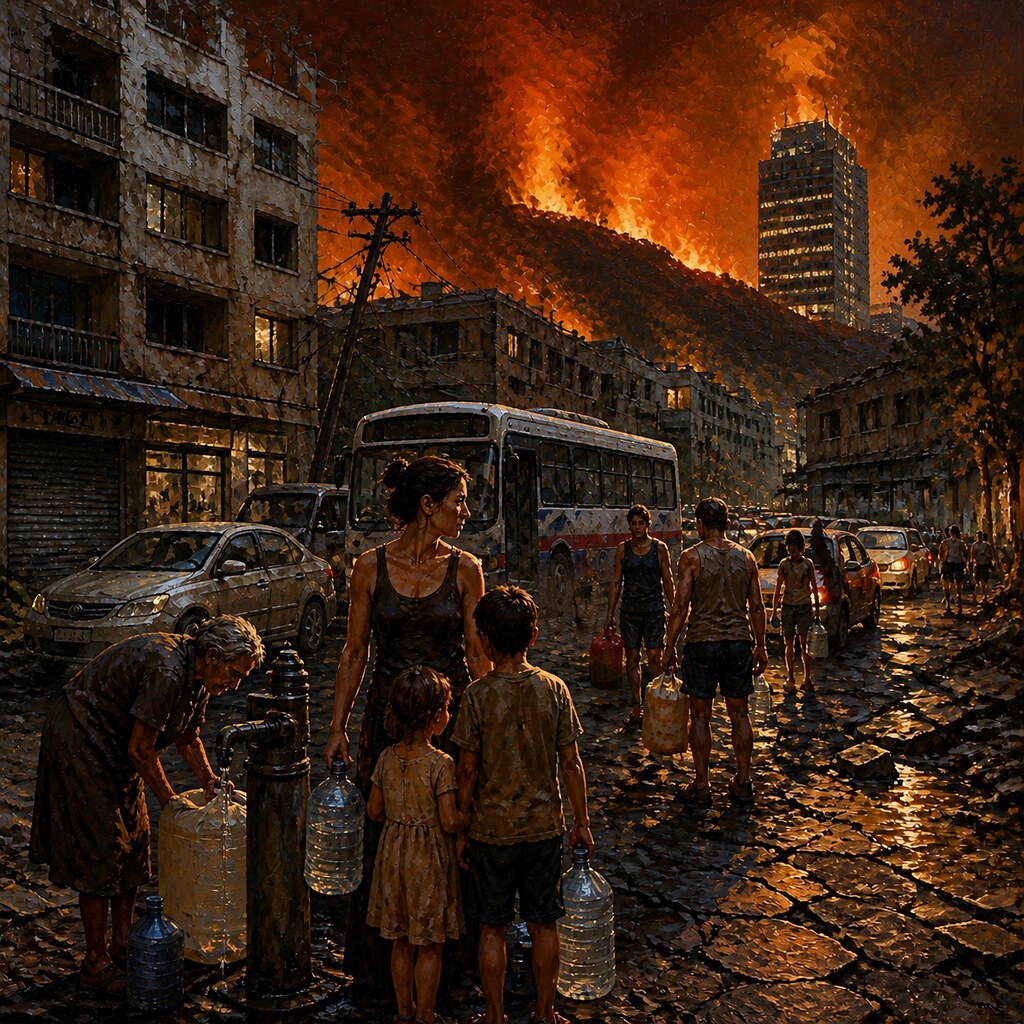
The air quality index was above 300. The sky was the color of a bruised peach. Ash fell on the lettuce beds. The forecast showed no relief for another ten days, and the long-range models suggested this would be the new August, every August, from now on.

She was kneeling in the dirt, wrapping tape around a cracked fitting, sweat cutting lines through the grime on her face.

I asked her why she bothered. The water table was dropping. The growing season was shifting. Half of what she planted that year had bolted or failed.

She looked up at me, squinting.

“What else would I be doing?”

Not a justification. Not an argument. Just a statement of fact about what a life contains when you stop waiting for the conditions to be right.

The line got fixed. The garden got watered. The tomatoes that survived were small and sweet, warm from the smoke-dimmed sun, and tasted like something worth staying alive for.

Yet that was not the same as being saved.

The water still came from an aquifer falling faster than winter could restore it. The smoke did not lift. The heat did not loosen its grip on the fields. There were people in the city who had no garden to lose, no yard in which to kneel, no spare hour to repair what was breaking. There were people whose bodies had already made the calculation for them: the old, the ill, the exhausted, the poor, the ones working two jobs beneath a sky they could not afford to leave.

Care is not a substitute for justice. A repaired pipe is not a public water system. A shared meal is not housing. Love cannot cool an apartment when the power fails, or bring an ambulance through a flooded road.

Sometimes there is no noble answer. Sometimes the work is done and someone is still lost. Sometimes you carry water and arrive too late.

This is the part no ethic can redeem. It is also the part that makes the ethic necessary. We do not tend because tending guarantees an outcome. We tend because abandonment is an outcome too.

What the Fire Leaves

None of this means the consequences are equal, or that nothing can be changed.

They are not. The difference between a world warmed by two degrees and one warmed by three is not an abstraction. It is crops that fail or do not fail; heat that kills or does not kill; coastlines defended or surrendered; forests that burn once or burn until they cannot return; people displaced from homes, and people who remain. Every fraction of a degree carries bodies inside it.

But we should stop speaking as if the task were to preserve any semblance of the world as it was.

That world has already begun to leave us. Many losses are locked in. The ice will continue to melt. The seas will continue to rise. The seasons will continue to become less reliable. Places built for a climate that no longer exists will become harder, and in many cases impossible, to defend. There will be retreats that ought to have been planned years earlier, migrations treated as emergencies because they were denied the dignity of preparation, and forms of suffering that exceed what most of us have prepared ourselves to imagine.

The question is not whether we can keep every floor of the building from burning.

We cannot.

The question is whether we allow the fire to become an excuse for deciding that only the penthouse is worth saving.

That is where politics still enters. Not as a promise of restoration, but as a struggle over distribution: who receives water, housing, medicine, cooling, food, evacuation, repair, and the right to remain somewhere safe. It is a struggle over whether the last functioning systems are treated as common necessities or as assets to be guarded by those wealthy enough to purchase insulation from the damage.

Individual preparation has its place. Practical competence, durable tools, access to medical supplies, local knowledge, and relationships of reciprocal care can reduce immediate vulnerability. But none of these constitutes a private exit from collapse.

A stocked pantry may carry a household through a short disruption, but it cannot answer the political question of who eats when disruption becomes the condition of ordinary life. A garden does not replace a hospital. A solar panel does not replace a public grid. No family, however prepared, can construct a livable future behind a locked gate while the society around it comes apart.

The Slow Violence of Adaptation

We cannot know the exact sequence of failures, but we should not mistake uncertainty for gentleness. Complex systems do not decline with dignity. They fray, fail, recover partially, and fail again—usually after people have already used up their savings, their health, their patience, and the small margins that once made a setback survivable.

A place may appear to endure for years while its foundations are quietly removed. The clinic remains open, but no longer through the night. The school still operates, but without a nurse, a counselor, or reliable cooling. Water still comes from the tap, but only intermittently, at a higher price, or with another warning to boil it. The bridge is still standing, though freight can no longer cross it. The supermarket is still lit, though shelves empty faster and food costs more than the people nearby can afford.

Then one season brings heat, fire, crop failure, flood, disease, or a disrupted supply route, and all the deferred damage arrives at once. The disaster is not only what nature does. It is the moment a society discovers that its capacities for care, repair, and rescue have been consumed by debt, privatization, austerity, and neglect.

The people caught inside such failure will not experience it as an abstract systems problem. They will experience it as an inhaler that cannot be refilled, an ambulance that does not come, an eviction notice after a flood, an elderly parent dying in an overheated apartment, a child drinking unsafe water, a family leaving home with nowhere affordable to go.

Some things will prove more durable than expected. Others will vanish with shocking speed. The deepest terror is that abandonment will be renamed adaptation, and carried out with the calm calculations of cost, risk, and return.

What a Life Is For

I have a friend who plants trees.

One summer, she planted fifty young trees along a riverbank. By September, most had died. Their leaves had crisped at the edges, then fallen. The irrigation lines meant to water them lay dry in the dirt.

I asked her whether she would plant again.

She looked out at the thin surviving row. “Of course,” she said. “They were alive.”

Not ‘they are alive now.’ Not a resolution—an acknowledgment of what had already been lost.

In an age that has made everything conditional, care refuses to let uncertainty decide the limits of love.

Beyond the riverbank, someone is waiting for water.

The Weight of Finitude

The oldest stories understood what modern life tries to forget: mortality does not make action meaningless. It gives action weight.

Gilgamesh searches for immortality, fails, and returns to the city he built. The heroes of old fought knowing they would die, not because death could be overcome, but because mortality made their choices irrevocable. A life that ends still asks what it was spent in service of.

Our civilization has made a religion of deferral: growth without end, technological salvation, the assumption that someone will invent something just in time.

Now the deferral is ending.

The systems have resisted every change proportionate to the danger. But they are not the whole of what exists. Underneath them—inside them, despite them, in their cracks and margins—there are still people who love their children, tend gardens, care for neighbors, make art for no reason, tell the truth when lying would be easier, and refuse to abandon the shipwrecked even when rescue seems unlikely.

These people may not save the world. The industrial civilization that has defined modernity may not be salvageable.

But there is something else to do besides rescue it.

There is being human in it.

What the Plague Will Take

I think often about the people who stayed in cities during plagues. Not those who had no choice, but those who could have fled and did not: nurses, gravediggers, priests who continued hearing confessions, merchants who kept selling bread, neighbors who checked the sick and carried the dead away.

They did not save their cities. The plague took what it took. Many of them died.

What they preserved was not a noble abstraction. It was the fragile machinery of human dependence: a cup of water carried upstairs, a door opened, a fever watched through the night, a body washed, a child fed after everyone else had gone. They kept ordinary obligations alive after ordinary life had become impossible.

This is not a call to martyrdom. No one is morally required to become a sacrifice for a failing world. But we are responsible for the choices fear makes tempting: whether to hoard what might be shared, to avert our eyes from suffering we cannot solve, to permit cruelty because it arrives dressed as necessity.

In a time of breakdown, decency may not look heroic. It may look like staying present when withdrawal would be easier; refusing the small corruptions by which fear turns other people into threats, burdens, or statistics; remembering that another person does not become less human when there is not enough left to save them.

The plague will still take what it takes. The question is what it will be permitted to take from us before it does.

The armies are coming. They have always been coming. Entropy does not hate us. It does not need to. It waits without malice, and in the end it is always fed.

The old gods knew this. Every harvest was a bargain with winter. Every house was built against the dark. Every fire was kept through the night by hands that understood it would someday go out.

We have mistaken our brief shelter for a victory. We have mistaken the walls for the world. But the walls will fall. The names we gave ourselves will thin in the mouths of those who follow, then vanish altogether.

Still, the fire asks to be kept.

Not forever. Nothing is kept forever. But tonight.

Tonight, the cracked fitting is wrapped in tape.
The tomatoes are still warm beneath the smoke.
Somewhere, an inhaler is waiting to be refilled.

There is water to carry. There is bread to divide. There is a door that must be opened before the cold gets in. There is someone calling from the other side of the dark.

We know enough of how this ends. No one will be untouched by its consequences, though they will not be borne equally. Whole ways of life will vanish. Species will go silent. The maps will change, and the future will inherit a poorer earth. What comes for us has been walking toward us since before the first fire was struck from stone.

But the hour has not yet closed.

So let us be difficult to extinguish. Let us be faithful to the small light. Let us make of our hands a shelter, of our mouths a truth, of what remains a meal shared among strangers.

Not because it will save us.

Because the last light still belongs to the living.

Share this:

  • Share on Bluesky (Opens in new window) Bluesky
  • Tweet
  • Share on Tumblr
  • Share on Mastodon (Opens in new window) Mastodon
  • Share on Reddit (Opens in new window) Reddit
Like Loading...

How Far Has Tech-Authoritarian State Capture Advanced?

26 Wednesday Aug 2026

Posted by xraymike79 in Collapse of Industrial Civilization, Mental Health

≈ Leave a comment

Tags

Algorithmic Accountability, Artificial Intelligence Governance, Civil Service, Climate Collapse, Corporate Power, Data Infrastructure, Defense Technology, Democratic Backsliding, Digital Authoritarianism, Emergency Governance, Executive Power, Immigration Enforcement, Long Emergency, National Security State, Political Economy, Public Procurement, Social Inequality, State Capture, Surveillance Capitalism, Tech Authoritarianism

The Architecture of Control

The political project described in Gil Durán’s The Nerd Reich and Jacob Silverman’s Gilded Rage is no longer best understood merely as an aspiration to subordinate government to a Silicon Valley faction’s will. It has achieved meaningful, though incomplete, institutional power: through executive action, public procurement, AI deployment, immigration enforcement, defense contracts, donor access, and attacks on the independent civil service. It has advanced fastest where presidential directives, procurement authority, and discretionary enforcement can move quickly; it is less successful where courts, federalism, public resistance, fiscal constraints, technical failure, and the sheer complexity of governing impose limits.

The immediate danger is not a fully consolidated techno-dictatorship. It is a government increasingly reorganized so that public authority serves a narrow fusion of executive power, national-security priorities, extraction, venture-backed technology, and ideologically aligned wealth—while democratic oversight and public-serving capacity weaken. Evidence from democracy monitors, federal actions, AI procurement, and immigration technology indicates that this shift is well underway.

Here, “advance” does not mean total control over the state. It means measurable movement in four areas: political control over administration, integration of private technical systems into coercive functions, public underwriting of favored technology sectors, and erosion of democratic checks and avenues for challenge.

The project’s advance can be measured in concrete institutional changes. The administration created Schedule Policy/Career, transferring roughly 8,000 policy-influencing career positions into a new excepted-service category and substantially weakening incumbents’ civil-service protections, making removal easier. It has used federal leverage to challenge state-level AI regulation, including an executive order on a national AI policy framework allowing agencies to condition discretionary grants on states’ agreement not to enforce AI rules deemed inconsistent with national policy. At the same time, private technology firms are becoming embedded in coercive government functions: ICE awarded Palantir contracts to develop and maintain ImmigrationOS, a system designed for enforcement targeting, self-deportation tracking, and more efficient removal logistics. Meanwhile, the Army granted Palantir a ten-year enterprise agreement with a ceiling of up to $10 billion, consolidating about 75 existing software and data contracts into a single procurement channel. These developments do not demonstrate that a single company or faction controls the government. They demonstrate something more durable: public administration is being reorganized around executive loyalty, proprietary technical infrastructure, and private firms whose commercial interests increasingly align with the state’s surveillance and immigration-enforcement priorities and, as one advocacy analysis argues, its wider military-security architecture.

The Project: Not Abolishing Government, But Changing Its Purpose

The language of Silicon Valley’s anti-state right can be confusing because it often celebrates “exit,” decentralization, crypto, private cities, deregulation, and freedom from bureaucracy. But the most influential version of this politics does not actually seek the disappearance of government. It seeks a state with different priorities and different beneficiaries.

Its priorities are more visibly concentrated in border enforcement, defense technology, energy and data buildout, and deregulation than in labor enforcement, environmental protection, social provision, or an independent professional civil service. The governing model favored by this coalition concentrates state capacity in securing borders, purchasing surveillance tools, funding defense technology, protecting favored investment sectors, expanding energy and data infrastructure, and shielding favored industries from regulation. By contrast, it has been more willing to weaken or subordinate the institutions and protections that constrain concentrated power: labor enforcement, environmental safeguards, AI regulation, public housing, social insurance, an independent professional civil service, and democratic checks on executive and corporate authority.

That is the bridge between Gil Durán’s The Nerd Reich and Jacob Silverman’s Gilded Rage. Durán explains the ideological vocabulary: elite sovereignty, technological destiny, the rejection of democratic equality, the fantasy of “exit,” and the apocalyptic promise that disruption will liberate superior individuals from public constraints. Silverman supplies the institutional and material account: tech wealth converts itself into political donations, personnel networks, land acquisition, defense contracting, data infrastructure, and privileged access to executive power.

The result is not a government captured by one company or one billionaire. It is a coalition project. Its participants do not agree on every issue, and their interests can conflict. But they share a broad preference for executive speed, weak regulation, anti-union policy, technological acceleration, national-security spending, immigration enforcement, and an administrative state made more vulnerable to the removal or marginalization of officials able or willing to resist presidential directives and corporate influence.

What Has Already Changed

By the available evidence, the movement has advanced furthest in four interlocking areas: control over administrative capacity, the expansion of surveillance and immigration enforcement, public subsidization of AI infrastructure, and the weakening of democratic checks.

1. The civil service is a central battlefield

A democratic state requires more than elections. It requires an administrative apparatus that can deliver services, preserve expertise, enforce law consistently, and resist being transformed into the personal instrument of a president or donor class. That is why the federal workforce is such a strategic target.

Staff reductions, hiring constraints, agency restructuring, and efforts to expand political control over policy-influencing roles do more than shrink government. They can alter what government is able to do. A state that loses inspectors, scientists, engineers, public-health workers, benefits administrators, attorneys, and regulators may remain powerful in coercive domains while becoming incapable of providing reliable services or enforcing obligations against powerful private actors.

The administration has openly treated the federal workforce as an object of executive remaking. Independent measures of American democratic health have registered sharp deterioration: Pew Research summarized multiple indices showing that the United States’ 2025 democratic ratings reached recent or historic lows; Freedom House rated the country at 81 out of 100, citing legislative dysfunction, executive overreach, restrictions affecting expression, and efforts to weaken anticorruption safeguards.

This does not mean that the civil service has been entirely conquered. Federal workers retain legal protections; courts can block unlawful action; agencies possess institutional memory; unions, whistleblowers, inspectors general, journalists, and state governments can still expose abuses. But the project does not require absolute conquest to succeed. It only needs to make resistance harder, expertise scarcer, enforcement less independent, and policy more vulnerable to executive command.

2. The immigration system is becoming a test case

The clearest example of technology serving coercive state power is immigration enforcement. Here, the abstract language of “AI,” data integration, and operational efficiency becomes concrete: systems identify people, prioritize targets, merge datasets, guide field operations, and scale detention or removal decisions.

Palantir’s role is especially revealing. ICE’s longstanding sole-source relationship with the company had already exceeded $145 million before the expansion of ImmigrationOS, a platform intended to support enforcement operations, including target identification, self-deportation tracking, and removal logistics. Separately, reporting on Palantir’s ELITE tool indicates that it draws on government data to identify and prioritize enforcement targets through advanced analytics, generating dossiers and address-confidence assessments for people potentially subject to arrest or deportation. Together, these systems illustrate how immigration enforcement is being reorganized around proprietary data infrastructure: political decisions about whom to pursue are translated into technical processes that are difficult for the public to inspect, contest, or appeal.

This is not simply a technical upgrade. It changes the operational scale of enforcement. A government that combines commercial data, databases, predictive or prioritization tools, facial-recognition systems, license-plate-reader networks, and broad administrative discretion can make immigration control more pervasive, rapid, and difficult to challenge.

The civil-liberties issue is not that computers make mistakes—though they do. It is that technical systems can convert political decisions into administratively opaque processes. Who is designated high priority? What data are used? What errors are tolerated? How can a person know they have been flagged? Can they correct the record? Who is accountable when a system directs state attention toward the wrong person? The risk is not hypothetical. In 2026, Kimberlee Williams spent six months in jail after Maryland police relied on a faulty facial-recognition match to identify her as a suspect; she was later identified as the fourteenth publicly known person in the United States wrongfully arrested after police reliance on the technology. The case exposes the accountability vacuum at the center of algorithmic enforcement: when a technical system directs state attention toward the wrong person, responsibility can be dispersed among the agency that supplied the data, the officers who acted on it, the vendor whose system produced the lead, and the officials who authorized its use.

The same basic danger extends beyond immigration. Once infrastructure exists to assemble personal information, identify targets, and automate prioritization, its techniques can migrate across institutional domains. The Electronic Frontier Foundation notes that algorithmic decision systems already shape consequential decisions made by police, courts, public agencies, employers, landlords, and insurance companies, often with insufficient transparency or meaningful recourse for affected people. This does not guarantee universal repression; it identifies the architecture through which selective enforcement can become routine, portable, and difficult to contest.

3. AI is being installed before democratic governance catches up

The AI agenda is perhaps the movement’s most consequential long-term achievement. The federal government is not merely adopting a few productivity tools. It is rapidly creating procurement pathways, cybersecurity partnerships, defense deployments, scientific-data integrations, and administrative systems that make private AI firms integral to public power.

A tracker maintained by the Revolving Door Project reported nearly 3,000 AI uses across 29 federal agencies in 2025—an increase of more than 75 percent over 2024. It describes AI’s use in analyzing sensitive data and delivering public services, raising the prospect that some functions previously handled by public employees may be automated or supplemented. Tech Policy Press reported that the Pentagon rolled out Google’s Gemini for Government as its largest generative-AI deployment to date, while the IRS began rolling out Salesforce’s Agentforce; it also noted an executive order directing federal agencies to challenge state AI regulations deemed “onerous.”

The administration’s AI-security initiatives explicitly envision closer collaboration between government and industry. A June 2026 White House fact sheet announced mechanisms for AI-enabled cybersecurity tools and services across federal agencies, state and local authorities, critical-infrastructure operators, and “trusted partners,” while resisting mandatory licensing, pre-clearance, or permitting for the development and distribution of AI models.

There are defensible reasons for governments to use advanced computing. Cybersecurity, scientific research, accessibility, medical analysis, fraud detection, and emergency logistics can all benefit from accountable tools. The issue is governance: whether the technology is transparent, auditable, appealable, privacy-protective, publicly accountable, and deployed only where its risks are justified.

The present direction favors speed, industry access, centralized technical power, and national-security framing. It risks producing a government that becomes dependent on proprietary systems it cannot fully inspect, explain, or replace. That is a form of structural capture. A contractor need not dictate every policy if agencies become operationally reliant on its infrastructure, personnel, data architecture, and definitions of risk.

4. Public resources are underwriting private technological power

The most basic contradiction of the tech-right program is that it profits from the public systems it disparages. SpaceX, Palantir, cloud providers, chip manufacturers, AI laboratories, defense startups, and surveillance companies all depend, in varying degrees, on public research, contracts, subsidies, energy systems, land, legal protection, and security policy.

The emerging arrangement is not laissez-faire capitalism. It is a form of state-backed technological corporatism: public risk, private ownership, public procurement, private data infrastructure, and national-security justification.

The scale matters. The administration’s policies have increasingly described AI dominance as a national priority, which turns private-sector buildout into a public mission. Analysts have warned that an “AI First” strategy embeds AI expansion in the bureaucracy, uses public procurement to reinforce the industry’s business model, and frames military and surveillance demand as necessary to win a geopolitical race.

This is exactly the transformation that Gilded Rage anticipates. A venture-capital and defense-tech ecosystem does not remain on the outside of the state, selling optional products into a neutral market. It becomes a governing partner, shaping which problems are legible, which solutions are funded, and whose expertise becomes indispensable.

How Well Is The Project Going?

The short answer is: better than its critics should be comfortable admitting, but much less completely than its supporters may imagine.

It is progressing rapidly because its actors have three advantages.

First, they possess concentrated wealth. Political donations, super PACs, think tanks, legal organizations, media ownership, lobbying networks, and personal relationships can influence agendas before the public ever votes on a policy.

Second, they possess institutional access. Technology companies supply systems the government increasingly believes it needs for defense, cybersecurity, intelligence, logistics, communications, AI research, and administration. This access becomes more powerful under an executive branch that treats regulation as a barrier rather than a democratic safeguard.

Third, they possess an emergency narrative. China, immigration, “wokeness,” crime, bureaucratic inefficiency, AI competition, energy scarcity, and national decline can all be presented as crises requiring speed, discipline, deregulation, security contracting, and obedience to technologically fluent elites.

But the project has profound weaknesses.

The Elites Cannot Escape Material Reality

The Long Emergency supplies the material limit on elite fantasies of control. A government can expand surveillance, automate paperwork, enrich contractors, militarize borders, and build data centers. It cannot automate its way out of water scarcity, extreme heat, ecological degradation, failing infrastructure, supply-chain fragility, public-health crises, or the social breakdown produced by inequality.

Complex societies depend on trust, skilled labor, public health, repair capacity, education, stable communities, energy systems, water, food, housing, and legitimate institutions. A regime that weakens these foundations while concentrating resources in defense, extraction, and private technological infrastructure may gain short-term command while making the underlying society less governable.

This is the central contradiction of selective protection. Elite enclaves, secure facilities, private security, air conditioning, data centers, and alternative jurisdictions can provide temporary insulation. They cannot independently reproduce the broad social and ecological conditions necessary for a sophisticated society to function. The people who build, maintain, transport, teach, heal, clean, farm, repair, and govern remain necessary.

Courts, States, and Civil Society Still Matter

American institutions have been damaged, but they have not disappeared. Federal courts, state governments, local governments, nonprofit organizations, unions, investigative journalism, university researchers, public-interest lawyers, civil servants, and organized communities retain real capacity to contest executive action.

This resistance is uneven. It is expensive, slow, and often defensive. But it matters. Federalism prevents total uniformity. Courts can delay or invalidate actions. State privacy, labor, environmental, and consumer-protection laws can constrain some forms of corporate power. Local resistance can obstruct private-city schemes, surveillance programs, and infrastructure projects. Public backlash can alter the political price of extremism.

The struggle is not between omnipotent elites and powerless citizens. It is between a highly organized coalition with exceptional resources and a fragmented but still substantial architecture of democratic resistance.

Corporate Interests Are Not Identical

Silicon Valley is not one party. Defense contractors, consumer platforms, chip companies, cloud providers, crypto firms, AI labs, electric-vehicle manufacturers, venture funds, and social-media companies have overlapping but not identical interests. Some benefit from deregulation; others need stable public investment, international markets, skilled immigration, research universities, grid reliability, and consumer confidence. Nationalist trade policies, political chaos, resource shortages, and international conflict can harm the very businesses that seek influence.

This makes the coalition powerful but unstable. Its members may share hostility toward regulation and democratic constraint, yet they disagree about how much state intervention they want, where public money should go, which technologies should dominate, and how much instability they can tolerate.

The Deeper Measure of Success

The project’s success should not be measured solely by whether a particular executive order survives review, a contract is awarded, or a billionaire’s preferred candidate wins an election. Its deeper success would be cultural and institutional: making it seem natural that technology companies should govern public functions, that the public sector should depend on proprietary systems, that democratic deliberation is an inefficient obstacle, that social protection is fiscally unrealistic, and that security requires ever more surveillance.

That normalization is already far advanced. The language of “innovation,” “efficiency,” “AI leadership,” “national competitiveness,” and “security” often narrows the range of imaginable alternatives. Questions about rights, worker power, privacy, environmental limits, public ownership, due process, and democratic control can be dismissed as nostalgic, naïve, anti-technology, or hostile to national strength.

That is why Durán’s ideological history matters. The essential political victory is not merely creating a private city or installing an AI system. It is convincing the public that those things are inevitable and that resistance itself is irrational.

What Remains Unresolved

The project has not solved its core dilemma: it wants the benefits of a complex, stable, technologically advanced civilization while weakening the public institutions, ecological safeguards, and social reciprocity that make such a civilization possible.

A government increasingly shaped by billionaire networks and defense-tech priorities may become highly capable of monitoring, sorting, and coercing people amid chronic scarcity. Yet it may remain unable—or unwilling—to secure the material preconditions of a livable society: housing, health care, clean water, affordable energy, climate adaptation, and institutions people can trust. In an era of cascading climate shocks, fiscal strain, displacement, and deteriorating public systems, that imbalance is not merely a policy failure. It creates the conditions for permanent emergency governance, in which surveillance and selective enforcement substitute for social provision, and instability becomes something to contain rather than resolve.

The most realistic danger is not a seamless, all-powerful technocratic regime. It is a brittle and unequal order: technologically advanced in protected sectors, highly capable of sorting, monitoring, and coercing targeted populations, yet increasingly unable to sustain the ordinary conditions of collective life.

That is the authoritarianism most compatible with the Long Emergency. It does not offer broad prosperity or stable normality. It offers defended enclaves of privilege, automated administration of scarcity, and harsher containment for people and places the system cannot—or chooses not to—protect.

Share this:

  • Share on Bluesky (Opens in new window) Bluesky
  • Tweet
  • Share on Tumblr
  • Share on Mastodon (Opens in new window) Mastodon
  • Share on Reddit (Opens in new window) Reddit
Like Loading...

The Nerd Reich and Gilded Rage: Silicon Valley, Authoritarian Power, and the Long Emergency

25 Tuesday Aug 2026

Posted by xraymike79 in Collapse of Industrial Civilization, Mental Health

≈ Leave a comment

Tags

Artificial Intelligence, Authoritarianism, Charter Cities, Climate Adaptation, Climate Breakdown, Corporate Power, Cyberlibertarianism, Defense Technology, Democratic Erosion, Digital Fascism, Elite Exit, Long Emergency, Network States, Political Economy, Silicon Valley, State Capture, Surveillance Capitalism, Tech Oligarchy, Technological Sovereignty, Venture Capital

The Machinery of Selective Survival

The age of dependable normality is ending. Heat, fire, flood, debt, insurance withdrawal, failing infrastructure, ecological loss, and political violence do not arrive as one final catastrophe; they accumulate, shock by shock, until recovery itself becomes a privilege. As the material foundations of ordinary life grow more brittle, the danger is not only that institutions will fail, but that they will continue to function selectively—protecting wealth, territory, data, and private enclaves while the public absorbs the smoke, heat, displacement, and loss. In such a world, technology is not a neutral instrument of progress. It can become the machinery through which abandonment is made efficient, dissent is managed, and survival is rationed.

The Nerd Reich: Silicon Valley Fascism and the War on Democracy by Gil Durán and Gilded Rage: Elon Musk and the Radicalization of Silicon Valley by Jacob Silverman examine the same transformation from complementary angles: the emergence of a technology elite that no longer regards democracy as a shared political achievement, but as a system to evade, capture, or redesign in its own interest.

Durán traces the ideology behind this shift: Ayn Rand’s cult of the exceptional producer, cyberlibertarian hostility to government, cryptocurrency’s promise of escape from public authority, AI accelerationism, private cities, and network states. Silverman shows how those ideas gain practical force through venture wealth, campaign finance, defense contracting, surveillance systems, land speculation, and the absorption of tech power into the machinery of the state. Together, the books reveal more than a collection of eccentric billionaire obsessions. They describe a political culture increasingly willing to subordinate democratic equality to wealth, technical authority, national-security power, and the prerogatives of the “builders.”

The Ideology Behind the Glamour

Durán’s greatest strength is genealogical. The Nerd Reich demonstrates that Silicon Valley’s reactionary turn did not begin with generative AI, cryptocurrency, Elon Musk, or a recent election. Its underlying ideas have circulated for decades.

Ayn Rand supplied one of its moral vocabularies. In her fiction, the “men of the mind” are burdened by an inferior and parasitic majority; taxation and regulation become violations of individual excellence; social obligation becomes a form of theft. In Atlas Shrugged, capitalist elites withdraw from society and allow it to collapse, proving their supposed indispensability. The fantasy is not merely that talented people deserve freedom. It is that the social world may need to be broken before the talented can rule it properly.

Cyberlibertarianism updated this drama for the digital age. Networks, encryption, digital money, and computation were imagined as tools that could make the territorial state obsolete. In the rhetoric surrounding early digital culture, cyberspace appeared as a sovereign domain beyond the reach of taxation, labor law, democratic regulation, and ordinary political obligation. Yet this vision depended on a profound historical evasion: the internet was materially enabled by public investment, military research, universities, and collective infrastructure, even as its new elites increasingly recast it as private territory.

The result was not a theory of democratic decentralization. It was a theory of insulation: freedom defined as release from obligation to the people whose labor, taxes, institutions, and infrastructure made technological wealth possible.

Apocalypse for the Affluent

The Nerd Reich is especially sharp in its account of The Sovereign Individual by James Dale Davidson and William Rees-Mogg, a book influential among parts of the technology and investment elite. The book predicted that computing, automation, cryptography, and digital money would undermine nation-states and free a new class of wealthy, mobile, technically sophisticated people from democratic constraints.

Its program was not collective preparation for disruption. It was private exit: offshore assets, alternative citizenship, protected enclaves, private security, and investment strategies meant to profit from instability. Citizenship becomes a liability; democracy becomes a failing legacy system; public security becomes a privilege reserved for those wealthy enough to insulate themselves from the society that sustains them.

That is why apocalyptic thinking matters so much in The Nerd Reich. The politics it describes does not simply predict disorder. It turns disorder into a legitimating myth. If public institutions falter, the failure can be read as proof that democratic life is obsolete and that a superior class deserves greater autonomy. Crisis becomes a marketing strategy, a moral alibi, and a rationale for hierarchy.

The Nerd Reich’s deepest moral accusation is that this ideology treats the insecurity of others as an occasion for elite self-emancipation. Its adherents need not cause every disaster to gain from a world in which public institutions are unable to provide security. Once fear of disorder, migration, inflation, technological change, or war becomes pervasive, private authority can market itself as the only remaining form of competence.

The State Is Not Abolished

One of The Nerd Reich’s most important corrections is directed at the libertarian self-image. The real objective is not necessarily a world without government. It is a world in which government no longer functions as a democratic counterweight to concentrated private wealth.

Tech-right rhetoric celebrates decentralization, exit, deregulation, and freedom from bureaucracy. Yet its most consequential actors seek influence over the actual machinery of the state: defense contracts, surveillance systems, administrative data platforms, AI policy, energy policy, immigration enforcement, public procurement, and electoral politics. The Nerd Reich’s portrait is not of entrepreneurs withdrawing from power but of capital moving into the control room.

Technology matters politically because it can disguise power as impartial calculation. An algorithm may seem less ideological than a public official, a risk score less coercive than a police order, and a “smart” administrative system more rational than democratic deliberation. Yet each system embodies prior decisions: who supplies the data, what outcomes are optimized, which mistakes are tolerated, whose claims can be appealed, and which private interests profit from its use.

The danger is therefore not science-fiction machine rule. It is familiar inequality hidden inside technical systems. A platform used to evaluate workers, assign public benefits, identify immigration targets, guide policing, or classify citizens by risk does not eliminate politics. It embeds political choices in infrastructure that is often difficult for the public to inspect or contest.

The Security State and Frontier

Gilded Rage strengthens The Nerd Reich by showing how Silicon Valley’s authoritarian politics acquire institutional force. If The Nerd Reich explains the ideology of elite exit, Gilded Rage shows that the tech class is not actually leaving the state. It is moving into some of its most coercive and lucrative functions.

Silicon Valley has always had a public and military history. Its development was shaped by Cold War defense research, intelligence funding, government procurement, universities, and public investment. The present alliance of venture capital, AI firms, surveillance contractors, and national-security institutions is therefore not an aberration. It is a revival—and intensification—of a long relationship between technological innovation, military power, and private profit.

This history exposes the limits of the libertarian story. The same actors who denounce government bureaucracy often depend on government contracts, legal protections, subsidies, infrastructure, research capacity, market access, and enforcement power. Their objection is not to the state itself. It is to a state that taxes their wealth, regulates their industries, protects labor, limits surveillance, enforces civil rights, or permits democratic majorities to decide technology’s social purposes.

The likely goal is selective government: expansive state capacity for defense, border enforcement, data collection, corporate subsidy, and policing; diminished public capacity for housing, health, labor rights, climate adaptation, and redistribution. The democratic state is not dismantled so much as reorganized around elite security and corporate opportunity.

Gilded Rage’s treatment of Palantir and the wider defense-tech boom helps make this concrete. Data platforms, AI systems, surveillance tools, and military technologies can be sold as neutral improvements in efficiency or national security. But their deployment necessarily involves political decisions: who is classified as suspicious, which communities are monitored, which military objectives are prioritized, what harms are acceptable, and whether affected people retain meaningful rights of appeal. Technical systems do not remove politics; they can make political power harder to see and harder to challenge.

Silverman also supplies a useful corrective to the glossy imagery of charter cities and network states. In Gilded Rage, these proposals revive an old frontier myth: supposedly empty territory awaits visionary founders, innovation requires exceptional legal zones, and communities standing in the way become obstacles to acquisition or management. But land is never empty. It has residents, ecosystems, water constraints, civic institutions, property claims, and histories of dispossession.

The conflict surrounding California Forever in Solano County illustrates the point. A secretive, billionaire-backed scheme assembled land for a proposed new city while many local residents experienced secrecy, legal pressure, uncertainty over water and infrastructure, and the impression that their community was expected to yield to an investor-led plan. The basic issue was not whether California needs housing. It was whether residents possess equal authority to decide their region’s future, or whether capital can accumulate land, law, media access, and political influence until public consent becomes a procedural formality.

A city is not an app, and its inhabitants are not merely users, customers, workers, or inputs. A city is a political community. If it is governed by corporations or designed around the prerogatives of investors, democratic membership becomes conditional.

AI and the New Hierarchy

The Nerd Reich’s discussion of artificial intelligence is among its most urgent sections. Durán rejects the industry’s portrayal of AI as a neutral productivity tool or an inevitable stage of progress, asking instead who owns the systems, who supplies their data, who performs their hidden labor, who bears their environmental costs, and who decides where they are deployed.

This is not an argument against every beneficial application of computation. AI can support accessibility, scientific research, medicine, public communication, and administrative work when it is transparent, accountable, and governed in the public interest. The book’s objection is to the claim that a small number of private firms may impose consequential systems across schools, workplaces, culture, medicine, government, and warfare while portraying democratic oversight as an irrational hindrance to progress.

AI’s immediate hazards need not involve a mythical superintelligence. They include job displacement, disinformation, fraud, surveillance, intellectual-property extraction, corporate concentration, environmental resource demands, and military use. The industry’s promise to liberate people from drudgery can also provide employers with new instruments to remove workers, intensify monitoring, and evade accountability for automated decisions.

AI thus fits The Nerd Reich’s broader account of Silicon Valley ideology. It centralizes command while being marketed as empowerment. It promises democratized knowledge while depending on extraordinary concentrations of capital, data, computing capacity, energy, and legal protection. It reframes the transfer of social decision-making from public institutions to private platforms as an unavoidable technical upgrade.

The Long Emergency as Context

The Long Emergency provides the material context that makes the political vision exposed in The Nerd Reich and Gilded Rage especially dangerous now. A period shaped by climate disruption, insurance retreat, strained public systems, rising essential costs, unequal mobility, and recurrent emergency governance creates an opening for elite projects that promise private competence in place of democratic solidarity.

Gilded Rage shows how that promise can move beyond ideology. Defense contracts, surveillance infrastructure, donor networks, regulatory influence, land acquisition, and the conversion of public crisis into private opportunity can turn elite preference into public policy.

The danger is not only that the wealthy may pursue bunkers, enclaves, private cities, or alternate jurisdictions. It is that they may use democratic institutions while hollowing out their democratic purpose—maintaining or expanding state capacity for surveillance, security, extraction, borders, and corporate subsidy while public capacity for housing, health, labor protections, climate adaptation, and social insurance is allowed to weaken.

In an era of recurring shocks, that is not withdrawal from government. It is the conversion of public authority into a system that protects some lives while managing, disciplining, or abandoning others.

The Long Emergency’s central question—whether the remaining capacities of society will protect life-support systems for the many or private insulation for the few—therefore shadows the political world described in The Nerd Reich. A class that regards citizenship as a burden, public regulation as tyranny, and democratic institutions as obsolete is profoundly unprepared for a century in which resilience depends on shared infrastructure, mutual obligations, durable public institutions, and long-term collective planning.

The Fascism Question

The Nerd Reich uses an intentionally incendiary title, but “fascism” should not be reduced to a casual insult for libertarian economics, corporate influence, technological enthusiasm, or an authoritarian temperament. Historically, fascist movements combined a cult of national renewal and the leader, contempt for pluralism, scapegoating of internal enemies, political intimidation and violence, and the use of state power to remake society along hierarchical lines.

The question, therefore, is not whether the United States has become a duplicate of Mussolini’s Italy or Hitler’s Germany. It plainly has not, and historical analogy becomes useless when it ignores differences of time, institutions, and scale. The question is whether recognizable fascist dynamics are being adapted to contemporary conditions: executive power treated as personal authority; elections accepted only when they affirm the leader’s will; disfavored groups and political opponents cast as internal enemies; public institutions purged or bent toward ideological loyalty; and private wealth, media, data platforms, police power, and military force aligned behind a politics of permanent emergency.

That is the danger Durán identifies. In the current American form, authoritarianism need not arrive through a single-party state, uniformed street militias, or an announced end to constitutional government. It can advance through emergency orders, administrative purges, selective enforcement, politicized surveillance, border militarization, billionaire-funded political networks, and technologies that sort, monitor, exclude, and discipline people at scale.

The point is not that Silicon Valley is reproducing the past exactly. It is that authoritarian politics adapted to a digital, financialized, climate-disrupted century may arrive without the uniforms and party rituals of an earlier era. It may speak instead through optimization, disruption, national security, innovation, and technological destiny—while using data systems, private capital, emergency powers, and state coercion to decide who is protected, who is monitored, and who can be abandoned.

Verdict

The Nerd Reich is a fierce, disquieting, and necessary work of political interpretation. Its prose is polemical, but the polemic serves a legitimate purpose: it refuses to let “technology” operate as a euphemism for an emerging class of privately empowered governors.

Its most enduring question is ethical. A society cannot confront shared crises if its most powerful members imagine themselves exempt from shared fate. The problem is not ambition, innovation, or private enterprise as such. It is an ideology that treats public obligation as weakness, democratic consent as inefficiency, and social disorder as the price—or the opportunity—of elite liberation.

Read alongside Gilded Rage and the Long Emergency framework, the book reveals a broader pattern. A technologically armed business class does not need to abolish the state in order to dominate it. It can use wealth, contracts, data systems, political patronage, cultural grievance, and emergency rhetoric to transform public authority into an instrument of selective protection.

The future question is not whether sophisticated technology will survive in isolated sectors or protected enclaves; it likely will, at least for a time. The harder question is whether technological power can help sustain public systems amid climate disruption, resource strain, and cascading institutional failure—or whether it will chiefly furnish the wealthy with temporary insulation while the ecological, institutional, and social conditions that make complex society possible continue to erode.

Share this:

  • Share on Bluesky (Opens in new window) Bluesky
  • Tweet
  • Share on Tumblr
  • Share on Mastodon (Opens in new window) Mastodon
  • Share on Reddit (Opens in new window) Reddit
Like Loading...

Humanity After the End: A Review of The Dog Stars

22 Saturday Aug 2026

Posted by xraymike79 in Collapse of Industrial Civilization, Mental Health

≈ 2 Comments

Tags

American Fiction, Apocalyptic Literature, Civilization And Collapse, Climate Grief, Dystopian Fiction, Ecological Elegy, Ecological Loss, Environmental Literature, Grief And Memory, Human Connection, Intimacy, Literary Criticism, Moral Injury, Pandemic Fiction, Peter Heller, Post-Apocalyptic Fiction, Resilience, Solitude, Survival, The Dog Stars

The World After Touch

Peter Heller’s The Dog Stars is haunted not merely by death, but by the obscene fact that the world goes on after what ought to have ended it. Its deepest terror is not the plague or the gunfire; it is survival after the beloved, the familiar, and the living world have become memory.

The novel is often read as post-apocalyptic fiction, but that term makes catastrophe sound too clean. Apocalypse suggests a conclusion: a final rupture, a last broadcast, a curtain falling over history. Heller gives us something worse. The world does not end. It remains. Roads weather in the sun. Houses stand empty. The airfield still holds its planes. Streams go on moving over stone. The mountains keep their terrible beauty. But the people are gone, and the trout are gone, and the future that once organized ordinary life has been erased.

What remains is not emptiness. Emptiness would be merciful. What remains is a landscape still beautiful enough to injure you.

The World After Plague

Hig, the novel’s grieving narrator—a former writer and pilot living at an abandoned Colorado airfield after a pandemic—lives in a world defined not by the moment of collapse, but by the daily labor of continuing afterward. The pandemic has passed through the country like fire through dry grass, and what it leaves behind is not merely depopulation. It leaves a damaged moral universe. A person cannot look at a stranger without seeing a possible threat. A cough, a fever, a body by the road, a figure approaching across open ground—each becomes uncertain evidence. Is this someone to help? Someone to flee? Someone who will kill you? Someone who will infect you?

The plague has done more than remove people from the world. It has made other people strange.

Before catastrophe, the human body is ordinarily a place of recognition. A hand on the shoulder. A lover turning toward you in sleep. A child leaning against a parent. A stranger accepted into the warmth of a house. These gestures are so ordinary that they become invisible. We do not understand how much civilization depends upon them until disease makes contact dangerous.

In The Dog Stars, breath becomes suspect. Fever becomes accusation. Blood becomes a boundary. The body is no longer simply where another person lives; it becomes a possible weapon, a reservoir of infection, a danger to be measured before it can be mourned or embraced. This may be the novel’s most intimate horror. The world has not only lost its people. It has lost the innocence of being near them.

Hig’s grief begins with Melissa—his beloved wife, lost to the pandemic and still the defining absence in his life—but it does not end with her death. It is grief for the vanished ordinary world in which one could touch without calculation. The house, the bed, the remembered life of shared meals and casual conversation become unbearable because they preserve the shape of what intimacy once was. The plague takes a wife, but it also destroys the assumptions that made love seem safe from the world.

The Perishable Earth

Yet the novel’s grief extends beyond the human. Hig mourns the trout. He mourns the altered forests, the vanished birds, the wrongness of seasonal change. The natural world in The Dog Stars is not scenery against which human tragedy plays out. It is itself a wounded participant.

The disappearance of trout from streams warmed beyond their tolerance becomes one of Heller’s most devastating images. A troutless creek may still be a beautiful creek. It may still run cold enough to touch, still shine beneath trees, still carry insects on its surface. But to Hig it has become a broken relationship. The fish are absent, yet their disappearance is not abstract; they persist in memory as a living measure of what the creek—and Hig himself—has lost.

This is how climate grief enters a life. Not only through statistics, maps, and scientific reports, though those have their proper force. It enters through recognition: the first year a stream falls too low; the bird missing from the morning; the forest that burns twice before it can regrow; the snow that arrives late, disappears early, or does not come at all. We call these events environmental change because the phrase is technical enough to hold at a distance. But they are losses. They are absences with shape.

The cruelty is that the world remains beautiful. Smoke can turn an evening sky magnificent. A dead forest can glow in snowlight. A green patch of surviving trees can feel almost holy because so much around it has died. Heller’s world is saturated with this doubleness: death within life, life within death, beauty intensified rather than erased by ruin.

That doubleness is not sentimental. It is what makes the loss bearable and unbearable at once. If the world became ugly when it was damaged, perhaps turning away would be easier. But it does not. The creek keeps talking. The mountains keep taking light. The living tree, the single bird, the clean patch of water become almost intolerably precious.

The Labor of Staying

Hig survives by attending to small things. Fuel. Seeds. Water. A radio. The condition of an engine. The movement of a figure across open ground. The body of the dog beside him. His days are made from maintenance, and maintenance becomes a form of prayer.

This is one of the novel’s quiet prophecies. In a damaged world, life contracts into its essential verbs: carry, mend, plant, store, watch, bury, return. The grand abstractions—progress, growth, convenience, national destiny—fall away. One discovers that civilization was never really an edifice of glass and steel. It was always the accumulated work of hands: someone repairing a pump, someone saving seed, someone making a fire, someone knowing how to keep the sick alive through the night.

Hig’s airplane—the cream-and-blue Cessna 182 Skylane he calls the Beast, an old aircraft at the Erie municipal airfield where he takes refuge after the pandemic—is both liberation and memento mori. It lifts him above the ruined land, granting a momentary freedom from grief, yet every flight is constrained by dwindling fuel, mechanical fragility, weather, and the knowledge that no system remains to replace what fails. The Beast is not a promise of the future, but a finite inheritance from the past.

So, too, is the garden. So, too, is the solar panel, the stored food, the gun, the radio, the scavenged part. Each object must be used carefully because it cannot be assumed to return. The great luxury of the old world was not merely abundance. It was the belief that replacement was normal.

Hig’s rituals of repair therefore become acts of resistance against entropy. He cannot restore the old world. He cannot bring Melissa back. He cannot cool the streams or make the lost animals return. But he can keep a machine alive for another day. He can put a seed in the ground. He can feed Jasper. He can make a meal. He can keep the smallest part of the world from falling immediately into silence.

Jasper and the Human Animal

Jasper, Hig’s aging blue-heeler mix and closest companion at the airfield, is the novel’s great counterforce to the plague. He is not merely a dog, but the last surviving form of uncomplicated intimacy in Hig’s life.

Jasper leans against him. Sleeps at his legs. Rides beside him. Grows old in public, without shame. He asks nothing except presence. In a world where every human encounter is contaminated by suspicion, Jasper offers touch without strategy. He is warmth without calculation.

That is why the dog’s eventual decline devastates Hig so completely. Jasper is not only companion and alarm system; he is continuity. He remembers a way of being close to another living creature before closeness became dangerous. He keeps Hig from becoming entirely enclosed inside grief, memory, and tactical vigilance.

The plague has taught the human survivors to fear bodies. Jasper returns the body to Hig as something sacred: a breathing creature that needs care, food, warmth, and company. Hig’s relationship with Jasper is not sentimental because it is rooted in mutual dependence: Jasper warns him of approaching danger, accompanies him on patrols and flights, and gives him a reason to maintain the daily routines of care, while Hig provides the aging dog with food, shelter, safety, and the steady human presence on which he, too, depends. They keep one another alive.

The dog’s loss leaves Hig not merely lonely but unmoored. Jasper is the last living creature who shared Hig’s life before he became a hardened survivor, accompanying him beside Melissa through the ordinary rituals of home, work, companionship, and love that the pandemic destroyed. When Jasper dies, Hig loses not just a beloved dog, but the final living witness to the self he once was.

In this sense, Jasper is the novel’s moral center. Without language, Jasper demonstrates that love is not invalidated by its inevitable loss: the companionship, loyalty, comfort, and meaning he gives Hig are worth the grief Hig knows will one day come when he is gone.

The Perimeter of Fear

Bangley, Hig’s heavily armed neighbor and reluctant survival partner at the Erie airfield, has reached the opposite conclusion. He sees the world as a perimeter. Inside are water, fuel, food, weapons, and the narrow territory of survival. Outside are threats. His rule—never negotiate—is the distilled theology of catastrophe.

Bangley is not wrong about danger. Heller does not permit that easy comfort. In the world Hig inhabits, people can be hungry, sick, armed, desperate, and cruel. A stranger may carry disease. A group may arrive looking for shelter and become a raid. Scarcity does not reliably make people noble.

But Bangley’s doctrine turns vigilance into a total philosophy. The stranger is no longer someone whose motives are unknown; the stranger is a danger by definition. Compassion becomes weakness. Mercy becomes a tactical error. The world is divided into the defended and the dead.

This is the moral injury created by the plague. Contagion makes isolation feel like wisdom. Violence begins to feel like clarity. Bangley’s logic has the force of lived experience: in a world where strangers may carry disease, hunger, weapons, or violent intent, suspicion can keep a person alive. Yet Heller refuses to let that fact become a moral absolution. The need for vigilance does not make every stranger disposable, nor does the reality of danger justify surrendering compassion as if it were merely a fatal weakness.

Hig’s continuing need to help people, to visit the sick, to seek contact, and to risk attachment is therefore not naïveté. It is a refusal to let fear become the only truth. He knows better than anyone how easily compassion can lead toward injury. Yet even in his reluctance, Hig recognizes that a life reduced to guarding a perimeter, counting supplies, and outlasting threats may preserve the body while hollowing out the reasons for being alive.

The novel’s central tension is not simply between good and evil, or softness and hardness. It is between two forms of survival. Bangley preserves himself by sealing the perimeter. Hig preserves his humanity by continuing, against every rational argument, to let the world break his heart.

The Risk of Love

Cima, a physician and fellow survivor whom Hig encounters after risking a flight beyond his safe fuel range, enters the novel not as a cure for apocalypse, but as its most difficult challenge: the possibility of loving—and being vulnerable to—another person again.

After a pandemic, after violence, after years of isolation, intimacy cannot return untouched. The body remembers. It remembers illness, danger, absence, the sudden inability to protect the people one loves. To desire another person after such a world is not simply erotic or romantic. It is an act of enormous risk.

To love is to permit another body into one’s defended space.

To sleep beside someone is to surrender vigilance.

To touch is to admit that one is still capable of need.

The pandemic has made every body both precious and potentially lethal. Cima’s presence forces Hig to confront a truth that grief had allowed him to postpone: he still wants to be alive among other people. He still wants to be known. He still wants a life that contains more than repair, patrol, food, and defense.

This is why love in the novel is so fragile. It comes not after grief, but through it. Melissa and Jasper are not replaced by Cima; their absences shape Hig’s capacity to love her. Every moment of closeness carries the knowledge of what he has already lost and what love may yet take from him, making this new attachment more tender in its rarity and more terrifying in its exposure to grief.

Heller understands that love does not overcome extinction. It does not redeem catastrophe. It simply refuses to grant catastrophe the final authority over the human heart.

The Work of Remembering

Grief in The Dog Stars is not an event that concludes. It is weather.

Melissa remains in the house, in the remembered shape of a meal, in the old habits of speech, in a book, in a song, in the sight of a dog waiting at the door. The dead remain in the living because memory is not a storage system one can switch off. It is a force that keeps returning. One may walk away from a grave, but one carries the grave forward.

This is why Heller’s ecological mourning matters so much. The dead trout, the dead trees, the vanished birds are not decorative metaphors for human grief. They are companions in it. They remind us that loss is not confined to the private heart. A changing climate produces public bereavement. It alters the sensory world: what we hear, smell, see, eat, remember, and teach children to notice.

One day, the strange question may not be whether we can adapt. We will adapt, because adaptation is what bodies do until they cannot. The deeper question will be whether we can remember what has been taken without converting memory into paralysis, bitterness, or cruelty.

Hig never resolves grief; he lives inside its repetitions. He tries to suppress memory, only to find it returning through a scent, a stream, a song, an empty space beside him. Yet he does not let mourning become a withdrawal from the world. He keeps fishing after the trout have vanished, planting despite uncertain harvests, flying despite the limits of fuel and safety, and looking closely at a landscape that has broken his heart. Even telling the story becomes an act of fidelity: a refusal to let the dead, the lost creatures, and the vanished world disappear a second time into silence.

That, perhaps, is the final act of resistance: to refuse the convenience of forgetting.

What Remains

The great sorrow of The Dog Stars is not that everything dies. Everything always dies. Its sorrow is that we persist in behaving as if love, abundance, safety, and a habitable earth are inexhaustible.

But the novel refuses the seduction of despair. It does not promise rescue. It does not restore the former world. It offers something harder: attention.

The attention of a man to a dog.

The attention of a person to a creek.

The attention required to repair an engine, plant a seed, dress a wound, recognize a threat, share food, and still see another person as human.

The pandemic in Heller’s world destroys more than populations and institutions. It damages the grammar of closeness itself. It teaches people to fear breath, bodies, strangers, and need. It makes isolation feel prudent and tenderness feel reckless.

Yet the novel’s quiet insistence is that tenderness is not opposed to survival. It is what makes survival worth the cost.

The world after may still contain mountains, gardens, engines, weapons, smoke, hunger, and death. It may be smaller, harsher, and more dangerous. But if there remains one creature to feed, one stream to mourn, one stranger to recognize, one hand to hold without certainty—then the work of being human has not ended.

It has only become more difficult—and therefore more necessary—to choose care when fear counsels withdrawal, to recognize kinship where catastrophe has taught us to see threat, and to preserve what tenderness we can in a world intent on making tenderness seem foolish.

Share this:

  • Share on Bluesky (Opens in new window) Bluesky
  • Tweet
  • Share on Tumblr
  • Share on Mastodon (Opens in new window) Mastodon
  • Share on Reddit (Opens in new window) Reddit
Like Loading...

Climate Crisis, Supply Chains, and the Erosion of Global Power

21 Friday Aug 2026

Posted by xraymike79 in Collapse of Industrial Civilization, Mental Health

≈ 1 Comment

Tags

Cascading Failure, Civilizational Decline, Climate Adaptation, Climate Crisis, Climate Finance, Climate Inequality, Ecological Overshoot, Energy Security, Energy Transition, Extractivism, Fossil Capitalism, Geopolitics, Global Order, Industrial Civilization, Infrastructure Collapse, Military Logistics, Political Economy, Resource Depletion, Supply Chains, Systemic Risk

The Long Emergency Is Also Geopolitical

The same forces that make homes uninsurable and public systems brittle are remaking the world beyond the shoreline: disrupted energy routes, weakening alliances, overstretched militaries, and states attempting to preserve a fading order through force.

The long emergency is often described as an ecological or economic condition: hotter summers, repeated disasters, crumbling infrastructure, rising insurance costs, debt, fragile supply chains, and less time to recover between shocks. But it is also geopolitical. It makes advanced states capable of dramatic action while increasingly less able to produce stable outcomes.

The global order built after the Second World War depended on conditions that are now less secure: relatively cheap energy, expanding trade, trusted alliances, American industrial and military predominance, and a broad belief that institutions could manage crises faster than crises could multiply. Those conditions are weakening together.

What emerges is not a clean collapse or a single decisive war. It is a widening mismatch between the ambitions of states and the systems they still possess to carry those ambitions out.

A country can threaten an adversary or impose sanctions, but it may not be able to control the economic, political, and humanitarian consequences that follow. A government can declare that it controls a strategic waterway; a social-media post does not move oil tankers, repair ports, replenish inventories, or compel another country to accept defeat.

The long emergency does not make powerful states powerless. It makes their power more brittle: increasingly able to destroy, deter, or disrupt, but less able to create the durable conditions of ordinary security.

The Supply Chain Behind Power

Modern military power is often imagined as aircraft carriers, missiles, satellites, and stealth aircraft. But power is also a supply chain.

A warship cannot eat rhetoric. It needs food, fuel, munitions, spare parts, medical supplies, mechanics, secure communications, and access to ports where crews and equipment can be maintained. Damage to a regional resupply hub, disruption at a strategic port, or insecurity along shipping routes can turn a distant deployment from a demonstration of power into an expensive logistical burden. This is not a new lesson.

Armies have always depended on supply. But the modern version is more fragile because it is more complex. A high-technology military depends on globally distributed manufacturing, specialized components, reliable fuel flows, data networks, commercial shipping, and agreements with countries that may no longer trust it.

The same is true for civilian life. Diesel is not merely a price on a trading screen. It moves food to stores, fertilizer to farms, ambulances to hospitals, construction equipment to damaged homes, and generators to communities after storms. Fertilizer is not an agricultural technicality. It is among the inputs holding modern food production above what local soils, seasonal rainfall, and human labor could otherwise provide.

Fertilizer reveals how quickly a strategic disruption becomes an ordinary hardship. Nitrogen fertilizer depends heavily on natural gas. Phosphate fertilizer depends on mines, chemical processing, sulfur flows, shipping, credit, and functioning ports. A disruption to one waterway can reach fields thousands of miles away not because farmers made poor decisions, but because modern agriculture has been organized around a small number of energy-intensive inputs and trade corridors.

When energy routes are threatened, the consequences do not remain in the Persian Gulf, the Red Sea, or a naval briefing room. They arrive at the grocery store, the fuel pump, the farm, the repair yard, and the household budget.

The systems that make high-energy life possible are also the systems that make it vulnerable. Every layer of efficiency adds another potential point of failure.

When Crises Arrive Together

Modern systems are designed around the assumption that emergencies are temporary, local, and sequential. A flood strikes one region while another sends equipment, labor, money, and supplies. A fire destroys one transmission corridor while neighboring systems remain available. A port closes, but other ports absorb the traffic.

That assumption is becoming less reliable.

The danger is not merely that disasters become more severe. It is that they occur together, recur before recovery is complete, or strike multiple connected regions at once. Heat and drought can reduce crop yields, lower river levels needed for transport and power generation, raise electricity demand for cooling, and increase wildfire risk. A storm can damage housing, roads, hospitals, and transmission lines at the same time. A conflict can interrupt grain and fertilizer exports while drought weakens harvests elsewhere.

The result is not a single failure but a chain of demands on the same limited stores of money, labor, fuel, repair capacity, public attention, and political legitimacy.

A society can survive a major disaster when it retains slack: spare transformers, trained crews, public reserves, redundant transport routes, functioning hospitals, mutual-aid agreements, and households with enough savings to endure interruption. It begins to fail when every reserve has already been committed to the previous emergency.

The long emergency is therefore not simply a future in which crises become larger. It is a future in which recovery itself becomes a scarce resource.

The Fossil Chokepoint Trap

The Strait of Hormuz and Bab el-Mandeb are more than features on a map. They are reminders that a fossil-dependent civilization has built geopolitical vulnerability into its daily metabolism.

Oil and gas move through narrow passages. So do tankers carrying goods, fertilizer inputs, and industrial materials. The ability to interrupt those flows gives regional actors leverage far beyond their size. It invites military deployments, coercive diplomacy, and permanent competition over routes no society should have to depend on so completely.

Around one-third of global seaborne fertilizer volumes pass through the Strait of Hormuz. The Gulf is also a major source of nitrogen and phosphate inputs. When that corridor is threatened, the consequences are not confined to petroleum markets. They move outward through fertilizer prices, crop yields, food prices, farm debt, humanitarian budgets, and political unrest.

This is how geopolitical risk enters the soil.

The standard response is to secure more supply: more drilling, more pipelines, more naval patrols, more weapons, more alliances of convenience. But this often deepens the very dependence it claims to solve.

A society that responds to energy insecurity by expanding fossil extraction does not escape the fossil system. It commits itself more deeply to the infrastructure, trade routes, and geopolitical bargains that make its energy insecure. It protects the old arrangement because it cannot imagine living without it.

This is why the energy transition matters for more than carbon emissions. Efficient buildings, electrified transport, regional grids, energy storage, public transit, and renewable generation can reduce exposure to oil shocks and maritime choke points. They do not eliminate conflict, and they do not automatically create justice. But they can reduce the degree to which ordinary life depends on the uninterrupted passage of fuel through contested water.

Yet an energy transition that simply replaces oil dependence with dependence on concentrated mineral supply chains would reproduce part of the same problem in a new form. Grids, batteries, electric vehicles, wind turbines, data centers, defense systems, and advanced electronics require minerals whose mining, refining, and processing remain geographically concentrated.

The lesson is not that decarbonization is futile. It is that decarbonization without material restraint, repairability, recycling, labor protections, diversified supply, and public control can create a cleaner version of the old vulnerability: vast systems dependent on distant extraction, fragile logistics, and geopolitical leverage.

The relevant question is not whether a society uses solar panels or oil tankers. It is whether it can meet essential needs with less throughput, more redundancy, shorter supply lines, and infrastructures designed to be repaired rather than replaced.

The Erosion of Primacy

For three decades after the Cold War, American policy often operated on an assumption that the United States should remain not merely secure, but preeminent: able to prevent any rival power from dominating Eurasia or challenging its global position.

That assumption was never only military. It rested on industrial capacity, technological leadership, the dollar’s global role, trusted alliances, access to energy, financial depth, and a public willing to accept the costs of global leadership.

Some of that foundation has weakened, while other elements remain formidable but increasingly contingent. The United States remains extraordinarily powerful. But it also carries high debt, politically fragile institutions, aging infrastructure, deep inequality, a polarized public, and households increasingly unable to secure housing, health care, insurance, or stable work. Europe faces related pressures: energy insecurity, aging populations, industrial strain, political fragmentation, and public systems under fiscal stress.

A country can retain the ability to destroy while losing the ability to repair. It can finance weapons systems while neglecting water systems. It can police distant shipping lanes while hospitals close, grids strain, and climate disasters erode the tax bases that support ordinary life.

This is a brittle form of strength: an attempt to preserve geopolitical status while the domestic foundations of that status deteriorate.

The central strategic error is to confuse dominance with security. Security means that people can live, eat, work, travel, remain housed, and survive a crisis. Dominance means forcing others to acknowledge one’s superiority. The first requires functioning institutions and reciprocal relationships. The second can become an endless demand for displays of power.

In a time of shrinking margins, the two become increasingly incompatible.

The United States has been able to run large deficits, fund an immense military establishment, and occupy a central place in global finance partly because the dollar remains the leading reserve currency and U.S. financial markets remain unusually deep and liquid.

But no financial arrangement is independent of the conditions beneath it. The dollar’s role reflects network effects, the size of the U.S. economy, the depth and liquidity of its financial markets, and continuing confidence in American legal, political, and financial institutions. None of those conditions is guaranteed to remain equally strong.

If a country treats those foundations as expendable while insisting that its power is permanent, it risks living inside a primacy bubble: a belief that global deference, cheap financing, military reach, and economic centrality will continue because they existed yesterday.

Such arrangements do not necessarily fail in a single crash. More often, they erode. Borrowing becomes more costly. Energy prices become more volatile. Public investment is delayed. Allies diversify. Supply chains shorten or bypass old routes. The military is asked to do more with political support for less. Domestic anger becomes easier for opportunists to exploit.

Then leaders facing a narrower field of real options turn to spectacle. They promise national restoration through tariffs, oil fields, territorial threats, border theater, military displays, and declarations of victory. They call compromise humiliation and restraint weakness.

The public, already anxious about declining living standards and institutional failure, may find that story emotionally satisfying. It supplies enemies and gestures. It does not supply a reliable grid, an affordable home, a working hospital, stable food prices, or durable peace.

Alliances Are Infrastructure

Alliances are often treated as abstractions: treaties, diplomatic receptions, defense commitments, and elite language about “the international order.” In fact, they are a form of infrastructure.

They are built slowly through shared standards, intelligence cooperation, trade, public trust, joint planning, military exercises, and the quiet expectation that a promise will still matter after an election. They make ports available, information usable, supply lines reliable, and crises less likely to turn into wars.

They cannot be manufactured overnight.

When an administration insults, threatens, extorts, or casually abandons long-standing allies, it does more than create a diplomatic scandal. It weakens the networks that make a country’s power operational. Allies begin to hedge. They rearm independently. They make new arrangements. They share less. They assume that a guarantee may be conditional, transactional, or worthless when it matters.

The result is a more heavily armed and less coordinated world.

This is the long emergency at the level of international relations. Just as an insurer can withdraw from a climate-exposed town, a government can withdraw from commitments that once made its partners safer. In both cases, the withdrawal may be explained as prudence, efficiency, or realism. In both cases, it can produce a vacuum that others must fill at far greater cost.

Trust destroyed in an afternoon may take decades to rebuild—if it can be rebuilt at all.

Collapse Is a Process

Industrial civilization is unlikely to end everywhere on the same day. Collapse is more likely to appear as a long, uneven loss of complexity: systems that still function, but at higher cost, with longer delays, narrower access, weaker maintenance, and less capacity to recover from disruption.

The hospital remains open but no longer provides every service. The road remains passable but is repaired less often. The grid returns after the storm, but more slowly and at greater cost. Insurance remains available, but only to those who can afford it. Food remains on shelves, but at prices that force households to sacrifice elsewhere. Elections continue, but public institutions lose the capacity to deliver what their promises imply.

This is not the absence of civilization. It is civilization becoming less reliable, less equal, and more punitive.

The danger lies partly in the fact that such decline can be normalized. Each reduction can be presented as an adjustment, an efficiency, a market correction, a temporary emergency, or the unavoidable price of security. The cumulative result is a society that still possesses advanced technology and military force while losing the everyday systems that make life livable.

The Same Emergency

The long emergency is not divided neatly between “domestic” and “foreign” problems.

A drought affects food prices and political stability. A war affects fertilizer, fuel, shipping, and public budgets. Rising debt constrains repair at home and diplomacy abroad. Climate disasters weaken local governments while military commitments expand. Insurers retreat from exposed places while governments attempt to defend access to distant sources of energy.

These are not separate crises. They are different expressions of a civilization that has become too complex, too unequal, too energy-intensive, and too accustomed to treating permanent expansion as normal. What appears as foreign policy abroad and austerity at home is often related to the same political tendency: protect the flows of capital, energy, and strategic power first, then ask the public to absorb the consequences.

A security policy organized around collective survival would measure strength differently. It would prioritize reliable local water systems, distributed electricity, affordable housing retrofits, public-health capacity, regional food reserves, repairable transit, and diplomacy designed to reduce—not merely manage—the need to police energy routes.

Such a program would not abolish conflict or eliminate scarcity. But it would make societies less dependent on the continuous functioning of distant, centralized, and increasingly contested systems.

What the System Will Preserve

It is tempting to say that the answer is obvious: reduce dependence on fossil chokepoints, strengthen public infrastructure, rebuild diplomacy, shorten supply chains where possible, and use remaining wealth and technical capacity to make ordinary life less exposed to distant shocks.

But obvious is not the same as politically possible.

The institutions that govern modern societies are not neutral managers of collective survival. They are deeply entangled with industries and asset structures that benefit from continued expansion: fossil fuels, real estate, finance, logistics, defense, data infrastructure, industrial agriculture, and the global system of debt that requires tomorrow’s growth to validate today’s claims on wealth.

A serious reduction in material throughput would not merely change the energy mix. It would force losses onto powerful balance sheets. It would strand fossil assets, reduce the value of land and infrastructure built for endless sprawl, challenge the growth assumptions behind pension funds and bond markets, constrain extractive industries, and expose how much private wealth rests on costs shifted onto workers, communities, ecosystems, and the future.

That is why the institutional response to crisis is so often not transformation but postponement.

Adaptation is often presented as if it were a menu of practical improvements: stronger roofs, higher seawalls, drought-resistant crops, cooling centers, backup power, flood barriers, and upgraded grids. But adaptation is not free, and the countries and communities most exposed to climate disruption often have the least fiscal room to undertake it.

The global gap is not marginal. Developing countries may require $310–365 billion annually for adaptation by 2035, while international public adaptation finance remains a fraction of that need. The difference is not a technical inconvenience. It is a decision about whose losses will be financed and whose will be treated as inevitable.

A world that cannot fund adaptation at scale will not experience climate change as a shared planetary challenge. It will experience it as a sorting mechanism. Places with money, credit, insurance, technical capacity, and geopolitical importance will build defenses. Places without them will absorb recurring loss, out-migration, hunger, disease, and political instability.

Governments continue to subsidize fossil fuels, often under the language of energy security. They protect insurers and lenders while telling households to absorb higher risk. They fund military deployments to secure fuel routes while underfunding systems that could reduce dependence on those routes. They treat public infrastructure as unaffordable, then repeatedly find vast resources for war, emergency bailouts, tax preferences, and the preservation of strategically important industries.

The result is not necessarily an organized conspiracy. It is more durable than that. It is an institutional reflex: when growth falters, preserve the claims of capital first and distribute the losses downward.

The homeowner receives the nonrenewal letter. The renter receives the eviction notice. The farm pays more for diesel and fertilizer. The hospital loses a service line. The town postpones repairs. The state cuts aid. The public is told that there is no money, no alternative, no choice.

Meanwhile, the system continues to build the next pipeline, data center, luxury development, weapons platform, and speculative asset structure—because each remains profitable in the narrow accounting that governs investment, even if together they deepen the conditions of collective insecurity.

This is the bleak possibility at the center of the long emergency: not that leaders fail to see what is happening, but that they see it clearly enough to protect themselves from it.

The wealthiest households will buy backup power, private security, insurance where it remains available, safer property, medical access, and mobility. Large firms will seek subsidies, government contracts, regulatory exemptions, and public bailouts. States will harden selected corridors, ports, energy facilities, and wealthy districts. The rest will be asked to become resilient in the sense that matters most to a declining order: to endure more disruption with less help.

Irreversible Loss

Some losses do not wait for political consensus. A damaged road can be rebuilt if a society retains money, materials, energy, and institutional capacity. A damaged ecosystem may not return on any human planning horizon. Coral reefs, ice sheets, forests, soils, fisheries, aquifers, and stable climate patterns do not all respond gradually or reversibly to pressure.

That matters because industrial society has been built on the assumption that future growth can repair present damage. But some of the underlying systems are not balance sheets. They cannot be recapitalized after the fact. They can cross thresholds beyond which restoration becomes impossible, prohibitively slow, or dependent on climatic conditions that no longer exist.

The long emergency is therefore not only a crisis of distribution. It is a race between political delay and irreversible loss.

Under these conditions, the great geopolitical question is not whether the United States, China, Russia, Europe, or any other power can dominate the world. It is whether any political system can break enough of its dependence on concentrated wealth to organize survival around something other than return on investment.

Under present political incentives, it is difficult to see how such a break would occur at the scale and speed required.

The more likely path is a world of fortified nodes and abandoned peripheries: protected energy infrastructure, secured shipping routes, private enclaves, militarized borders, and increasingly brittle public systems outside them. The language will remain one of renewal, innovation, energy dominance, national greatness, and market confidence. The material reality will be rationed safety.

That is what the long emergency looks like when corporate capitalism remains politically sovereign. It does not voluntarily end growth. It burns through the ecological, financial, and social capacity on which future stability depends, then treats the scarcity it creates as the natural order of things.

Share this:

  • Share on Bluesky (Opens in new window) Bluesky
  • Tweet
  • Share on Tumblr
  • Share on Mastodon (Opens in new window) Mastodon
  • Share on Reddit (Opens in new window) Reddit
Like Loading...

The Long Emergency Has No Referee

20 Thursday Aug 2026

Posted by xraymike79 in Collapse of Industrial Civilization, Mental Health

≈ 2 Comments

Tags

Climate Adaptation, Climate Finance, Climate Inequality, Climate Migration, Democratic Resilience, Disaster Federalism, Disaster Recovery, Environmental Justice, Housing Insecurity, Institutional Capacity, Insurance Retreat, Managed Decline, Managed Retreat, Municipal Fragility, Political Economy, Public Infrastructure, Risk Pricing, Rural Health Care, Social Abandonment, The Long Emergency

No Announcement Precedes Abandonment as Policy

The letter will not say that your town has been abandoned.

In response to my earlier essay on the long emergency, a reader asked the question that resilience language too often evades: who decides what counts as essential, and what happens when the sorting of places and people occurs without any accountable decision-maker?

It will say that your homeowners’ policy cannot be renewed on the same terms.

It will look like a private transaction—a company updating a contract in response to risk. But for a family whose house is their main asset, it can be the first official notice that a larger system has begun to retreat.

A house that cannot be insured becomes harder to finance. A house that cannot be financed becomes harder to sell. A shrinking tax base leaves less money for roads, drainage, schools, ambulances, water systems, and fire protection. Families with savings and mobility leave first. Those without remain, watching the value of their homes—and the capacity of their community—erode together.

No governor needs to declare that a place has been triaged. No federal official needs to say that some citizens deserve less safety than others. The sorting can occur through thousands of nominally private, technical, and local decisions, each one defensible on its own terms. The insurer revises a model. The bank revises its lending rules. The hospital closes a unit. The county postpones a culvert replacement. The state tells a town it must cover more of the cost itself.

By the time the pattern is visible, no one will claim to have chosen it.

The Politics of “Essential”

This is the uncomfortable question beneath every appeal to resilience: who decides what counts as essential?

In a stable and affluent society, the answer can seem self-evident. Hospitals, schools, electricity, roads, water, emergency communications, housing, and insurance are simply parts of normal life. But when repeated disasters collide with declining tax bases, rising borrowing costs, aging infrastructure, and insurance retreat, “normal” is no longer a neutral category. It becomes a budget line.

Is air conditioning in Phoenix or Seville a luxury, or a life-support system when heat can kill? Is a rural hospital with three specialists a sentimental inefficiency, or the difference between surviving a stroke, a difficult birth, or a highway accident and dying on the way to a regional center? That is not a hypothetical question postponed until some future collapse. Rural health care is already being thinned by financial stress. The next flood, heat wave, wildfire, or mass-casualty event will not arrive in a country whose basic capacity is intact; it will arrive in places where the emergency room may already be gone.

Is broadband in a shrinking county an amenity, or the condition of access to work, school, banking, telemedicine, benefits, and emergency alerts?

There are no painless answers. A society cannot preserve every existing settlement pattern, facility, road, and private asset unchanged in a harsher climate and a more constrained economy. Pretending otherwise turns planning into denial.

But the opposite error is worse: allowing insurance markets, lenders, asset managers, and austerity-minded administrators to decide what is “essential” while presenting their decisions as merely economic. A price is never just a price when the thing being priced is shelter, cooling, medical care, water, or the ability to remain in one’s community.

The question is not whether some forms of retreat will occur. They already are. The question is whether retreat is democratically governed, publicly supported, and fairly shared—or whether it happens by default, with losses pushed onto those least able to bear them.

A Government of Offloading

This is where the current Trump administration—and the broader politics that may outlast it—matters.

Trump-style governance presents itself as strength: returning power to states, cutting bureaucracy, protecting taxpayers, freeing markets, restoring national energy dominance, and replacing distant expertise with common sense. Some parts of that critique resonate because federal disaster systems can be slow, opaque, and badly designed. Communities do need more say. Agencies do need to move faster. Local knowledge matters.

But devolving responsibility is not the same as creating capacity.

The FEMA Review Council convened by President Trump recommended a substantial shift in disaster policy: higher or revised thresholds for federal assistance, more reliance on formula grants and state-level discretion, sliding federal cost shares intended to reward preparedness, a greater role for private insurance, and continued movement toward property-level risk-based pricing in the National Flood Insurance Program. It also proposed narrowing and restructuring survivor assistance, with FEMA focused more on emergency and temporary housing while states assume more responsibility for long-term housing solutions.

Some recommendations could streamline aid or reduce bureaucratic delay. Direct funding after a disaster can be better than forcing devastated towns to spend money they do not have and wait for reimbursement. Faster mitigation funding could help communities reduce repetitive losses. The question is not whether every reform is sinister.

The question is what happens when those changes are imposed on a country where fiscal capacity is radically unequal.

A wealthy state, county, or suburb may have the tax base, administrative staff, credit rating, and political influence to absorb a higher local share of disaster costs. A poor rural county, a tribal community, a coastal parish, an aging industrial town, or a low-income urban neighborhood may not. It may face the same flood, fire, heat, or storm with fewer planners, fewer engineers, weaker hospitals, less reserve money, and residents who cannot pay higher premiums or relocate before their homes lose value.

In that setting, “local control” can become a polite phrase for local abandonment. The result could be a form of disaster federalism in which the right to recover depends increasingly on the wealth and administrative competence of the jurisdiction in which one happens to live. Two families can lose the same roof in the same kind of storm and face radically different futures: one in a state with money, staff, political influence, and a stronger insurance backstop; the other in a county already short of engineers, hospital beds, affordable rentals, and tax revenue.

This is not merely inequality after disaster. It is inequality in the recognized right to recover from one.

Risk Priced by Wealth

The central mechanism is insurance.

Risk-based pricing has an intuitive fairness: why should someone in a safer place subsidize repeated losses in a more dangerous one? The problem is that climate risk is no longer a marginal concern affecting a few reckless property owners. It is spreading through housing markets, municipal finance, infrastructure, and public health. And people did not choose their exposure on equal terms.

Many families bought homes in floodplains, fire zones, coastal areas, or overheated cities because that was where work, family, affordability, or history placed them. Many inherited those homes. Others rent and have no meaningful control over the buildings, drainage systems, utility reliability, or zoning rules that shape their risk. Meanwhile, governments and developers spent decades encouraging vulnerable construction, subsidizing sprawl, underpricing insurance, neglecting infrastructure, and treating future losses as someone else’s problem.

To tell households now that the market has discovered their risk is to confuse a social failure with an individual moral failing.

This is no longer a niche problem confined to beachfront mansions or homes in obvious flood zones. One recent estimate places more than one-fifth of U.S. homes in areas of severe or extreme wind, flood, or wildfire risk, representing trillions of dollars in exposed property value. The significance is not that all of those homes will suddenly become unsellable. It is that a housing system built on the assumption that risk can always be insured, financed, and passed to the next buyer may be discovering its limits all at once.

The old social bargain was never that every house would be safe. It was that, after misfortune, a family could repair, borrow, sell, move, and begin again. The long emergency begins when those exits close in sequence.

The FEMA council’s recommendations align with the National Flood Insurance Program’s shift toward more property-specific risk pricing and contemplate a larger role for private insurance. Those measures may improve actuarial accuracy, but without large-scale mitigation, affordability protections, tenant safeguards, and public support for voluntary relocation, they also risk converting climate exposure into a sorting machine.

The likely sequence is mundane:

An insurer exits. A lender becomes cautious. A buyer disappears. A town’s assessed values weaken. Its bond costs rise. Repairs are deferred. Services thin out. The people who can leave do. The people who cannot are instructed to be resilient.

Renters are often the first people made invisible by this process. They do not own the house whose value collapses, but they can still lose the home, the neighborhood, the school, the job commute, and the informal networks that made life possible. After a disaster, damaged rentals disappear from an already tight market; landlords sell, rebuild at a higher price point, or simply do not return. The displaced are counted briefly in hotel rooms, shelters, and assistance programs, then dispersed into relatives’ homes, longer commutes, overcrowded apartments, or another county altogether.

Homeowners may be trapped in devalued property. Renters can be expelled from place altogether.

The long emergency is also distributed across time. For people with assets paid down, adult children grown, and decades of relative stability behind them, it can remain an event to observe, interpret, and narrate. For younger households carrying mortgages, rent burdens, child-care costs, and insecure work in exposed places, it is already the condition in which every major life decision is made. They are not being asked how to prepare for an emergency. They are being asked whether it is still rational to build a life inside one.

This is not an accidental side effect. It is what happens when the right to safety is replaced by the ability to purchase it.

Resilience or Managed Decline

The language of resilience can conceal two opposite projects.

One version of resilience means reducing exposure before catastrophe: flood-safe housing, cooling centers, reliable grids, public clinics, evacuation routes, affordable insurance, stronger water systems, accessible transit, repair capacity, and buyouts or relocation plans that do not turn displaced people into refugees in their own country. It means a national floor beneath which no community is allowed to fall simply because its tax base is weak or its residents are poor.

The other version asks people to endure recurring losses with less support. It calls austerity preparedness. It calls privatized risk responsibility. It calls the withdrawal of federal capacity “efficiency.” It calls a community’s inability to rebuild evidence that the community was never viable.

That is not resilience. It is managed decline with better branding.

The distinction becomes clearest after the third or fourth disaster. There is a difference between rebuilding a school higher and safer after one flood and repeatedly spending public money to restore the same homes while everyone involved knows that insurance will disappear, heat will intensify, and the next storm is likely to arrive before the last recovery is complete.

At some point, recovery becomes impossible not because a place has failed morally, but because the interval between shocks has become shorter than the time needed to repair, finance, insure, and stabilize ordinary life.

That is the ratchet of the long emergency. It does not need cinematic collapse. It only needs the erosion of recovery time.

The Emotional Problem

The politics of adaptation has a weakness that strongmen understand.

A demagogue offers a clean story: the country was betrayed; enemies are responsible; strength means punishment, extraction, walls, tariffs, deportations, or a return to a mythic past. The gesture is visible. It offers anger a target and gives supporters the feeling that someone is acting.

Real resilience has no comparable theater. It offers drainage design, building codes, transformer inventories, zoning hearings, hospital funding formulas, insurance regulation, public works schedules, and arguments over culvert diameters. It asks people to invest now to prevent losses they may never see. It asks those with wealth and political power to contribute to systems that protect people they do not know.

That is why collapse analysis can become politically dangerous when it becomes fatalistic. If every institution is corrupt, every reform futile, every warning proof of decline, and every public project a scam, then the man promising to smash the system can seem like the only person doing anything at all.

But destruction is easy to perform. Maintenance is harder because it requires competence, patience, and obligations that cannot be reduced to a slogan.

The answer is not to imitate the theater of authoritarian politics. It is to make collective provision visible again. A repaired water system, a lower electricity bill, a working clinic, a reliable evacuation route, an affordable home retrofit, a school that remains open, and a town that recovers without evicting its poorer residents are not glamorous. But they are what strength looks like when strength is measured by whether ordinary people can stay alive, housed, connected, and dignified.

No Referee Is Coming

The long emergency has no neutral referee who will arrive and distribute losses fairly.

Markets will not do it. They are designed to price risk, not to preserve communities. Private insurers have a duty to shareholders, not to the civic future of a flood-prone county. Banks can protect their balance sheets without protecting the people whose homes secure their loans. State governments can be sincere and still be overwhelmed. Federal agencies can be necessary and still be inadequate.

That is why the question cannot be avoided: who decides what is essential, and who pays?

A democratic answer begins with a few principles. There must be universal guarantees for basic safety: clean water, cooling and heat protection, emergency communication, accessible health care, habitable housing, energy reliability, and meaningful disaster assistance. There must be public power to regulate insurance, constrain reckless development, fund mitigation, and provide dignified relocation where remaining is no longer safe. There must be real local participation in decisions about rebuilding, retreat, and regional investment—because people cannot be treated as debris to be cleared from a balance sheet.

None of this means preserving every existing arrangement. Some places will have to change. Some assets will lose value. Some infrastructure will be retired. The honest politics of the 2030s may indeed be less about saving everything than about organizing the arguments over who bears the loss.

But there is an immense moral and political difference between a society that shares loss openly, protects people through transition, and gives them a voice in the decisions that reshape their lives—and one that tells them their premium went up, their hospital closed, their school consolidated, and their town declined because that is what the market decided.

The ratchet has momentum. It does not care about a five-year plan. But neither does it absolve anyone of responsibility.

The future will be shaped not only by heat, storms, debt, and dwindling recovery time. It will be shaped by whether people accept a politics in which safety is a private purchase and abandonment is disguised as local choice.

That is the real fight of the long emergency: not over whether change is coming, but over whether the people living through it retain the power to decide what—and whom—the country refuses to leave behind.

Share this:

  • Share on Bluesky (Opens in new window) Bluesky
  • Tweet
  • Share on Tumblr
  • Share on Mastodon (Opens in new window) Mastodon
  • Share on Reddit (Opens in new window) Reddit
Like Loading...

The Long Emergency: Unmaking Modern Life

15 Saturday Aug 2026

Posted by xraymike79 in Collapse of Industrial Civilization, Mental Health

≈ 11 Comments

Tags

Catabolic Decline, Climate Adaptation, Climate Collapse, Climate Governance, Climate Inequality, Climate Migration, Climate Triage, Compound Risk, Disaster Capitalism, Ecological Limits, Economic Resilience, Environmental Justice, Fossil Capitalism, Insurance Retreat, Long Emergency, Managed Retreat, Political Ecology, Public Infrastructure, Social Reproduction, Unequal Continuity

This Is Not the Old Collapse Story

The phrase “long emergency” has been used before, most notably by James Howard Kunstler, whose 2005 book described the disruption he expected from the end of cheap oil, climate change, water scarcity, economic instability, and conflict. Kunstler’s central target was a petroleum-dependent civilization—especially the American landscape of suburbs, highways, long supply chains, and speculative development—that could not survive the decline of abundant, cheap energy.

John Michael Greer offered a different but related model: “catabolic collapse.” Rather than a single apocalyptic break, Greer argued that complex societies can enter a long descent, consuming their own infrastructure, institutions, knowledge, and stored wealth to maintain familiar levels of life for a while longer. Services degrade, maintenance is deferred, systems become more brittle, and each attempt to preserve the old order leaves fewer resources available for the future.

Both frameworks grasp something essential. Modern civilization rests on material flows, ecological systems, and accumulated infrastructure that cannot be replaced indefinitely by financial claims, technological optimism, or political rhetoric. Both reject the comforting fantasy that industrial normality can continue forever.

But the emergency now unfolding cannot be reduced either to the end of cheap oil or to a gradual return to a preindustrial baseline. Fossil energy has not disappeared. In many places, it remains abundant enough to power extraction, military systems, global logistics, data centers, air conditioning, and elite consumption—while simultaneously destabilizing the climate conditions that make food systems, housing, insurance, water, public health, and infrastructure viable.

The present danger is not simply energy scarcity. It is a collision between continued industrial throughput and climate destabilization, intensified by unequal wealth, insurance retreat, unaffordable climate-sensitive essentials, public debt, political capture, militarized borders, and the shrinking ability of households and governments to recover between shocks.

In that sense, the long emergency described here is a form of catabolic decline, but it is not a smooth descent. It is a jagged, unequal, and geographically uneven process. Some regions may preserve advanced technology, renewable power, medicine, finance, and high-capacity infrastructure. Others may be pushed into recurring evacuation, food insecurity, debt, declining public services, forced mobility, and permanent disaster governance.

The question is therefore not whether humanity “returns” to a preindustrial baseline. There is no single baseline to which a warming, ecologically damaged, nuclear-armed, globally interconnected world can return. The question is whether the remaining capacities of industrial civilization are used to preserve life-support systems for the many—or to preserve private wealth, fossil assets, borders, and elite security while the rest of society is left to absorb the descent.

2026: The Damage Is Present

By 2026, the climate crisis is no longer principally a forecast. Long-term human-caused global warming had reached about 1.4°C above the 1850–1900 average, while individual years had already approached or temporarily exceeded 1.5°C. The period from 2015 through 2025 was the hottest eleven-year span in the observational record, and 2025 was among the two or three hottest individual years. The World Meteorological Organization projects an 86% chance that at least one year from 2026 through 2030 will exceed 2024 as the warmest on record, and a 91% chance that at least one year will temporarily exceed 1.5°C.

The damage is visible in pieces rather than as one unified event.

Floods arrive after rainfall that exceeds the capacity of roads, culverts, drainage systems, dams, and housing built for an older climate. Heat waves strain electrical grids, threaten outdoor workers, overwhelm hospitals, and turn air conditioning from a convenience into a survival technology. Drought and heat undermine food production, while heavy rain destroys crops, soils, roads, and storage in different places—or in the same place in consecutive years. Wildfire has become a public-health, housing, transport, and water-security crisis rather than merely a forest-management issue.

The Copernicus Climate Change Service’s 2025 assessment documented floods, heatwaves, drought, and wildfires across the world. It reported severe wildfire activity in Europe and North America, Europe’s highest annual fire emissions in two decades, and Canada’s second-highest annual wildfire emissions.

The full assessment of 2026 cannot yet be made; the year is still underway. But its first eight months already show the same pattern of compounding extremes rather than a return to normal. Record heat and drought helped drive severe wildfire conditions in France and Spain, while fires across Canada, Europe, and the United States produced unusually high emissions and widespread smoke exposure. World Weather Attribution found that human-caused climate change intensified the drought and heat conditions underlying the 2026 fires in France and Spain.

The point is not that every year will exceed the last in every metric. Climate variability remains real. The point is that severe heat, drought, flooding, smoke, and fire are no longer rare interruptions to an otherwise stable climate. They are becoming recurrent operating conditions for modern life.

This is what the early long emergency looks like: not universal collapse, but compounding failure.

The physical crisis is intensified by political choices that continue to protect the systems causing it. The Trump administration is not the cause of the long emergency. It is an accelerant: a political project that treats fossil expansion, deregulation, and emergency authority as answers to instability, even when those answers deepen the climatic and institutional instability from which the emergency arises. The administration has declared a national energy emergency, accelerated fossil-energy development, ended the prior pause on liquefied-natural-gas export approvals, and pursued broad reversals of climate and environmental protections.

A single administration cannot reverse the physics of global warming or explain every source of economic distress. But it can determine whether a society enters the next decade with more clean electricity, resilient infrastructure, scientific capacity, public-health protection, and adaptation funding—or with more fossil lock-in, weaker rules, and less ability to recover. Regulatory rollbacks, cancelled projects, lost expertise, and newly approved fossil infrastructure can shape emissions and public capacity long after an election has passed.

This is the political logic of the long emergency: real fears about energy costs, jobs, and grid reliability are used to justify measures that preserve short-term fossil power while increasing long-term exposure to heat, fire, flood, pollution, insurance withdrawal, and fiscal strain. The costs return later, distributed downward through bills, illness, debt, displacement, and public-service failure.

A household receives a raise and still falls behind because insurance, rent, food, cooling, repairs, debt payments, and transport rise faster than its disposable income. A municipality rebuilds after a fire or flood, but delays water-pipe replacement, bridge maintenance, public transit, clinics, or housing. A government spends more on disaster aid while cutting the public systems that would reduce the next disaster’s harm.

The crucial category is not merely inflation. It is climate-sensitive essentials:

  • Housing in a place that remains safe enough to inhabit.

  • Home, renter, vehicle, and health insurance.

  • Electricity for cooling, heating, refrigeration, and communications.

  • Water that remains available, clean, and affordable.

  • Food whose price is not repeatedly destabilized by harvest and transport shocks.

  • Repair, transport, health care, evacuation, and relocation capacity.

A household can remain technically employed and still become steadily less secure. When the costs that rise fastest are the costs of staying alive, headline wage growth becomes a poor measure of resilience.

The following timeline is not a timetable of destiny; it marks overlapping thresholds already visible in present conditions.

2026–2030: The End of Recoverable Disaster

The first major threshold is not physical uninhabitability. It is the loss of recoverability.

A disaster is recoverable when insurance pays, savings cover the deductible, contractors are available, public infrastructure is restored, employment resumes, schools reopen, and the next disaster does not arrive before the previous one has been absorbed.

That model is already weakening.

Private insurance is designed for risks that are occasional, geographically diversifiable, and statistically estimable. Climate disruption undermines all three. Fire, flood, heat, drought, storm surge, and infrastructure loss increasingly strike multiple regions or recur in the same ones. The historical data used to price risk describe a climate that no longer exists.

The result is predictable: rising premiums, larger deductibles, narrower coverage, nonrenewals, insurer withdrawal, public insurers of last resort, and homes that become difficult to mortgage because lenders require insurance. When insurance retreats, the climate risk does not disappear. It moves onto households, renters, banks, local governments, and public budgets.

The first people trapped by this system will often be those who can least afford to move. Wealthier households can sell early, relocate, absorb losses, or buy safety. Poorer homeowners may see the value of their property fall before they can leave. Renters may receive little recovery assistance but face higher rents after each disaster. Elderly, disabled, indebted, rural, and low-income households may remain in dangerous places because moving requires deposits, transport, medical continuity, child care, social networks, and a job at the destination.

Climate migration will therefore not resemble an orderly retreat to safer regions. It will often look like doubling up with relatives, temporary accommodation that becomes permanent, vehicle dwelling, debt-financed relocation, eviction, commuting farther, or moving only after a house, job, health condition, or local public service has already failed.

By 2030, many places will still be populated and technically functioning. But they will be functioning on thinner margins: less insurance, more debt, more emergency aid, more temporary repair, more exhausted workers, and less confidence that the next shock can be survived.

The False Comfort of Numbers

The phrase “once-in-a-thousand-year event” will survive because it is dramatic, but it will become increasingly misleading.

A thousand-year flood is not an event that nature schedules once per millennium. It is a local statistical estimate: under an assumed historical climate, a flood of a particular size had roughly a 0.1% chance of occurring in a given year. But the atmosphere is warming, moisture capacity is increasing, sea levels are rising, soils and forests are changing, snowmelt is shifting, and urban drainage is being overwhelmed.

The probability distribution itself is moving.

That is why the right question is not how often an old label appears. It is whether the systems that protect people were designed for a climate that has vanished.

Copernicus’s global temperature-distribution graphic provides the clearest visual explanation. From 1940 to 2025, the distribution of daily global temperature anomalies shifts decisively warmer. The recent years do not merely contain more warm days; they occupy a hotter range altogether. Yesterday’s outliers become today’s operating conditions, while new extremes emerge beyond the range used to design infrastructure, insurance models, labor rules, food systems, and emergency plans.

In 2025, half of global land area experienced more days than average with at least strong heat stress. In some parts of the southern United States and East Asia, that meant up to 45 additional days; in parts of central Africa, the increase in very strong heat stress reached roughly 110 days.

This is not simply uncomfortable weather. It changes the cost of electricity, labor productivity, worker safety, hospital demand, school operations, water supply, food storage, fire conditions, and the ability of cities to function without continuous mechanical cooling.

2030–2035: The Great Sorting

The next phase is likely to be a sorting process.

Not every country, city, neighborhood, or household will experience the long emergency in the same way. The world will divide less neatly between “safe” and “unsafe” places than between places that retain the capacity to adapt and places that do not.

Some wealthy districts will install backup power, flood barriers, air filtration, private security, water storage, cooling, fire protection, and sophisticated insurance products. Some states will preserve advanced medicine, renewable electricity, functioning transportation, digital communication, and protected food supply for large portions of their populations.

But many places will confront the opposite trajectory. Public systems will be asked to perform more while collecting less revenue from poorer, displaced, indebted, or declining populations. Schools, hospitals, water systems, roads, transit networks, emergency services, and utilities will face a maintenance backlog that grows after each emergency.

The basic pattern will be:

Climate shock → higher household and public costs → debt, disinvestment, and deferred maintenance → weaker recovery → greater loss in the next shock


This is how a modern society can decline without formally disappearing.

A bridge remains open but is inspected less often. A town still has a hospital but fewer specialists, longer waits, and intermittent capacity during heat or smoke emergencies. A water system still delivers water but suffers leaks, contamination events, rate hikes, or drought restrictions. A home is still occupied but uninsured, increasingly difficult to repair, and impossible to sell at a price that permits a safe move.

The decisive resource will be not wealth in the abstract, but slack: savings, public revenue, mutual trust, spare housing, skilled repair labor, surplus electricity, food reserves, social insurance, and time to recover.

A society optimized for efficiency has little slack. It discovers the value of redundancy only after redundancy has been eliminated.

2035–2040: Adaptation Becomes Triage

By the late 2030s, the political language of adaptation will become harder to sustain in its comforting form.

Adaptation does not mean that every place can remain as it is. It means that some harms can be reduced if there is money, institutional capacity, time, legitimacy, and a physical option to reduce risk. The IPCC distinguishes “soft” adaptation limits—where technically available options are blocked by finance, governance, or social conditions—from “hard” limits, where no feasible action can avoid intolerable risk. It assesses that many natural systems are already near hard limits and that additional systems will reach limits as warming rises.

For ordinary people, adaptation triage will be felt in mundane decisions:

  • Which homes receive buyouts and which are left to lose value.

  • Which coastlines receive barriers and which are designated for retreat.

  • Which neighborhoods get cooling centers, upgraded drainage, public transit, and resilient power.

  • Which hospitals remain open.

  • Which farms receive water.

  • Which roads and power lines are rebuilt after repeated destruction.

  • Which populations are told to relocate without being given the means to do so.

The language will be technical: risk-based pricing, managed retreat, resilience investment, cost-benefit analysis, fiscal sustainability, hardening, and prioritization.

The lived meaning will be simpler: some places will be defended; others will be abandoned.

This is the point at which insurance becomes one of the clearest signals of civilizational retreat. A house without affordable insurance may lose mortgage access. A neighborhood full of unmortgageable homes loses buyers, property value, tax revenue, businesses, and eventually public services. Municipal insolvency or austerity follows not because people have disappeared, but because the economic machinery that allowed the place to function has stopped treating it as a viable investment.

2040–2045: The Politics of Scarcity

Scarcity does not automatically produce solidarity. It often produces hierarchy.

As food, water, land, insurance, housing, labor capacity, energy, and public funds become more contested, governments will face increasing pressure to decide who qualifies for protection. The danger is not merely open authoritarianism. It is administrative abandonment: a society in which people retain formal rights but cannot obtain the practical goods necessary to live securely.

The political response may include:

  • Border militarization and criminalization of displaced people.

  • Blame directed at migrants, minorities, poor people, or regions judged “irresponsible.”

  • Emergency powers that become normal administrative tools.

  • Privatized disaster response and public subsidies for private loss.

  • Debt discipline imposed on cities and countries that need adaptation investment.

  • Corporate claims that fossil expansion is necessary for energy security even as climate damage accelerates.

  • A widening gap between those who can purchase protection and those managed through austerity, policing, or temporary aid.

The long emergency will not make politics less important. It will make politics more brutally material.

The question will no longer be whether climate change is real. It will be whether a city can keep water running, whether a family can remain insured, whether workers can survive a transition, whether food prices trigger unrest, whether hospitals can operate during heat, and whether governments can preserve legitimacy while rationing declining capacity.

If elites insist on protecting luxury consumption, speculative wealth, fossil assets, and private insulation while asking ordinary people to accept insecurity, the result will not be orderly adjustment. It will be resentment, noncooperation, radicalization, and fractured governance.

The Geopolitical Wildcard

The world is already becoming more violent. UCDP recorded 61 active state-based conflicts in 2024—the highest number since its records began in 1946—and nearly 160,000 deaths from organized violence. Eleven conflicts reached the level of war, each causing at least 1,000 battle-related deaths.

Climate change does not mechanically cause war; repression, inequality, militarization, territorial disputes, and state failure remain more decisive. But climate shocks intensify the material pressures through which conflict spreads: food and water stress, livelihood loss, displacement, debt, and collapsing public legitimacy. The World Bank projects that up to 216 million people could move within their own countries by 2050 without stronger climate and development action.

War would be an accelerant, not a separate crisis. It could sever food, fertilizer, fuel, shipping, medicine, and financial networks precisely when adaptation depends on cooperation and functioning trade. Wealth can buy temporary insulation; it cannot secure a society from the failure of the world system on which it depends.

Nuclear war remains an extreme contingency, not a forecast. But a hotter, more unstable, and more militarized world creates more crises in which nuclear-armed states and their alliances confront one another under food stress, water scarcity, displacement, and collapsing trust. A nuclear exchange would not merely intensify the climate emergency; it could devastate food production, trade, governance, and international cooperation on a scale that overwhelms adaptation itself.

2045–2050: Civilization in Unequal Form

By 2050, there will probably still be advanced technology, high-capacity states, medical systems, data networks, renewable generation, modern agriculture, and concentrated zones of security. The idea that every society suddenly becomes a wasteland is not credible.

But neither is the assumption that modern civilization remains intact merely because advanced technology survives somewhere.

The likely world is one of unequal continuity.

In some places, people will live with reliable electricity, resilient construction, air-conditioned transit, protected water, advanced health care, dense public services, and the means to absorb shocks. In others, life will be defined by recurrent evacuation, high food and energy costs, degraded housing, interrupted public services, smoke seasons, water restrictions, precarious work, migration pressure, debt, and periodic disaster governance.

The global climate outcome by 2050 remains contingent on emissions decisions made now. But existing-policy pathways are still consistent with roughly 2.8°C of warming by 2100, far beyond the Paris targets and sufficient to increase losses, damages, and adaptation limits sharply through mid-century and beyond.

That projection is not a schedule. It is a central estimate built from emissions pathways and climate-model responses, not a guarantee that change will unfold smoothly. Warming is already weakening carbon sinks and thawing permafrost, which releases additional carbon dioxide and methane. Forest dieback, ice-sheet loss, and disruption of major ocean circulation can amplify damage or lock in irreversible change. The IPCC assesses with high confidence that permafrost warming will release carbon, and that the Atlantic Meridional Overturning Circulation will very likely weaken this century; it is less confident about the timing and scale of abrupt Amazon dieback or an AMOC collapse. The danger is not that science can date a single “collapse point,” but that interacting feedbacks can make regional food, water, fire, and infrastructure crises arrive sooner and compound more severely than a smooth warming curve suggests.

The late 2040s will not be the endpoint of warming, but they may be the period when its institutional consequences become impossible to treat as exceptional.

The central divide will not be between a world that “collapsed” and one that “adapted.” It will be between societies that used remaining wealth and capacity to protect life-support systems and societies that allowed markets and coercive institutions to allocate survival.

The Choice Inside the Emergency

The long emergency is already here because the systems that made modern life dependable are under simultaneous pressure: a destabilized climate, worsening inequality, unaffordable essentials, shrinking household buffers, fiscal strain, ecological loss, debt, political polarization, and corporate power organized around continued extraction.

The danger is not merely physical damage. It is the loss of the capacity to recover.

Once disasters arrive faster than households, cities, ecosystems, and governments can repair, the baseline ratchets downward. Savings are depleted. Infrastructure is deferred. Workers leave. Public trust collapses. Insurance retreats. Debt rises. The next shock lands on a weaker society.

That is how slow collapse works.

It is not inevitable that every society will follow the worst path. But at roughly 2.8°C of warming under current-policy trajectories, no society can preserve its existing way of life simply by becoming more resilient. The task is no longer to save every asset, neighborhood, industry, or coastline. It is to decide, before markets and disasters decide by force, what must be defended, what must be abandoned, and who will bear the loss.

That means building public housing in safer places before displacement becomes mass homelessness; funding buyouts and managed retreat at values high enough to let people actually relocate; protecting water, food distribution, public health, cooling, sanitation, and electricity for essential services even when other consumption must be cut; and guaranteeing income, pensions, health care, and real work to people whose industries, homes, or regions can no longer be sustained. It means accepting that some coastal development, water-intensive agriculture, extractive infrastructure, luxury consumption, and settlement patterns will not be preserved.

At three degrees, adaptation is not a promise of normality. It is triage under conditions of escalating food, water, health, infrastructure, and livelihood risk. The IPCC assesses that repeated and concurrent climate hazards compound risks across these systems, while adaptation limits expand with warming. The humane objective is not to prevent every loss. Many losses are now unavoidable; the political task is to prevent them from being converted into abandonment—to keep retreat from becoming eviction, rationing from becoming hunger, emergency planning from becoming authoritarian rule, and ecological contraction from becoming a permission slip for the rich to preserve comfort while everyone else absorbs the collapse.

The alternative is to continue protecting asset values, fossil profits, private luxury, militarized borders, and the ability of the wealthy to buy temporary safety.

The physical limit is real. But the distribution of harm remains political.

By 2050, the question may no longer be whether civilization endured. It may be more difficult:

For whom did it endure, and at whose expense?

Share this:

  • Share on Bluesky (Opens in new window) Bluesky
  • Tweet
  • Share on Tumblr
  • Share on Mastodon (Opens in new window) Mastodon
  • Share on Reddit (Opens in new window) Reddit
Like Loading...

The Limit Is Real, but So Is the Choice

13 Thursday Aug 2026

Posted by xraymike79 in Collapse of Industrial Civilization, Mental Health

≈ 1 Comment

Tags

Capitalist Externalities, Catastrophic Risk, Civilizational Overshoot, Climate Breakdown, Climate Justice, Climate Tipping Points, Democratic Resilience, Ecological Limits, Energy Descent, Energy Security, Fossil Capitalism, Industrial Civilization, Long Emergency, Planetary Boundaries, Political Ecology, Population Dynamics, Reproductive Autonomy, Resource Depletion, Systems Collapse, Unequal Collapse

The Question Beneath the Crisis

Jack Alpert, PhD, is the director of the Stanford Knowledge Integration Laboratory, or SKIL, an independent systems-analysis project concerned with what he calls “civilization viability.” For decades, Alpert has examined the relationship among population, energy, material depletion, food systems, technological complexity, ecological limits, and social conflict. His work is not conventional environmental advocacy. It treats civilization as a physical system: energy and materials flow through machines, farms, grids, mines, infrastructure, and institutions; when those flows fail, the systems dependent on them fail as well.

In Civilization’s Predicament and Its Unwinding Behavior, Alpert argues that modern civilization rests on a one-time bonanza of concentrated energy—coal, oil, gas, uranium, and the mineral resources industrial energy makes accessible. These flows made possible the extraordinary expansion of food production, public health, infrastructure, technological capacity, consumption, and global population over the last several centuries. But they also created a civilization structurally dependent on forms of extraction and throughput that cannot continue indefinitely.

Alpert’s central concern is not climate change, oil depletion, or population growth considered separately, but their interaction. As resource flows diminish and ecological systems deteriorate, he argues, food and essential services become scarcer; scarcity increases hierarchy, exclusion, and conflict; conflict further reduces productive capacity; and a self-reinforcing “Scarcity-Conflict-Death Spiral” begins.

His first question is therefore the right one:

“Who gets injured, and when?”

It is the question beneath every oil shock, food shortage, flood, drought, blackout, heat wave, crop failure, migration crisis, and argument about energy security. It also exposes the moral weakness of nearly every proposed solution. When a system is under strain, someone pays. The uncertainty is whether the costs are shared, reduced, and democratically governed—or transferred downward until the vulnerable break first.

Alpert is right to insist that ecological limits cannot be negotiated away by rhetoric, market optimism, or the promise of better technology. But his warning becomes more powerful—not less—when it is joined to an account of the economic system that has treated those limits as expendable.

The modern world has expanded by drawing down concentrated stores of fossil energy, minerals, soils, forests, aquifers, fisheries, and atmospheric stability. It has treated these living and nonliving systems as inputs without end, and their degradation as somebody else’s expense. The apparent success of industrial civilization has therefore always contained an accounting fraud: gains are counted as wealth while exhausted soil, poisoned water, destabilized climate, extinguished species, damaged bodies, and future losses are treated as externalities.

Corporate capitalism did not accidentally develop this blindness. It institutionalized it.

A company that slows extraction, absorbs environmental costs, pays for restoration, designs products to last, or refuses profitable expansion may be outcompeted by one that does not. Governments dependent on employment, tax revenue, debt, political donations, and economic growth are pressured to subsidize the same destructive activity. Financial institutions seek returns in the present while consequences accumulate in the future. The result is a system whose ordinary operation converts ecological stability into private profit and leaves the damage for others to absorb.

The climate crisis makes the pattern visible. The world has known for decades that fossil-fuel combustion destabilizes the conditions under which agriculture, cities, coastlines, public health, and complex infrastructure function. Yet fossil investment and dependence persist, while institutions meant to regulate them remain constrained by wealth, political capture, unequal development, and fear of economic disruption. The IPCC finds that institutional barriers limit mitigation at scale and that financial flows remain misaligned with climate goals. Its assessment of climate impacts also finds that, as warming increases, adaptation options become more constrained and less effective, losses and damages rise, and additional human and natural systems reach adaptation limits.

In that sense, Alpert’s indictment lands: a civilization organized around endless material expansion cannot be expected to stop voluntarily at the boundary of ecological safety.

Humans Are Not Exempt From Ecology

Nor are human beings exempt from the dynamics that govern other populations.

When a species gains access to an unusually abundant resource, loses constraints, or enters a new habitat, its population can expand rapidly. If that growth exceeds the long-term carrying capacity of its environment, the resource base is degraded. Food becomes scarce. Disease, predation, conflict, or reduced fertility follow. Population falls—sometimes gradually, sometimes violently. The removal of a predator from an ecosystem can create precisely this pattern: abundance, expansion, habitat degradation, then correction.

Humanity’s extraordinary resource pulse was fossil energy.

Fossil energy was not merely another commodity within industrial civilization. It was the temporary metabolic subsidy that enabled modern civilization’s massive scale. Coal, oil, and gas multiplied the scale at which human societies could farm, pump water, manufacture fertilizer, move goods, refrigerate food, build cities, practice medicine, mine materials, and wage war. They enabled a population surge and a consumption system that would have been impossible under earlier energy systems. But fossil energy was never simply a gift. It was a drawdown of ancient sunlight, spent at industrial speed.

The danger is therefore not only that individual oil fields decline. It is that a vast civilization has been built around high-throughput flows that are physically finite, environmentally destructive, geopolitically fragile, and unequally controlled. The climate consequences of those flows now threaten the agricultural, water, coastal, and infrastructure systems on which industrial civilization depends.

This is the strongest part of Alpert’s warning. Growth does not continue indefinitely because a society wishes it to. A population, economy, or technological system can overshoot the conditions that support it. And a correction imposed by climate disruption, depleted resources, war, disease, or institutional failure is likely to be harsher than a correction chosen in advance.

But ecology supplies a warning, not a license for prophecy.

The Danger of False Precision

From this systems framework, Alpert reaches his most consequential conclusion: that 13.4 billion people alive during this century will die from starvation or conflict. That conclusion does not follow with scientific certainty from the fact of overshoot.

It depends on specific assumptions: that usable energy delivery from the Earth’s crust will effectively collapse this century; that the sustainable human population is fixed near 600 million, or ultimately 50 million; that technological and institutional adaptation cannot materially change the outcome; and that scarcity will become a self-reinforcing spiral of conflict and death.

Any one of these assumptions may contain part of the truth. The problem is not that the model is too grim. The problem is that, together, they generate a near-worst-case outcome by treating several uncertain and contingent pathways as though they must converge in the same direction.

Human carrying capacity is not a single timeless number inherited from 1700. It is shaped by energy systems, land use, food waste, diets, public health, irrigation, soil practices, climate conditions, material consumption, technology, and—above all—how resources are distributed.

That does not mean technology will save us. It means a model that excludes institutions, class, power, waste, social design, and democratic choice cannot tell us what must happen.

There is a critical difference between these two claims:

Industrial civilization faces severe overshoot and breakdown risk.

and

Humanity is mathematically fated to lose nearly everyone alive this century.

The first is a grave and evidence-based warning. The second is a forecast presented with a precision the evidence cannot sustain.

Alpert does not merely describe coercive population control as a danger that may accompany collapse. He presents it as a conceivable means of preventing the collapse he predicts. In the talk’s final scenario, after arguing that near-zero births would be required and that conventional authoritarian or consensual coercion would fail, he imagines a biogenetic student releasing a contagious virus that sterilizes the global population, with laboratory births later managed to stabilize humanity near 50 million. He presents this as a stark choice between such an act and the mass starvation and conflict deaths he predicts.

Whether intended as provocation, thought experiment, or proposal, the scenario places a global violation of bodily autonomy among the conceivable routes to civilizational survival. It is therefore not only ethically indefensible; it would also require or produce exactly the apparatus of fear, secrecy, mistrust, resistance, and domination that makes cooperative survival impossible.

The fact that voluntary reform has failed does not make atrocity rational.

Three Degrees Is Not a Civilization Plan

The climate evidence does, however, demand that catastrophe no longer be treated as a distant abstraction.

At around 3°C of global warming, the IPCC assesses that risks across many sectors and regions reach high or very high levels, with widespread systemic impacts, irreversible changes, and further hard limits to adaptation. This is not merely a world of hotter summers. It is a world of escalating pressure on food production, water availability, health, coastal settlements, ecosystems, infrastructure, labor, and governance—often in the same places and at the same time.

We are not yet locked into the most extreme warming imagined by older high-emissions scenarios. But under policies already in place, the world is still headed toward roughly 2.8°C of warming this century. Other current-policy assessments place the figure near 2.6°C, with an estimated range of roughly 2.1–3.3°C. That is not the absolute worst case. It is the near-worst case that existing institutions have made normal.

Research on tipping elements adds another disturbing dimension. Current warming already lies within the lower uncertainty range for some climate tipping points. At 1.5–2°C, several large-scale thresholds become likely or possible, including severe warm-water coral reef loss, abrupt permafrost thaw, and irreversible processes involving the Greenland and West Antarctic ice sheets. The 2025 Global Tipping Points assessment reports that warm-water coral reefs are already passing a thermal tipping point, with grave consequences for marine biodiversity and the human communities dependent on reef systems.

None of this permits anyone honestly to name a near-future calendar date when “modern civilization” will cease to exist. Climate systems do not offer that kind of stopwatch, and civilization is not a single object that either exists or disappears everywhere at once.

But something more sobering can be said:

A world at or near 3°C cannot be assumed to sustain industrial civilization at its present scale, distribution, and material intensity. At that level of warming, the IPCC assesses high or very high risks across its major categories of concern; scholars writing in PNAS have therefore identified 3°C or more as a threshold for “extreme climate change,” carrying underexamined but plausible risks of cascading failure, mass mortality, political instability, and worldwide societal collapse.

Some states, corporations, and wealthy enclaves may preserve access to advanced technology, medicine, communications, renewable electricity, and material security. Others may experience repeated state failure, food emergencies, mass displacement, infrastructure abandonment, political violence, or chronic disaster governance. The outcome will not be one synchronized apocalypse. It will be a widening geography of unequal collapse.

That distinction matters because civilization continuing somewhere is not the same as civilization remaining intact for most people.

The Most Likely End Result

If present institutions continue delaying meaningful change, the likeliest outcome is neither painless green modernization nor an immediate worldwide die-off. It is a long emergency: uneven, compounding, and politically contested.

It will likely include:

  • More frequent food-price shocks as heat, drought, floods, soil loss, fertilizer dependence, conflict, and transport disruptions affect harvests.
  • Expanding water stress, especially where aquifers, snowpack, rivers, and rainfall patterns are already under pressure.
  • Higher mortality from heat, disease, smoke, disasters, and disrupted health systems, concentrated among people with the least protection.
  • Retreat from exposed coastlines, repeated rebuilding after storms and fires, and expanding areas that become uninsurable or unaffordable to maintain.
  • Greater migration, border militarization, nationalism, ethnic scapegoating, and conflict over land, water, and energy.
  • More brittle electricity, transport, insurance, housing, and food systems, especially where governments have privatized maintenance and made basic services dependent on continuous growth.
  • A widening division between fortified, energy-secure enclaves and regions managed through abandonment, debt, extraction, policing, or emergency aid.

This is not a prediction that every country becomes a wasteland. It is a prediction that the ordinary reliability on which modern life depends will become increasingly expensive, unequal, and difficult to preserve.

The decisive variable will be politics: not simply how much hardship people endure, but whether states retain legitimacy and capacity while elites remain cohesive enough to govern the crisis rather than weaponize it against one another.

Societies can use their remaining energy and material capacity to protect essentials—water, food, public health, housing, transit, local grids, emergency systems, repair capacity, and ecological restoration—or they can spend it protecting luxury consumption, asset values, militarized borders, fossil infrastructure, and elite insulation.

Collapse Requires a Split Above

The political pathway from hardship to systemic breakdown is not automatic. Ecological stress and mass deprivation do not automatically produce revolution. Hunger can create rage, protest, migration, crime, and local disorder; it does not by itself create the organization, strategy, communications, armed capacity, or institutional defections required to overthrow a state. A regime can survive extraordinary suffering when its ruling coalition remains cohesive, its fiscal machinery functions, and its security institutions continue to obey; revolutions become much more likely when security elites defect.

The more dangerous condition is the convergence of pressure from below with fracture from above. Peter Turchin’s structural-demographic theory identifies a recurring pattern in historical instability: wealth concentrates, ordinary living standards erode, state finances deteriorate, and the number of wealthy or credentialed people competing for power grows faster than the number of positions available to absorb them. The result is an expanding class of frustrated aspirants—counter-elites—who possess education, money, status, networks, and political ambition but are excluded from the power they expected to wield.

Counter-elites can supply capacities that an angry population, by itself, often lacks: organizers, ideologues, funders, lawyers, media figures, commanders, defecting officials, and alternative claims to legitimacy. Mass participation supplies scale and moral force; factions of the elite provide coordination, access, and a pathway through the state. The risk of historical breakdown rises sharply when these forces align while a government can no longer finance its obligations, manage competing claims, or rely on a unified military and security apparatus.

This is not a mechanical formula. Revolutions have multiple causes, and their tipping points are difficult to predict. But scholarship on regime collapse consistently treats changes in elite cohesion and the behavior of the security establishment as decisive variables. Moghaddam’s account identifies long-term social change, fragmentation within the ruling elite, and the emergence of leadership capable of directing a revolutionary movement as conditions that prepare the ground for regime collapse. The relevant question, then, is not merely whether climate stress makes people desperate. It is whether climate stress, falling real living standards, and failed public systems intensify existing elite conflict—and whether excluded but capable actors decide that the existing order is no longer worth defending.

That is why a Pan-American energy alliance could be either useful or disastrous. If it becomes a regional cartel designed to secure more extraction for economic growth, it merely extends overshoot beneath a different flag. If it becomes a framework for mutual aid, distributed power, public ownership of essential systems, demand reduction among affluent consumers, durable goods, public transit, regional repair capacity, and protection for people most exposed to climate shocks, it may reduce the violence of contraction.

What Planned Contraction Requires

Planned contraction is not a slogan for voluntary simplicity, nor a promise that local gardens and mutual aid can substitute for a functioning state. It is a political program for deciding what must be protected, what must be reduced, and who has the authority to make those decisions before markets and emergencies make them by force.

Its first principle is not equality of sacrifice. It is the protection of life-support systems. Food production and distribution, clean water, public health, housing, sanitation, electricity for essential services, local transport, communications, and emergency response must be treated as public utilities rather than as commodities available only to those able to pay. This requires public ownership or strict public direction where private ownership has made essential systems brittle, extractive, or inaccessible.

Its second principle is that contraction must begin where throughput is least necessary and political power is most concentrated. Luxury energy use, private aviation, oversized vehicles and homes, speculative construction, planned obsolescence, militarized consumption, fossil subsidies, and extractive projects designed chiefly for private profit cannot be protected while ordinary people are asked to accept less food, heat, mobility, health care, or security. A transition that imposes austerity below while preserving excess above will not be perceived as collective survival. It will be recognized, correctly, as class rule under emergency conditions.

Its third principle is democratic constraint on emergency power. Climate shocks will create demands for rapid centralized action. Some coordination is unavoidable: rationing in a fuel crisis, evacuation during disaster, water restrictions in drought, and priority allocation for hospitals, food systems, and public transit. But emergency powers must be defined in advance by law, narrowly tied to demonstrable conditions, automatically subject to short expiration dates, and renewable only through recorded legislative approval. Their use must be reviewable by independent courts, public auditors, and locally elected bodies with access to the underlying data. Emergency measures must also preserve non-discrimination, due process, and the ability of workers, journalists, civil-society organizations, and affected communities to challenge abuse.

These safeguards do not guarantee freedom. History shows that sunset clauses and formal review can become rituals that legitimate permanent exception when oversight is weak. The point is not to imagine a crisis government that can be trusted. It is to disperse authority, preserve organized opposition, and make emergency power costly to extend, visible to the public, and difficult to convert into a permanent structure of rule. Traditional legal frameworks likewise emphasize declared crisis, transparency, time limits, necessity, proportionality, and non-discrimination as conditions for legitimate emergency action.

Its fourth principle is distributed capacity within a common public system. Mutual aid, local food networks, repair cooperatives, neighborhood cooling centers, microgrids, municipal water systems, and regional emergency reserves matter not because they eliminate the need for national coordination, but because they prevent every failure from becoming a total failure. A society able to feed, cool, repair, communicate, and care locally has more room to resist abandonment when national institutions falter.

None of this guarantees success. It would require confronting concentrated wealth, fossil interests, creditor power, militarized borders, and political institutions built to preserve growth. It would provoke resistance from the same elites whose competition can turn crisis into collapse. But that is precisely why planned contraction must be described as conflict, not consensus: a struggle over whether remaining energy and material capacity are used to preserve life or preserve existing hierarchies.

Principles without an organized force capable of defending them are not a transition strategy.

Who Can Force the Transition?

The agent capable of forcing planned contraction will not be a single virtuous class, party, or government. No existing institution is pure enough, strong enough, or trusted enough to carry such a transition alone. A revolutionary party can become a new administrative elite. A national government can invoke emergency to centralize power. Local networks can provide care and resilience but cannot, by themselves, defeat fossil capital, cancel debt, redirect industrial production, or restrain a militarized state.

The most plausible political agent is therefore a contested coalition: organized labor in the systems that keep society alive; public-sector workers; tenants; farmers; Indigenous and frontline communities; municipal and regional governments; public-health and emergency workers; climate and environmental-justice movements; repair, food, energy, and care cooperatives; and dissident fractions of the professional, bureaucratic, financial, technical, and political classes. Such a coalition would not arise from moral agreement. It would arise because each constituency has a material interest in preventing essential systems from being sacrificed to asset values, fossil rents, debt claims, and elite insulation.

The role of counter-elites is not to rule on behalf of a passive public. It is to bring legal knowledge, organizational skill, technical expertise, institutional access, and resources into a broader democratic struggle. Their usefulness depends on whether they can be bound to public institutions and accountable constituencies rather than becoming a replacement ruling class. The issue is not whether counter-elites will exist—they already do—but whether their conflict with established power is directed toward democratizing essential systems or merely redistributing privilege within the elite.

The practical struggle would occur at several levels simultaneously. Municipalities can municipalize water, housing, energy, transit, and emergency services; unions can fight for public transition plans, worker control, and guaranteed livelihoods; regional coalitions can build public food reserves, repair networks, microgrids, and mutual-aid infrastructure; national movements can demand public investment, debt relief, fossil phaseout, anti-monopoly action, and democratic control of essential systems. None of these measures is sufficient alone. Together, they create institutions through which a society can defend life while reducing destructive throughput.

This is not a promise of peaceful convergence. Fossil interests, creditors, security institutions, and entrenched wealth will resist. The political task is not to wait for an ideal coalition, but to make the defense of ordinary survival—food, water, housing, health, energy, mobility, and care—the common ground on which otherwise divided groups can act. A transition becomes more politically possible when the people who operate, repair, feed, house, heal, and govern society can recognize themselves as a power capable of withholding cooperation from an order that treats their survival as expendable.

Power Is More Than Protest

The force capable of advancing such a transition is not reducible to a march, an election, or a vanguard seizure of the state. It is the organized capacity to interrupt business as usual while making an alternative order governable: workplace organizing and strikes in essential systems; tenant and debt organizing; campaigns to block new extraction; divestment, litigation, and public exposure of fossil interests; electoral organization; municipal action; and the creation of public institutions capable of keeping people housed, fed, cooled, transported, and cared for.

No single tactic defeats entrenched power. The point is to combine pressure that raises the political and economic cost of obstruction with material guarantees that reduce fear of transition. A worker in the fossil-fuel sector who is asked to accept job loss and economic insecurity is likely to resist; a worker guaranteed income, pensions, retraining into real unionized work, and a voice in the transition has reason to join. The same principle applies to communities whose land, air, water, and health have long been treated as expendable.

The aim is neither purity nor a fantasy of instant rupture. It is to build enough organized power that governments, firms, and security institutions face a choice: accept democratic redistribution and planned phaseout, or attempt to govern through increasingly visible coercion and abandonment. The outcome is not assured. But without independent organizations capable of disrupting extraction, withdrawing consent, and administering essential services, no coalition can turn moral argument into durable political power.

Coalition Does Not Mean Consensus

A coalition for planned contraction would not eliminate conflict among those it brings together. Fossil-fuel workers may reasonably demand income, pensions, and secure employment while communities living beside refineries, mines, pipelines, power plants, and waste sites may reasonably demand rapid closure, cleanup, health protection, and authority over the land on which they live. Municipal governments may seek revenue and stability; technical experts may seek discretion; frontline communities may resist being asked once again to bear the risks of a transition designed elsewhere. These are not secondary disagreements. They are the conflicts that any serious transition must be able to face.

The answer cannot be to preserve harmful production indefinitely in the name of jobs, nor to impose closure on workers and communities without material security or democratic power. A just phaseout requires enforceable guarantees: income and pension protection, retraining connected to actual unionized jobs, public investment in affected regions, remediation funded by the firms that profited, and no closure or replacement project planned without meaningful decision-making power for affected workers and frontline communities. Transition policy should not ask workers to choose between dignity and survival, or ask frontline communities to choose between clean air and economic abandonment.

Nor can technical or professional counter-elites simply be trusted to arbitrate these disputes. Their authority must remain limited, contestable, and subordinate to institutions in which affected people can organize, see the relevant information, challenge decisions, and withhold consent. Public ownership matters not because every public institution is democratic, but because it creates a terrain on which democratic control can be fought for. The purpose of coalition is not to abolish conflict. It is to give conflicts short of violence public, material, and democratic means of resolution.

The Real Choice

Alpert is correct that the future is no longer a choice between continued expansion and no change. The physical world has already imposed limits. Climate damage is already irreversible in some respects, and adaptation limits have already been reached in some sectors and regions.

We can permit markets, scarcity, climate shocks, and militarized states to perform the correction. That path produces a brutal hierarchy in which poor, colonized, displaced, elderly, disabled, and politically marginal people are injured first and worst.

Or we can choose planned contraction of destructive throughput: reduced fossil use, reduced luxury consumption, reduced waste, fewer resource-intensive goods, less militarism, less planned obsolescence, fewer extractive megaprojects, and a transfer of remaining capacity toward public survival.

Population is part of the predicament. It cannot be removed from any honest accounting of food, water, energy, land, climate, and material demand. But the failure of societies to restrain population growth does not establish that reproductive coercion is an effective solution. Coercion does not occur in a vacuum. It requires institutions capable of surveillance, enforcement, classification, punishment, and control over bodies at a planetary scale. Those are precisely the institutions most likely to become authoritarian, unequal, corrupt, and violent under conditions of scarcity.

A program that gives some authority the power to decide who may reproduce does not abolish hierarchy; it makes hierarchy biological. It does not prevent the scarcity-conflict spiral; it supplies that spiral with its most intimate and explosive grievance. It would generate resistance, concealment, black markets, persecution, sabotage, ethnic targeting, political repression, and possibly conflict on a scale sufficient to destroy the social trust and public-health capacity required for any orderly transition.

The ethical objection is therefore also a practical one. A civilization cannot preserve itself by destroying the conditions of legitimacy, cooperation, and mutual trust on which civilization depends. The question is not whether population restraint is difficult. It is whether the proposed means of imposing it would create a machinery of domination more destructive than the problem it claims to solve.

The question is not whether a reckoning is coming. It is already here, distributed through heat, hunger, debt, displacement, illness, and the slow failure of systems once taken for granted. The question is whether that reckoning will be administered by markets, militarized borders, and those rich enough to purchase temporary safety—or whether the remaining wealth, energy, and human capacity of this civilization will be used to protect food, water, shelter, health, and public order before it protects fossil assets, luxury consumption, private wealth, and the political power built around them.

Who gets injured, and when? That is not a question for the future. It is the question by which the present must be judged.

Share this:

  • Share on Bluesky (Opens in new window) Bluesky
  • Tweet
  • Share on Tumblr
  • Share on Mastodon (Opens in new window) Mastodon
  • Share on Reddit (Opens in new window) Reddit
Like Loading...

The Western Hemisphere After Oil

12 Wednesday Aug 2026

Posted by xraymike79 in Collapse of Industrial Civilization, Mental Health

≈ 2 Comments

Tags

Civilizational Overshoot, Climate Lock-In, Critical Mineral Politics, Distributed Grids, Energy Democracy, Energy Geopolitics, Extraction Ecology, Fossil Fuel Lock-In, Hemispheric Integration, Mutual Aid Infrastructure, Petrostate Realism, Political Economy of Oil, Post-Carbon Planning, Regional Energy Security, Resilience Over Growth, Resource Nationalism, Strategic Mutualism, Supply Chain Opacity, Unequal Exchange Theory

The Plan Beneath the Energy Crisis

In the midst of an oil crisis shaped by war, disrupted shipping, thinning reserves, and uncertain supply data, Matt Randolph, better known online as Mr. Global, has proposed a striking answer: a Western Hemisphere energy consortium intended to reduce the Americas’ exposure to OPEC-driven price shocks, Middle Eastern chokepoints, and the volatility of the global oil market.

Randolph does not approach energy primarily as a conventional environmental advocate. He is an oil-and-gas veteran with more than three decades in the industry, a vice president and principal partner at Oklahoma-based Sentinel Energy, and a former Shell employee whose work has included oil-field operations and completions. As Mr. Global, he has built a large audience on social media by challenging misinformation about energy policy while also acknowledging climate change, promoting renewable energy, and warning that an energy transition without adequate planning can create new vulnerabilities.

In a recent YouTube presentation, Randolph proposes what he calls a Pan-American Energy Alliance: a voluntary partnership joining North, Central, and South America and the Caribbean around shared fuel reserves, long-term supply agreements, cross-border infrastructure, common technical standards, public and private financing, renewable power, mineral processing, and emergency mutual aid. The idea is not merely to produce more oil. It is to organize the hemisphere’s oil, gas, uranium, hydropower, wind, solar, geothermal energy, critical minerals, refineries, factories, ports, pipelines, and workers around regional security rather than dependency on distant conflict.

The proposal arrives amid a genuine crisis of visibility and control in global energy markets. But its starting premise requires correction. There is no established evidence that OPEC secretly concealed 500 million barrels of oil in order to manipulate consumers. The more credible account is subtler and, in some ways, more alarming: analysts have struggled to reconcile supply models with barrels moving through alternative routes, opaque inventories, emergency stockpile releases, and disrupted shipping during the Iran and Strait of Hormuz crisis. The Wall Street Journal described a “case of the missing barrels,” not proof of an OPEC conspiracy.

That distinction matters.

The central danger is not simply that a cartel hides oil from the world. It is that modern civilization has made survival dependent on fuel systems so global, concentrated, opaque, and politically contested that governments often cannot clearly see where supply is, who controls it, or how long it will last. In such a system, a war near one strait, a tanker bottleneck, a refinery outage, a hurricane, or a panic in financial markets can become a higher grocery bill, an unaffordable commute, a closed clinic, or an empty pharmacy thousands of miles away.

Randolph’s answer deserves to be taken seriously—not because the Western Hemisphere can simply drill, mine, and build its way to permanent security, but because his proposal identifies a real civilizational weakness: the Americas have immense resources, yet they remain organized through supply chains that are fragile, unequal, and governed principally by profit.

Whether a hemispheric energy alliance becomes a source of resilience or merely a larger version of the same destructive machine depends on what kind of integration it creates—and what kind of civilization that integration is designed to preserve.

The Good Idea Inside the Bad Metaphor

The first problem is the comparison to OPEC.

OPEC is a cartel built around the management of oil supply. Its power comes not from cooperation in the abstract but from the ability of member states to coordinate output in a global commodity market. A Pan-American alliance that attempted to imitate that function would not solve the underlying vulnerability. It would merely relocate the authority to decide whose fuel is cheap, whose industry receives supply, and whose hardship counts as acceptable.

That is not energy democracy.

It is regionalized scarcity management.

The better part of Randolph’s proposal is not the cartel idea. It is the mutual-aid idea.

Countries can share emergency fuel reserves. They can coordinate disaster response. They can create common technical standards for transmission, storage, ports, microgrids, and emergency equipment. They can establish public financing for renewable power, batteries, distributed generation, resilient water systems, and regional repair capacity. They can build transmission links where those links make ecological, engineering, and social sense.

This is not fantasy. It is the unfinished work of regional integration.

Latin America and the Caribbean already generate roughly two-thirds of their electricity from clean sources, led by hydropower, wind, solar, geothermal energy, and bioenergy. Yet the region remains divided into national systems with limited interconnection and incompatible rules. OLADE has identified 16 regional electricity-interconnection projects that could expand interconnection by 2040, requiring an estimated $3.5 billion in initial investment and targeting 5,000 megawatts of cross-border capacity, but it also acknowledges the deeper obstacle: electricity can cross borders more easily than regulation, financing, and political trust can.

That is the real challenge.

The problem is not that the hemisphere has failed to discover oil, sunlight, rivers, wind, lithium, copper, or gas. The problem is that it has organized these resources around unequal extraction.

Poorer countries export crude, copper concentrate, lithium-bearing material, agricultural commodities, and labor. Wealthier countries or foreign corporations often capture the refining, intellectual property, finance, machinery, and finished-goods value. Then the same countries that supplied the raw material are told they cannot afford the energy transition.

A genuine hemispheric compact would reverse that pattern.

It would not ask Chile to export lithium while importing expensive batteries. It would not ask Caribbean islands to remain dependent on diesel deliveries while possessing some of the world’s best solar resources. It would not ask Indigenous communities, rural workers, and mining regions to absorb pollution and displacement so distant shareholders can call it green growth.

It would build local capacity, public ownership, worker power, repair systems, storage, efficient buildings, and durable infrastructure.

That version is feasible.

It is also much harder than announcing a new alliance.

Oil Does Not Obey Maps

The second problem is oil.

The Americas can produce immense quantities of oil and gas. The United States is a major producer. Canada is its dominant crude supplier; U.S. crude imports from Canada averaged 3.9 million barrels per day in 2025. Brazil, Guyana, Mexico, Venezuela, Colombia, Ecuador, Argentina, and others add substantial potential supply.

But physical abundance is not the same as price independence.

Oil is traded globally. Tankers move toward the highest-value market. Refineries are built around specific crude grades. Gasoline and diesel prices respond to international benchmarks, refinery outages, shipping costs, inventories, speculation, sanctions, and global supply-demand balances. Even a country that produces large volumes of crude cannot simply declare itself immune to world oil prices while remaining part of the world oil market.

The United States has learned this repeatedly.

It can produce enormous amounts of oil and still experience price shocks because American gasoline prices are tied to international oil markets. The question is not merely whether a barrel exists somewhere within a political boundary. It is whether that barrel can be refined into the right product, transported to the right place, sold at a politically chosen price, and protected from the wider market’s pull.

To sever that connection would require more than an alliance.

It would require export controls, quotas, subsidies, mandated domestic allocation, price regulation, strategic stockpiles, and public control over major parts of the energy system. It would mean telling producers that they cannot always sell to the highest bidder and telling consumers that energy cannot always be allocated by ability to pay.

Those policies may be defensible during a crisis.

But they are not the free-market regional preference Randolph describes. They are a different political economy.

The same difficulty applies to natural gas. North American gas integration is real and consequential. But a seamless continental pipeline system reaching every part of South America and the Caribbean is not a simple extension of existing infrastructure. Geography, the Darién Gap, fragmented national grids, coastlines, hurricanes, maintenance burdens, financing risks, and political conflict all matter. Electricity interconnection can help; it cannot turn an entire hemisphere into one frictionless socket.

A resilient system must be connected enough to share help, but not so centralized that one failure cascades everywhere.

That balance is engineering.

It is also politics.

The Missing Limit

The deeper weakness in the Pan-American Energy Alliance is not that it wants too much cooperation.

It is that it still imagines the central problem as insufficient access to energy.

The modern world does need energy. Hospitals need it. Water systems need it. Food systems, refrigeration, public transit, schools, communications, and disaster response need it. A poor country denied reliable electricity is not being protected by an abstract critique of industrial growth.

But the existing development model does not stop at providing what people need.

It demands perpetual expansion of extraction, throughput, consumption, transport, construction, finance, and waste. It turns every new energy source into a reason to build more highways, more data centers, more military capacity, more industrial agriculture, more disposable goods, and more systems that will themselves require rescue after the next climate shock.

That is how efficiency becomes acceleration.

That is how resilience becomes another market.

A hemispheric project built mainly around new oil fields, LNG terminals, pipelines, petrochemical plants, ports, mines, and export corridors would deepen the very dependence it claims to solve. It would lock governments into protecting long-lived fossil-fuel assets precisely when climate disruption is making every grid, coast, river basin, farm, and city harder to maintain.

Existing fossil-fuel infrastructure alone carries enough committed emissions, under historical operating assumptions, to jeopardize the remaining pathway for limiting warming to 1.5°C. Expanding continental oil, gas, LNG, and petrochemical infrastructure would deepen that lock-in. Building a new continental fossil infrastructure system may reduce one geopolitical vulnerability while magnifying the planetary vulnerability underneath it.

There is no secure gasoline price on an unlivable planet.

There is no durable energy alliance if drought weakens hydropower, heat strains transmission, storms destroy coastal infrastructure, wildfires threaten grid corridors, and communities are asked to sacrifice land and water for somebody else’s security.

The point is not that the Americas should isolate themselves from the world.

The point is that no region can consume, extract, and build its way out of overshoot.

What a Real Alliance Would Be

A serious Pan-American project would begin with a different question.

Not: How can the hemisphere guarantee enough energy for endless growth?

But: What energy systems allow people to live safely, decently, and democratically through an age of climate disruption and material constraint?

That alliance would prioritize the least glamorous investments first.

It would weatherize homes before expanding luxury consumption. It would build distributed solar and storage for Caribbean islands before subsidizing more imported diesel. It would fund microgrids for hospitals, water plants, cooling centers, and emergency shelters. It would expand public transit and rail before treating every household’s dependence on a private gasoline vehicle as permanent. It would reduce energy demand through efficient housing, local food systems, durable goods, repair, and public services.

It would build grids where grids make communities safer.

It would preserve local backup systems where long-distance interconnection creates new vulnerability.

It would require free, prior, and informed consent from Indigenous peoples and affected communities. It would share technology rather than monopolize patents. It would create publicly accountable financing rather than debt traps. It would measure success not by barrels exported or megawatts announced, but by whether people can keep the lights on, store medicine, cook food, travel to work, cool their homes, and survive disaster without being impoverished.

That would not be OPEC for the Americas.

It would be something more difficult and more necessary: a compact for collective survival.

Matt Randolph is right that the next shock will expose every weak link we have chosen not to repair. He is right that the hemisphere contains vast resources. He is right that dependency on distant wars and chokepoints is dangerous.

But the lesson is not that the Americas need a bigger extraction machine of their own.

The lesson is that civilization has become too dependent on systems that fail catastrophically when growth, profit, and geopolitical rivalry are treated as more important than survival.

The question is not whether the hemisphere can power itself.

It can.

The question is whether it can learn to use power without repeating the system that made power so dangerous.

Share this:

  • Share on Bluesky (Opens in new window) Bluesky
  • Tweet
  • Share on Tumblr
  • Share on Mastodon (Opens in new window) Mastodon
  • Share on Reddit (Opens in new window) Reddit
Like Loading...

We Saved the World

11 Tuesday Aug 2026

Posted by xraymike79 in Collapse of Industrial Civilization, Mental Health

≈ 2 Comments

Tags

Anthropocene Satire, Apocalyptic Bureaucracy, Civilizational Narcissism, Colonial Expansionism, Cosmic Irony, Ecocritical Speculation, Ecological Grief, Existential Comedy, Extractive Capitalism, First Contact Farce, Galactic Containment, Human Exceptionalism, Interstellar Quarantine, Planetary Mismanagement, Progress Mythology, Promethean Folly, Species Satire, Stewardship Failure, Surveillance Culture, Technological Hubris

A silver vessel hung above the plain,
And trembling crowds pressed close to see the sight;
The government convened in haste to feign
A welcome, while jets scrambled—armed to fight.

The generals stood in uniforms well-pressed,
While crowds held phones aloft to broadcast fear;
Below, they swayed, enraptured, half-possessed—
A species filming what it could not hear.

“Behold,” I said, “the towers we have raised,
Our weapons, planes, machines of steel and code;
We’ve forged a light that leaves us unafraid,
And taught the Earth to bear the weight we load.”

They passed through cities thick with heat and haze,
Past rivers choked with plastic, oil, and waste;
Their hands read poison written in the clay,
And forests burned to feed the market’s taste.

“Technology will mend what we have torn,”
I said, though all my practiced calm gave way;
“We’ll make new worlds; new markets will be born—
And leave this failing one for Mars one day.”

One alien approached with measured tone:
“If you are wise, why eat the nest that feeds?
An invasive species, fully grown,
Consumes its host beyond its hunger’s needs.”

They filed their diagnosis, cold and clear:
SELF-AWARE CONTAGION. KEEP IT HOME.
Then sent the verdict where all worlds could hear:
QUARANTINE THIS WORLD. DO NOT LET IT ROAM.

The ships withdrew; below, the crowd roared proud,
With flags unfurled and weapons raised on high;
“We saved the world!” they cried beneath the clouds,
While Earth burned on, its stewards watched it die.

Share this:

  • Share on Bluesky (Opens in new window) Bluesky
  • Tweet
  • Share on Tumblr
  • Share on Mastodon (Opens in new window) Mastodon
  • Share on Reddit (Opens in new window) Reddit
Like Loading...
← Older posts
Newer posts →

Connect with me on BlueSky:

Connect with me on Tumblr:

Who really pulls the strings?:

The megawealthy and Washington have become so symbiotic as to be a single entity. The bought-and-paid politicians sitting in Washington are simply the marionettes of the corporations and financial elite who are dictating public policy and regulations.

Preserving the Status Quo

There is no right wing or left wing, only the aristocracy and the serfs (a vertical paradigm). To know this is to be like a fish who has broken the surface of the water, realizing he was in water the whole time.

A Kabuki Play

"What we have, in what passes for US democracy in 2012, is a kabuki play that Cicero put to papyrus 1948 years earlier. All historical empires and war aggressors have used propaganda to claim their looting and police states were necessary and helpful to the 99%. Instead, a sorrowful history tells us they were almost always for the sole benefit of the 1%." - Albert Bates

Climate Change & Global Warming Myths (Click on Icon)

Climate Change Videos

Topics

  • Basic Rules of this Website
  • Capitalism
  • Climate Change
  • Collapse of Industrial Civilization
  • Consumerism
  • Corporate State
  • Cyber-Warfare
  • Cyberwarfare
  • Ecological Overshoot
  • Empire
  • Environmental Degradation
  • Inequality
  • Intro
  • Mental Health
  • Military Industrial Complex
  • Neo-Colonialism
  • Oligarchy
  • Peak Oil
  • Pollution
  • Wall Street Fraud
  • Weekend Funnies for the Depressed Collapsitarian
  • Year-End Review

Doomsday Clock Stats

Meta

  • Create account
  • Log in
  • Entries feed
  • Comments feed
  • WordPress.com

Enter your email address to follow this blog and receive notifications of new posts by email.

Archives

  • September 2026
  • August 2026
  • July 2026
  • June 2026
  • May 2026
  • April 2026
  • March 2026
  • February 2026
  • January 2026
  • December 2025
  • November 2025
  • October 2025
  • September 2025
  • August 2025
  • July 2025
  • June 2025
  • May 2025
  • April 2025
  • March 2025
  • February 2025
  • January 2025
  • May 2024
  • September 2023
  • June 2022
  • January 2022
  • July 2021
  • January 2021
  • December 2020
  • September 2020
  • January 2020
  • September 2019
  • June 2019
  • March 2019
  • February 2019
  • March 2018
  • May 2017
  • February 2017
  • December 2016
  • November 2016
  • May 2016
  • April 2016
  • March 2016
  • February 2016
  • January 2016
  • December 2015
  • November 2015
  • July 2015
  • June 2015
  • May 2015
  • April 2015
  • March 2015
  • February 2015
  • January 2015
  • December 2014
  • November 2014
  • October 2014
  • September 2014
  • August 2014
  • July 2014
  • June 2014
  • May 2014
  • April 2014
  • March 2014
  • February 2014
  • January 2014
  • December 2013
  • November 2013
  • October 2013
  • September 2013
  • August 2013
  • July 2013
  • June 2013
  • May 2013
  • April 2013
  • March 2013
  • February 2013
  • January 2013
  • December 2012
  • November 2012
  • October 2012
  • September 2012
  • August 2012
  • July 2012
  • June 2012
  • May 2012

Lobster: The Journal of Politics, Parapolitics, & History

The Essays and Speeches of William Blum

RSS 3 Quarkes Daily

  • An error has occurred; the feed is probably down. Try again later.

RSS A Closer Look

  • Pseudo-Patriots
  • 7 RULES on Approaching Authoritarian Supporters
  • Trump supporters report higher levels of psychopathy, manipulativeness, callousness, and narcissism
  • How Mike Johnson became Speaker
  • Feed and Freeze
  • No! Obama Did Not Control Congress His First Two Years!
  • What Kind of Job Is Important
  • The Mathematics of Inequality
  • Cookies
  • The Choice

RSS A Prosperous Way Down

  • Quickly Check Your eBay Sold Items: Easy Guide
  • Water Heater Replacement Cost: How Much to Replace a Water Heater?
  • Easily Check MasteryConnect Scores Now!
  • Amazing! Master Your Blink Smart Home Skill
  • Easy Prusa MK3 Hot End Replacement Guide
  • Quickly Fix an Oil Leak: Easy How-to Guide
  • Cost to Repair Coolant Leak: Shocking Price Guide
  • Essential Swiss Francs: How Much Local Currency Should I Take to Switzerland?
  • Easily Change Mouse Cursor in Figma: A Simple Guide
  • Easily Create a Nonprofit Organization Website: A Simple Guide

RSS Adam Curtis Blog

  • SAVE YOUR KISSES FOR ME
  • WHILE THE BAND PLAYED ON
  • HE'S BEHIND YOU
  • MENTAL CHANNEL NUMBER ONE - THE MAN FROM MARS
  • HOW TO KILL A RATIONAL PEASANT
  • IF YOU TAKE MY ADVICE - I'D REPRESS THEM
  • WHITE NEGRO FOR MAYOR
  • RUPERT MURDOCH - A PORTRAIT OF SATAN
  • BODYBUILDING AND NATION-BUILDING
  • WHO WOULD GOD VOTE FOR?

RSS Adam Vs The Man

  • An error has occurred; the feed is probably down. Try again later.

RSS AdBusters

  • An error has occurred; the feed is probably down. Try again later.

RSS Against the Grain

  • An error has occurred; the feed is probably down. Try again later.

RSS Aljazeera

  • Pressure to boycott Israel game grows as Ireland preparations stall
  • Blast in Pakistan’s Dera Ismail Khan kills several people
  • Pezeshkian says Iran ‘no longer trusts talks with Washington’
  • Ebola spreads in DR Congo, putting neighbouring nations at risk
  • An unexpected welcome: Syrian Kurds return to their homes in Afrin
  • Israel bans Arab parties from election: Who they are, why it matters
  • Virat Kohli says he will retire from India cricket after 2027 World Cup
  • England vs Spain: UEFA Nations League – Predictions, teams, head-to-head
  • Trump ‘rejects’ Iran’s seven-day ceasefire proposal. What’s next?
  • Senegal draw in Vieira debut, Nigeria survive scare, but Cape Verde crash

RSS Aljazeera – Opinion

  • Senegal draw in Vieira debut, Nigeria survive scare, but Cape Verde crash
  • China, US to open AI ‘communication channel’ after summit, White House says
  • Pro-Palestine Action group to rally at Labour conference led by Burnham
  • Pochettino regrets limited role in Balogun red card decision at World Cup
  • Iran war squeezes Iraq’s economy as oil revenues fall and prices rise
  • Disaster zone declared across Bangkok as heavy rain triggers flooding
  • Could AI firms be held responsible for mass shootings?
  • Manchester City found guilty? What we know; what could the punishment be?
  • Yuki Kurihara, Japan’s 11-year-old e-sports prodigy, wins Asian Games gold
  • ‘Nowhere else to go’: Gaza families shelter in buildings that may collapse

RSS All Tied Up and Nowhere to Go

  • An error has occurred; the feed is probably down. Try again later.

RSS Alternative Radio

  • [Ilan Pappé] International Law & the Case of Gaza

RSS AlterNet

  • An error has occurred; the feed is probably down. Try again later.

RSS Ambrose Evans-Pritchard

  • An error has occurred; the feed is probably down. Try again later.

RSS Anarchist News

  • Site Updates Welcome! Bring Your Updates Here
  • ANews Podcast 484 – 9.18.26
  • An Action That Reached Its Goals
  • Humanism and the Inhumanity of Transhumanism
  • The People Aren't Alright
  • They tried to bury us, but didn’t know we are seeds!
  • Response of Nikos Maziotis to Guilfoyle's Statements
  • Italy: Anarchist Song Festival, Oct. 2-4
  • Asymmetric Speech Constraints Around Anarchism
  • ASR 95 (Fall 2026)

RSS Antony Loewenstein

  • Israeli reaction to Naza film speaks to a damaged nation
  • TRT World interview on Netanyahu’s delusional UN speech
  • Talking the Palestine Laboratory in Poland
  • The Antony Loewenstein Podcast: An Interview with Akbar Shahid Ahmed on “Crossing the Red Line”
  • Double Down News Watch on Israeli election meddling
  • Haaretz interview on the dangers of the Palestine lab and AI
  • ABC Radio Brisbane interview about Macklemore and speaking out for Palestine
  • The Palestine Laboratory in Iran
  • The Antony Loewenstein Podcast: Assal Rad on How Propaganda Hides in Plain Sight
  • The Existential Threat to Palestine and Hanson’s Persecution Complex w/ Antony Loewenstein

RSS Apocadocs

  • An error has occurred; the feed is probably down. Try again later.

RSS Arctic Emergency Institute

  • An error has occurred; the feed is probably down. Try again later.

RSS Arctic Methane Emergency Group (AMEG)

  • AMEG Strategic Plan
  • Breaking the Chain
  • AMEG Policy Brief
  • The biggest story of all time
  • Getting the picture
  • Storm exacerbates Arctic predicament
  • Food security threatened by sea ice loss
  • Supplementary evidence to the EAC from John Nissen on behalf of AMEG
  • Message from the Arctic Methane Emergency Group

RSS Arctic News

  • An error has occurred; the feed is probably down. Try again later.

RSS Arctic Sea Ice

  • An error has occurred; the feed is probably down. Try again later.

RSS Arctic Sea Ice News & Analysis

  • Arctic sea ice minimum ties for tenth lowest
  • Arctic zigs; Antarctic zags
  • NSIDC’s analysis site Sea Ice Today returns
  • Sea Ice Today services reduced
  • Antarctic sea ice maximum settles in third place
  • 2025 Arctic sea ice minimum squeezes into the ten lowest minimums
  • Taking a bite out of the Beaufort
  • The peak of summer, the depths of winter
  • SSMIS sunsets AMSR2 rises
  • May sea ice…always grace our planet’s poles

RSS Around the Coast Mountains

  • The name’s Mark… Mark BC
  • Packrafting / Fatbiking Buntzen Lake
  • My New Surly Pugsley Fatbike Build
  • Salsipuedes Canyon by Fatbike
  • Bridge River Recon Part 3 — Chilcotin Mountains Park
  • Bridge River Recon Part 2
  • Bridge River Recon, Part 1
  • Chilcotin Bikerafting Route
  • May 25 to 28 — Long Beach, California to Alfonsinas, Mexico
  • Ring Pass, Attempt #2

RSS Arthur Silber

  • Moving Interruptus, and Why Hospitals Suck
  • Crisis
  • How Many Damn Fucking Times Do I Have to Explain This?
  • So Close, Yet So Far
  • Very Sick, Very Scared
  • Help! Please
  • Mama's Last Hug
  • Twilight Zone America
  • Concerning Moral Judgment, and Moral Monsters
  • SERIOUS TROUBLE: Pain. Hospital. ???

RSS Arundhati Roy

  • Arundhati Roy on her fugitive childhood: ‘My knees were full of scars and cuts – a sign of my wild, imperfect, fatherless life’
  • Modi’s model is at last revealed for what it is: violent Hindu nationalism underwritten by big business | Arundhati Roy
  • This is no ordinary spying. Our most intimate selves are now exposed | Arundhati Roy
  • ‘We are witnessing a crime against humanity’: Arundhati Roy on India’s Covid catastrophe – podcast
  • Arundhati Roy on India’s Covid catastrophe: ‘We are witnessing a crime against humanity’
  • Modi's brutal treatment of Kashmir exposes his tactics – and their flaws | Arundhati Roy
  • Arundhati Roy extract: 'The backlash came in police cases, court appearances and even jail'
  • Literature provides shelter. That's why we need it | Arundhati Roy
  • Amid arrests and killings, Bangladesh and India must fight censorship | Arundhati Roy
  • An exclusive extract from Arundhati Roy’s The Ministry Of Utmost Happiness

RSS Arundhati Roy Says

  • A perfect day for democracy
  • Arundhati Roy speaks about the issue of rape in India
  • We Call This Progress
  • ‘Those Who’ve Tried To Change The System Via Elections Have Ended Up Being Changed By It'
  • Roy Against the Machine
  • If we do not love people, what are we fighting for?
  • All roads lead to Sharjah book fair
  • ‘Fairy princess’ to ‘instinctive critic’
  • Arundhati Roy shuns 'activist' tag
  • State attacking tribals in name of Green Hunt: Roy

RSS ASPO – USA

  • On hiatus
  • The Energy Bulletin Weekly – 23 October 2022
  • The Energy Bulletin Weekly – 17 October 2022
  • The Energy Bulletin Weekly – 10 October 2022
  • The Energy Bulletin Weekly – 3 October 2022
  • The Energy Bulletin Weekly – 26 September 2022
  • The Energy Bulletin Weekly – 19 September 2022
  • The Energy Bulletin Weekly – 12 September 2022
  • The Energy Bulletin Weekly – 5 September 2022
  • The Energy Bulletin Weekly – 29 August 2022

RSS Avedon’s Sideshow

  • And a heart all plated with chrome
  • It's drivin' me mad
  • Not another one, aw, no
  • It's time we started rockin' the boat
  • Not just anybody
  • Well you know it's a shame and a pity
  • It was a time when strangers were welcome here
  • We will protect our home
  • All you gotta do is call
  • Waiting for Twelfthnight

RSS Bad Astronomy

  • Slate Mini Crossword for Sept. 26, 2026
  • I’ve Developed a Soft Spot for Some of the Worst Shows on the Internet
  • The Great Republican Panic Is Upon Us
  • The First Amendment Constitutional Crisis Is Here
  • Bond, Treasury Bond
  • After Years, Ryan Murphy’s Flagship Show Might Finally Be Worth Watching Again
  • The Supreme Court Bets That Trump and GOP States Will Follow the Law on Voter Purges. Uh-Oh.
  • Trump Perfected His Favorite New Legal Pretext in Environmental Cases
  • The Real Lesson to Take From the Viral Lesbian-Bar-Meltdown Story
  • Trump Is Being Oddly Cozy With Xi Jinping

RSS Barbara Ehrenreich

  • An error has occurred; the feed is probably down. Try again later.

RSS BBC: Science & Environment

  • Bangkok roads submerged as flood disaster declared
  • The treasured 'eternal snow' on this tropical island is about to disappear forever
  • What are my children exposed to? Why I want testing for cancer-causing chemicals
  • Just how hot and dry was your summer? Use our postcode lookup to find out
  • Toxic waste: 'Every person that played in the pool is dead'
  • Elephants use medicinal plants to treat themselves, researchers find
  • When and how to see the Harvest Moon in 2026
  • Blood tests find high level of cancer-causing forever chemical in residents near factory
  • Waste sector crisis could see rubbish piling up on streets, experts warn
  • Did El Niño turn Hurricane Polo into the most powerful storm of the season?

RSS Big Picture Agriculture

  • BIG PICTURE AGRICULTURE'S LATEST NEWS
  • How to Stay Informed About Agriculture, Food, and Farming Issues
  • Dr. Walter Falcon's 2019 Iowa Farm Report
  • Agriculture Reading Picks
  • The Merits of Amaranth
  • Global Food and Agriculture Photos October 28, 2018
  • Unloading Livestock in Ohio 1938
  • Agriculture Reading Picks
  • Managed Rotational Grazing with Profitable Dairy in Minnesota
  • Global Food and Agriculture Photos October 21, 2018

RSS Bill Moyers

  • PODCAST: Dr. Bandy Lee Saw It Coming – The Violence Foretold in Donald Trump’s Election
  • Trump-Russia-Ukraine Timeline
  • Insurrection Timeline
  • Juneteenth: America’s Other Independence Day
  • March 30, 2021
  • Letters From an American: Heather Cox Richardson
  • The Pandemic Timeline
  • Racism in America
  • Bill Moyers On Democracy Podcast
  • Stop Attacks on Asian-Americans NOW!

RSS Bit Tooth Energy

  • Waterjetting 37e - Using Cavitation to disintegrate rock
  • Waterjetting 37d - Underground Drilling with Waterjets
  • Waterjetting 37c - A Drilling Diversion
  • Waterjetting 37b - How safe is it?
  • Waterjetting 37a - Removing Explosives
  • Waterjetting 36d - Going through more complex walls.
  • Waterjetting 36c - Cutting walls
  • Waterjetting 36b - Katrina anniversary and the power of water
  • Waterjetting 36a - Jet stripping of tires
  • Waterjetting 35e - A low cost version of the soil sucker

RSS Bizarro Blog

  • An error has occurred; the feed is probably down. Try again later.

RSS Brane Space

  • Reviewing Algebra II (Part Four): Manipulating Complex Numbers, Solving Complex Equations
  • Did Open AI's Collective Of Agents Really Solve The Navier -Stokes Equations (In 3D)? Not Quite
  • Why A Plurality Of White Women Remain Entranced By Trump - And The Aspiration To 'Mar-A-Lago Face'
  • Spherical Harmonics - The Math Behind Solar Oscillations
  • After His Appalling U.N. Outburst Can We Finally Say Trump Is So Deranged He Needs To Be Removed ASAP?
  • Mensa Maximizing Box Volume Problem
  • WSJ's Barton Swaim - In New Screed - Misfires On Risk Assessment From Covid-19 To AI Threats
  • Examining Quantitative Aspects of The Pressure Stress Tensor
  • Mark Elias Was Correct: Supremes Don't Merit A "Gold Star" - Includes Update On SC Ruling To Allow Trump Voter Verification Plan
  • Looking Again At Fresnel Diffraction - Part Three

RSS Brave New World

  • Georgia and the European Union – What Lies Ahead?
  • Islam: The Overlooked Aspect of Rumi’s Poetry
  • Remembering Nur ad-Din Zengi: The Light of Faith
  • Francophobia Among Muslims: Just Another Myth?
  • A Year in Kazakhstan: Some General Observations
  • ‘Dirilis Ertugrul’ — A History We’ve Forgotten?
  • Almaty, Kazakhstan: City of Tourists and Mountains
  • Nur-Sultan City (Astana): A Young and Futuristic City
  • Tashkent, Uzbekistan: The City with 2200+ Years of History
  • Remembering Berke Khan, 1209-66

RSS Breaking the Set

  • Abby Martin Breaks the Set One Last Time
  • Never Stop Breaking the Set!
  • Cuba Part III: The Evolution of Revolution
  • Cuba Part II: Ebola Solidarity & Castro’s Daughter on Gay Rights
  • Why Are Americans Getting Their Medical Degrees in Cuba?
  • Cuba Part I: Revolution, Sabotage & Un-Normal Relations
  • Why the CIA Won’t Give Up on Venezuela | Interview with Eva Golinger
  • [531] Bayer Infects Thousands with HIV, Clinton's Shocking Bedfellows & Netanyahu’s Cartoon Lies
  • CIA Torture Whistleblower John Kiriakou: Wake Up, You’re Next
  • Abby Responds to John McCain Promoting Breaking the Set

RSS Bulletin of the Atomic Scientists

  • An error has occurred; the feed is probably down. Try again later.

RSS Business Insider

  • Stanford dean says AI labs are competing with universities for faculty: 'I won't lie, I worry about this'
  • We partied with VCs at an astrology app launch. On the menu: anxiety, love, and manifesting money.
  • A health scare taught Steph Curry that tiny health details matter. Now he's serious about recovery — and the power of saunas.
  • I've helped hundreds of kids land Wall Street jobs. Here's how I train them.
  • Getting delivery for your Costco order? Here's which app is cheapest
  • Inside Meta's grind to turn Muse from a clunky chatbot into an AI sensation
  • We asked our Gen Z and millennial reporters and editors about AI agents. Here's where they split.
  • My baby business was pummeled by tariffs on China and Canada. It's taught me perseverance.
  • When his wife got sick, this doctor turned to an AI chatbot to navigate her rare cancer diagnosis. Then he invested.
  • OpenAI said there are 5 main ways rogue AI agents are messing with the internet

RSS C-Realm

  • Untitled
  • Untitled
  • Untitled
  • Ego-Syntonic Integration
  • Private Eschatologies
  • When Forecasting becomes Prophecy
  • The Seer, the Validator, and the Pastoral Guide
  • Moralization of Dissent and Narrative Management
  • 2019 pre-COVID transition
  • Conversation with East Forest

RSS Cagle: Premium Cartoon News

  • Untitled
  • Does 9/11 mean enough to you?

  • Dark Money Wave Overwhelms 2026 Voters
  • Eagle Questions Canada Trade War
  • Roberts Court Leashes Trump on Shadow Docket
  • Trump Grinds Farmer in Midterm Scheme
  • RFK Jr Brain Worm Endangers Child
  • Trump Bull Tariffs Midterm Exemptions
  • Federal Reserve Explains Rate Cuts
  • Trump War Medals Iran Skeleton

RSS Cassandra’s Legacy

  • Cassandra is Dead. Long Live Cassandra!
  • Margherita Sarfatti: the Woman Who Destroyed Mussolini
  • Are Mercenary Armies Evil? From Malatesta Baglioni to Evgeny Prighozyn:
  • The Lucky Demons that Rule us. Why Pay to Risk Your Life?
  • Cassandra: singing no harmonious tune; for it tells of no good
  • Ugo Bardi's Latest Post on "The Seneca Effect": The Collapse of Saudi Arabia's Water Supply
  • Ugo Bardi's Latest Post on "The Seneca Effect"
  • Ugo Bardi's Latest post on "The Seneca Effect"
  • Ugo Bardi's latest post on "The Seneca Effect"
  • Ugo Bardi's Latest Post on "The Seneca Effect". The Hydrogen Myth

RSS Censored News

  • 'Tohono O'odham Sacred Mountain Facing Demolishment' by Ophelia Rivas
  • Bizarre Flights Above Tohono O'odham Nation: US Military Claims it is Eliminating Enemy Drones
  • Mohawk Nation News 'The Red-X: Ursula Honking on Bobo!'
  • US Military Surveillance After Federal Agents Take Control of Tohono O'odham Nation
  • Standing Rock's Mni Wiconi Reunion -- Lolly Be 'The Spirit was Present Again'
  • Mohawk Nation News 'The Caroussel' is Spending out of Control
  • In The Spirit of Resistance, Mni Wiconi 10 Year NODAPL Reunion Photo Page
  • Live from Mni Wiconi NODAPL Reunion at Standing Rock
  • Mni Wiconi NODAPL Ten Year Reunion: A Time for Healing, Prayer and a New Generation
  • Lakota Youth Runners Now at the NODAPL Reunion at Standing Rock

RSS Center For Biological Diversity

  • Hawai‘i Needs Rules to Prevent Destructive, Invasive Pests From Spreading Across State, Letter Says
  • Western Gray Squirrels Granted Washington State Endangered Status
  • Lawsuit Challenges EPA Approval of Denver Oil Refinery Air Permit
  • Companies Lobbying for Weak U.N. Plastics Treaty Spend Big on U.S. Politics
  • Court Orders Do-Over for Proposed Highway Right-of-Way Through National Conservation Area in Utah
  • Petition Seeks Endangered Species Protection for Oregon’s Crater Lake Newt
  • California Court Upholds Ventura County Program to Safeguard Wildlife Connectivity
  • Miami-Dade Mayor’s Office Recommends Canceling Miami Wilds Deal
  • U.S. to Review Outdated Offshore Drilling Plans Linked to Huntington Beach Spill
  • House Republicans Target Center for Biological Diversity in Appropriations Rider

RSS Center for Investigative Journalism

  • An error has occurred; the feed is probably down. Try again later.

RSS Center for Economic & Policy Research

  • No, Other Countries Are Not to Blame for High Drug Prices
  • EPA’s Power Plant Pollution Rollback Threatens Public Health and Safety
  • US Escalation in the Caribbean and Latin America – Live Updates (September 2026)
  • The Press Stands Up! Courage Is Contagious
  • The AI Bubble Monitor
  • The AI Bubble and Government Debt: Can Anyone Bring Logic to a Policy Debate?
  • The Promise of Trump’s Trade Cutoffs: Shortages and Higher Prices
  • For Many, Economic Well-Being Depends on More Than Wages Alone
  • Mostly Economics – Episode 52
  • Trump Adds His Newly Appointed Fed Chair to His Enemies List

RSS Charles Eisenstein’s Blog

  • An error has occurred; the feed is probably down. Try again later.

RSS Chomsky

  • The Kind of Anarchism I Believe in, and What's Wrong with Libertarians
  • Upcoming speaking event in Boston with Noam Chomsky, Amy Goodman, and Jeremy Scahill
  • Violence and Dignity: Reflections on the Middle East (2013 Edward Said Lecture)
  • How Noam Chomsky is discussed, by Glenn Greenwald
  • Profile of Noam Chomsky in the Financial Times
  • Brief profile of Noam Chomsky in The Guardian (UK), by journalist Charles Glass
  • Rare video of Noam Chomsky interviewed with Gore Vidal in 1991
  • Complete videorecording of 1971 debate between Noam Chomsky and Michel Foucault
  • Noam Chomsky profile in the Financial Times
  • Additional video excerpt of Noam Chomsky speech at East Stroudsburg University, Pennsylvania

RSS Chris Hedges

  • Predatory Sex and the Single Generation
  • Meet the 22 California Billionaires Opposing Prop. 40
  • The Fate of the Endangered Species Act Rests on Two Simple Words
  • The Israeli Filmmakers Behind ‘NAZA’ Might Lose Their Citizenship
  • How the Smithsonian Became the Latest Front in Trump’s Culture War
  • Did a Texas Developer Have a Duty to Disclose Toxic Oil and Gas Waste?
  • The Concrete Jungle Where Dreams Are Made
  • Now Streaming: Constitutional Misconduct
  • A Generation of Orphans
  • Pete Hegseth Wants to Be President

RSS Class Warfare Blog

  • Was Osama Bin Laden Right All Along?
  • More Math Innumeracy, Item … I Lost Effing Count
  • Maybe We Need to Think More About Who Is Interacting with Pseudo AIs
  • Finally Some Uncommon Sense about Killer AIs
  • Math Struggles Continued
  • Things Tend to Come in Threes
  • Once More Into the Breech
  • What Has Happened to Our Math Skills?
  • I Don’t Do Social Media
  • OMG! Why Not Just Put Your Money in a Pile and Light it off?

RSS Cliff Schecter

  • Pezeshkian says Iran ‘no longer trusts talks with Washington’
  • Ebola spreads in DR Congo, putting neighbouring nations at risk
  • An unexpected welcome: Syrian Kurds return to their homes in Afrin
  • Israel bans Arab parties from election: Who they are, why it matters
  • Virat Kohli says he will retire from India cricket after 2027 World Cup
  • England vs Spain: UEFA Nations League – Predictions, teams, head-to-head
  • Trump ‘rejects’ Iran’s seven-day ceasefire proposal. What’s next?
  • Senegal draw in Vieira debut, Nigeria survive scare, but Cape Verde crash
  • China, US to open AI ‘communication channel’ after summit, White House says
  • Pro-Palestine Action group to rally at Labour conference led by Burnham

RSS Climate and Capitalism

  • Super El Niño may cause 451,000 excess deaths by February
  • Planetary Health Check: Mounting pressure on life support systems
  • Ecosocialist Bookshelf: October 2026
  • Social Murder: The Vinyl Chloride Coverup
  • Earth’s water cycle has become more erratic and unpredictable
  • Two reviews of ‘Metabolic Rifts: Capitalism’s Assault on the Earth System’
  • ‘El Niño is being supersized before our eyes’
  • Emissions, sea level and ocean heat reach record highs
  • BC First Nations: Stop the West Coast Oil Pipeline!
  • Ecosocialist Bookshelf: July 2026

RSS Climate Central

  • The looming threat for Maine’s iconic potato industry
  • Ellis Island, lighthouses among historic NJ sites flooding as seas rise
  • Still rare in Iowa, electric car powers Des Moines family’s home during blackouts
  • Storied Maine ski resort bets future on reining in high costs of warmer winters
  • Hardly any past Winter Olympic host cities will have the snow to host in 60 years
  • Data may be Colorado’s best bet to mitigate increasing wildfire risk on the Front Range
  • How sea level rise is affecting your commute to and around Atlantic City
  • ‘A moral imperative’: Monastic sisters in rural Midwest make faith-based case for climate action
  • As flooding amplifies along the East Coast, Buddhist and Jewish faith leaders join the climate fight
  • ‘Preach now or mourn in the future’: How Key West faith leaders are confronting climate change

RSS Climate Change: The Next Generation

  • Untitled
  • Tamino's latest on the September 2024 temperature anomaly
  • Unofficial Temperature Records on July 9, 2023
  • Historic Greenland ice sheet rainfall unraveled
  • Flip Flop: Why Variations in Earth's Magnetic Field Aren't Causing Today's Climate Change
  • Let's call climate change deniers what they really are: CLIMATE LIARS!
  • Amy Westerfelt: The Reason COVID-19 and Climate Seem So Similar: Disinformation
  • Bill McKibben's response to Michael Moore's Planet of the Humans
  • WaPo: The Congo rain forest is losing ability to absorb carbon dioxide. That’s bad for climate change
  • Mark Carney of the Bank of England unveils climate stress test

RSS Climate Citizen

  • UN Oceans Conference: Australia commits to 30% highly protected marine areas by 2030, signs on to High Seas Biodiversity Treaty, Blue NDC Challenge
  • Prime Minister Albanese says global warming a factor in Tropical Cyclone Alfred and its extreme weather impacts
  • Younger people disproportionately represented in climate heat-related mortality trend according to Mexico study
  • Guest Post: Trusted partner to the Pacific, or giant fossil fuel exporter? This week, Australia chose the latter
  • INC5: Negotiations for Global Plastics Treaty 5th meeting in Busan, South Korea
  • Climate Progress in Australia's 2024 Annual Climate Statement delivered by Chris Bowen
  • Victoria releases latest (2022) Greenhouse gas emissions report showing year on year 4.3 megatonnes increase
  • Guest Post: After nearly 10 years of debate, COP29’s carbon trading deal is seriously flawed
  • Australia at COP29 Climate Diary
  • Fossil of the Day awards at COP29 in Baku, Azerbaijan

RSS Climate Code Red

  • So what is the goal of climate action? Serious question!
  • The coming Super El Niño could push a hotter world towards food crisis
  • Australia must rethink leadership in the Trump era – Starting with climate

RSS Climate Connections

  • An error has occurred; the feed is probably down. Try again later.

RSS Climate Denial Crock of the Week

  • An error has occurred; the feed is probably down. Try again later.

RSS Climate Progress

  • An error has occurred; the feed is probably down. Try again later.

RSS Climate Snapshot

  • An error has occurred; the feed is probably down. Try again later.

RSS ClimateSight

  • Increasing melting of West Antarctic ice shelves may be unavoidable – new research
  • Let’s hear more from the women who leave academia (Part 2)
  • Let’s hear more from the women who leave academia.
  • Talking, typing, and the social model of disability
  • We need your help! Share your views on climate change with us.
  • Ice sheet melting: it’s not just about sea level rise
  • How I became a scientist
  • How does the Weddell Polynya affect Antarctic ice shelves?
  • Climate change and compassion fatigue
  • The silver lining of fake news

RSS Club Orlov

  • An error has occurred; the feed is probably down. Try again later.

RSS ClusterFuck Nation

  • The Deluge
  • The Late, Great Debate About Suburbia, an Apologia
  • Communion-and-Care
  • September 2026 | Eyesore
  • A Theory of Everything
  • Light and Dark
  • Good Faith v. Bad Faith
  • KunstlerCast 451 — Alan Berman's Psychohistory Prediction Engine, Mapping the Matrix
  • Insurrection for Real
  • Oh, Canada?

RSS Cocktailhag – FDL

  • An error has occurred; the feed is probably down. Try again later.

RSS Colin Tudge

  • Let's not bet the farm | Colin Tudge
  • Why the world needs a renaissance of small farming | Colin Tudge
  • Are modern British children suffering from 'nature deficit disorder'? | Colin Tudge and Aleks Krotoski
  • Let the country, not the City, drive the UK economy | Colin Tudge
  • Farming needs Adam Smith's invisible hand, not finance capitalism | Colin Tudge
  • Survivors by Richard Fortey - review
  • Why woodlands are wonderful
  • Fossil Ida's great big family | Colin Tudge

RSS Common Dreams: News

  • In Win for Missouri Voters, Supreme Court Smacks Down GOP's Rigged Map a Third Time
  • 'Working People Won': Unions Score Deal to Shield Federal Workers From Government Shutdown Firings
  • New York Times Affirms Haaretz Report: Netanyahu Was Warned About Oct. 7
  • Trump's ICE Wasted Millions of Dollars on Deadly Immigrant Detention Drive: Audit
  • Watchdog Says Trump Control of $400 Million Political War Chest a 'Clear-Cut Violation of Campaign Finance Law'
  • 'Maybe Trump’s Neighbors Know Something He Doesn’t': Palm Beach County, Home to Mar-a-Lago, Passes Data Center Moratorium
  • Fresh Calls for Trump Removal as Tucker Carlson Claims He Said 'In the End, We All Die, Anyway' Ahead of​ Iran War
  • US Citizens 'Could Lose Their Right to Vote' After Supreme Court Gives Green Light to Trump's Voter Purge Database
  • Ad for US Senate Seat in Kansas Pillories Roger Marshall for Having Pregnant Mom Arrested Over $50 Medical Payment
  • 'Every Taxpayer... Should Be Outraged': Anger Spreads Over 'Illegal' US-Funded Pro-Trump Ad

RSS Consortium News

  • Families Demand Answers on Israel Killing UK Citizens
  • Jonathan Cook: Media Can Make Us Believe Anything
  • Jeffrey Sachs: Stop Mad King Donald’s Iran War
  • Recognizing the Ansar Allah Government in Yemen
  • Defiant Iran Responds to Trump
  • What Lavrov Told the UN Security Council
  • Last Day to Donate to Summer Fund Drive
  • ICE Is Disappearing People
  • Trump’s Unconscionable UN Rant
  • The Impeachment of Pete Hegseth

RSS Consumer Energy Report

  • How Bulk Diesel Fuel Delivery Reduces Downtime for Industrial Operations
  • Death of the Florescent Shop Light – Energy Efficiency
  • Methanol VS Ethanol – Technical Merits and Political Favoritism
  • Bill Nye the Science Guy – Social Primate and Nuclear Energy
  • World’s Smallest Gasoline Engine – Technology Breakthrough
  • How Much Oil Does the World Produce? – Production Facts and Figures
  • World Sets New Oil Production and Consumption Records
  • What Makes Up the Cost of a Gallon of Gasoline? – Gas Price
  • Road Trip – Thoughts on the Satsop Nuclear Power Station
  • What Happened at Choren? – History & Events

RSS Corp Watch

  • An error has occurred; the feed is probably down. Try again later.

RSS CorrenteWire

  • An error has occurred; the feed is probably down. Try again later.

RSS CorrenteWire – Quick Hits

  • An error has occurred; the feed is probably down. Try again later.

RSS Counter Currents

  • An error has occurred; the feed is probably down. Try again later.

RSS CounterPunch

  • An error has occurred; the feed is probably down. Try again later.

RSS Crooked Timber

  • How to run the ivory tower?
  • NY Times should look across the East River, not across the Atlantic
  • Into the darkness?
  • Sunday photoblogging: La Pointe courte
  • Existential Risks in an Age of Science
  • The one where I figure out in real time whether I enjoy climbing
  • The US is not a serious country
  • Sunday photoblogging: Hôtel d’Alfonce, Pézenas
  • Youth CND
  • When Money Mattered

RSS Crooks and Liars

  • Iran War's Impact On Diesel Gas Hitting MAGA Farmers Hard
  • Leaked Army Plans Indicate Yet Another Military Invasion Is Coming SOON
  • Seb Gorka Tells America: Go F**k Yourself On The Price Of Gas
  • Trump Invites State Dinner Guests To Tour His WH Destruction 'As A Special Treat'
  • Melania Tells Fox News She Had A Good Life Under Communisim
  • Paxton Shrugged Off Massacred Uvalde Children As ‘God’s Plan’
  • Trump Goes Full-Blown Fascist Propaganda In New Ad Paid For By OUR Tax Dollars
  • Kyrsten Sinema’s Ex-Side Piece Goes Completely Off The Rails At Her Home
  • Trump FDA Pick Lays Ground To Outlaw Birth Control
  • Mike's Blog Round Up

RSS Cryptome

  • An error has occurred; the feed is probably down. Try again later.

RSS Culture Change

  • Low Cost Polluting: The Real American Dream?
  • We Did It: Sailing Cargo in the Aegean
  • Cure for Depending on 90K Oil Spewing Cargo Ships: Sail Power Makes Inroads, Now in Mediterranean
  • The Trump Presidency: Celebration of the Little Boy, and Mass Awakening
  • Stepping Back from Trump's Election: Critique of underlying US Culture in a List - 25 Limitations
  • Dirty Fossil Fuel ‘Business-As-Usual’ Tactics Spew Out of the IMO at COP22
  • The Unconnected and Unrewarded in the New Divisive Dichotomy: Being Either Online Or Not
  • The Ameliorators: a possible coalition of progressives on (e.g.) NAFTA
  • It's the 21st, and this is what a growing movement is doing
  • Pro-Climate Actions - a community flier and poster

RSS Dahr Jamail

  • An error has occurred; the feed is probably down. Try again later.

RSS Daily Kos Comics

  • An error has occurred; the feed is probably down. Try again later.

RSS Damn the Matrix

  • Meet President Nate Hagens
  • Australia, we’re in trouble…..
  • The Civilization Bubble
  • A Time of Monsters
  • The future of warfare
  • Collapse 2050
  • Here we go AGAIN
  • The Wind Turbine Saga
  • Civilizational Phase Change
  • China: the Truth

RSS Dan Hagen

  • As Ye Sow...
  • What Gorgeous Thing
  • Crows as Cheerful as Saints
  • Not Doing, But Consuming
  • Peak Absurdity
  • So Don't Wait
  • Want Some Good Advice?
  • The Odyssey: Fantasy and Humanity
  • Some Lessons to Learn
  • Throw Yourself a Grappling Hook

RSS Dangerous Intersection

  • The Pagers
  • Research Paper Harpoons the COVID Vaccines
  • Regarding the Recent US “Sale” of Mega-Bombs to Israel
  • Government and Corporate Actors Are Coordinating to Regulate AI to Keep us “Safe”
  • Idea for a Truth versus Tribal Phone App

RSS Dark Ages America

  • Shifting to Substack
  • Postscript: A Passion for Cruelty: A Nation Spinning Out of Control
  • Karma Comes to America
  • And So, We Come to the End
  • The Origins of Sadism
  • Soul-Changers
  • 481
  • Calling All Texans: Major Event Coming Your Way
  • 479
  • Displacing Your Rage

RSS David Bollier

  • Torange Khonsari on the Potential of Commons/Public Partnerships
  • Taking Co-Living Seriously in Architecture & Design
  • A Stunning Visual History of English Land Commoners and Their Folk Culture
  • Brave New Alps: New Forms of Rural Resurgence Through Commoning and Care
  • Jeremy Lent’s ‘Ecocivilization’ – A Bold Vision for System Change
  • Now Available -- Audiobook and Digital Versions of ‘Think Like a Commoner, Second Edition'
  • Benjamin Mako Hill on the Social Dynamics of Online Collaboration
  • Federico Savini on Degrowth and Its Future
  • Stéphanie Leyronas: France’s Bold Experiment in Commons-based Development
  • Lewis Hyde on Gift Economies and Cultural Commons

RSS David Cay Johnston (Link – National Memo)

  • An error has occurred; the feed is probably down. Try again later.

RSS David Cay Johnston (Link – Tax Analysts)

  • An error has occurred; the feed is probably down. Try again later.

RSS David Harvey

  • The Story of Capital – Class 2
  • The Story of Capital – Class 1
  • New free online course starting September 8th – The Story of Capital
  • Interview: David Harvey on Marx and Capitalism
  • Book Review: David Harvey’s Masterclass in Marx
  • The Ghosts of Antonio Gramsci
  • What Everyone Should Know About How Capital Works
  • New book review of The Story of Capital by Matt McManus for Marx & Philosophy Review of Books
  • Book Review: “Capital’s Media, Digital Command, and the Fate of Public Communication: Reflections on David Harvey’s The Story of Capital”
  • A League of Socialist Cities: David Harvey interviewed by Novara Media

RSS David Hilfiker

  • An error has occurred; the feed is probably down. Try again later.

RSS David McNally

  • An error has occurred; the feed is probably down. Try again later.

RSS David Roberts

  • Inside the movement to recognize nature as an artist
  • How plants could help us detect, and even destroy, dangerous ‘forever chemicals’
  • How a 1.3-mile stretch of street became a much-needed park space in Queens, New York
  • ‘For anybody who could use a break’: A Q&A with sci-fi author Becky Chambers
  • A world built on fossil fuels is loud. Here’s how advocates are defending peace and quiet.
  • Even your favorite YouTube creators are feeling the effects of federal cuts
  • What is it like on the climate job market right now?
  • How Italy got its citizens — and me — to adopt a rigorous recycling scheme
  • Meet the DJs spinning Earth Day into nightlife
  • France’s new high-speed train design has Americans asking: Why can’t we have that?

RSS Death by Car: Capitalism’s Drive to Carmageddon

  • 놓치지 말아야 할 고급 중고차 구입 팁 5가지 체크리스트
  • 레트로 중고차의 매력, 2026년 활용법 총정리!
  • 왜 요즘 중고차를 사는 게 좋을까? 2026년 중고차 모델 5가지 체크리스트
  • 자동차 전문가가 추천하는 사고 싶은 중고차 모델 조사하기 리스트 2026년 필수 체크리스트
  • 처음 알게 된 중고차의 초기 투자로서의 장점 5가지 체크리스트
  • 요즘 핫한 학생이 추천하는 중고차 모델 리스트 2026 체크리스트
  • 취미로 중고차 수집을 시작할 때 필요한 사전 지식 2026년 가이드
  • 중고차로 인한 비용 절감 효과: 2026년 절약하는 5가지 방법
  • 요즘 인기가 높은 중고차, 직장인 선택 비결 5가지 총정리
  • 친환경 중고차 구입 방법에 숨겨진 혜택들, 2026년 절약 가이드

RSS Decline of the Empire

  • An error has occurred; the feed is probably down. Try again later.

RSS Deep Green Resistence News Service

  • An error has occurred; the feed is probably down. Try again later.

RSS Deepak Tripathi’s Diary

  • Fragmented Britain: Seventh Prime Minister in a Decade
  • Netanyahu’s “Forever War” on Gaza: What Made it Unsustainable
  • The Fall of Syria’s Bashar al-Assad: What it Means
  • United Kingdom Heading for General Election
  • Assertions of Sovereignty: Dimensions of Domestic and Foreign Policy

RSS Democratic Underground

  • An error has occurred; the feed is probably down. Try again later.

RSS Democratic Underground – Breaking News

  • An error has occurred; the feed is probably down. Try again later.

RSS Democratic Underground – Good Reads

  • An error has occurred; the feed is probably down. Try again later.

RSS Democracy Now

  • "Crossing the Red Line": Akbar Shahid Ahmed on Biden, His Advisers, Harris & Israel's War in Gaza
  • The Hague Group: South Africa Leads Coalition Against U.S./Israel's "Unilateral Bullying" of the ICC
  • "Grotesque": Ex-Israeli Negotiator Daniel Levy on Netanyahu's U.N. Speech & Israel's Impunity
  • "Stop Arming Israel": 100+ Arrested at Jewish Voice for Peace Sit-In Outside Netanyahu U.N. Speech
  • Headlines for September 25, 2026
  • "Gilded Rage": Jacob Silverman on How a Radicalized Silicon Valley Shapes Trump's AI Policies
  • "Colonial AI": African Countries Seek Tech Sovereignty But Fear a New Digital Colonialism
  • Should U.N. Help Set Global AI Rules? AI Tech Billionaires Address Security Council
  • Nobel Laureate Maria Ressa on Trump's Media Ban, Regulating AI & the "Tech Coup in Plain Sight"
  • Headlines for September 24, 2026

RSS Derrick Jensen

  • An error has occurred; the feed is probably down. Try again later.

RSS Desdemona Despair

  • An error has occurred; the feed is probably down. Try again later.

RSS Desertification

  • Across China: International students witness China’s desert greening miracle
  • From Combating Desertification to the Green Economy: China Seeks to Reach 26% Forest Coverage by 2030
  • Interview: China shows degraded land can recover. The world is not paying enough, UN senior official says
  • COP17 desertification: recognising the role of pastoralism in sustainable ecosystem management
  • Chinese scientists turn to bamboo to strengthen the Great Green Wall
  • Chinese data challenges US-Iran war claims; bamboo vs desertification: SCMP’s 7 highlights
  • 150 years ago, Britishers brought a South American tree to stop desertification in Thar, now it has become a thorny issue in India
  • https://www.aa.com.tr/en/africa/mauritania-launches-aerial-seeding-campaign-to-combat-desertification-affecting-84-of-its-land/4015454
  • The United Nations Convention to Combat Desertification (UNCCD)
  • Supporting Mongolia in Fighting Desertification and Promoting Sustainable Land Management

RSS deSmog Blog

  • DeSmog Wins Covering Climate Now Awards for Exposing Corporate Denial and Delay
  • Advertising Contracts with Big Oil Hit Record High as Profits Soar from War in Iran
  • Bristol Becomes First UK City to Ban Fast Fashion Adverts Over Industry’s Environmental Toll
  • Q&A: This Comedy Series Is Taking Aim at Big Oil’s PR Machine
  • Majority of Planned Alberta Data Centre Projects Could be Under Foreign Control
  • Carbon Capture Is Booming. So Is the Push to Shift Oversight to States
  • Les manœuvres des lobbys pour affaiblir le projet d’interdiction de la publicité pour les énergies fossiles
  • Exclusive: Oil Industry Moves to Weaken Proposed Fossil Fuel Advertising Ban in France
  • School Students Missed 15 Million Teaching Hours Due to June Heatwave
  • Reform Receives £5 Million from International Investors

RSS Digbys Blog

  • Untitled
  • They can save the world by @BloggersRUs
  • Just drifting: R.I.P. Buck Henry By Dennis Hartley
  • It looks like he wants to take Iraq's oil money
  • Untitled
  • Let's not forget who worked with Suleimani's IRGC
  • You can't win if you don't show up to play by @BloggersRUs
  • Friday Night Soother
  • I'm just going to leave this here.
  • Who wants to be the next Andy McCabe?

RSS Disinfo – Ecology

  • An error has occurred; the feed is probably down. Try again later.

RSS Dispatches from the Underclass

  • An error has occurred; the feed is probably down. Try again later.

RSS Dissent Magazine

  • Death by Data Centers
  • Rebooting the Tech Worker Movement
  • After the Data Centers
  • Operation Metro Surge Wasn’t the End
  • The Party of Baristas
  • Exit Strategy
  • The Socialist Wave Hits Rhode Island
  • How Europe Politically Underdeveloped Africa
  • Know Your Enemy: The Pump and Dump Presidency
  • Off Center

RSS Dissident Voice

  • An error has occurred; the feed is probably down. Try again later.

RSS Do the Math

  • In the Name of Science
  • Safety in NIMBers
  • Is Cognition Inherently Dangerous?
  • Academic Prison
  • Feynman's Sentence
  • Big Picture Questions
  • The Smartphone Hypothesis
  • Accepting Loss as Fair
  • Galactic Time
  • A Lawful Anarchist

RSS Dollars & Sense Blog

  • An error has occurred; the feed is probably down. Try again later.

RSS Doug Stanhope

  • An error has occurred; the feed is probably down. Try again later.

RSS Douglas Rushkoff

  • Foreward to The New Inquisition
  • Program Or Be Programmed: 11 Commands for the AI Future
  • Substack
  • Nonbinary: A Memoir – Afterward
  • Artificial Creativity
  • Douglas Rushkoff: Silicon Valley’s elite prize data over reality, and it’s hurting us all
  • Breaking from the Pace of the Net
  • The Model Isn’t The Territory, Either
  • ‘We will coup whoever we want!’: the unbearable hubris of Musk and the billionaire tech bros
  • Team Human ep. 248: I Will Not Be Autotuned – Live from All Tech Is Human’s Responsible Tech Mixer

RSS Dr. Paul Craig Roberts

  • PCR and Mike Farris discuss the world situation, which is worse than is realized
  • At the UN General Assembly both Trump and Netanyahu bragged about their depravity
  • The Widening War in the Middle East
  • A Jewish Exploiter of Gentile Women Finally Is Punished
  • Putin’s never-ending ever-widening war is now affecting all of us and the worst is yet to come
  • The Israeli Lobby Boasts of Its Rule of America
  • Trump’s “Russian sanctions” Have Destroyed the German Automobile Industry
  • Mike Whitney Shares My Concern that Netanyahu’s Success in Involving Iran in a Proxy War with the US will End in Catastrophe
  • Putin Continues “Trusting in Trump” while Trump Piles “Sanctions from Hell” on Russia
  • Ron Unz Describes the Israel that the “Christian Zionists” support

RSS Dredd Blog

  • The Land of Bullshitistan
  • The El Nino/La Nina Chronicles - 11
  • The El Nino/La Nina Chronicles - 10
  • APPNDX 2s
  • APPNDX 4s
  • APPNDX 6s
  • APPNDX HTML
  • APPNDX 5s
  • APPNDX 3s
  • APPNDX 1s

RSS Ear to the Ground – Truth Dig

  • An error has occurred; the feed is probably down. Try again later.

RSS Early Warning

  • New York Not Close to Exiting Lockdown
  • Is New York Containing Covid?
  • New York vs Italy
  • NYC Update - 46.5% increase Sunday over Saturday.
  • We Are About to Lose New York City to Covid
  • Containing Covid-19 (Or Not)
  • Covid-19 update
  • Covid-19 Infection Rates
  • Global Carbon Sink Holding Up So Far
  • The Wake-Up Call from David Buckel

RSS Earth First

  • “UNC Dildo-Boy” accosts homophobic preacher, releases anti-technology declaration
  • Subpoena caps bad week for fossil fuel
  • Less Than 60 Hours Left to Support Indigenous Land Defenders!
  • Shh! That Zookeeper Is a Total *&^%#!
  • Marcellus Shale Earth First! Aerial Blockade Celebrates 2 Weeks
  • Sabotaging the Badger Cull
  • Occupied Abenaki Lands Desecrated by 9/11 Memorial Protesters Intervene to Address U.S. Imperialism & Genocide
  • The Earth First! Newswire Has Moved
  • Massive Mine Proposed at Oak Flat, Sacred Tribal Land
  • Wharton Coal Prep Plant Spill Turns Boone County, WV River White

RSS Earth Observatory: Image of the Day, Natural Hazards, and News

  • APOD: 2026 September 26 – Mirrored Meteor and Milky Way
  • Circling the Black Hole at the Photon Sphere
  • NASA, Boeing to Provide Update on Starliner Development
  • Approaching the Photon Sphere
  • Looking Up at the Photon Sphere
  • Circling the Black Hole
  • Two More NASA Balloons Remain for Fall Campaign
  • Approaching the Black Hole
  • NASA’s SpaceX Crew-13 Set for Saturday Arrival at NASA Kennedy
  • The Nature of the Universe Great Debate in 1998: Program

RSS Earth Observatory: Image of the Day

  • APOD: 2026 September 26 – Mirrored Meteor and Milky Way
  • Circling the Black Hole at the Photon Sphere
  • NASA, Boeing to Provide Update on Starliner Development
  • Approaching the Photon Sphere
  • Looking Up at the Photon Sphere
  • Circling the Black Hole
  • Two More NASA Balloons Remain for Fall Campaign
  • Approaching the Black Hole
  • NASA’s SpaceX Crew-13 Set for Saturday Arrival at NASA Kennedy
  • The Nature of the Universe Great Debate in 1998: Program

RSS Earth Observatory: Natural Hazards

  • APOD: 2026 September 26 – Mirrored Meteor and Milky Way
  • Circling the Black Hole at the Photon Sphere
  • NASA, Boeing to Provide Update on Starliner Development
  • Approaching the Photon Sphere
  • Looking Up at the Photon Sphere
  • Circling the Black Hole
  • Two More NASA Balloons Remain for Fall Campaign
  • Approaching the Black Hole
  • NASA’s SpaceX Crew-13 Set for Saturday Arrival at NASA Kennedy
  • The Nature of the Universe Great Debate in 1998: Program

RSS Earth Policy Institute Blog

  • An error has occurred; the feed is probably down. Try again later.

RSS Ecocide Alert

  • What Answer Engine Optimization (AEO) Actually Means
  • Meet Purple: A Head Start for Your Ecommerce Store 
  • How to Monetize a Blog Without Turning It Into a Job
  • WordPress.com Changelog: Custom AI Themes and A New Video Player
  • Twenty-Five Years Later, We Remember
  • 8 Ways to Grow Website Traffic When Google Sends Less of It
  • WordPress.com Changelog: A New Hosting Dashboard, a ChatGPT Plugin, and WordPress 7.1
  • WordCamp US 2026 Recap: The Artist and the Algorithm
  • Build with Your Expert WordPress Agent: WordPress Studio’s New Desktop Experience is in Beta
  • Your WordPress.com Site Now Works from Inside ChatGPT

RSS Ecohuman World

  • An error has occurred; the feed is probably down. Try again later.

RSS Eco-Shock News

  • Radio Ecoshock: Hard Rains and the Struggle to Say “No”
  • Radio Ecoshock: War Is Climate Change
  • Radio Ecoshock: Wildfires – The New Climate War
  • Radio Ecoshock: Ecoshock Fall Kick-Off: Hot Times, Global Report
  • Radio Ecoshock: By Fire And Flood, They Shall Know
  • Radio Ecoshock: Hippos in London: Rising Methane & “Termination Event”
  • Radio Ecoshock: Disaster-ology for our time (replay)
  • Radio Ecoshock: Urgent Planet & Manufactured Fright (replay)
  • Radio Ecoshock: Climate Free-Fall
  • Radio Ecoshock: Hot And Polluted Episodes (replay)

RSS Ecological Headstand

  • Dilke, Chapman, and Dahlberg Pop-ups
  • For the Abolition of the Wages System!
  • The Incredible Shrinking Blog
  • Keynes "hadn't got round to it"
  • Napoleon Solow and the Phantom Mechanism
  • Mathiness, Growth and Increasing Returns
  • Viral Gyro Spiral
  • Untitled
  • Untitled
  • Never Mind the Bollocks. Here's the Gyro.

RSS Ecological Sociology

  • Commons Enabling Infrastucture
  • A Short History of Progress: Book Review
  • Foucault, Power, Truth and Ecology
  • Democratizing Capital at Scale: Cooperative Enterprise and Beyond
  • Stanford: Climate Change Ten Times Faster than Previous 65 Million Years
  • Beyond Market and State: The Renaissance of the Commons
  • What Then Must We Do? The Next American Revolution
  • John Thackery: Limits to Resilience
  • Timothy Mitchell: Carbon Democracy
  • The Informal Economy Blog

RSS Ecologise

  • Deep Warming
  • My Continent Is Not Your Climate Laboratory
  • Why this Maharashtra village is fighting for the long forgotten Gramdan Act?
  • Ignored health risks, bungled pilot projects, bonanza for Dutch firm: Modi Govt. forces fortified rice on poor
  • Protests against Ratnagiri Refinery: Skeletons in the Development Closet
  • What will be the history of India without the history of its plant life?
  • We are ‘greening’ ourselves to extinction
  • [WATCH] We are living in a deluded world: Interview with Iain McGilchrist
  • The Avocados of Wrath
  • How Mr Miyawaki Broke My Heart

RSS Economic Hardship Reporting Project

  • Rideshare Drivers Want a Fair Hearing Before Losing Their Jobs
  • Saluting a Matriarch—25 Years After ‘Nickel and Dimed’
  • A Rare Win in Indian Country: How Tribes Drove Out a Mining Company in One Week
  • ‘It Kept Adding Up’: How Add-On Utility Fees Can Lead to Eviction for Tenants
  • Recognition Without Representation: Working Class in U.S. Print Media 1980-2025
  • ‘Losing My Mind’: New York Prisons Are Holding People in ‘Shit Rooms’ With No Running Water
  • Back to the Lab Again
  • America’s Trash Can: Toxic Prisons and the Calculus of Disposability
  • My Day in the Gig Economy
  • Black lands, Mexican bands: how a southern rural family built a Latino cultural hub

RSS Economic Undertow

  • Ending The War In Ukraine By Attacking Russian Railroads
  • The Good, the Bad and the Takfiri (Repost from 2014)
  • Z Marks the Spot
  • The Death of Economics
  • Cars and More Cars …
  • Repost From 2015: Pied Piper of Dumb Money
  • The Arc of the Moral Universe
  • Meet the New Year, Same as the Old Year
  • David Graeber Dead …
  • Frieden In Unserer Zeit, Peace In Our Time

RSS EcoWorldView

  • An error has occurred; the feed is probably down. Try again later.

RSS Empire Burlesque

  • An error has occurred; the feed is probably down. Try again later.

RSS Empirical Magazine

  • From the Empirical Archives: Genius or Folly?
  • From the Empirical Archives: Nights Such as These
  • From the Empirical Archives: Second Time Foster Child
  • From the Empirical Archives: A Moment with Mary Nash-Pyott
  • From the Empirical Archives: In the Shade of a Cave
  • From the Empirical Archives: In Search of a Good Teacher
  • From the Empirical Archives: The Circle and the Pyramid
  • From the Empirical Archives: Why Human Rights Matter
  • From the Empirical Archives: Arizona
  • From the Empirical Archives: The Offer by Jennifer Hanno

RSS EmptyWheel

  • Andrew Boutros’ Hot-and-Cold Privilege Claims
  • The Third Time for MO Gerrymandering is . . . the Same as the First Two Times
  • Antifa Goes to SCOTUS
  • Be Careful of What You Wish For, Stolen Documents Conspiracy Edition
  • Sheri Mecklenburg’s Mic Drop
  • “December problems:” The Iran War Is a Reality that Exists Outside Trump’s Attempt to Con the Election
  • What the Senate Might Look Like
  • Missouri GOP Channels their Inner Vizzini in Last Ditch Gerrymandering Scam
  • A Player To Be Named Later
  • Carney’s Stuck in the Middle with EU

RSS End of More

  • An error has occurred; the feed is probably down. Try again later.

RSS Energy Balance

  • "London's Last Wilderness." Film screenings at Reading Biscuit Factory, running from Tuesday September 29th - Sunday October 4th (2026).
  • “The Man From Earth” ...and all of us.
  • "The Little Things That Run the World": Film screening + TTR's own film ("What If a Better World Were Possible?") + Panel Discussion, 6.00 pm on Tuesday, July 14th (2026).
  • "For Our Children's Earth: Building the Soil, Sustaining the Future." A talk given at Braziers Park College.
  • "Becoming Nature Positive" & "Transition Town Reading: What If a Better World Were Possible?" Film double bill, Tuesday June 9th (2026), 7 pm, Reading Biscuit Factory.
  • “What If a Better World Were Possible?" A film made by Transition Town Reading.
  • Why are Fuel Prices so High?
  • Strait of Hormuz Chokehold Released for Now, but Global Supply Chains Remain at Risk.
  • "The Energy and Climate Conundrum," talk by Prof. Chris Rhodes, on April 28th (2026), 7-9 pm, Zero Degrees Reading.
  • Is the Hormuz Chokehold a Foretaste of Peak Oil?

RSS Environment & Food Justice

  • National Association for Chicana and Chicano Studies Statement on the Climate Crisis
  • La Lucha por La Sierra | Scion of Texas Oil Barons Seeks to Overturn Historic Use Rights to the Sangre de Cristo Land Grant
  • Biopiracy in Mexico | Foundation stealing wild beehives in Yucatán
  • Deep Seeds at the Permanent Forum on Indigenous Issues | April 2018
  • Exclusive Update - Monsanto in Mexico | Corporate impunity and the beekeeper struggle against transgenic soybeans
  • Student Blogs | Race, Gender, and Settler Colonial Violence
  • Notas de Campaña | Por una Tortilla 100 ciento Nixtamalizada
  • Campaign Notes | For 100 Percent Nixtamalized nonGMO Tortillas | Part One
  • Maize: Our Identity, Our Food | Photo Exhibit of Indigenous Corn Farmers Featured at UN Headquarters
  • Protecting the Sacred in Corn | Seed Sovereignty Documents | Berenice Sánchez Intervention on the Protection of Indigenous Agroecosystems presented to the UNPFII-2018 | 1 of 2

RSS Envisionation Blog

  • Mike Berners-Lee on the climate risks posed to the UK: “We Are Not Ready!”
  • New RSPB & BTO Report: Climate Change Risks Wipe Out of 80% of UK’s Seabirds by 2050
  • Rafe Pomerance 1946 – 2026: The Man Who Rang the Alarm — And Never Stopped
  • Roger Hallam: +3ºC Global heating Will Lead to 4 Billion Dead
  • New Genn Podcast: Prof. Chad Briggs on Cognitive Warfare and Climate Chaos
  • Antarctica’s Warning Sign: Inside the Collapse of Hektoria Glacier
  • Why Do Politicians Keep Pushing North Sea Drilling When It Won’t Lower Your Bills? Intercview with Ed Matthew, E3G Think Tank
  • Last Resort: Could Geoengineering Save the AMOC from Collapse?
  • Have The UK Green’s Abandoned Climate For Far-Left Populism?
  • Why We Need A Climate Solvency Plan – Sir David King

RSS Extraenvironmentalist Blog and Podcasts

  • [ Episode #95 // Economy of Things ]
  • [ Episode #94 // Rocking the Google Bus ]
  • [ Episode #93 // Climate Agreements ]
  • [ Episode #92 // Decrypting Cryptocurrency ]
  • [ Episode #91 // Age of Stagnation? ]
  • [ Episode #90 // Missing Out ]
  • [ Autumn 2015 Interlude // Archaeoacoustics ]
  • The Energy Transition Show – [Episode #0] – subscribe @ energytransitionshow.com
  • [ Episode #89 // How on Earth ]
  • [ Episode #88 // Resilience Imperative ]

RSS ExtraEnvironmentalist’s Videos

  • [ Charles Eisenstein // Living Without Economic Growth ]
  • [ James Howard Kunstler // American Dream on Hiatus ]
  • [ Peter Victor // Ecological Economics]
  • [ Janice Harvey // Creating Culture ]
  • [ Peter Brown // What is Degrowth? ]
  • [ Michael M'Gonigle // A Future for Education ]
  • [ David Suzuki // Observing Our Species ]
  • [ Bill Rees // Why We're in Denial ]
  • Intro to Montreal video

RSS ExtraGeographic

  • Why Coventry council is using Palantir AI
  • CMAT at Glastonbury 2025. Over the barriers, into the crowd
  • We live and we die, we know not why / But I’ll be with you when the deal goes down
  • How to stop dogs barking
  • Review: What did you do yesterday? podcast
  • Gracie Abrams is resonating
  • Paul Heaton at Glastonbury 2024. Join the caravan of love
  • All Gregs on Desert Island Discs have to select The Wonder Stuff
  • Jimmy Buffett, Tropical Rock and the deadheads with credit cards
  • Trapped in the David Letterman Late Show archive

RSS Facts for Working People

  • A Message For Afscme Local 444 members. Organized Labor and Politics
  • Ken Klippenstein: Feds Think AI Critics Are Foreign Agents
  • US/Israeli War on Iran is State Terrorism
  • The media can make us believe anything they want – even that Charles loved Diana
  • When people picture the Irish who went to Britain, they picture a man with a shovel.
  • Don't Let Blinken, Biden and The Democrats off the Hook on Gaza. War Criminals All
  • Russian elections: stagnant politics and economy, unending war
  • Editorial: support for Israel collapsing everywhere
  • Ed Sheeran just learnt: Being pimped by the billionaires for genocide is a bad look
  • Pink to replace Macklemore on Ed Sheeran tour

RSS Fair: Fairness & Accuracy in Reporting

  • An error has occurred; the feed is probably down. Try again later.

RSS Fairewinds

  • An error has occurred; the feed is probably down. Try again later.

RSS Fairfax Climate Watch

  • MERCATO AUTO EUROPEO: AGOSTO ANCORA IN CRESCITA (+5,3%) CON 832.637 UNITÀ
  • Leonardo Delle Foglie, amministratore delegato di Tersan Puglia, nominato esperto del Gruppo Tecnico Energia di Confindustria
  • AI e medicina alla preview di DIGITALmeet: dall’Imaging digitale fino all’analisi della voce, IA supporto strategico
  • Addio “foglioline”: la fine della natura come scorciatoia del marketing
  • Copeland completa l’acquisizione di Dickson
  • Temporali di venerdì: rischio nubifragi e grandinate su Adriatico e Sud
  • Banche e assicurazioni: più di 7 su 10 hanno già portato l’AI in produzione, ma dati e governance ne limitano la scalabilità.
  • RICICLO PLASTICA, ASSORIMAP SCRIVE ALLA PREMIER MELONI: LA CRISI ORA È EMERGENZA
  • Lazio: soluzioni gestionali per assicurare immunoglobuline in patologie croniche complesse
  • UNRAE CAMBIA VOLTO PER ACCOMPAGNARE L’ITALIA NELLA NUOVA MOBILITÀ

RSS Farooque Chowdhury’s Diary

  • Road rage faces student spirit
  • Fires within the Arctic Circle
  • A Facebook post on quota mobilisation
  • Marx in Bangladesh
  • Drug money and ambulance
  • The disinformation campaign on Venezuela
  • Bangladesh Liberation War Exposed A Neocolonial State’s Failure
  • DIGNITY OF TEACHERS AND AN ADMISSION TEST : THE EDUCATION MARKET EXHIBITS ……….
  • The Ambiguity: The Case Of Democracy
  • Blackmailing Bankers Now Stage A Coup In Greece

RSS Feasta

  • Universal Basic Income and a Wellbeing Economy: A Proposal for Ireland
  • Hormuz and Dividend
  • Tribute to Willi Kiefel
  • Submission to the Irish Regional Assemblies on their Regional Spatial and Economic Strategies
  • The Cost of Growth: Film screening and discussion in Dublin, June 24
  • Webinar: Securing our Food Sovereignty
  • Rethinking Systems: Growing Local Strength for People and Planet
  • Finding steady ground in a time of crisis
  • Governing For The Future: Institutions And Practices
  • Oil Windfall Profits Tax & Dividend

RSS FireDogLake

  • David vs. Goliath: Consumer Watchdog Gets Their Day in Court With Googl
  • What I Care About Is the Social Safety Net
  • Obama Meets With Labor, Progressive Groups Today
  • What the Marijuana Legalization Polling in 2012 Says About Its Prospects Moving Forward
  • Petraeus Affair Shows Dominant Power of Government Surveillance State
  • Pelosi to Speak to House Democrats Amid Rumors That She Will Step Down From Leadership
  • United Parcel Service to Boy Scouts of America – no funds for your anti-gay org
  • For the Long-Term Unemployed, It Is A Fiscal Cliff
  • Love In The House Of Spy
  • Fatster’s Roundup

RSS Fish Out of Water

  • Platner’s exGF wrote “I will personally go campaign for Collins” told Times it was a joke.
  • A Miraculous Rebirth in the Gulf of Mexico
  • Ice Detention of Legal Irish Man Married to U.S. Citizen Creates Major International Incident
  • Stretched Polar Vortex set to Split in Two likely leading to Severe Tornado outbreaks in March
  • Pray for Jamaica then send money: Hurricane Melissa’s 185mph winds coming ashore.
  • Key satellite data for Hurricane intensification forecasts and sea ice extent terminated by Trump
  • Particularly Dangerous Situation for Memphis Region: Tornado outbreak updated
  • Tornado outbreak this weekend from Plains to Carolinas enhanced by Stratospheric Warming Updated
  • Harris winning North Carolina & Georgia – NY Times – strong early voting for Kamala
  • PWB: The Community Cats of old San Juan Puerto Rico

RSS Foreign Confidential

  • Film History: the French New Wave
  • Nine Beautiful Places to Visit in Slovenia
  • Top 10 European Islands to Visit
  • Little Europe: the Amazing Microstates
  • Chinese Virologist, MD, PhD, Says Coronavirus Made in Wuhan Lab
  • Rebels and Spies: the [GREAT] Graphic Novels of Vittorio Giardino
  • Deep in Red China ...
  • Preview Video Comic Strip Hero Battles Totalitarian China
  • Dystopian Graphic Novel Depicts China as Nazi-Like Occupier of USA
  • Coming Soon to Your Digital Device: Dack Dixon, Special Agent

RSS FracTracker

  • CNX’s Expanded Radiation Monitoring and Disclosure Fall Short
  • Tracking Pennsylvania’s Oil and Gas Waste in 2025
  • Pennsylvania 2025 Oil & Gas Production Report: Record Gas, Low-Producing Wells, and Long-Term Liabilities
  • PA DEP Approves Unusual “Mineral Brine” Well in Erie County, Raising Concerns About New Regulatory Loophole
  • Campaign Update: Progress on FracTracker’s Community Air Monitoring Projects
  • From Coal Plant to AI Campus: FracTracker Documents Construction at Homer City
  • An update on Southwest Detroit Industrial Impacts: The Zug Island Ruling
  • Introducing the New FracTracker U.S. Data Centers Tracker Dashboard
  • FracTracker’s New Data Tool Visualizes Shell’s Pollution, Violations, and Malfunctions Ahead of Permit Public Hearing (copy)
  • FracTracker’s New Data Tool Visualizes Shell’s Pollution, Violations, and Malfunctions Ahead of Permit Public Hearing

RSS George Monbiot (Alternet)

  • An error has occurred; the feed is probably down. Try again later.

RSS George Monbiot (Official Home Page)

  • An error has occurred; the feed is probably down. Try again later.

RSS Get Real List: Chris Nelder

  • Moving on…
  • My new gig
  • Announcing the Energy Transition Show
  • Guest appearance on The Energy Gang podcast
  • My most recent project: NPV+
  • Taking over the grid
  • The straight dope on oil prices
  • New report casts doubt on fracking’s future
  • Stranded asset risks are larger than anyone thinks
  • Cleantech is sexy again

RSS Gil Smart

  • With Gil Smart on guns, the NRA
  • Gil Smart right on development
  • Gil Smart makes sense
  • Insightful is Gil Smart
  • Right on, Gil Smart
  • Gil Smart wrong on gun ownership
  • Gil Smart goes off the deep end
  • Gil Smart: What's the future of work in America?
  • Gil Smart: What’s causing the rise in panhandling?
  • Invasion of Gil snatchers?

RSS Glen Ford – Black Agenda Report

  • An error has occurred; the feed is probably down. Try again later.

RSS Global Guerrillas

  • An error has occurred; the feed is probably down. Try again later.

RSS Global Occupy News

  • An error has occurred; the feed is probably down. Try again later.

RSS Global Oneness Project

  • Farewell RSS Feeds

RSS Global Research

  • Bibi Netanyahu is a Criminal. The October 2023 Plan to Commit Genocide against Palestine. The False Flag
  • Genocide Convention: Politicians, Heads of Government Supportive of Genocide against Palestine are Liable of Arrest and Punishment
  • Conflito na Ucrânia será decidido no campo de batalha – Mearsheimer
  • Democracia americana em declínio, aponta relatório da IDEA
  • Overcoming Negative Emotions
  • Muscle Health Plays Crucial Role in Diabetes Risk, Study Finds
  • Selected Articles: Finland Refutes ‘Russian Threat’ Myth
  • Soviet Victory Cannot Be Used to Whitewash Nazi Collaborators Criminal Legacy
  • Belarus and Poland’s New “Snowdrop Diplomacy” Could Lead to a Thaw in the New Cold War
  • EU Top Diplomat Kaja Kallas Criticizes Russian Elections, Ignoring Crisis of European Democracy

RSS Global Research CA

  • An error has occurred; the feed is probably down. Try again later.

RSS Gonzalo Lira

  • An error has occurred; the feed is probably down. Try again later.

RSS Green is the New Red

  • Trump Supporter Promises Legislation to Label Protest as “Economic Terrorism”
  • Violence against environmentalists is now at an all-time high
  • “To Build a Fire”: New Split EP With “Old Lines” and Will Potter
  • “It changes who you are—forever. What you do with that change is what defines who you are.”
  • Exclusive: New Virtual Reality Investigation Goes Inside Factory Farms
  • New Sticker — Animal Rights Activists Must “Join or Die”
  • “Truth and Power” TV series features Will Potter on “eco-terrorism,” ag-gag laws, and investigative journalism
  • This woman rowed straight into a hurricane. And you should too.
  • 6 Lessons From How the FBI and Media Treat Militia Groups
  • Here’s How One Activist Convinced the FBI to Leave Him Alone

RSS Green on Huffington Post

  • An error has occurred; the feed is probably down. Try again later.

RSS Greenpeace Blogs

  • An error has occurred; the feed is probably down. Try again later.

RSS Greg Palast

  • The Gestapo Meme That Became a Trump Executive OrderAre you on the citizenship list that doesn’t exist?
  • This is the 9/11 Report That Got Me Banned from The GuardianAnd why Osama Bin Laden was reading my book
  • I’m ready to give up. How about you?
  • 4.7 Million Will Lose Their Vote — Today We Counterattack
  • DSA has a race problemThe Arab v. Black collision
  • Trump bombed…the audienceHe killed it at the White House Correspondents’ Dinner
  • Thom Hartmann, Detective
  • I laughed when Trump…
  • Superman vs. Josh Fox
  • Platner: Face Down in the Oyster Pond

RSS Gregor Macdonald

  • An error has occurred; the feed is probably down. Try again later.

RSS Grinning Planet

  • An error has occurred; the feed is probably down. Try again later.

RSS Grist

  • Whether it’s ‘super’ or ‘Godzilla,’ El Niño is already breaking records
  • My boomer mom’s cheap online shopping habit drives me nuts
  • Why haven’t we had an Atlantic hurricane yet? Thank El Niño.
  • Gas, solar, and tech companies all want this bill. Will Congress pass it?
  • UN passes first declaration on sea level rise, protecting island nations’ sovereignty
  • As the Pentagon expands across the Pacific, Guam offers a warning
  • Trump cut their climate jobs. This secretive network found them new ones.
  • As climate disasters multiply, Indigenous governance offers a way forward
  • This Sicilian community has endured for centuries. Can it survive a changing climate?
  • Marine protected areas aren’t as protected as you think

RSS Growth Busters

  • 99: Unless Someone Like You Cares a Whole Awful Lot
  • 98: In Memory of Richard Heinberg 1950 – 2026
  • 97: The Wit and Wisdom of Paul Ehrlich
  • 96: Paul Ehrlich (1932-2026): Behaving Against Our Interests
  • 95: Technology – Fast and Furious Into Overshoot

RSS Guernica Mag

  • The August-September Issue
  • Faint Lines
  • Tether
  • Bye-Bye, Palestine
  • The Little Corner of the Factory
  • After Development: In Conversation with Dasho Karma Ura
  • The Insistence of Beauty: Tina Chang and Nathalie Handal in Conversation
  • Pistil/Pistol
  • I’ve Gone to Look for America, Term Two
  • How Do We Know? AI and I read “I felt a Funeral – in my Brain,” by Emily Dickinson 

RSS Guy McPherson’s Blog

  • Science Snippets: Heatwaves are Exceeding Human Limits
  • Water Vapor Reaches Record High in August
  • Science Snippets: Scientists Admit Earth is Hotter than Previously Revealed
  • Science Snippets: We are in Overshoot
  • Science Snippets: Irregular Climate Change in the U.S.
  • Science Snippets: Extreme Wildfires, Droughts, and Storms Likely with Moderate Warming
  • Climate Change Destroys Habitat for Tropical Invertebrates

RSS Health After Oil

  • Public Health’s Response to Decline: Loyalty to the 1%
  • Health systems, neoliberalism, and the end of growth: The World Health Organization in denial
  • Postcard from the Frontline
  • Power, Identity and Social Change as We Enter Degrowth
  • Health groups put climate first in election poll – Media release 5 August 2013

RSS Hot Topic: Global Warming and the Future of New Zealand

  • Postcards from La La Land #132: time warps and twaddle
  • The final cut: crank paper on NZ temperature record gets its rebuttal – warming continues unabated
  • Anthropogenic climate change is real: pithy post-punk anthem for the Trump generation
  • Why (and how) cheaper solar power, batteries, electric and autonomous vehicles are going to change our world over the next 5 years
  • At last it can be revealed: climate change researcher describes challenge of pulling off worldwide global warming conspiracy

RSS How to Save the World

  • Me and Mrs Jones
  • Self-Confined
  • AI Should Be Called IR: Info Robotics
  • Links of the Month: September 2026
  • Signs of Collapse: When Investors Realize All Stocks and Bonds Are Mostly Worthless
  • Living Under a Permanent Dictatorship
  • The Beautiful and the Sublime
  • How AI music is upending ‘World Music’
  • The West’s Growing Precarity and Poverty
  • Flattening Into Sameness

RSS I am Not a Number

  • THE ART OF THE POSSIBLE?
  • Alt-Right conspiracy theories are obviously true… except they are not.
  • The civil war in the LP was NEVER about antisemitism.
  • English patriotism and the left – a political conundrum
  • The new Reclaim Party and the ‘culture wars’ – the incoherence of our two party system and the failure of liberalism
  • An alternative to the Labour Party?

RSS I Cite

  • An error has occurred; the feed is probably down. Try again later.

RSS Iamronen

  • LLM Coding: Generative Sequences
  • LLM Coding: Unfolding Wholeness & Living Structures
  • AI & Quality
  • 1000 Petals
  • How to draw the Sri Yantra
  • Mushrooms, second encounter
  • Michael Levin | Cell Intelligence in Physiological and Morphological Spaces
  • Religiousness in Yoga Part 17: Nirodha
  • Religiousness in Yoga Part 16: Jñāna, Bhakti, Mantra, Rāja, Kriyā, Karma, Laya, Tantra, Haṭha, Kuṇḍalinī
  • Religiousness in Yoga Part 15: Antarāya, Iśvara-praṇidhāna

RSS Ian Welsh

  • The Psychology Of Elite Depravity
  • Conditions for Revolutionary Change In The West: Fiscal
  • Joe Biden’s Three Genocides in Four Years: Ukraine Part 3
  • Preparing For Bad Times, Trumpocalypse Edition
  • By Their Fruits Ye Shall Know Yemen and Obama & Trump’s America, Too
  • Week-end Wrap – Political Economy – September 20, 2026
  • Open Thread
  • Information Overlord: AI Doomers Up to No Good, House of Saud or House of Cards?
  • Doom, As Predicted
  • Joe Biden’s Three Genocides in Four Years: Ukraine Part 2

RSS Idea Explorer

  • Partial Shutdown
  • Life vs. Artificial Life
  • Can’t Give Up
  • Best Future
  • Limits to Superiority
  • The World Is Dying and We’re Doing This
  • Belief and Reality
  • Value Statement
  • Interactions of Value
  • Interactions

RSS Idea Explorer – Big Pic Explorer

  • An error has occurred; the feed is probably down. Try again later.

RSS Idea Explorer: Land of Conscience

  • Remember
  • Death Stoppers
  • A Clear Choice
  • Update
  • Projects and Responsibility
  • In Pursuit Of Waste
  • Doubt
  • Remembrance
  • Seeking Miracles
  • Emergence

RSS If You Love This Planet – Helen Caldicott

  • REGISTER TO WATCH: February 19, 2024 7 pm EST webinar Dr. Helen Caldicott and Martin Sheen
  • Steven Starr, Bruce Gagnon and William Hartung at the Dynamics of Possible Nuclear Extinction symposium
  • Dr. Helen Caldicott, Ted Postol, Max Tegmark and Alan Robock at The Dynamics of Possible Nuclear Extinction symposium
  • Dr. Caldicott’s October 2014 speech: The Ukraine Crisis, Is Nuclear Conflict Likely?
  • Dr. Helen Caldicott interviewed by Bob Herbert about her latest book, “Loving This Planet”
  • Best of 2011: Dr. Caldicott’s speech in New Hampshire three weeks after Fukushima
  • Subhankar Banerjee on how corporate resource wars and global warming are decimating native peoples and forests worldwide
  • Marion Pack on the many safety risks at the San Onofre nuclear power plant and how a Fukushima-type meltdown would contaminate Southern California
  • Tom Engelhardt on Washington’s increasing war focus to the exclusion of everything else and its indiscriminate use of drones
  • Holly Barker on the devastating ongoing effects of mid-century U.S. nuclear weapons testing on the Marshall Islands

RSS Indybay Features

  • May Day 2026 Confronts War and Autocracy
  • Juristac is Protected
  • Chevron Outspends All Other Lobbyists in California
  • Mapping California's Factory Farming Industry
  • No Kings, No ICE, No War
  • New Year's Eve Demonstration at California City ICE Detention Facility
  • SF Students Walkout for Massive Anti-ICE Action
  • TPS Hearing Temporarily Stalls Deportations of Haitians
  • ICE Out Everywhere! January 30 National Day Of Action
  • ICE Out of Super Bowl and End the Deportations

RSS Indybay Newswire

  • Rally Outside Dreamforce
  • Why Ro Khanna and AOC Should Run for President in 2028
  • craqdi due to the changes in the native and autonomous left
  • People you choose to defend or attack reveals your politics
  • The Hug Act is Now on Gov. Gavin Newsom's Desk. But will He Sign It?
  • Real History: After 9/11, the “War on Terror” Was a War of Terror
  • Venezuela: Conferencia de Luis Britto Garcia, «El peor convenio petrolero del mundo»
  • 25 Years Ago, 9/11 Triggered a U.S. Crusade of Torture
  • 2026 Fall National Immigrant Solidarity Network News Alert!
  • Dichiarazione Del Collettivo A/I Sulle Sanzioni Disposte Dal Governo USA Nei Suoi Confront

RSS Information Clearing House

  • An error has occurred; the feed is probably down. Try again later.

RSS Inside Left – The OFFICIAL Anti-Olympics Blog™

  • An error has occurred; the feed is probably down. Try again later.

RSS Institute for Public Accuracy

  • Iran at the UN General Assembly
  • Challenging Zionism in Schools
  • NSA Restructuring
  • RootsAction and Progressive Democrats of America Urge AOC and Ro Khanna to Run in 2028
  • 9/11 Whistleblower Coleen Rowley on Continuing Perpetual War Propaganda
  • Former Immigration Judge Calls for Resignations
  • Israeli Military Funding of U.S. Universities Research
  • The Road to Medicare for All
  • ‘Quadcopters’ Used to Kill Children in Gaza
  • Israel and Its Lobby ‘Gone Rogue’

RSS International Debt Observatory

  • An error has occurred; the feed is probably down. Try again later.

RSS io9

  • An error has occurred; the feed is probably down. Try again later.

RSS iWatch: Global Muckraking

  • An error has occurred; the feed is probably down. Try again later.

RSS Jack Nelson-Pallmeyer Blog

  • Five Things We Need to Know About the “Fiscal Cliff”
  • Wasteful Pentagon Spending and Costly Wars Hurting Minnesota Communities
  • Don’t Forget to Remember: Amnesia about War Costs is Costly
  • Jack Nelson-Pallmeyer Blog # 16:
  • Militarization, MNASAP, Move to Amend, and the Common Good
  • The Three Most Dangerous Words a Soldier Can Hear: “Support Our Troops”
  • Selling War Is Easy: Challenging the Culture of War
  • Tax Day Numbers to Motivate Action for Peace
  • Making Sense of Recent Polls Showing Most Americans Want to End the Afghan War Part Part 1: Why This is Good but not Great News
  • Neil Young, Jackson Browne, and the Insights of Andrew

RSS Jacobin

  • Saudi Arabia’s Yemen Strategy Has Fallen to Pieces
  • Greed and Economic Desperation Are Fueling Sudan’s Civil War
  • A Union Feud Shouldn’t Sink California’s Billionaire Tax
  • The First Walmart Union Contract in North America
  • Europe’s Far Right Kisses the Ring
  • AI Destruction Isn’t Hypothetical. It’s Already Here.
  • History Is Back. Fukuyama Is Neither Surprised nor Thrilled.
  • The Iran War Is Starving India
  • The Rising Left Can’t Ignore Labor’s Ongoing Crisis
  • A New Leader Wants to Move Bulgaria Left

RSS Jeremy Scahill

  • NYC Mayor Smeared a Grandmother as an “Outside Agitator” to Justify NYPD Assault on Columbia
  • New York Times Brass Moves to Stanch Leaks Over Gaza Coverage
  • Leaked NYT Gaza Memo Tells Journalists to Avoid Words “Genocide,” “Ethnic Cleansing,” and “Occupied Territory”
  • “Man-Made Hell On Earth”: A Canadian Doctor on His Medical Mission to Gaza
  • Kibbutz Be’eri Rejects Story in New York Times October 7 Exposé: “They Were Not Sexually Abused”
  • The Story Behind the New York Times October 7 Exposé
  • With Netanyahu Threatening Rafah Invasion, Biden Prepares to Send Israel More Bombs
  • Israel’s Ruthless Propaganda Campaign to Dehumanize Palestinians
  • ICJ Ruling on Gaza Genocide Is a Historic Victory for the Palestinians That Israel Vows to Defy
  • 21 Israeli Troops Killed While Planting Explosives for a Controlled Demolition in Gaza

RSS Jill Stein

  • An error has occurred; the feed is probably down. Try again later.

RSS Joe Bageant

  • An error has occurred; the feed is probably down. Try again later.

RSS John Cook Video Uploads

  • The Science of Cranky Uncle Part 3: Fighting Misinformation with Critical Thinking
  • The Science of Cranky Uncle Part 2: Inoculation Theory
  • The Science of Cranky Uncle Part 1: Why We Can't Ignore Misinformation
  • Climate misinformation: Will Happer on CO2 being plant food
  • Climate misinformation: David Legates & Willie Soon on CO2 lag
  • Climate misinformation: Marco Rubio on past climate change
  • Climate misinformation: Rick Perry compares climate denial to Galileo
  • Climate misinformation: John Stossel likens climate science to religion
  • Critical Thinking Cafe 2
  • Wishful Thinking about COVID v3

RSS John Hively

  • Supreme Court Fantasy Stories and Their Constitutional Violations
  • The War Over Global Warming is Class Warfare on Many Fronts
  • How the Billionaires Corporate News Media Have Been Used to Brainwash Us
  • Is President Biden Serious About His Infrastructure Package?
  • President Joe Biden and the False Promises of Immigration Reform and Raising the Federal Minimum Wage to $15
  • The Billionaires Have Programmed Too Many of Us Into Opposing Teams
  • When the Dust Clears…the Rich Have Been Redistributing $2.5 trillion Every Year for the Last Twenty-Five Years
  • The Political Games of the Billionaires and Their Political Representatives
  • SW Washington’s Take on the STATE’S Disparity STUDY
  • Why the Electoral College is Allowed to Exist

RSS John Pilger

  • MARK CURTIS PAYS TRIBUTE TO THE JOURNALISM AND FILM-MAKING OF THE LATE JOHN PILGER
  • “A DEEPLY FELT LOVE FOR ORDINARY PEOPLE” – THE WORLD REMEMBERS JOHN PILGER
  • “HE GAVE A VOICE TO THOSE NOT HEARD” – DARTMOUTH FILMS HONOURS JOHN PILGER
  • WE ARE SPARTACUS. ARE WE? THIS MAY BE THE QUESTION OF OUR AGE.
  • THERE IS A WAR COMING SHROUDED IN PROPAGANDA. IT WILL INVOLVE US. SPEAK UP.
  • THE TRUE BETRAYERS OF JULIAN ASSANGE ARE CLOSE TO HOME
  • SILENCING THE LAMBS. HOW PROPAGANDA WORKS.
  • THE US IS ‘CLOSE TO GETTING ITS HANDS ON JULIAN ASSANGE’
  • WAR IN EUROPE AND THE RISE OF RAW PROPAGANDA
  • THE JUDICIAL KIDNAPPING OF JULIAN ASSANGE

RSS John Perkins

  • An error has occurred; the feed is probably down. Try again later.

RSS John W. Whitehead

  • An error has occurred; the feed is probably down. Try again later.

RSS John Zerzan: Anarchy Radio

  • Anarchy Radio 09 22 2026
  • Anarchy Radio 09 08 2026
  • zerzan-silence
  • Anarchy Radio 08 25 2026
  • Anarchy Radio 08 11 2026
  • Anarchy Radio 07 28 2026
  • Anarchy Radio 07 14 2026
  • Zerzan, J.: El Crepúsculo de las Máquinas, Madrid, 2016.
  • The Final Straw - Anti-civilization Anarchism: A Conversation with John Zerzan
  • Média Recherche Action - Domestication, aliénation et civilisation (partie 1)

RSS Jonathan Turley

  • The Socialist Chic: Almost Half of Americans Now Hold Positive Views of Socialism
  • Bring on the Generals: Roughly 60 Percent of Polled Democrats Would Support a Military Coup
  • Federal Court Orders Reinstatement of CNN, MS NOW, and Politico at White House
  • Second Shot at the Second Amendment: Could Heller Be Undone by an Errant Qualifier?
  • From Holdout to Hunted: Kevin Reddington Seeks Phone Records and Interview with Holdout Clancy Juror
  • Beware of Politicians Claiming to Protect Us from the Press
  • Fake News or Viewpoint Discrimination: Can the President Ban Disfavored Media?
  • Unpacking the Narrative: The Supreme Court Remains a Court of Consensus
  • Palestinian Activist Defaces Churchill Statue and Boasts About it in Court…British Jury Finds Him Not Guilty
  • The Purge: Princeton Faculty Reach Perfect Zero in Support for Republicans

RSS Karl Grossman

  • I've switched from this site to my website -- www.karlgrossman.com -- for my blog.
  • The End of Police Raids -- at Long Last -- on Gays of Fire Island
  • "Fire Island Was Paradise,Truly Paradise"
  • My First Big Story
  • Disaster Waiting to Happen at Indian Point
  • Zephyr Teachout -- The Most Refreshing Candidate for New York Governor in Decades
  • Science May Be Objective But That Doesn't Mean That All Scientists Are Because of Their Drive to Push Their Institutions and Projects
  • Secret Diablo Canyon Report Revealed
  • Solar Power as an Alternative to Dangerous Nuclear Power in Space
  • The Lyme Disease Epidemic

RSS Karl North Eco-Intelligence

  • An error has occurred; the feed is probably down. Try again later.

RSS Kate Ausburn

  • An error has occurred; the feed is probably down. Try again later.

RSS Keith Farnish

  • Uprooting Civilization (Part 2)
  • Uprooting Civilization (Part 1)
  • The Problem With…Conspiracy Theories
  • What If…No One Voted?
  • The Problem With…Responsibility
  • An Experiment In Self Liberation
  • Getting Real
  • Finding My Limit
  • What If…We Stopped Using Money
  • Anger Is Good

RSS Knight Science Journalism – MIT

  • The Tracker Now Lives Here …
  • A farewell post: Three reasons why good science writing is worth defending.
  • Globe story on non-invasive prenatal testing offers murky argument.
  • (UPDATED/2*) What Ho? A 2014 List of Lists of best, worst, or otherwisest in 2014
  • Cancer & poverty: When a reporter’s journey becomes part of the story.
  • Malcolm Gladwell faces new charges of using others’ information without attribution.
  • Retraction Watch awarded a two-year, $400,000 grant from the MacArthur Foundation
  • Scientific American reshapes blog network, cuts number of blogs and bloggers in half.
  • The 13 boldest ideas in science: If you wear lipstick and pearls…
  • In the Aftermath of the Holsey Execution: What Courts Say About Drunken Lawyers and Hypothetical Justice.

RSS Kulture Critic

  • In the Folds of the Flesh: Philosophic Reflections on Touch
  • A New World Apocalyptic Eschatology
  • The QAnon Shaman ~ and his Modern Cargo Cult
  • Distraction, Deflection, Diremption
  • A BRAVE ‘NOVEL’ WORLD
  • Myth, Mystery, and Magic: Religious Imagination in Ancient Egypt
  • Patience, A Personal Reflection on Life and Its Impermanence
  • Embodiment, Ecstasy, Emptiness
  • What’s Love Got To Do With It?
  • ‘Putin Did It’ ~ The Russians are Coming

RSS Kunstler Cast

  • An error has occurred; the feed is probably down. Try again later.

RSS Kurt Kobb

  • All energy is local: The emerging physical delivery problem for petroleum fuels
  • Pipeline "solution" to Strait of Hormuz closure gone in a flash
  • Strategic metals literally going up in smoke
  • Conflict combines with climate change to push food supply down and prices up
  • AI destroys transgenerational memory by tearing apart rare books to scan them
  • Military conflicts combine with climate constraints to impede navigation across the globe
  • As U.S. oil and refined product exports soar, will the Trump administration impose an export ban?
  • The Iran war is a monkey trap for the United States
  • Does Elon Musk think AI is socialist?
  • Taking a break - no post this week

RSS Lack of Environment

  • An error has occurred; the feed is probably down. Try again later.

RSS Law and Disorder

  • Law and Disorder September 21, 2026
  • Law and Disorder September 14, 2026
  • Law and Disorder September 7, 2026
  • Law and Disorder August 31, 2026
  • Law and Disorder August 24, 2026
  • Law and Disorder August 17, 2026
  • Law and Disorder August 10, 2026
  • Law and Disorder August 3, 2026
  • Law and Disorder July 27, 2026
  • Law and Disorder July 20, 2026

RSS Le Monde diplomatique – English edition

  • September: the longer view
  • UK sanctions: Israel can rest easy
  • Somaliland in the Great Game
  • The search for an alternative to the dollar is on
  • Donald Trump's red scare
  • Macron, worst ever president?
  • Somaliland at the centre of regional geopolitics
  • New alliances replace old certainties
  • Germany: charting its own course
  • Military spending fuels Rheinmetall's rise

RSS Le Monde diplomatique – Open Page

  • September: the longer view
  • UK sanctions: Israel can rest easy
  • Somaliland in the Great Game
  • The search for an alternative to the dollar is on
  • Donald Trump's red scare
  • Macron, worst ever president?
  • Somaliland at the centre of regional geopolitics
  • New alliances replace old certainties
  • Germany: charting its own course
  • Military spending fuels Rheinmetall's rise

RSS Leaving Babylon

  • Even Iran is laughing at us
  • Reaping what you’ve sown
  • From Belarus with love
  • Self-hastened death
  • Requiem for a truly civilized world
  • Pollan’s psychedelic adventure
  • Intentional immiseration
  • Responding to Orlov’s Virtuous Collapse Sequence
  • Farewell to mainstream medicine
  • Dancing through the elder years

RSS Lee Camp

  • An error has occurred; the feed is probably down. Try again later.

RSS Lee Fang

  • An error has occurred; the feed is probably down. Try again later.

RSS Leonardo Boff

  • An error has occurred; the feed is probably down. Try again later.

RSS Les Leopold

  • An error has occurred; the feed is probably down. Try again later.

RSS Life Itself

  • Goodness, mostly
  • Light or Darkness?
  • AI and Chaos Forever
  • One Year of War on Ukraine
  • Confessions of a Petroleum Engineer and Ecologist
  • On Snowflakes, Blogs and Loneliness
  • Why the Year 2022 Stood Out?
  • Bad Karma
  • Hope Dies Last
  • Ascent of the Angry and Stupid

RSS Limited, Inc.

  • On sidewalks, cities, corruption and laterality
  • Mr. Grice's progeny
  • Les Rita: mon amour
  • We the people
  • Love of brooding: Cioran
  • Sartre's round trip
  • on reading Christopher Sorrentino's Now Beacon Now Sea
  • An old fear
  • The anti-charlatan charlatan
  • A gnomic note

RSS Link TV – Earth Focus

  • An error has occurred; the feed is probably down. Try again later.

RSS Low-Tech Magazine

  • Out Now: Low-tech Magazine Volume IV
  • Rediscovering the Handcart
  • Low-tech Magazine: The Uncompressed Book Series

RSS LRB Blog

  • In Bishkek
  • Human Melting
  • The Resistible Rise of the AfD
  • Active Dying
  • 9/15

RSS Luis J. Rodriguez

  • The death of a grandson to fentanyl
  • Updates from Luis J. Rodriguez (Mixcoatl Itztlacuiloh)
  • Help Luis J. Rodriguez become California governor
  • Stand Firm on Election Day
  • 50th Anniversary of Chicano Moratorium Against the Vietnam War
  • Trump's War on the United States
  • Covid-19: The Collective initiation from which something new and vital must be born
  • Class warfare playing out on TV
  • Creativity in a Time of Chaos
  • We are the weave and weaver, we are the dream and dreamer

RSS Mabinogogiblog

  • Victims of Terrorism Day; Poem
  • CHANGING OUR NEOLIBERAL WORLD
  • REPORT ON DELIVERY OF LETTER TO ENVIRONMENT AGENCY, JULY 23rd
  • Ogrin and the Boy
  • MorePeaceful.world/
  • 33rd Anniversary of the Murder of Bulic Forsyth
  • An Ecological Approach to the “Meaning of Life” Question
  • JANUARY 2026 WEATHER IN BRITAIN AND MAN-MADE CLIMATE CHANGE
  • LIVING BRUE DAY, MARCH 28th GLASTONBURY TOWN HALL
  • RESOLVING THE WAR IN UKRAINE: MOVING THE IMMOVABLE

RSS Manicore – Accueil

  • An error has occurred; the feed is probably down. Try again later.

RSS Marginal Revolution

  • Should you text more?
  • A doomsday scenario for American AI
  • Good points from James Gilliland
  • Friday assorted links
  • *My Dreadful Body*
  • Armenia notes
  • Peter Thiel on AI and tech stagnation and democracy
  • Earth fact of the day
  • Thursday assorted links
  • CA 91326: A Public Choice Mystery Investigation

RSS Mark Biskeborn – Underground Essays

  • Kafkaesque
  • Larry Summers Still Living Large
  • War and Corruption Deficits: Insects and Leviathans
  • Breaking News: Lt. Col. Shaffer Accuses Former CIA Dir. Tenet
  • Movie Review: Zero Dark Thirty
  • Wild Sex, Drugs, Howling in the Desert
  • Bradley Manning—A Case of Class-based Justice System
  • Drones Enable Corporate Power
  • Corporations in the U.S. and in Mexico an Inverted Totalitarianism: Devour, Prey, Seduce
  • Rapture of Charlatans

RSS Mark Fiore

  • An error has occurred; the feed is probably down. Try again later.

RSS Mark Lynas

  • FAQ on ‘Clean Energy Shift’ – what it is and why it matters
  • Why is the Marine Stewardship Council giving this Norwegian trawler company ‘license to krill’?
  • To help the climate, we need to get positive about energy
  • As we breach 1.5 °C, we must replace temperature limits with clean-energy targets
  • Why we should protect the high seas from all extraction, forever
  • Hope and memory in Hiroshima: A journey from Mount Fuji to global zero
  • This is how to avoid annihilating ourselves in a nuclear war – NewScientist
  • One Nuclear War Can Ruin the Whole Climate – WSJ
  • New book – Six Minutes to Winter: Nuclear War and How to Avoid It
  • Trump wins – but don’t despair

RSS Martin Wolf

  • An error has occurred; the feed is probably down. Try again later.

RSS Matt Bruenig

  • Three More Thoughts on AI
  • Yglesias, Israel, and Moderation
  • What Am I Doing With AI These Days?
  • My Fully Automated Labor Law Research Tool Is Finally Here
  • What even is an autonomous AI agent?
  • Technical Details of My LLM-Generated Book
  • Some Thoughts on AI
  • The Midwit Theory of Geoff Shullenberger
  • Desert and Capitalism Again
  • Dissecting My Recent Argument (Are Error Theories Offensive?)

RSS Matt Taibbi

  • An error has occurred; the feed is probably down. Try again later.

RSS Matt Wuerker

  • An error has occurred; the feed is probably down. Try again later.

RSS Max Keiser

  • An error has occurred; the feed is probably down. Try again later.

RSS Media Lens

  • ‘You Can’t Be Neutral On A Moving Train’ – The Ed Sheeran Furore
  • The Nepal And Tibet Flood – Another Warning, Another Failure To Respond
  • 4 Billion Dead: ‘There Are No Words’
  • ‘Let’s Just Embrace A Mediterranean Lifestyle’: Climate Lunacy And Burnham’s ‘Pragmatism’
  • 25 Years Of Media Lens – The BBC’s Paul Adams On Iran
  • Whitewash: Media Silence Over Starmer’s Gaza Legacy
  • Invitation To A Turkey Shoot – How To Debunk Climate Denial
  • Media Myopia As We Hurtle Towards Climate Oblivion
  • ‘Starmageddon’ – The Anti-Polanski Smear Campaign That Ate Itself
  • A Lefty Progressive Goes To The Tank Museum

RSS Media Matters – Environment

  • An error has occurred; the feed is probably down. Try again later.

RSS Media Matters – Everything

  • Fox guest on possible troop withdrawal from Afghanistan: "The solution is more blood, sweat, and tears" 
  • Fox host defends Trump: "Just because you use harsh language doesn't mean your intent is to denigrate another race"
  • Fox News is talking more about abortion than the Democratic debates did
  • Fox & Friends touts Trump's "connections to Ohio" without noting they involve housing discrimination
  • The only Black Republican in the House announced he will not seek reelection. Fox News covered it for 20 seconds.
  • Fox's Newt Gingrich complains about Bernie Sanders and Elizabeth Warren: "I don't remember us electing an angry president literally in my lifetime"
  • Fox's Stuart Varney: Electing a Democrat as president will lead to an economic contraction
  • New Bureau of Land Management head complained that federal employees aren’t held “personally responsible for the harm that they do”
  • Sean Hannity says one of his main criticisms of Republicans is that they aren't more like Rush Limbaugh
  • On Fox, Rush Limbaugh complains about efforts to address the climate crisis: "There is no man-made climate change"

RSS Media Roots

  • An error has occurred; the feed is probably down. Try again later.

RSS Methane Hydrates

  • Joint New Zealand - German 3D survey reveals massive seabed gas hydrate and methane system
  • Noctilucent clouds: further confirmation of large methane releases
  • Earthquake M6.7 hits Sea of Okhotsk
  • Methanetracker
  • Sea of Okhotsk
  • High daily peak methane readings continue over Antarctica
  • Is Global Warming breaking up the Integrity of the Permafrost?
  • Antarctic methane peaks at 2249 ppb
  • Methane hydrates
  • Message to the Survivors

RSS Michael Hudson

  • The UN is blocked from effective leadership
  • Your Sunday Read
  • Who Gets Paid When the System Breaks?
  • When the World Stops Paying Tribute
  • But Wait There’s More!
  • How Washington Built the BRICS Alternative
  • The Architecture of Dependency
  • Everything Important Is an Externality
  • Escape from Creditor Rule
  • The End of the Creditor’s World

RSS Michael Miller – Viewpoint

  • An error has occurred; the feed is probably down. Try again later.

RSS Michael Parenti

  • An error has occurred; the feed is probably down. Try again later.

RSS Mike Philbin – Free Planet

  • PROJECT STRATOS ZERO EV
  • EXPANDING EARTH: the amazing theory by Neal Adams.
  • HERTZAN CHIMERA UNIT IN 2026
  • 20 MPH SPEED LIMITS:
  • LAUNDRYMAN: a new Hertzan Chimera serial-killer novel for 2026?
  • MADELINE SOTO: missing persons case
  • FLINT: a new Hertzan Chimera novel... coming in 2025
  • STAR CITIZEN - HALF A BILLION DOLLARS - TEN YEARS AND COUNTING
  • ELECTRO-BULLET: reinterpreting a classic...
  • LAST OF THE CATHEDRA available in trade paperback from Amazon.

RSS Mondoweiss

  • Inside Gaza’s ‘widows camp,’ where women now support their families alone
  • Netanyahu just incited genocide in his UN speech. Here’s what you missed.
  • Palestinians in Masafer Yatta are surviving without water after Israeli settlers cut off a lifeline
  • Palestinian Elections: Gaza & West Bank youth launch independent list in rejection of factional politics
  • What you need to know about Robert Kraft, the pro-Israel billionaire who pressured Ed Sheeran to drop Macklemore
  • America loves free speech, except when it comes to Palestine
  • Israel just pardoned a soldier who executed a wounded Palestinian
  • Always the Victim, Never the Bigot: the Zionist campaign against Abdul El-Sayed doubles down
  • No body, no death certificate: the bureaucratic limbo trapping the widows of Gaza’s missing men
  • Inside Israel’s ‘soft’ ethnic cleansing plan for Gaza through the eyes of its victims

RSS Mons Angelorum: Deadly Serious 3

  • An error has occurred; the feed is probably down. Try again later.

RSS Mons Angelorum: Waiting for Good Weather

  • An error has occurred; the feed is probably down. Try again later.

RSS Mother Jones

  • An error has occurred; the feed is probably down. Try again later.

RSS MR Zine

  • An error has occurred; the feed is probably down. Try again later.

RSS Musings on Iraq

  • Review Kathleen Bailey, The UN Inspections in Iraq, Lessons for On-Site Verification, Westview Press, 1995
  • This Day In Iraqi History - Sep 25 KRG held independence referendum Iraqi forces would attack Kurds and seize disputed areas afterward
  • This Day In Iraqi History – Sep 24 UN inspectors found over 50,000 docs on Iraq’s nuclear program when it denied it had such a program
  • Iraq Negotiations To Disarm Pro-Iran Resistance In Disarray
  • This Day In Iraqi History - Sep 23 Natl Sec Adv Rice said Iraq would be next stage in war on terror
  • Iraq Reportedly Sidelined In Trump Administration Leads To Rote Policy Decisions
  • This Day In Iraqi History - Sep 22 Iraq invaded Iran starting Iran-Iraq War
  • This Day In Iraqi History - Sep 21 Coup plot by PM Razzaq vs Pres Arif discovered Led to Baathist purge from govt
  • This Day In Iraqi History - Sep 20 Bush talked with Blair about seizing Iraq’s southern oil fields
  • This Day In Iraqi History - Sep 19 Bush again asked for report on Iraq-Al Qaeda ties after already told none existed

RSS Nafeez Ahmed

  • IDF's Gaza assault is to control Palestinian gas, avert Israeli energy crisis | Nafeez Ahmed
  • World Bank and UN carbon offset scheme 'complicit' in genocidal land grabs - NGOs | Nafeez Ahmed
  • The open source revolution is coming and it will conquer the 1% - ex CIA spy | Nafeez Ahmed
  • Iraq blowback: Isis rise manufactured by insatiable oil addiction
  • Defence officials prepare to fight the poor, activists and minorities (and commies) | Nafeez Ahmed
  • Pentagon preparing for mass civil breakdown | Nafeez Ahmed
  • The inevitable demise of the fossil fuel empire | Nafeez Ahmed
  • US shale boom is over, energy revolution needed to avert blackouts | Nafeez Ahmed
  • Scientists vindicate 1972 'Limits to Growth' – urge investment in 'circular economy' | Nafeez Ahmed
  • Exhaustion of cheap mineral resources is terraforming Earth – scientific report | Nafeez Ahmed

RSS Naked Capitalism

  • Links 9/26/2026
  • How Three Colonial Powers Gained – and Then Lost – Control Over the Straits of Hormuz and Bab el‑Mandeb
  • The Laundering: How Congo’s Stolen Riches Become Your Lawful Cellphone
  • Iran War: Trump Rejects Iranian Offer, Saudi-Yemeni War On the Boil
  • Coffee Break: Catching Up on a Few Recent Scientific Advances
  • Announcing Nancy T’s “Double Your Donation” Challenge!
  • Q&A: Amy Westervelt on the Corporate Poisoning of the Information Aquifer — and How to Undo the Harm
  • Links 9/25/2026
  • The CIA — Or Rather, Some Unidentified Person in Lithuania — Warns of Russian Drone Attacks Against France, Spain or Italy
  • Matt Stoller: Naked Capitalism – Your Guide to the Great Unwind

RSS Naomi Klein

  • An error has occurred; the feed is probably down. Try again later.

RSS Naomi Klein – Guardian.UK

  • Are we living in the End Times? With Naomi Klein and Astra Taylor – Stateside with Kai and Carter
  • The end times fascists are plotting their escape from our world. Our mission is clear | Naomi Klein and Astra Taylor
  • Naomi Klein and Astra Taylor: the future according to end times fascism – video
  • Alaa Abd el-Fattah’s tweets were wrong, but he is no ‘anti-white Islamist’. Why does the British right want you to believe he is? | Naomi Klein
  • Wealth and power shape the climate emergency – the most important tool we have to defend ourselves is the facts | Naomi Klein
  • The rise of end times fascism | Naomi Klein and Astra Taylor
  • Night of bombing in south Beirut – as it happened
  • How Israel has made trauma a weapon of war
  • We need an exodus from Zionism | Naomi Klein
  • The Zone of Interest is about the danger of ignoring atrocities – including in Gaza | Naomi Klein

RSS Nature Protects, As She is Protected

  • No Name Calling Please, Give Us Evidence Which Proves GM Crops Are Safe
  • Let’s Be Honest About Genetically Modified Crops
  • Hindu roots of modern ‘ecology’
  • Ancient wisdom for a contemporary problem
  • By trashing the Gadgil report recommendations, did we just kill the Western Ghats?
  • GM crops debate needs Swadeshi voice
  • GM food crops – Why India must say no
  • GMOs are uneeded and unsafe - says India's largest farmer union
  • And all is not lost
  • Up and up and up

RSS Navdanya’s Diary

  • Food for health: the right to health is to live healthy lives
  • Making peace with the Earth. 600 organisations urge a sustainable new start
  • The Seed War
  • An Agroecological Transformation to Tackle Climate Change
  • Rewilding food, rewilding farming
  • Which future of food do we want?
  • Vandana Shiva : No to Junk Food in Schools, Yes to Climate Change Education in Schools
  • Education and knowledge can stop the fake “science” of multinationals that is leading the planet and society to collapse
  • We Need Biodiversity-Based Agriculture to Solve the Climate Crisis
  • Industrial Agriculture, based on War Technologies, continues to kill millions of species driving the sixth mass extinction: Agroecology is the Future

RSS New Internationalist

  • An error has occurred; the feed is probably down. Try again later.

RSS New Left Project

  • An error has occurred; the feed is probably down. Try again later.

RSS New World Notes

  • Observations on Work
  • The GOP and the Dems: Hypocrisy and Betrayal
  • Can Technology Save Us?
  • George Carlin at the National Press Club
  • Bitter Lake
  • How to Ruin an Economy
  • Killing Us Softly
  • Confronting the Authorities
  • Peasant of the Dawn
  • Police

RSS News Junkie Post

  • Mayotte Crisis: Putrid Leftover of France’s Imperialist and Colonialist Scrooge?
  • China, Russia and India Versus USA, EU and Japan: Axes Powers of a New Global Cold War?
  • French Radical Protests: Can the Sinister Fascist Traits of Capitalism be Overcome?
  • Qu’est donc la memoire?
  • The Stench of Extinction
  • Forget Wars on Covid and Terror: War on Climate Collapse Is the Only War of Necessity for Human Survival
  • Covid Fear Management Policies: Distractions from and Tests for Looming Climate Collapse
  • France Neoliberal Macron: Vanguard of a Covid Global Corporate Dictatorship?
  • Magic Woman of Haiti’s Mountains
  • Afghanistan War Outcome: Hope for Sovereign Nations Fighting the Scourge of Neocolonial Imperialism

RSS NOAA: Monthly State of the Climate Report

  • August 2026 Monthly National Climate Report
  • August 2026 Monthly Global Climate Report
  • August 2026 Global Drought Narrative
  • August 2026 Monthly Upper Air Report
  • August 2026 Monthly Tropical Cyclones Report
  • August 2026 Monthly Tornadoes Report
  • August 2026 Monthly Synoptic Discussion
  • August 2026 Monthly Global Snow and Ice Report
  • August 2026 Monthly Wildfires Report
  • August 2026 Monthly Drought Report

RSS Notes from the Aboveground

  • On Inequality
  • Shameless is as shameless does
  • Wages of Rebellion
  • Seveneves
  • Guns across America
  • How to Clone a Mammoth
  • Madness in Civilization
  • Post-TV
  • Thieves of State
  • Protecting the Wild

RSS NYT Examiner

  • An error has occurred; the feed is probably down. Try again later.

RSS Occupy.com

  • Poisoning Our Food for Profit Was Always Their Plan
  • Hungary for Democracy?
  • 'Limitarianism' Is the System Our Current Moment Requires
  • Britain Steers Away from its Far-Right Crash Course
  • The Movement Against Big Tech's Flock Cameras Transcends Partisanship—and It's Winning
  • 'Abolish ICE' is the Moderate Position — We Need to Punish ICE
  • Trump’s New World Disorder: Abandoning Rojava Kurds While Boosting the Islamic State?
  • The Democratic Establishment Is Panicking and Knows Its Time Is Almost Over
  • How Billionaires Are Using Data Centers as a Weapon in the Class War
  • Donald Trump Fits the Bill for the Biblical Antichrist

RSS Occupy las Vegas

  • An error has occurred; the feed is probably down. Try again later.

RSS Occupy Wall Street

  • An error has occurred; the feed is probably down. Try again later.

RSS Oddity Central

  • Entrepreneur Opens Unique Salons Where Customers Relax By Being Gently Scratched
  • Male Fugitive Avoids Capture for 8 Years by Changing Gender and Living as a Woman
  • Qatar’s 13-Year-Old Volleybal Giant Raises Eyebrows at Asian Championship
  • Blind Man With No Driver’s License Drinks and Drives Car 150 Miles on Highway
  • Bizarre Beauty Trend Sees Men Trimming Their Eyelashes to Look More Masculine
  • Group of Conspiracy Theorists Damage Traffic Light Sensors They Claim Are Actually Assault Weapons
  • China Builds 288-Meter Outdoor Elevator to Help Children Reach School Easier
  • World’s Ugliest Hawaiian Shirt Was Designed to Make You Invisible to AI Surveillance Cameras
  • Man Gets Jail Time for Using Robot Vacuum to Record Cheating Wife
  • World’s Fastest Humanoid Robot Can Already Run Faster Than Usain Bolt

RSS Of Two Minds

  • What's the Point of AI, Anyway?
  • Smug Hypocrisy Invites Nemesis
  • Since We're All On Board the Hyperinflation Ship, Will It Sail As Expected?
  • We Can't Automate Learning, We Can Only Automate Dependence on AI
  • Social Media Is Pointless Slag
  • We're Living in a Tragicomic Parody
  • The Irresistible Temptations of Centralized Power
  • The Blindfolded Can't Make Informed Decisions--and We're All Blindfolded
  • We're Actually Only "Renting" What We Think We "Own"
  • The Lit Fuse: Low Interest Rates Ruined the Economy

RSS One Penny Sheet

  • An error has occurred; the feed is probably down. Try again later.

RSS One Struggle – South Florida

  • Beyond The Headlines – Issue #3
  • Toys on the Dash and Cops at the Vigil
  • Beyond the Headlines: Issue #2
  • Organize Against Alligator Alcatraz!
  • “No Kings Day 2025”: Your discontent shouldn’t end at a protest
  • Solidarity and Support for Haiti in 2025
  • Beyond the Headlines: Issue #1
  • Beyond the Headlines:
  • GANG VIOLENCE, CHAOS IN HAITI – WHY?
  • Don’t Fall for Capitalist Slick Talk About “Community Redevelopment”

RSS Orion Magazine

  • An error has occurred; the feed is probably down. Try again later.

RSS Our Finite World

  • Affordability, Not Scarcity, Is the Real Energy Crisis
  • Why Oil Shortages May Bring Lower Prices–and Recession
  • China and US Trade Talks: A Solution for Oil Shortages?
  • Losing the Iran War May Be the Best Outcome for the World
  • A New Explanation for Tariffs and Bombings
  • Understanding Deglobalization: The Role of Diesel and Jet Fuel
  • 2026: Expect a very uneven world economic downturn
  • Too many promises; too few future physical goods
  • A lack of very cheap oil is leading to debt problems
  • What has gone wrong with the economy? Can it be fixed?

RSS Pando Daily

  • An error has occurred; the feed is probably down. Try again later.

RSS Paul Haeder

  • An error has occurred; the feed is probably down. Try again later.

RSS Paul Kingsnorth – Elswhere

  • An error has occurred; the feed is probably down. Try again later.

RSS Paul L. Street

  • Peter Baker, Please: Reflections on Some Lame Thoughts on Communism and Autocracy from the Nation’s Leading Trump Correspondent
  • Trump Fascism Never Sleeps, ctd. — July 25th Report
  • Cold Truths Behind the Coming Big Biden Butt Kiss
  • Amerikaner Fascisation Marches On: Reflections on an Ugly April
  • Don’t Laugh Off Fascism: Three Key Mistakes on Trumpism-Fascism
  • Bad Thinking: Left, Center, and Right*
  • Putin Leftism and Confused Anti-Imperialism: Reflections on Some Radical Failures Regarding the Ukraine War
  • The “Socialist” Democrats? Seriously? Explaining a Recurrent Republi-Fascist “Smear”
  • No War with Russia: It’s This System, Not Humanity That Needs to Become Extinct
  • Lawlessness in the Name of Law and Order: The Republi-fascist Response to Trump’s Indictment

RSS PBD – Progressive Blog Digest

  • 46
  • HIS LEGACY
  • THE END GAME
  • DISUNIFICATION
  • THE WALL
  • GUILTY!
  • DSM-5
  • MOVING ON
  • 6000
  • CRICKETS

RSS PeakOil.com News

  • EU warns of energy price crisis, asks countries to consider curbing demand, letter shows
  • Iran offers US deal to reopen Strait of Hormuz in seven days
  • Washington’s Oil Takeover of Venezuela
  • EU Shrugs Off Gas Supply Fears Despite Low Storage Levels
  • Hormuz crude volumes suddenly hit highest daily peak since July
  • Gulf of Oman ship-to-ship oil transfers reach limit as Saudi exports surge
  • FBI, Coast Guard boarded hacked oil tankers heading toward US coast
  • Peter Schiff Warns Record Diesel Prices Could Leave US Vulnerable To Next Energy Shock, Says Trump’s Diesel Export Ban Could ‘Backfire’
  • Ukraine Says 2 Russian Refineries Ablaze after Strikes
  • Oil and Gas Prices Peak Again: How the Middle East Conflict Plays into Moscow’s Hands and What It Means for Belarus

RSS Peak Prosperity Blog

  • An error has occurred; the feed is probably down. Try again later.

RSS Peak Prosperity: Daily Digest

  • An error has occurred; the feed is probably down. Try again later.

RSS Peak Prosperity: Featured Voices

  • An error has occurred; the feed is probably down. Try again later.

RSS People Before Profit Blog

  • An error has occurred; the feed is probably down. Try again later.

RSS Phlegm

  • "we fight each other while it devours us" Belgium June 2017
  • West Didsbury Manchester. May 2017
  • Dulwich picture gallery. April 25th 2017
  • Ostend, Belgium April 2017
  • Jacksonville, Florida - USA
  • Sheffield - UK
  • Lexington, Kentucky - USA.
  • Reykjavik - Iceland
  • Toronto - Canada.
  • Birmingham, UK.

RSS Phyllis Bennis

  • An error has occurred; the feed is probably down. Try again later.

RSS Physicist-Retired Newsvine

  • An error has occurred; the feed is probably down. Try again later.

RSS Pink Tank

  • An error has occurred; the feed is probably down. Try again later.

RSS PlanetSave – Climate

  • An error has occurred; the feed is probably down. Try again later.

RSS Political Violence @ a Glance

  • A Fond Farewell to Political Violence @ A Glance
  • Sudan’s Junta Chief Survived the Coup, but Can He Win the War?
  • The Limits of Plausible Deniability in Ukraine and Beyond
  • The Responsibility to Protect Palestinians
  • Ecuador Has 99 Problems but a Coup Isn’t One
  • How Economic Crises Make Incumbent Leaders Change Their Regimes from Within
  • Do No Harm: US Aid to Africa and Civilian Security
  • Perceptions in Northern Ireland: 25 Years After the Good Friday Agreement
  • Viewpoint: Is Military Aid Really the Best Way to Help Ukraine?
  • Beyond Victimhood: Women’s Contributions to Criminal Violence

RSS Popular Resistance

  • An error has occurred; the feed is probably down. Try again later.

RSS PRN with Danny Schechter

  • An error has occurred; the feed is probably down. Try again later.

RSS Progressive Radio Network

  • An error has occurred; the feed is probably down. Try again later.

RSS ProPublica

  • I Deliberately Bet Like a Problem Gambler. DraftKings Made Me a VIP.
  • What Does Your Data Reveal About Sports Betting Apps? Help ProPublica Find Out.
  • Colorado Marijuana Company Voluntarily Recalls Dozens of Contaminated Products Amid State Regulatory Delays
  • Across the Country, Youth Prisons Are Closing. This State Is Building More.
  • How the Smithsonian Became the Latest Front in Trump’s Culture War
  • Susan Collins Dismissed Our Reporting as Old News. Some of Her Claims Aren’t True.
  • The Federal Agency That’s Supposed to Protect Consumers Just Made Another Business-Friendly Move
  • The FBI Anti-Corruption Squad Was Circling Susan Collins — Until Trump Got in the Way
  • Watch: The New Supreme Court
  • “Our Dear Friend Umar”: How We Uncovered That a Russian Oligarch Bankrolled Donald Trump Jr.’s Wedding

RSS Project Censored

  • Paramount-Warner Bros. Deal on Ice
  • News That Didn’t Make The News From Palestine
  • State, Soldiers, and Systematic Sadism
  • The Project Censored Newsletter—July 2026
  • Reframing AI: Human Creativity as Resistance
  • ALPRs: The Surveillance State on Wheels
  • Whose AI? Whose Opposition?
  • Don’t Say Israel: Analyzing and Combating Censorship and Propaganda
  • Press Freedom Under Pressure: Media, Academia, and Gaza
  • Venezuela’s Earthquake Aftermath: Recovery Amid Sanctions and Propaganda

RSS Public Intelligence

  • 2025 Bilderberg Meeting Participant List
  • U.S. Senate Homeland Security Committee Interim Report on July 13th, 2024 Trump Assassination Attempt
  • Joint Chiefs of Global Tax Enforcement Crypto Assets Risk Indicators for Financial Institutions
  • 2024 Bilderberg Meeting Participant List
  • U.S. House Financial Surveillance Report: How Federal Law Enforcement Commandeered Financial Institutions to Spy on Americans
  • Asymmetric Warfare Group Iran Quick Reference Guide
  • (U//FOUO) FBI Domestic Terrorism Reference Guide: Sovereign Citizen Violent Extremism
  • Department of Justice Critical Incident Review Active Shooter at Robb Elementary School
  • Virginia Guiffre v. Ghislaine Maxwell Unsealed Jeffrey Epstein Documents Batch 8 January 9, 2024
  • Virginia Guiffre v. Ghislaine Maxwell Unsealed Jeffrey Epstein Documents Batch 7 January 8, 2024

RSS Pulse

  • Unveiling the Panoptic State
  • How Gaza has changed the narrative on global Jihad
  • Universal Jurisdiction in Islam
  • Rachid Ghannouchi’s letter from a Tunisian Prison
  • ILAN PAPPE : There is still time to stop the Gaza genocide
  • From the Israel-Palestine Memory Hole
  • Scotland First Minister’s family stuck in Gaza
  • maiñ Burhan hūñ
  • A Protest for Ukraine free of Dogma and Cynicism
  • Dismantling Hindutva with Islamophobia?

RSS Quartz

  • An error has occurred; the feed is probably down. Try again later.

RSS Question Everything

  • An error has occurred; the feed is probably down. Try again later.

RSS R-Squared Energy

  • An error has occurred; the feed is probably down. Try again later.

RSS Rabett Run

  • Bad (and the few ok) population decline arguments
  • The Mikes have the Willies
  • Just why are people doing the thing that I said they should do?
  • Elon believes in half of "Fake It Til You Make It"
  • Dispatchable Hydropower For The Win! (Just Don't Call It That)
  • Alex Tabarrock and Argumentum ad Flubberum
  • Brian's new gig
  • Something left unsaid about Koutsoyiannis et al.
  • "A Left That Refuses to Condemn Mass Murder Is Doomed"
  • Well, crud

RSS Rabble.Ca

  • Don’t buy-in to climate science denialism
  • UCP set to announce plan to bust up AHS
  • Deepfakes and gender based violence
  • City of Vancouver to lowest paid workers: Let them eat cuts!
  • Hundreds of thousands of Quebec public sector workers vow further strike action
  • Dual boss battle: video game workers face-off multiple employers at once
  • Degrowth, green energy, social equity, and circular economy
  • Take Back Alberta completes take over of UCP board
  • Saving Palestinian lives will save Israeli lives
  • Edmonton activist protests climate crisis with demonstration in AB legislature

RSS Radical Philosophy

  • Adorno’s Marx and philosophical terminology
  • Lecture, 7 February 1963
  • Why read Adorno
  • Thermal contradictions of electronic capital
  • Lumpendialectic
  • After we achieved political understanding
  • Embodied phantasm
  • Saint-Alban’s contested legacy
  • Frantz Fanon at Saint-Alban
  • The space of ideology

RSS Ran Prieur

  • An error has occurred; the feed is probably down. Try again later.

RSS Random Communications from an Evolutionary Edge

  • Four timely articles about AI
  • Six Doorways into a Larger Intelligence We Need
  • Five Guiding Assumptions of Co-Intelligence (Legacy Series Part 1)
  • New forms of radical local action
  • A Transformational Book That Was Missing — Until Now
  • A Glimpse Into the Emergence of My Work and the Shape of My Current Life
  • Expanding democratic genius into collective wisdom (Part 2)
  • PS: Attunement as a source of wisdom
  • Expanding democratic genius into collective wisdom (Part 1)
  • A celebration of my favorite Taoist visionary evocateur of participatory deliberative democracy, Audrey Tang

RSS RANTINGS ON MARKETS, ECONOMICS AND BUSINESS STRATEGY

  • Update On The Crisis Of Capitalism That The System Doesn’t Want You To See
  • France’s Sunday Presidential Election Looms Large
  • 2022 – A World Where Everything Is On The Brink
  • The Power Elite, The World Of Men, And A Simple Litmus Test To Determine When They Will Be Defeated
  • Is The CIA Involved In The Origins Of The Coronavirus?
  • Buckle Up For What May Possibly Be A 2022 Social And Economic Shit Show
  • The Trump Administration And CIA Talked Of Murdering Julian Assange… And More
  • Newly “Discovered” And Potentially Damning Documents On US Funding Of Coronavirus Research
  • Now We Will See America’s True Soul
  • The Best Video I’ve Ever Watched On Why The US Is Really In Afghanistan- Pathological Plunder

RSS Read the Science

  • An error has occurred; the feed is probably down. Try again later.

RSS Reader Supported News

  • An error has occurred; the feed is probably down. Try again later.

RSS Reader Supported News – Posts

  • An error has occurred; the feed is probably down. Try again later.

RSS Real Economics

  • Week-end Wrap – Political Economy – September 20, 2026
  • Week-end Wrap – Political Economy – September 13, 2026
  • Week-end Wrap – Political Economy – September 06, 2026
  • Week-end Wrap – Political Economy – August 30, 2026
  • Week-end Wrap – Political Economy – August 23, 2026
  • Week-end Wrap – Political Economy – August 16, 2026
  • Week-end Wrap – Political Economy – August 09, 2026
  • Week-end Wrap – Political Economy – August 02, 2026
  • Week-end Wrap – Political Economy – July 26, 2026
  • Week-end Wrap – Political Economy – July 19, 2026

RSS Real-World Economics Review Blog

  • Physics envy — a sure way to make economics useless
  • Hannah Arendt’s ‘Archimedian point’
  • AI didn’t steal the mathematician’s work, Sam Altman did
  • Paul Romer explains what is wrong with economics
  • Dealing with the AI productivity boom: We do know how to share the wealth
  • The History of Economics?
  • The calibration hoax
  • Trump corruption threatens the dollars, not government debt
  • Cherry-picking economic models
  • The trolley trick: Marginalizing morality in elite education

RSS Red Pepper

  • The people’s airwaves: saving local TV
  • Radical Jung – review
  • Five ‘quiet’ women who shaped Britain’s politics
  • The battle for community-led Pride in Place
  • Pop songs for political inspiration
  • Forgiveness is part of socialism
  • August pause and autumn updates
  • Water apartheid and green colonialism
  • Book previews: summer 2026
  • Reform, Restore and the fragmenting right

RSS Reddit: Environment

  • Private jets pollute up to 14 times as much as commercial planes and are undertaxed in US, report says
  • Judge rules EPA illegally ended $7B Solar for All program, intended to make solar power accessible to more than 900,000 lower-income Americans.
  • Scientists develop a way to restore aging EV batteries without breaking them down into raw materials
  • India’s power-sector emissions flat for two years due to clean-energy surge
  • ExxonMobil now sees 2050 carbon dioxide emissions at 30 billion metric tons, roughly 10% above its prior-year outlook. That 2050 level is nearly triple what would be needed to keep warming to 2C (3.6F) versus pre-industrial times.
  • Court reinstates $7B ‘Solar for All’ program axed by Trump
  • Water scarcity poses grave threat to lives as global reserves deplete. Terrestrial water storage has been declining since 2014, while groundwater levels in many regions have decreased over several years.
  • The Iran war is driving clean energy development. It’s not enough to help the planet, yet
  • Scientists warn that Antarctica's Thwaites Glacier is being weakened by warm ocean water eroding its ice shelf, threatening long-term global sea-level rise.
  • Europe's earliest Glacier Loss Day in years signals a reckoning for the Alps

RSS Reddit: Overpopulation – Unending Growth

  • Some truths about overpopulation - for all sides
  • What are some links that you like to share in discussions relevant to overpopulation?
  • Overpopulation has caught up with humanity
  • The biggest lie is that there is no better alternative. They invest billions into the red scare propaganda.
  • It is honestly creeping me out how much people are caring about the fertility rates
  • Greta Thunberg's views on overpopulation. It's a real shame about this part.
  • Canada’s Huge Population Revisions Reveal A Much Worse Economy
  • National TFR at 1.9
  • Overpopulation Is a Consumption Crisis: A 3-Step Survival Plan
  • Mexico’s fertility rate falls to around 1.2 children per woman, according to new government survey

RSS Republic of Lakotah – Mitakuye Oyasin

  • An error has occurred; the feed is probably down. Try again later.

RSS Resilience.org

  • An error has occurred; the feed is probably down. Try again later.

RSS Richard Heinberg

  • MuseLetter #400: As America turns 250, its attention to continued survival fades and fractures
  • MuseLetter #399: When the Saints Go Marching Out: New Orleans and the Resilience of Cities
  • MuseLetter #398: Small Modular Nuclear Reactors are a Dead End
  • Museletter #397: The 2026 Energy Crisis and Our Wile E. Coyote Moment
  • Museletter #396: The Future of Forests
  • Museletter #395: The Empire Crumbles
  • Museletter #394: Nourishing the Bioregional Economy
  • Museletter #393: Electricity Price Squeeze: Something’s Going to Give
  • Museletter #392: What Futures Are Possible?
  • Museletter #391: Gratitude in the Great Unraveling

RSS Robert Koehler

  • Make America Racist Again
  • United Humanity: A Future Beyond War
  • Where Does Indifference to Life Begin?
  • Do You Believe in Them Yet?
  • Sanctuary Cities and International Security
  • This Old House . . .
  • Earth Day Is the Planet’s Future
  • There’s No Real Future Without Empathy
  • Everything That Doesn’t Matter
  • A Little Mix of Money, Poetry and God

RSS Robert Kuttner

  • An error has occurred; the feed is probably down. Try again later.

RSS Robert Lindsay

  • An error has occurred; the feed is probably down. Try again later.

RSS Robert Scheer

  • Predatory Sex and the Single Generation
  • Meet the 22 California Billionaires Opposing Prop. 40
  • The Fate of the Endangered Species Act Rests on Two Simple Words
  • The Israeli Filmmakers Behind ‘NAZA’ Might Lose Their Citizenship
  • How the Smithsonian Became the Latest Front in Trump’s Culture War
  • Did a Texas Developer Have a Duty to Disclose Toxic Oil and Gas Waste?
  • The Concrete Jungle Where Dreams Are Made
  • Now Streaming: Constitutional Misconduct
  • A Generation of Orphans
  • Pete Hegseth Wants to Be President

RSS Robert Scribbler

  • OBX Wave Report July 6 — 1-2 Foot, Waves Likely to Build a Bit Friday and Saturday
  • The OBX Wave Report July 5 — 1-2 Foot With Some Shark Bumps Reported
  • OBX Wave Report July 4th — Celebrating Freedom in the 2 Foot Surf
  • OBX Wave Report July 3 — 2 Foot, Clean, Hot Weather
  • OBX Wave Report July 2 — 2-3 Foot With Little Barrels + Talking Climate Crisis
  • OBX Wave Report June 30 — 2-4 Foot Friday For Future + Record Global Heat
  • OBX Wave Report June 29 — Gorgeous Green 2-3 Footers With Light Northeast Winds
  • OBX Wave Report June 28 — 2-3 Foot and Semi-Clean
  • OBX Wave Report June 27 — 1-3 Foot and Cleaning Up Through Afternoon
  • OBX Wave Report June 26 — 1-3 Foot and Choppy With Strong Southerly Winds

RSS Rogue Columnist

  • An error has occurred; the feed is probably down. Try again later.

RSS RollingStone: Politics

  • An error has occurred; the feed is probably down. Try again later.

RSS RT: Documentary

  • Free to be yourself. Surf master & disabled pupil inspire each other (Trailer) Premiere 02/23
  • Beauty and the Bleach. Skin-whitening trend ravages Senegalese women
  • A gastronomic odyssey through St. Pete’s literary haunts – Taste of Russia Ep. 17
  • Beauty and the Bleach.Skin-whitening trend ravages Senegalese women (Trailer) Premiere 02/19
  • Of Ice and Fame. Medvedeva v Zagitova: friends off the ice, rivals on it
  • Is this a yolk? Ostrich omelettes & peculiar pastries - Taste of Russia Ep. 16
  • Champions of the spirit. Unknown stories of 1st Soviet Olympic medalists
  • Of Ice and Fame. Medvedeva v Zagitova: friends off the ice, rivals on it (Trailer) Premiere 02/10
  • Champions of the spirit. Unknown stories of 1st Soviet Olympic medalists (Trailer) Premiere 02/09
  • Art at the Stake. Afghan artists risk lives to return style, music, and culture to their country

RSS RT Today

  • Why is the Swiss government opposing stricter neutrality rules?
  • ‘Super El Nino’ could cause over 450,000 deaths – study
  • Trump preparing to bomb Iran after midterms – WSJ
  • EU faces worst energy crisis since 2022 – Brussels
  • Saudi Arabia ‘has not ruled out’ developing nuclear weapons – WaPo
  • Tens of thousands protest German conscription plans (VIDEOS)
  • NATO troops injured in friendly fire training incident
  • Trump told Zelensky to meet with Putin in Moscow – Bloomberg
  • AI could ‘cause a billion deaths’ – Bill Gates
  • What if AI’s greatest threat is what it reveals about us?

RSS RT: USA News

  • An error has occurred; the feed is probably down. Try again later.

RSS Sail Transport Network

  • We Did It: Sailing Cargo in the Aegean
  • Cure for Depending on 90K Oil Spewing Cargo Ships: Sail Power Makes Inroads, Now in Mediterranean
  • Dirty Fossil Fuel ‘Business-As-Usual’ Tactics Spew Out of the IMO at COP22
  • Noah’s Ark Gone Awry
  • Good News/Bad News for Consumers in an Increasingly Energy-Challenged, Shipping-Dependent World
  • Sail cargo's imminent achievement: Timbercoast's Steel Schooner, the Avontuur
  • COP21 Follow-up for Sail Transport and Its Fight against Shipping Emissions and for Resilience
  • Shipping Emissions Must Be Tackled at COP21 with Advances such as Sail Power
  • Maine Sail Freight — America Gets Serious about Clean, Renewable Energy for Transport
  • The Tres Hombres Ship is Homeward Bound

RSS Science-Based Life

  • Sciencey Stuff You May Have Missed: Week 22
  • Sciencey Stuff You May Have Missed: Week 21
  • Sciencey Stuff You May Have Missed: Week 20
  • Sciencey Stuff You May Have Missed: Week 19
  • Sciencey Stuff You May Have Missed: Week 18
  • Sciencey Stuff You May Have Missed: Weeks 16 & 17
  • Science Stuff You May Have Missed: Week 15
  • Sciencey Stuff You May Have Missed: Week 14
  • Sciencey Stuff You May Have Missed: Week 13
  • Sciencey Stuff You May Have Missed: Week 12

RSS ScienceDaily: Top Environment News

  • An error has occurred; the feed is probably down. Try again later.

RSS ScienceDaily: Top Science News

  • An error has occurred; the feed is probably down. Try again later.

RSS Scrap Weapons

  • Effects of a Nuclear War: Bridging Science, Policy, and Global Risk Governance 
  • Conceptualising a COP for Weapons
  • When Deterrence Meets Climate Catastrophe: Rethinking Nuclear Risk in a Post-Treaty World
  • Arms and Arguments March 2026 Review
  • Arms and Arguments February 2026 Review
  • Arms and Arguments January 2026 Reviews
  • The New START Treaty and Nuclear Winter: Re-centering Global Risk in Arms Control Debates
  • Prioritizing Weapons and Ammunition Management Ahead of the 2026 Somalia Transition
  • Who Decides the Future? Intergenerational Perspectives on Disarmament
  • ‘A House of Dynamite’ is a great film, which gets nuclear security dangerously wrong. Why does that matter?

RSS Seemorerocks

  • An error has occurred; the feed is probably down. Try again later.

RSS Shadow Government Statistics

  • An error has occurred; the feed is probably down. Try again later.

RSS Shame Project

  • Wall Street Journal Issues Epic Correction On Radley Balko’s Error-Riddled Reporting
  • Malcolm Gladwell’s “David & Goliath” Asks Us To Pity the Rich
  • Radley Balko: Anatomy of a “Stand Your Ground” Shill
  • Radley Balko
  • Radley Balko: Anatomy of a “Stand Your Ground” Shill
  • NPR’s Education Coverage Funded By Pro-Privatization Billionaires
  • Charles Murray
  • Why is Malcolm Gladwell running cover for the enablers of serial child molester Jerry Sandusky?
  • The Atlantic’s Jeffrey Goldberg Was a Follower of Jewish Rightwing Terrorist Meir Kahane
  • Recovered History: Wall Street-Funded Self Help Propaganda Greased the Real Estate Bubble

RSS Simple Climate

  • What is the gender and ethnic balance of the science stories I write?
  • New year, new ideas
  • Why we should be wary of ’12 years to climate breakdown’ rhetoric
  • Can we fight climate change on our own?
  • Becoming more than an old gasbag: Climate chemistry on YouTube, cryogenic energy storage, and community renewable energy
  • How does carbon dioxide cause global warming?
  • Australian rodent first mammalian victim of climate change
  • Modern mussel shells much thinner than 50 years ago
  • A very beautiful and unusual animal in danger
  • Eyes on Environment: the many stories of climate change

RSS Skeptical Science

  • Skeptical Science New Research for Week #39 2026
  • Fact brief - Does wind power require backup from fossil fuels?
  • Rapid Warming in the Himalaya Exacerbates Geohazard Cascades Beyond Adaptation Limits
  • 2026 SkS Weekly Climate Change & Global Warming News Roundup #38
  • Skeptical Science New Research for Week #38 2026
  • The next water crisis is beneath our feet
  • The Atmosphere Just Set a Water Vapor Record
  • Factcheck: Reform UK’s 45 false or misleading claims about climate and energy
  • 2026 SkS Weekly Climate Change & Global Warming News Roundup #37
  • Skeptical Science New Research for Week #37 2026

RSS Smithsonian – Smart News

  • Mysterious 'Anomalies' Have Been Detected Beyond King Tut's Tomb. Could They Be Secret Passageways Leading to the Long-Lost Remains of Queen Nefertiti?
  • In a First, Sea Turtles Were Spotted Nesting on the U.S. West Coast. Scientists Say the 'Super' El Niño Could Have Brought Them There
  • Hitler Had an Intense, Mysterious Relationship With His Half-Niece. New Research Suggests His Alibi for Her Murder Might Not Hold Up
  • Two New Stick Insect Species Have Been Discovered in Australia—and Another One Was Hiding in Plain Sight
  • Scientists Invent a Digestible, Paper-Based Battery That Can Power Swallowed or Implanted Medical Devices
  • Two Thousand Years Ago, Julius Caesar Conquered the Settlement That Eventually Became Paris. Archaeologists May Have Just Found It
  • Where Did Bats Originate? Huge Genetic Study May Have Settled the Longstanding Debate and Rewritten the Creatures' Evolutionary Tree
  • See a Stunning Collection of Stolen Greek Artifacts, Spanning 5,000 Years, That Were Just Returned to Greece
  • Some Birdsongs Are More Pleasing to Human Ears Than Others. Higher-Pitched, Complex Calls Tend to Sound More Beautiful to Us
  • A 3,000-Year-Old Warhorse Burial and a Ramses II Tablet, Among Other Relics, Have Been Discovered in an Ancient Egyptian Fortress

RSS Social Text Journal

  • No Need for Gender: A Brief Meditation on Nonbinary Life
  • On Counter-cartographies: Neurodivergence and the Errancies of Performance
  • Kushnerism: Gaza Gentrification Means Palestinian Genocide
  • On Henrike Kohpeiß’s Bourgeois Coldness
  • On Nouri Gana’s Melancholy Acts
  • From the Classroom to Gaza: Belated Narratives and the Shared Struggle for Freedom
  • A Hundred Years of Coloniality: Sedulur Sikep and Fitri DK’s Nyawiji Ibu Bumi
  • Black Limbs, White Laws: On Patricia J. Williams’s The Miracle of the Black Leg
  • Two Poems from Neutrøis
  • A Review of Aliyyah Abdur-Rahman’s Millennial Style

RSS Speaking Truth to Power

  • Carolyn Interviewed about her book “Undaunted” by Canadian Ecopsychology Network
  • Will You Be Diagnosed With Mysticism In 2021? By Carolyn Baker
  • Collapsing Into The New Administration Amid Pandemic Lunacy, By Carolyn Baker
  • Collapse Changes Everything: Stop Whining For Perfection, By Carolyn Baker
  • The Collapse Of Ideology And The End Of Escape, By Jem Bendell
  • Top Global Experts Say Humanity Must ‘Heal Our Broken Relationship With Nature’ to Prevent Future Pandemics, Jessica Corbett
  • The United States: An Obituary, By Richard Heinberg
  • Reviving Radical Social Work In Collapse, By Desiree Coutinho
  • We Are All Being Cooked In The Soup Together, By Paul Levy
  • Some Progressives Are in Denial About Trump’s Fascist Momentum, By Norman Solomon

RSS squashpractice

  • An error has occurred; the feed is probably down. Try again later.

RSS State of Nature

  • An error has occurred; the feed is probably down. Try again later.

RSS State of the Union

  • Reading four poems from roughly 30 years ago, before departing for Okinawa from Vũng Tàu, 9/26/26
  • Untitled
  • Untitled
  • Untitled
  • Untitled
  • Untitled
  • Untitled
  • Untitled
  • Untitled
  • Untitled

RSS Stephanie McMillan

  • Constant decentralization builds collective strength
  • What does this moment ask of us?
  • Forced to become a commodity
  • Comrades
  • United, the working class can end capitalist exploitation
  • Everything for Everyone
  • “Overthrow” and other verb choices
  • Dialectics: fundamental contradiction
  • Revolution: overturning
  • Intentions for 2022: affirmations for revolution

RSS Steve Cutts

  • Safety First
  • Happy Friday!
  • Loop #3
  • Merry Christmas!
  • Infinity Loop II
  • ‘The Battle of Walmarté’
  • Can’t beat the classics
  • Happy Judgement Day
  • Slumber Party
  • A Brief Disagreement

RSS Steve Lendman Blog

  • An error has occurred; the feed is probably down. Try again later.

RSS Stop the War Coalition

  • An error has occurred; the feed is probably down. Try again later.

RSS Submedia TV – Molotov!

  • An error has occurred; the feed is probably down. Try again later.

RSS Subrealism

  • Chipocalypse Now - I Love The Smell Of Deportations In The Morning
  • No Donut Or Coffee Breaks Required...,
  • Is This Why The Little Dogs Have Been Yapping And Snarling At The Russian Bear?
  • USS Harvey Milk To Be Renamed 'USS No Homo'
  • Lil Buckwheat Can't Get A Job But Still Gotta Eat....,
  • Negroe Fatigue
  • Our private research universities are not actually purely private...,
  • The Hidden Holocausts At Hanslope Park
  • Is RFK Jr Being Blackmailed?
  • Are American Elites Terrified Of Whitney Webb?

RSS Subversify Magazine

  • Hillbilly Elegy: An Uncomfortable Glimpse Into the Mindsent of Young Republicans
  • Andy Kaufman and Paul Reubens: Welcome to the Playhouse
  • Georgia Tann: America’s Most Notorious Child Trafficker
  • Comedy as Moral Allegory: Modern Literature’s Subtle Lessons
  • 10 Books Considered Ahead of Their Time

RSS Summit County Community Voice

  • An error has occurred; the feed is probably down. Try again later.

RSS Sun Weber

  • “Pity the nation"
  • A Requiem for the Beautiful Earth
  • On Our Way
  • Earth Gifts 2
  • Earth Gifts 1
  • An American Child's Future.
  • Green Irony
  • NARCISSUS from me me to ennui
  • Survivalists, The Optimistic Minority
  • A Rock, A Tree, A Cloud

RSS Survival Acres

  • An error has occurred; the feed is probably down. Try again later.

RSS Surviving Capitalism

  • Recommended Websites/weblogs & Sources of Information and Analysis (updated at least once a month to include current changes. Grand Thesis, which formulates my political philosophy, is below this post.)
  • Recommended Websites/weblogs & Sources of Information and Analysis (updated at least once a month to include current changes. Grand Thesis, which formulates my political philosophy, is below this post.)
  • Grand Thesis: Socialism is not only necessary, it is a matter of survival of the human species and other species (This is an essay in its final edited form except for needed improvements.)
  • Recommended post of the year: President Putin at the Valdai Discussion Club: “He Who Sows the Wind Will Reap the Whirlwind”
  • Recommended article: War on ‘Russian Disinformation’ is the New ‘War on Terror’ and Equally Fake with Ben Norton
  • A recommended article of the year: "Germany’s Energy Suicide: An Autopsy" by Pepe Escobar
  • Article of the month of September 2022: Breaking! NY Times: "US Created COVID-19"
  • Video of the month: "Is the Ukrainian War on its Own People Now Over?"
  • A message to my readers
  • Article of the year: "How Spooks and Establishment Journalists Are Circling The Wagons"

RSS Talking Points Memo

  • The Midterms Look Bad for Republicans. How Are GOP Candidates Coping?
  • SCOTUS Finally Puts an End to Missouri Republicans’ Map Scheme With Slap on Wrist for Lower Judges
  • Federal Judge Blasts ‘Inhumane and Unconstitutional’ Conditions in NYC ICE Detention
  • The Broadview Six Case May Be About to Break Open
  • Supreme Court Lets Trump Use Beefed-Up Citizenship Verification System That Could Hurt Eligible Voters
  • The AI Economy – Not An Exaggeration
  • Don’t You Just Hate Seeing Aileen Cannon in a Pickle?
  • TPM Video: 2028 Dem Contenders, Tattoos, and How the GOP Is Grappling With Its Midterm Woes
  • How the Smithsonian Became the Latest Front in Trump’s Culture War
  • Extremist Sheriff’s Seizure of Ballots on California Redistricting Was Illegal, Court Rules

RSS The Agonist Blog

  • Paiement en 3 ou 4 fois : ce qui change quand le BNPL devient un vrai crédit
  • Démarchage téléphonique en 2026 : ce que change l’encadrement des jours, horaires et de la fréquence des appels
  • Leasing voiture : LOA, LLD et les points de vigilance avant de signer
  • Aide exceptionnelle à l’apprentissage : ce que touchent vraiment les employeurs
  • Mandataire auto : comment ça marche, avantages et pièges à éviter
  • Demarches-simplifiees.fr change de nom : ce qui change pour vos démarches en ligne
  • Conciliateur de justice : un bénévole gratuit pour régler vos litiges du quotidien
  • Socio-esthétique : quand prendre soin de son image aide aussi à se soigner
  • Gogoflix la nouvelle adresse ne fonctionne plus : les dernières infos.
  • Nouvelle adresse Cineregal bloquée ! C’est partis en Septembre 2026

RSS The Angry Arab

  • Migrated to Twitter
  • Will US global hegemony last for another century?
  • Eulogy of Dar As-Sayyad
  • My interview from yesterday on the latest about the Khashoggi matter
  • US Secret Wars against Communism
  • The New Congress and Palestine
  • Why the US-Saudi Crisis will Pass
  • The Khashoggi Affair
  • jets over Ridyah
  • Untitled

RSS The Archdruid Report

  • This blog is now closed...

RSS The Art of Annihilation

  • It’s a Family Affair – Venezuela’s Second Largest Newspaper Serves U.S. Empire
  • Support for Canadian Truckers Skyrockets – Alongside Vaccine Injuries in Canadian Children
  • The Great Reset: The Final Assault on the Living Planet [It’s Not a Social Dilemma – It’s the Calculated Destruction of the Social, Part III]
  • It’s Not a Social Dilemma – It’s the Calculated Destruction of the Social [The Enclosure of Africa, Part II]
  • It’s Not a Social Dilemma – It’s the Calculated Destruction of the Social [Part I]
  • COMMENTS on ‘Green’ billionaires behind professional activist network that led suppression of ‘Planet of the Humans’ documentary
  • The Clairvoyant Ruling Class [“Scenarios for the Future of Technology & International Development” 2010 Report]
  • COVID-19 as a Weapon. The Crushing of the Disposable Working Class – by Design
  • The Show Must Go On. Event 201: The 2019 Fictional Pandemic Exercise [World Economic Forum, Gates Foundation et al.]
  • Mandatory Masks in the Age of Climate Emergency & Planetary Biodiversity Crisis

RSS THE AUTOMATIC EARTH

  • Debt Rattle September 26 2026
  • Debt Rattle September 25 2026
  • Debt Rattle September 24 2026
  • Debt Rattle September 23 2026
  • Debt Rattle September 22 2026
  • Debt Rattle September 21 2026
  • Debt Rattle September 20 2026
  • Debt Rattle September 19 2026
  • Debt Rattle September 18 2026
  • Debt Rattle September 17 2026

RSS The Big Picture

  • Transcript: Glen Kacher, CIO of Light Street Capital
  • 10 Tuesday AM Reads
  • From “Liar’s Poker” to Today: An Evening with Michael Lewis
  • 10 Monday AM Reads
  • 10 Sunday Reads
  • MiB: Glen Kacher, CIO of Light Street Capital
  • 10 Weekend Reads
  • She Saw the Flock Story Coming…
  • 10 Friday AM Reads
  • How to Get Rich Slowly

RSS The Bureau of Investigative Journalism

  • An error has occurred; the feed is probably down. Try again later.

RSS The Conflicted Doomer

  • No Blog Post Today
  • Get Ready
  • Sick and Tired
  • The Year the Nose Fell Off
  • No Blog Post Today
  • Friendships
  • The Right to Be Stupid
  • Lies
  • Whole Lot of Whistling Going On
  • Being Thankful

RSS The Conversation: Energy + Environment

  • An error has occurred; the feed is probably down. Try again later.

RSS The Cost of Energy

  • Elevatorul auto, unul dintre cele mai importante instrumente dintr-un service
  • Avantaje si dezavantaje pentru iPhone 7
  • Cele Mai Bune Jucarii pentru Pisici
  • Cel Mai Bun Compresor Auto
  • Cel Mai Bun Pavilion de Gradina
  • Cel Mai Bun GPS pentru TIR
  • Cea Mai Buna Piscina Gonflabila
  • Cea Mai Buna Telecomanda Universala
  • Cele Mai Bune Manusi de Portar
  • Cele Mai Bune Genunchiere

RSS The Daily Banter

  • Interview With A Men’s Rights Activist And Child Porn Advocate
  • MAJOR UPDATE: The Daily Banter Is Closing Down And Moving Exclusively To Email
  • Interview With A Men’s Rights Activist And Child Porn Advocate
  • Watch Alexandria Ocasio-Cortez Rips Apart Dark Money In Politics In 5 Astonishing Minutes
  • Eddie Haskell’s State Of The Union Was An Infuriating Study In Gaslighting
  • Let Them Eat Fake
  • Trump Described By U.S. Intelligence Officials As Willfully Ignorant
  • We Now Have Proof Trump’s Family Separation Policy Was Meant To “Traumatize” Children
  • Are Steve Schmidt And Howard Schultz Helping Trump Get Re-elected? Maybe, Maybe Not.
  • Kellyanne Conway: Cory Booker ‘Sexist’ Because He Is Running For President

RSS The Daily Impact

  • An error has occurred; the feed is probably down. Try again later.

RSS The Dark Mountain Project

  • Summer Bookshelf Offers
  • The Sister-Sows
  • Boundary? What Boundary?
  • Two Poems from the Bestiary
  • Birubi
  • Five Salmon Dancing
  • Introducing Dark Mountain: Issue 29
  • Plant People
  • Of Hidden Futures and Star-Shaped Worlds
  • January Archive Offer

RSS The Disaffected Lib

  • The Sorcerer's Apprentice - Still Looking for the Magic Wand.
  • Raising the Bar or Catch-Up Ball
  • Living In an Anti-Vax World
  • Junk Has Got to Go. In a World Short of Resources, the Case for a Steady State Economy Returns.
  • Our Ghastly Future
  • An Inauspicious Day, March 11
  • A Trip Down Memory Lane
  • McConnell Tells Trump to "Back Off"
  • A Sea of Bodies
  • Wishful Thinking?

RSS The Dissenter

  • David vs. Goliath: Consumer Watchdog Gets Their Day in Court With Googl
  • What I Care About Is the Social Safety Net
  • Obama Meets With Labor, Progressive Groups Today
  • What the Marijuana Legalization Polling in 2012 Says About Its Prospects Moving Forward
  • Petraeus Affair Shows Dominant Power of Government Surveillance State
  • Pelosi to Speak to House Democrats Amid Rumors That She Will Step Down From Leadership
  • United Parcel Service to Boy Scouts of America – no funds for your anti-gay org
  • For the Long-Term Unemployed, It Is A Fiscal Cliff
  • Love In The House Of Spy
  • Fatster’s Roundup

RSS The Duck of Minerva

  • An error has occurred; the feed is probably down. Try again later.

RSS The Ecologist

  • Fracking industry advances with phase one exploratory applications in South Africa
  • What the closure of a small Suffolk factory says about the future of the automotive industry
  • Digging yourself a hole: how Australia is keeping coal current
  • How a circular economy can help prevent a global water crisis
  • Is Hurricane Harvey a harbinger for America’s future?
  • New report says electric cars will dramatically improve Britain's energy security
  • Climate change could tarnish the flavour of cava, study suggests
  • How to win the climate wars – talk about local ‘pollution’ not global warming
  • Ecologist Special Report: The Al Hima Revival
  • Dealing with climate migration: 'what matters are our actions'

RSS The Ecosocialist

  • An error has occurred; the feed is probably down. Try again later.

RSS The End of Capitalism

  • We live in the 20s
  • Marx and Colonialism – Zombie-Marxism Part 3.2 – What Marx Got Wrong
  • How Capitalism Causes Depression
  • The Paradoxical Viewpoint
  • How Anti-Capitalists Can Seize the Moment as Trump Enters the White House
  • Response to Reader’s Questions
  • Obscuring The Promise of Democracy: Mass Media Reacts to the 1960s
  • How Does Capitalism Make You Feel?

RSS The Energy Skeptic

  • Trump eliminates birth control abroad
  • In a world without people, how long would NYC last?
  • Network States to replace democratic governments with billionaire Silicon Valley CEO dictators & Republicans
  • Why the kerogen in oil shale will never fill up your tank
  • ‘The oil we eat’. Following the food chain back to iraq
  • Vanishing open spaces: population growth and sprawl in America
  • Admiral Rickover 1957: Energy Resources & Our Future
  • The Green New Deal is not a solution for the real problem: Overshoot
  • A transition from fossil fuels to renewables could take a century – if it ever happens
  • Electrifying freight trains in the U.S. is a bad idea

RSS The Equation (Union of Concerned Scientists)

  • Extra Time, Quiet Cuts: Surface Transportation Reauthorization Extension
  • Congratulations! You’re a Disinformation Target. 6 Ways to Head Off the Deception
  • What Teddy Roosevelt Knew and Trump Doesn’t Get: Public Lands Need Science  
  • The NRC is Regulating Nuclear Security Like It’s September 10, 2001—And We Should All Be Concerned 
  • Ask a Scientist: How Can We Make Sure Environmental Rules Work in the Real World? 
  • The Democracy We Must Protect Together
  • An Export Ban Isn’t Enough to Increase Domestic EV Battery Recycling 
  • Fossil Fuel-Driven Climate Change is Worsening Wildfire Seasons
  • Dear Early-Career Expert: You Are Still Valued
  • Cumulative Impacts: From Assessment to Action

RSS The Exile Nation Project

  • An error has occurred; the feed is probably down. Try again later.

RSS The Exiled Online

  • An error has occurred; the feed is probably down. Try again later.

RSS The Fall of Civilization

  • Join the LiveJournal Revival!
  • Woo-hoo!
  • The Recession has Restarted
  • 10 to 15 years
  • Untitled
  • NASA-sponsored HANDY model tells us what we already knew.
  • A big pile of crap.
  • If not one hell, then the other.
  • In the End, we will remember not the words of our enemies, but the silence of our friends.
  • Peak Food

RSS The Global MuckRaker

  • China Capital stories reveal how ICBC advanced China’s political goals across four continents
  • ICIJ journalist Micah Reddy freed after 4 days in secretive Djibouti custody
  • Trump administration gave firm with ties to ballroom donor the green light to do business with a sanctioned Russian bank
  • Statement on missing ICIJ journalist Micah Reddy
  • ‘Tinder Swindler’s’ plan for a dating app sparks industry backlash
  • US prosecutors accuse Huawei of ‘far-reaching criminal scheme’ spanning decades
  • UK Parliament debates infrastructure security after China Capital revelations
  • Chinese banking giant serves firms linked to oligarchs and autocrats to push Beijing’s agenda
  • Chinese bank helped Huawei spirit $1B out of London days after US indictment of the tech giant
  • ICBC promoted corrupt executive, ignored employee misconduct as it pursued global expansion

RSS The Great Change

  • The Penguin Returns
  • The Burden of Knowledge
  • Hamburger with a Side of EpiPen
  • The Picasso of Grift
  • Migrants of Ape in the Gasoline Crack of History
  • A True Crime Family Coloring Book
  • Seaweed Permaculture
  • Eleven Ecovillages, Vegan Liverwurst, and Proof That Greed Is Optional
  • Versammlung
  • From Beer, Biochar and from Biochar, Beer

RSS The Guardian – Environment

  • An error has occurred; the feed is probably down. Try again later.

RSS The HipCrime Vocab

  • New Location
  • New Site Up.
  • Automation and The Future of Work: Black Lives Matter - part 2
  • Automation and The Future of Work: Black Lives Matter
  • Against Techno-Fetishism
  • Corn-Pone Hitler?
  • The Other Dieoffs
  • The Dying Americans
  • The Hipcrime Vocab on JRE
  • Oil and Money - Lessons Learned

RSS The Institute for Anarchist Studies

  • Announcing the 2026 IAS Anarchist Horizons Grantees
  • Applications Now Closed for the 2025-2026 Grant Cycle
  • Announcing the 2026 Grant Cycle – Applications Now Open!
  • Encampments Paved the Way for Jewish Liberation by Naomi Bennet
  • 10 Movies for Anarchists (and the Anarcho-Curious) By Tate Williams
  • CONTROL: Call for Perspectives’ Submissions: 2026 Deadline Extended to February 16th!
  • Announcing the 2025 IAS Anarchist Horizons Grantees
  • Applications Now Closed for the 2024-2025 Grant Cycle
  • Announcing Our 2024-2025 Grant Cycle – Applications Now Open!
  • New IAS Lexicon Pamphlet: Democracy Beyond The State

RSS The Monkey Trap

  • An error has occurred; the feed is probably down. Try again later.

RSS The New Left Review

  • Donald Sassoon: Changing the Guard
  • Benjamin Kunkel: The New National Question
  • Mao Jian: Rogue Verbs
  • Perry Anderson: Introduction: Correspondence with Carlo Ginzburg
  • Carlo Ginzburg & Perry Anderson: Correspondence
  • Mario del Pero: Polarity’s Dialectician
  • Ilya Budraitskis: People Who Think Differently
  • Julian Stallabrass: Ultra-Processed Images

RSS The Oil Drum

  • An error has occurred; the feed is probably down. Try again later.

RSS The Onion (Satire)

  • An error has occurred; the feed is probably down. Try again later.

RSS The Physics arXiv Blog

  • An error has occurred; the feed is probably down. Try again later.

RSS The Political Circus

  • An error has occurred; the feed is probably down. Try again later.

RSS The Principle of Imminent Collapse

  • Emergent Characteristics and Behaviors
  • Flash Flooding and The PIC
  • Photo of the Day - Feb 12, 2024
  • Lunar New Year Year of the Dragon
  • My MERCHR shop of ClickaSnap Images
  • ClickASnap has partnered with Merchr Hub for Print on Demand
  • The PIC in Everyday Situations
  • Dear Readers of the PIC
  • The AI Revolution Will Be What We Make It
  • Hop on Over to My New Blog

RSS The Rag Blog

  • JAMES RETHERFORD / Noel Godin: The Art of the Tart
  • MICHAEL MEEROPOL / LABOR / Time to Consider a Four-Day Workweek
  • MICHAEL MEEROPOL / REMEMBRANCE / David Rosner, a great public intellectual, a defender of public health
  • SUSAN VAN HAITSMA / CULTURE / Down on the Drag: Austin Music History
  • ALICE EMBREE / MEDICARE / Taking on the Medicare Disadvantage
  • AUSPOP / CULTURE / Retrospective of Underground Comix Pioneer Gilbert Shelton
  • ALLEN YOUNG / OPINION / June: From shame to pride
  • BRUCE MELTON: UNGINEERING, Not Geoengineering
  • ALICE EMBREE / MAY DAY! MAY DAY!
  • ALICE EMBREE / HISTORY / Where on earth was The Rag?

RSS The Raw Story

  • Judge punts James Comey trial to 2027 with 'true threat' challenge 'ripe for decision'
  • Don Jr.'s ex turned MAGA ambassador shills for client of lobbyist she drags around: WSJ
  • Pete Hegseth's 'thinly veiled' campaign message for troops sparks fury: 'Absolute monster'
  • Boebert's rough month gets rougher as overdue finances suggest she's 'broke': reporter
  • Self-described Jan. 6 rallygoer turns on Greg Abbott in new attack ad
  • 'Clearly ludicrous': Ex-GOP congressman torches Trump's defense of D.C. arch
  • Trump's war on CNN takes flight as network kicked off Air Force One: 'Singled out'
  • Trump preparing for fresh bombing offensive on Iran after the midterms: WSJ
  • Scorn as rogue AI bots hit Trump agencies: 'Superintelligence just being super!'
  • Max Miller drags MAGA senator ex-father-in-law into divorce fight over abuse claims

RSS The Satanic Capitalist

  • An error has occurred; the feed is probably down. Try again later.

RSS The Siberian Times: Ecology

  • An error has occurred; the feed is probably down. Try again later.

RSS The Skeptical Humorist

  • An error has occurred; the feed is probably down. Try again later.

RSS The Schuster Institute for Investigative Journalism

  • An error has occurred; the feed is probably down. Try again later.

RSS The Smirking Chimp

  • Islamophobia and the 9/11 Lessons Unlearned
  • Clavicular’s Charges Shows the Real Danger of MAGA Manhood
  • What To Plan for in the U.S. if You’re a Foreign Leader? Here’s What I’m Hearing.
  • An IPCC for Inequality Is Good, But It Can’t Replace the Movement That Made It Possible
  • Trump Orders America to “Love Me” and Sends Us Taxpayers the Bill
  • MAGA Loves Motherhood (If You’re White)
  • 10 Steps To Fix What Trump Has Broken
  • ‘Mood Is Very Bad’: GOP Operative Says ‘Knives Are Out’ As Election Nears
  • Apologies to Caligula: Trump Is Out of His Goddamn Mind
  • Donald Trump Abdicates as Leader of the Free World

RSS The Sociological Cinema

  • Don't Be Racist!
  • Don't Be a Racist!
  • How One Sociologist is Using Fiction to Address Trauma, Healing, and Interpersonal Relationships: An Interview with Dr. Patricia Leavy
  • No going back to normal--the left must seize the moment and dominate the crisis
  • An Open Letter: What Is the End-goal of Sociology?
  • ​Film: A Case of Literary Sociology
  • Tracking the Model Minority Trope in Hollywood Film
  • Sociologist’s New Novel Teaches Research Methods and Critical Thinking
  • Racism, Can You Talk About It? An Infographic Assignment
  • An Interview with Dr. Patricia Leavy about the Handbook of Arts-Based Research

RSS The Solari Blog Report

  • An error has occurred; the feed is probably down. Try again later.

RSS The Thin Red Line

  • Cuba was saved from a brutal, destabilizing despotism
  • Impediments to Peace in Syria
  • Microchip your Pets!
  • The Federal Reserve: A quintessentially capitalist institution
  • Guilty of everything: How America scapegoats a public dissident
  • The right to suppress human rights: 2 case studies
  • Thoughts on the Shuttering of Al Jazeera America
  • My house for a kingdom: Israel resists Palestinian concessions
  • Human life is too important to let police take it with impunity
  • Palestinians Demand huge Concessions - Survival, Rights & Non-destroyed Infrastructure

RSS The Tree

  • An error has occurred; the feed is probably down. Try again later.

RSS The Usual Mix

  • Što se MUP-u mota po glavi zadnjih 50+ godina?
  • “Nekultura” hrvatskih “biciklista”
  • Zagrebačke Mickey Mouse biciklističke staze, 2841. nastavak: 3. generacija loših rubnjaka
  • Trijumf “zdravog razuma”
  • Otvoreno pismo B.net-u/A1
  • Biciklom po svijetu: pokret!
  • Biciklom po svijetu: dalmatinsko zaleđe
  • Aktivistička posla: Upravni sud srušio Studiju utjecaja na okoliš za golf na Srđu
  • Kratka povijest hrvatskih šefova države
  • Reforma kurikuluma

RSS The Yes Men

  • An error has occurred; the feed is probably down. Try again later.

RSS The Yes Men Blog

  • An error has occurred; the feed is probably down. Try again later.

RSS The Young Turks

  • Republicans Have A School Shooting Conspiracy Theory
  • The Young Turks LIVE! 2.20.18
  • How To Get Featured On TYT
  • White People Claiming To Be Attacked At Black Panther
  • Your Boss Might Be Stealing From You But There's Nothing You Can Do About It
  • Cancer Drug Price Raised 1400%
  • WORST National Anthem Performance EVER
  • Conservatives Attacking School Shooting Survivors Online
  • Democratic Focus Group Has Some Bad News...
  • Top REPUBLICAN Donor: No More Money Until AR-15 Ban

RSS This is Ecocide

  • An error has occurred; the feed is probably down. Try again later.

RSS Thom Hartmann

  • Sue's Stack is moving
  • Monday 06 March '23 show notes
  • Friday 03 March '23 show notes
  • Thursday 02 March '23 show notes
  • Wednesday 01 March '23 show notes
  • Tuesday 28 February '23 show notes
  • Monday 27 February '23 show notes
  • Friday 24 February '23 show notes
  • Thursday 23 February '23 show notes
  • Wednesday 22 February '23 show notes

RSS Thomas Riggins’ Blog

  • PERU SHOWS LIMITS OF ANTI-CHINA US PUSH
  • DUDS AND DUBIOUS EVIDENCE
  • CIA's Advice to Putin
  • Untitled
  • NO MORE KINGS?
  • 1789
  • As Parents Reject Vitamin K Shots, Some Babies Develop Devastating Bleeding By Maggie Astor— NYT 7/9/2026
  • PUTIN'S POPULARITY AT LOWEST LEVEL SINCE 2022!!!
  • NEW POST NYT 6/25/2026
  • FIVE GENDERS AND COUNTING?

RSS Thoughts On The Roof

  • How to build a beaver deceiver
  • Did climate change wipe out the mega-fauna
  • Benefits from Beavers
  • Maasa
  • Increasing my electricity bill
  • Punctuated Evolution
  • The AMOC
  • Chris Hayes and Bill McKibbin
  • Arctic - Antarctic tipping point
  • Iran's nuclear ambitions

RSS Three E’s

  • An error has occurred; the feed is probably down. Try again later.

RSS Tom Toles

  • An error has occurred; the feed is probably down. Try again later.

RSS Too Much Online

  • In France, Echoes of a Daring FDR
  • A Flying Public Finally Erupts
  • The Railroad Robber Baron Returns
  • The Charities Making Inequality Worse
  • Has America Become Too Generous?
  • Policing in America’s Plutocracy
  • A New Rationalization for Riches
  • Standing Up for ‘Bullied’ CEOs
  • By the Numbers
  • What Makes a Recession ‘Great’?

RSS Top of the Ticket

  • Letters to the Editor: There's good reason for the media's extensive coverage of Israel
  • Letters to the Editor: L.A. can encourage apartment development without slashing Measure ULA
  • Letters to the Editor: Making Head Start English-only would deprive children of cognitive benefits
  • Granderson: Republican candidates can't escape the stink of Trumpism
  • Contributor: Can we get some clarity on the latest U.S. trade policy?
  • Letters to the Editor: Coyotes aren't vicious toward humans and deserve our protection
  • Letters to the Editor: Citizens United ruling proved that morality and legality don't always coincide
  • Letters to the Editor: Don't let a setback distract us from California's need for a high-speed rail
  • Letters to the Editor: Taxes are supposed to benefit the common citizen, not the super-rich
  • Letters to the Editor: Unhoused Californians are being left behind in El Niño preparations

RSS Transition Voice

  • An error has occurred; the feed is probably down. Try again later.

RSS Transparency International News Feed

  • An error has occurred; the feed is probably down. Try again later.

RSS Treasure Islands

  • An error has occurred; the feed is probably down. Try again later.

RSS Tree Hugger

  • An error has occurred; the feed is probably down. Try again later.

RSS Triple Crisis

  • An error has occurred; the feed is probably down. Try again later.

RSS TRNN: Audio Feed

  • UK Local Elections: Labour Moves Forward
  • 200th Anniversary of the Birth of Marx and a Revolution in Understanding History
  • Ohio Governor's Race: Kucinich Attacks Cordray's 'Left' Credentials
  • Activists Discuss How Public Officials Thwart Accountability for Sexual Harassment
  • French Unions & Students Mobilize Against Reforms: Another May '68?
  • US Gov. and Media Whitewash 'Reformer' Saudi Prince MBS as He Beheads Dissidents
  • Natalie Portman's Boycott of Netanyahu Prompts Attack by Billionaire-Backed Right-Wing Rabbi Shmuley Boteach
  • UK's 'Windrush Scandal' Shines Light on Who is an 'Illegal' Immigrant
  • 'Poison Papers': US and Canadian Regulators Colluded with Manufacturers of Highly Toxic Substances
  • Police Crack Down on Puerto Rico May Day March Against Austerity

RSS TRNN: News Feed

  • UK Local Elections: Labour Moves Forward
  • Netanyahu's Long History of Crying Wolf over Fake 'WMDs' in Iran and Iraq
  • Laura Flanders Show: Taking Down the Confederacy - Symbol by Symbol
  • 200th Anniversary of the Birth of Marx and a Revolution in Understanding History
  • US Interventions in Latin America Continue and Intensify
  • Ohio Governor's Race: Kucinich Attacks Cordray's 'Left' Credentials
  • Sixth Consecutive Week of Friday Gaza Protests Leaves Over 160 Wounded
  • Economic Update: The Contributions of Karl Marx (Pt 1/4)
  • Hopkins Students Fight Against 'School to War Pipeline'
  • Activists Discuss How Public Officials Thwart Accountability for Sexual Harassment

RSS Truth-Out

  • Iranian American Organization Sues Trump to Demand End to War on Iran
  • Pro-Palestine Stanford Students Celebrate Dismissal of Harsh Charges
  • Over 100 Protesters Arrested at Peaceful Sit-In Ahead of Netanyahu’s UN Speech
  • Democrat Files 26 Impeachment Articles Against Trump Over War, ICE, Corruption
  • DHS Claim of 16K Noncitizen Voters in Nevada Falls to 0 After State Inquiry
  • Forced Psychiatric Care Can Feel Like a “Forever Sentence,” Victims Say
  • Poll: Approval of Socialism at Record High as Capitalist Principles Hit New Lows
  • The Billionaire Tax Could Be Defeated by 2 Other Tax Measures — Here’s How
  • Pesticide Linked to Cancer Pollutes 25 Percent of US River and Stream Miles
  • Processing Error Could Disenfranchise Tens of Thousands of Voters in Texas

RSS Undercurrents Alternative News

  • 'Ethical loneliness’- Sheffield Documentary Festival
  • Sol Cinema gives Wales the Royal Treatment
  • Free radical counter culture videos to good home
  • Majority of Government press meetings are with right wingers
  • Watch LIVE reports from COP climate talks & resistance in Glasgow
  • Court rules undercover policing operation against protest movements were 'unlawful and sexist'
  • Exploding Cinema- video art in the 1990s- new book out
  • Crane protest in support of Palestine at Vauxhall, London
  • Rich man V skateboarders of Mumbles (beep beep)
  • Solar powered Cinema accepts first cryptocurrency payment

RSS Underminers Blog

  • Underminers in German
  • Pulped
  • Autumn Migration
  • After Seasonturn : The Author as Underminer
  • The Conorol Trilogy
  • Guest Essays – At Last A Page
  • Looking for an Agent
  • The Network is No More
  • 10k and Running
  • A Fictional Start

RSS Uploads by Vsauce2

  • Giant Robot, Electronic Skin and more -- Mind Blow #117
  • Robot Muscle, Plant Tattoos and more -- Mind Blow #116
  • Skywalker Hand, Planet Discovery and more -- Mind Blow #115
  • I Eat Brains And Explain Zombies
  • Laser Mapping, Floating Island and more -- Mind Blow #114
  • Dunbar's Number (Friend Limit)
  • One-Touch Healing Device -- Mind Blow #113
  • Eclipse At Sea
  • The Invention Of Blue
  • Scapegoats

RSS Urbanomics

  • Weekend reading links
  • Public policy for domestic semiconductor design and components in general
  • Separating infrastructure construction and O&M, and mitigating the risks
  • Weekend reading links
  • Disaggregating India’s savings and its risk capital challenge
  • The global crisis of falling student learning outcomes
  • Capital wars to follow trade wars?
  • Weekend reading links
  • Deregulation - chainsaw Vs the wood-splitting maul
  • Update on the emerging AI economy

RSS Versobooks.com

  • An error has occurred; the feed is probably down. Try again later.

RSS Veterans Today

  • Who Set Up The Hit?
  • Might The Polls Be Wrong?
  • Why Is the African Dish, Shakshuka So Popular In Israel?
  • Exploring Winning Betting Strategies In Blackjack
  • How to Identify GI Bill Fraud
  • Rumsfeld Shady Heritage in Pandemic: GILEAD’s Intrigues with WHO & Wuhan Lab. Bio-Weapons’ Tests with CIA & Pentagon
  • Age Old Battle Between Khazarian Mafia and True Christianity Crashing Into Finality
  • Shipping to Poland from the US: Navigating Customs Clearance
  • Braving the Storm and Tackling Addiction in the Ranks of US Veterans
  • Navigating the Transition from Battlefield to Civilian Life for Our Homefront Heroes

RSS Vice

  • An error has occurred; the feed is probably down. Try again later.

RSS Vimeo Video Picks

  • An error has occurred; the feed is probably down. Try again later.

RSS Volatility

  • The Final Addiction
  • Where it Comes From and Where it Goes
  • Ordeal
  • The Intact Against the Cult (with notes on public protest)
  • Come Home
  • Springtime
  • Desert City
  • Make A Desert to Prepare the Way for the Beast
  • Why Reject the Good News?
  • Miasma Now

RSS Waging NonViolence

  • What the climate movement can learn from organized labor
  • How to combat fear at the polls this November
  • Being a dissident is a capacity, not a calling
  • In danger of statelessness, Bhutanese refugees build power against deportation
  • A popular movement in Kashmir defies severe repression
  • 25 years after 9/11, how do we build a movement to stop endless wars?
  • Making change from the dirt up
  • US communities are organizing to end complicity with genocide in their backyards
  • What the 1960s can teach us about cross-racial solidarity
  • Why solidarity is vital to freeing imprisoned human rights defenders

RSS Waldenswimmer

  • Paul Beckwith, thinking WAY outside the box
  • Saturday Morning Essay: "Pond Scum," a New Yorker article by Kathryn Schulz
  • Now Is the Winter of Our Discontent Made Glorious Summer
  • Over at Fielding's Place
  • Check in with Fielding Mellish over at the other place
  • Arctic Sea Ice and Weird Weather
  • A few notes from Mellish on 9-11 Truther
  • A Reply from Professor Oscar Pemantle
  • Over at Fielding Mellish Observations
  • Politically Incorrect observations at Fielding's Place

RSS Wall of Controversy

  • An error has occurred; the feed is probably down. Try again later.

RSS War Criminals Watch

  • 4/7/25 Israeli Troops Blow Whistle on War Crimes in Gaza 'Kill Zone'
  • 3/29/25 The Real Outrage in Yemen
  • 3/9/25 Columbia University’s Nazi Tradition
  • 11/7/24 Don't Let Democrats Whitewash What They Did on Gaza Once Trump Is in Office
  • 10/7/24 1 The Human Toll: Indirect Deaths from War in Gaza and the West Bank, October 7, 2023 Forward
  • 10/07/24 United States Spending on Israel’s Military Operations and Related U.S. Operations in the Region, October 7, 2023 – September 30, 2024
  • 10/4/24 Inside the State Department’s Weapons Pipeline to Israel
  • 9/18/24 'The Genocide Gentry': Weapon Execs Sit on Boards of Universities, Institutions
  • 9/16/24 Biden Genocide Case: Legal Experts, Ex-Diplomats, Human and Civil Rights Groups Urge Court to Review Palestinians’ Claims That Biden Is Enabling Israel’s Genocide in Gaza
  • 9/1/24 UARCs: The American Universities that Produce Warfighters

RSS War in Context

  • Attention to the Unseen
  • The poison in Britain’s Labour Party
  • We have become enslaved by our impatience
  • A history of hype behind Cambridge Analytica
  • Facebook employees feel increasingly responsible for the world’s problems
  • The ancient hunt in which the tracker’s skill united reason and imagination
  • Novichok chemical attack near Porton Down fed catnip to conspiracy theorists
  • The depletion of the human microbiome and how it can be restored
  • Are we smart enough to know how smart animals are?
  • The immobilization of life on Earth

RSS War is a Crime

  • An error has occurred; the feed is probably down. Try again later.

RSS Washington’s Blog

  • An error has occurred; the feed is probably down. Try again later.

RSS Water is Life

  • Another World Water Day Gone
  • Humanitarian Disaster in the Sahara
  • We Are The Cure
  • The Future Is Now the Present
  • A Thank you
  • Making Rivers Come Alive...My Struggle To Live
  • Planning For An Island's Demise
  • Keep Talking...
  • NASA/Water In Space
  • Climate Change Drying Up One of World's Largest Lakes

RSS We Meant Well

  • Will AI Kill Us All? Maybe
  • Unhappy in the World’s Happiest Country
  • What I Miss the Most About Pre-9/11 America
  • A Real Problem with Healthcare is Access, Not Just Insurance
  • New Values-Based Recruiting for State Department
  • Racial Discrimination or Reparations?
  • Has Trump Helped Curb Illegal Immigration?
  • Do You Get It Yet? The State Department Rarely Matters Anymore
  • The Letter Q Will Harm Democrats
  • State to Save Millions Closing Visa Offices Across Africa

RSS Web of Debt

  • The Sovereign Reset: Escaping the Interest Trap with Greenbacks
  • AI Abundance, Part 5: Meaning Beyond Work 
  • AI Abundance, Part 4: THE CLARITY ACT AND THE STABLECOIN WARS
  • AI ABUNDANCE, PART 3: GOVERNMENT MONEY WITHOUT STRINGS ATTACHED
  • The AI Revolution: Where Capitalism Meets Socialism: The Abundance Paradigm, Part 2
  • THE ABUNDANCE PARADIGM: WHY AI FORCES A RETHINKING OF MONEY ITSELF — PART 1
  • All Wars Are Bankers’ Wars: Iran and the Bankers’ Endgame
  • Regime Change at the Fed: From Big Bank Bailouts to Local Productivity
  • The Wealth Concentration Engine: Rethinking America’s Financial Plumbing
  • Compound Interest Is Devouring the Federal Budget: It’s Time to Take Back the Money Power

RSS What If?

  • Comet Ice
  • Star Ownership
  • Transatlantic Car Rental
  • Hailstones
  • Hot Banana

RSS Where’s Our Money

  • An error has occurred; the feed is probably down. Try again later.

RSS Whole Larder Love: Grow Gather Hunt Cook

  • An error has occurred; the feed is probably down. Try again later.

RSS Who What Why

  • Push Comes to Shove: The Unspeakable Threat to Election 2026
  • SCOTUS Greenlights Use of Flawed Database to Determine Voter Eligibility
  • One Win Is Not a Lasting Majority
  • Republicans Are Not Beating the Cult Allegations This Week
  • NJ Fines Data Center $1.1M After Drone Pics Expose 62 Gas Generators
  • Judge’s Block of Trump’s WH Press Ban Also Highlights Limits of US Legal System
  • How Zimbabwe’s Regime Is Fueling a Dirty Lithium Boom
  • US Awards $99M for Geothermal Drilling, Technology Projects
  • Like the Velociraptors in Jurassic Park, RFK Jr. Is Learning
  • DoorDash Agrees to $131.5M Settlement for Shortchanging Workers

RSS Why Evolution Is True

  • Pushback on the the movie “NAZA”
  • Jesus ‘n’ Mo ‘n’ morality
  • Friday: Hili dialogue
  • The two-state delusion
  • Jesus ‘n’ Mo ‘n’ free speech
  • Hili dialogue
  • Eye surgery and a complication

RSS Wild Ancestors

  • Untitled
  • Wild Free & Happy Sample 65
  • Wild Free and Happy Sample 64
  • Wild Free and Happy Sample 63
  • Wild Free and Happy Sample 62
  • Wild Free and Happy Sample 61
  • Wild Free and Happy Sample 60
  • Wild New World
  • Wild Free and Happy sample 84: Wild Free Isolation
  • Wild Free and Happy sample 83 Update: Human Web

RSS William Bowles

  • The night NATO sent 1,900 drones at Russia
  • Trump readies 40,000 bombs for Israel, wider war after Nov. 3
  • How the IDF executed an elderly Palestinian woman who posed no threat
  • Modernisation Does Not Mean Capitalism: The Thirty-Eighth Newsletter (2026)
  • Israel kills another Palestinian in detention amid escalating torture, abuse, and deprivation in its prisons
  • How Palantir Turned Ukrainians Into Lab Rats (And Helped Ruin Ukraine)
  • Let’s make ministers come clean on Palantir
  • We have power too- here’s what I want you to remember
  • Israel forces pregnant Palestinian detainee to give birth in prison amid abuse and deprivation
  • Iran Targets US Warships In Shock Clashes Ongoing In Strait Of Hormuz-Saudi Gas Pipeline Eliminated

RSS Wired – Danger Room

  • An error has occurred; the feed is probably down. Try again later.

RSS Wolff Economics

  • An error has occurred; the feed is probably down. Try again later.

RSS Work of the Negative

  • Trump to Ukraine/Europe: Drop dead
  • Syrian revolution topples Assad: preliminary thoughts
  • Lead-editorial article: The U.S. election as manifestation of counterrevolution
  • The U.S. election as manifestation of counterrevolution
  • Review of Terminal Warfare
  • The perfect COP head is the oil honcho al-Jaber
  • Trumpist coup reveals fascist threat and Left’s philosophic void
  • The Trump administration’s fear of teenagers
  • No One Is Too Small to Make a Difference, by Greta Thunberg–book review
  • Climate strikes as resistance and revolutionary potential: the connection with Marcuse’s concept of the liberation of nature as determinant between socialism and fascism

RSS Wunderground: Dr. Jeff Masters

  • An error has occurred; the feed is probably down. Try again later.

RSS WWS

  • Campus police report sheds new light on suicide of University of Michigan researcher Danhao Wang
  • Mamdani’s cops arrest anti-Netanyahu protesters at United Nations General Assembly
  • Bradford White strike entering decisive stage as workers fight decades of UAW-enforced concessions
  • Democrats accuse Trump of “appeasing” China in state visit by Xi
  • Freedom for Bogdan Syrotiuk! Stop political persecutions!
  • While Trump and Netanyahu threaten the world at UN, class struggle grows on every continent
  • Stop conscription in Germany! Stop the Ukraine war! Freedom for Bogdan Syrotiuk!
  • Australia: University of Melbourne meeting demands freedom for Bogdan Syrotiuk
  • Indonesian fires expose millions in South East Asia to toxic smoke
  • Workers Struggles: Asia, Australia and the Pacific

RSS Yale Environment 360

  • Alaska's ‘Rusting’ Waters More Acidic Than Mine Drainage
  • This Map Shows Where Warming Has Accelerated
  • The Solar Boom in Developing Nations: Fast, Chaotic, and Unequal
  • To Deter Seals, Tasmanian Salmon Farmers Have Set Off 1,800 Bombs This Year
  • In India, a Surge of Solar Is Keeping Coal Power in Check
  • Microplastics in Soil a ‘Trojan Horse’ for Toxins
  • Why Germany Is Building an Ark for U.S. Climate Data
  • At Least 124 Environmental Defenders Killed Worldwide Last Year
  • From Indigenous Loss, a Potent Legal Argument on Climate
  • Iceland, One of Three Countries That Still Hunts Whales, Considers Ban

RSS Yes Magazine

  • Bringing Our Kids Back to Just Schools
  • There’s No Opting Out of These Crises – Liberation Is Collective
  • Connecting Our Individual Actions With Systemic Change
  • Resisting Extractivism and Creating a New Commons
  • How Standing Rock Changed Us All
  • Planting the Seeds for a Youth-Driven Antimilitarism Movement
  • What We Do Together Holds Us Together
  • Building a Future When Empire Is Obsolete
  • Rebellions Work — and They Represent a Long Tradition
  • We All Have a Responsibility to End War

RSS Your Passport to Complaining

  • Mamdani is not that good
  • New Communities Gathering in Virginia – Sept 4-7
  • Where to invest in the 100 days til the midterms
  • UK Communities Conference – July 9 thru 12
  • Reddit: “Why don’t they wake up?”
  • Communities Conferences 2026
  • Playgrounds and Promenades
  • A New Peruvian Commune
  • Is Texas a Dummymander?
  • AI and the midterms – Bushwick Feb 15

RSS Z Communications Economy Page

  • An error has occurred; the feed is probably down. Try again later.

RSS Zed Books

  • An error has occurred; the feed is probably down. Try again later.

RSS Zero Anthropology

  • An error has occurred; the feed is probably down. Try again later.

RSS Zoriah

  • New Exhibition Opening Today in Chicago
  • Children's Most Loved Toys
  • Paris Attacks
  • Happy Halloween From Paris - Père Lachaise Cemetery
  • Chernobyl Small Group Workshop - One Spot Left for December 2015

FAIR USE DISCLAIMER, US COPYRIGHT LAW

This blog may contain copyrighted material, the use of which has not always been specifically authorized by the copyright owner. All posts are clearly attributed by name and/or active link to the original author/artist and website. I am making such material available on a non-profit basis for educational, research and discussion purposes in my efforts to advance understanding of environmental, political, human rights, economic, democracy, scientific, and social justice issues, etc. I believe this constitutes a 'fair use' of any such copyrighted material as provided for in US Copyright Law, Title 17 U.S.C. Section 107. Consistent with this notice you are welcome to make 'fair use' of anything you find on this web site. However, if you wish to use copyrighted material from this site for purposes of your own that go beyond 'fair use', you must obtain permission from the copyright owner. More information at http://www.law.cornell.edu/uscode/17/107.shtml.

Blog at WordPress.com.

Privacy & Cookies: This site uses cookies. By continuing to use this website, you agree to their use.
To find out more, including how to control cookies, see here: Cookie Policy
  • Subscribe Subscribed
    Collapse of Industrial Civilization
    Join 1,091 other subscribers

    Have a WordPress.com account? Log in now.

  • Collapse of Industrial Civilization
    View site in Reader
    Manage subscriptionsSign upLog in
    Report this content
    Collapse this bar
%d