Gail from Wit’s End referred me to Guy McPherson’s presentation above. I just finished watching it a few minutes ago. Here are my thoughts on the talk.
This is the big wild card which may well bring everything down since the IPCC assessments and climate models either don’t factor in these feedback effects or, if they do, don’t do it with much accuracy. For example, the Arctic is melting three times faster than predicted and that will have implications for the entire planet. The Arctic melt, as well as Greenland melt, makes all global climate change predictions unreliable. Another example just came across the news today:
Doha, Nov 27 (Prensa Latina) The rapid increase in temperature in the Arctic has caused a loss of ice in the subsoil of the region, a fact that should be considered in climate models, experts said today. If the “permafrost” melts, it will free all the carbon accumulated for centuries, said Kevin Schaefer, of the United Nations Environment Programme (UNEP) at the 18th Conference on Climate Change held in Doha, Qatar.
“Once it starts happening, the process is irreversible. There is no way to recapture the carbon released. And the process wil continue for centuries, due to the organic matter being very cold and descomposing slowly”, said the scientist.
This excess of carbon released into the atmosphere was never included in the projections of global warming, which is why the UNEP recommends that the Intergovernmental Group of Experts on the Evolution of the Climate specifically take into account the growing impact of permafrost thawing on global warming…
All of these uncertainties should give everyone pause because it means that the most dire predictions could very well be correct, as Guy points out in his talk.
Towards the end of the video, the camera spanned the auditorium and I could see all the empty seats. There were perhaps a few dozen people in attendance of Guy’s talk. That’s a sad commentary on society, but it also points to something else – catastrophe fatigue or the normalization of catastrophe. The slow and steady stream of doomsday news along with the popularizing of such themes in mainstream entertainment and pop culture has served to desensitize people to catastrophe and violence:
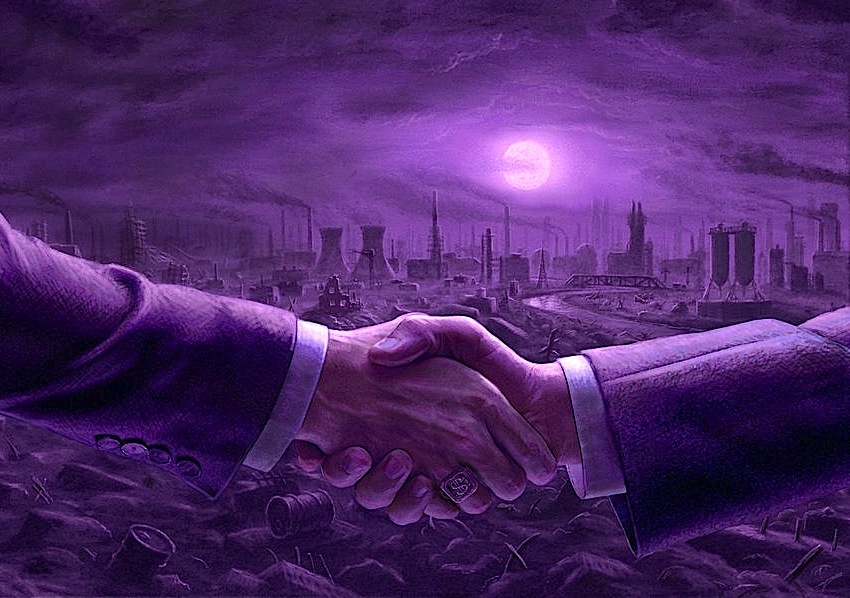
Guy doesn’t really talk explicitly about the link between capitalism and the environmental crisis. He should. Capitalism feeds off of crisis. As they say, capitalism is crisis. It is the primary root cause of the civilization-ending eco-collapse we are facing:
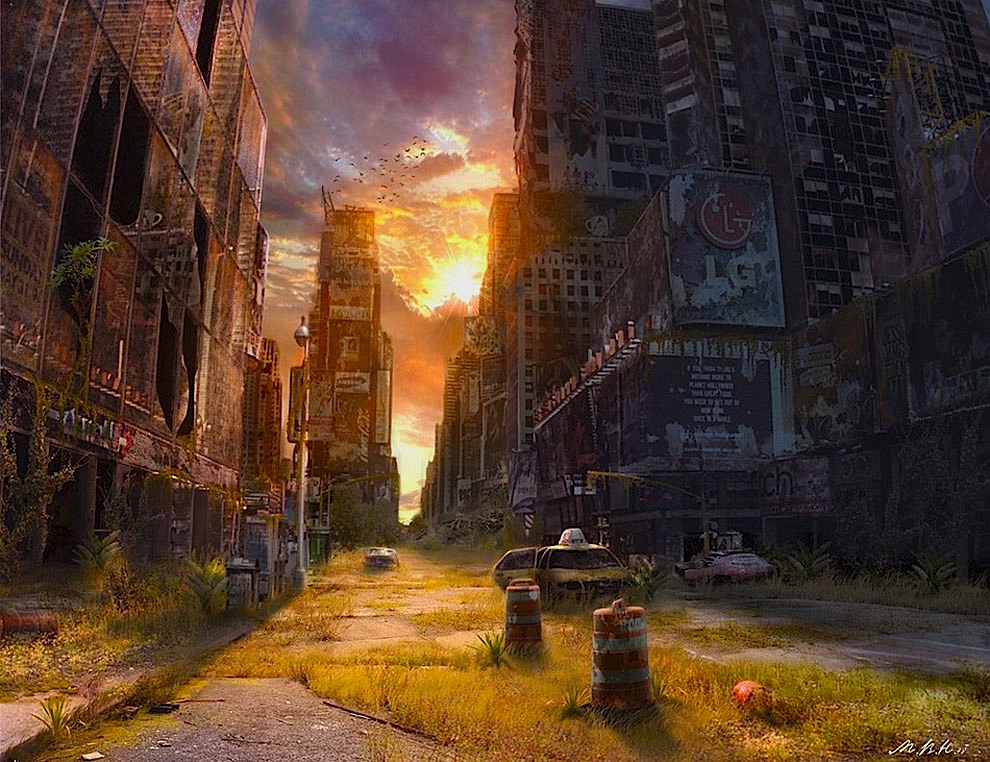
I thought I’d post a few pictures of what the world will look like before the end of this century. Artists have the intuitive imagination to conjure up such visions the general public can only imagine through Hollywood zombie flicks which seem to be all the rage these days. Why do I feel this vision is inevitable? Just look at the daily news to see what I mean:
It used to be that the mentally insane, flailing their arms and talking to invisible people in the streets, were the ones ranting and raving about the end of the world, but now it’s scientists who, in an attempt not to offend the beliefs of the scientific illiterati and free-market faithful, downplay their findings as much as possible. Optimism bias infects even the scientific community.
…we are the most tragic species. We not only destroy all of the world around us, we are aware of doing it but unable to stop ourselves. We have faith and hope that things will get better, that we can turn around at the last second what we’ve screwed up over years and decades. Which of course is nothing but an excuse to keep on screwing up. All courtesy of our optimism bias.
What better exemplifies the delusional optimism of man than the belief that he could hide out in a bunker to survive the ravages of a nuclear war? I’ll tell you what tops that fantasy – the belief that man can continue to do what he has done and expect the planet to unfailingly absorb all the environmental assaults we can throw at it via the endless growth of capitalist production and consumption. The planet is not some massive ShamWow towelette for man’s nonstop flow of excrement.
Of all the findings in the 2012 edition of the World Energy Outlook, the one that merits the greatest international attention is the one that received the least. Even if governments take vigorous steps to curb greenhouse gas emissions, the report concluded, the continuing increase in fossil fuel consumption will result in “a long-term average global temperature increase of 3.6 degrees C.”
This should stop everyone in their tracks. Most scientists believe that an increase of 2 degrees Celsius is about all the planet can accommodate without unimaginably catastrophic consequences: sea-level increases that will wipe out many coastal cities, persistent droughts that will destroy farmland on which hundreds of millions of people depend for their survival, the collapse of vital ecosystems, and far more. An increase of 3.6 degrees C essentially suggests the end of human civilization as we know it.
To put this in context, human activity has already warmed the planet by about 0.8 degrees C — enough to produce severe droughts around the world, trigger or intensify intense storms like Hurricane Sandy, and drastically reduce the Arctic ice cap. “Given those impacts,” writes noted environmental author and activist Bill McKibben, “many scientists have come to think that two degrees is far too lenient a target.” Among those cited by McKibben is Kerry Emanuel of MIT, a leading authority on hurricanes. “Any number much above one degree involves a gamble,” Emanuel writes, “and the odds become less and less favorable as the temperature goes up.” Thomas Lovejoy, once the World Bank’s chief biodiversity adviser, puts it this way: “If we’re seeing what we’re seeing today at 0.8 degrees Celsius, two degrees is simply too much.”
At this point, it’s hard even to imagine what a planet that’s 3.6 degrees C hotter would be like, though some climate-change scholars and prophets — like former Vice President Al Gore in An Inconvenient Truth — have tried. In all likelihood, the Greenland and Antarctica ice sheets would melt entirely, raising sea levels by several dozen feet and completely inundating coastal cities like New York and Shanghai. Large parts of Africa, Central Asia, the Middle East, and the American Southwest would be rendered uninhabitable thanks to lack of water and desertification, while wildfires of a sort that we can’t imagine today would consume the parched forests of the temperate latitudes.
In a report that leads with the “good news” of impending U.S. oil supremacy, to calmly suggest that the world is headed for that 3.6 degree C mark is like placing a thermonuclear bomb in a gaudily-wrapped Christmas present. In fact, the “good news” is really the bad news: the energy industry’s ability to boost production of oil, coal, and natural gas in North America is feeding a global surge in demand for these commodities, ensuring ever higher levels of carbon emissions. As long as these trends persist — and the IEA report provides no evidence that they will be reversed in the coming years — we are all in a race to see who gets to the Apocalypse first.
Enjoy industrial civilization’s fossil fuel blow-out sale while it lasts. This is a one-time-only, circus-like ‘liquidation event’. Everything must be commodified regardless of ecological loss or intrinsic value to the web of life. The Human species won’t want to miss these deals! There will be no returns or exchanges available as we are going out of business for good due to bankruptcy proceedings with Mother Earth. All life forms and resources on the planet must go!!!
I find it interesting that we are living in a time where the average person can, with a little research every night, have a good idea of what is going on globally with the economy, the environment, and societal structures. But with that knowledge comes the realization that you are essentially powerless to change the big picture. And so it is with our slide into a truly barbaric future. Having avoided any news this past week, I slept well. Tonight, however, is a different story as I start back into reading up on the latest world events and perspectives from prominent authors. It’s a real horror show developing these days.
We know that our ‘political economy of aristocracy‘ is a major impediment in moving away from our fossil fuel-based system and creating a socially just society, but the elite will do whatever is within their power to hold onto their place in the capitalist hierarchy:
…It is in any individual’s self-interest to preserve that in which they are most invested; but the rich pose a particular danger because their self-interest often leads them to attempt to protect and preserve entire modes of economic activity that society needs to move past in order to avoid colliding with the limitations of natural resources inherent in any specific mode of technology. No more clear example can be imagined that the Koch family interest pouring hundreds of millions and billions of dollars into conservative think tanks and political lobbies that not only deny global climate change, but also actively oppose the development of clean energy technologies. But a more instructive example may be the Walton family interests, which seek to avoid the development of public understanding of how the Wal-Mart business model shifts much of its employment costs onto the government – a modern twist on the methods by which the wealthy “pauperize the multitudes” identified in the Founders’ political economy of aristocracy…
Professor David McNally has an insightful new essay spelling out the machinations of capitalism which the elite have and will continue to carry out in order to preserve the status quo and gross inequality of our political economy. Some excerpts:
…Of course it is better for businesses if there is lots of demand for their goods. But the purpose of a capitalist enterprise is not to make sales; it is to make profits. The ability of firms to accumulate, invest, grow and beat out their competitors depends on profitability. And once capitalism gets into a systemic crisis of the sort that broke out in 2008, profitability cannot be restored without enormous destruction. There are two key mechanisms by which this happens.
The first involves destroying excess or unproductive capital. If firms in one industry after another are forced into bankruptcy and/or gobbled up by the competition, those that remain will eventually restructure and reorganize themselves to produce at lower cost (and higher profits). Having bought up bankrupted assets on the cheap, and having taken over the market shares of failed companies, they will be in a position to invest again.
The second capitalist mechanism for exiting a crisis involves driving down working people’s living standards. Put simply, by devaluing human life and the costs of reproducing people – via lower wages and benefits and reduced “social wages” (the public services available by way of pensions, social assistance, health care and education) – capital reduces its costs of doing business. And it is the latter strategy, reducing the costs of reproducing people, that has dominated thus far.
The reason for this is simple. In addition to funneling trillions of dollars to bail out the financial sector, the world’s central banks, particularly those in the Global North, have lowered borrowing costs to just a hair above zero. This means that faltering companies can stay alive by borrowing money that is virtually free. That is why there has been nothing so far like the wave of corporate bankruptcies witnessed during the Great Depression or across the 1980s. And because such a wave of bankruptcies would once again rock the financial system, nothing like it should be expected in the short term.
That leaves austerity as the capitalist class’ principal strategy. Here, they have racked up considerable success. Not only have public services been drastically curtailed, so have living standards generally. In the U.S., median incomes contracted more than four percent during the “recovery” since 2010 and have now declined to where they stood in 1995. That represents the elimination of all wage gains in the past 17 years. In the U.K., meanwhile, living standards have been pushed 13 percent below their 2008 levels.[4] Now, all of this may be bad for “the economy” in the abstract: reduced incomes mean less spending and less employment. But we don’t live in an economy in the abstract. We live in a capitalist economy whose imperative is profit. And reduced incomes are highly functional for capital.
To that end, governments everywhere have embarked on programs designed to increase the precariousness of everyday life. They know that insecurity makes it harder for workers to fight back, and so they are using every weapon in their arsenal to render workers less comfortable, confident and secure. They are attacking labour rights, undermining job security, driving down wages, benefits and social entitlements, and relying heavily on migrant labourers. Indeed capital’s ideal precarious worker for the age of austerity is the migrant who enters a country bound to a single employer, with no rights to live and stay beyond the length of their employment contract. In Canada, the proportion of entrants admitted under the Temporary Foreign Worker Program is skyrocketing, and the same is true for similar programs elsewhere.
Not surprisingly, austerity and growing precariousness have done wonders for corporate profits, which have risen persistently since 2009. However, in the absence of significant destruction of capital, those profits are sitting idle rather than being invested in new means of producing wealth. By early 2012, U.S. corporations were sitting on nearly $2 trillion in cash, a record amount. European firms were doing the same, holding around two trillion euros. And that is the dilemma capital faces at the moment. Austerity has boosted profitability, but it has not made investment attractive. Moreover, the lack of a new investment boom sets limits to just how high profits can rise (indeed, by mid-2012 corporate earnings seemed once again to be faltering). Consequently, the system keeps spinning its wheels unable to acquire the traction required for a sustained recovery and expansion.
And so, the capitalist class and their governments continue to do what they know best: enforce ever-greater sacrifices on working people. Greece, of course, is the center of the austerity storm. Pensions there have been cut in half, wages slashed by a third. Homelessness is soaring and soup kitchens struggle to keep up with those in need of food. Suicide rates have risen alarmingly. Notwithstanding all that, the “troika” – the European Central Bank, the IMF and the European Commission – demand more blood. Already, the Greek government has tabled a budget for 2013 that will cut billions more from pensions, wages and social benefits, notwithstanding their own forecast that the Greek economy will contract once again by nearly five percent. The whole purpose of these cuts is to prove to international capital that Greece will abide by the discipline of financial markets and that, should it receive new “loans” from the troika, it will use this money only to pay back global banks. Perish the thought that some of these funds might find their way to teachers, nurses or pensioners. Indeed, to say the money is “loaned” to Greece is entirely false: these funds enter a special account through which they are channelled directly to banks. And for that purpose the Greek people are being bled dry.[5]…
We now see the corporate elite in America, the beneficiaries of taxpayer bailouts, off-shore tax havens, government contracts, as well as near zero Fed loans, sharpening their blades to cut the throats of the American people:
The corporate CEOs who have made a high-profile foray into deficit negotiations have themselves been substantially responsible for the size of the deficit they now want closed.
The companies represented by executives working with the Campaign To Fix The Debt have received trillions in federal war contracts, subsidies and bailouts, as well as specialized tax breaks and loopholes that virtually eliminate the companies’ tax bills.
The CEOs are part of a campaign run by the Peter Peterson-backed Center for a Responsible Federal Budget, which plans to spend at least $30 million pushing for a deficit reduction deal in the lame-duck session and beyond.
During the past few days, CEOs belonging to what the campaign calls its CEO Fiscal Leadership Council — most visibly, Goldman Sachs’ Lloyd Blankfein and Honeywell’s David Cote — have barnstormed the media, making the case that the only way to cut the deficit is to severely scale back social safety-net programs — Medicare, Medicaid, and Social Security — which would disproportionately impact the poor and the elderly.
Yet the CEOs are not offering to forgo federal money or pay a higher tax rate, on their personal income or corporate profits. Instead, council recommendations include cutting “entitlement” programs, as well as what they call “low-priority spending.”
Many of the companies recommending austerity would be out of business without the heavy federal support they get, including Goldman Sachs and JPMorgan Chase, which both received billions in direct bailout cash, plus billions more indirectly through AIG and other companies taxpayers rescued.
Just three of the companies — GE, Boeing and Honeywell — were handed nearly $28 billion last year in federal contracts alone. A spokesman for Campaign To Fix The Debt did not respond to an email from The Huffington Post over the weekend…
Now this brings me to Chris Hedges’ last essay which I just read tonight. He’s becoming more apocalyptic as time goes on. Chris knows what I know: we are headed towards a hellish future in which a tiny elite will try to hang on to their wealth and power at the expense of everyone else, including the planet. High tech weaponry and surveillance technology will be used to enslave and control the masses while maintaining capitalism’s grip on society:
…The impending collapse of the international economy, the assaults on the climate, the resulting droughts, flooding, precipitous decline in crop yields and rising food prices are creating a universe where power is divided between the narrow elites, who hold in their hands sophisticated instruments of death, and the enraged masses. The crises are fostering a class war that will dwarf anything imagined by Karl Marx. They are establishing a world where most will be hungry and live in fear, while a few will gorge themselves on delicacies in protected compounds. And more and more people will have to be sacrificed to keep this imbalance in place…
…As the world breaks down, this becomes the new paradigm—modern warlords awash in terrifying technologies and weapons murdering whole peoples. We do the same in Afghanistan, Iraq, Pakistan, Yemen and Somalia.
Market forces and the military mechanisms that protect these forces are the sole ideology that governs industrial states and humans’ relationship to the natural world. It is an ideology that results in millions of dead and millions more displaced from their homes in the developing world. And the awful algebra of this ideology means that these forces will eventually be unleashed on us, too. Those who cannot be of use to market forces are considered expendable. They have no rights and legitimacy. Their existence, whether in Gaza or blighted postindustrial cities such as Camden, N.J., is considered a drain on efficiency and progress. They are viewed as refuse. And as refuse they not only have no voice and no freedom; they can be and are extinguished or imprisoned at will. This is a world where only corporate power and profit are sacred. It is a world of barbarism…
Evil unencumbered by the slightest conscience seems to me to be what has been described above. By comparison, the droogs in ‘A Clockwork Orange’ appear quaint.
In my previous post I quoted Professor Charles Hall’s assertion that the current economic paradigm is ill-equipped to account for and address externalities such as resource depletion and environmental degradation. Peak oil as well as climate change/global warming are just two in a long list of biophysical constraints which neoclassical Keynesian economics, i.e. mainstream economics, overlooks:
…the crisis looming before us is likely to be, if anything, more terrible than the Great Depressions of 1873-93 and 1929-39. The continuing industrialization of agriculture and urbanization of population—by 2010, it is estimated, more than half the earth’s inhabitants lived in cities—has made more and more people dependent upon the market to supply them with food and other necessities of life. The existence on or over the edge of survival experienced today by the urban masses of Cairo, Dhaka, São Paulo, and Mexico City will be echoed in the capitalistically advanced nations, as unemployment and government-dictated austerity afflict more and more people, not just in the developed world’s Rust Belts but in New York, Los Angeles, London, Madrid, and Prague.
Left to its own devices, capitalism promises economic difficulties for decades to come, with increased assaults on the earnings and working conditions of those who are still lucky enough to be wage earners around the world, waves of bankruptcies and business consolidations for capitalist firms, and increasingly serious conflicts among economic entities and even nations over just who is going to pay for all this. Which automobile companies, in which countries, will survive, while others take over their assets and markets? Which financial institutions will be crushed by uncollectible debts, and which will survive to take over larger chunks of the world market for money? What struggles will develop for control of raw materials, such as oil or water for irrigation and drinking, or agricultural land?
Gloomy though such considerations are, they leave out two paradoxically related factors that promise further dire effects for the future of capitalism: the coming decline of oil—the basis of the whole industrial system at present—as a source of energy, and the global warming caused by the consumption of fossil fuels. Even if continuing stagnation should slow greenhouse gas-caused climate change, the damage already done is extremely serious. Elizabeth Kolbert, a journalist not given to exaggeration, called her soberly informative account Field Notes From a Catastrophe. The melting of glaciers threatens not only Swiss views but the drinking supplies of whole populations in such areas as Pakistan and the Andean watersheds; droughts have ravaged Australian and Chinese agriculture for years now, while floods periodically devastate the low-lying South Asian homes of tens of millions of people. The rolling parade of disasters is, unfortunately, only getting started. It will accompany a stagnant economy and only be exacerbated by the increased greenhouse-gas emissions that a return to true prosperity would bring… – essay adapted from Paul Mattick’s book ‘Business as Usual: The Economic Crisis and the Failure of Capitalism‘
The mandatory growth requirement of mainstream economics also precludes the concept of sustainability. I have not yet read the above referenced book ‘Business as Usual: The Economic Crisis and the Failure of Capitalism’, but a prominent socialist speaking of peak oil and global warming in the same paragraph is always intriguing. However, a brief critique of the book by a reader finds that Mattick does not go nearly far enough in incorporating these two realities into his analysis of our current crisis:
All mainstream institutions have subscribed to the near religious belief of the infallibility of the capitalist economy which itself is considered a self-regulating system governed by the “invisible hand” of the free market as explained by Adam Smith in The Wealth of Nations. Market ‘value’ is produced by the optimal use of capital, labor, and production. Mainstream economics operates under the assumption of a world with freely available and unlimited resources. It divides and reduces all resources into units of monetary value, not taking into consideration the value such resources hold in maintaining the ecological balance of the planet.
Isn’t it the height of hypocrisy that those wealthy nations trumpeting the superiority of the free market are also the same countries which dominate global resources and world markets by military superiority as well as the subversive and coercive tactics of their economic hitmen?
…war is integral to imperialism. Imperialism – and especially the imperialist powerhouse, the USA – needs the threat of war to sustain itself: ideologically, militarily, geo-politically and also financially. The arms and defence industry is a major part of the US economy. In 2011, the defence budget was a staggering $698 billion, or 4.8% of the US GDP (link). Add to that the cost of increased security concerns – for example, to combat the ‘terrorist threat’ within imperialist countries – and you have a major chunk of the economy being reliant on the continued existence of enemies within and without.
It’s a form of military Keynesianism to keep a faltering economy going. The further capitalism sinks into decline, the more irrational the drive to war becomes and the more ludicrous are the reasons presented by imperialism (weapons of mass destruction, nuclear capability, etc).
…a very naive view of how the world is run [is to hold the belief that] David Cameron, Barack Obama and Benjamin Netanyahu just ‘happen’ to be spending ‘too much’ on military, which on the surface seems deeply illogical at a time of official austerity. But, of course, the opposite is true: it is their way of staying in power.
Of course, we should fight against such ridiculous spending on increasingly refined machinery to exterminate humanity. But we should be clear why. – link
Moreover, America’s military has become a self-perpetuating industrial complex for profiting from war and instability.
Another problem with the world’s dominant economic system is that GDP is a misguided and inaccurate gauge for measuring the standard of living and well-being of the general populace:
…History shows that democratic forms are no proof against a slide into repressive forms. In Germany in the 1930’s, a declining standard of living contributed to the rise of the Nazi party; Hitler was democratically elected to the office of Chancellor (and then proceeded to establish himself as Fuehrer).
As America’s perpetual-growth economy faces the reality of ecological limits, as climate change imposes costs and decreased well-being on us, as food and energy and other resource prices increase because of the inexorable logic of a declining Energy Return on Energy Invested at the physical foundation of our economy, we face the prospect of a widespread decline in our standard of living. This dynamic lies at the root of this fact: Americans coming of age today are among the first generation who can’t be confident that they will be better off than their parents. By one widely used measure of well-being (the genuine progress indicator, which deducts loss of ecosystem services and other “disamenities” from the national accounts), the American standard of living has flatlined since the 1970s, despite continued strong growth in GDP.
Thus the cautionary lessons from Egypt and Tunisia. GDP is a measure of the commotion of money in an economy, not a measure of delivered well-being. If sustained or rising well-being is what is economically and politically desirable, we should measure it directly, instead of counting on GDP to do the job. And if we accept the idea of popular sovereignty—that governments rule with “the just consent of the governed,” as Jefferson put it in our Declaration of Independence—we must recognize that as the middle class goes, so goes the legitimacy of the regime in power. No system of government—despotic or democratic—fares well when the majority of its citizens experiences a declining standard of living… – link
For those who have not read Darbikrash’s last post, A Nation of Hustlers and Swindlers, it lays bare the big con game of capitalism. Similarly, the mechanic scenes in Oliver Stone’s U-Turn represent, for me, capitalism’s exploitive process of getting something for nothing:
This will be my last post until after Thanksgiving break.
I featured Professor Charles Hall in EROEI and the Collapse of Empires and here he is again with another interesting talk on energy and EROEI to clear away all the bullshit headlines about America becoming the “New Saudi Arabia”. Our economy simply cannot grow anymore without energy inputs that have a high EROEI. Of course you also have to take into account the environmental externalities of fossil fuels which are writing the epitaph on our tombstones – “Homo Sapiens had more fossil fuels than brains. Mother Nature tried to warn them, but their addiction was too strong and their propaganda too pervasive.”
…Many experts now believe that, absent the discoveries of numerous new giant oilfields or breakthroughs in development of alternative fuels, oil demand will persistently push global prices to unaffordable levels, shackling economic growth indefinitely.
Even if discoveries somehow keep pace with demand, extracting oil from increasingly harsh conditions, such as beneath the Arctic Ocean or other deep ocean waters, will put upward pressure on prices.
Despite the potentially huge economic consequences, no full-scale, multinational energy conservation effort has been launched to buy time for development of alternatives, such as electric cars, that would ease pressure on oil supplies and prices.
When oil prices eclipsed $100 a barrel in 2011 and early this year, they were edging toward the “breaking point” – the threshold where economies can no longer expand, said Charles Hall, a professor in the School of Environmental Sciences and Forestry of the State University of New York. Hall, a co-author of the book “Energy and the Wealth of Nations: Understanding the Biophysical Economy,” said that the economy has stalled in the past when U.S. energy costs have approached 13 percent of the gross domestic product.
Annual global expenditures on raw energy have climbed to an estimated $8 trillion to $9 trillion, exceeding 10 percent of the $70 trillion world gross domestic product. Those figures, however, omit the succession of price up-charges along the manufacturing, marketing and delivery chain for energy-related components of goods and services.
“I don’t think the economy is ever going to grow again . . . not on a sustained basis,” Hall said in an interview…
…“The first half of the age of oil saw this rampant expansion of industry, transportation, trade, agriculture,” said Colin Campbell, an 81-year-old retired Irish petroleum geologist who founded the peak oil movement. “The population went up six times in parallel over 100 to 150 years . . . triggered by the cheap, easy energy that made everything possible.
“Now we face the second half, which is about to dawn, which just undermines this whole world system under which we’re now living,” he said. “Naturally, no one wants to admit that.”... – link
…Also, the elite don’t want to admit that the game they control is over. Capitalism is finished. We won’t have to fret about what will replace this economic system which people believe is irreplaceable because the system is self-destructing and taking all of us with it.
And about those environmental externalities that are sealing our fate in the annals of extinct species…
In a devastating speech at Bristol University Tuesday November 6th, 2012, Dr. Kevin Anderson accused too many climate scientists of keeping quiet about the unrealistic assessments put out by governments, and our awful odds of reaching global warming far above the proposed 2 degree safe point.
In fact, says Anderson, we are almost guaranteed to reach 4 degrees of warming, as early as 2050, and may soar far beyond that – beyond the point which agriculture, the ecosystem, and industrial civilization can survive.
All this comes from one of the world’s top climate scientists, plugged in to the latest research and numbers. Kevin Anderson is from the UK’s premier climate modeling institution, the Tyndall Centre for Climate Change Research, and the University of Manchester. He delivered the speech “Real Clothes for the Emperor, Facing the Challenges of Climate Change” at the Cabot Institute of the University of Bristol in Britain.
His estimates are backed up by recent reports from the International Energy Agency, and now the global accounting firm PricewaterhouseCoopers. I also quote from Joe Romm’s blog at thinkprogress.org, and a comment by Lewis Cleverdon from Wales, in the Transition blog at transitionculture.org. – link
Did anyone really think there would be no consequences for this?:
An interesting study, just out by Stanford University professor Gerald Crabtree, says that humans are indeed getting dumb and dumber. According to Crabtree, this unfortunate process began when humans switched from hunter-gatherers to a sedentary agrarian culture. Advances from that point onward made survival less stressful, but also negated the process of natural selection pressures which acted on genes responsible for intellectual and emotional development.
To me this is a bit scary in light of how technologically advanced we have become, especially in the area of deadly weaponry.
…With the development of agriculture, came urbanization, which may have weakened the power of selection to weed out mutations leading to intellectual disabilities. Based on calculations of the frequency with which deleterious mutations appear in the human genome and the assumption that 2000 to 5000 genes are required for intellectual ability, Dr. Crabtree estimates that within 3000 years (about 120 generations) we have all sustained two or more mutations harmful to our intellectual or emotional stability. Moreover, recent findings from neuroscience suggest that genes involved in brain function are uniquely susceptible to mutations. Dr. Crabtree argues that the combination of less selective pressure and the large number of easily affected genes is eroding our intellectual and emotional capabilities….
I would say that with the discovery of petroleum, Homo Sapiens really hit their stride with the ‘dumbing-down’ effect of circumventing evolutionary pressures. As someone named Reality Broker at the Huffington Post commented:
Why should they need to think when there is a vast wealth of ‘knowledge’ on the web? They don’t need to think, there’s an app for that, or a blog full of people who’ll nurture their ‘beliefs’. Humans are becoming more like the Borg, with their collective Twitter feeds…their smart phones attached to their heads like some Cybernetic implant.
It is unfortunate that for many its getting harder to select the raisins from the rabbit manure.
Crabtree’s study dovetails with biologist Ernst Mayr’s belief that intelligence is a “lethal mutation”. At some point our intellect allowed us to make the jump from mere survival to living with all the creature comforts surrounding us today, but at the cost of avoiding the natural selection process which weeded out those deleterious genetic mutations to our brain.
However, hope springs eternal and Professor Crabtree has confidence that we will be able to overcome the ill-effects of this little deviation from natural selection:
…But not to worry. The loss is quite slow, and judging by society’s rapid pace of discovery and advancement, future technologies are bound to reveal solutions to the problem. “I think we will know each of the millions of human mutations that can compromise our intellectual function and how each of these mutations interact with each other and other processes as well as environmental influences,” says Dr. Crabtree. “At that time, we may be able to magically correct any mutation that has occurred in all cells of any organism at any developmental stage. Thus, the brutish process of natural selection will be unnecessary.”
Unfortunately, the brutish process of natural selection won’t be avoidable with mankind having surpassed the bio-capacity of the planet, putting us irrevocably into environmental overshoot. The fact that there’s something like 19,000 nuclear weapons in the hands of an emotionally and intellectually stunted species does not make me sleep any better, either.
A newly released study commissioned by the C.I.A. entitled Climate and Social Stress: Implications for Security Analysis highlights the vulnerabilities of our globalized economy to climate change. Of particular interest is the section on energy. To summarize:
1.) Oil is the most highly integrated commodity of globalized trade. Its tightly interconnected market was created in the aftermath of the OPEC embargoes of the 1970’s to prevent its manipulation by political actors. Its integration is said to be fully complete to the point that any disruption in the global oil system will cause an economic ripple effect throughout the world. Rapid oil consumption in China and India without a corresponding increase in production has left the oil market extremely tight (i.e. Peak Oil).
2.) Due to the facts stated above, any changes in climate could easily disrupt the world’s energy system. For example:
(a.) Tropical storms and sea-level rise can disrupt production, refining, and transport of petroleum since a large percentage of oil refining and processing are located in coastal areas vulnerable to such storms and floods. This is true in the U.S., Europe, China, and India. An example would be Hurricane Katrina and Rita in 2005 which disrupted oil and gas operations of off-shore rigs, coastal refining, and transport via sea ports and pipelines.
(b) Drought will cause oil refining disruptions since that process requires large amounts of water. If the drought is accompanied by higher temperatures, the scarcity of water will be exacerbated because the oil refineries will require even more cooling by water. A warming planet will also cause infrastructure damage (pipelines and drilling platforms) in Arctic operations due to collapsing earth from the melting of permafrost.
We are entering an era in which not only the global energy system is vulnerable, but the social, agricultural, and technological infrastructure is also at the mercy of climate disruptions. They were all designed around assumptions of moderately stable climate conditions, and as climate exceeds boundary thresholds, these infrastructures will break. As was demonstrated by Hurricane Sandy recently in New York/New Jersey with the power outages, gas shortages, and Nuclear plant shutdowns. The droughts this past summer in the U.S. midwest show the fragility of our food system whose development assumed fairly stable weather patterns and rainfall.
A quote from the study:
…The fundamental science of climate change suggests that continued global warming will increase with frequency or intensity (or both) of a great variety of events that could disrupt societies, including heat waves, extreme precipitation events, floods, droughts, sea-level rise, wildfires, and the spread of infectious diseases. Underpinning many of these extreme events is an acceleration of the global hydrological cycle. For each 1.8° F (1° C) increase in the global mean surface temperature, there is a corresponding 7 percent increase in atmospheric water vapor. Because warm air holds more water vapor than cool air, this leads to more intense precipitation. Essentially, warm air increases evaporation from the ocean and dries out the land surface, providing more moisture to the atmosphere that will rain out downwind. Water vapor is also a powerful naturally occurring greenhouse gas. As such it is the source of a very positive feedback to the coupled climate system that amplifies any external forcing by a factor of approximately 1.6…
We’ve passed a tipping point with the Arctic ice melt which has set off other feedback loops (Arctic amplification, methane release from permafrost melt, loss of the albedo effect, alteration of the Jet Stream, Greenland glacier melt, etc) and tipping points, some of which we are not even aware of, as the study acknowledges:
…there may be other processes in the Earth system, not yet identified, that have tipping points that could lead to abrupt climate change. Because of such gaps in knowledge, the possibility of such events occurring in the next decade or so cannot be totally discounted…
I would say “God help us” if the traditional farming lands -the bread baskets of nations- become dust bowls, but that’s exactly where we are headed with climate change and no miracle is going to fall out of the sky to save us.
Drought Disaster Designations Map (PDF, 504KB) Text-only (accessible) version Map shows designations due to drought across the country under USDA’s amended rule. Any county declared a primary (red) or contiguous (orange) disaster county makes producers in that county eligible for certain emergency aid.
The study talks about what it terms a “cluster of extreme events” resulting from large-scale climate processes, causing catastrophes in separate and distant areas of the globe. Trying to deal with such widespread and seemingly unrelated disruptions would quickly overwhelm the global community’s resources. An example given was in the year 2010 with the massive drought and forest fires in Russia and the epic floods in Pakistan:
…The two events were linked by more than just their proximity in time. The meteorological pattern that lead to the Russian heat wave, in which the large-scale upper-level wind flow developed a strong and persistent ridge, also contributed to the development of the meteorological pattern that resulted in the Pakistani floods —a downstream leading trough (Lau and Kim, 2012). The fact that these two extreme events corresponded in time with each other and with a single larger meteorological pattern was unusual but not totally unexpected. Circulation events like this one, which cause some event clusters, are known to occur but are not well resolved in current climate models…
…If climate events and extremes were independent in a statistical sense, the likelihood of a cluster or a compound event of any size could easily be estimated mathematically. But as the above example makes clear, extreme events in different parts of the world can be driven by common underlying forces and thus have an intrinsic relationship such that when one such event occurs, the likelihood increases that other extreme events linked to them by common causes will also occur. In statistical language, such events are called dependent.
The changing climate zones also enable the spread of tropical diseases and pests. Outbreaks of new virus strains would tax healthcare delivery systems:
…Climate events might also put stress on global health systems in various ways, most of them hard to predict. As discussed in the next chapter, climate change is expected to alter the ranges of disease vectors or pathogens in ways that expose large human populations to diseases to which they have not been previously been exposed. This could lead to a rapidly increasing demand for treatments and supplies that may not have been adequately stockpiled. If such health problems arise in combination with a disruption of supply chains for critical inoculations or medications, the potential for a severe health crisis could grow dramatically. Again, the effects might be felt far from the locations where the climate events occur. Climate events, especially when they occur in clusters, can also stress the capacity of international disaster response and humanitarian relief systems and thus cause harm in places that are not directly affected by the events but that need international assistance for other reasons…
“You can debate the specific contribution of global warming to that storm. But we’re saying climate extremes are going to be more frequent, and this[Hurricane Sandy] was an example of what they could mean. We’re also saying it could get a whole lot worse than that.”
Mr. Steinbruner, the director of the Center for International and Security Studies at the University of Maryland, said that humans are pouring carbon dioxide and other climate-altering gases into the atmosphere at a rate never before seen. “We know there will have to be major climatic adjustments — there’s no uncertainty about that — but we just don’t know the details,” he said. “We do know they will be big.”
The study was released 10 days late: its authors had been scheduled to brief intelligence officials on their findings the day Hurricane Sandy hit the East Coast, but the federal government was shut down because of the storm.
How ironic is that? The authors of this study had to postpone their meeting with U.S. intel authorities because of a climate chaos event.
Here’s what else is ironic…
…as the need for more and better analysis is growing, government resources devoted to them are shrinking. Republicans in Congress objected to the C.I.A.’s creation of a climate change center and tried to deny money for it. The American weather satellite program is losing capability because of years of underfinancing and mismanagement, imperiling the ability to predict and monitor major storms.
As is generally known by those studying the most important issue of our time, the forecasts by the IPCC are on the conservative side with scientists overly cautious not to include predictions which may be perceived as too pessimistic. A new study in the Science Journal shows that actually the more pessimistic climate models are much more accurate:
It’s important to note that the IPCC estimates do not fully take into account feedback loops and tipping points. Below is an excerpt from “Imperiled Life: Revolution against Climate Catastrophe” by Javier Sethness-Castro (2012):
…A 2009 study on climate change performed at the Massachusetts Institute of Technology–less optimistic and thus perhaps more realistic, for example, than the IPCC’s reports to date regarding the prospect of achieving significant carbon emission reductions in the near future–finds there indeed to be a chance that temperatures will increase 7.4°C (13°F) over preindustrial temperatures by the century’s end, with a 90 percent chance that the temperature increase would range between 3.5°C and 7.4°C (4.8°F-13°F).(75) The study’s authors are quick to clarify that even their decidedly bleak conclusions might be underestimates, as they, like the IPCC, donot fully account for the various feedback mechanisms that could arise given catastrophic climate change. NASA’s Dennis Bushnell, for his part, estimates that the average global temperature increase expected during this century once these feedbacks have been accounted for would amount to between 6°C and 12°C (10.5°F-21°F).(76) Warming of such apocalyptic proportions would be entirely horrific: it should be remembered that it was a 6°C (10.5°F) increase that triggered the end-Permian mass extinction.(77)
Though a matter of controversy among climatologists, there is reason to fear that overheating beyond these levels could induce a runaway greenhouse effect that would give rise to what Hansen terms “the Venus syndrome,” whereby climatic change abruptly delivers Earth to a state resembling that of Venus, where life simply cannot exist.(78)…
And another two news stories from the last few days with more ominous signs of possible acceleration into climate chaos:
I’m finding it harder to carry on with blogging about reality without compartmentalizing all this grim news into some dark recess of my brain, only to be unlocked at night when I read up on this subject. I live two lives – one in the fake world that we all mill around in like zombies in order to survive… and the other in this blog researching the coming apocalypse. No wonder the Apocadocs turned to humor to deal with this stuff.
I mentioned biologist Ernst Mayr in my last post and his views on man’s higher intelligence which, according to Mayr, is an extremely rare happenstance and not at all favored by natural selection; it is therefore a “lethal mutation”. It appears our “highly intelligent” species is bereft of the wisdom necessary to fully appreciate the consequences of our technological prowess, the ramification of which are truly global and are most certainly leading to our demise. Rather than fix the root causes of climate change, what do we do? We discuss building sea walls and bioengineering our way out of this mess. That’s insane linear thinking.
There was a debate in the mid 1990’s between Ernst Mayr and Carl Sagan concerning the probability of extraterrestrial life. In that exchange Mayr explains why the likelihood of higher intelligence is so rare.
Here is an excerpt:
…Adaptations that are favored by selection, such as eyes or bioluminescence, originate in evolution scores of times independently. High intelligence has originated only once, in human beings. I can think of only two possible reasons for this rarity. One is that high intelligence is not at all favored by natural selection, contrary to what we would expect. In fact, all the other kinds of living organisms, millions of species, get along fine without high intelligence. The other possible reason for the rarity of intelligence is that it is extraordinarily difficult to acquire. Some grade of intelligence is found only among warm-blooded animals (birds and mammals), not surprisingly so because brains have extremely high energy requirements. But it is still a very big step from “some intelligence” to “high intelligence.” The hominid lineage separated from the chimpanzee lineage about 5 million years ago, but the big brain of modern man was acquired less than 300,000 years ago. As one scientist has suggested (Stanley 1992), it required complete emancipation from arboreal life to make the arms of the mothers available to carry the helpless babies during the final stages of brain growth. Thus, a large brain, permitting high intelligence, developed in less than the last 6 percent of the life on the hominid line. It seems that it requires a complex combination of rare, favorable circumstances to produce high intelligence…
Our fossil fuel-driven technology coupled with an economic model of unlimited production has had unintended consequences, as pointed out by this blogger:
…Our needs went from necessity to contentment to luxury to superfluousness. For example, we needed efficient means of communication. We had the telephone. It improved and became more and more efficient in the form of better and better mobile phones. Today, we are wallowing in the quagmire of mobile phones discarded sooner than they are bought because our superfluousness makes our phones outdated too soon. The same is the case with a lot of other things like cars, TV, computer, and so on.
The impact of such discarded things or things sold secondhand on the environment is tremendous. Chomsky calls the impact an ‘externality.’ The impact is external and we are not aware of it directly. The impact caused by the ever-increasing number of vehicles on the environment is not known to us when we go to buy yet another new car for another member of the family. Even the transaction of a secondhand mobile phone has certain externalities. A lot of our activities today are marked by externalities.
The aggregate of such externalities will be the root cause of the extinction of mankind…
We will never solve the problem of our economy’s negative environmental externalities because accounting for such costs would destroy the system. However, the destructiveness of those very externalities will solve this problem for us by ending the existence of industrial civilization. To put it another way, the cost of giving up fossil fuels is exorbitant, but the cost of not doing so means the permanent end of mankind’s reign over the planet.
Without a doubt, we’ve become an arrogant species who thinks of itself as a force of nature to be reckoned with. Unfortunately for us, the real world of biophysical sciences says that we are not above the laws of the natural world and we’ll be dealt with accordingly. When organisms cannot adapt to their environments, they go extinct. When the activities of man alter the favorable atmospheric conditions for his existence, then he suffers the same fate of every life form that has disappeared from the face of the Earth. Intelligence served man well in his primitive state, offering flexibility against changing conditions, but on today’s technological scale that encompasses the entire planet, it’s cumulative effect has been to destroy.
According to Mayr, intelligence is a double-edged sword, serving as a tool for our survival or rapidly carrying out our own annihilation. Higher intelligence, As Mayr said, is a “lethal mutation”.
Bloomberg Businessweek’s rendition of the toll taken on the President dealing with the stress of the next four years. King Romney was the alternative cover:
…the road ahead for President Obama as he faces the fiscal cliff and crucial decisions for the future of the economy, business, and defense,” writes Businessweek. “The opposition remains considerable, and no matter how successful he is, the hardest job in the world will take its toll.
…and the fate of the human species (you wouldn’t expect Bloomberg Businessweek to mention this, would you?):
Train wrecks, even one that appears to be happening in slow motion, usually are ‘shocking’. Great speech by Chomsky, especially the climate change segment:
…maybe humans are somehow trying to fulfill a prediction of great American biologist who died recently, Ernst Mayr. He argued years ago that intelligence seems to be a lethal mutation. He—and he had some pretty good evidence. There’s a notion of biological success, which is how many of you are there around. You know, that’s biological success. And he pointed out that if you look at the tens of billions of species in human—in world history, the ones that are very successful are the ones that mutate very quickly, like bacteria, or the ones that have a fixed ecological niche, like beetles. They seem to make out fine. But as you move up the scale of what we call intelligence, success declines steadily. When you get up to mammals, it’s very low. There are very few of them around. I mean, there’s a lot of cows; it’s only because we domesticate them. When you get to humans, it’s the same. ‘Til very recently, much too recent a time to show up in any evolutionary accounting, humans were very scattered. There were plenty of other hominids, but they disappeared, probably because humans exterminated them, but nobody knows for sure. Anyhow, maybe we’re trying to show that humans just fit into the general pattern. We can exterminate ourselves, too, the rest of the world with us, and we’re hell bent on it right now…
…organisms that do quite well are those that mutate very quickly, like bacteria, or those that are stuck in a fixed ecological niche, like beetles. They do fine. And they may survive the environmental crisis. But as you go up the scale of what we call intelligence, they are less and less successful. By the time you get to mammals, there are very few of them as compared with, say, insects. By the time you get to humans, the origin of humans may be 100,000 years ago, there is a very small group. We are kind of misled now because there are a lot of humans around, but that’s a matter of a few thousand years, which is meaningless from an evolutionary point of view. His argument was, you’re just not going to find intelligent life elsewhere, and you probably won’t find it here for very long either because it’s just a lethal mutation. He also added, a little bit ominously, that the average life span of a species, of the billions that have existed, is about 100,000 years, which is roughly the length of time that modern humans have existed.
With the environmental crisis, we’re now in a situation where we can decide whether Mayr was right or not. If nothing significant is done about it, and pretty quickly, then he will have been correct: human intelligence is indeed a lethal mutation. Maybe some humans will survive, but it will be scattered and nothing like a decent existence, and we’ll take a lot of the rest of the living world along with us.
So is anything going to be done about it? The prospects are not very auspicious. As you know, there was an international conference on this last December. A total disaster. Nothing came out of it. The emerging economies, China, India, and others, argued that it’s unfair for them to bear the burden of a couple hundred years of environmental destruction by the currently rich and developed societies. That’s a credible argument. But it’s one of these cases where you can win the battle and lose the war. The argument isn’t going to be very helpful to them if, in fact, the environmental crisis advances and a viable society goes with it…
By all accounts, we appear to be racing toward our own expiration date.












 Collapse of Industrial Civilization