This post features a couple of stories highlighting the total inner rot behind the facade of a free press, completely driven by the profit motives of corporations, and this country’s so-called democratic system with its fictitious “free work force”.
14 Year Ex-MSM ‘Journalist’: “None of it is Real.”
The financial elite and Washington have become a single entity, with the rotating door between lobbyists, industry, and positions of government operating more like an eight-lane autobahn highway. Under the stampede of corporations buying off the instruments of government, the news media or fourth estate has been completely flattened into the grease-palmed asphalt of that profiteering highway. Once in a while a flicker of ethical consciousness propels a few souls to climb out of the corrupt cesspool. A case in point is Andrea Seabrook, a 14-year mainstream media journalist who states, “None of it is Real.”
After 14 years at National Public Radio, Andrea Seabrook left in July and, to hear her talk about her experience covering Capitol Hill, it’s clear that she had one takeaway: It’s damn frustrating. “I realized that there is a part of covering Congress, if you’re doing daily coverage, that is actually sort of colluding with the politicians themselves because so much of what I was doing was actually recording and playing what they say or repeating what they say,” Seabrook told POLITICO. “And I feel like the real story of Congress right now is very much removed from any of that, from the sort of theater of the policy debate in Congress, and it has become such a complete theater that none of it is real. … I feel like I am, as a reporter in the Capitol, lied to every day, all day. There is so little genuine discussion going on with the reporters. … To me, as a reporter, everything is spin.
We’re still light years behind the eight ball of actually doing anything radical enough to save ourselves, but it is reaffirming to hear straight from the horse’s mouth that the system is total B.S..
Climate Change Denier makes it Mandatory his Minions of Coal Miners Attend a Romney Rally.
Earlier this month, Mitt Romney was welcomed for a campaign event at the Century Mine in Beallsville, Ohio, by hundreds of coal workers and their families. Now many of the mine’s workers are saying they were forced to give up a day’s worth of pay to attend the event, and they feared they might be fired if they didn’t, according to local news radio WWVA.
The claims have been mostly denied by Rob Moore, Chief Financial Officer of Murray Energy Company, which owns the mine. He acknowledges that workers weren’t paid that day but says no one was made to attend the event. Well, kind of.
The claims have been mostly denied by Rob Moore, Chief Financial Officer of Murray Energy Company, which owns the mine. He acknowledges that workers weren’t paid that day but says no one was made to attend the event. Well, kind of.
“Our managers communicated to our workforce that the attendance at the Romney event was mandatory, but no one was forced to attend,” he told local news radio WWVA, which has received several emails from workers claiming that the company records names of workers that don’t attend those types of events…
Murray, who is also a climate-change denier, has been an outspoken critic of President Obama’s stance on coal. That view may be why Moore told WWVA that having employees attend the Romney event “was in the best interest of anyone that’s related to the coal industry in this area or the entire country…
Better you not think about the civilization-ending reality of climate change because your job depends on this CO2-polluting substance. That’s got to be the epitome of short-term thinking – today grab a dollar that results in you and your children’s death tomorrow. Nobody ever said this living arrangement was sensible.
I’ve never seen such an avaricious society……John Adams
Far from the valorized notion of job creators, father figure capitalists and the land of milk and honey, Morris Berman rightly points out the roots of a system that demands one sell their labor power for substinence wages must of necessity- at some point- redirect to a swindle.
The mandate of selling one’s own labor power in a system that requires exploitation to function reduces the calculus of survival to one of two options:
1.) The availability of plentiful jobs with wages ratcheting upwards over the years, allowing the worker to attain financial independence through an eventual participation in rent seeking retirement.
-Or-
2.) Hitting the big payoff, the mother lode, striking it rich-in other words achieving success at the envied goal of rich accumulation, usually through starting their own business, day trading or some other similar scheme of differential accumulation.
I suppose there is a third option, which is the life of crime, e.g. using criminal means to achieve sufficient accumulation to attempt to satisfy, in perpetuity, the need to sell one’s labor power for substinence. This is also the thesis that professional gamblers prefer, but as we shall see from this post, there is not much difference from these options and option # 2 above.
Great wealth unexplained is often the accumulation of a series of crimes and illegalities undiscovered, from insider trading to market manipulation, monopolies and official corruption, occasionally mixed in with sheer dumb luck and ruthless disregard for the law.
That is why the wealthy are rarely the great artists, athletes, or inventors who they hold up as the example of excellence to which they can hardly presume. The modern wealthy generally create nothing except a climate of injustice, fraud, and corruption.
When times are good, as in the period of most of the 19th and early/mid 20th century, when labor is relatively scarce and wages relatively high, option 1 provides passable solace to the American middle class worker. From about 1970 onward, roughly coinciding with the onset of neo-liberal capitalism, we have toggled to a relative surplus of workers with the onset of cheap labor in the Far East. Now we have too many workers competing with a highly discounted foreign labor pool, with entire industries “offshored” to China with the easily anticipated resultant of a hollowed out community structure left behind, with insufficient tax base to support itself.
In addition, the capitalist mode of production has at the same time affected a massive maldistribution of wealth, wherein entire segments are using accumulated profits for rent seeking endeavor, extracting as much money from the economy as fast as possible with no regard to the consequences. So we have vast numbers of affluent and wealthy individuals with no place to invest with consistent returns, as the low hanging fruit of reliable investment opportunities for this class has been consumed by simply too much wealth chasing too few investment opportunities.
The intersection of these two phenomena goes a long way to explain our current situation, how we got here and why we are not likely to leave. Of course, all of this has been written and discussed previously ad nauseum, but for me, the puzzling question is why do people go along with what must now be for most, a clear case of cause and effect?
Even a cursory look at income and wealth distribution shows a 3σ distribution of income, in statistics this means that 99.6% of all income is captured with average value of some $22,500 in annual wage earner income. None of the values within this 3σ distribution of income is sufficient to satisfy the basic objective of achieving enough of a “nest egg” to catapult oneself into a comfortable retirement, given the current FDIC insured interest rates typically used for most retirees.
The conclusion- you must be a statistical outlier to achieve financial independence, you must somehow, against all odds, land in the 4σ-6σ range of incomes, which is to say .4%-.0001% of total wage earners. These are the probabilities of lotteries, hence my declaration to “The Lottery of the Middle Class”.
Why do vast numbers of people accept a system of forced exploitation with such small numbers of possible positive outcomes? It is a near statistical certainty that you will die with insufficient money to take care of yourself and family-even after 30 or 40 years of labor- why roll the dice on this almost certain bust?
The answer lies partially in Marx’s theory of class consciousness, and to be sure, if times are good and sufficient standard of living upgrades are provided, usually through technology, then people are not likely to dig too deeply into the underpinnings of probabilities. But when times are not good, when a labor surplus is apparent, and when even so called “guaranteed” rates of return are fast evaporating, what then?
Sociology has shown us that class consciousness is not all it was cracked up to be, it turns out Americans don’t necessarily begrudge others –in fields other than their own- the realization of outsized incomes, profits, and wealth. On a street where all the residents are plumbers, the house on the end of the street owned by an attorney is not criticized, under the presumption that he has more education, more experience, and has taken more risk-supposedly- to the furtherance of his “well deserved” wealth. After all, each plumber had the option to choose a field in law, goes the rationale, and instead went in to plumbing, and you reap what you sow, so to speak.
So this is part of it. And class consciousness is also a part of it too.
But increasingly, it is becoming evident that other factors are influencing the relative success of others within our immediate frame of reference. Many freshly minted law school graduates can’t get a job. Many “blue chip” trades and vocations cannot get work- at all. So something is wrong with this narrative, and this specter of doubt and confusion intersects nicely with the emergence of pop culture figures in professional sports, reality TV shows, and other public spectacles of wealth and accumulation.
This leads us to the lottery mentality, the barely conscious realization that we had better come up with some huge and rapid “winnings” if we are to propel ourselves into the outlier category, and achieve financial independence.
The specific reaction to this notion varies by income stratification, but the underlying themes are always the same, get rich, get rich quick, and get it at the expense of someone else. But for this to work, we need the lottery equivalent of the 2nd Law of Thermodynamics, we need a tacit acceptance of the necessity of exploitation, as we need to allow it’s existence- at our expense-until such time as we can harness the very same exploitative skill sets against someone else to benefit ourselves.
For those in the middle to upper middle class, this usually means some type of business scheme, a Walter Mittyesque flight of fancy that the intrepid entrepreneur will someday cook up a batch of Kettle Korn or beef jerky to sell at the local swap meet, or who has an invention of a Pet Rock or similarly useless contrivance with no redeeming social quality. These fanciful daydreams are part of the illusion, the faintly obscure vision that within all of our grasp is the Big Reveal, that golden idea that will launch us into the glorious world of senseless accumulation.
But statistics are unkind to the dreamer, the probabilities of any of these “ideas” propelling the prospective entrepreneur into the outlier categories is slim indeed. In a world were aggregate demand has been obliterated by a near complete loss of disposable income, and private debt has choked off any semblance of borrowing for such trinkets, the “market” for many of the useless doodads is non existent. And of the more substantial contributions to society that might garner realistic revenue, such as a new pharmaceutical compound or medical device, the squadrons of scientists needed and tens of millions of dollars of capital required relegate any substantive ideas to the universe of monopoly scale corporations.
Like the gleam of the Powerball Lottery MegaMillions, the pull is too great and the desperation too profound to ignore. So the Faustian bargain of turning a blind eye to the accelerating exploitation intrinsic in the capitalist mode of production is undertaken with a sigh and a shrug of indifference, for someday, it will be your turn. To deny the exploitation is to quit 5 minutes before the miracle has happened, to close off any avenue of the Walter Mitty fantasy, because if no one else gets it, than neither do you.
At the other end of income stratification, the lower class, we see a strikingly similar protocol, these actors are quite a bit more likely to buy an actual lottery ticket, preferring to dispense with the tedium of writing a business plan. Or perhaps it is to aspire to professional sports, or a reality TV show, or perhaps a rap star. All with statistically similar outcomes. But surprisingly, the mnemonic of the Donald Trumps of the world, haranguing and extolling those to bootstrap themselves off the dole into the riches that capitalism offers does trickle down to the trailer parks and tenements of the world.
Nowhere is this sad and pathetic prophesy more humorously portrayed than the outrageous Canadian television show (now off the air) Trailer Park Boys. Filmed as a faux “mockumentary” this show, which ran 7 seasons in Canada (and sporadically on American cable) was brilliant in its over the top portrayal of life in a trailer park. Dismissed by some as just crude humor (and be warned it is crude and profane in the extreme) the opening scenes of bucolic wonder with golden sunsets and neatly manicured yards, children playing on the swings all goes very, very wrong. The characters represent what it looks like when a community either cannot- or will not- sell their labor power and cannot exist in a normative society. The characters are perennially down market, no education, no social mobility and no future, they bond together under a thick haze of alcoholism and drug use, the show uses side splitting humor as salve to an extremely pathetic covalence, with the characters unable to differentiate between petty crime and legitimate commerce, as the differentiation is reduced to shades of barely discernable grey.
At this level of stratification the difference between a “business” that involves stealing shopping carts for scrap metal is no more or less noble than a Harvard graduate selling financial derivatives.
Stripping away any overture of intellectual loftiness, absent any academic commentary, the Trailer Park Boys reduce those bucolic sunsets into the banal vision of life on the fringes of Capitalism- and expose a nation of swindlers and hustlers, relying on a lottery to survive.
Democracy Now had an interesting little run-in with David Koch at the RNC that the corporate-laden media tried to sweep under the rug. With all the dittoheads in the audience chanting “USA! USA! USA!” as the Romneybot of the billionaires mouthed his platitudes, it was refreshing to see an actual journalist at work:
While oil and gas giant David Koch was protected from questioning by his ‘survivaball’ of humans that sprang upright around him, Amy Goodman was able to direct the same question to Edward Cox who answered in the following manner:
AMY GOODMAN: Are you concerned about, especially young people, looking at what’s happening in the country, where a handful of multi-millionaires and billionaires are so disproportionately determining the democratic process?
EDWARD COX:That’s a statement that isn’t true. This country is governed by the people. That’s what it’s always been based on.
RNC SECURITY 1: Will you keep this moving? One deep.
AMY GOODMAN: Yeah, I will. I will.
RNC SECURITY 1: OK, thank you.
AMY GOODMAN: OK, one deep, I got you. Mr. Cox answered a question. Why can’t—why can’t Mr. Koch answer a question? I only have one question.
KOCH HANDLER 2: He’s not going to answer. Get out of here.
If you really want to know how David Koch would have answered Amy’s question, a similar inquiry was put to him by Politicker “about the controversial level of influence major contributors have on American elections.” Here was his answer:
We have a free society and people are free to do what they want, you know, as long as they don’t hurt others and they obey the law,” Mr. Koch said. “So, I believe in free speech and if people want to spend money in politics or something else, it’s their right, nothing wrong with that. So, I endorse that.
So you see, as far as the elite are concerned, we live in a free society in which there should be no constraints on the corrupting influence that wealth has on government institutions and public policy. For them, freedom includes the ability to buy the instruments of government so that the interests of the elite may be best served rather than the common good of the citizenry who failed to rise to the ranks of the 0.001% in the game of capitalism. As Noam Chomsky explains in “Plutonomy and the Precariat: On the History of the U.S. Economy in Decline“:
For the general population, the 99% in the imagery of the Occupy movement, it’s been pretty harsh — and it could get worse. This could be a period of irreversible decline. For the 1% and even less — the .1% — it’s just fine. They are richer than ever, more powerful than ever, controlling the political system, disregarding the public. And if it can continue, as far as they’re concerned, sure, why not?
Going back to Chomsky’s article, the interests of the elite do not include facing up to the reality of climate change because it’s a direct threat to their power and the wealth they have hoarded. Capitalism must be defended at all costs, even if that means denying that this system is causing our own extinction:
…Practically every country in the world is taking at least halting steps towards trying to do something about it. The United States is also taking steps, mainly to accelerate the threat. It is the only major country that is not only not doing something constructive to protect the environment, it’s not even climbing on the train. In some ways, it’s pulling it backwards.
And this is connected to a huge propaganda system, proudly and openly declared by the business world, to try to convince people that climate change is just a liberal hoax. “Why pay attention to these scientists?”
We’re really regressing back to the dark ages. It’s not a joke. And if that’s happening in the most powerful, richest country in history, then this catastrophe isn’t going to be averted — and in a generation or two, everything else we’re talking about won’t matter…
In the minds of the elite, if they can’t keep a stranglehold on the world, then they’ll be damned if anyone else is going to be allowed to live on a habitable planet.
…we’ve triggered five positive-feedback events, any one of which leads to near-term human extinction. Each of the five has been reported in the refereed journal literature, as a quick search will reveal: reduction of Arctic sea ice, rapid decomposition of boreal peat, release of Siberian methane, release of ocean methane hydrates, and the drought in the Amazon basin.
I suggested we look into the SurvivaBall:
“We’ve done all we could to show these people what sucked about letting greed run our future, but instead of freaking out, they just took our business cards.”
I think many of us intuitively understand that free market ideologues have a narrow path to walk in order to keep afloat their construct of a world that is best run by the omnipotent and omniscient capitalist market system. Perhaps the idea that our globalized capitalist economy knows best is as damaging to society as the teachings of a fanatical cult urging all its members to drink from the poisoned chalice. Certainly the needs of the global capitalist economic system, currently propped up by money printing, supersedes all other considerations, including compassion for our fellow man and the well-being of the environment which is the forgotten lynchpin of the economy, not to mention the crucial factor in determining whether or not humankind continues to survive on this planet.
In the realm of the worker and the capitalist elite(the ones who own the means of production), the exploitation of humans on such a large-scale amounts to a society of wage-slave toiling zombies:
The distinguishing feature of a capitalist society is the commodification of human labour—and it is this that differentiated early modern England from any other nation. England was not the first country to develop long-distance trade or to plunder other parts of the world; throughout the fifteenth, sixteenth and seventeenth centuries, countries like Portugal, Spain and Holland exceeded England in these regards. What set English society of the time apart from its European rivals, however, was that it alone established an extensive labour market, the key to capitalist development. […]
On the labour market, every economic transaction touches directly on essential qualities of human life—material, social and moral. In exchange for wages, those who sell their labour power surrender to the capitalist ultimate control over the work to be done, its conditions, pace and organization. Rather than treating our creative energies as a unique source of personal identity, “the owners of the conditions of production treat living labour-power as a thing” (Marx, Capital, v. 1, trans. Fowkes, 1976, p. 989). The result is a profound personal alienation, a hollowing out of the meaning of life. This is why the poor, as we shall see, have historically resisted being driven into the labour markets as their only means of survival.
Reflecting on this relationship, Karl Marx described work under capitalism as alienated labour: Relinquishing control over her labour, the worker suffers an estrangement from an essential part of her humanity. As Marx (Wage Labour and Capital, Progress Publishers, 1952, p. 20) put it in one succinct passage:
“But the exercise of labour power, labour, is the worker’s own life-activity, the manifestation of his own life. And this life-activity he sells to another person in order to secure the necessary means of subsistence. Thus, his life-activity is for him only a means to enable him to exist. He works in order to live. He does not even reckon labour as part of his life, it is rather a sacrifice of his life. […]”
For the worker, in other words, work is a means to life, but not life itself. Real life begins after work, during “free time”. The familiar expression, “Thank God It’s Friday”, is a depressing acknowledgement that work for the majority is oppressive, alienating, boring and dehumanizing. Of course, things look very different from the vantage point of the capitalist.
Since the worker alienates control of her labour to the employer, the capitalist is in a position to exploit that labour—to force the labourer to perform an amount of work that exceeds the value of the wages paid. Indeed, this is the whole point of the transaction for the capitalist: to make a profit on the purchase of labour by getting workers to produce more value than what they are paid. And this difference between labour’s output and the wages paid—called surplus value—is the secret to the massive inequalities of capitalism: enormous amounts of the wealth produced by workers accumulate in the hands of the owning class.
And our economic system labels everyone the cold and dehumanizing term of “consumers”. Your behavior is methodically studied and cataloged so that the system can exploit your consumerist tendencies:
When you accept the label of ‘consumer’, you accept that you have become a financial object, willing to be manipulated by whatever marketing tricks abound. Consumer choice would be far better entitled ‘Conchoice’, a term describing the true level of choice that individuals are provided with, should they find themselves within the consumer culture.
Here is an email from Darbikrash, entitled ‘Buy or Die’, which illustrates the mind-numbing, invasive nature of corporations and the consumer culture:
…As there are too many goods chasing too few consumers (with any money left) the end game is to invent markets, to cajole and hoodwink people into believing they need something that they really don’t, and then to create products to port into this fabrication, rotating through product ideas at high speed to “see what sticks”.
What is really laughable is the degree of planning, co-ordination and control that exists in a typical retail outlet, say for example, Bed, Bath and Beyond. Every square inch of that jumbled, packed to the rafters collection of junk and useless assorted trinkets is planned. The product lineout is planned seasonally, and rotated to reflect the calendar quadrant. Each product, each one, is placed at the precise height, shelf location, and aisle location to optimize traffic and elicit the best response to a shoppers’ buy signals. The orientation of the aisles, the sequence to which high demand products are placed to maximize traffic to get to that product is profound. They know with statistical certainty which direction you will turn your shopping cart when you enter the store and when you reach the end of a given aisle.
They run full scale mock-ups or “focus groups” to optimize traffic patterns to increase the sales volume of the highest margin items. Shelf placement is determined by the highest margin. Products with lower margins are back charged to the manufacturers with “slotting fees”, bribes in effect to obtain higher shelf placement in a more lucrative aisle.
The store locations and real estate acquisition decisions are made with greater precision than a military invasion of a foreign country, and in many ways it is just that. They know to 6 significant digits the average household income within a 40 mile radius of each store location. They know how many times you leave the house to buy a product, and how far you are willing to drive to get it. They know if you’re male or female, married or single, and they know the preference curves of your demographic. They know how close to the entrance you will want to park before you drive off in disgust, and they know what type of music to play over the loudspeaker to increase your propensity to buy. They know how many visits you’ll make (on average) per calendar quarter, and the average amount of money you’ll spend at each visit, to incredible accuracy.
But just try and pass a law that restricts a multi-national from acting as a sovereign state. Just try to pass something that will put consumer protections in place. Imagine the uproar if there was an initiative to place healthy food in the front of a store and unhealthy food in the back, for example. There would be riots in the streets, with calls of Communist and Police state tactics shouted from every corner.
Apocalyptic headlines seem to be daily occurrences now. Here’s just a few headlines that grabbed my attention over the last week(click on them to go to the original article):
Form the article:
Why do we care?,’’ Abdalati, an ice scientist, asked. ‘‘This ice has been an important factor in determining the climate and weather conditions under which modern civilization has evolved.’’
Scientists sometimes call the Arctic the world’s refrigerator and this is like leaving the fridge door open, Scambos said.
‘‘This is kind of a knob on global weather,’’ Wagner said. ‘‘We don’t know the impact yet of fiddling with it.
When people in my house leave the fridge door open, I get pissed and close it. The electric bill goes up due to an overworked fridge trying to cool the food. The Earth, unfortunately, has no ability to shut the door that the human species has permanently torn off its hinges, irreparably destroying the thermostat. On the other hand, the Earth doesn’t really care that we have doomed ourselves to extinction.
Back in 2009, a Lieutenant Vasquez of the U.S. Navy made the following comments which sum up how industrial civilization is perpetuating its own demise:
“It makes me uneasy anyway to think that we’re going to let a trend caused by global warming – the melting of the ice – allow us to explore and exploit more fossil fuels, which led to the warming in the first place.
“That seems wrong-headed to me, but nevertheless it’s likely to happen and there’s already a debate about exactly who’s got the rights to the minerals and the oil that’s there under the Arctic continental shelf, and how to go about exploiting it.
“It’s unfortunate, from a broader view, understanding the science of what the future holds, but I think it’s inevitable because oil and gas are going to be extremely valuable in the coming century as supplies dwindle.”
~~~~~~
From the article:
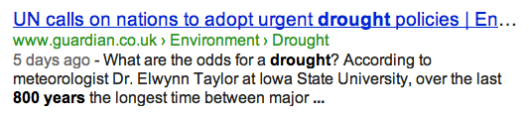
Tree-ring chronologies from long-term climate records show the western U.S. drought is already the most severe of the past 800 years. It will exceed the 1930s-era Dust Bowl with more consecutive dry years.
Less rainfall is expected in the U.S. West in each of the next 80 years than the annual average level during the drought of 2000 through 2004, the op-ed continues. Schwalm (an earth scientist), Williams (a geographer) and Schaefer (a National Snow and Ice Data Center scientist) analyzed that extreme drought in a new study in the journal Nature Geoscience.
Climatologists say we will experience reduced agricultural productivity, scarcer water resources and carbon sequestration (plants turning carbon into oxygen). The climatologists previously reported in a scientific journal that drought already has halved the amount of carbon dioxide they normally photosynthesize.
OK, that’s enough to scare any of us who studied biology out of our wits. But there’s more.
Major river basins show flow reductions of 5 to 50 percent. Western crop yields are down by 13 percent, with many local cases of crop failure….
Right now we are living in the glory days known as the “wet years”. Our descendants, if there are any, will look back in anger at their forefather’s myopic and self-destructive worship of economic growth and profit at the altar of an economic system they proclaimed to be the greatest the world has ever seen – capitalism. As has been said by a few wise people, “We can either save ourselves, or we can save capitalism.”
…Climate change is projected to increase the frequency, intensity, and duration of droughts, with impacts on many sectors, in particular food, water, health and energy,” WMO secretary general Michel Jarraud said. “We need to move away from a piecemeal, crisis-driven approach and develop integrated risk-based national drought policies.”
Mannava V K Sivakumar, director of WMO’s climate prediction and adaptation branch, says only Australia has a national policy toward drought and the advantage of a policy – rather than a disaster management, which some countries have – is that national action is required no matter who is in political power.
Australia’s government says its 2004 policy is no longer sufficient to deal with climate change, however, and over the past two years it has tried a pilot programme in western parts of the country aimed at shifting from a crisis-oriented approach to risk management.
Sivakumar said the agency is also encouraging more continuing support especially for “the poorest of the poor”, small farmers whose daily wages determine whether they and their families will eat on any given day.
If you’ve been paying attention, our system of transnational capitalism and globalization has ushered in a global land grab which I blogged about here. From where I’m sitting, there appears to be no concern for what’s really sustainable or socially just, but what the monied interests can steal from the weakest and most impoverished living on our planet.
Leading water scientists have issued one of the sternest warnings yet about global food supplies, saying that the world’s population may have to switch almost completely to a vegetarian diet over the next 40 years to avoid catastrophic shortages.
Humans derive about 20% of their protein from animal-based products now, but this may need to drop to just 5% to feed the extra 2 billion people expected to be alive by 2050, according to research by some of the world’s leading water scientists.
“There will not be enough water available on current croplands to produce food for the expected 9 billion population in 2050 if we follow current trends and changes towards diets common in western nations,” the report by Malik Falkenmark and colleagues at the Stockholm International Water Institute (SIWI) said….
…”Nine hundred million people already go hungry and 2 billion people are malnourished in spite of the fact that per capita food production continues to increase,” they said. “With 70% of all available water being in agriculture, growing more food to feed an additional 2 billion people by 2050 will place greater pressure on available water and land.
As George Dvorsky points out: “…it’s not enough for the researchers to suggest that switching to a non-meat based diet is the solution. Agriculture in general takes a tremendous toll on the environment and is a major contributor to the ongoing depletion of water reserves. It’s estimated, for example, that in the US, withdrawn surface water and groundwater use for crop irrigation exceeds that for livestock by about a ratio of 60:1. The issue, therefore, would seem to be one about the production of potable water and the development of more sustainable agricultural techniques…”
But I really don’t think we’ll be able to pack in a few more billion people on this planet at our current rate of destruction. Cannibalism might be how some get their allowance of meat in the future.
~~~~~~
from the article:
Life in the world’s oceans faces far greater change and risk of large-scale extinctions than at any previous time in human history, a team of the world’s leading marine scientists has warned.
The researchers from Australia, the US, Canada, Germany, Panama, Norway and the UK have compared events which drove massive extinctions of sea life in the past with what is observed to be taking place in the seas and oceans globally today.
Three of the five largest extinctions of the past 500 million years were associated with global warming and acidification of the oceans – trends which also apply today, the scientists say in a new article in the journal Trends in Ecology and Evolution.
Other extinctions were driven by loss of oxygen from seawaters, pollution, habitat loss and pressure from human hunting and fishing – or a combination of these factors….
…“It is very useful to look back in time – because if you forget your history, you’re liable to repeat it.”…
…“We need to understand that the oceans aren’t just a big dumping ground for human waste, contaminants and CO2 – a place we can afford to ignore or overexploit. They are closely linked to our own survival, wellbeing and prosperity as well as that of life on Earth in general.
“Even though we cannot easily see what is going on underwater, we need to recognise that the influence of 7 billion humans is now so great it governs the fate of life in the oceans. And we need to start taking responsibility for that.”…
…we need to stop releasing the CO2 that drives these massive extinction events, curb the polluted and nutrient-rich runoff from the land that is causing ocean ‘dead zones’, manage our fisheries more sustainably, and protect their habitat better….
I recall a quote from Philippe Cousteau Jr., the grandson of world-renowned environmentalist Jacques Cousteau:
“I could cut my leg off, I could cut my arm off, I could gouge my eye out, I’d still probably survive, but not very well, and that’s what we’re doing to the ocean.
“It’s the life support system of this planet. We’ve been dumping in it, we’ve been polluting it, we’ve been destroying it for decades, and we’re essentially maiming ourselves… It’s not a question of whether the oceans can take anymore. The ocean can’t take any more. They couldn’t take any more fifty years ago.
”The question is, ‘when are we going to stop?”
Yes, that is the question of the ages. And the answer is that we won’t stop until our economic system collapses.
~~~~~~
…And the above article near my own stomping grounds. You know things are going haywire when flood insurance is needed for a suburban neighborhood located in the desert.
I came across the above video yesterday evening. It’s a recording of Mitt Romney recounting his days at Bain Capital when he was off-shoring U.S. manufacturing to slave labor camps in China. From the video I’m assuming that America’s gift to the world, as Romney refers to it, is neoliberal capitalism and the privilege that economic system brings to the masses who can enjoy working for pennies per hour in a sweatshop factory complete with dormitories holding “12 girls per room”, all of which is enclosed by barb-wired fencing. And as Romney relates, the fences are to keep the hoards of people out who are dying to fill a position in the factory as soon as someone falls over. For Romney and the typical vulture capitalist, this is a wet dream: endless numbers of cheap laborers ready to fill assembly-line positions which are unencumbered by unions, safety regulations, and basic rights for workers. In such factories humans are reduced to cattle in order to extract the maximum profit. A Foxconn executive expressed the general sentiment of corporate capitalists when he referred to his workers as “animals” earlier this year. Despite recent reports by the Fair Labor Association (FLA) on the heels of an eye-opening report on labor conditions, the reality on the ground, as Romney can attest to from his days at Bain, is the same as it ever was:
As reported here, China Labour Watch is claiming that bribery is undermining the audit system. China Labour Watch founder Li Qiang has not minced his words: “Although the working hours at Foxconn have been reduced to less than 60 hours per week, the intensity of the hourly work has been increased. According to our follow-up investigation, the workers have to complete the workload of 66 hours before within 60 hours now per week. As a result, the workers get lower wages but have to work much harder and they are not satisfied with the current situation. The harsh working conditions are by no means isolated to just Foxconn but exist throughout Apple’s supply chain. However, that report only focused on Foxconn factories. It is Apple’s entire supply chain system that should be responsible for the squeezing of workers.”
The plan underlines the fact that the Republican Party and the oil, gas and coal industries, long in agreement on policy and ideology, have grown closer than ever before. Romney, whose top energy adviser is the wealthiest oilman in the country, is on pace to raise more money from these industries than either George W. Bush or Sen. John McCain (R-Ariz.) did when he ran for president. The industries are also pumping millions into the new unlimited money vehicles, super PACs and dark money nonprofits, that are spending tens of millions of dollars per month to influence the election…
…A central part of the plan is taking the power to permit and license new onshore drilling on federal lands out of the hands of the federal government and putting it into the hands of the states. That means that states like Alaska or North Dakota, which is enjoying a massive oil boom under the current regulatory regime, would be able to allow drilling on federal lands with no oversight from Washington.
North Dakota stands out, in particular, as it is where Romney’s top energy adviser, oil billionaire Harold Hamm, is making his fortune. Hamm, whose stump speech is only three words, “Beat Barack Obama,” has given $985,000 to Restore Our Future and raised money for the Romney campaign. He would profit greatly from this change in policy as his company, Continental Resources, would be freed to drill beyond the Bakken fields in North Dakota using techniques including hydraulic fracking and horizontal drilling….
…Among many other policies supporting the industry, Romney calls for a repeal of regulations limiting the amount of mercury, a hazardous pollutant, that can be emitted from coal and oil power plants…
Overlooking the catastrophic externality of climate change, notice that Romney is heralding America’s energy independence through his plan of ‘Drill, Baby, Drill’ of fossil fuels. If you look at the following graph, you’ll see that there is no amount of drilling we could do within America to achieve fossil fuel energy independence:
As you can see, America hit peak oil around 1970 at 9.637 mbpd (million barrels per day), as predicted by Hubbert, and then in 1993 America’s domestic oil production was surpassed by consumption, a point from which we have never recovered. Even with the recent drastic drop in consumption due to an anemic economy, we are still importing around 10 to 11 MBPD while domestic production is somewhere between 7 to 8 MBPD. Domestic production would have to double from the current rate or total consumption, which sits currently at roughly 18 to 19 MBPD, would have to be halved while allowing for the requisite economic growth that we worship. That’s not going to happen. As Loren Steffy explains, “U.S. oil production gains are like water pumps on the Titanic“:
…The much-ballyhooed increase in U.S. production simply isn’t enough to have a meaningful effect on global oil prices, which doubled from 2005 to 2011. That ultimately is the biggest factor in setting prices for retail gasoline.
U.S. production gains look impressive, but much of it offsets declines earlier in the decade because of major hurricanes that disrupted offshore and Gulf Coast facilities. Domestic production was 7.5 million barrels a day in 2010, according to the Energy Information Administration, and that number probably increased to about 7.7 million barrels last year, estimates Jeffrey Brown, an independent petroleum geologist in Fort Worth who writes frequently on oil issues.
In 2004, before the spate of hurricanes, production was 7.2 million barrels. That means domestic production hasn’t increased more than about 500,000 barrels a day despite the fracking binge and other efforts to encourage drilling. During the same period, net exports for all countries in North America — including Canada, Mexico and Venezuela, some of our biggest suppliers — fell by 1.4 million barrels, or 23 percent, according to Brown’s analysis.
Brown compares the situation to water flowing into the Titanic after it hit the iceberg.
“Let’s assume that water is pouring into the ship 10 times faster than than water is being pumped out,” he said. “The water being pumped out is analogous to the slow increase in U.S. crude oil production. The water flowing in is analogous to declining annual net exports. Guess which metric most people seem to be focused on?”
That doesn’t even account for China, India and other rapidly developing countries, whose oil imports are rising sharply, increasing the competition for oil with countries like the U.S.
“So, while slowly increasing U.S. crude oil production is very important, the dominant trend we are seeing is that developed oil importing countries like the U.S. are being gradually priced out of the global market for exported oil,” Brown said…
King Romney, nevertheless, will use the rallying call of his energy plan to increase domestic oil production, with its attached gifts of even more environmentally destructive deregulation and kleptocratic giveaways to Big Oil from the taxpayer, as a reason for voters to put him into the White House. But as pointed out at Fair.org, this is all a smokescreen manipulating public perception:
In a New York Times story (8/24/12) about Mitt Romney’s energy proposals, reporters Eric Lipton and Clifford Krauss make this observation:
With gasoline prices again approaching $4 a gallon, Mr. Romney, the presumptive Republican nominee, is also trying to merge energy and economic policy in a way that will make voters see increased energy production as a pocketbook issue.
Note that Lipton and Krauss don’t say that increased U.S. energy production will actually affect the $4-a-gallon price of gas and hence the voters’ pocketbooks; that would be inaccurate, since oil is a global commodity and it’s impossible for the U.S. to increase its production enough to change it substantially. In fact, with the formulation “in a way that will make voters see,” the Times reporters suggest that they are well aware that increased oil drilling will not actually alter gas prices–that this is a matter of changing public perceptions, not economic realities.
But then, Lipton and Krass don’t do anything in their piece to let the reader know that the implied connection between increased drilling and lower gas prices is fraudulent…
The doublespeak used by politicians of all stripes to bend reality is the same as it ever was.
When I agreed with Mike that I’d run with the baton for a lap or two on his website, I began to think of a way to conjure up a good reason why so many world ills could be written of to an audience in mute silence, even if provoked.
And so, here is my take on why too few understand, and why too many would stop reading this article at this point to find their entertainment elsewhere:
In China, from time immemorial, they have possessed a certain refinement of industry and art. It is the art of molding a living man. They take a child, two or three years old, put him in a porcelain vase, more or less grotesque, which is made without top or bottom, to allow egress for the head and feet. During the day the vase is set upright, and at night is laid down to allow the child to sleep. Thus the child thickens without growing taller, filling up with his compressed flesh and distorted bones the reliefs in the vase. This development in a bottle continues many years.
After a certain time it becomes irreparable. When they consider that this is accomplished, and the monster made, they break the vase. The child comes out — and, behold, there is a man in the shape of a mug!
Give me the child under the age of seven, and I care not what you do with him after, has rung true with me for some time. I’ve written previous articles elsewhere to such effect. But after finding my own conclusions with the support of the author and school teacher John Taylor Gatto, whose article The Six Lesson Schoolteacher led me to his book Weapons of Mass Instruction, it appeared that even though it is a revelation, again, only a handful paid attention.
I had put the books down and was hoping to leave them be a while longer, becoming a people watcher and bystander, viewing the world and defining an answer, and I’d near given out.
Then, in June, BBC Radio 4 aired a radio play of Robert M. Pirsigs Zen and the Art of Motorcycle Maintenance, dramatized by Peter Flannery. I sat in my car in the UK for the full hour of the play, completely rapt with the broadcast, and afterward – aware that there is a limited time the BBC chooses to allow hearing it again on-line, I transcribed a salient part of it, hoping some day soon I’d find a place to post it:
Phaedrus arrived at the university of Chicago already in a world of thoughts so different from mine or yours I doubt we could understand it. He decided to write a doctorate or thesis on the meaning of Quality; but in which discipline? It would take quite a program to accept a PHD in which the candidate refused to define a central term. And then he found the Chicago Inter-disciplinary Program in analysis of ideas and study of methods.
Phaedrus – Professor?
Professor – Yes?
Phaedrus – I was told you wanted to see me about my application for a scholarship?
Professor – Aah, you are the gentleman who’s going to tell us all about quality.
Phaedrus – Well, I’d like to try.
Professor – Yes. I’m sure you would. There’s something I’m not clear about. What is your substantive field?
Phaedrus – English composition.
Professor – English composition is a methodological field, not a substantive one – (laughs) – I’m afraid I cannot recommend a scholarship. In fact, I cannot for the dear life of me understand how the university has admitted a candidate who is ignorant of the difference between method and substance. If you’ll excuse me.
Phaedrus – I do-not accept the division of method and substance. I think this is maybe where you’ve all been going wrong.
Professor – I beg your pardon?
Phaedrus – It is just an outgrowth of Aristotle’s ideas about form and substance. What I intend to show is that the concept of quality drops away with this dichotomy.
Professor – Oh! I See! You’ve managed to prove Aristotle wrong?
Phaedrus – I’m working on it. And where better to present this thesis than a great university like this?
Professor – Perhaps because it contradicts everything ‘we’ believe in?
Phaedrus – A university that can’t accept a thesis that contradicts its fundamental beliefs is in a rut, don’t you think?
Professor – A rut?
Phaedrus – Look at it this way; you want some other university to come up with an historic break-through between eastern and western philosophy? You want to be behind the game here? Besides, this is Chicago. This is where guys get rubbed out. It’s time Aristotle got his.
Megalomania. Delusions of grandeur. Though they couldn’t stop him from writing his thesis, Phaedrus was already done for. He had declared war on the ancient Greeks because they had invented reason. The analytical tool with which to understand and classify life and set it up over quality; the instinctive response to life that creates beauty and goodness and allows you to experience them.
In circus trapeze terms, everybody in life is either a catcher or a fly-er. In Greek philosophy terms, everybody is either a Platonist or an Aristotelian. Plato is the fly-er – the essential Buddhist seeker – soaring ever upward toward the ‘One’, and Aristotle is the catcher – the eternal motorcycle mechanic, endlessly sorting the things of life into piles and putting labels on them. It was ironic that Phaedrus – the teacher of rhetorical Greek soon revealed Plato’s hatred of all rhetoricians – especially those known as Sophists.
The Sophists were teachers of wisdom. But they didn’t teach fixed principles – truth for instance – they taught about the improvement of man – the good. A ready excellence. The duty of man to himself to be the best he could be. So a thousand years before Aristotle’s mind and matter, there had been a thing called ‘Excellence’, which sounded awfully like ‘Quality’.
He read it again. A ready excellence – duty of man towards himself – and saw this was an exact translation of the Sanskrit word ‘Dharma’ – sometimes described as ‘The One’. He stood for a moment – totally still – then lightening hit all around him. Quality and Excellence – Dharma – that’s what the Sophists had been teaching before the church of reason – before substance, before form – before mind and matter – a thousand years before dialectic itself. ‘Quality’ had been absolute.
Rain hits us like pellets. The twentieth century – that’s all around us now. The mediocre built-in towering edifice over the dust of the good. Time to finish this twentieth century Odyssey of Phaedrus the madman and have done with it.
The next time the class in Ideas on Methods met, they’d been assigned another Platonic dialogue which went by the name of Phaedrus. The young man Socrates is talking with. Our Phaedrus had read the dialogue so thoroughly, he practically knew it by heart.
He was ready.
Professor – – Well then, today we are to discuss the Phaedrus dialogue. Who would like to begin – Mr Quality, how would you characterize Phaedrus here?
Phaedrus – He prefers solitude – he is an outsider – he is aggressive.
Professor – He is indeed aggressive. Does he not threaten his master Socrates with violence at one point? I trust we’ll be having none of that? Phaedrus means what?
Phaedrus – Wolf.
Professor – Wolf.
Phaedrus – Umm hmm.
Professor – Indeed it is so. And with your long beard and your rather piercing eyes Mr Quality, there is something of the wolf in you. I will ask you to take us through the dialogue, if you’ll please, Mr Phaedrus.
Phaedrus – Plato was using his dialogue to allow Socrates to describe to us the soul – the One. What I have been referring to as Quality. The source of all things including reason – and therefore not something that can be understood or defined – or reached by reason.
Professor – Then it doesn’t exist. This is tiresome. But well done Socrates and Plato for somehow managing to agree with you three thousand years before you were born.
Phaedrus – No, I am simply pointing out that the ‘One’ in India and the ‘One’ in Greece must be the same entity, otherwise there would be Two. But though it cannot be defined, it can be described; approached, as it were. And in this dialogue Plato lets Socrates approach the idea of Quality by using the notion of two horses pulling a chariot. In the chariot is the seeker. His goal is the soul – the ‘One’ – Quality. The two horses are the white horse of reason and the black horse of passion. The dialects suggest that reason will be the truer guide to finding the ‘Oneness’ of existence, but of course all this is just an opinion …
Professor – Stop! Plato was not suggesting anything, and this is not simply Socrates opinion. Socrates has sworn to the gods that this is the truth. That reason – rational thought – is the only way to understand existence. If what he says is not the truth, then he is forfeiting his own soul.
Phaedrus – Well, ahh, no.
Professor – Socrates does not say it is the literal truth?
Phaedrus – Well, yes.
Professor – Thank you.
Phaedrus – But, two pages earlier he also tells us that it is all just an analogy; a way of describing the journey towards the ‘Oneness’ of existence. The white horse of reason is just an analogy; a figure of speech – therefore we are not being told that reason stands above everything, so why, I wonder, do you teach that when it isn’t true?
Professor – My Goodness – I thought all the Sophists were long dead.
Phaedrus – So did I, but there you sit, using the power of your words and of your authority in the church of reason to defend a palpably untrue position – that reason is everything – is a lie! But of course, it is a lie that keeps the world in the hands of guys like you.
Professor – Guys like me?
Phaedrus – Yeah. Intellectual bullies. Guys who can only function in a system based on weakness. What you really want from us here today isn’t ability, it’s inability. A truly able student is a threat to you. The perfect student in this institution is the one who is willing to accept the bowing and scraping and the intellectual prostration you need from us to maintain your power. Sheep is what you want. But mark what I’m saying here: sometimes the shepherd goes above the timber-line, and he calls and he calls for his sheep to come but he doesn’t find himself looking in the eyes of his sheep – he finds the eyes of a wolf – staring right back at him. So by all means, call me Phaedrus, if you’d like to.
Phaedrus looks at the professor struggling to make brave face of it but lost for words. When the bell rings to end the class, he walks out and leaves the university for ever.
Books and plays are likened to incendiary bombs. Sometimes when they are written and published they can change a world from a status where the sun goes around it as a flat earth held up on pillars, to a globe third in line from a sun that it orbits. A book can invert and disprove a lie with a truth, as much as it can conjure a proof in a lie as a truth. It is up to every reader to fight with facts over falsehood – then act – which requires inordinate energy to stand for a conviction, as those without proof defend as argument without basis of fact.
Many an ideology come and go. It is which that is fertile and which that is barren that can prove which is mankind’s sustainable path. That chosen path is the one instilled in our children of today who are the future generation, and our legacy of tomorrow.










 Collapse of Industrial Civilization