On my downtime right now and trying to recoup from doomer fatigue, but the following story simply reinforces my belief that industrial civilization will die at its own hands while taking the rest of the living planet with it in a manmade greenhouse extinction event. Capitalism gives humans the perverse incentive to value death and artificial wealth over life and nature’s wealth. Note to self – must read everything by Peter Ward.
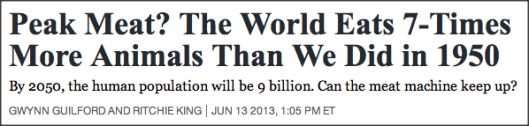
An article about ‘peak meat’ ran in The Atlantic and Quartz today, adding yet another peak to the mounting list of constrained and over-consumed resources on the planet:
Besides the health risks of eating too much red meat, i.e. heart disease, there is the environmental impact affecting everyone, meat-eaters and vegans alike. In the last couple years there have been increasing calls for the developed countries to dramatically cut their meat consumption by 50% to reduce greenhouse gases from industrial meat production. The fertilizers used to grow the feed crops for cattle “produce the most potent of the greenhouse gases.”
Retail sales of meat and poultry have risen in the U.S. in recent years, but the actual volume sold has been decreasing. The increased sales totals have been a result of increased prices due to higher production input costs. Look at the graph below and you’ll see that farmed fish have overtaken beef production. Part of this may be due perhaps to a more health-conscience public, but I believe the primary reason is because of increased production costs which are ultimately from increased energy costs or constraints of peak net energy:
As grain and soybean prices have risen well above historical levels in recent years, the cost of producing grain-eating livestock has also gone up. Higher prices have nudged consumers away from the least-efficient feeders. This means more farmed fish and less beef. In the United States, where the amount of meat in peoples’ diets has been falling since 2004, average consumption of beef per person has dropped by more than 13 percent and that of chicken by 5 percent. U.S. fish consumption has also dropped, but just by 2 percent…
…Cattle consume 7 pounds of grain or more to produce an additional pound of beef. This is twice as high as the grain rations for pigs, and over three times those of poultry. Fish are far more efficient, typically taking less than 2 pounds of feed to add another pound of weight. Pork and poultry are the most widely eaten forms of animal protein worldwide, but farmed fish output is increasing the fastest. – source
In the next graph we see that while farm fishing is on the rise, wild caught fish have been on the decline due to overfishing, destruction of ocean ecosystems, and what has been called peak fish.
So the world is replacing beef and wild-caught fish with farmed fish or aquaculture. But just as cattle farming and the overharvesting of the oceans for 7 billion people create their own far-reaching environmental impacts, so too does farmed fish:
As cattle ranches have displaced biologically rich rainforests, fish farms have displaced mangrove forests that provide important fish nursery habitats and protect coasts during storms. Worldwide, aquaculture is thought to be responsible for more than half of all mangrove loss, mostly for shrimp farming. In the Philippines, some two thirds of the country’s mangroves—over 100,000 hectares—have been removed for shrimp farming over the last 40 years. …Another problem with intensive confined animal feeding operations of all kinds, whether for farmed fish or for cattle, is not what gets extracted from the environment but what gets put in it. …Along with the vast quantities of waste, the antibiotic and parasite-killing chemicals used to deal with the unwanted disease and infestations that can spread easily in crowded conditions also can end up in surrounding ecosystems. The overuse of antibiotics in livestock operations can lead to antibiotic-resistant bacteria, threatening both human and animal health. In the United States, for instance, 80 percent of antibiotics use is in agriculture—and often not for treating sick animals but for promoting rapid weight gain. – source
On his website Peak Food, John Gossop lists the reasons why we are headed for a global famine in 2025:
In response to the increasing demand for food, wealthy countries have gone overseas on a land grab to secure soil and water resources:
…in the past 10 years, up to 227 million hectares of land were sold in developing and emerging countries, or signed away as long-term leases. The total area is roughly six times the size of Germany. In the past two years, competition has intensified further, especially in sub-Saharan Africa. According to Oxfam, more than 60 % of the land deals concern countries that suffer poverty and hunger. This is considered worrisome since international investors are basically interested in exporting commodities to richer economies. – source
Peak food production seems to have been reached due to the water-energy-food nexus, according to Marita Wiggerthale, trade and food expert for Oxfam Germany:
Peak food production has already been reached because there is increased competition between food, fuel and feed,” Wiggerthale said, pointing to biofuel production that diverts 15 percent of the world’s corn to engines and the world’s growing appetite for meat, which pushes farmers to grow food for animal feed at the expense of other food crops. – source
I’m not sure what new crops will survive in a climate pattern of extreme drought, floods, and fluctuating temperatures, but some think we can GMO are way out of this mess.
“Beekeeper Industry is Doomed and Cannot Survive for another 2 to 3 Years…”
And to add to the threat of the world’s food supply, a mass die-off of the bees is underway, probably from the nemesis effect of our pesticide and chemical-saturated environment. Don’t these news reporters look a little too relaxed reporting this horrific story in the video below?
Sacramento California is now witnessing first hand, the daunting implications of colony collapse disorder. It is estimated that California produces about 80 percent of the world’s almonds. There are 6,000 almond orchards in that region and many of the farmers are finding that there simply aren’t enough bees to pollinate their crop. A fourth generation beekeeper lost 70% of his hives while another lost 100%.
The negative effects of the honeybee shortage were predicted last year so measures were taken to try and offset this dangerous scenario. 11,000 hives were brought to California from all over the country; of these 11,000 hives, hundreds were found dead upon arrival. There are an abundance of theorized causes of colony collapse disorder, from disease, to mites, to pesticides. In a recent U.C. Davis study, in which a large sample of hives was examined, 150 different chemical residues were found on the bees.
The effects of honeybee loss are near cataclysmic as it is estimated that one third of the entire world’s food supply comes from pollination. Pesticides are a key suspect in the hunt for the culprit and fortunately there is something that we can all do to counter their use. We can buy organic, buy local, and grow our own food. Practicing self-sustainability and support for local sustainable farmers is a key factor in staving off the potential for worldwide food shortages… – source
I’m working on adding graphics and trimming down a couple videos made from an extraenvironmentalist podcast of interviews with energy specialists Chris Nelder and Gregor Macdonald; but in the meantime, here is an update on the water-energy-food nexus exacerbated by climate change which I blogged about here. The social consequences are spelled out:
…US farms are already crippled: the Department of Agriculture says the corn (maize) crop is likely to be the worst since 1995. As a result, the Food Price Index (FPI) of the United Nations Food and Agriculture Organization rose 6 per cent in July, to 213.
More unrest is likely in the next year, although we cannot predict where, says Bar-Yam. That depends on how governments respond… – source
…and on the energy and water front:
…Power plants are a hidden casualty of droughts, says Barbara Carney of the National Energy Technology Laboratory (NETL) in Morgantown, West Virginia, because they are completely dependent on water for cooling and make up about half the water usage in the US. That makes them vulnerable in a heat wave. If water levels in the rivers that cool them drop too low, the power plant – already overworked from the heat – won’t be able to draw in enough water. In addition, if the cooling water discharged from a plant raises already-hot river temperatures above certain thresholds, environmental regulations require the plant to shut down.
One nuclear plant in Connecticut recently had to shut down because the sea water used for cooling was too warm. Nationwide, nuclear generation is at its lowest in a decade, with the plants operating at only 93 per cent of capacity.
Nuclear is the thirstiest power source. According to NETL, the average nuclear plant that generates 12.2 million megawatt hours of electricity requires far more water to cool its turbines than other power plants. Nuclear plants need 2725 litres of water per megawatt hour for cooling. Coal or natural gas plants need, on average, only 1890 and 719 litres respectively to produce the same amount of energy….
Bio fuel thirst
Reports of how much energy the US has generated this summer won’t be released for some months, he says. The North American Energy Reliability Corporation’s most recent report (PDF) calls the drought outlook “not optimistic” for energy, but says that most of the US should be able to meet its energy demands this year. The exception is Texas, where resources are expected to be tight.
Utility-scale power isn’t the only energy source being hurt by the drought, however. With corn harvests expected to be as low as 75 per cent of normal yields, biofuel production is also suffering. Compared to other energy sources, biofuel production requires the most water.
…Arjen Hoekstra of the University of Twente in the Netherlands calculates the total water use of different industries – including not just cooling but every step in the supply chain as well. According to his “water footprint calculator”, biofuels require orders of magnitude more water than any other energy source… – source
Some farmers profit from the energy industry’s scramble for water while other farmers are fearful, holding back water for their crops…
…Select Energy sources water for oil companies in drilling hotspots across the country, and some landowners can make between $70,000 and $85,000 over the course of a year and a half by selling the water in their ponds to the company, said Mike Wilson, a regional sales manager at Select Energy.
But many landowners aren’t as willing to give up their water now that supplies have become so scarce.
“Farmers are scared about the water supply, too,” said Jeff Gordon, CEO of Texas Coastal Energy Co., a small oil company that began exploring in Kansas last year. “They are now saying, ‘We need to save our water for our crop and our livestock.’ ”
With two oil wells slated to be drilled in the next month, Texas Coastal is considering drilling its own water well at a cost of between $10,000 and $25,000.
Otherwise, it would have to pay to truck water in from out of state or buy it from local farmers and ranchers. Either method could add 3% to 4% to the overall cost of drilling an oil well. Depending on the size of the well and the amount of water required, that could add up to between $20,000 and $200,000.
To the oil companies, it’s worth it. With oil prices hovering around $90 a barrel and the cost to produce a barrel of oil only around $15, the profits are huge, said Gordon, whose company is still aggressively leasing mineral rights, which gives it rights to drill on certain properties.
If the drought worsens or persists for too much longer, however, it could threaten the oil boom, particularly among the smaller drilling companies that can’t afford the added costs and delays, he said.
“That can cripple a drilling company, as lack of water can basically suspend operations,” he said.
Petro River’s Alba said the drought won’t affect his current drilling plans, but hewill carefully assess water availability before expanding into other areas of Kansas.
Scrambling to get the oil companies to stay: Mike Lanie, the economic development director in Harper County, which is at the center of the oil boom, is determined to keep oil companies from pulling out. – source
The financial drain on the system from the drought…
The U.S. government recently announced it would buy $170 million in various meats to help drought-stricken farmers. Other costs to the taxpayer from this epic drought include payouts from federal crop insurance programs:
Crop insurance losses: Your tax dollars on the hook
The drought of 2012 is also likely to result in record payouts from the federal crop insurance program. This taxpayer-funded program subsidizes insurance for farmers and also partially compensates private insurers, with additional emergency assistance that kicks in during extreme events like the current drought.
“The end of the human race will be that it will eventually die of civilization.”
~ Ralph Waldo Emerson
The water-energy-food nexus is an interlocking problem. For example, biofuel production takes land and water away from food production. Besides the contamination to water reservoirs, the process of hydrofracking and tar sands utilizes massive amounts of water which could otherwise be saved for farming:
Oil sands extraction uses significant amounts of water (2-4.5 barrels per barrel of oil produced), which ends up in toxic tailings lagoons that have never been successfully reclaimed. An analysis using industry data estimated that these lagoons already leak over a billion gallons of contaminated water into the environment each year. – source
Hydrofracking injects large volumes of water (up to six million gallons of water per gas well) mixed with sand and toxic chemical additives at high pressures to release the gas. Most of the water is then returned to the surface as polluted wastewater – that must be treated by wastewater treatment plants already overburdened and not necessarily designed to remove these chemicals. Industry analysts predict it will cost $3 billion to treat the industrial wastewater associated with Marcellus shale development… Groundwater supplies may become contaminated with these chemicals as they already have in parts of Pennsylvania and other states. Currently, oil and gas companies that use hydraulic fracturing are exempt from regulations under the Safe Drinking Water Act that would require them to disclose the cocktail of chemicals they use.
– source
Scaling back on the production of these unconventional energy sources in order to conserve land and water for food will increase the cost of conventional oil, and thus food prices, since industrial agriculture is dependent on fossil fuels:
Due to the vast size of these [industrial] farms, the farms are operated in a similar manner to that of large industrial factories. And these “factories” require large quantities of synthetic fertilizers, pesticides, and fuel all derived from fossil fuels, which is a limited natural resource on our planet (Hidden Costs of Industrial Agriculture, 2008). “After cars, the food system uses more fossil fuel than any other sector of the economy — 19 percent.” This high dependence on fossil fuels makes industrial agriculture heavily unsustainable. “Twentieth-century industrialization of agriculture has increased the amount of greenhouse gases emitted by the food system by an order of magnitude; chemical fertilizers (made from natural gas), pesticides (made from petroleum), farm machinery, modern food processing and packaging and transportation have together transformed a system that in 1940 produced 2.3 calories of food energy for every calorie of fossil-fuel energy it used into one that now takes 10 calories of fossil-fuel energy to produce a single calorie of modern supermarket food” (Pollan, 2008).
The monkey wrench of climate change is now thrown into the picture…
What happens to the stability of the world when fertile lands become dust bowls, when rainfall no longer follows its traditional seasonal pattern, when crop yield forecasts become less and less reliable as climate change begins to bite? We don’t have to look very far back to see the upheaval caused in countries whose majority population lives on the razor-edge of starvation:
2007–2008 – Food riots in India, Peru, Morocco, Egypt, Bangladesh, Pakistan, Zimbabwe, Mozambique, Namibia,
Uzbekistan, Indonesia, Yemen, Guinea, Cameroon,
Burkina Faso, Mauritania and Senegal. [64][65][66][67][68][69]
And again in 2010-2011:
For those who think that adaption to climate change is feasible, please consider what Kurt Cobb articulates in a recent post:
…costly existing agricultural infrastructure won’t be easily moved or replaced. …soil quality is not uniform from place to place. [Do you] think that as temperatures warm and devastate the American grain belt with recurrent drought, we can simply transfer the growing of much of the world’s export grain crop north to the Canadian Shield which has soil so thin it has never supported agriculture?
The ‘Catch-22’ kicker is that the continued use of fossil fuels, the indispensable elixir of industrial civilization’s existence, is exactly what is causing climate chaos in the first place. And as I showed with one simple chart in a previous post, we are using more of this deadly ingredient than ever before. In his latest article ‘The hunger wars in our future’, Michael Klare warns us about the social disruptions that lie in the future as a result of the insidious water-energy-food nexus that grips our modern-day way of life:
…When we think about climate change (if we think about it at all), we envision rising temperatures, prolonged droughts, freakish storms, hellish wildfires, and rising sea levels. Among other things, this will result in damaged infrastructure and diminished food supplies. These are, of course, manifestations of warming in the physical world, not the social world we all inhabit and rely on for so many aspects of our daily well-being and survival. The purely physical effects of climate change will, no doubt, prove catastrophic. But the social effects including, somewhere down the line, food riots, mass starvation, state collapse, mass migrations, and conflicts of every sort, up to and including full-scale war, could prove even more disruptive and deadly…
At this point, the focus is understandably on the immediate consequences of the still ongoing Great Drought: dying crops, shrunken harvests, and rising food prices. But keep an eye out for the social and political effects that undoubtedly won’t begin to show up here or globally until later this year or 2013. Better than any academic study, these will offer us a hint of what we can expect in the coming decades from a hunger-games world of rising temperatures, persistent droughts, recurring food shortages, and billions of famished, desperate people.
Remember when both Bush, Cheney and Obama famously quipped that “the American way of life was non-negotiable.” Mother Nature and the Grim Reaper have rephrased that self-righteous slogan to read:
“The American way of life is unsustainable, non-redeemable, and a limited-time-only.”



 Collapse of Industrial Civilization