We’re approaching the one year anniversary of this website and I really have not explicitly stated my core beliefs and ideas. So let me begin by stating ten essential positions of this website:
1.) Anti-Capitalist. Capitalism has several fatal flaws which we’ve discussed here in numerous posts. It is at the root of our social and environmental ills. A system which atomizes society, turning each against the other as competitors and targeting all members of society with a nonstop stream of marketing and advertising propaganda, is the antithesis of a community-building ethos.
…cast your eyes on capitalism as a meme that effectively mutates the thinking of people, turning them into over consumers and profiteers. It is the relentless drive to grow profits that pushes us to do what we do. And that meme has metastasized globally. That is the real disease.
The original capitalism arose as a means to aggregate enough excess harvest so as to re-invest in capital equipment (before formal depreciation entered the scene) for the farm or village. It quickly led to investment in growing the capacity of a community to support more people and have more stuff and that led us, eventually, to what we have today — unbridled avarice and waste… ~ George Mobus
2.) Anti-Imperialist. Imperialism is the economic dominance and exploitation of a country, often underwritten by military force.
3.) Anti-Militarist (not the same as Pacifist). This stance goes along with 1 and 2. The Military Industrial Complex (MIC) has become a branch of government unto itself. ‘War for profit’ is big business with retiring generals becoming consultants to the weapons manufacturers. A large percentage of congressmen and senators are personally invested in the American war machine. With the War on Terror, the tail is wagging the dog.
4.) Man is part of nature, not separate from it. All life forms on Earth have intrinsic worth which cannot be accurately monetized or commodified. Economic activity by humans incurs environmental costs, but these costs are externalized. An economy which internalizes these costs is the only sustainable system able to support human societies long-term. What is the final cost of CO2 emissions, but likely the extinction of the human species along with everything else (6th Mass Extinction).
5.) Technology is not corrupt, the system is. I am not anti-technology. How a society applies a particular technology determines that technology’s social worth. Do we use it to keep vegitative patients alive at great cost? Do we use it to produce energy whose byproduct is toxic waste lingering for eons? Do we use it to annihilate each other under a mushroom cloud?
Many citizens of industrial capitalism have become technophiliacs, developing an unhealthy and unrealistic faith in the ability of technology to solve any and all problems. That’s a failure of a social system which deifies technology, promoting it as a cure-all while also using it to reproduce inequality and injustice.
Speaking on the Arab Spring and the Egyptian Revolution, Professor David Correia says:
…In the end, the particular objects and artifacts of everyday “technology” are the tools of corporations and authoritarian governments. And by now it should be clear that democracy and capitalism do not cohere and the revolution cannot be carried out via “technology.” Rather the struggle must become a struggle over the social, political and economic conditions that have made the everyday objects of technology—our digital campfires—nothing more than the tools of authoritarian despotism and capital accumulation.
6.) We live under a form of growing tyranny called inverted totalitarianism. I first read about the term inverted totalitarianism from journalist Chris Hedges who quotes from political philosopher Sheldon Wolin. Hedges has done a great job of documenting and explaining the rise of the corporate state in this country and around the world. From the Fourth Estate to higher education to all other social institutions and venues, we have literally been ‘occupied’ by corporations.
7.) Climate Change, or more aptly ‘climate disruption’, is human-caused.
Our use of fossil fuels since the beginning of the industrial revolution has disrupted the natural carbon cycle of the planet. I have numerous links on this site to scientific findings proving that climate change is happening and is caused by human activity. The evidence is overwhelming and supported by near unanimity amongst the scientific community. The fossil fuel lobby is extremely powerful and has financed a ‘public deception’ campaign to cast doubt on the root cause of climate change.
8.) Peak Oil is real and happening. It’s all about Energy Return on Investment (EROEI), and it’s a liquid fuel crisis. Despite the rampant self-deception of carbon man and the ‘public deception’ campaign by the fossil fuel industry, America is not and will not become energy self-sufficient in its current configuration of ‘urban sprawl to nowhere’ and its capitalist cornerstone of the automobile industry (individualized transportation).
Despite increased efforts to get more drivers to adopt fuel-efficient vehicles, U.S. households spent the highest percentage of their income on gasoline in 2012 than they did in any other year in nearly three decades except for 2008, according to new estimates.
The Energy Information Administration reported that the average household spent $2,912 on gasoline in 2012, or nearly four percent of their pre-tax income. – source
9.) Peak everything is happening. From industrial minerals which serve as the building blocks for modern civilization to the seafood that we eat, humans are eating the planet out of house and home. The energy bonanza of fossil fuels enabled the human population to spread far and wide, becoming a force of nature which now has the dubious distinction of having a geologic era named after it – The Anthropocene – and which has spurred one Professor to start a campaign in order to rename Homo sapiens to something other than ‘wise’. The Four Horsemen of Industrial Civilization (Climate Change, Peak Net Energy, Ocean Acidification, and Peak Water) are converging to bring Homo sapiens reign to an end.
10.) With business-as-usual, humans will likely become extinct by the end of this century or shortly thereafter. Multiple tipping points have already been triggered which will have non-linear and self-reinforcing feedback effects. We have covered many of these feedback loops on this site. Suffice it to say, only the timing of the final consequences is debatable at this point. Massive and radical changes to our society could always be started to lessen the final impacts, but such a proposal is like telling a nicotine addict, who smokes through their tracheostomy, that “it’s never too late to quit.” Ugghh!
So I think we can all agree on most if not all of the above statements. If there are any questions on my core beliefs or if there are ideas which you think should have been included, then let me know. By the way, none of the above positions makes me a “Doomer”. I hate that title. I’m a realist.
Humans are the premier practitioners of hype.
At this very moment, brave conservationists are risking their lives to protect dwindling groups of existing African forest elephants from heavily armed poachers. And here we are in this safe auditorium talking about bringing back the Woolly Mammoth. Think about it… Hype can come back to bite you.
The extinction event which I talked about in ‘Free Markets, Corporate Profits and Mass Extinctions‘ looks by all unbiased scientific accounts to be happening again. Instead of volcanoes inducing climate change, today it is man’s industrial activities, specifically the burning of stored ancient sunlight, that is bringing about the end of the world as we know it. We will soon breach 400 ppm of atmospheric CO2 levels:
The ratio of carbon dioxide in Earth’s atmosphere is flirting with 400 parts per million, a level last seen about 2.5 million to 5 million years ago, according to the Scripps Institution of Oceanography at UC San Diego….
…The speed at which Earth’s atmosphere has reached that density of carbon dioxide, a known greenhouse gas, has scientists alarmed.
Scientists estimate that average temperatures during the Pliocene rose as much as 18 degrees Fahrenheit. Sea levels during that 2.8-million-year epoch ranged between 16-131 feet higher than current levels, according to Richard Norris, a Scripps geologist.
“I think it is likely that all these ecosystem changes could recur, even though the time scales for the Pliocene warmth are different than the present,” Norris said. Heating the ocean probably will cause sea level rises and change the Ph balance of the ocean, affecting a wide array of marine life, he said. “Our dumping of heat and CO2 into the ocean is like making investments in a pollution bank,” he said…
Let’s go over and update the major tipping points again(covered earlier here and here) which are currently in play:
Jason Box speaks the language of Manhattans. Not the drink—the measuring unit.
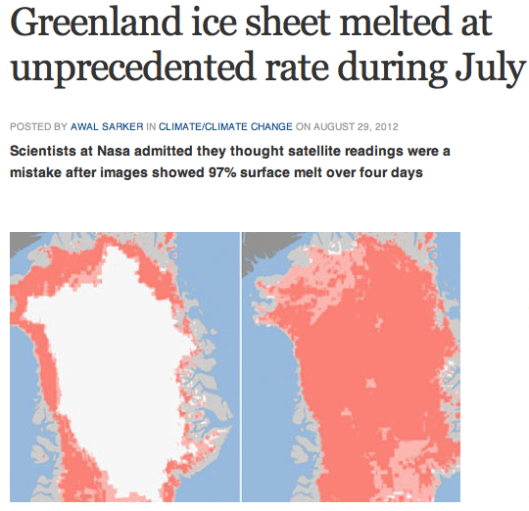
As an expert on Greenland who has traveled 23 times to the massive, mile thick northern ice sheet, Box has shown an uncanny ability to predict major melts and breakoffs of Manhattan-sized ice chunks. A few years back, he foretold the release of a “4x Manhattans” piece of ice from Greenland’s Petermann Glacier, one so big that once afloat it was dubbed an “ice island.” In a scientific paper published in February of 2012, Box further predicted “100 % melt area over the ice sheet” within another decade of global warming. As it happened, the ice sheet’s surface almost completely melted just a month later in July—an event that, in Box’s words, “signals the beginning of the end for the ice sheet.”
Box, who will speak at next week’s Climate Desk Live briefing in Washington, D.C., pulls no punches when it comes to attributing all of this to humans and their fossil fuels. “Those who claim it’s all cycles just don’t understand that humans are driving the cycle right now, and for the foreseeable future,” he says. And the coastal consequences of allowing Greenland to continue its melting—and pour 23 feet’s worth of sea level into the ocean over the coming centuries—are just staggering. “If you’re the mayor of Hamburg, or Shanghai, or Philadelphia, I think it’s in your job description that you think forward a century,” says Box. “They’re completely inundated by the year 2200.”…
3.) Unleashing of Tundra methane clathrates and sub-sea methane deposits from (1) and (2):
Courtesy of the work by Sam Carana, the multitude of reinforcing feedback loops from the loss of the Arctic Ice Sheet are listed below:
Albedo feedback: Accelerated warming in the Arctic speeds up the decline of ice and snow cover, further accelerating albedo change.
Methane feedback: Methane releases in the Arctic further add to the acceleration of warming in the Arctic, further contributing to weaken Arctic methane stores and increasing the danger that methane releases will trigger runaway global warming.
Currents feedback: Sea ice loss can cause vertical sea currents to weaken, reducing the cooling effect they had on the seabed. This can thus further cause sediments to warm up that can contain huge amounts of methane in the form of free gas and hydrates.
Storms feedback: Increased frequency and intensity of storms can cause substantially more vertical mixing of the sea water column, causing more warming of the seabed, thus further contributing to the warming of sediments, as above.
Storms feedback: Accelerated warming in the Arctic can result in more storms, causing mixing of cold Arctic air with warmer air from outside the Arctic. The net result is a warmer Arctic.
Storms feedback: More open waters can result in more storms that can push the ice across the Arctic Ocean, and possibly all the way out of the Arctic Ocean.
Storms feedback: Storms also cause more waves that break up the sea ice. Smaller pieces of ice melt quicker than large pieces. A large flat and solid layer of ice is also less susceptible to wind than many lighter and smaller pieces of ice that will stand out above the water and capture the wind like the sails of yachts.
Storms feedback: Storms cause waters to become more wavy. Calm waters can reflect much sunlight back into space, acting as a mirror, especially when the sun shines under a low angle. Wavy waters, on the other hand, absorb more sunlight.
Fires feedback: More extreme weather comes with heatwaves and storms. Thus, this is in part another storms feedback. The combination of storms and fires can be deadly. Heatwaves can spark fires that, when fueled up by storms, turn into firestorms affecting huge areas and causing huge amounts of emissions. Storms can whip up particles that when deposited on ice, snow or the bare soil, can cause more sunlight to be absorbed.
Open doors feedback: Accelerated warming in the Arctic causes the polar vortex and jet stream to weaken, causing more extreme weather and making it easier for warm air to enter the Arctic.
Two papers released last week in the journal Nature Geoscience provide evidence that warming and melt in West Antarctica are occurring at levels that are highly unusual compared to natural variability.
The West Antarctic Ice Sheet contains about 2.2 million cubic kilometers of ice; enough to raise global sea levels by 3 to 4m. What’s making glaciologists nervous is that the ice rests on bedrock which is below sea level; this makes it vulnerable to attack from below by a warming ocean as well as attack from above by increasing air temperatures.
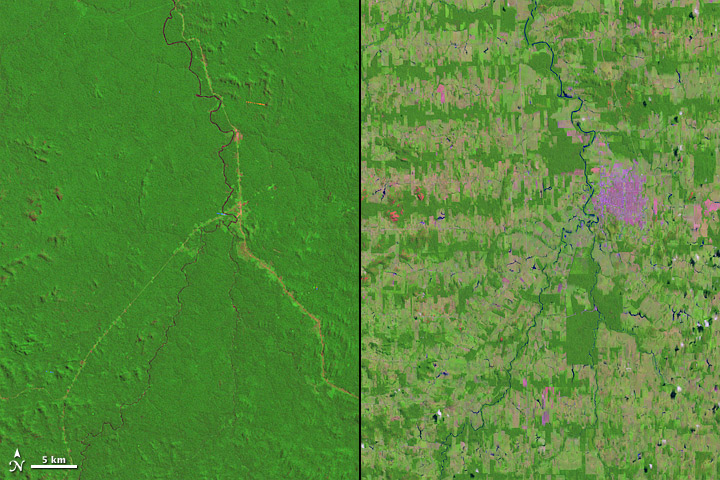
As some of us were heading off for the Easter holiday weekend, the Brazilian government was quietly releasing deforestation trends showing an increase in deforestation for the first time in five years.
These numbers use the DETER rapid response satellite system, a system that provides estimates of deforestation rates every month. Over the time period documented, August 2012 to February 2013, the rates increased an estimated 26.82% and an area of the Amazon larger than the size of the city of London disappeared.
In absolute numbers, that means 1,695 square kilometers (654 square miles) of forest have disappeared. That equals an area the size of 237,000 soccer fields…
…The increase in deforestation rates can be directly attributed to the Brazilian government’s systematic dismantling of the laws and agencies that protect the Amazon…
…President Dilma Rousseff’s approval of a new Forest Code, a law that provides amnesty for crimes committed after 2008 in the Amazon and reduces large areas of protected land, paved the way for the increase in deforestation. The president also structurally weakened government agencies like IBAMA, the federal environmental enforcement agency, so unfortunately it won’t be a surprise if deforestation continues to rise in the Amazon…
After more than a decade, the mountain pine beetle epidemic that surged through British Columbia appears finally to be in remission. Having devastated the province’s lodgepole pine forests, the insect is running out of food.
But forest managers now see new beetle infestations appearing at the edge of the Boreal Forest, in Alberta, and in the Yukon and Northwest Territories — areas well outside the insect’s historical range. As a warming climate lifts the temperature limitations that once kept the beetle in check, scientists fear it may continue its push across the continent, perhaps as far as the Atlantic Coast…
…Without debating the causes of global climate change the effects of forest dieback can be viewed factually. The earth is warming and droughts are increasing in severity and magnitude. Temperature and drought are major contributing factors to forest dieback, so more trees will be dying in the future. As more carbon is released from dead trees, especially in the Amazon and Boreal Forests, more greenhouse gasses are released into the atmosphere. Increased levels of greenhouse gasses increase the temperature of the atmosphere. The negative feedback loop is reinforced and the biological adaptations of the species determine its survival. Projections for dieback vary, but the threat of global climate change only stands to increase the rate of dieback. The issue is complex and models are intricate, so scientists have serious work ahead of them.[8]
Scientists do not know the tipping points of climate change and can only estimate the timescales. When a tipping point, the critical threshold, is reached a small change in human activity can have long-term consequences on the environment. Two of the nine tipping points for major climate changes forcast for the next century are directly related to forest diebacks. Scientists are worried that forest dieback in the Amazon[9] rain forest and the Boreal[10] evergreen forest will trigger a tipping point in the next 50 years.[2]… – source
7.) The Sahara and Sahel in Africa
It is difficult to estimate the overall ability to increase food production, but a recent analysis suggests that human consumption may be approaching the limits of the net primary plant production (NPP) — that is, the maximum photosynthetic production that is possible on the planet.
It is “not whether humans will reach the global NPP boundary but when they will do so.” It seems probable that the developed countries will continue their excessively high levels of consumption. The emerging economies are likely to continue to eat more protein and a larger slice of grain production in countries with an appropriate climate for grain production will be diverted to feeding animals, or ethanol to drive automobiles. A child born in the Sahel today could belong to the first generation to come to maturity in the contemporary world where the ability to feed large numbers of ecological refugees may well diminish. It is also possible that the secondary effects of the collision of population growth and climate change could create what scientists call an “asymmetrical uncertainty.” The possible consequences of this asymmetrical uncertainty on political processes and violence could range from a slow worsening of the current situation to extremely serious conflict over resources and threats to security. Biologically, adverse factors can interact in ways that can cause a rapid downward spiral. For example, as noted above, ambient temperatures over 29°C (84°F) lead to a rapid decline in crop yields.
[At least 95% of the food production in the Sahel is based on rain-fed agriculture. The agricultural sector employs, directly or indirectly, more than half of the Sahel’s population…Global warming will mean that in temperate lands, where much of the global crop production occurs, the most productive regions will migrate away from the equator. While the net aggregate change as a result of climate change at a global level may be slow, the regional effects in the Sahel will be more rapid, significant, and adverse.] – source
8.) The El Nino Southern Oscillation(ENSO):
Climate models appear to be unable to accurately predict ENSO changes. Although scientists can predict some large-scale and long-term effects of anthropogenic global warming, there remains a lot of unknowns about specific regional effects.
The problem may lie in the models’ inability to reproduce the cycling between the ENSO’s El Niño and La Niña phases, especially given that many scientists think that La Niña is the major driver of drought in the southwest. The ENSO “behaves much messier in the real world than in climate models”, says Jessica Tierney, a climate scientist at the Woods Hole Oceanographic Institution in Massachusetts who has investigated the role of the ENSO in East African rainfall variability2. “We’re not sure how it has varied in the past, and we don’t know how it might change in response to climate change. This is really one of the big uncertainties we’re facing.”
In addition to their failure to reproduce El Niño and La Niña, existing models do not fully capture other factors that influence rainfall, such as clouds and vegetation. But Smerdon adds that the atmospheric and oceanic dynamics that inhibit rainfall and favour prolonged drought may be essentially random and so almost unpredictable.
Last week’s findings highlight the broader challenge of predicting how precipitation patterns will change as the global climate warms. Models are often at odds over the very direction of regional changes. For example, different projections prepared for the Colorado Water Conservation Board disagree on whether mean precipitation in the state will increase or decrease by 2050 (ref. 3).
But the uncertainties don’t change the larger picture, scientists say. “Climate models are not perfect, but they do the big things really well,” says Tierney. “We can be pretty confident that the southwest will warm and that water will become scarcer.
…since the 1970s the atmospheric circulation patterns over the Pacific have tended to favor La Nina conditions over El Nino ones. And, they write: “The overall trend towards a stronger, La Niña-like Walker circulation is nearly concurrent with the observed increase in global average temperatures.”
We know from historical data that from these two climatic events – the Medieval Warm Period(the long stable warming period over Europe) and the Little Ice Age(a well-known described historical event) – that the temperature changed, and our big question is, “Does the ocean also respond in this very short time scale?”
And one of the major results and maybe one of the biggest prices is that the ocean and the thermohaline circulation(THC) respond to these thermal drivers within just a decade.
…What we are mostly concerned about is that there is a certain threshold which is then reached, a certain point of no return more or less. So we will have a trend where it’s getting warmer and warmer and warmer, and there will be no return from this warming… and that will change the whole system, the whole flow of the system, and the thermohaline circulation may be changed…
The major threats we see right now to the thermohaline circulation mainly derive from the Arctic region. We see increased melting from the Greenland Ice Sheet. We see a retreat of Arctic See Ice. We see large reorganizations in the Arctic ocean system which accumulate fresh water. All of these things are components which may affect the thermohaline circulation.”
The most important factors affecting changes in the conditions of the thermohaline circulation are:
1.) Global warming itself caused partly by greenhouse gases from human activity.
2.) From AGW, there will be more rainfall in the higher latitudes causing glacial melt.
Density in the water is a key factor for the THC driver mechanisms. Cold surface water temperatures make the water denser and high ocean salinity cause these waters to sink. These are the main engines that run the THC, but now more fresh water is entering the ocean through the melting of the Arctic and Greenland ice sheets.
When this is integrated into the models, a new development of the engines is revealed. In a warmer climate state, the engine of the Labrador Sea seems to simply collapse…
10.) The Indian Summer Monsoon:
…Writing in the journal Environmental Research Letters, researchers at the Potsdam Institute for Climate Impact Research and Potsdam University in Germany said increasing temperatures and a change in strength of a Pacific Ocean circulation pattern known as the Pacific Walker circulation in spring could cause more frequent and severe changes in monsoon rainfall.
The Walker circulation usually brings areas of high pressure to the western Indian Ocean but in El Nino years this pattern gets shifted eastward, bringing high pressure over India and suppressing the monsoon, they said.
Computer simulations show that with future global warming the Walker circulation is likely to bring more high pressure over India even without an increase in El Nino events.
These failures of the monsoon system suggested by the simulation, defined as a 40 percent to 70 percent reduction in rainfall below normal levels, were unprecedented in the researchers’ observational record, taken from the India Meteorological Department dating back to the 1870s.
“Our study points to the possibility of even more severe changes to monsoon rainfall caused by climatic shifts that may take place later this century and beyond,” lead author Jacob Schewe said. – source
Indeed if humans were able to set aside their anthropocentric view of the world, we would be frantically changing our behavior and rearranging our economic and social activities in order to prevent our own demise. But alas, if things aren’t right between one’s ears, then everything else is moot.
(Edit on 3-9-2015: The following video has been made “private”, but it can be viewed in its entirety here.)
Amongst all the drama of the fiscal cliff, the story that should have gotten front page space this week is that the Antarctic is melting much faster than previously thought. In my post ‘Burning the Candle at Both Ends‘, the recent finding that the Antarctic was indeed losing ice came as a revelation to many and dispelled the popular belief amongst the global warming ‘denialist’ crowd that the South Pole ice sheet was increasing. The situation has now gotten more dire:
What are the ramification of this? We’ve released another ticking methane time bomb and opened up one more pandora’s box of known and unknown feedback loops:
…Half the West Antarctic ice sheet and a quarter of the East Antarctic sheet lie on pre-glacial sedimentary basins containing around 21,000bn tonnes of carbon, said the scientists, writing in the journal Nature.
British co-author Prof Jemma Wadham, from the University of Bristol, said: “This is an immense amount of organic carbon, more than 10 times the size of carbon stocks in northern permafrost regions.
“Our laboratory experiments tell us that these sub-ice environments are also biologically active, meaning that this organic carbon is probably being metabolised into carbon dioxide and methane gas by microbes.”
The amount of frozen and free methane gas beneath the ice sheets could amount to 4bn tonnes, the researchers estimate…
And what will happen to coastal communities? If one were to perform a linear projection of sea level rise from recent records, then you would get the following results:
…Currently, sea level is rising at the rate of 3 mm each year. Given 1″ = 25 mm, this means by the end of the century a rise of 87 (yrs) x 3 mm / yr. = 261 mm or (261 mm/ 25 mm/in) = 10.44 inches – enough to wash away roughly one third of S. Florida and most of the sea level areas of the Atlantic coast…
…IPCC (2007) suggested a most likely sea level rise of a few tens of centimeters by 2100. Several subsequent papers suggest that sea level rise of ~1 meter is likely by 2100. However, those studies, one way or another, include linearity assumptions, so 1 meter can certainly not be taken as an upper limit on sea level rise…
…Hansen (2005) argues that, if business-as-usual increase of greenhouse gases continue throughout this century, the climate forcing will be so large that non-linear ice sheet disintegration should be expected and multi- meter sea level rise not only possible but likely. Hansen (2007) suggests that the position reflected in IPCC documents may be influenced by a “scientific reticence”…
…Perceived authority in the case of ice sheets stems from ice sheet models used to simulate paleoclimate sea level change. However, paleoclimate ice sheet changes were initiated by weak climate forcings changing slowly over thousands of years, not by a forcing as large or rapid as human-made forcing this century. Moreover, in a paper submitted for publication (Hansen et al., 2013) we present evidence that even paleoclimate data do not support the degree of lethargy and hysteresis that exists in such ice sheet models…
…The increasing Greenland mass loss in Fig. 1 can be fit just as well by exponentially increasing annual mass loss, a behavior that Hansen (2005, 2007) argues could occur because of multiple amplifying feedbacks as an ice sheet begins to disintegrate. A 10-year doubling time would lead to 1 meter sea level rise by 2067 and 5 meters by 2090. The dates are 2045 and 2057 for 5-year doubling time and 2055 and 2071 for a 7-year doubling time.
However, exponential ice loss, if it occurs, would encounter negative (diminishing) feedbacks. Our simulations (Hansen and Sato, 2012) suggest that a strong negative feedback kicks in when sea level rise reaches meter-scale, as the ice-melt has a large cooling and freshening effect on the regional ocean. Such a slowdown in the rate of sea level rise would be little consolation to humanity, however, as the high latitude cooling would increase latitudinal temperature gradients, thus driving powerful cyclonic storms (Hansen, 2009), and coastlines would be continually moving landward for centuries.
West Antarctic ice is probably more vulnerable to rapid disintegration than Greenland ice, because the West Antarctic ice sheet rests mainly on bedrock below sea level (Hughes, 1972). The principal mechanism for mass loss from West Antarctica is warming of the ocean, melting of West Antarctic ice shelves, and thus increased flux from the ice sheet to the ocean.
The several analysis methods compared by Shepherd et al. (2012) concur that the West Antarctic ice sheet mass imbalance has grown since 2005 from an annual mass loss of 0-100 Gt ice to a recent annual mass loss of 100-200 Gt ice (Fig. 4 of Shepherd et al.)…
There are roughly seven billion humans on Earth at this time, all of whom have a death sentence hanging over their head via anthropomorphic climate change. Perhaps this partly explains the recent popularity of zombies and the ‘walking dead’ in our culture. Forthright thoughts on this subject from a scientist commenting at the Arctic Sea Ice Blog:
The first signs have appeared of what will be a mass culling of the human population by way of famine in the decades to come:
…According to the Food and Agriculture Organisation in Rome, global wheat production is expected to fall 5.2% in 2012 and yields from many other crops grown to feed animals could be 10% down on last year.
“Populations are growing but production is not keeping up with consumption. Prices for wheat have already risen 25% in 2012, maize 13% and dairy prices rose 7% just last month. Food reserves, held to provide a buffer against rising prices, are at a critical low level. It means that food supplies are tight across the board and there is very little room for unexpected events,” said Abdolreza Abbassian, a senior economist with the FAO…
My youngest son, who is eight years old, shocked me last week with a certain question. I don’t talk about the subject matter of this blog to him for obvious reasons. He asked me whether in the future the world would become a sort of technological paradise or a destroyed planet. I couldn’t answer his question. I didn’t even want to try.
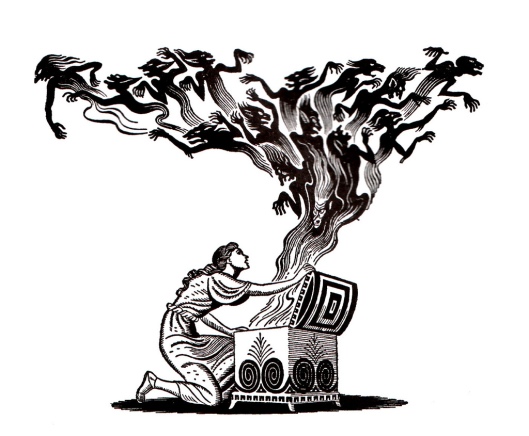
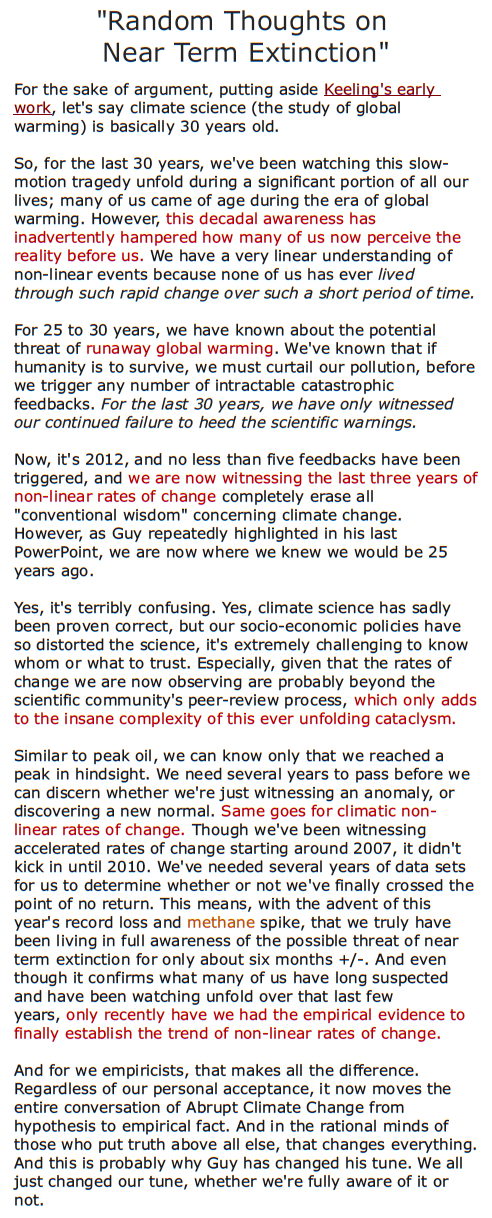
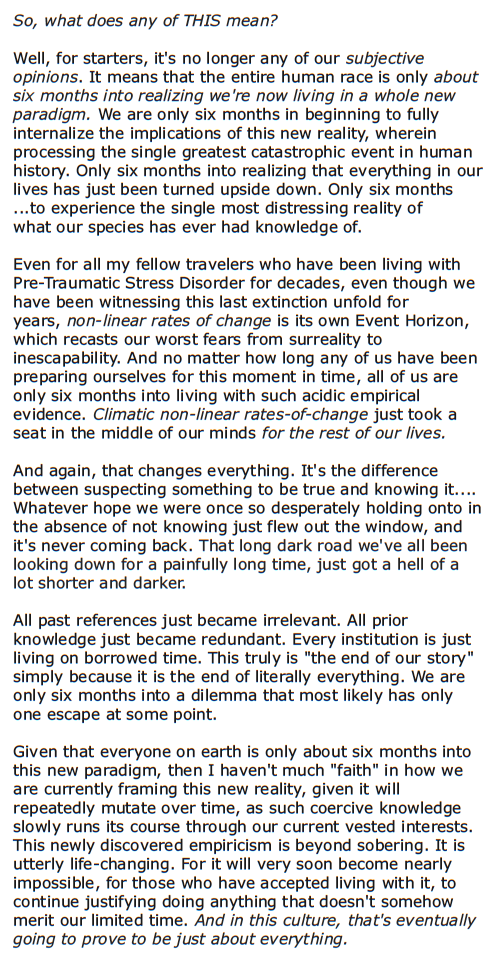
The following thoughts were emailed to me by Adam at speciesurvivalibrary and they appeared as a comment on the message board of Nature Bats Last dated November 28. The readers “found it quite moving”, as did I. Therefore, I compiled a video at the end to go along with Daniel’s articulate and resonating words. The scientific confirmations this year of the havoc industrial civilization has wrought to our one and only home have truly been life-altering for me, forcing me to question and re-evaluate everything. For those who have begun to internalize the cold reality of what lies in the not too distant future for mankind, the proverbial rug has been pulled out from under your world. We have unleashed Pandora’s box and the demons are methodically throwing off balance and unravelling the world we once knew, shattering the illusion of man’s dominion over nature.
The claims of near term extinction for mankind are getting stronger and stronger as new scientific evidence is released. Sometime before the end of this century, we’ll all be toast, so any measures we take now at “building resilience” will only be short-lived exercises in self-preservation. That’s how short-sighted we humans are: no consideration for the children and future generations. As long as we can stay comfortably cocooned within the wasteful amenities and faux culture distractions of industrial civilization, we’ll keep sucking on the great ‘carbon energy’ cigar to keep the illusion going, despite the fact that we’re committing species suicide. We are like the domesticated animal that can no longer survive in the natural world. Our addiction to fossil fuels has literally become an ingrained trait, selectively advantageous in the short-term but ultimately leading to our own evolutionary dead end.
If you missed it, the latest news is that, contrary to the propaganda put out by climate change deniers, the Antarctic is not gaining ice, but losing ice:
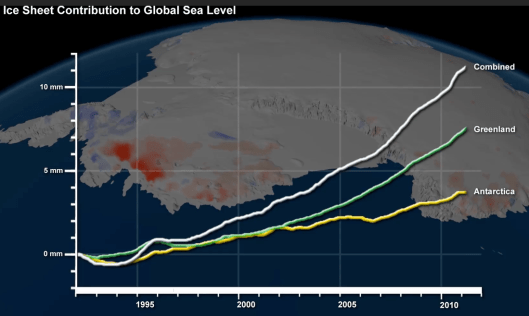
This is not good news. A new international study—done by 47 experts using data from multiple satellites and aircraft—shows that the Earth is losing ice at an ever-increasing rate from both poles. We’ve known for years that the Arctic has been suffering massive ice loss, with the record low broken more than once in recent years. What’s devastating about this new report is that it shows unequivocally and quantitatively that the Antarctic is also losing land ice, with the critical West Antarctica ice sheet losing on average 65 billion tons of ice every year.
Measuring ice is difficult to do and uncertainties are generally pretty big. By combining several different methods from several different sources, the scientists were able to get the best, most accurate measurements ever made. These new data show that the ice loss from both poles has increased by a factor of three since the 1990s. Just Greenland—the largest source of fresh water ice in the Northern Hemisphere—is losing ice at a rate five times what it did just in the 1990s: about 142 billion tons per year.
Together, since 1992, this ice melt has added over a centimeter (about a half inch) to sea level rise. That may not sound like much, but it doesn’t take much rise in sea levels to start causing catastrophic changes in erosion, storms, and flooding. Worse, this accounts for only about one-fifth of the total amount of sea level rise. Much of the rise is due to the water in the oceans expanding due to warming and other sources.
There’s a double whammy for you: Global warming is increasing the amount of water in the oceans from melting ice, and also increasing the sea level rise by heating up the water itself…
…This new study wipes out yet another false claim from climate change deniers, too. A common refrain from them is that Antarctic ice is increasing, not decreasing. However, this is not true for two reasons. The first is that they count sea ice in that measure. However, Antarctic sea ice tends to melt away completely every year in the spring and summer, and then it reforms in the winter. It therefore on average does not contribute to sea level rise or to the heat budget of the Earth. Second, this new study shows the claim is wrong anyway. We are losing ice from Antarctica every year, and it’s the critical land ice…
I’m sorry to say this, but all the ghastly visions of runaway climate change may very well come to fruition, wiping any trace of humans off the face of the Earth. In the end, man wasn’t really any different from lowly bacteria overwhelming the confines of a petri dish and extinguishing themselves. I’m sure we’ll have amassed an amazing trove of video, literature and other media documenting the horrors to come so that when some alien race visits the planet in the future, they will be able to watch bemused at how humans killed themselves off in the name of “progress” and a dollar.
Michael Sandmel:
“We make up half the world’s population, and frankly, we’re being screwed. We’re being denied a future by a lack of ambition, a lack of vision, and governments that are far too beholden to the interests of big fossil fuel companies, big coal companies, the banks that fund them.”
Having lived in the Mohave desert for about a decade, I had the dubious pleasure of enduring its scorching summer temperatures which can push 130° Fahrenheit. Without the usual creature comforts of modern industrial civilization like air conditioning, refrigerated foods and drinks, and piped-in water, life is such inhospitable places would be brutal if not impossible. What if such desert heat was the norm across the land surface of the planet? Then extreme places of desert heat like the Mohave desert would become dead zones for any living plant or animal we have known. Instead of peaking at around 130° F, it would reach unthinkable, Venus-like temps of greater than 200° F. Depending on the source you use, the average land surface temperature that we humans have enjoyed is 13° to 17° Celsius or 55.4° to 62.6° Fahrenheit. For the ocean surface, the average is about 17 °C (62.6 F). According to new research concerning the time of the Permian-Triassic Mass Extinction or ‘mother of all extinction events’, there occurred yet another mass extinction within that time span called the Smithian-Spathian extinction in which lethal global warming developed. The average land temperature in the tropics was an unimaginable 122-140°F (50-60°C)with average sea surface temperatures of 104°F (40°C). Such intolerable temperatures resulted in a massive ‘dead zone’ belt around the Earth:
Plant and animal life had it rough 250 million years ago. As if to add insult to injury, the end-Permian mass extinction was quickly followed by yet another mass extinction, what’s called the Smithian-Spathian extinction. New research suggests that the Earth got excruciatingly hot during this period, creating a veritable ‘dead zone’ in tropical areas, what forced the remaining animal life to head to the poles. And it lasted for nearly 5 million years.
According to research done by Yadong Sun and Paul Wignall of the University of Leeds, UK, this was hottest era on Earth since it cooled down from its initial molten formation. Their study has reset notions of just how hot our planet can get — a disturbing bit of insight that could reset current models of climate change on Earth.
The Smithian-Spathian extinction was time that characterized the shift from the Permian era to the Triassic, just before the emergence of the dinosaurs. By this point, the mysterious Permian Extinction had reduced the life on Earth to a select group of insects, plants, marine life (like fish, coral, sea lilies, and ichthyosaurs), and terrestrial animals (like insects and the reptilian tetrapod).
Sun and Wignall’s research indicates that during this time, the heat at the tropical regions reached an astounding 50 to 60°C (122°F to 140°F) on land, while the waters at the surface reached 40°C (104°F). They were surprised to discover that the water could get that hot; previous estimates assumed that sea-surface temperatures could not surpass 30°C (86°F). Moreover, at 40°C, most marine life dies and photosynthesis stops…
…What happened? Essentially, the superhot Earth was caused by a breakdown in global carbon cycling. Normally, plants help regulate temperature by absorbing CO2 and burning it as dead plant matter. But without plants, the CO2 levels rose unchecked, causing a spike in temperatures. Specifically, the researchers estimate that at least 12×103 gigatons of isotopically depleted carbon as methane was injected into the atmosphere…
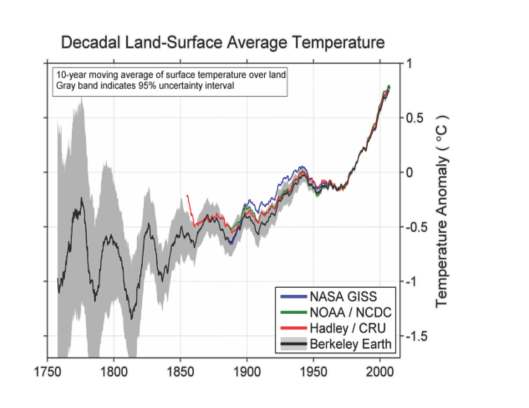
…My total turnaround, in such a short time, is the result of careful and objective analysis by the Berkeley Earth Surface Temperature project, which I founded with my daughter Elizabeth. Our results show that the average temperature of the earth’s land has risen by two and a half degrees Fahrenheit over the past 250 years, including an increase of one and a half degrees over the most recent 50 years. Moreover, it appears likely that essentially all of this increase results from the human emission of greenhouse gases.
These findings are stronger than those of the Intergovernmental Panel on Climate Change, the United Nations group that defines the scientific and diplomatic consensus on global warming…
Are we in the beginning phases of walking headlong into another mass extinction of our own creation, altering the chemistry of the oceans and atmosphere through the burning of fossil fuels? If you’ve been reading this blog, then you know about feedback loops and tipping points and their consequences if humans continue to force changes in the delicate ecosystems of this planet. Monthly reports from the NOAA are not very comforting:
…The average global temperature across land and ocean surfaces during September was 0.67°C (1.21°F) above the long-term 20th century average. This temperature ties with 2005 as the record warmest September in the 133-year period of record. The Northern Hemisphere tied with 2009 as second warmest on record, behind 2005. The Southern Hemisphere also ranked second warmest on record, behind 1997. It was also the highest departure from average for any month in the Southern Hemisphere since May 2010…
The difference between now and 250 million years ago is that profit-seeking corporations were not around to hoodwink the denizens of the planet into perpetuating their own extinction…
…despite its history and today’s unprecedented riches from science, the U.S. has begun to slip off of its science foundation. Indeed, in this election cycle, some 236 years after Jefferson penned the Declaration of Independence, several major party contenders for political office took positions that can only be described as “antiscience”: against evolution, human-induced climate change, vaccines, stem cell research, and more. A former Republican governor even warned that his own political party was in danger of becoming “the antiscience party.
Or the fact that the belief in an unfettered free market has become sacrosanct…
…In order to understand the fervor of this continued popular support for failed policies, it is important to grasp the utopian, quasi-theological nature of neoliberal ideology. In the neoliberal worldview, the self-regulating market is not a merely human construct, but a form of naturally-occurring “spontaneous order” that produces optimum outcomes and maximum individual freedom if left completely unfettered. (13) It is, as Karl Polanyi pointed out in “The Great Transformation,” a radically utopian vision that rests on a blind faith that markets are essentially part of the natural order. (14)
On the political right, this faith has reached its fullest expression, ultimately moving markets into the realm of the sacred, where their legitimacy cannot be questioned. In this utopian setting, regulation is not merely ill advised; it is a violation of natural law that is nearly sacrilegious…
We’re not wiser, just more manipulative and conniving…
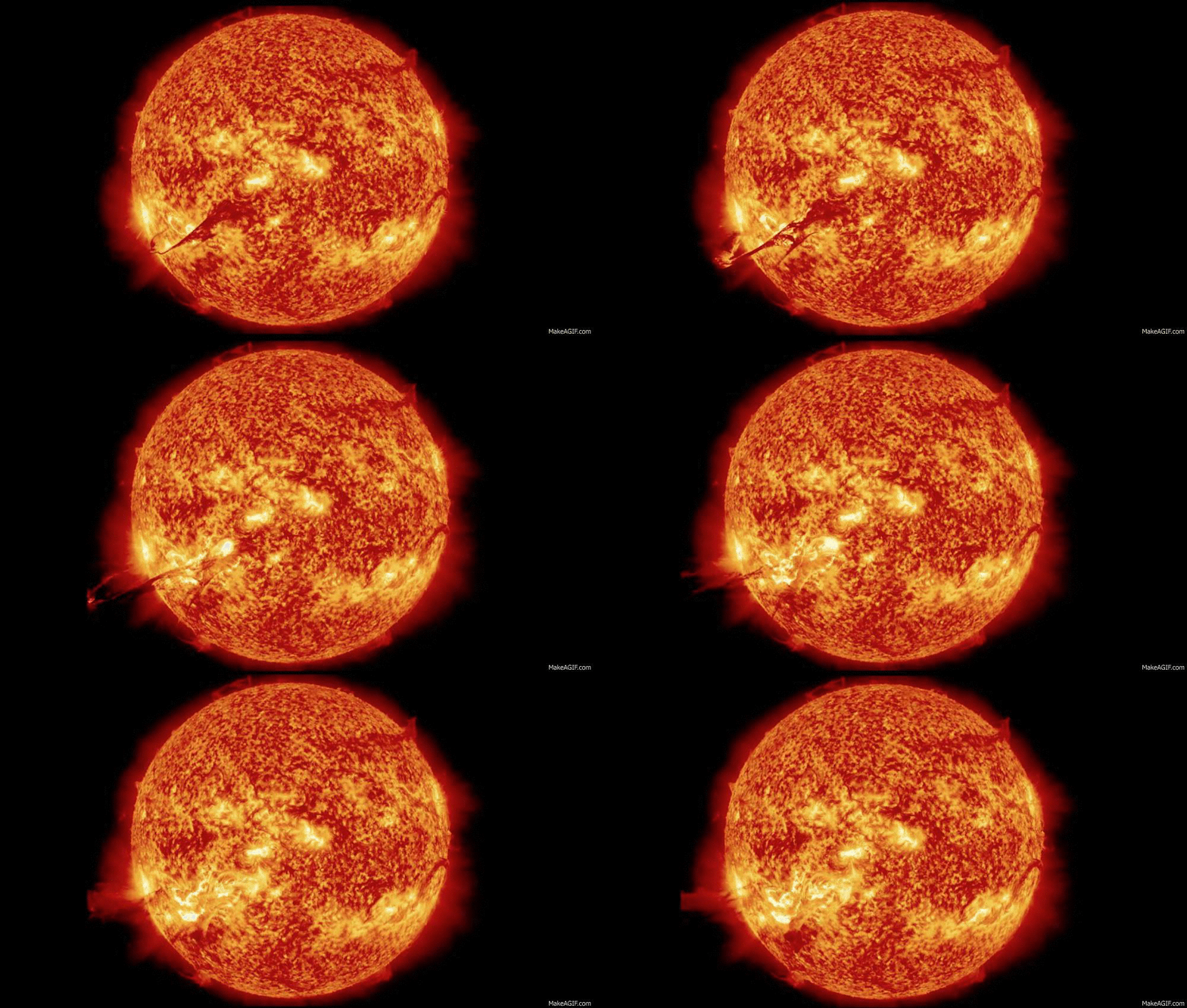
Coronal Mass Ejection from August 31, 2012. And the associated 4096×4096 (!) video.
What force, more than anything else, has regulated the evolution and expansion of mankind throughout history? A new study with climate models by geneticist Andrea Manica at the University of Cambridge, UK, and his colleagues shows how sensitive the human species has been to climate over the past 120,000 years and continues to be to the present day. The rise and fall of ice sheets and sea levels and the desertification of continents acted as road blocks to control the migration and settlement of humans across the planet.
…To see just how sensitive our species has been to changes in climate over the ages, Manica ran the model several times, varying the strength of climate’s effect on populations.
In parallel, he also modelled the history of human genetic variation, and compared that with real data on the genetic makeup of modern populations. Strikingly, he was only able to reproduce the known timings of migrations, and the real-world genetic data, if the human populations in his model were highly sensitive to the climate.
It’s the first time anyone has been able to explore climate’s power to facilitate human expansion, says Rick Potts of the Smithsonian National Museum of Natural History in Washington DC. “The study fills in many of the links that have only been assumed or guessed at,” he says…
…Stewart has proposed that earlier bouts of climate change helped the many hominin species to evolve, by forcing them into isolated refuges where they evolved separately (Science, doi.org/jcz). If that’s correct, climate has been determining our fate for even longer than Manica’s model suggests.
While agriculture produces more food than hunting and gathering, and so supports more people, ultimately climate’s effect on food production still limits our population. “We are very much governed by climate,” he says.
With the discovery of oil, coal, and other fossil fuels we were able to vastly increase our numbers. Our entire transportation system, industrialized agricultural system, globalized economy of trade, and modern medical system would not exist without fossil fuels. Even so, humanity could have dealt with the painful problem of peak oil by powering down to a less energy intensive way of life, but something much more insidious developed which would throw modern civilization for a loop. Professor Tim Lenton and Hans Joachim Schellnhuber wrote a paper in 2007 identifying 9 specific tipping elements for the Earth’s climate:
Click to Enlarge…
1.) The Arctic sea ice is considered a “highly sensitive” tipping point with low uncertainty and is expected to disappear completely in summer within a decade, leaving behind open and dark waters which will absorb more of the sun’s heat that once was reflected by white ice.
In figure below, global emissions cause warming, especially in the Arctic, where warming is further accelerated by feedbacks, in particular sea ice loss and methane releases, threatening to lead to runaway global warming.
From the following graph, you can see Lenton’s and Schellnhuber’s tipping points (8 of 14) which are sensitive(yellow/red) to just a few degrees of warming:
Several positive feedbacks have been identified within the first tipping point of disappearing Arctic sea ice:
There are at least three positive feedbacks working together to reinforce one another – and now a fourth on salinity:
The albedo flip effect as sea ice is replaced by open water absorbing more sunlight, warming and melting more sea ice.
As the sea ice gets very thin, it is liable to break up easily and get blown into open water where it will melt more easily.
The open warmer water is allowing increased strength of storms, which break up the ice to make for more open water.
The storms are churning up the sea to a depth of 500 metres, producing salinity at the surface that will mean slower ice formation in winter and more open water next year.
These feedbacks are dangerous for methane. AMEG has been warning that, as the sea ice retreats, storms will warm the sea bed, leading to further release of methane. In ESAS, we only need mixing to a depth of 50 metres – so a storm capable of mixing to 500 metres will really stir things up.
Another feedback is the pollution and soot resultant from increased shipping traffic, oil drilling activity, and other exploitive ventures by our ravenous and wrong-headed culture. Like arsonists taking pleasure in their destructive activities, industrial civilization simply throws more fuel into the bonfire of anthropogenic climate chaos. You can see plainly from the current Arctic resource grab that “THE MARKET” is a soulless, nihilistic, and sapient-less entity with a one-track mind of commodification and exploitation.
2.) The Greenland ice sheet is considered a “highly sensitive” tipping point with low uncertainty and a decay time of approximately 300 years as cycles of degradation and regrowth tip toward melting. A rise in sea levels of more than 20 feet is estimated from the melting of the Greenland ice sheet.
The Greenland ice sheet is likely to be more vulnerable to global warming than previously thought. The temperature threshold for melting the ice sheet completely is in the range of 0.8 to 3.2 degrees Celsius of global warming, with a best estimate of 1.6 degrees above pre-industrial levels, shows a new study by scientists from the Potsdam Institute for Climate Impact Research (PIK) and the Universidad Complutense de Madrid. Today, already 0.8 degrees of global warming has been observed. Substantial melting of land ice could contribute to long-term sea-level rise of several meters and therefore it potentially affects the lives of many millions of people.
The time it takes before most of the ice in Greenland is lost strongly depends on the level of warming. “The more we exceed the threshold, the faster it melts,” says Alexander Robinson, lead-author of the study now published in Nature Climate Change. In a business-as-usual scenario of greenhouse-gas emissions, in the long run humanity might be aiming at 8 degrees Celsius of global warming. This would result in one fifth of the ice sheet melting within 500 years and a complete loss in 2000 years, according to the study. “This is not what one would call a rapid collapse,” says Robinson. “However, compared to what has happened in our planet’s history, it is fast. And we might already be approaching the critical threshold.”…
And the surprises just keep on coming(click on pic to go to story):
…and unprecedented ‘Ice Quakes'(click on pic to go to story):
3.) The Boreal Forest, which rings the northern latitudes and provides habitat for migratory bird species and other wildlife, could die back within 50 years as trees succumb to summer heat stress, increased diseases and other threats. This is considered an “intermediately sensitive” tipping point with large uncertainty.
The most noteworthy destruction of boreal forests is the extraction of Canadian tar sands:
-Oil sands mining is licensed to use twice the amount of fresh water that the entire city of Calgary uses in a year.
-At least 90% of the fresh water used in the oil sands ends up in ends up in tailing ponds so toxic that propane cannons are used to keep ducks from landing.
-Processing the oil sands uses enough natural gas in a day to heat 3 million homes.
-The toxic tailing ponds are considered one of the largest human-made structures in the world.
-The ponds span 50 square kilometers and can be seen from space.
-Producing a barrel of oil from the oil sands produces three times more greenhouse gas emissions than a barrel of conventional oil.
As if the hellish blight of tar sands operations was not enough of a sacrifice zone for our unsustainable lifestyles, plans are being laid to duplicate the process for America’s own oil sands project in Utah.
An administrative law judge in Salt Lake City has ruled against two environmental organizations that are trying to block a Canadian company’s plan to open the first large-scale oil sands mine in the United States.
Judge Sandra Allen sided with U.S. Oil Sands and Utah’s Division of Water Quality in deciding that the state rightfully granted the Calgary-based company permission to mine and process oils sands without requiring a pollution permit or water monitoring at the PR Spring mining site in eastern Utah. The judge agreed with the Water Quality Division’s opinion that there is so little ground water within 1,500 feet of the surface of the proposed mine that additional safeguards weren’t needed.
The northern boreal forests comprise almost one third of the Earth’s forest systems, covering 1.5 billion hectares. Along with the temperate forest of the mid-latitudes, and tropical forest near the equator, it is one of the three great forest ecosystems of the world, supporting a rich diversity of wildlife, endangered species, and extremely valuable timber…
…There is general consensus that climatic changes will have the greatest impact on boreal forests; their unique adaptation makes them more sensitive to temperature fluctuations than temperate or even tropical forests. Indeed, fossil pollen and macro fossil records demonstrate that North American boreal forests expanded and receded in response to temperature changes over the past 10,000 years. Even a slight increase in mean annual temperature is enough to affect many species’ growth and regeneration…
…The rate of climate change — and not the change itself — is perhaps the biggest threat to the boreal forest. With rapid change, conditions may become unsuitable for trees to complete their life cycle. Seedlings are especially sensitive to short-term drought, saplings to varying levels of sunlight, and mature trees to soil moisture during the growing season. Thus, in a kind of “arrested development,” healthy-looking tree populations may not ever mature to the point of reproduction. Entire remnant stands of forest may no longer sustain themselves, or their resident animal and plant communities. A temperature rise of only 2 degrees C could, for example, eliminate up to half of the animals currently inhabiting boreal mountain ranges from the Rocky Mountains to the Sierra Nevada…
4.) The West Antarctic Ice Sheet could collapse within 300 years, leading to a sea level rise of as much as 15 feet worldwide. This is considered an “intermediately sensitive” tipping point with large uncertainty.
A new study sheds light on the vulnerability of the Antarctic to climate change(clink on the pic to go to story):
5.) The Amazon rainforest could die back significantly within 50 years due to a combination of deforestation and global warming, which could trigger a 30% decrease in rainfall. This is considered an “intermediately sensitive” tipping point with large uncertainty.
The Amazon Rainforest is expected to be reduced by 40% by 2030 at the current rate of deforestation, despite recent reductions. A current scientific paper states that due to deforestation, the Amazon is becoming a net CO2 emitter rather than a sink for the world’s carbon dioxide. When we take into account the uncertainties of climate change-induced droughts, the prospect of losing one of the earth’s major lungs becomes a near certainty:
…One of the scarier possibilities to emerge from this body of work is worth dwelling on a bit, simply because it would be so devastating if it came to pass: the so-called Amazon dieback scenario. Many scientists were deeply skeptical of the idea when it was first published, but events in the last few years have made them less dismissive.
The scenario emerged most clearly in computer analyses in Britain led by Peter M. Cox of the University of Exeter and published in 2000 as a paper in the journal Nature. Running a large-scale computer simulation in which forests interacted with a changing global climate through the course of the 21st century, the Cox group found that forests would continue to take up carbon until about 2050.
But then, their computer predicted, warmer temperatures and water stress would cause a huge dieback of the Amazon forest, which would stop absorbing carbon and start emitting it as a result.
That was a startling possibility for many reasons, not the least being that the Amazon is the richest single ecosystem left on the planet, and functioning as a major carbon sponge is only one of the critical roles it plays. Might the Amazon really die as a direct consequence of human-induced climate change?…
…[That question] took on a new urgency in 2005, however, when a severe drought hit the Amazon region, killing many large trees. In 2010, there was an even larger drought with potentially worse damage — two “once a century” droughts just five years apart. The 2010 drought is still under study; some evidence suggests that the 2005 drought was linked to high Atlantic Ocean temperatures that may in turn be linked to human emissions of carbon dioxide.
The droughts raise a disturbing question: Could the great dieback predicted for midcentury already be starting?
Scientists do not know. They say the effects of the two droughts are likely to be transient, but only if similar events do not recur anytime soon. Oliver L. Phillips, a researcher at the University of Leeds, led a team that documented a huge loss of carbon in the Amazon because of the 2005 drought. “The most likely outcome is that the forest will gain all that carbon back, and then some,” he said in an interview.
But he and other scientists say that if the Amazon starts experiencing such droughts every few years, all bets are off.
“It’s a worrisome moment for the Amazon,” said Daniel C. Nepstad, an American scientist working at the Amazon Environmental Research Institutein Brazil to understand the pressures on the forest. “This is either just a big coincidence that we had these two severe droughts in close sequence, or it is a sign of things to come.”…
…In Brazil, the enforcement of land-use laws reduced deforestation by 76 percent in eight years, from 10,424 square miles in 2004 – when a swath bigger than Maryland was cleared of jungle – until last year, when the country’s National Institute for Space Research reported that 2,471 square miles had been destroyed.
But more than 40 percent of the Amazon jungle is beyond Brazil’s borders, spread across eight countries in a carpet of green six times the size of California. These countries are poorer and less stable than Brazil, with less capacity to control clear-cutting of trees. Government agencies that regulate land use are spread thin, and some of those countries, including Bolivia, actively promote development in the jungle.
Satellite data and field work by environmental and forestry ministries in the region show that deforestation in the non-Brazilian Amazon rose from an annual average of 1,930 square miles in the 1990s to 2,779 square miles last year.
“There’s more deforestation going on in the Andean Amazon than in the Brazilian Amazon,” said Timothy Killeen, an ecologist and geographer in Bolivia who works with environmental groups and has been studying deforestation in the Amazon for 25 years. “Before, Brazilian deforestation was four times as great as in the Andean Amazon. Now the Andes has more. We’re winning the battle in Brazil but losing the battle in the Amazon.”
Environmentalists say the destruction of the Andean Amazon is particularly worrisome because it affects the lifeblood of the entire Amazon, the rivers flowing down from the Andes.
This post is part one of a three-part series. In the second part I will talk about the other climate change tipping points as described by Professor Tim Lenton.
I imagine a child born today would look at all adults as grotesque monsters. With the world we are leaving them, how could they see us otherwise…
Without a doubt, climate change is the elephant in the room that no country is dealing with in a manner that reflects its dire consequences for humans and every other living creature on planet Earth. The oceans grow more acidic and warm, eventually to turn into lifeless and hypoxic dead zones. Tropical jungles continue to disappear under bulldozers to make way for monoculture industrial farming. Forests fall to invasions of beetles and burn from epic wildfires in a warming planet. Vast tracts of farmland are desiccated by relentless drought while the government continues its mandate of turning food into fuel for this country’s mammoth population of vehicles. The central banks continue to print money for the hedge funds and casino capitalists to speculate in “THE MARKET”. And the masses, bombarded with infotainment of carnival politics and Hollywood gossip, walk around in an entertained stupor, comforted in the belief that industrial civilization is infallible and exempt from the laws of physics and bankruptcy of an overexploited planet. Like an obsessive compulsive lunatic, growth is still the word that drips from the tongue of every mainstream economist, politician, and captain of industry. Global coal consumption continues its inexorable rise upward, with astronomical consumption predictions heralded for the distant future…
Intelligence, cooperation and foresight are of no use in a system which is intransigent to change. The final, calamitous destination over the cliff and down into the abyss seems clear to a few, but most still hang onto hope and miracles, the beliefs of desperate and delusional men. Scientists are astonished to see changes happening that just a few years ago were predicted only to become reality by the end of this century. A new study says that extreme scenarios are no longer unthinkable:
A new study to be published in the next issue of Current Science predicts up to 2 degrees rise in temperature in India as early as the 2030s. Climate change’s catastrophic effect, it seems, is here faster than anyone had expected.
A two degrees rise in the average global temperature is considered the danger line beyond which climate change will have intense impacts. Till now the general belief was that there is enough time to avert what scientists call ‘catastrophic’ climate change. Perhaps not any more…
…a large section of people find such extreme scenarios hard to believe. So how reliable are these projections? “Scientists are not speculating,”says R K Chaturvedi, the lead author of the study and a national environmental science fellow . “Our findings are based on robust climate models. In fact, for the first time, we have used an average of 18 climate models to arrive at a finding which will have a smaller margin of error. These models have managed to predict our past correctly. So if the temperature rise in the past has been predicted correctly and we have compared them with real data, why will it throw up incorrect projections for the future?”
Ravindranath reaffirms that the situation is serious. “Jammu and Kashmir and a few other parts of the Himalayan region will be the worst affected. The region is projected to experience the highest mean warming up to 8 degrees by 2080s. I’m not joking when I say there will be no snow in Kashmir. The only way to remember snow fall in Kashmir will be to watch the old Shammi Kapoor flick Junglee,” he says wryly.
Even scientists not connected with the study agree that a future doomsday scenario is possible. “The findings are quite reasonable,” says S K Dash, head of the department of Centre for Atmospheric Sciences at IIT Delhi. “Not many studies have been done based on so many climate models . Therefore, the results of this study are likely to be reliable. Our own studies have shown that India has experienced an average temperature rise of about 1.2 degrees in the past 100 years. So it’s not strange to assume a two degrees rise by 2030,” he says.
Many scientists feel that India, especially , would feel the heat of this projected change in temperature more than others. Sudhir Chella Rajan, professor at the department of humanities and social sciences at IIT Madras, who recently evaluated India’s National Climate Action Plan on Climate Change, says that India is more vulnerable because of a variety of reasons. “First, our vast size and geography has hot spots like the Himalayas and the coastal areas. Then there is poverty. The poor are not resilient enough to deal with intense impacts like very warm periods or even floods. That’s why it’s time we reacted faster to this impending disaster.
Scientists are recording the dying of the planet we once knew, but for all intents and purposes, their work is like that of a pathologist studying a body post-mortem. The process we have unleashed is now unstoppable. A team of scientists are now looking more closely at the disappearing forests:
…Until recently, however, ecologists hadn’t really focused on drought-induced die-offs as a discrete category of forest trauma. That began to change, Anderegg said, after a meeting in Austin, Texas, last year. “Several of us decided to sit down, put our heads together and begin to look at the possible effects.”
They looked at dozens of individual studies, and found plenty. The loss of a forest’s dominant tree species has a ripple effect on all the other species that live there, by changing the amount of sunlight that reaches the forest floor; changing the mix of nutrients that enter the soil as leaves or needles decompose; allowing soil to wash away, especially on steep slopes, and — in some cases, at least — encouraging more fires….
…Forests are not only affected by climate; they also affect it. A living tree absorbs carbon from the air; kill the tree, and the carbon stays in circulation to trap heat. Not only that, as the tree decays, the carbon locked inside is gradually released back into the atmosphere. “It’s a double whammy,” Anderegg said….
…Broadly speaking, there are huge gaps in what scientists know. “This whole area has been fairly under-studied until now,” Anderegg said. “We need more research with a really wide net.”
To try and coordinate it, he and several colleagues have created a collaborative website to share knowledge about drought and tree mortality. The urgency of such research is only underscored by the 2012 drought, the worst to hit the U.S. in more than 50 years.
“The droughts of the early 2000’s caught us by surprise,” Anderegg said. “This one is our chance to pay attention as it unfolds.
Desperate calls for geoengineering and a “binge” on nuclear plants to avoid runaway climate change are now surfacing in the headlines:
A leading British academic has called for accelerated research into futuristic geo-engineering and a worldwide nuclear power station “binge” to avoid runaway global warming.
Peter Wadhams, professor of ocean physics at Cambridge University, said both potential solutions had inherent dangers but were now vital as time was running out.
“It is very, very depressing that politicians and the public are attuned to the threat of climate change even less than they were 20 years ago when Margaret Thatcher sounded the alarm. Co2 levels are rising at a faster than exponential rate, and yet politicians only want to take utterly trivial steps such as banning plastic bags and building a few windfarms,” he said.
“I am very suspicious of using technology to solve problems created by technology, given that we have messed up so much in the past but having done almost nothing for two decades we need to adopt more desperate measures such as considering geo-engineering techniques as well as conducting a major nuclear programme.”…
…Wadhams, who is also head of the polar ocean physics group at Cambridge and has just returned from a field trip to Greenland, was reacting to evidence that Arctic sea ice cover had reached a record low this summer.
This latest rate of loss is 50% higher than most scenarios outlined by other polar scientists and coincide with alarming new reports about a “vast reservoir” of the potent greenhouse gas, methane, that could be released in Antarctica if the ice melts equally quickly there. Greenpeace said last night that it agreed with the academic’s concerns but not with his solutions.
“Professor Wadhams is right that we’re in a big hole and the recent record sea ice low in the Arctic is a clear warning that we need to act. But it would be cheaper, safer and easier to stop digging and drilling for more fossil fuels,” said Ben Ayliffe, the group’s senior polar campaigner.
“We already have the technologies, from ultra-efficient vehicles to state-of-the-art clean energy generation, to make the deep cuts in greenhouse gases that are needed to stave off the worst effects of climate change. Unfortunately, we’re still lacking the political and business will to implement them,” he added.
Wadhams, who has done pioneering work on polar ice thinning using British naval submarines from 1976 onwards, said these latest satellite findings confirmed his own dire predictions.
And they feed into the alarming scenarios that the Arctic Methane Emergency Group have been warning about.
“What we are now seeing is a fast collapse of the sea ice that means we could see a complete loss during the summer by 2015 – rather than the 20 to 30 years talked about by the UK Meteorological Office. This would speed up ocean warming and Greenland ice cap melt and increase global ocean levels considerably as well as warming the seabed and releasing more methane.”
Asked whether the latest evidence made a ban on drilling for carbon-releasing oil and gas necessary as Greenpeace has contended, Wadhams said “philosophically” such exploration made little sense. “We have been conducting a global experiment with the burning of fossil fuels and the results are already disastrous and this would accelerate them,” he argued saying that there were also practical worries because of the enormous difficulty of dealing with any spillage or a blowout under moving ice where oil would get trapped inside the ice in a kind of inaccessible “oil sandwich’…









 Collapse of Industrial Civilization