It begins when truth is strangled in the square,
When every word is weapon for the strong,
When algorithms bind us in a snare,
And no one knows what’s right or what is wrong.
The downfall starts when kindness grows rare,
When empathy’s a luxury ignored,
When all our voices yield to this despair,
And mercy’s just a word we left long interred.
The first cracks form in whispers sharp and low,
When neighbors turn in silence at the gate,
The market aisles stretch barren, row by row,
And every stare drips venom, thick with hate.
The children learn to hate before they read,
As history books burst into digital flame,
While scientists warn, but leaders never heed,
Too late to end the rot we cannot name.
With silence choking through the crowd,
We watch our young bartered off for parts,
While oligarchs declare their power proud:
That profit reigns above the pulse of hearts.
The middle class awakens stripped and poor,
While billionaires build bunkers underground,
And those who once knocked gently at your door
Now smash it in without the slightest sound.
The last descent starts soft, like morning mist:
A power grid that flickers, then goes dark,
Supply chains strangled by greed’s iron fist,
As civilization snuffs out its final spark.
The collapse unfolds in borrowed time,
While leaders feast on manufactured fear,
Each stolen vote, each corporate crime
Lets oblivion edge ever near.
The hospitals run short on basic care,
While insurance barons count their gold,
And families break apart beyond repair
As human worth gets packaged, bartered, and sold.
The infrastructure crumbles piece by piece—
First blackouts last just hours, then whole days,
While politicians prophesy of peace
As cities burn within infernal blaze.
No angels come, no saviors rise,
Just maggots squirming in our eyes,
Beneath a sky that never cries,
The end devours—division multiplies.
The story’s end begins when we forget
That towers built on sand will always fall,
And every civilization’s deepest debt
Is thinking it will last through it all.
We see it coming, yet we turn away—
Pretending fate will not change the price we pay.
In resplendent suites where crystal prisms fall,
Gilded age titans mourn riches grown too small.
They pace on fine rugs from a strife-torn shore,
Restless, hungry, haunted—ever craving more.
Meanwhile, beneath the smoke of factory skies,
Where choking soot dims children’s hollowed eyes,
The pauper finds, when coin and hope are gone,
A peace well-purchased, though the cost was drawn.
For masters clutch at gold that turns to dust,
And merchants carve their profit from men’s trust,
While debtors, bowed by ledgers’ leaden chains,
Find solace in the quiet of what remains.
For those cast down, forgotten in the shade,
Who dwell beneath the world the rich have made,
The stones of ruin cradle their embrace—
The future still, surrendering to waste.
Yet look ahead—the ages twist the same,
Though smokestack labor’s traded hands and name;
The towers gleam with glass instead of grime,
But hunger echoes, constant, through all time.
Ten billionaires may chart the global course,
Their rockets fly while workers lose recourse;
Plastic paradises veil the daily strain
Of empty hands outstretched in silent pain.
The rich still quake at whispers of their fall,
Stock tickers flicker, fortune tempts them all;
While those below, with nothing left to spend,
Find peace in knowing loss has reached its end.
And so the poor, with the emptiness they keep,
Learn life is brief, its treasures shallow, cheap.
What counts is breath, and love, and fragile health,
Not gilded tombs nor graves that boast of wealth.
“Mars would be more habitable than this place right now so it’s crazy. There’s absolutely nothing,” said Shaun, a resident of the Palisades Bowl community.
In a world undergoing hydroclimate whiplash, the latest apocalyptic catastrophe has now befallen one of the richest cities in the world in the richest nation on Earth. Warm 100 mile per hour winds have spawned walls of fire reaching more than 100 feet in height within the city of Los Angeles, obliterating entire neighborhoods for as far as the eye can see and blanketing the city with a pall of toxic substances. A reporter who was there at the time said those hurricane force winds made it impossible for him to walk, as he was forced to take shelter in an abandoned car. A fire chief for the city said he had never seen a fire storm of such strength and magnitude in his entire multidecadal career. Experts are quoted as saying a firewall from a ten lane highway would not have stopped the Palisades inferno, with winds carrying embers miles ahead of the fire. As of today, warnings have been issued again for the imminent return of those ominous Santa Ana winds. The dryness levels of air, soil, and vegetation in California have been “literally off the chart.” The ongoing LA fires will likely become the costliest natural disaster in US history and help create a record-breaking year for property loss from extreme disasters. As this Pyrocene Age continues to gather force, a climate change-denying US President, who promises to erase any sort of facade about caring for the environment or curbing GHG emissions, has been sworn in again for another round of kleptocracy. Pseudo president-elect Musk, who believes that the primary threat to civilization is a dwindling human population, will have his own office in the White House complex.
Underpopulation concerns and EA(Effective Altruism) are particularly popular among wealthy white men like Musk, perhaps because they justify the push for infinite growth — more people, more wealth, more space exploration, and a continuation of the business-as-usual that favors the rich.
Peter Kalmus, a climate scientist who saw the writing on the wall and left his home in California after observing the increase in heatwaves and its effect on the local environment in recent years, had this to say a few days ago:
“…no place is actually safe. These kinds of impacts of these floods and fires and heat waves and storms, I think of them sort of like popcorn happening around the whole planet. You can’t know exactly where any one of these events is going to happen, but they’re starting to come at a higher frequency, sort of like when the popcorn really starts to get going and they’re starting to pop harder. It drives me kind of bonkers when people say this, especially when climate scientists who should know better say like, this is the new normal, for example. It is not. We are on a rising escalator towards higher planetary temperatures and all of the more frequent and severe impacts that come with that, which is really, frankly, terrifying.”
We could say that the ‘new normal’ is No New Normalfor millennia, which is how long it will take Earth’s systems to stabilize after the Anthropocene Epoch has ended. Why did modern humans discount the future so much? If you ask scientist William Rees, he will say it is because humans, like any other organism, will expand and use any tool available to us to consume all available resources until environmental constraints impede us. And this innate biological urge is bolstered by today’s religion of Capitalism which started in the 16th century and today emphasizes infinite economic growth and profit. With fantasies of geoengineering techno-fixes, modern humans have literally externalized the entire cost of destroying the planet’s habitability for humans or any other large or small vertebrate and invertebrate that has evolved to live within the Holocene Epoch. Talk about a behavioral blind spot! The collective failure of modern Homo sapien to grasp the complexities of our environmental impacts and deal with them to any significant degree is our fatal flaw. We are proving our collective intelligence to be not much better than yeast in a wine vat. It’s far easier to imagine a cataclysmic reckoning from ecological overshoot that wipes out Earth’s human population rather than any radical and cooperative effort by nationstates to abandon our fossil-fueled economy and religion of Technocapitalism. Our ever-expanding Technosphere now outweighs all life on Earth and can be considered a parasitic threat as it accumulates ever more nonbiodegradable waste in the biosphere. With the current President-elect having amassed a cabinet of uber-wealthy far exceeding that of any other in American history, you should not expect the habitability of the planet to be a topic of discussion or even a fleeting thought in their $kull. In fact, the first order of business was to withdraw from the Paris Climate Pact. The death drive is alive and well in the human psyche; it will be full throttle into the abyss of the Anthropocene extinction.
You’ve got to love the title of this 2024 report from Munich Re, the largest reinsurer in the world…
Hardly any other year has made the consequences of global warming so clear: with annual average temperatures reaching around 1.5°C above pre-industrial levels for the first time, 2024 will surpass the previous record from 2023. This makes the past eleven years the warmest since the beginning of systematic record-keeping.
The impact of man-made climate change on weather disasters has been proven many times over by research: in many regions, severe thunderstorms and heavy rainfall are becoming more frequent and more extreme. Although tropical cyclones are not generally increasing in number, the proportion of extreme cyclones is growing. They, in turn, are rapidly intensifying and bringing extreme precipitation with them.
This was the case for Helene and Milton, where World Weather Attribution studies have shown that both hurricanes were significantly more severe and brought much more extreme rainfall than in a hypothetical world without climate change. For the flash floods in the Valencia region, another study found that climate change made an event with this rainfall intensity twice as likely to occur.
And in the case of the flooding in Brazil, a study came to the conclusion that weather conditions such as those seen this year have become twice as likely due to climate change; as a result, they are becoming more frequent…
*Note that their report does not include heatwaves and droughts.
Here is the most current chart showing the upward trajectory of billion dollar weather disasters for the US, from 1980 through 2024:.
Considering we have now gone full Oligarch, you may never see a chart like this again or you may simply be brainwashed into discarding it as fake news. The politicization of our multi-pronged crisis or polycrisis will further fracture the average citizen’s ability to cope with societal breakdown. Some already believe nothing can be trusted in a world of AI and deep fake technology.Will anything convince people of this existential threat, as they continue flocking to the most vulnerable places??? Some of the younger generation are making a conscious choice:
My own daughter, a recent college graduate, told me she’d decided to stay in Chicago not just because of relatively affordable housing, but because it is “a cold climate near a large body of fresh water”. Such are the dystopian calculations of a generation born into a warming world.
Let’s not mince words; we are returning the planet to the climate volatility characteristic of the Pleistocene Epoch when agriculture was impossible, but we are doing it with fire rather than ice. There is no analog in geologic time for such a Fire Age, other than the similarity with prior mass extinctions wherein the chemical makeup of the atmosphere and oceans was altered through volcanism, albeit at a much slower rate and longer expanse of time. The Permian-Triassic extinction event, considered to be the fastest extinction in our geologic past, played out over 60,000 years. We can already see that the unpredictable hydroclimate whiplash we have set in motion from our fire-catalyzed climate upheaval will eventually make any attempts at large-scale agriculture impossible to sustain. An accelerated water cycle is already locked into the world’s climate system and now irreversible. A new study shows these wild swings between heavy precipitation and severe drought have increased substantially worldwide since the 1950s:
Using a metric of ‘hydroclimate whiplash’ based on the Standardized Precipitation Evapotranspiration Index, global-averaged subseasonal (3-month) and interannual (12-month) whiplash have increased by 31–66% and 8–31%, respectively, since the mid-twentieth century. Further increases are anticipated with ongoing warming, including subseasonal increases of 113% and interannual increases of 52% over land areas with 3 °C of warming.
“…The potential refugee problem in GLOBAL MERCANTILISM could be unprecedented. Africans would push into Europe, Chinese into the Soviet Union, Latins into the United States, Indonesians into Australia. Boundaries would count for little – overwhelmed by the numbers. Conflicts would abound. Civilisation could prove a fragile thing.”
Since 1990, global CO2 emissions have increased by more than 60% and they continue their inexorable rise with 2024 marking the highest rate of increase since record-keeping began in 1958, driven by record wildfires:
“These latest results further confirm that we are moving into uncharted territory faster than ever as the rise continues to accelerate,” says Prof Ralph Keeling, who leads the measurement programme at the Scripps Institution of Oceanography in the US.
Modern industrial civilization is entrapped in a Death Spiral characterized by denial, distrust, dogmatic thinking, flawed decision making, myopic single-minded focus on one ‘solution’, and self-reinforcing dysfunctional behavior. This has lead to a monumental gap between the elite and the masses, rise of authoritarianism, and rampant resource waste and depletion. We deny our way of life is unsustainable and carry on as if we are separate and superior to the environment that gave birth to us and which sustains us. We live and compete within a socioeconomic system which pits neighbor against neighbor and atomizes communities and families, dehumanizing individuals as consumers. Corporate media feeds us scripted narratives to manage and control the information we receive, thus creating an age of paranoia and distrust. Our political leaders are puppets of big-monied corporate interests which prioritize economic growth and profit over environmental and social concern. The fate of humanity rests in the hands of leaders who hide behind greenwashing and promise nothing more than delusional techno-fixes for growing existential threats. Are we not in the final stages of catabolic capitalism where society itself gets consumed and profit is extracted from scarcity, disaster, conflict, and crisis?
…Sandy Trust, the lead author of the report, said there was no realistic plan in place to avoid this scenario.
He said economic predictions, which estimate that damages from global heating would be as low as 2% of global economic production for a 3C rise in global average surface temperature, were inaccurate and were blinding political leaders to the risks of their policies.
The climate risk assessments being used by financial institutions, politicians and civil servants to assess the economic effects of global heating were wrong, the report said, because they ignored the expected severe effects of climate change such as tipping points, sea temperature rises, migration and conflict as a result of global heating…
…If these risks were taken into account the world faced an increasing risk of “planetary insolvency”, where the Earth’s systems were so degraded that humans could no longer receive enough of the critical services they relied on to support societies and economies.
The decline in global human population this century will not be a smooth bell curve, but a precipitous vertical drop. How could there be any other outcome when we have deluded ourselves into thinking that living in megacities of concrete and steel, driving 3,000 pound exoskeletons over asphalt roads, and eating steaks exported from Brazil are all part of a natural and sustainable way of life?!? The apocalyptic hellscapes we see in places like Gaza and Syria are coming to all of the civilized world one day and very soon.
Since most of us will eventually be relegated to the ranks of the poor or ‘working poor’, I thought it fitting to feature an expert on poverty, Barbara Ehrenreich, author of Nickel and Dimed. She is now heading the Economic Hardship Reporting Project whose goal is to “force this country’s crisis of poverty and economic insecurity to the center of the national conversation.” I have added their blog to my list of RSS feeds. For anyone who thinks that Mrs. Ehrenreich is unaware of the larger apocalyptic picture unfolding in the world, please listen to what she says about the demise of industrial civilization. And since our last post by Darbikrash centered around the rent-seeking financialization of the economy, in particular its effects on small businesses and individual liberties, it behooves us to look at how corporations and government entities prey on the poor and use them as a vast resource pool from which to extract dollars.
In what ways do the poor get used as a source for rent-seeking financialization? Here are a few:
…as Business Week helpfully pointed out in 2007, the poor in aggregate provide a juicy target for anyone depraved enough to make a business of stealing from them.
The trick is to rob them in ways that are systematic, impersonal, and almost impossible to trace to individual perpetrators. Employers, for example, can simply program their computers to shave a few dollars off each paycheck, or they can require workers to show up 30 minutes or more before the time clock starts ticking.
Lenders, including major credit companies as well as payday lenders, have taken over the traditional role of the street-corner loan shark, charging the poor insanely high rates of interest. When supplemented with late fees (themselves subject to interest), the resulting effective interest rate can be as high as 600% a year, which is perfectly legal in many states.
It’s not just the private sector that’s preying on the poor. Local governments are discovering that they can partially make up for declining tax revenues through fines, fees, and other costs imposed on indigent defendants, often for crimes no more dastardly than driving with a suspended license. And if that seems like an inefficient way to make money, given the high cost of locking people up, a growing number of jurisdictions have taken to charging defendants for their court costs and even the price of occupying a jail cell….
You might think that policymakers would take a keen interest in the amounts that are stolen, coerced, or extorted from the poor, but there are no official efforts to track such figures. Instead, we have to turn to independent investigators, like Kim Bobo, author of Wage Theft in America, who estimates that wage theft nets employers at least $100 billion a year and possibly twice that. As for the profits extracted by the lending industry, Gary Rivlin, who wrote Broke USA: From Pawnshops to Poverty, Inc. — How the Working Poor Became Big Business, says the poor pay an effective surcharge of about $30 billion a year for the financial products they consume and more than twice that if you include subprime credit cards, subprime auto loans, and subprime mortgages.
These are not, of course, trivial amounts. They are on the same order of magnitude as major public programs for the poor….
From for-profit prisons subsidized by taxes to government-mandated premiums for the private health insurance industry, I bet if the amount of rent-seeking as a proportion of the GDP in America was able to be quantified, we’d find that this country and its captive denizens are treated as just one big plantation from which to harvest greenbacks. According to economist Joseph E. Stiglitz, an inordinate proportion of those at the top of the free market heap have made rent-seeking the primary method by which they have accumulated their riches:
…The magnitude of “rent seeking” in our economy, while hard to quantify, is clearly enormous. Individuals and corporations that excel at rent seeking are handsomely rewarded. The financial industry, which now largely functions as a market in speculation rather than a tool for promoting true economic productivity, is the rent-seeking sector par excellence. Rent seeking goes beyond speculation. The financial sector also gets rents out of its domination of the means of payment—the exorbitant credit- and debit-card fees and also the less well-known fees charged to merchants and passed on, eventually, to consumers. The money it siphons from poor and middle-class Americans through predatory lending practices can be thought of as rents. In recent years, the financial sector has accounted for some 40 percent of all corporate profits. This does not mean that its social contribution sneaks into the plus column, or comes even close. The crisis showed how it could wreak havoc on the economy. In a rent-seeking economy such as ours has become, private returns and social returns are badly out of whack.
In their simplest form, rents are nothing more than re-distributions from one part of society to the rent seekers. Much of the inequality in our economy has been the result of rent seeking, because, to a significant degree, rent seeking re-distributes money from those at the bottom to those at the top.
But there is a broader economic consequence: the fight to acquire rents is at best a zero-sum activity. Rent seeking makes nothing grow. Efforts are directed toward getting a larger share of the pie rather than increasing the size of the pie. But it’s worse than that: rent seeking distorts resource allocations and makes the economy weaker. It is a centripetal force: the rewards of rent seeking become so outsize that more and more energy is directed toward it, at the expense of everything else. Countries rich in natural resources are infamous for rent-seeking activities. It’s far easier to get rich in these places by getting access to resources at favorable terms than by producing goods or services that benefit people and increase productivity. That’s why these economies have done so badly, in spite of their seeming wealth. It’s easy to scoff and say: We’re not Nigeria, we’re not Congo. But the rent-seeking dynamic is the same….
Below is a good discussion from a couple days ago of the expanding poverty problem in America featuring Barbara Ehrenreich. Don’t mind the free market lackey from the ultra-conservative think tank American Enterprise Institute. He thinks that the access to information the internet created has made people less poverty-stricken than in the past. For those who can afford a computer and internet subscription, the information age has only made them more aware of how fucked they are in a world of depleting resources run by a ruthless transnational oligarchic elite.
What we have in America is a twisted form of socialism for the elite wherein the few are supported by the collective wealth extraction from the many, as precisely described by Dennis Kucinich:
The rancorous debate over the debt belies a fundamental truth of our economy — that it is run for the few at the expense of the many, that our entire government has been turned into a machine which takes the wealth of a mass of Americans and accelerates it into the hands of the few. Let me give you some examples…
The above montage of clips from the satirical movie ‘The Distinguished Gentleman‘, in which Freshman Congressman (and con man) Thomas Jefferson Johnson (Eddie Murphy) is schooled in the ways of Washington by legendary lobbyist Terry Corrigan (Kevin McCarthy), is as true today as it was back when that movie was made more than twenty years ago, so says Marty Kaplan. The following excerpts from the transcript of Bill Moyer’s latest report – Big Money, Big Media, Big Trouble – tells the sorry and sordid tale of our political economy/society. This Moyer’s interview with Kaplan, a true insider to our political and media complex, is quite extraordinary. He affirms what the general populace is unable to comprehend… that we live in a society in which the news media and government institutions are entirely owned by the corporate oligarchs. The government regulators are owned by the very companies they are charged with over-seeing by way of Wall Street’s army of lobbyists and the revolving door that exists between government and private sector positions. Actual news to inform the public on the state of affairs and issues affecting them is virtually nonexistent on the media airwaves.
…what’s really driving it, if you think of this as a symptom and not a cause, I think what’s really driving it is the absolute demonization of any kind of idea of public interest as embodied by government. And at the same time, a kind of corporate triumphalism, in which the corporations, the oligarchs, the plutocrats, running this country want to hold onto absolute power absolutely. And it’s an irritant to them to have the accountability that news once used to play.
…the notion of spectator democracy has, I think, extended to include the need to divert the country from the master narrative, which is the influence and importance and imperviousness to accountability of large corporations and the increasing impotence of the public through its agency, the government, to do anything about it. So the more diversion and the more entertainment, the less news, the less you focus on that story, the better off it is.
And the self-serving triviality of corporate-run ‘news’ media has become a self-reinforcing mechanism whereby stats are being kept of what is the most popular story which then gets kicked up to the top and influences what that corporate news channel reports on in the future. It’s all driven by ratings and profit rather than educating and informing people on facts and real issues. So Neil Postman was right… We are being entertained to death, literally. This nihilism plays right into the hands of those controlling the levers of power who would not benefit from a well-informed, well-eduated public. The vast majority of public discourse has been reduced to an echo chamber of the crap (divisive ‘wedge issues’, celebrity gossip, sensationalist stories, corporate propaganda, consumerist materialism, valorization of the predatory skills of the modern competitive capitalist, etc.) that fills the corporate-controlled airwaves.
…
BILL MOYERS: You wrote The Distinguished Gentleman 20 years ago. Could you write it today?
MARTY KAPLAN: Oh God, it still is the same. All you have to do is add a couple of zeros to the amount of money. And the same laws still apply. It is fabulous and miserable at the same time.
BILL MOYERS: Was Washington then, and is it now, the biggest con game going?
MARTY KAPLAN: It is the biggest con game going. And the stakes are enormous. And the effort to regulate them is hopeless, because the very people who are in charge of regulating them are the same people who are wholly-owned subsidiaries of the lobbies that run them.
BILL MOYERS: I have it on very good authority that a prominent Washington senator recently told a group of lobbyists in Washington, a room full of lobbyists, that they are the lifeblood of the city. And I thought, “Kaplan has to do a vampire movie now.” Right?
MARTY KAPLAN: Exactly. The connection between the legislators and the lobbyists is so intimate that it’s not even embarrassing for a senator to say that in front of a room. The culture is so hermetically sealed from the rest of the country that it doesn’t occur to them that there is something deeply outrageous and offensive and corrosive of democracy to admit that the money side of politics and the elected side of politics belong to each other.
BILL MOYERS: You wrestle with this, you and your colleagues at the Norman Lear Center, and all the time, on how, on what the system is doing to us. So let me ask you, “How did this happen in America? How did our political system become the problem instead of the answer?”
MARTY KAPLAN: Part of it is the nexus of media, money, and special interest politics. The citizens have given the airwaves to the station. We own the electromagnetic spectrum and for free we give out licenses to television stations. Those stations, in turn, use that spectrum to get enormous amounts of money from special interests and from members of Congress in order to send these ads back to us to influence us. So we lose it in both ways. The other day, the president of CBS, Les Moonves, was reported by “Bloomberg” to have said “Super PACs may be bad for America, but they’re … good for CBS.” I mean, there it is. This is a windfall every election season, which seems not to even stop ever, for the broadcast industry. So not only are they raking it in, they’re also creating a toxic environment for civic discourse. People don’t hear about issues. They hear these negative charges, which only turn them off more. The more negative stuff you hear, the less interested you are in going out to vote. And so they’re being turned off, the stations are raking it in, and the people who are chortling all the way to Washington and the bank are the ones who get to keep their hands on the levers of power. So one of the big reasons that things are at the pass they are is that the founders never could have anticipated that a small group of people, a financial enterprise and the technology could create this environment in which facts, truth, accountability, that stuff just isn’t entertaining. So because it’s not entertaining, because the stations think it’s ratings poison, they don’t cover it on the news.
BILL MOYERS: They don’t cover the news.
MARTY KAPLAN: They don’t cover politics and government in the sense of issues. They’re happy, occasionally to cover horse race and scandal and personality and crime and that aspect of politics. But if you look at a typical half hour of news, local news, because local news is one of the most important sources of news for Americans about campaigns. A lot—
BILL MOYERS: You and your colleagues have done a lot of research on local news.
MARTY KAPLAN: Yes, we’ve been studying it now since 1998. And each year it gets more depressing and it’s hard to believe. We, not long ago, did a study of the Los Angeles media market. We looked at every station airing news and every news broadcast they aired round the clock. And we put together a composite half hour of news. And if you ask, “How much in that half hour was about transportation, education law enforcement, ordinances, tax policy?” everything involving locals, from city to county. The answer is, in a half hour, 22 seconds.
BILL MOYERS: Twenty-two seconds devoted to what one would think are the serious issues of democracy, right?
MARTY KAPLAN: Yes. Whereas, in fact, there are three minutes about crime, and two and a half minutes about the ugliest dog contest, and two minutes about entertainment. There’s plenty of room for stuff that the stations believe will keep people from changing the dial.
BILL MOYERS: What is the irony to me is that these very same stations that are giving 22 seconds out of a half hour to serious news, are raking— and not covering politics, are raking in money from the ads that the politicians and their contributors are spending on those same papers.
MARTY KAPLAN: Yes, they’re earning hundreds of thousands and millions of dollars from the ads that they are being paid to run. And not even risking running a minute of news, which might actually check on the accuracy of an ad. Truth watches, they’re almost invisible now.
BILL MOYERS: So they will tell you, however, that they’re in the entertainment business. That they’re in the business to amuse the public, to entertain the public. And if they do these serious stories about the schools or about the highways or about this or that, the public tunes out. That the clicks begin to register as—
MARTY KAPLAN: It’s one of the great lies about broadcasting now. There are consultants who go all around the country and they tell the general managers and the news directors, “It is only at your peril that you cover this stuff.” But one of the things that we do is, the Lear Center gives out the Walter Cronkite award for excellence in television political journalism every two years. And we get amazing entries from all over the country of stations large and small of reporters under these horrendous odds doing brilliant pieces and series of pieces, which prove that you can not only do these pieces on a limited budget, but you can still be the market leader.
…
MARTY KAPLAN: Well, what’s really driving it, if you think of this as a symptom and not a cause, I think what’s really driving it is the absolute demonization of any kind of idea of public interest as embodied by government. And at the same time, a kind of corporate triumphalism, in which the corporations, the oligarchs, the plutocrats, running this country want to hold onto absolute power absolutely. And it’s an irritant to them to have the accountability that news once used to play.
BILL MOYERS: What do you mean by that? News challenges their assumptions, challenges their power?
MARTY KAPLAN: It used to be that the news programs that aired, believe it or not, had news on them. They had investigative stories.
But then somewhere in the 1980s, when 60 Minutes started making a profit, CBS put the news division inside the entertainment division. And then everyone followed suit. So ever since then, news has been a branch of entertainment and, infotainment, at best.
But there was a time in which the press, the print press, news on television and radio were speaking truth to power, people paid attention, and it made a difference. The— I don’t think the Watergate trials would have happened, the Senate hearings, had there not been the kind of commitment from the news to cover the news rather than cutting away to Aruba and a kidnapping.
BILL MOYERS: What is the basic consequence of taking the news out of the journalism box and putting it over into the entertainment box?
MARTY KAPLAN: People are left on their own to fend for themselves. And the problem is that there’s not that much information out there, if you’re an ordinary citizen, that comes to you. You can ferret it out. But it oughtn’t be like that in a democracy. Education and journalism were supposed to, according to our founders, inform our public and to make democracy work.
You can’t do it unless we’re smart. And so the consequence is that we’re not smart. And you can see it in one study after another. Some Americans think that climate change is a hoax cooked up by scientists, that there’s no consensus about it. This kind of view could not survive in a news environment, which said, “This is true and that’s false.” Instead we have an environment in which you have special interest groups manipulating their way onto shows and playing the system, gaming the notion that he said she said is basically the way in which politics is now covered.
It’s all about combat. If every political issue is the combat between two polarized sides, then you get great television because people are throwing food at each other. And you have an audience that hasn’t a clue, at the end of the story, which is why you’ll hear, “Well, we’ll have to leave it there.” Well, thank you very much. Leave it there.
BILL MOYERS: You have talked and written about “the straightjacket of objectivity.” Right? What is that?
MARTY KAPLAN: Well, the problem with telling the truth is that in this postmodern world, there’s not supposed to be something as truth anymore. So all you can do if you are a journalist is to say, “Some people say.” Maybe you can report a poll. Maybe you can quote somebody. But objectivity is only this phony notion of balance, rather than fact-checking.
There are some gallant and valiant efforts, like PolitiFact and Flackcheck.org that are trying to hold ads and news reports accountable. But by and large, that’s not what you’re getting. Instead the real straightjacket is entertainment. That’s what all these sources are being forced to be. Walter Lippmann in the 1920s had a concept called “spectator democracy” in which he said that the public was a herd that needed steering by the elites. Now he thought that people just didn’t have the capacity to understand all these complicated issues and had to delegate it to experts of various kinds.
But since then, the notion of spectator democracy has, I think, extended to include the need to divert the country from the master narrative, which is the influence and importance and imperviousness to accountability of large corporations and the increasing impotence of the public through its agency, the government, to do anything about it. So the more diversion and the more entertainment, the less news, the less you focus on that story, the better off it is.
BILL MOYERS: Are you saying that the people who run this political media business, the people who fund it, want to divert the public’s attention from their economic power? Is that what you’re saying?
MARTY KAPLAN: Yes.
Let us fight about you know, whether this circus or that circus is better than each other, but please don’t focus on the big change which has happened in this country, which is the absolute triumph of these large, unaccountable corporations.
This is about as dismal and effective a conspiracy, out in plain sight, as there possibly could be. So I don’t say that this is going to be solved or taken care of. What I do say is the first step toward it is at least acknowledging how toxic the situation has become.
…
BILL MOYERS: What you’re saying is that the political square is now a commercial enterprise, owned and operated for the benefit of the brand, CNN, Fox, all of those, right?
MARTY KAPLAN: That’s correct.
BILL MOYERS: How did it happen? How did we sell what belonged to everyone?
MARTY KAPLAN: By believing that what is, is what always has been and what should be. The notion that what goes on is actually made by people, changes through time, represents the deployment of political power. That notion has gone away. We think it’s always been this way. People now watching these CNN and Fox. They think this is how it works. They don’t have a sense of history. The amnesia, which has been cultivated by journalism, by entertainment in this country, helps prevent people from saying, “Wait a minute, that’s the wrong path to be on.”
BILL MOYERS: Amnesia, forgetfulness? You say that they’re cultivating forgetfulness?
MARTY KAPLAN: Absolutely.
…
BILL MOYERS: You made a very important speech not long ago at a media conference in Barcelona. And you tried and did draw the distinction between— you said the battle of the future is between big data and big democracy. In layman’s language, what is that?
MARTY KAPLAN: Big data, the age of big data that we’re supposed to be in, refers to the way in which, as we go on the internet, as we do all these media activities, watching television, which are at the center of our lives, we’re leaving a trail behind. We’re giving bits of ourselves up. And that set of bits is being collected and mined relentlessly.
So every time we buy a product or send an e-mail or vote how many stars to a restaurant, all this stuff creates a profile that companies buy and sell to each other. And that stuff is being used currently not only to market to us, to target ads toward us, but it’s also being used to profile us. There’s something called “web lining.” Which is similar to what used to be called “red lining.” The— that phenomenon, which is now illegal, in which people who were discriminated against because of the neighborhoods they live in. Right now—
BILL MOYERS: Banks drew a red line around impoverished neighborhoods that they would not then serve.
MARTY KAPLAN: Exactly. And so today imagine if you were to permit a private detective to follow you as you went to your drug store and bought a medication to help you with depression or as you made a phone call to a bankruptcy lawyer, because you needed one. Imagine if that kind of information could be put together and used against you to decide that you’re a bad credit risk or that maybe your insurance company should turn you down, because you suffer from this problem.
That kind of information, that kind of digital profiling is something which is emerging as a huge industry. And unless there are controls on it and constraints, as they have to some degree in Europe but not nearly enough even there, we are about to kiss goodbye our ownership of our privacy and also even the ownership financially of our information. We are the people who make Facebook and Twitter worth the billions of dollars that they’re worth, because we are giving up our information to them, which they are then selling and raising capital around.
BILL MOYERS: But in a libertarian era, what are the restraints and constraints against that? Where are they going to come from?
MARTY KAPLAN: Well, right now, the constraints in this country are voluntary. The Obama White House not long ago issued a digital code of conduct, which included privacy. In which they asked companies and companies did step up to it to say, “We’re not going to track people if they don’t want to be tracked.” And other such efforts to get people in control.
But what we do know, the record of just the past couple of months, is that company after company was doing stuff to us that’s astonishing, that we didn’t know about. The ways in which the apps that you use on your smartphones were vacuuming up information about you, your address book and all your pictures.
Stuff that you had no idea you had consented to, which in fact usually you had not, suddenly was all owned by other people, as well. You have not given permission, but that essential part of you is now not yours. That’s the name of the game now. This is baked into the business model of data mining, which is at the heart of so much of the digital economy.
BILL MOYERS: But that’s big data. You talked about big democracy.
MARTY KAPLAN: So at the same time as our data is being mined, there is this movement to protect people using technology to give them the power to say, “I’m not going to opt into this stuff.” We’re still at the beginning of this industry. And there has to be rules of the road. And part of those rules include my attention rights. My rights to control my identity, my privacy, and my ownership of information.”
BILL MOYERS: In your speech in Barcelona, you pointed to two simultaneous covers of TIME Magazine appearing the same week. One for the editions in Europe, Asia, and South Pacific, and it was about the crisis in Europe. The other, which appeared in the American edition, featured a cover about animal friendships. You use these two covers to illustrate the difference between what you call “push journalism” and “pull journalism.” What’s the difference?
MARTY KAPLAN: Push journalism is the old days, which seem no longer to apply in the era of the internet, in which an editor, a gatekeeper, says, “Here’s the package which you need to know.” All of that is ancient history now.
Instead, now, it’s all driven by what the consumer is pulling. And if the consumer says, “I want ice cream all the time.” And whether that ice cream is Lindsay Lohan, or the latest crime story, that’s what’s delivered. And as long as it’s being pulled, that’s what is being provided. So it’s quite possible that in the U.S., the calculation was made that the crisis in Europe and the head of Italy would not be a cover that one could use. But that pet friendships would be the sort of thing that would fly off the newsstand.
BILL MOYERS: So the reader is determining what we get from the publication?
MARTY KAPLAN: On a minute by minute basis, stories that the reader’s interested in immediately go to the top of the home page. There are actually pieces of software that give editorial prominence to stuff that people by voting with their clickers have said is of interest to them. No one is there to intervene and say, “Wait a minute, that story is just too trivial to occupy more than this small spot below the fold.” Instead, the audience’s demand is what drives the placement and the importance of journalistic content.
BILL MOYERS: So George Orwell anticipated a state as big brother, hovering over us, watching us, keeping us under surveillance, taking care of our needs as long as we repaid them with utter loyalty. Aldous Huxley anticipated a Brave New World in which we were amusing ourselves to death. Who’s proving the most successful prophet? Huxley or Orwell?
MARTY KAPLAN: Well, I think Huxley is probably right, as Neil Postman said in—
BILL MOYERS: The sociologist, yes.
MARTY KAPLAN: —in Amusing Ourselves to Death. That there’s no business but show business. And we are all equally guilty, because it’s such fun to be entertained. So you don’t need big brother, because we already have big entertainment.
BILL MOYERS: And the consequences of that?
MARTY KAPLAN: That we are as in Brave New World, always in some kind of stupor. We have continual partial attention to everything and tight critical attention on nothing.
…
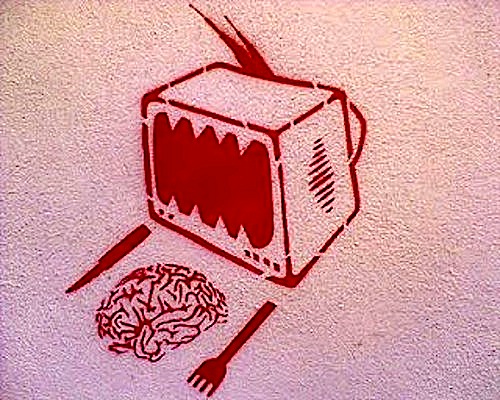
According to stats from 2010 for TV viewing by adult Americans, we’re glued to the boob tube in our waking hours. This explains why having an intelligent conversation with most Americans is an impossible task. All they can do is regurgitate what has been constantly programmed into their heads.
• The average American watches 35:34 (hours/minutes) of TV per week
• Kids aged 2-11 watch 25:48 (hours/minutes) of TV per week (Q1 2010)
• Adults over 65 watch 48:54 (hours/minutes) of TV per week (Q1 2010)
And according to the latest Nielsen study, TV viewing is on the increase, notwithstanding a tiny drop in the number of households who own a TV:
…despite all the competition from cable TV, videogames, and the Internet, the average household watched 59 hours, 28 minutes of broadcast TV per week during the 2010-2011 season, setting a new record. Lanzano drew particular attention to the competition — or lack of it — from Facebook, noting that while the average person spends about 13 minutes a day on Facebook, they spend 297 minutes watching TV. “No wonder our friends at [General Motors] are making some changes,” he said. [Last month GM announced that it will stop placing ads on Facebook, after determining that they had little impact.]


 Collapse of Industrial Civilization