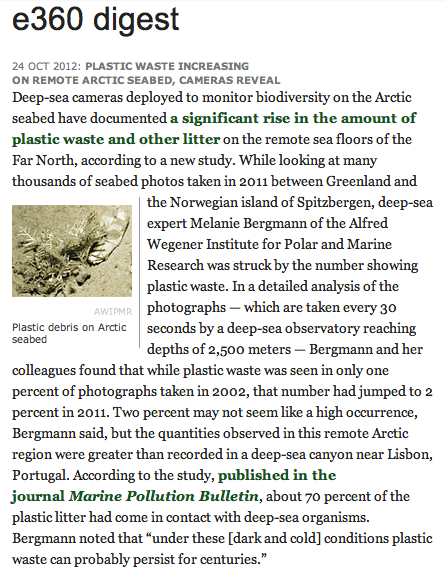
It’s late and I’m about to nod off, but a few headlines caught my eye. The first is on plastics and its growing ubiquitousness in the natural world. If you read an earlier post I did on this subject, then you’ll know that plastics may well be the one thing that will persist long after industrial civilization has passed into the ether of history. Plastics and nuclear waste will be the lasting reminders of carbon man. As the following article explains, this stuff is showing up in the dark, cold depths of the melting Arctic.
Click to go to original article…
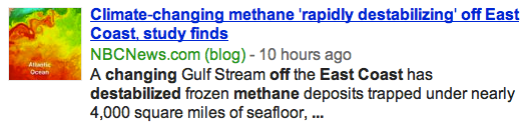
In other news, the ominous threat of a cataclysmic global release of methane from ocean floors is continuing to develop, increasing the possibility of runaway climate change…
A changing Gulf Stream off the East Coast has destabilized frozen methane deposits trapped under nearly 4,000 square miles of seafloor, scientists reported Wednesday. And since methane is even more potent than carbon dioxide as a global warming gas, the researchers said, any large-scale release could have significant climate impacts.
Using seismic records and ocean models, the team estimated that 2.5 gigatonnes of frozen methane hydrate are being destabilized and could separate into methane gas and water.
It is not clear if that is happening yet, but that methane gas would have the potential to rise up through the ocean and into the atmosphere, where it would add to the greenhouse gases warming Earth.
The 2.5 gigatonnes isn’t enough to trigger a sudden climate shift, but the team worries that other areas around the globe might be seeing a similar destabilization.
“It is unlikely that the western North Atlantic margin is the only area experiencing changing ocean currents,” they noted. “Our estimate … may therefore represent only a fraction of the methane hydrate currently destabilizing globally.”
The wider destabilization evidence, co-author Ben Phrampus told NBC News, includes data from the Arctic and Alaska’s northern slope in the Beaufort Sea.
And it’s not just under the seafloor that methane has been locked up. Some Arctic land area are seeing permafrost thaw, which could release methane stored there as well.
An expert who was not part of the study said it suggests that methane could become a bigger climate factor than carbon dioxide.
“We may approach a turning point” from a warming driven by man-made carbon dioxide to a warming driven by methane, Jurgen Mienert, the geology department chair at Norway’s University of Tromso, told NBC News.
“The interactions between the warming Arctic Ocean and the potentially huge methane-ice reservoirs beneath the Arctic Ocean floor point towards increasing instability,” he added.
OK that’s enough information to put me soundly to sleep. Wake me up when the ‘Methane Time Bomb’ nightmare is over. The pot starts to boil, but the frogs are still comfortable…
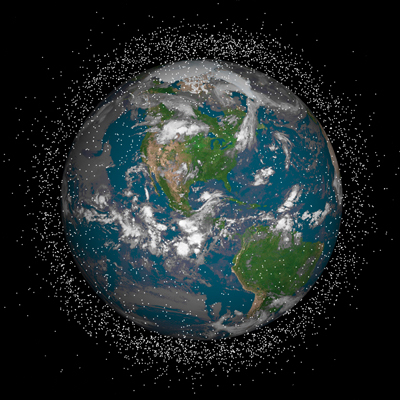
Locked within the Earth for millions of years was an energy source that fueled the rise of Humans and gave them dominion over every last inch of the planet. With traces of industrial chemicals and junk even finding its way into orbit around Earth, no corner of the planet escaped the tinkering hand of man.
His large brain gave him the ability to invent and build an army of machines to do his bidding. From their creation and until the last day of their operation, these fossil fuel-powered machines served man tirelessly in every conceivable manner, from personal transportation to food production.
Soon the lifeblood of this automated empire began running short, driving man to evermore extreme measures of securing carbon energy in order to feed his world of machines. Water, air, and land were sacrificed to keep the system going.
But For every force, there is a counter force. For every positive, a negative. The counter weight to man’s unrelenting urge for carbon was the inexorable build-up of atmospheric CO2 as the rest of the world rushed to join industrial civilization. The world’s leaders flew to popular vacation spots and drank cocktails while discussing the growing menace of climate change:
Insanity is doing the same thing over and over again and expecting different results.” That is precisely what global leaders entrusted with the stewardship of the world are doing. Their lives revolve around glittering banquets and long and dreary conferences, where they listen to each other in endless process-driven negotiations – so far from the reality of the day-to-day hardships of more than half of humanity.
A domino of numerous climate tipping points was set into motion, upsetting a once-benign climate. At first, fire seasons grew longer with more frequent and intense conflagrations. Ocean corals turned white from warming waters. The Arctic melted with astonishing speed, unleashing a host of warming feedback loops. Small, imperceptible temperature changes that took decades to occur were now happening more rapidly.
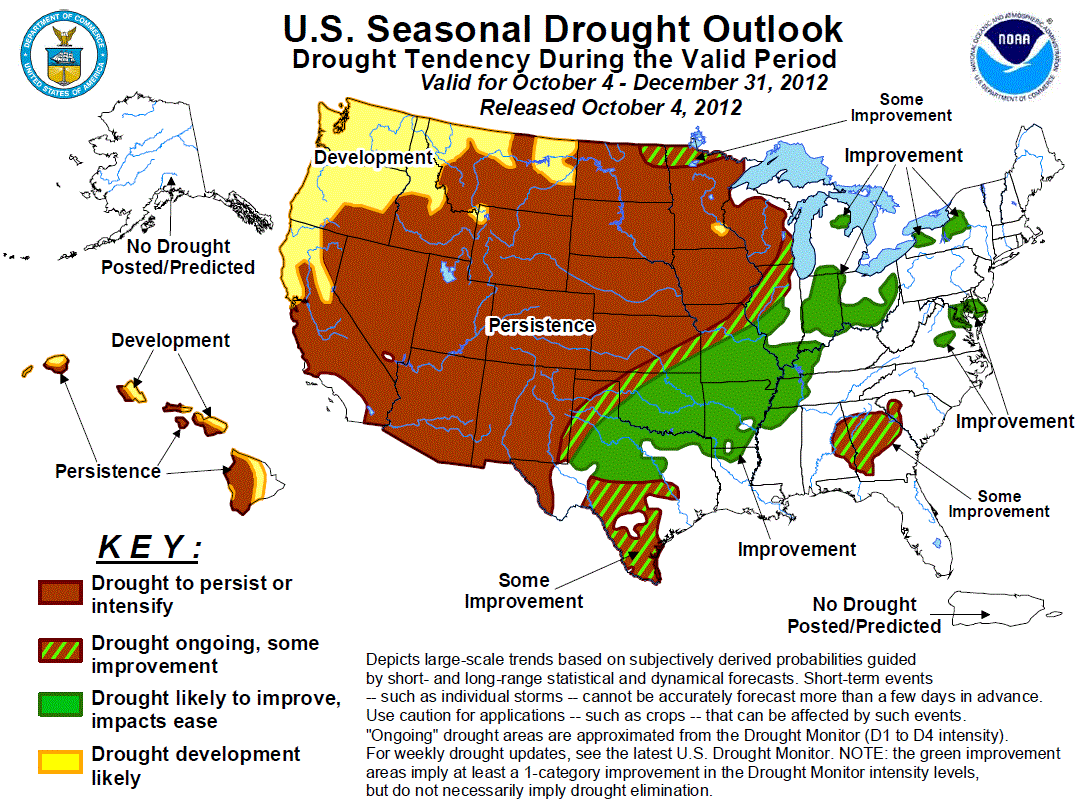
A warming planet opened the door for exotic tropical diseases to spread northward and around the globe. Talk of adaptation to human-induced climate change became a cruel joke. Torrential floods and crop-withering droughts of biblical proportion occurred more regularly, propelling the hungry masses to riot. The food vaults of impoverished countries were the first to be raided, followed soon after by those of wealthy nations. Weaker nation states fell first as their resource-strapped and overwhelmed governments collapsed under the weight of climate-induced starvation and energy blackouts. Various desperate geoengineering schemes were carried out in a hail Mary attempt to save man and his fossil fuel-addicted way of life, but to no avail. The master had become the slave; servile devotion to an unsustainable mode of living turned around to bite us in the ass. An overdrawn Earth had come calling to collect on humanity’s debt and close the account. Within the blink of a geologic eye, the habitability of the planet for humans as well as most other creatures had disappeared.
Climate change is indisputably anthropogenic – human-made. The long deep-pocketed propaganda, public relations, and lobbying arms of the corporate carbon industrial complex have long insisted that global warming is a reflection of unalterable natural forces that operate independently of human control. But the preponderant majority of the climate-sentient world agrees with the overwhelming consensus finding of contemporary earth scientists that global warming is anthropogenic (“human made”) – that it reflects the visible hand of human practice, politics, and policy. It knows that the story of the world’s broken ecology is about the human release of greenhouse gases resulting from the uncontrolled extraction and use of carbon-based fossil fuels.[8]
The harsh reality has to be acknowledged in elite capitalist media. Reflecting its duty to provide its privileged readers with reasonably accurate information, even the neoliberal, arch-capitalist Anglo-American Economist magazine acknowledges the dominant role of human agency in a recent special supplemental report on “The Vanishing North.” According to The Economist last June, “The shrinkage of the sea ice is no less a result of human hands than the ploughing of the prairies. The cause is global pollution, and the risks it carries are likewise global. The Arctic, no longer distant or inviolable, has emerged, almost overnight, as a powerful symbol of the age of man.”[9]
“Accelerating the Catastrophe”
What do the two dominant U.S. business parties offer towards the goal of saving the planet – well, its living species – from the crisis of anthropogenic global warming? Less than nothing. An escalation of the assault, in fact, making the problem worse.
Writing about the drastic melting of “the earth’s air-conditioner,” Gillis notes a chilling lack of urgency in reacting to the problem the part of rich nation governments, whose “main response has been to plan for exploitation of newly accessible minerals in the Arctic, including more oil.”[10]
Instead of acting to limit greenhouse emissions, those governments see the retreat of the great northern ice cover as an opportunity “to accelerate the catastrophe…The reaction,” Noam Chomsky notes, “demonstrates an extraordinary willingness to sacrifice the lives of our children and grandchildren for short-term gain. Or, perhaps, an equally remarkable willingness to shut our eyes so as not to see the impending peril.”[11] …
…The Republicans and the Democrats both decline to take the great time bomb of climate change[18] with anything remotely like the seriousness it deserves since doing so would disrupt “the economy.” They both worship at the altar of growth and the notion that “a rising tide lifts all boats” – capitalism’s longstanding fake, eco-cidal answer to popular pressure for jobs, and end to poverty, and the downward redistribution of income and wealth.[19] They both refuse to let long-term considerations of livable ecology and human survival interfere with the short-term pursuit of material expansion and the bottom line, not to mention the short-term logic of the election cycle.
I often wonder why people, who know that climate change is real, refuse to discuss it. They refuse to discuss it because it will upset their regimen of making money and carrying along with business-as-usual.
Bill Mckibben was on some late night TV show and he mentioned that the executive of some oil company said that if we need to move our food production north, then we will. Here is why that won’t work. Climate change means widespread famine, wars for dwindling resources, the fall of States, and the final extinction of man. There’s no more pretending that economic growth is possible or even a sane path for us to follow. Yet the system continues on through coerced participation.
I wonder if our forebears from 100 years ago would alter their actions if they knew from scientific and observable evidence that their way of life would cause the extinction of their progeny. Do you think they were more sensible back then? At that time, Edward Bernays and the tools of mass media manipulation had not yet entered society. Are not climate change deniers and free market ideologues the flat-earthers or Salem witch hunters of the 21st century? Feel free to give me an answer if you have one.
If you destroy the oceans, the cradle of life, then they will overtake you, returning you from whence you came…
You don’t want to push the system past those kind of tipping points because, if we do, we leave a situation for our children and grandchildren that will be out of their control. They won’t be able to stop it.
This post is the second in the climate tipping points series. Part one is here. Before getting into some of the other tipping points, I want to mention an excellent new paper, Going to Extremes: Climate Change and the Increasing Risk of Weather Disasters, written by Dr. Jonathan Overpeck, Professor of Geosciences and Atmospheric Sciences at the University of Arizona. It encapsulates a lot of pertinent information explaining the new reality of extreme weather events which humans will have to contend with from here on out.
An excerpt:
Agriculture
Scientists warn that global warming may threaten global food security as the changing climate could fundamentally affect humanity’s collective ability to feed itself. Although an increase in the amount of carbon dioxide in the atmosphere may initially promote plant growth, it does not necessarily translate into more food. Crops tend to grow more quickly in higher temperatures, leading to shorter growing periods and less time to produce grains. However, a changing climate will bring other, more significant hazards for agriculture, including greater water stress and the risk of higher temperature extremes that can quickly damage crops.
Agricultural impacts will vary across regions and by crop. Moderate warming and changes in precipitation are expected to decrease yield in seasonally dry and low-latitude areas. In California, where half the nation’s fruit and vegetable crops are grown, climate change is projected to decrease yields of almonds, walnuts, avocados, and table grapes by up to 40% by 2050.
Scientists have determined that any benefits increased carbon dioxide for some crops will be largely outweighed by negative factors if global temperature rises more than 1.8°F (1.0°C) from late 20th century values. It is expected that for each degree of warming, yields of corn in the United States and Africa, and wheat in India, will drop by 5-15%. In addition, if temperatures rise 9°F (5°C), most regions of the world would experience yield losses and global grain prices would potentially double…
…[The] NOAA recently concluded, after looking through 50 years of weather data, that droughts like the record 2011 Texas drought was made “roughly 20 times more likely” because of global warming. Indeed, observations have shown that certain extremes—high heat, heavy precipitation and floods, duration and intensity of droughts and extremes related to higher sea levels—have increased over the last half of the century.
Continuing on the list of Lenton’s and Schellnhuber’s tipping points…
6.) The Sahara and Sahel in Africa could change dramatically, becoming either far more dry or far more wet, as ocean temperature and vegetation-climate feedbacks change within a decade or so. This is considered an “intermediately sensitive” tipping point with large uncertainty.
Desertification and lower rainfalls with infrequent torrential floods from a warming climate is the clear winner according to studies:
One of the most significant climatic variations in the African Sahel since the late 1960s has been the persistent decline in rainfall. The Sahel is characterized by strong climatic variations and an irregular rainfall that ranges between 200mm and 600 mm with coefficients of variation ranging from 15 to 30% (Fox and Rockström, 2003; Kandji et al., 2006). A rainfall decrease of 29-49% has been observed in the 1968-1997 period compared to the 1931-1960 baseline period within the Sahel region (McCarthy et al., 2001). The West Africa region has experienced a marked decline in rainfall from 15 to 30% depending on the area (Niasse, 2005). The trend was abruptly interrupted by a return of adequate rainfall conditions in 1994. This was considered to be the wettest year of the past 30 years and was thought to perhaps indicate the end of the drought. Unfortunately, dry conditions returned after 1994 (McCarthy et al., 2001).
The rainfall variability in Africa has been studied by numerous authors since the beginning of the recent drought period in the 1970s. Many studies focused on the Sahelian areas ( Farmer, 1988; Lamb & Peppier, 1992; Hulme, 1992). Others also compared Sahelian rainfall with rainfall over other West African and Central Afrcan rregions (Thompson et al. 1985; Buishand, 1984).
Eminent scientist, Sir Gordon Conway, the former chief scientific adviser to the British Department for International Development and the former President of the Rockefeller Foundation said that Africa is already warming up faster than the global average and that the continent will experience a greater amount of intense droughts, floods and storm surges as a result…
…While there are many facets to climate change in Africa, in the case of central Nigeria it is important to look at food, water and migration. The environmental concerns in the Delta region and rising water levels across the south coast present challenges in themselves and would require an article in themselves.
Food crisis
Climate change threatens the ability of West Africa to compete in the global food system. An increase in temperature will undoubtedly reduce yields in a region where the population is set to double within the next two decades. Some projections claim that crop production will drop by 50% within the same timeframe as this population boom.
Nigerian food producers do not have the capacity to deal with such climate or population fluctuations. Consequently food availability in many regions will be dangerously compromised leading to greater competition for resources.
Water crisis
In addition to the concerns of food production, the availability of water in the Sahel reached crisis levels several times in recent years. In 2010 the region suffered a widespread famine, partially as a result of water shortages, and is now in the midst of an ongoing drought that has affected 18 million people.
Debates continue to rage over the future of Sahelian water as some project a decrease in rainfall of 40 percent in a region beset by drought already. Others have posited that rainfall may increase the Sahel but that such a change would likely lead to an infestation of locusts the like of which have been destroying farmland in Mali and Niger in recent weeks. When the rains do arrive the cities in the region are often unable to deal with them, evidenced by yesterday’s lethal flooding in Jos which has killed at least 35 people.
While future projections of waterfall vary, there is no doubting the present and impending threats from desertification.
Desertification is the most egregious form the temperature increase has taken as much of the Sahel is already suffering from climate-induced drought. Approximately 1,350 square miles of Nigerian land turns to desert each year. To put it in perspective, that is over twice the size of Greater London becoming impossible to farm each year. This leads to both farmers and herdsmen having to abandon their homes to move to an area with more abundant resources.
Migration crisis and conflict
Encroaching deserts do not merely mean water scarcity and a threat to food security but also mass migration. The direct competition for resources has the potential to become more acute in several regions of Nigeria and beyond in West Africa.
An example would be the millions of Malians and Burkinabes in Cote d’Ivoire as a result of the Sahelian droughts of the 1970s and 1980s. When the use of migrant labour lost its appeal to Cote d’Ivoire amidst the conflicts of the 1990s it set the course for outside interests to have a major impact on internal conflicts. Migration disputes continue between the two countries to this day including a substantial impact upon the Ivorian crisis of 2010-11.
As the Sahel continues to dry up as a result of climate change, the land can no longer support the animal stocks required by herders to survive. Since the only useful land to the herders is to the south of the desert, they move their herds towards the agricultural regions populated by sedentary farmers. Naturally, the destruction of crops by the herds creates tensions between those moving the animals and those who struggle to grow enough food for themselves in an increasingly unforgiving climate.
The policy solutions up to this point have focused on short-term political factors leading to knee-jerk responses to the violence. Communities in Ghana, Burkina Faso and Nigeria have expelled Fulani herders. The existential threat is forcing the Fulani to fight back.
A refusal to acknowledge the role that climate change has played in the region has led to a failure of governance. Such forced relocations are merely postponing the problem for a future government rather than trying to fix it. In this sense the agricultural policies in Nigeria have become a microcosm for climate policy.
In the case of Nigeria poor governance as a result of political short-termism has exacerbated the food crisis, the catalyst for migration issues. Until the 1970s agriculture made up 60% of Nigeria’s GDP. Since then technological stagnation, myopic policies and corruption have turned the country into a net importer at a cost of $150 billion each year. The $500 million allocated to agriculture in the 2012 budget could be enough to facilitate the needs of the country if spent wisely. Some have even argued that Nigeria has the capacity to be the breadbasket for the whole of West Africa.
Politics of inaction
Political short-termism has blighted Plateau State both in terms of local politicians and the global response to climate change. The sudden explosions of conflict in the region have been predicted for decades. Despite the upsurge in brutal violence, the policies remain largely the same.
With roughly 40% of Africa now affected by desertification, solutions will have to come soon. One such solution is the ‘Green Wall’, a wall of trees 4,300 miles long and 9 miles wide stretching across the African continent from Senegal to Djibouti. The idea has been advocated by West African leaders for over 30 years but has only now been realised.
Erecting walls has rarely provided a long-term solution to conflict. It is unlikely to do so for climate change.
7.) The El Nino Southern Oscillation, occurring across the tropical Pacific Ocean roughly every five years, refers to patterns of warming and cooling in the Pacific Ocean that affect weather worldwide. It could within 100 years change to a persistent warm or cool pattern, or change so that warm El Nino patterns are more intense, leading to more intense droughts in some areas, and likelihood of flooding elsewhere. This is considered an “intermediately sensitive” tipping point with large uncertainty.
Kevin Trenberth, Senior Scientist in the Climate Analysis Section at the National Center for Atmospheric Research (NCAR), suggests that we are seeing changes in El Nino:
There’s another elephant in the room: the long-term influence of greenhouse gases. “In my view, El Niño and La Niña are very likely changing as a consequence of climate change, but such changes cannot be measured when you get only one event every three to seven years,” says Trenberth. “The natural variability is enough to make it impossible to determine a climate change signal.” Still, he adds, when it comes to El Niño and La Niña, it’s best not to assume that past performance is any guarantee of future results.
8.) The Atlantic thermohaline circulation (THC) is a global 3-dimensional belt of ocean currents that transports large amounts of heat and freshwater around the world. In the North Atlantic, it manifests in a meridional overturning circulation (AMOC) which, through its northward transport of warm tropical waters by the Gulf Stream and North Atlantic Current, ensures these warm waters reach Europe.
The THC could collapse within 100 years as warming of the oceans alters water density and disrupts the global circulation of the seas. This is considered a “lowly sensitive” tipping point, with intermediate uncertainty.
from ‘Abrupt Climate Change‘ (Lead Author: Thomas L. Delworth,* NOAA Geophysical Fluid Dynamics Laboratory, Princeton, NJ):
…AMOC and the likelihood of future changes in the AMOC in response to increasing greenhouse gases, including the possibility of abrupt change.
We have five primary findings:
• It is very likely that the strength of the AMOC will decrease over the course of the 21st century in response to increasing greenhouse gases, with a best estimate decrease of 25-30%.
• Even with the projected moderate AMOC weakening, it is still very likely that on multidecadal to century time scales a warming trend will occur over most of the European region downstream of the North Atlantic Current in response to increasing greenhouse gases, as well as over North America.
• No current comprehensive climate model projects that the AMOC will abruptly weaken or collapse in the 21st century. We therefore conclude that such an event is very unlikely. Further, an abrupt collapse of the AMOC would require either a sensitivity of the AMOC to forcing that is far greater than current models suggest or a forcing that greatly exceeds even the most aggressive of current projections (such as extremely rapid melting of the Greenland ice sheet). However, we cannot completely exclude either possibility.
• We further conclude it is unlikely that the AMOC will collapse beyond the end of the 21st century because of global warming, although the possibility cannot be entirely excluded.
• Although our current understanding suggests it is very unlikely that the AMOC will collapse in the 21st century, the potential consequences of such an event could be severe. These would likely include sea level rise around the North Atlantic of up to 80 centimeters (in addition to what would be expected from broad-scale warming of the global ocean and changes in land-based ice sheets due to rising CO2), changes in atmospheric circulation conditions that influence hurricane activity, a southward shift of tropical rainfall belts with resulting agricultural impacts, and disruptions to marine ecosystems.
9.) The Indian summer monsoon, which is needed to sustain crops, could collapse anytime as land-to-ocean pressure gradients change with pollution and warming patterns. That could lead to an “erratic” fluctuation that would “chaotically change between an active and a weak phase.” This is considered an “intermediately sensitive” tipping point with large uncertainty.
THE dizzying midday heat of India’s northern plains cracks the earth. Farmers slump on the charpoys on which they sleep outdoors. It should be raining, yet the sky is clear. Prithi Singh, lean and wrinkled, says his entire rice crop has withered, along with fields sown for fodder. After two summers of erratic and delayed monsoons, this year the rains simply failed…
The monsoon months, June to September, bring three-quarters of India’s annual rainfall. Official studies show it to be erratic in four out of every ten years. Yet farmers rarely get any useful warning of shortfalls. As recently as late June, India’s meteorologists were predicting a normal monsoon. Punjab and Haryana, two north-western agricultural states, now say rains are about 70% below average.
Six western states have issued drought warnings.
The government in Delhi says it may soon offer emergency help. The country remains predominantly rural: over 600m out of 1.24 billion Indians rely directly on farming. Nearly two-thirds of Indian fields are fed only by rain. A one-off drought is tolerable. Rural job-creation schemes have lifted incomes for the poorest. Food prices have only started to creep up. Granaries are overflowing, thanks to recent bumper crops.
What is disturbing, though, are tentative signs of long-term change to the summer rains. A less stable monsoon pattern would be harder to predict. It would arrive late more often, yield less water, become more sporadic, or dump rain in shorter, more destructive bursts (which happened two years ago in Pakistan, where the Indus basin disastrously flooded). The concerns of experts about the monsoon long predate today’s dry spell.
Too little is known about summer weather systems on the subcontinent. India is short of observation stations, weather planes, satellites, climate scientists and modellers. The government and foreign donors are scrambling to make amends. But even with better data, monsoons are ill-understood once they leave the sea or low-lying land. At altitude, notably, for instance, approaching the Himalayas, it is far trickier to grasp just how factors such as wind direction, air pressure, latent heating and moisture levels interact to deliver monsoon rains.
One trend looks clear: India has grown warmer over the past six decades. Glaciers are melting in the Himalayas, and orchards in the range’s valleys are being planted on ever-higher slopes in search of a temperate climate. Crops in the northern grain belt, notably wheat, are near their maximum tolerance to heat, and so are vulnerable to short-term blasts of higher temperatures. North India’s cities are also growing hotter.
How more warmth affects the monsoon is not straightforward. A land mass heating faster than the oceans will, in theory, draw in more moisture to produce heavier monsoons. Yet the reverse appears to be happening. Specialists who met in February in Pune, in Maharashtra state, reported a 4.5% decline in monsoon rain in the three decades to 2009.
India’s leading climate modeller, R. Krishnan, of the Indian Institute of Tropical Meteorology in Pune, points to a study showing a “steady decline” in rainfall on the Western Ghats, which run down the west coast. A Japanese model that he has applied to southern India predicts that a still more rapid decline in rainfall is likely.
Such a fall may matter little for states such as Kerala in the south, which gets a monthly drenching of 50 centimetres (20 inches) during the wet season. But Mr Krishnan notes other changes, notably evidence that far fewer depressions have formed in the Bay of Bengal, off India’s east coast, in recent summers. Since these help drive rain to India’s arid northern plains, he concludes that “there is every reason to be concerned about the monsoon.”…
…Yet a decline in average rainfall may not be the main worry. Experts who met in Delhi in May to discuss climate-induced “extreme events” in India suggest that likelier threats include more short and devastating downpours and storms, more frequent floods and droughts, longer consecutive dry days within monsoons, more rapid drying of the soil as the land heats, and a greater likelihood that plant and animal diseases might spread.
It does not bode well for farmers, or for crammed cities with poor sewerage and other rotten infrastructure. Slums and coastal cities look especially vulnerable. Mumbai was overwhelmed in 2005 when nearly a metre of rain was dumped on the city in 24 hours.
Such events will happen more often, the highest official in the country’s environment ministry warns. He wants urgently to bring about a big increase in insurance schemes that spread weather-related risks. Rajendra Pachauri, who leads the United Nations’ Intergovernmental Panel on Climate Change, worries that India is not yet even seriously debating the new threats. He says it is ill-prepared for floods and droughts “that are now considered once-in-every-20-years events, but will be happening once in two years.
Part three of climate tipping points will be posted in a week or two.
“Capitalism has the innate genius of being inexorably driven to destroy everything it encounters, in order to turn it into money. ‘Creative destruction’ -the creation of money through the destruction of life. It is reaching its absolutely inevitable apotheosis now.”
~ Mulga Mumblebrain
Capitalism has unleashed the real weapon of mass destruction…
Occam’s razor suggests that the more likely explanation for some phenomenon is the explanation which requires the fewest number of assumptions or required assertions. Even though in science the correct answer is sometimes the more complex one, rationally speaking, the fewer amount of assumptions that we have to make in order to get a theory to work, the better.
For example, think of how many assumptions you have to make to consider the September 11th attacks a government conspiracy. So many claims about time, space, engineering, politics, prior knowledge, flight patterns, etc., must be made to even start bridging the gap. On the other hand, the simpler explanation that requires less assumptions (and indeed has more evidence) is that a group of terrorists hijacked some planes and flew them into the buildings.
By association, Occam’s razor regularly dismantles most conspiracy theories without much effort. Of course, any of the conspiracies could be true, but without evidence the numerous assumptions that need to be made push these theories into irrational confines.
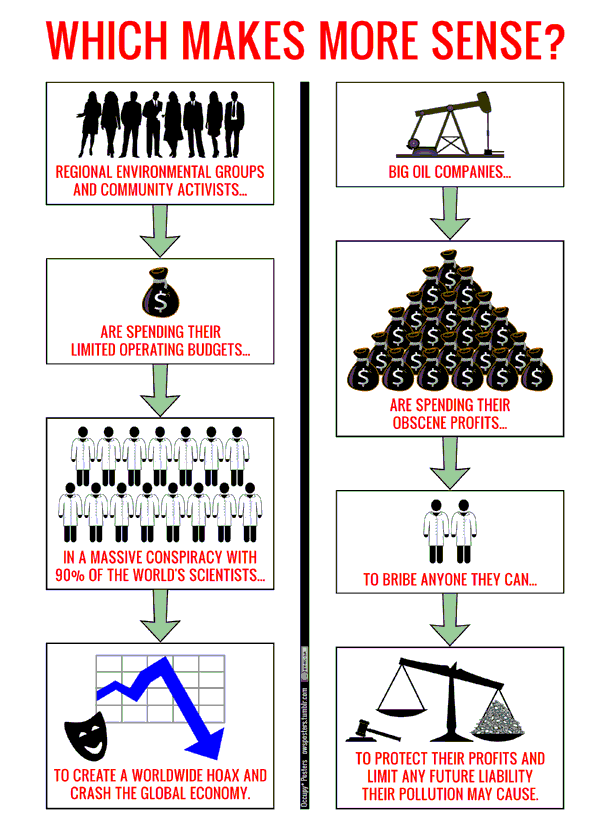
The infographic below takes a similar approach. On the side that accepts anthropogenic (human-caused) global warming, it takes many more assumptions to make the idea that the majority of the world’s climate scientists are in collusion to make a worldwide hoax from which they see no benefit work than it does to think that oil companies are protecting their bottom line. We know that there are huge oil lobbies, oil companies that have scientists in their pockets, and that large corporations are trying to purposefully undermine the science of climate.
Therefore, which makes more sense?
At the root of the Anthropocene Crisis of the 21st century is the unabated expansion of humankind fueled by fossil fuels. We are pushing all other living things off the cliff of extinction, with ourselves soon to follow.
…32 per cent of livestock breeds are under threat of extinction within the next 20 years, the UN Food and Agriculture Organization says. And 75 per cent of the genetic diversity of agricultural crops has been lost since 1900.
“Because we don’t really know the full impacts of climate change down the line, we don’t really know what’s going to happen in terms of growing conditions around the world. It’s just safer for us to have a lot of these other varieties in our pocket,” said David Ainsworth, spokesman of the CBD Secretariat.
Cooper said the pace of extinctions among the planet’s estimated 9 million species – plants, animals from insects to whales but excluding legions of tiny bacteria – was perhaps 100 times the background rate estimated in fossil records.
“If you project the rates into the future, the rest of the century, they are likely to be 100 times larger still,” he said. The rising human population threatens ever more habitats with expanding cities, farms and roads…
The machine of industrial civilization has become the master of our fate. It rolls onward under its own colossal impetus, crushing all in its path. The billions of people in the globalized economy are now mere cogs in its wheel. ‘Economic development and growth’ is the mantra chanted by all. ‘Green’ and ‘sustainable’ are the adjectives used by corporations to whitewash the continued plunder of the environment. Capitalism, an economic system that requires continued expansion and control, is inherently unstable and incompatible with the long-term habitability of the planet. Will the principles of biophysical economics become accepted as truth before we destroy ourselves?
The answer lies in this excerpt from Chris Hedges’ latest essay:
…perhaps the most egregious assault will be carried out by the fossil fuel industry. Obama, who presided over the repudiation of the Kyoto Accords and has done nothing to halt the emission of greenhouse gases, reversed 20 years of federal policy when he permitted the expansion of fracking and offshore drilling. And this acquiescence to big oil and big coal, no doubt useful in bringing in campaign funds, spells disaster for the planet. He has authorized drilling in federally protected lands, along the East Coast, Alaska and four miles off Florida’s Atlantic beaches. Candidate Obama in 2008 stood on the Florida coastline and vowed never to permit drilling there.
You get the point. Obama is not in charge. Romney would not be in charge. Politicians are the public face of corporate power. They are corporate employees. Their personal narratives, their promises, their rhetoric and their idiosyncrasies are meaningless. And that, perhaps, is why the cost of the two presidential campaigns is estimated to reach an obscene $2.5 billion. The corporate state does not produce a product that is different. It produces brands that are different. And brands cost a lot of money to sell…
Sometime next week I’ll post part two of climate tipping elements, but I want to emphasize right now that industrial civilization’s undoing will be its transgression of environmental elements which will cause dramatic and worsening rates of climate change. The delusion that there will be nice, slow and predictable changes from anthropogenic climate change has already been destroyed by the first tipping point of the melting Arctic sea-ice sheet and its multiple, concomitant feedback loops. The Arctic is now irreparably altered, never to recover from the clumsy tinkering and meddling of human hands. Arctic animal species face mass extinction not only from the loss of their habitat but also from hybridization and competition from southern species migrating northward as well as the spread of diseases. Bid adieu to those disappearing glacial Arctic landscapes once designated as World Heritage sites.
Localized ecological systems are known to shift abruptly and irreversibly from one state to another when they are forced across critical thresholds. Here we review evidence that the global ecosystem as a whole can react in the same way and is approaching a planetary-scale critical transition as a result of human influence.
Climates found at present on 10–48% of the planet are projected to disappear within a century, and climates that contemporary organisms have never experienced are likely to cover 12–39% of Earth. The mean global temperature by 2070 (or possibly a few decades earlier) will be higher than it has been since the human species evolved.
At 400ppm CO2, potential climate conditions have reached levels which last existed in the peak Pliocene epoch (5.3-2.6 million years ago). Given an increase in extreme weather events under conditions of +0.8C, an even higher rate of extreme events is expected under conditions of +2.0C currently shielded by industrially emitted sulphur aerosols.
Like 99.999% of the population, I do have to generate a living which means coercive participation in the predominant economy. This forced inclusion in the globalized capitalist model is illustrated quite well in the following article. If you’re in a hole, quit digging. But if you are capitalist carbon man, then you can’t help but keep digging:
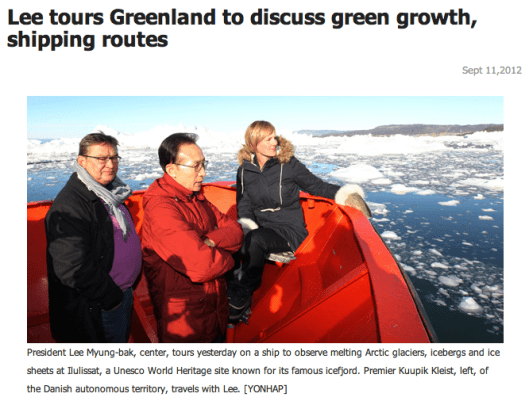
KANGERLUSSUAQ, Greenland – President Lee Myung-bak said Sunday Korea wants to help Greenland pursue economic development in an environmentally friendly way, expressing sadness and concern after seeing the Arctic glaciers that are melting due to global warming…
‘Development’ is the code word for supplanting nature with the money-generating schemes of capitalist carbon man.
Lee arrived in Greenland earlier in the day to take a first-hand look at problems resulting from climate change and to hold talks with Premier Kuupik Kleist of the Danish autonomous territory about green growth, resource development and Arctic shipping routes…
There’s that oxymoron again – “green growth”. Development and growth by industrial civilization is neither green nor sustainable. It’s simply another nail in the coffin for the natural world and all other species that don’t have an opposable thumb, walk upright, and trade shares on Wall Street.
Upon arrival at the airport in the small town of Kangerlussuaq, Lee flew on a light plane to Ilulissat, a Unesco World Heritage site known for its famous icefjord, one of the best locations to observe melting Arctic glaciers, icebergs and ice sheets…
Was that “light plane” another product of “green growth” and “sustainable development”? Perhaps it was buoyed in the air by magical green technology.
Premier Kleist and Danish Crown Prince Frederik traveled together with Lee.
“This is a tragic site,” Lee said aboard an icebreaker while touring the ice-floating sea, apparently meaning that global warming, caused by economic development, is having serious impacts on the environment…
…Increasingly warm weather has led to Arctic ice melting dangerously…
No shit, it’s caused by “economic development”! But these twits think attaching the word ‘green’ to the word ‘development’ will make everything all better. Capitalist carbon man is apparently no smarter than yeast in a petri dish. Yeast in a petri dish never choose degrowth over reproducing and consuming ever more.
Melting occurred on about 40 percent of the surface of Greenland’s ice sheets on July 8, but it expanded to 97 percent only four days later. A massive glacier twice the size of Manhattan broke off from Greenland recently, officials said.
Lee’s entourage also included three special members: prominent Korean climber Um Hong-gil, who is the world’s first to scale the globe’s 16 tallest mountains; famous cartoonist Hur Young-man; and Shin Soo-min, a college student chosen for his enthusiasm about green growth.
Carbon dioxide and other heat-trapping gases are blamed for warming the globe.
In an effort to tackle the issue, Lee has championed what is dubbed the “low carbon, green growth” policy, one of Lee’s trademark policies that calls for seeking economic growth through environmentally friendly technologies and industries without releasing greenhouse gases…
Oh, so now we will also attach the words ‘low carbon‘ to the word ‘development’. Sugar and spice and everything fucking nice!!!
Greenland is also rich in oil, rare earth materials and other resources. According to the U.S. Geological Survey, about 17 billion barrels of oil are estimated to be buried along Greenland’s western coast, with another 31.4 billion barrels along the northwestern coast.
Greenland is also believed to be holding the world’s largest reserves of rare earth materials. At least 10 regions have been confirmed to be holding the increasingly important resources, with the southern region holding enough reserves to meet 25 percent of global demand, officials said.
During the flight to Ilulissat, Prince Frederik told Lee that he hopes countries like Korea will help develop Greenland while preserving its environment. Lee said in response that he came to Greenland with “the spirit of green growth.”
Later in the day, Lee held talks with Kleist about ways to boost cooperation in green growth and resources development, saying Korea is willing to work actively together to transform “environmental crisis” into “economic opportunities.”
The two sides also signed four memoranda of understanding calling for cooperation in resources development, geological survey and Arctic science and technology. The agreements are expected to serve as a foothold for Korea’s participation in Greenland’s development.
“South Korea wants to seek economic development in a way that Greenland remains green,” Lee said during the signing ceremony. “I hope Greenland will be preserved as Greenland forever. In this sense, South Korea can be a good partner.
So now the truth comes out from under the cloak of feel-good greenwashing. We just can’t wait to get our hands on all that newly revealed, CO2-polluting carbon energy. How else would we be able to run our fossil fuel-based economies? Oh boy, we really do have more than enough fossil fuels to destroy every living thing on Earth, and like a moth’s fatal attraction to a flame, we just can’t stop ourselves. A few types of heat-loving bacteria will be the last remaining survivors in this brave new world of our own creation.
The tipping point is only recognized and acknowledged after it’s too late. Exponential, or non-linear, growth is sneaky in that one minute things appear manageable, even benign, when in fact we are mere moments away from total saturation and death. That’s the situation we are in now, having reached the limits of growth on a finite planet. Despite all the handwringing about the Euro Crisis and fixing the problem there, the only way out is degrowth and an awareness that we must live within the means that the earth will allow. For self-serving reasons, the social hierarchy that benefits from the current system will not allow this to happen because it would mean a radical restructuring of how the economy works and how the world’s resources are used and distributed. This is the straitjacket we are caught in by those benefiting at the top of the ponzi scheme who want to use austerity in an attempt to preserve the current scheme at the expense of the masses. But under our capitalist economic system, austerity becomes self-defeating:
The reasons given by S&P, the rating agency concerned, is revealing: “we believe that a reform process based on a pillar of fiscal austerity alone risks becoming self-defeating, as domestic demand falls in line with consumers’ rising concerns about job security and disposable incomes, eroding national tax revenues” (www.standardandpoors.com).
Without growth, debt reduction becomes impossible – and yet the only way capitalism has to stimulate growth is by government intervention, thus increasing debt! Capitalism is caught in a vicious pincer movement from which it cannot escape.
The following post explains why we have reached the limits of cheap fossil-fuel driven growth, requiring an out-of-the-box thinking in order to solve our current problems.
The true danger posed by our exploding population is not our absolute numbers but the inability of our environment to cope with so many of us doing what we do.
“In the last 200 years the population of our planet has grown exponentially, at a rate of 1.9% per year. If it continued at this rate, with the population doubling every 40 years, by 2600 we would all be standing literally shoulder to shoulder.” says Professor Stephen Hawking as reported by Edward Morgan in Looking at the New Demography.
Suffice to say the rate of population growth will not continue, and Morgan makes the case we are already in stage 5 of The Demographic Transition Model
click on chart for sharper image
Peak Oil Implications on Population Growth
Whereas Morgan presents a relatively benign view of things, even wondering if there are ways to reverse stage 5 decline, Paul Chefurka in Population: The Elephant in the Room sees things quite differently, primarily because of oil usage.
Each of the global problems we face today is the result of too many people using too much of our planet’s finite, non-renewable resources and filling its waste repositories of land, water and air to overflowing. The true danger posed by our exploding population is not our absolute numbers but the inability of our environment to cope with so many of us doing what we do.
It is becoming clearer every day, as crises like global warming, water, soil and food depletion, biodiversity loss and the degradation of our oceans constantly worsen, that the human situation is not sustainable. Bringing about a sustainable balance between ourselves and the planet we depend on will require us, in very short order, to reduce our population, our level of activity, or both. One of the questions that comes up repeatedly in discussions of population is, “What level of human population is sustainable?“
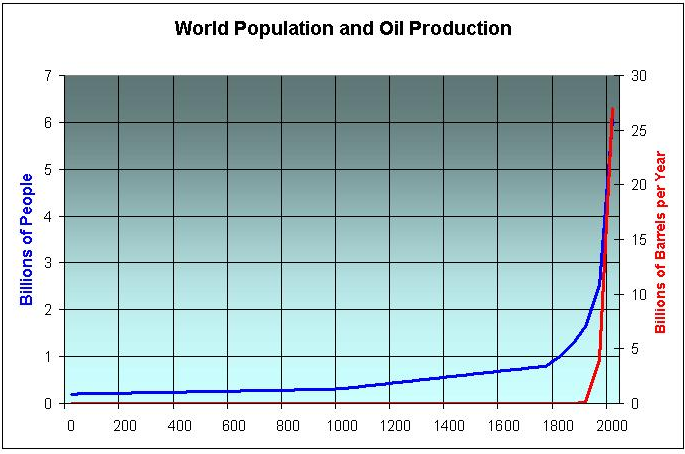
Oil first entered general use around 1900 when the global population was about 1.6 billion. Since then the population has quadrupled. When we look at oil production overlaid on the population growth curve we can see a very suggestive correspondence:
A closer look at the two curves from 1900 to the 2005 reinforces the impression of a close correlation:
The first questions everyone one asks when they accept the concept of Peak Oil is, “When is it going to happen?” and “How fast is the decline going to be?”
The steepness of the post-peak decline is open to more debate than the timing of the peak itself. There seems to be general agreement that the decline will start off very slowly, and will increase gradually as more and more oil fields enter decline and fewer replacement fields are brought on line. The decline will eventually flatten out, due both to the difficulty of extracting the last oil from a field as well as the reduction in demand brought about by high prices and economic slowdown.
The post-peak decline rate could be flattened out if we discover new oil to replace the oil we’re using. Unfortunately our consumption is outpacing our new discoveries by a rate of 5 to 1. to make matters worse, it appears that we have probably already discovered about 95% of all the conventional crude oil on the planet.
A full picture of the oil age is given in the graph below. This model incorporates actual production figures up to 2005 and my best estimate of a reasonable shape for the decline curve. It also incorporates my belief that the peak is happening as we speak.
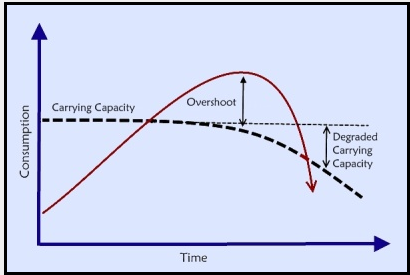
In ecology, overshoot is said to have occurred when a population’s consumption exceeds the carrying capacity of its environment, as illustrated in this graphic:
Overshoot
Populations in serious overshoot always decline. This is seen in wine vats when the yeast cells die after consuming all the sugar from the grapes and bathing themselves in their own poisonous alcoholic wastes. It’s seen in predator-prey relations in the animal world, where the depletion of the prey species results in a die-back of the predators. Actually, it’s a bit worse than that. The population may actually fall to a lower level than was sustainable before the overshoot. The reason is that unsustainable consumption while in overshoot allowed the species to use more non-renewable resources and to further poison their environment with excessive wastes.
In the case of humanity, our use of oil has allowed us to perform prodigious feats of resource extraction and waste production that would simply have been inconceivable before the oil age. If our oil supply declined, the lower available energy might be insufficient to let us extract and use the lower grade resources that remain. A similar case can be made for a lessened ability to deal with wastes in our environment.
Excess Deaths
[Chefurka goes through a series of grim charts culminating with with this explanation of what is coming]
The Cost
The human cost of such an involuntary population rebalancing is, of course, horrific. Based on this model we would experience an average excess death rate of 100 million per year every year for the next 75 years to achieve our target population of one billion by 2082. The peak excess death rate would happen in about 20 years, and would be about 200 million that year. To put this in perspective, WWII caused an excess death rate of only 10 million per year for only six years.
Given this, it’s not hard to see why population control is the untouchable elephant in the room – the problem we’re in is simply too big for humane or even rational solutions. It’s also not hard to see why some people are beginning to grasp the inevitability of a human die-off.
UN Population Projections
Let’s put aside the really grim projections and simply ponder the “low population track” in the following charts of population projections from the UN.
I cannot find the article or source for that chart but the image is from a link on Seeking Alpha.
Demographic and Economic Questions
Is that low UN track that unbelievable? If not, what if the starting point is now, not 2040?
Who is going to pay the medical costs of all the retirees in the developed-world if people live longer and the population simply stagnates?
Where are the energy resources going to come from if the population keeps growing instead?
Where are the energy needs of China alone going to come from at the current rate of China’s economic growth regardless of whether the Chinese population grows or not?
Those who think we are going to “grow” our way out the the current global economic mess better have good answers for the questions in points number one and three above.
Problem number two is a huge problem in Japan right now. The US will face the same problem not too far down the road.
Those who suggest immigration and population growth is the solution to problem number two better have an answer to question number three while also explaining how immigration and population growth is nothing more than a can-kicking exercise.
The China problem is right here, right now. Peak oil all but ensures China’s growth rate is going to plunge in the not too distant future, there is going to be a huge global showdown over oil supplies with China the winner, or a cheap easy to produce means of renewable energy is found in the next five years?


















 Collapse of Industrial Civilization