He counted the dead by their boots, not their names.
Their mothers would never pronounce them the same.
Forty-three soldiers. A child with no shoes.
He smoked while perfecting the art of bad news.
He walked until the road forgot his feet.
A column passed him, shuffling through the heat.
One looked at him. He looked back, cold and gray.
He signed their death like any other day.
His wife stopped asking where he went at night.
His daughter flinched whenever he held her tight.
His hands smelled of metal. No one would say.
Home learned to be quiet in a careful way.
The war ended with singing and lights in the square.
He watched from a window like he wasn’t there.
His daughter ran outside to join the crowd.
She didn’t wave to him. He was almost proud.
A boy lay flat beside the garden wall.
He played at dying, waiting for the call.
He saw the soldier watching. Grinned and stood.
“I got three enemies—killed them like you would.”
He didn’t answer. Turned and walked inside.
The boy kept playing: shoot, kill, hide.
He closed the shutters. Poured himself a drink.
He sat until the room began to sink.
His hands began to shake around the glass.
The room was still. The shaking wouldn’t pass.
He gripped the table. Steadied. Breathed. And then
His men shuffled through the room again.
His wife came down and stood without a word.
She’d lived with this for years. She’d seen and heard.
She didn’t touch him. Threw his drink away.
They didn’t speak. What was there left to say?
He stood at last. The chair scraped on the floor.
He walked past her and through the open door.
The street was pale. The last lamp flickered out.
His shadow vanished down an unknown route.
The column shuffled on. He joined the count.
No one said his name or looked about.
Forty-four soldiers. A child with no shoes.
The dead don’t speak. The dead don’t get to choose.
He wore his ribbons, bore their praise,
Smiled through the crowd’s empty gaze.
But sand still grinds behind his eyes—
A child’s shoe burning where she lies.
Some nights he leaves his body and soul,
Floats where the dead consume him whole.
Their silent faces never part—
A spectator to his own dark heart.
He came back home to his wife’s stare,
She kissed a stranger standing there.
The kids asked why he screamed at night—
He learned to say he was alright.
One night he made a list of names.
The men in suits who lit the flames.
He traced their addresses in red—
He had new orders in his head.
He found them in their gated homes,
Behind their walls of glass and chrome.
One by one he carved their life—
The wars came home. He was the knife.
But in the silence after death,
He heard a question on his breath:
“Does vengeance cleanse, or sow the seed—
The monster you swore to never feed?”
They found the knife but not the man.
He vanished like the war began—
No grave, no name, no final stand,
Just grains of rumor in the sand.
In my previous ‘arms industry’ posts (Guns, God, and Greenback$ as well as Guns ‘R U.S.), I alluded to the revolving door between the arms industry and the government and the corruption of politics by the money involved therein. In one of the most interesting interviews of 2012 aired today on DemocracyNow, arms industry analyst Andrew Feinstein, author of “The Shadow World: Inside the Global Arms Trade” and a former African National Congress member of Parliament in South Africa, sheds more light and insight on this very subject:
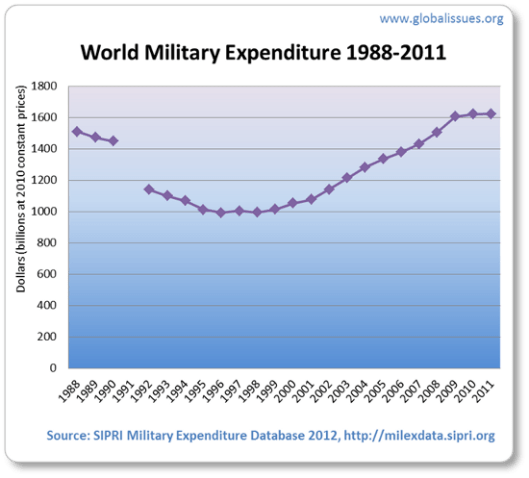
ANDREW FEINSTEIN: …The global arms trade is a $1.74 trillion-a-year business. That’s $250 for every person on the planet. And the profit motive behind the global arms trade is absolutely crucial. This is a business that is about big, big money. The trade contributes around 40 percent of all corruption in all global trade. So its impact on countries, on governments, on ordinary individuals in terms of the economic opportunity costs are absolutely massive.
Now, you will find that many spokespeople for the trade would try to distinguish between the legal or formal trade, on the one hand, and the illegal or illicit trade, on the other. I argue in the book that this distinction is a fallacy, that the boundaries are in fact extremely fuzzy and that the licit and the illicit are very closely intertwined, in addition to which the industry is largely protected because of its very close links to governments, to intelligence agencies, obviously to the military, and to lawmakers. So it is very seldom—even with the inadequate regulations that exist globally around the trade in weapons, it is very, very seldom that people who break those regulations are actually brought to book…
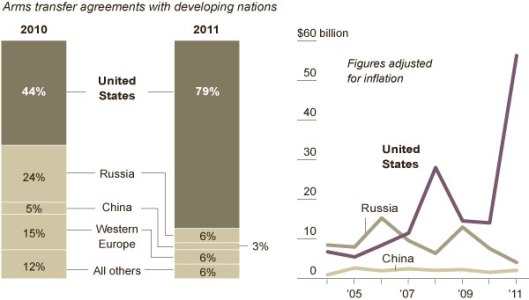
…Now, the situation that pertains at a global or international level has very many similarities with the domestic situation, particularly in the U.S., because let’s—let’s bear in mind while discussing this that the U.S. buys and sells almost as much weaponry as the rest of the world combined. So what happens in the U.S. is going to have enormous impact on the rest of the world. And what happens domestically, in terms of the ownership of weaponry within the U.S., really does, as I say, reflect the global trade in arms, in that we see it’s a $3.5 billion-a-year industry. And here we’re talking about smaller weaponry—about handguns, about assault rifles, semi-automatic weapons, the sorts that are used in the tragedy at Sandy Hook and all of the others that we’ve seen over the years throughout the U.S.
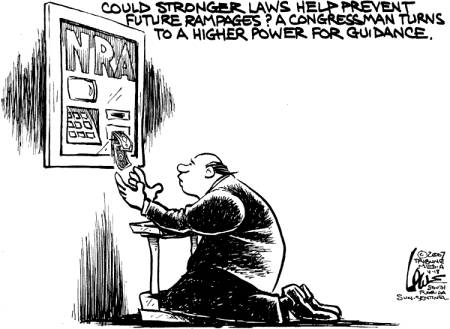
But the NRA, the gun sellers, the gun users seem to be afforded an extraordinary level of protection by government, by law enforcement authorities, just as happens on the global level. And part of this is because of the revolving door of people between, for instance, the NRA and government. Recent figures suggest that 15 of 28 officials in the NRA came from—sorry, lobbyists in the NRA came from important positions within government dealing with some of these same issues, so that the sorts of decisions being made by government are being informed disproportionately by those who want guns to be unregulated, by those who are making massive profits out the suffering of the victims of gun crime…
…let me make another point that I think is absolutely crucial about this and to understand where the NRA is coming from and, unfortunately, where the global trade in arms comes from, as well. And that is the linkages between politics and the gun lobby, and particularly, in terms of those linkages, money. One of the reasons that I focus on the global trade in arms in my work is because I saw, both in the context of South Africa, but also at a global level, the way in which money has come to pollute our politics. And the relationship between defense contractors on an international level and political parties and individual politicians are deep and profound. At a domestic level, the relationships between the NRA and specific elected representatives, not only in terms of money contributed, but also in terms of support given, are, again, profound. And unless we are able to break these linkages between money and politics that so pollute the way we are governed around the world, we will not be able to deal with some of the most intractable problems that face us as human beings —problems of the weaponization of the world, problems of climate change…
…I have not seen anywhere else in the world a gun lobby that has the same level of influence on its own government as the NRA does in the United States. My own assessment of what happened in July with the arms trade treaty is that the NRA, through the words of Mr. LaPierre and others, made clear to the Obama administration that it would make the president’s re-election a lot more difficult if he supported an international arms trade treaty. And I think it’s in that way that the NRA had such direct influence on the U.S. decision to effectively scupper negotiations for what in my opinion wouldn’t have been a strong-enough arms trade treaty, but would have been far better than any form of regulation that we have at the moment. So, yes, I think this is something of a unique situation, where a gun lobby has the extent of influence that it has in the United States of America…
What I find most disturbing is that in an age of resource constraints and austerity measures aimed at the lower class, global sales from the arms industry are booming and that growth is coming primarily from the United States of America (aka ‘Guns ‘R U.S.’):
As was stated by Feinstein, the world-wide anti-corruption body, Transparency International, reports that the arms industry is one of the most corrupt business sectors, accounting for 40-50% of corruption in global trade.
Corruption plays a significant role in influencing arms procurement. But despite repeated scandals, this situation has been largely ignored by governments, NGOs and academics.” ~ Laurence Cockroft, Chairman of Transparency International’s UK chapter.
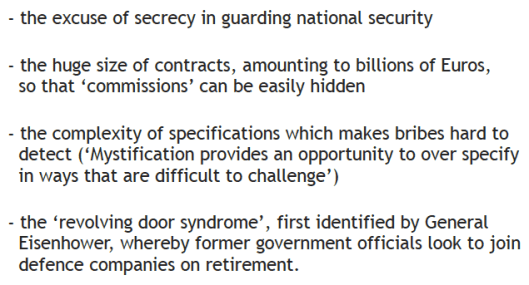
‘Commissions’ are the euphemism for bribes which are paid by manufacturers to governments and average at least 10% of contracts that run in the tens of $billions per year. Some reasons for the rampant corruption in the arms industry:
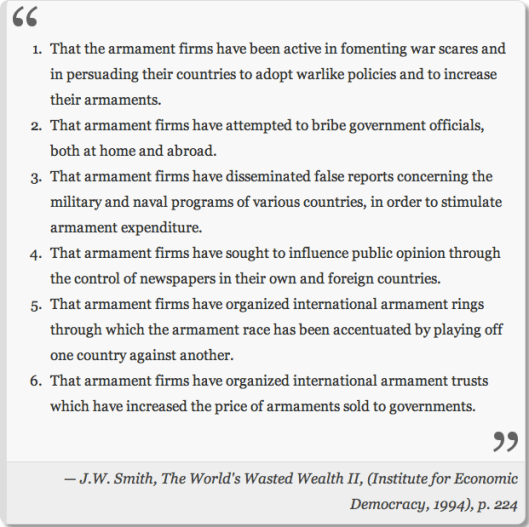
The merchants of death have only grown more powerful in recent times, and their horrific impacts to the well-being of humanity are as true today as they were after World War I when the League of Nations listed six primary criticisms of global arms dealers, as quoted by J.W. Smith:
Stung by the horrors of World War I, world leaders realized that arms merchants had a hand in creating both the climate of fear and the resulting disaster itself.
Americans need to understand that the NRA is very much a part of this global arms trade. If one follows the money, the reasons why the NRA is adamantly opposed to any sort of regulation on guns becomes painfully apparent. While the US domestic arms industry conveniently wraps itself and its profit motive behind the patriotic fervor of the Second Amendment and the colonial ghosts of Founding Fathers, the horrors of the Sandy Hook massacre are blamed on everything under the sun except for that which hides in plain sight — an unregulated, out-of-control global and domestic arms industry.


 The merchants of death have only grown more powerful in recent times, and their horrific impacts to the well-being of humanity are as true today as they were after World War I when the League of Nations listed six primary criticisms of global arms dealers, as quoted by J.W. Smith:
 From a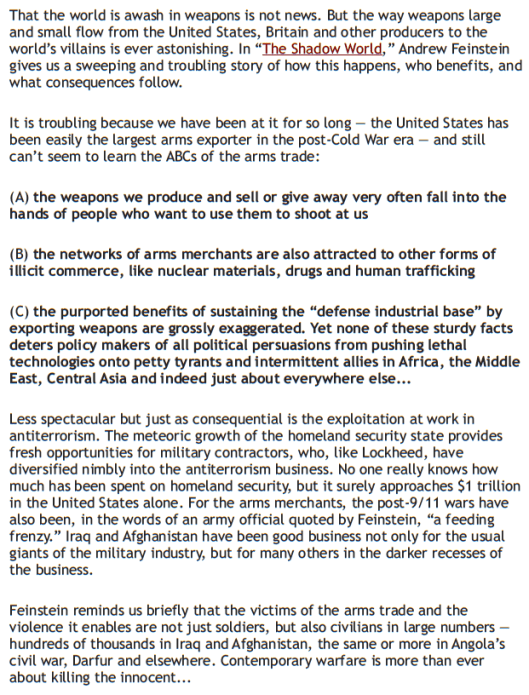

 Collapse of Industrial Civilization