Since we were on the subject of rent-seeking in our last two posts, I happened to be in Phoenix over the weekend and was reminded of this insidious subject when I saw the following headline at the local newsstand:
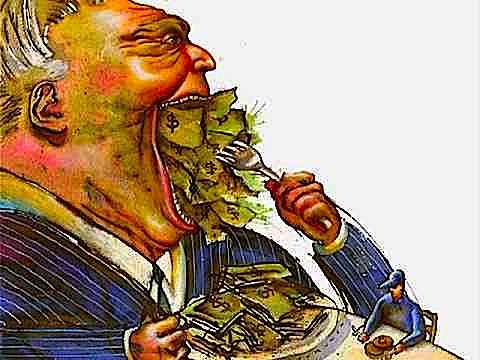
This story was covered more in-depth at the Huffington Post. This post is not an endorsement of illegal immigration, but an expose’ of how the relentless and amoral function of profit-seeking in capitalism has taken over our correctional institutions through privatization, becoming another wasteful and corrupt form of rent-seeking. For-profit prisons are one of the more grotesque formations in the annals of capitalism.
According to the aforementioned articles, the for-profit prison industry has grown from just 10% of beds to the present proportion of one half. And this growth has come off the backs of taxpayers who are footing the bill for the expansion of federal facilities to house the roughly 400,000 illegal immigrants jailed each year. The cost to taxpayers will be nearly 2 billion this year. The question is how has this growth occurred in an environment of falling illegal immigration:
Much of the drop in illegal immigrants is due to the persistently weak U.S. economy, which has shrunk construction and service-sector jobs attractive to Mexican workers following the housing bust. But increased deportations, heightened U.S. patrols and violence along the border also have played a role, as well as demographic changes, such as Mexico’s declining birth rate.
If you read between the lines, the answer is in the amount of lobbying that the for-profit industry has carried out in order to milk the system and secure governments contracts:
The industry’s giants – Corrections Corporation of America, The GEO Group, and Management and Training Corp. – have spent at least $45 million combined on campaign donations and lobbyists at the state and federal level in the last decade, the AP found…
…it wasn’t until 2005 – as the corrections companies’ lobbying efforts reached their zenith – that ICE got a major boost. Between 2005 and 2007, the agency’s budget jumped from $3.5 billion to $4.7 billion, adding more than $5 million for custody operations.
Dora Schriro, who in 2009 reviewed the nation’s detention system at the request of Homeland Security Secretary Janet Napolitano, said nearly every aspect had been outsourced…
…An AP review of Federal Election Commission data found the prison companies and their employees gave to key congressional leaders who control how much money goes to run the nation’s detention centers and who influence how many contracts go to the private sector…
Besides the fact that it’s your tax dollars being stolen, how does this affect you? You’re not an illegal immigrant, you say. The tentacles of the prison industrial complex have a way of entangling more of the ever-growing ranks of the poor, an increasing number of which are the former members of the crumbling middle class. If you fall off the capitalist treadmill of debt peonage and run afoul of the law, the 1%’ers have a bed in one of their for-profit prisons waiting for you…
Since most of us will eventually be relegated to the ranks of the poor or ‘working poor’, I thought it fitting to feature an expert on poverty, Barbara Ehrenreich, author of Nickel and Dimed. She is now heading the Economic Hardship Reporting Project whose goal is to “force this country’s crisis of poverty and economic insecurity to the center of the national conversation.” I have added their blog to my list of RSS feeds. For anyone who thinks that Mrs. Ehrenreich is unaware of the larger apocalyptic picture unfolding in the world, please listen to what she says about the demise of industrial civilization. And since our last post by Darbikrash centered around the rent-seeking financialization of the economy, in particular its effects on small businesses and individual liberties, it behooves us to look at how corporations and government entities prey on the poor and use them as a vast resource pool from which to extract dollars.
In what ways do the poor get used as a source for rent-seeking financialization? Here are a few:
…as Business Week helpfully pointed out in 2007, the poor in aggregate provide a juicy target for anyone depraved enough to make a business of stealing from them.
The trick is to rob them in ways that are systematic, impersonal, and almost impossible to trace to individual perpetrators. Employers, for example, can simply program their computers to shave a few dollars off each paycheck, or they can require workers to show up 30 minutes or more before the time clock starts ticking.
Lenders, including major credit companies as well as payday lenders, have taken over the traditional role of the street-corner loan shark, charging the poor insanely high rates of interest. When supplemented with late fees (themselves subject to interest), the resulting effective interest rate can be as high as 600% a year, which is perfectly legal in many states.
It’s not just the private sector that’s preying on the poor. Local governments are discovering that they can partially make up for declining tax revenues through fines, fees, and other costs imposed on indigent defendants, often for crimes no more dastardly than driving with a suspended license. And if that seems like an inefficient way to make money, given the high cost of locking people up, a growing number of jurisdictions have taken to charging defendants for their court costs and even the price of occupying a jail cell….
You might think that policymakers would take a keen interest in the amounts that are stolen, coerced, or extorted from the poor, but there are no official efforts to track such figures. Instead, we have to turn to independent investigators, like Kim Bobo, author of Wage Theft in America, who estimates that wage theft nets employers at least $100 billion a year and possibly twice that. As for the profits extracted by the lending industry, Gary Rivlin, who wrote Broke USA: From Pawnshops to Poverty, Inc. — How the Working Poor Became Big Business, says the poor pay an effective surcharge of about $30 billion a year for the financial products they consume and more than twice that if you include subprime credit cards, subprime auto loans, and subprime mortgages.
These are not, of course, trivial amounts. They are on the same order of magnitude as major public programs for the poor….
From for-profit prisons subsidized by taxes to government-mandated premiums for the private health insurance industry, I bet if the amount of rent-seeking as a proportion of the GDP in America was able to be quantified, we’d find that this country and its captive denizens are treated as just one big plantation from which to harvest greenbacks. According to economist Joseph E. Stiglitz, an inordinate proportion of those at the top of the free market heap have made rent-seeking the primary method by which they have accumulated their riches:
…The magnitude of “rent seeking” in our economy, while hard to quantify, is clearly enormous. Individuals and corporations that excel at rent seeking are handsomely rewarded. The financial industry, which now largely functions as a market in speculation rather than a tool for promoting true economic productivity, is the rent-seeking sector par excellence. Rent seeking goes beyond speculation. The financial sector also gets rents out of its domination of the means of payment—the exorbitant credit- and debit-card fees and also the less well-known fees charged to merchants and passed on, eventually, to consumers. The money it siphons from poor and middle-class Americans through predatory lending practices can be thought of as rents. In recent years, the financial sector has accounted for some 40 percent of all corporate profits. This does not mean that its social contribution sneaks into the plus column, or comes even close. The crisis showed how it could wreak havoc on the economy. In a rent-seeking economy such as ours has become, private returns and social returns are badly out of whack.
In their simplest form, rents are nothing more than re-distributions from one part of society to the rent seekers. Much of the inequality in our economy has been the result of rent seeking, because, to a significant degree, rent seeking re-distributes money from those at the bottom to those at the top.
But there is a broader economic consequence: the fight to acquire rents is at best a zero-sum activity. Rent seeking makes nothing grow. Efforts are directed toward getting a larger share of the pie rather than increasing the size of the pie. But it’s worse than that: rent seeking distorts resource allocations and makes the economy weaker. It is a centripetal force: the rewards of rent seeking become so outsize that more and more energy is directed toward it, at the expense of everything else. Countries rich in natural resources are infamous for rent-seeking activities. It’s far easier to get rich in these places by getting access to resources at favorable terms than by producing goods or services that benefit people and increase productivity. That’s why these economies have done so badly, in spite of their seeming wealth. It’s easy to scoff and say: We’re not Nigeria, we’re not Congo. But the rent-seeking dynamic is the same….
Below is a good discussion from a couple days ago of the expanding poverty problem in America featuring Barbara Ehrenreich. Don’t mind the free market lackey from the ultra-conservative think tank American Enterprise Institute. He thinks that the access to information the internet created has made people less poverty-stricken than in the past. For those who can afford a computer and internet subscription, the information age has only made them more aware of how fucked they are in a world of depleting resources run by a ruthless transnational oligarchic elite.
What we have in America is a twisted form of socialism for the elite wherein the few are supported by the collective wealth extraction from the many, as precisely described by Dennis Kucinich:
The rancorous debate over the debt belies a fundamental truth of our economy — that it is run for the few at the expense of the many, that our entire government has been turned into a machine which takes the wealth of a mass of Americans and accelerates it into the hands of the few. Let me give you some examples…
It would be a mistake to view today’s finance capitalism as the “final stage” of industrial capitalism. The name of the new game is neofeudalism and austerity, and its preferred mode of exploitation is debt peonage. Like creditors in ancient Rome, today’s financial power is seeking to replace democracy with a financial oligarchy. The result is a resurgence of pre-capitalist “primitive accumulation,” by debt creation and foreclosure rather than the military conquests of past epochs.
Much of the dismantling of the social fabric that describes the general malaise of our times is not visible to the consumer or generic citizen. However, to peer down the darkened hallways in the backstage of American business is to glimpse the machinations of a frightening leviathan that subsumes social power in a manner that cannot be conceptualized in the traditional left vs. right paradigm.
The issue at hand is privatization, the stalwart conviction that free markets are the only means of adjudication for the natural tension between self seeking utility maximization of the individual, and the needs and rights of society as a independent entity. The perpetrators have constructed an arena of false contest, populated with sacrificial ideological tropes in pursuit of their real agenda.
It is the purpose of this article to examine some of the hidden means by which privatization- as practiced by the bourgeoisie- is being used to subsume the sovereignty of both individuals and small businesses.
A critical component to understanding privatization is to understand the need for obfuscation, e.g. to become invisible. Barring this, the next best defense against revolution and dissent is to deny that any disagreement exists, or if it does, then to valorize it and present it as irrefutable status quo, thus enjoining the conservatives who are loathe to change anything deemed as established, and can be counted on to circle the wagons in the so called “pursuit of liberty”.
Staunchly in the category of invisibility is the entire concept of rent-seeking, which is to say, the premise of unearned labor, or in plain English, getting something for nothing. Much of the financial economy of today is nearly totally dedicated to rent-seeking activities, so called financial engineering that attempts, through various debt mechanisms, to extract value from either land or industrial production without adding any value whatsoever. (For a particularly good and thorough discussion of rent seeking see this article)
If you are getting something for nothing, the last thing you want is for anyone else to know of this; so much of the current media discussion is either valorizing the financial class, or by working to maintain the invisibility of the rent-seeking genre. An understanding of this rent-seeking activity, and it’s relationship to so-called “free market” dynamics is critical to debunking the more mainstream conservative and Libertarian theories of economics, which crumble rather quickly within this framework.
Another frame of reference which adds to this discussion is a remedial listing of the three circuits of Capitalism, a.) Industrial capitalism, b.) Mercantilist Capitalism, and c.) Finance (Money lending) Capitalism. All three strains utilize exploitation to achieve access to surplus value, and all three seek to exchange supra-profits for social power. To illustrate, we can look at the Forbes list of the top 10 wealthiest Americans, and we can see that these three strains are all represented:
1. Bill Gates Microsoft (Industrial Capitalist)
2. Warren Buffett Berkshire Hathaway (Finance Capitalist)
3. Larry Ellison Oracle (Industrial Capitalist).
4. Christy Walton Walmart (Mercantile Capitalist)
5. Charles Koch manufacturing, energy (Industrial Capitalist)
6. David Koch manufacturing, energy (Industrial Capitalist)
7. Jim Walton Walmart (Mercantile Capitalist)
8. Alice Walton Walmart (Mercantile Capitalist)
9. S. Robson Walton Walmart (Mercantile Capitalist)
10. Michael Bloomberg (Finance Capitalist)
What is interesting about the relationship of these three strains is the internal competition for surplus value which is quite remarkable and very vigorous. Most of the publicized argument for regulatory constraints against the Finance Capitalist for example, is not from consumers or citizens, but stems from Industrial Capitalists who are loathe to give up surplus value to rent-seekers, preferring instead to capture this surplus for their own uses.
To further set the stage for our discussion, we can examine briefly the extents of control on modern media and the political economy by these three strains. The Financial Capitalists dominate the levers of power through direct capture of government figures, usually by interchanging and exchanging employees back and forth through key positions, as well their highly documented financial contributions. The Mercantilists however, are dominant in the advertising media, preferring instead to take their case directly to the consumer, shaping and stimulating demand by convincing consumers to purchase products and services that they did not know they needed. The long standing and principal Industrial Capitalists of course use both media and government to advance their objectives, but they add another dimension to their ideological control by purchasing controlling stakes in free market think tanks, such as the Libertarian Cato Institute (Koch brothers), the Heritage Foundation, and many others. Most of the so called “free market” think tanks that are influential on public policy can be traced to a controlling interest from Industrial Capital.
So we can see that the three strains of capital have hegemony in their own unique portals, influencing public policy with free domain to the exchange of their out-sized surplus values into social power.
The end game of all this is for the furtherance of rent-seeking activities. This is done in many different ways, but the subject of this article is a focus on privatization, and specifically the behind-the-scenes activities that are imposed on small businesses as well as employees.
The top level observation regarding the push to privatization is that it simply allows capitalist enterprise, large and small, to subvert constitutional protections by engaging private citizens in superficially mutual contracts. Modern political philosophy has been co-opted to allow wide ranging civil rights abuses under the cover of “mutual consent” in the context of a contract between private parties.
Examples would be private party contracts between employees (employment agreements) and between large and small businesses (supply agreements) .
Once private citizens enter into so called mutual contracts, the court system provides wide latitude for enforcement of virtually any draconian measure, as long as two private parties ostensibly agree. In many cases, basic constitutional protections are circumvented, and the entire principle of political economy is upended in the favor of the author of the contract. In theory, the employee or small business has the “right” to not sign any agreement which runs roughshod over his best interests, but in practice, such options are not readily available, particularly for employment agreements, when a prospective employee may be in desperate need of a job, as he or she is forced to sell his labor power for sustenance wages. If there are insufficient offerings of competing private employment contracts (as is often the case) the prospective employee must take what he can get- however onerous and biased the contractual terms are.
This is of course the objective of the Capitalist economy, to 1.) insure a standing army of unemployed workers, at the ready, to fill on demand openings in the Capitalist mode of production, incurring no costs to the Capitalist until such time as this labor power is needed, and then when needed to hire only using draconian and highly biased employment agreements that transfer State-like control to a Capitalist entity that is much better positioned to provide enforcement. 2.) To externalize costs to the greatest degree possible, such as societal infrastructure costs, by creating a privatized, Capitalist entity to take over former State controlled functions and to apply the aforementioned labor principles to realize this new profit center, that can cater such services only to these that can afford them, while exploiting those that provide labor power to these privatized entities.
Once these externalized functions are brought under the umbrella of the Capitalist mode of production, the issue of mutually agreeable contract law can be brought to bear to strip these workers of their Constitutional rights, and further weaken any efforts to consolidate and resist.
The folks over at Crooked Timber have provided some particularly good examples and arguments around this notion of using contract law to subvert even basic liberties:
Life at Work
To understand the limitations of these …….. we have to understand how little freedom workers enjoy at work. Unfreedom in the workplace can be broken down into three categories.
1. Abridgments of freedom inside the workplace
On pain of being fired, workers in most parts of the United States can be commanded to pee or forbidden to pee. They can be watched on camera by their boss while they pee. They can be forbidden to wear what they want, say what they want (and at what decibel), and associate with whom they want. They can be punished for doing or not doing any of these things—punished legally or illegally (as many as 1 in 17 workers who try to join a union is illegally fired or suspended). But what’s remarkable is just how many of these punishments are legal, and even when they’re illegal, how toothless the law can be. Outside the usual protections (against race and gender discrimination, for example), employees can be fired for good reasons, bad reasons, or no reason at all. They can be fired for donating a kidney to their boss (fired by the same boss, that is), refusing to have their person and effects searched, calling the boss a “cheapskate” in a personal letter, and more. They have few rights on the job—certainly none of the First, Fourth, Fifth, Sixth, and Seventh Amendment liberties that constitute the bare minimum of a free society; thus, no free speech or assembly, no due process, no right to a fair hearing before a panel of their peers—and what rights they do have employers will fight tooth and nail to make sure aren’t made known to them or will simply require them to waive as a condition of employment. Outside the prison or the military—which actually provide, at least on paper, some guarantee of due process—it’s difficult to conceive of a less free institution for adults than the average workplace.
2. 2. Abridgements of freedom outside the workplace
In addition to abridging freedoms on the job, employers abridge their employees’ freedoms off the job. Employers invade employees’ privacy, demanding that they hand over passwords to their Facebook accounts, and fire them for resisting such invasions. Employers secretly film their employees at home. Workers are fired for supporting the wrong political candidates (“work for John Kerry or work for me”), failing to donate to employer-approved candidates, challenging government officials, writing critiques of religion on their personal blogs (IBM instructs employees to “show proper consideration…for topics that may be considered objectionable or inflammatory—such as politics and religion”), carrying on extramarital affairs, participating in group sex at home, cross-dressing, and more. Workers are punished for smoking or drinking in the privacy of their own homes. (How many nanny states have tried that?) They can be fired for merely thinking about having an abortion, for reporting information that might have averted the Challenger disaster, for being raped by an estranged husband. Again, this is all legal in many states, and in the states where it is illegal, the laws are often weak.
3. 3. Use of sanctions inside the workplace as a supplement to—or substitute for—political repression by the state
While employers often abridge workers’ liberty off the job, at certain moments, those abridgments assume a larger function for the state. Particularly in a liberal state constrained by constitutional protections such as the First Amendment, the instruments of coercion can be outsourced to—or shared with—the private sector. During the McCarthy period, for example, fewer than 200 men and women went to jail for their political beliefs, but as many as 40% of American workers—in both the public and private sectors—were investigated (and a smaller percentage punished) for their beliefs.
And, perhaps most succinctly:
What makes the private sector, especially the workplace, such an attractive instrument of repression is precisely that it can administer punishments without being subject to the constraints of the Bill of Rights. It is an archipelago of private governments, in which employers are free to do precisely what the state is forbidden to do: punish without process. Far from providing a check against the state, the private sector can easily become an adjutant of the state. Not through some process of liberal corporatism but simply because employers often share the goals of state officials and are better positioned to act upon them.
So this is the end state that the “free market” evangelists push for, this is the holy grail of privatization, externalized costs to a system that can act outside of the constraints of the Bill of Rights.
We can extend this discussion to the even further reaches of transparency, that of the nature of contracts between large and small businesses. In addition to the above noted employer/employee social relations enforced under a Capitalist entity governed by private contract, the same private contract modality has some startling repercussions for business:
1.) Mercantilists demand slotting fees to product producers for prominent product (shelf) placement at retail locations. They routinely create profit centers with draconian shipping requirements, for example, if a shipping label is off center from a specific location on a carton by even an inch, the producer is fined for each instance of this deviation. Missing or incorrectly filled out paperwork, spelling errors, any excuse for a “deviation” results in a back charge (fine) to the producers. It is not unusual to see small manufacturers shipping product to “big box” retailers, and to have so many back charges that their entire profit margin is consumed before the first unit is even sold. Which of course, is the goal.
2.) Small manufacturers are expected to honor dubious return policies, many large retailers force contract language on suppliers that require them to accept returns months, sometime years after shipment, often when the product was clearly misused. Replacement costs are often entirely pushed onto the supplier, yielding a system that is nearly impossible to accurately track inventory, when such products are never really sold, if they can be returned for full credit months later.
3.) Contract language for even small, non-mercantilist orders has escalated dramatically over the last few years. Consider:
a. Supply agreements can dictate and restrict any outspoken political dissent or endorsement.
b. You can be forced to decline sales within certain industries, to certain customers deemed competitive to the purchaser, or constrained to within certain geographic radii.
c. You can be prohibited from selling a certain product or service to anyone but the original purchaser.
d. You can be forced to accept liability for failures that have nothing to do with your product or service.
e. You can be forced to submit to a dress code for certain customer facing events, and translate this code internally to your own organization.
f. You are often forced to agree to all types of intrusive audits, in some cases unannounced, and can be forced to absorb any lost production costs or accounting support costs in support of these audits- regardless of their outcome.
4.) But perhaps most egregiously, it is now increasingly common to submit to mandatory electronic form of payment, wherein you provide your confidential banking account information, and payment is only made, and cannot be made any other way, by means of a wire transfer directly into your private business account. Reading of the small print in the contract yields an almost universal caveat, the payer can reverse any payment immediately and electronically, directly from your account, without notice and without permission; further, if there is any payment dispute, fines or penalties, or the occurrence of any perceived damages and liability that can result in charge backs to you, the supplier, these can be extracted without notice and without permission.
If you read the fine print on any recent home mortgage documentation you will see similar examples of this from our friends the Finance Capitalists, and if you are foolish enough to consider borrowing money for a business venture from a Finance Capitalist, you will get a first class education in exploitation via contract documents.
The sum total of all this, under the mantle of privatization, is the absolute and unchallenged control by the large scale Capitalist of both consumer and small business based endeavor, seeking to capitalize any surplus value that is achieved though small business or consumer debt onset, and to reduce this to rent-seeking in a fashion that would put Mussolini to shame.
Turns out the devil you don’t know is far worse than the devil you do know.
Dear potential contributors (DK, Tom Tom, Kramerfaust, Sunson),
I am going to send you an invitation tonight so that you can contribute. You’ll have to sign up with wordpress in order to submit your work to me. It looks like Kramerfaust already has a wordpress account set up. Per the WordPress staff:
Your new user will now be able to access your blog by visiting the My Blogs section of their dashboard when they log in to WordPress.com.
You won’t have to blog at the site you initially create; it’s just a required formality. Or you can simply email me at Collapsitarians@gmail.com. I’m looking forward to reading your posts. More voices means more worldly knowledge to glean from and different perspectives to appreciate.
Since I started this site, the stats tell me that the top four google searches which have brought people here are the following:
1.) collapse of industrial civilization
2.) the price of offshore revisited
3.) james holmes sociopath
4.) collapse peak oil
The first one is an obvious outcome. I was surprised this domain had not been previously claimed since it seems to be such a hackneyed phrase. As Greer has noted, in the twilight of past civilizations, the elite are increasingly seen as corrupt and stories of societal collapse become popular in the mainstream culture. The second one relates to my post about the trillions being hoarded in offshore tax havens by the 0.001%. Backed by the power of the State, the global elite live in a cocoon of cossetted comfort, indifferent to the hand-to-mouth existence of the majority. They’ve got the iron fist of the Military Industrial Complex and Police State to protect their wealth from the rest of humanity who will be falling off the net energy cliff into poverty and desperation.
The third google search phrase is apparent to all unless you have been living under a rock since July 20th. We have these mass shootings periodically here in the Land of the Second Amendment just as a reminder that guns don’t kill people. Guns are completely innocent in these mass bloodlettings and should not be denied their freedom of getting into the hands of every man, woman, and child in the country. The response by the public is simply to buy even more guns. Why refute such logic in a world that thinks more debt is the answer. More debt, more growth, more firepower, more people, more wars, more cars, more profit, more, more, and more…..
And the last google search is not a surprise either. Despite all the propaganda of another oil surfeit, educated peak-oilers have not been swayed.
Connecting the ‘War on Terror’ with the control of resources abroad and the crushing of dissent both here and overseas:
In order to overtake and dominate, sometimes you have to draw your opponent in close to you. Knowing that the oil and gas reserves of the Middle East make it an area of vital geopolitical and national security importance, an empire would use all available opportunities to insert itself there, even if it meant invasion under some false pretense. With the trumped-up claims of terrorist ties to Iraq and WMD, 9-11 gave the empire the pretense to invade. Today we can see the results here and here and here.
“Moreover, as America becomes an increasingly multi-cultural society, it may find it more difficult to fashion a consensus on foreign policy issues, except in the circumstance of a truly massive and widely perceived direct external threat.” (p. 211)
“Never before has a populist democracy attained international supremacy. But the pursuit of power is not a goal that commands popular passion, except in conditions of a sudden threat or challenge to the public’s sense of domestic well-being. The economic self-denial (that is, defense spending) and the human sacrifice (casualties, even among professional soldiers) required in the effort are uncongenial to democratic instincts. Democracy is inimical to imperial mobilization.” (p.35)
“To put it in a terminology that harkens back to the more brutal age of ancient empires, the three grand imperatives of imperial geostrategy are to prevent collusion and maintain security dependence among the vassals, to keep tributaries pliant and protected(!), and to keep the barbarians from coming together.” (p.40)
Now we get to today’s video from Journeyman pictures which gives further evidence from a whistleblower that all the stops were pulled in order to make this ‘War on Terror’ fly. No more Geneva Convention, no more questioning of the efficacy or, for that matter, morality of the brutal torture done by countries we once condemned as barbaric:
The War on Terror was the perfect existential threat needed to prop up neoliberal capitalism and its resultant world of an opulently rich class ruling over the teeming masses of serfs. In a civilization dominated globally by such an economic system which is designed to funnel the shrinking wealth (i.e. energy) of society into the hands of a tiny elite, there can be no other future to look forward to for those at the bottom but despair and poverty:
Now the following story should lay to rest the question of who is really waging this class war and laying waste to the rest of humanity. While the Über Rich hide their wealth in tax havens to the tune of at least $21 trillion, the Working Class lose their jobs due to the criminal acts of white-collar crooks, sacrifice their children in foreign wars, cope with cutbacks on social services and shoulder the burden of increased taxes to pay for the roads, bridges, and infrastructure required for society to function, resort to food stamps in an attempt to feed their families, and in some cases commit suicide to escape the hell they have been thrown into by the protected thieving class of the upper 1%.
And a recent example that shows the aloof, above-the-law mentality of these elitist pricks is illustrated in the following video:
This is reality: The elite feel they are above paying the taxes needed to run a functioning society while the rest of humanity is expected and forced to pay those government taxes as well as corporate bailouts. It’s called accumulation by dispossession.
Wealthy tax evaders, aided by private banks have exploited loopholes in tax legislation and stashed over $21 tn in offshore funds, says a report. The capital drained from some developing countries since 1970 would be enough to pay off national debts.
The findings show the gap between the haves and the have-nots is much larger than previously thought.
The document, entitled The Price of Offshore Revisited, was commissioned by The Tax Justice Network campaign group and leaked to the Guardian. The report provides the most detailed valuation of the offshore economy to date.
“The problem here is that the assets of these countries are held by a small number of wealthy individuals while the debts are shouldered by the ordinary people of these countries through their governments,” wrote James Henry, expert on tax havens and former chief economist at consultancy McKinsey in his report.
The document cites the world’s leading private banks as cherry-picking from the ranks of the uber-rich and siphoning their fortunes into tax-free havens such as Switzerland and the Cayman Islands.
The wealth of the super-rich is “protected by a highly paid, industrious bevy of professional enablers in the private banking, legal, accounting and investment industries taking advantage of the increasingly borderless, frictionless global economy.”
Henry writes that a large part of the trillion dollar hoard belongs to around 92,000 individuals, an elite class of super-rich who make up 0.001 percent of the global population.
“These estimates reveal a staggering failure: inequality is much, much worse than official statistics show, but politicians are still relying on trickle-down to transfer wealth to poorer people,” said John Christensen of the Tax Justice Network.
The report records the flow of capital from countries into offshores over the past few decades. Saudi Arabia saw almost $300 billion drained from their economy since the 1970s, while Russia saw almost $800 billion leave its economy in hidden assets since the fall of the Soviet Union. Nigeria issued a loss of $300 billion since the mid-1970s.
Henry points the finger at the world’s top ten private banks, among them UBS and Credit Suisse, for aiding wealthy clients to dodge taxes.
According to Henry’s figures, the top financial leaders processed more than $6 trillion in funds in 2010, more than double the previous year.
Banking system – rotten to the core
Last week the US Senate released a report damning the actions of the UK bank HSBC. The report highlighted evidence of the bank’s law security policies leading to money laundering cases.
It referenced $7 billion in cash that had crossed the Mexican border into the US and been deposited in HSBC from 2007 to 2008. The report suggests that the billions of dollars could have come from drug sales in Mexico.
The probe also shed light on a number of other instances when the bank bypassed US safeguards, potentially bankrolling terrorists and drug lords in the process.
The bank had previously had to pay out $1bn to US authorities for money laundering offenses committed between 2004 and 2010.
The G20 has repeatedly made calls to end tax-free havens since the beginning of the financial crisis in 2008, but these plans have not yet come to fruition.
He looked like an assassin ready to go to war,” said Jordan Crofter, a moviegoer who was unhurt in the attack early Friday, about a half-hour after the special midnight opening of “The Dark Knight Rises.
Just a half hour drive from Columbine is the city of Aurora Colorado in which the latest ritual blood bath has been carried out in a hail of bullets. 71 hit and 12 dead.
Clad in a gas mask, ballistic helmet, and body armor from the neck down to the legs, the gunman burst into a theater after tossing in a couple of gas canisters. Was this a terrorist act from some fundamentalist Middle East group? No, it came from 24-year-old American James Holmes, described as “shy”, “high-achieving” and from a “good family.” He was in fact a college graduate with a bachelor’s degree in neuroscience. Tom Mai, a retired electrical engineer, said “the mother told him Holmes couldn’t find a job after earning a master’s degree and returned to school.” Holmes even left his apartment booby-trapped, a sort of double tap assault for those hunting him.
What can be said of this most recent disturbed outcry from modern civilization’s youth? I see it as a reflection of the perverse and twisted culture which this young person was faced with, an atomized society which commodifies everything in its site and turns all it can into a financial transaction of some sort. What is worth preserving of a society which destroys the future of its offspring with mountains of social debt in the form of exorbitant college loans, a degraded and polluted environment, no option for meaningful work, a two-tier class system of haves and have-nots, a rising Security and Surveillance State, and a world at war for the last of the earth’s resources? Of course this is all normal for a country that glorifies sociopathic behavior:
…Sociopathic behavior becomes normalized and even glorified in business culture, and the businessmen who are less sociopathic get eaten alive by the more sociopathic ones.
The entirety of business sociopathy is glorified by the nation’s culture, in art, media, etc. as tens of millions of Americans long to be the next Bill Gates, who is nothing more than a White Crips/Bloods gang member with glasses and a high IQ.
Less sociopathic businessmen who try to act decent are destroyed and then, for their decency, are attacked in common culture as losers, failures and even scum. Women avoid them and their families look at the ground when someone brings up their name. At the individual level, people who try to play fair and be nice are told that they are displaying loser attitudes and ordered to harden up and act more sociopathic.
Capitalism is really the normalization, rationalization, glorification and even deification of sociopathy across society.
My only surprise is that we don’t see more of these meltdowns taking place in this bankrupt and systemically corrupt system of ours. If you read medical journalist Robert Whitaker, America’s rise in mental illness has gone up in lockstep with “our society’s increased use of psychiatric medications.”
Another factor for America’s escalating random violence is the entrenched gun culture. America was awarded the dubious honor of being the ‘most armed country in the world’ by Reuters back in 2007. And lest we forget, America is the largest arms dealer in the world.
Surely the lack of effective gun laws that would prevent such massacres also is worth mentioning, thanks to the legendary lobbying power of the NRA whose motto was best exemplified by their now deceased spokesman Charlton Heston who said you can pry the gun “from my cold, dead hands.” America just loves its guns:
If there was a fast and sudden collapse of the economy and industrial civilization, America might be one of the last places you’d want to find yourself due to the above reasons I have described.
I’m politically agnostic so I don’t really pay too much attention to the machinations of our faux democracy, best described as a “kabuki theater of empty formalisms that disguise the offstage conspiracies of corporate/state elites.” Politics has become like the fake professional wrestling of the WWF: a rigged and meaningless spectacle for the apathetic masses.
The latest titillating maneuver comes from the DNC in the form of a video illustrating King Romney waffling over if/when he’ll disclose his income tax returns. It features Romney’s Olympic-qualified dressage horse named Rafalca and was to be Volume 1 of a series of videos:
But apparently the video cut too close to the bone for the Romney Royalty, and since late Wednesday the DNC has decided to pull the plug on the series:
…At the time, the DNC was billing the video as “the first in a series of digital products highlighting Rafalca.”
But by late Wednesday, the DNC had done a complete 180 and decided it “will longer use the Romney’s Olympic-bound dressage horse to portray Mitt Romney as ‘dancing around the issues’ because it could be seen as offensive to the (Mitt Romney’s) wife Ann,” CNN’s Political Ticker blog reported….
…The catalyst for the DNC’s about-face on the wisdom of “highlighting Rafalca” was an interview, scheduled to air Thursday, in which Ann Romney told Good Morning America’s Robin Roberts, “It makes me laugh. It’s like ‘Really?’ You know, there’s so many people out of work right now, and there’s this guy right here that has the answers for fixing the economy, and all these attacks are going to be — they’re going to try everything. They’re going to throw spaghetti at the wall.”
What’s even more offensive and alarming is that the masses can’t readily see that, for all practical purposes, there is no difference between the two candidates we are being offered when it comes to reality-based issues such as the collapsing middles class, institutionalized criminal behavior on Wall Street, enthrallment to the banks and military industrial complex, and myopic vision on dire environmental issues like climate change which threatens to take us all down, rendering every other issue moot. But let’s humor the idea that humanity will still be here in any sizable numbers by mid-century and take a look at the financial viability of the 99%:
So we have the poverty-stricken plebs choosing between a wealthy elite and an exorbitantly wealthy elite. And many still think that’s a choice they need to make. To what end I don’t know. As some like to say, “Jesus wept!”
David Cameron could be replaced by any number of heads of state. The externalization of costs is intrinsic to capitalism and not something that can be changed without radically altering what we know to be this current economic system. I’ll be on sabbatical for a few weeks, so I won’t be analyzing too much, but Monbiot just put out an essay that deserves some commentary when I get more time.
David Hilfiker is someone I’ve quoted before, but I haven’t revisited his website until recently. I’m glad to find that he’s still producing. His work is licensed under a creative commons, so I’m re-publishing a recent essay of his worth reading:
If we can’t fix something, does it make sense to try?
It’s too late to prevent climate change; it already happening, and much worse is coming. The powerful forces of consumerism, a capitalist economic system, government, the power of the corporations, and the influence of the media create a web that we will not untangle without profound changes in our society. If we can’t actually solve the problems of global warming and climate change, if the results are going to be tragic, where do we find hope? How do we respond? Paradoxically, responses are popping up everywhere. Something new is afoot.
I sometimes teach classes about the environmental crises facing us and the devastation they’ll cause. One of the basic messages of the course is that preventing climate change is no longer possible. It’s already here and much more is inevitable. I explain at the beginning of the course that the forces arrayed against environmental sanity are simply too strong for the usual political or personal fixes to be effective. And until we understand what we’re up against, we can’t react effectively. American consumerism, the structure of our government, the nature of our economic system, the power of the corporations, and the dominance of media are a tightly interwoven web that is virtually invulnerable to human attack. I warn class members that the first two-thirds of our time together will be depressing, but I ask them to hang in there with me until our last sessions when we can begin to talk about what hope might look like.
But they never do hang in there. By the third or fourth session, each class has, in one way or another, resisted or outright refused to continue examining the web and has insisted on asking, sometimes angrily, what we can do about it.
But to ask “What can we do about it?” usually means “What can we do to fix it?” When I respond that there’s nothing we can do to fix it, there’s near rebellion within the class. Where’s the hope, then? What good does it do to understand it if we can’t fix it? Why should we do anything at all?
Every class so far has responded this way. It seems built in, programmed. You may have similar feelings as you read on. What’s going on?
The Positive Outlook as Problem
Our country’s historical optimism and positive outlook are blinding us to the painful future that awaits us. We Americans have an unshakeable faith in progress, in our capacity to overcome obstacles. “Things’ll turn out,” we remind each other. “Look at the bright side,” we say. Even when things clearly won’t work out, even when there is no bright side, it’s rude to say so in mixed company.
This official optimism is thoroughly grounded not only in the Enlightenment thinking that suffuses the West but also in our particular history as a nation. The colonization of the Americas, the taming of the frontier, and the growth of an affluent middle class all required confidence unwarranted by the chances of success. But the eventual success reinforced our native optimism. Until the last fifty years, our experience has been that as a nation we can accomplish whatever we set our minds to.
We’ve been understandably proud of our can-do attitude. We attribute much of our success to our optimism and willingness to forge on against seemingly insuperable odds. We have risen above nature, we believe, and are no longer subject to it. Our intellect and our technology will ultimately solve any problem. Anything less than a positive outlook is considered “defeatist” or “needlessly depressing.” We shouldn’t be “quitters.” Optimism is part of the American creed. It’s official.
So what’s the matter with that?
The circumstances of our history have changed dramatically and our persistent optimism is obscuring reality, shrouding what’s really happening and diverting us from our real work. The United States is the only industrialized country, for instance, where there is no national, politically effective response to our environmental future. The most benign bill to establish a system of cap-and-trade of carbon emissions didn’t stand a chance in Congress. Of the 65 Republicans who agreed to answer the question (most refused an interview), “only five said they believed a ‘significant amount’ of climate change was due to human activity.”[1] As we’ll see, there are political and economic reasons for this stance, but it could not dominate the public discussion except for our official optimism that, really, we can manage anything that happens.
Global Climate Change
The environmental challenges we face are overwhelming, any one of which could rise to the top of our list of concerns under the right circumstances:
climate change
the loss of farmland the size of Nebraska around the world every year
the decimation of ocean fisheries from overfishing
the loss of biological diversity with an estimated rate of species extinction 1000 times the rate of normal loss
the pollution of air and water, the long-term effects of which (cancer, fetal abnormalities, cognitive dysfunction, and so on) often take decades to reveal themselves, and
the loss of freshwater, which will almost certainly lead to 21st century resource wars
Any of these is a profound threat to our civilization, but the most immediate and most on our minds is climate change, so I’ll stick with that. Carbon Emissions, Tipping Points, and Likely Outcomes
Most readers will know a fair amount about global climate change, recognize that it’s primarily the result of carbon dioxide (CO2) emissions from human activity, and accept the scientific consensus of an ominous future if carbon emissions are not controlled. To recapitulate briefly, climate change is the result of a drastic rise greenhouse gases—CO2, methane, nitrous oxide and others—unlike any the Earth has seen in 200,000 years. Sunlight can pass unchanged through this layer of gases, but the warmth produced when it strikes the Earth can’t pass back out. So the Earth has warmed an average of 0.7º Celsius (C) or 1.0º Fahrenheit (F) above the baseline that had been consistent for millennia.
What some are just beginning to acknowledge is that the battle to prevent climate change is already lost. Even some mainstream TV has dropped the conditional. It’s no longer “possible” or “some-scientists-say” climate change or “if” or “when” climate change occurs. With rising oceans; frightening changes in disease distribution; the increasing occurrence of record-setting heat waves and droughts; and record floods, hurricanes and tornados; the climate is changing fast. As environmentalist Bill McKibben writes in his book Eaarth, we live on a new planet … and we won’t get the old one back.
Given the current forty percent increase in the concentration of greenhouse gasses, the unwillingness of major polluters like China and the United States even to consider real changes, and how long it will take to reach sustainable levels of emissions even after major polluters have sincerely committed themselves to radical action, CO2 emissions won’t even begin to decrease anytime soon, and certainly not before further, even more dangerous, destabilization of the climate.
Reports from the UN’s Intergovernmental Panel on Climate Change (IPCC) warn that if we don’t keep the total temperature rise below 2º C, the risks will be too great to accept. Unfortunately, because of CO2’s long half-life in the atmosphere, just the CO2 we’ve already emitted commits us to a rise of 1.5º C.
One must understand, however, that the IPCC’s estimates and predictions are very conservative. Their mandate is to carefully present data that is unassailable, but individually many scientists on the panel are more forthcoming and, in general, deeply pessimistic. For them, the science is bad enough, but the practicalities are worse. We’ll examine those practicalities below.
The End of the Long Summer
There’s a further dark cloud on the horizon that—in keeping with our innate optimism—has been only minimally publicized. The last 11,700 years have been a period of unusual climatic stability, labeled by one author “The Long Summer.”[2] Without this stability, many scientists believe, agriculture and the establishment of our civilizations would have been unlikely. But in the last 120,000 years, no other stable period like this has occurred. The normal has been wild swings in climate with temperature changes of up to 10º C in as little as fifty years, perhaps fewer.
Scientists aren’t yet sure what has given us the long summer, but, given the much more common instability in our history, they fear that even small temperature changes will tip us out of this fragile balance and into almost unimaginable scenarios. The details (when and how bad) are unknown but could include: sea level rises of twenty feet or more that inundate Florida and much of the tip of Manhattan; an uninhabitable tropical belt and American Southwest; the loss of the Amazon rainforest; and the deaths of even billions of people from hunger, thirst, and the resultant political instability.
Unfortunately, this is not science fiction. How could it happen? One reason we can’t make reliable specific predictions is that “positive feedback loops” are one of the big unknowns that science doesn’t yet understand well. The loss of albedo (the fraction of the sun’s rays reflected away from the Earth) that causes the Arctic’s melting ice is well known. Ice reflects most sunlight harmlessly back into space, but the darker, ice-free water absorbs it, warming the sea. As warming shrinks the ice cap, less ice and more open sea causes further warming, melting the ice cap even faster. That’s a positive feedback loop, a destructive spiral.
A potentially more ominous example comes from the massive amounts of methane stored in the arctic permafrost, frozen Siberian peat bogs, and vast deposits under ocean beds. Molecule for molecule methane is twenty times more potent a greenhouse gas than CO2 although its much smaller concentrations in the atmosphere make it, currently, less important than CO2. When the permafrost or peat bogs begin to melt, however, the methane is released, intensifying the greenhouse effect, warming the earth, further melting the permafrost and round we go. There’s so much methane locked in the permafrost and peat bogs that once serious amounts begin to be released, all bets about climate future are off. The even greater amounts of methane under ocean beds are very sensitive to the temperature of the water just above them; even a small change could cause large “burps” of methane release, which are believed to have caused dramatic warming and mass extinctions earlier in Earth’s geological history.
There are many other known positive feedback loops:
Oceans are a major sink for CO2, but as they warm they can’t hold as much CO2.
Rain forests sequester huge amounts of CO2, but as the tropics warm, they dry out and release all that carbon, further warming the Earth.
Ocean plankton, small plants responsible for approximately half of the Earth’s photosynthesis,[3] metabolize CO2, taking the carbon with it when it dies and sinks to the bottom. Warming seas reduce not only the amount of ocean plankton but also its metabolism, decreasing CO2 uptake, increasing the concentration in the atmosphere and creating another vicious feedback loop.
The timing of such feedback loops and the resultant sudden rise in temperature can’t yet be predicted, but their likelihood renders the IPCC’s gradual curve hopelessly conservative. Even more worrisome are the still unknown feedback loops in this complex organism that is Earth.
Such feedback loops will be important in the end of the long summer. Rising temperatures will almost certainly push the climate off the perch it’s balanced on. How soon? According to the geological record, even the current 0.7º C rise has previously been enough to bump the earth off balance. And once that happens, it’s a whole new ballgame. The Earth itself becomes the major player—and the illusion of human control of the environment will dissipate quickly.
No amount of optimism can change the reality that we live on a new planet.
Political and Social Realities That Will Make Change Very Difficult
So far what I’ve said will be not be news to anyone who has made it their business to study these matters. The nation’s response to this frightening reality, however, has been muted. Some individuals have changed their lifestyles considerably to reduce their carbon footprint; some states have followed the leads of California and New England in passing laws to limit CO2 emissions. But the federal government has done virtually nothing.
If we don’t understand the reasons behind this minimal response, we will either continue in our blind optimism or descend into despair. Even most national environmental groups still talk—publicly at least—about avoiding the coming tragedy if we do such and so: if the people were to push hard enough, if politicians could be convinced, if the media were to wake up, and so on. But these environmentalists have apparently not been talking to the political or social scientists, for the “ifs” aren’t going to happen. Few of the writings on climate change (or other environmental crises, for that matter) have taken political and/or economic realities, consumerism, the power of modern media, or the influence of the corporations into account,[4] which is something like ignoring sexual desire when considering overpopulation.
Each of these forces is powerful in itself. But it is their interaction that creates the impenetrable web that will make escalating climate change inevitable.
A small diversion: As a physician I’m in the habit of being precise with my language, and I’m quite aware that, logically, nothing in the future is inevitable. But climate change has already happened and given the physics of CO2 and the time it will take to reduce emissions once the world agrees to reduce them significantly, much more climate change is utterly certain. But I’m saying something more. What I mean is that given this web of forces, calamitous climate change is as certain as human predictions get. There will be no world-wide binding agreement to reduce emissions in the foreseeable future. Only a literal miracle or a momentous breakdown in the social and economic order soon would be enough to open new possibilities.
Given the precarious position of our economy, the dysfunction of our politics, and the coming environmental realities, of course, such a breakdown is likely eventually, say within 50 years, if not sooner. But when it eventually happens and the requisite changes are eventually made, it will be too late to prevent widespread suffering.
The danger is that recognition of the inevitability of this catastrophe can lead to despair and inaction. My purpose is not to snuff out hope but to open our eyes. Gar Alperovitz has written that within human history change is “as common as grass.” And we must prepare ourselves for that moment, ready to take advantage of it to limit the coming catastrophe as much as possible. And until those changes can occur we must find ways of acting that will relieve as much suffering as possible.
Let’s begin to tease the web apart.
Consumerism
Although the majority of Americans recognize the reality of climate change and want governmental action, there has been no sustained popular demand for a change in policy. Why not?
Most Americans are deeply committed to their material lifestyle. The unspoken reality is that any effective challenge to climate change will require a radical transformation of that material lifestyle. Environmentalists and their organizations generally want to avoid this “inconvenient truth,” but the energy for indoor temperatures to our satisfaction, transportation of food, importation of goods from distant lands, personal transportation, manufacturing and much else all guzzle fossil fuels and emit CO2. A sustainable level carbon emissions—ie a level that the natural earth could recycle without rises in atmospheric CO2 levels—would be about two tons of CO2 for each person in the world per year. The average American uses 20 tons. As China, India and other poor countries develop economically, it’s utterly unrealistic—to say nothing of unjust—to expect them to keep to a 2-ton limit unless the Western world reduces its consumption accordingly.
What would 2 tons per year for the average American look like? It’s difficult to imagine, but for starters it would mean:
no air travel (period)
mostly local transportation on foot or bicycle (or the not-yet-existent) adequate public transportation
vegetarian, if not vegan, diets
only locally produced food … even in the winter
no air conditioners … even in the South
elimination of individual ownership of luxuries (and many other things we consider necessary), for instance, TVs, computers or washing machines
reducing the average size of our homes by at least a third, if not a half (or having others share our space)
and so on
Virtually no national environmental group acknowledges publically that a truly sustainable lifestyle will require such drastic changes. In Al Gore’s otherwise excellent and important film, Inconvenient Truth, we are left with the impression that changing to CFL light bulbs, driving a Prius, recycling, and buying carbon offsets would be enough. Well, no, it won’t be enough. In this sense those opposing carbon limitations are absolutely right: our “way of life” will have to change. Polls may show that most Americans are concerned about the environment, but how many will voluntarily vote for such changes until absolutely forced to?
This consumerism is powerfully encouraged by media advertising. Corporations and the US government are powerful purveyors of consumerism. Only economic reality (that is, major declines in personal incomes) will force a possible (though not guaranteed) loosening of the vise-like grip of American consumerism. But consumerism is only one element of the web.
The Capitalist Economic System
Our current economic system has been a direct cause of our environmental crises. Absent government intervention, capitalism’s fundamental theory precludes a significant reduction in carbon emissions. Think about these basic assumptions of capitalism:
Self-interest should be the primary economic motivator.
Monetary profit is the only goal.
The value of everything is measured by money.
Who gets what is determined by how much money they have.
Property is private and—within broad legal limits—owners can do anything they want with their property, regardless of the suffering it may cause others.
I am not exaggerating; these assumptions are recognized in basic economic textbooks. While individual owners and corporations serving a local area may, and fortunately often do, ignore some of the assumptions for the sake of the wider community, large publicly-held corporations adhere to them rigorously. But if we examined these assumptions carefully, most of us would find each one immoral as a basis for our behavior. Who of us, for instance, believes that pure self-interest, defined as monetary profit, should be one’s goal, especially one’s sole goal?
How does capitalism lead inexorably to environmental devastation? First, the problem of “externalities” is well recognized. An externality is a cost of producing a product that is foisted onto someone else in order to sell the product at the cheapest price. Environmental costs, for instance, are usually externalized. When a coal-fueled electric plant discharges CO2 into the air, for instance, the company doesn’t pay for the cost of the resulting damage; the rest of us do. The public thus subsidizes electricity generation from fossil fuels which allows the companies to lower their prices. If companies had to pay the full cost of their production, however, wind and solar power would be more than competitive, and we’d have much more of it.
Competition will force externalization of environmental costs upon even the CEO who is truly concerned about the environment. If the company were to buy the expensive equipment necessary to sequester the CO2, its electricity would be priced out of the market. It’s not necessarily greed (although it sometimes is); it’s not necessarily an unconcerned management (although it sometimes is). The problem is built right into capitalism and wouldn’t change significantly if you or I were the CEO. The morally right decision would too often run a company out of business.
A second, related, built-in characteristic of capitalism is that businesses must grow to survive; growth generally requires higher and higher levels of consumption fueled by powerful advertising that increases consumer desire and the sense that luxury items are actually necessities. Consumer desire increases, creating growth and the increased consumption of natural resources.
Third, the private nature of property legally inhibits the government from many of the regulations that could limit greenhouse gas emissions.
Adam Smith, the first theorist of capitalism, recognized another problem. Extremes of inequality are built into free-market capitalism. Under capitalism, government intervention is required through some kind of redistribution of income, for instance, progressive taxation. Free-market theorists claim that in material terms the market “lifts all boats.” Even if this were true, it’s clear that in practice the freer the market, the greater the inequality. Inequality ultimately destroys democracy because of the power of the wealthy and the powerlessness of the poor. The wealthy not only have massively disproportionate influence on government, they also control the media, which can obscure what’s actually happening politically. This demoralizes the population who consequently won’t become active and work to change policy. This has become especially obvious in the United States over the last thirty years.
The theory of capitalism loudly trumpeted by those in power, constrains government from “interfering in the market,” but that “interference” is, in fact, the only way to control capitalism’s built-in environmental devastation.
Corporations and Their Structure
Their wealth and power give corporations commanding influence over attempts at environmental sanity. Whole communities can be held hostage to a corporate threat to abandon the area, destroying jobs. Corporate political contributions and lobbying provide overwhelming influence over politicians. Their immense size allows them power over the structure of the economy, for instance, over economic agreements among and within countries.
Much of the corporate impact on the environment is exacerbated by the legal structure of the corporation. Small or local businesses tend to moderate capitalism’s underlying assumptions through loyalty to employees, concern about environmental impact on the local community, and rigorously honest behavior. But the “owners” of large corporations are many thousands of investors—whether working-class individuals through their retirement funds, wealthy individuals, or other corporations—who have bought stocks for the sole purpose of financial returns. Management has only one mandate, to maximize profits, which leads to the pure capitalism described above. Regardless of the environmental consciousness of the management, corporate managers are constrained from any other concern except the best interests of the stockholders, the bottom line.
Since the late 1800s, corporations have, notoriously, had most of the legal rights of individuals. Outside narrow legal limits, the right to free speech, for instance, allows the most blatantly exploitative advertising, which pushes the conspicuous consumption at the heart of global climate change. The right to free speech also allows corporations to offer essentially unlimited financial support to advancing a particular political position. The corporate right to privacy prevents routine public examination of the internal records which could hold them accountable for their practices; such accountability could have prevented the operational “shortcuts” that led to the Gulf oil disaster. The corporate right to equal protection before the law makes the efforts of West Virginians to prevent mountain-top removal much more difficult. And so on. We are so used to these individual rights being afforded to corporations that—except when their most egregious behavior leads to disasters—we hardly think about it.
But corporations are not persons.
They are immortal.
They are wealthy beyond imagination and collectively have dominance over the economic lives of millions of voters.
No live person or group of persons has actual legal responsibility for their actions. Shareholders cannot be held accountable for even illegal behavior by the corporation. Corporate managers have no personal responsibility for corporate actions that might hurt, or even kill, others, as long as the action is technically legal. True, the corporation may go bankrupt, but the worst actual persons can suffer is the loss of their investment.
As inanimate “persons” corporations feel no sense of moral responsibility, for instance, to their communities.
The power of corporations has not always been so overwhelming. Those of us of a certain age can remember
when unions were strong enough to successfully stand up to employers,
when CEO salaries were “only” forty times their employees;’ not six hundred,
when their impact upon democracy was not so detrimental, and
when it was possible to get elected without corporate support.
But in the late 1970s—after media became crucial to getting elected and campaign costs skyrocketed—the business community developed new and powerful tactics. Previously, individual companies or industries had lobbied for their own interests, often at cross-purposes with one another. But, as documented by Jacob Hacker and Paul Pierson in Winner-Take-All Politics, in the 1970s, several national business associations (such as the Chamber of Commerce and the Business Roundtable) organized their members to act in concert. Within only two or three years the impact on government had become profound, forcing Democrats—who controlled the presidency and both houses of Congress in the late 1970s—to reduce corporate and capital gains taxes and preventing them from passing labor and consumer-protection legislation. While there have been important exceptions, virtually no one gets elected and no bill gets passed if the corporations are united and strongly opposed. And even when they lose the vote in Congress, the corporate lobbying presence at every step of the way assures their influence in writing the details of the laws, writing the regulations, pressuring the regulatory agencies, and assuring their own impact in enforcing the law. Corporations can lose the election and win the wars. An obvious example is the failure of even the Democrats—despite vast popular support—to agree on minimal tax increases on the wealthy.
Corporations provide the cheap goods and encourage the consumerist culture of more. They own the media and are thus powerful influences on the cultural and political beliefs of the consumer.
Media
Progressives will sometimes respond to these concerns by suggesting that, when economic conditions turn bad enough, the middle class will soon start voting for the 99%. And virtually every progressive essay on either the environment or economic inequality will eventually suggest new legislation or a constitutional amendment that could change things for the better. And there is no shortage of workable ideas: public financing of campaigns, tax rates as progressive as they were thirty or fifty years ago, a Tobin tax that would put a minuscule tax (perhaps ¼ of one percent) on stock transactions, powerful cap-and-trade legislation, and so on. The ideas are endless, and they are all good ones that would indeed improve the situation markedly. What those who suggest these ideas usually ignore or vastly underestimate, however, is the power of advertising and, thus, the media, to influence our thinking.
We are all aware of the power of advertising to keep us addicted to consumerism. We can be sold things we don’t need, don’t really want, and certainly can’t afford … even if they are collectively destroying us. As individuals, however, most of us believe that we are immune to the effects of advertising. But advertisers would not spend over $3 billion a year in the US alone if it were not effective. A hundred years of psychological research has provided the industry the tools to influence us well underneath our conscious radar. Even media content that’s not technically advertising is, for the most part, a powerful advertisement for a consumerist lifestyle as we watch the way that the mostly affluent characters in the dramas live.
Also often missed is the ability of a well-funded advertising campaign to sway voters’ preferences and their understanding of an issue. Polls suggest that less than 5% of people know much about political issues or how politics work. In our ingnorance, it’s not difficult for the media to use the same techniques used to sell us new cars in order to sell us political opinions and policies. A good example is the sophisticated advertising campaign against that majority of Americans who, at the beginning of the campaign, supported required caps on carbon emissions. At the end of the advertising campaign, however, large swaths of the population viewed the bill as damaging to the economy, certain to raise prices, and devastating to employment. The bill, toothless as it was, didn’t stand a chance against the media.
Other than poorly funded public radio and television, the national media are large corporations themselves, almost always owned by other corporations. Like most corporations, media claim to be strongly pro-environment. But their impact on global climate change has been devastating.
Yes, it’s true that American voters could radically change the system to reduce carbon emissions, but they won’t … at least until things get much worse. Against the propaganda, fear techniques, and commitment to consumerism, the likelihood of a majority of the electorate demanding the very painful change necessary is extraordinarily low. And when it does finally happen, it will be far too late to prevent truly catastrophic change.
Government
Only government—when it is functioning as government—can mandate limits on carbon emissions or regulate the many other changes necessary. With a democratic government, a nation’s people decides what the majority wants and creates laws to make it possible.
The government could modify the economic system to force the internalization of environmental costs or alleviate inequality. It could drastically reduce the political power of corporations through public financing of campaigns and limitations on corporate lobbying. Government could control the power of media by breaking up the oligopoly, reinstating the fairness doctrine, mandating balanced coverage of political issues, and requiring a certain percentage of public service programming. It could eliminate economic subsidies for oil companies or corporate farming. And it could use its “bully pulpit” to enlist the support of the population in reducing our material consumption. Needless to say, little of this will happen anytime soon.
Perhaps the most dangerous and successful tactic of the far right over the last forty years has been to convince most of us—liberals and conservatives alike—that the federal government is incompetent at its best and malevolent at its worst. Considering the government a negative force, voters have been willing either to “starve the beast” by supporting tax cuts and reducing government impact or to withdraw from the democratic process completely. As the government becomes weaker, of course, it becomes less capable of providing services effectively, which makes voters even less willing to invest in it, a vicious circle of emasculation. As government loses its public support, however, the corporations and the 1% remain by far the strongest kids on the block.
Like the corporations, government is also firmly committed to economic growth fueled by consumerism. George W Bush’s notorious comment after 9/11, “Go shopping,” is emblematic. What the public learns is that “growth” (ie material growth) is necessary to the American way of life … which is true if increasing material wealth is essential to the American way of life.
The government’s unwillingness to face climate change is typified by President George HW Bush’s statement twenty years ago at the first Earth Summit: “The American way of life is not negotiable.”
Unfortunately, the founders of our country deliberately and explicitly designed the Constitution to prevent radical change. The presidential system (rather than a parliament led by a prime minister) and the two separate houses of Congress (one of which is elected to two-year terms, the other to staggered six-year terms) means that the president often belongs to a different party from the legislature and/or that the legislature itself is divided. Since the consent of both houses of Congress and the president is almost always necessary, controversial change is seriously hampered. An amendment to the Constitution requires two-thirds vote of each house of Congress, plus ratification by 75% of state legislatures. The filibuster—while not established by the Constitution—is a matter of Senate rules. This requirement of a supermajority can hamstring the Senate … as it has, most notably since the last presidential election.
This governmental structure makes blocking change much easier than creating change. With its power to block legislation, the minority can control and paralyze government, as the Republican Party is now doing. While government has the technical capacity to make the needed changes, in fact, it is virtually impotent in the face of the wealthy and the corporations.
The “impossibility” of making change with the usual means
So, that’s the web of forces blocking the way to environmental sanity. The political histories of DDT and tobacco teach us that it can take decades after a scientific consensus is reached to create adequate regulation. And those political struggles were before the corporations developed their extraordinary power. Each strand in the web is supported by each of the others, making any one element virtually impervious to change from below. I’ve taken these many paragraphs outlining these forces because I really do mean that change is not possible within the current social, economic, and political structure of our country. Despite our native optimism, many of us know this: voting, political organizing, running pro-environment candidates, lobbying, recycling campaigns, running for office, or anything else we have imagined have not fundamentally challenged these dominant forces and won’t until other powerful forces confront them.
I’m sure I sound like an utter cynic or nihilist. But I’m not emphasizing the inevitability of tragedy out of cynicism, perverseness or sensationalism. Nor do I have a secret roadmap to a solution that I’m about to reveal. Rather, I think we need to consciously face up to what most of us at some level really know. Only this will allow meaningful hope and appropriate response.
How Do We Respond to the Coming Tragedy?
Despair, grief, even cynicism and apathy are normal responses to the coming tragedy. We must not push them aside but recognize their reality and allow ourselves to grieve. And we must help each other navigate through these painful waters.
But we must also remember that what’s coming makes it even more important to find hope within our grief and act with courage and decisiveness. We can’t make it all better, but we have been given the opportunity to participate in what is perhaps the greatest human struggle in recorded history. We are witness to a time in history like no other, and we can make a difference. Helen Keller once said, “I rejoice to live in such a splendidly disturbing time.” [5]
What can we do? One response is to continue our work to reduce carbon emissions even in the face of the lost opportunity to prevent climate change. One of the great tasks before us is to alleviate as much as possible the human suffering that is coming. Because there will be so much pain, even our seemingly small response—reducing our own consumption, educating others about the realities of what we face, working for (even minimal) political change, or forcing an oil company to slow down (or even back down from) some planned expansion—anything that slows the process down even minutely will still have profound impact on this greatest of all challenges.
Another important task will be to mitigate the impact of the climate change that will occur. Two obvious examples are the Dutch strengthening of their dikes and the prior preparations to relocate residents of South Pacific islands that will soon be inundated. One impact of climate change will be a disruption in the economy. Such disruptions always impact the poor most heavily so any work for justice is also an important response to climate change. Creating structures that will give the best chances for survival in a post-carbon world (local sustainability, learning basic skills, farming and farmers markets, for example) will be important.
Until recently many environmentalists have resisted such work for mitigation for fear of relaxing societal pressure to reduce carbon emissions. It’s a legitimate point, but since complete prevention is no longer an option, mitigation must be part of any response we make.
Such responses may feel puny and insufficient to us who are used to fixing things. We will need each other’s help to work through those feelings of despair and hopelessness.
Localization
As one important kind of reaction, the localization movement is particularly important. Even small responses by individual citizens, small cities, or regions with common interests are crucial to the survival of our civilization. In any ecological niche, diversity and complexity give the needed resilience against threats. But the modern obsession with efficiency has destroyed much of that complexity. In her book The End of the Long Summer, Dianne Dumanoski points out that “the electronics industry has relied on specialized semiconductor chips made by [only] two companies who manufacture them in the same industrial park” in Taiwan.[6] A small earthquake or terrorist strike could wipe them out.
But local initiatives to create, grow or manufacture what is absolutely needed in the immediate area mean that many separate locations within the world are supplying necessities, offering a functional diversity that, like any ecology, offers stability in the face of multiple threats. Protest against local environmental damage can provide an opportunity for social and political change that tends to unite the community. Democracy, too, can be localized through the intimacy of town meetings or individual meetings with elected officials who are more likely to be neighbors than bureaucrats. Jobs that are localized, that is, tied to local needs—in hospitals, schools, garbage collection, and so on—can’t be exported abroad.
This localizing of power, production and social connection is well underway. In his book Blessed Unrest, Paul Hawken describes his lecturing on environmental issues in the mid-1990s. He noticed that, at the end of his talks, people would often come up, describe their (mostly) local environmental or political projects, and hand him their business cards. Soon he had thousands of cards. Wondering what this meant, he started researching such small groups around the world. He estimates that there may be over a million such groups from the massive Sierra Club to individual young people selling local produce in the farmers’ market. If we Include not only the social justice groups, indigenous rights groups and those with no official standing that Hawken recognizes but also the many direct-service nonprofits, there are millions around the world. Hawken points out that the first group formally created to meet the needs of others was the Society for Abolition of the Slave Trade organized in England in 1787. Now they are countless. And their explosive growth continues, spreading inexorably.
These are not, Hawken stresses, an organized movement, with any kind of central leadership. Their goals are often quite different from one another, sometimes working at cross-purposes. They come into existence and may disappear. But they’re part of a spiritual awakening that’s happening around the globe.
The Earth’s Immune System
Hawken likens this loose network to the human immune system, which has usually been characterized in top-down military images, but, in fact … there’s nobody in charge. There are different parts to the immune system that actually work independently, and within each of those parts there are millions of individual elements that do their job with considerable independence. The immune system is only minimally coordinated and comprises diverse, disordered and imprecise entities … and yet without it we’d die in a matter of days.
Like the immune system, these countless organizations in this global web may have little individual power to cure the earth’s sickness, and there’s no guarantee of any individual’s or group’s positive impact. You might think that—given the vast and powerful forces aligned against them—their uncoordinated efforts would have only minor impact. But Hawken’s work suggests that the whole may be much greater than the sum of its parts.
The city of Cleveland, for instance, is experimenting with worker-owned cooperatives that supply laundry to hospitals and educational institutions, creating local jobs that pay reasonable wages and are not going to move away. Hawken has long lists of other examples, for instance, small local banks that have sprung up to meet the financial needs of the community (and have been relatively immune from the 2008 crash, largely because their loans were made on a personal basis); they are a good example of functional redundancy. Volunteer organizations form free clinics, social service organizations, or foot patrols to protect the neighborhood. Credit unions and other co-ops (with about 120 million members across the country), 10,000 worker-owned firms, and community- or customer-owned businesses have all begun to change the face of capitalism.
These millions of organizations may be something like an ant colony. No single ant grasps the big picture or needs to direct the group’s effort, but following a few simple innate principles, the shortest route to the food is located, the anthill is built. Perhaps these few simple principles of the global movement are care for the Earth, care for one another, and care for future generations.
Hawken subtitles his book How the Largest Movement in the World Came into Being and Why No One Saw It Coming.
Its grass-roots origins, minimal ideology and loose coordination give this movement a resilience that no top-down organization could ever have; you can’t kill it by co-opting the leadership … because there isn’t any overall leadership. Its use of modern communications technology give the whole a power never before available to dispersed groups. The “movement” constantly grows and renews itself; one organization may disappear because of whatever, but others take its place. Those that are small with few resources by necessity use their resources efficiently and work with profound dedication. They are familiar with local conditions. They go with whatever works rather than ideology, so they tend to be far less polarizing than national politics. Unlike most larger organizations, they’re much more able to switch their activity in response to the actual conditions on the ground. They can make mistakes, even disappear, without seriously undermining the whole.
The current international order won’t last forever; it never does. As Alperovitz writes, the details are never clear in advance, but fundamental political, economic, and social change is routine in world history. The upheavals of the last decade are only the foreshocks. And we’re right in the middle of that now. What will happen when the current order falters? Could it be that a new order has been developing, unnoticed, right under our nose? The Polish union Solidarity had its political uprising, but after that was crushed, it continued organizing, providing needed services that the government couldn’t handle, developing a powerful base. It became almost a shadow government, so that, when the Polish government collapsed in the 1980s, Solidarity was there to pick up the pieces.
Hope
Do I think that these organizations are going to save the environment? No, I don’t. Do I think that they will topple the current order, bring about justice, and restore human rights? Possibly, but not anytime soon.
Then what about hope? If the future is so bleak, where does one find hope? My response is: Hope for what? What do you want to be able to hope for? Hope that we’ll prevent climate change? Hope that our lifestyle will survive? Hope that our grandchildren will inherit the same Earth we’ve known? I don’t know where to find that kind of hope except in illusion.
But if we hope to ameliorate the worst of climate change, if we hope to prepare ourselves so that the damage is minimized, or if we hope to create new structures that provide for local communities, then there is reason for hope. If, at a personal level, we hope for fulfilling and deeply meaningful work; if we hope for joy in participating with others for the general good; if we hope for community; in fact, if we hope for any of the most important things in life, then there’s hope and a lot of it.
Let me offer one possible scenario. The collapse, whether it comes now or in fifty years, will be painful, one we probably can’t imagine now … not just from the environment but from financial instability, inequality, resource wars and so on. In the rubble of all that, some new order will have to develop. It could be fascist totalitarianism, but it could also be the fundamental rebuilding we are hoping for. After the economic collapse of the Great Depression, Franklin Roosevelt picked up ideas and small projects that had been lying around and working on a small scale. He expanded them into national programs. As our future new order is built, it may also be the ideas lying around, the already existent small structures we’ve created that will be picked up. And they could form the basis for a new society. For that, it’s reasonable to hope.
Given the uncertainty of the future, we can’t know what’s going to be picked up and what will disappear. But we do know that loving others, having compassion for our neighbor, prioritizing the poor, caring for the Earth, and following our deepest yearnings are both needed now and must be the hallmarks of the new society that will survive. Anything based on those values is worth doing.
So we follow the leadings we’re given: OccupyingOurLocalCommunity, personal recycling, getting arrested to stop the XL pipeline, putting pressure on politicians to stop mountaintop removal, teaching adult education, fostering community-supported agriculture, growing our own food, supporting large national organizations, working for a constitutional amendment, lobbying political representatives, running for office, and on and on. It may be that we continue to do the very same things we’re doing now. Those things that are not going to change the immediate future may well be part of the coming new order. If our understanding of reality deepens and is not blinded by optimism, we are less susceptible to being blown away by our failure to fix the crisis or the criticism that what we’re doing won’t make any difference. Perhaps our preparation will ameliorate the future crisis and lessen much suffering. Perhaps our preparations will be taken up as building blocks for a new society. We live under fewer illusions. We cannot hope to get the same Earth back, but we can hope to soften what’s coming. We can find hope in the process, in the community, in our work together. These are hopes we can count on.
I’ll be going on sabbatical for a while, so I’ll leave you with a further discussion of the failings of Capitalism. Any talk of growth is simply another version of the capitalist system. In order to ensure the survival of our species, we must break from that paradigm. It’s as simple as that. Below are excerpts of an essay which hits on the major problems of our current economic system. I’ll post again when I can, but the next two weeks will be sporadic.
… Harmony in the world—among its people and between humans and the rest of the ecosystems—is not possible in the context of capitalism. Capitalism, a system that has been in existence for some 500 years (merchant capitalism for approximately 250 years and industrial capitalism for about 250 years)—a relatively short time in the 150,000 year history of anatomically modern humans—has shown that it fosters interpersonal relations and metabolic interactions with the earth that are detrimental to achieving a harmonious existence. This is a result of capitalism’s basic characteristics and the relationships it creates as it normally functions. The purpose of capitalism is not to satisfy human needs and preserve the environment. There is only one purpose and driving force—ultimately responsible for both its dynamic periods and its crises and long periods of slow growth (stagnation)—and that is the accumulation of capital without end. The capitalist system has a number of basic characteristics and also fosters specific human characteristics and relationships. Here are ten key aspects of capitalism:
It has to grow (or else it is in crisis) and its very logic and motivating force impels growth.
It has no other driving force than the accumulation of ever greater amounts of capital.
Through the creation of so-called “externalities” (or side effects) it wreaks damage on humans as well as the ecosystem and the life support systems needed by humanity and other species. In Paul Sweezy’s words: “As far as the natural environment is concerned, capitalism perceives it not as something to be cherished and enjoyed but as a means to the paramount ends of profit-making and still more capital accumulation.”1
It promotes the use of nonrenewable resources without regard to the needs of future generations, as if there was no end to them, and abuses even renewable resources such as ocean fisheries and forests.
It creates vast inequality in income, wealth, and power both within and between countries. Not only class, but race, gender, and other inequalities are built into its laws of motion.
It requires and produces a reserve army of labor—people precariously connected to the economy, most kept in poverty or near poverty—so that labor is available during economic upswings and workers can easily be fired when not needed by businesses.
It promotes national economic and political competition and imperialism, leading to wars for domination and access to resources.
It fosters and rewards those particular human traits that are useful for thriving or even just existing in such a possessive-individualist society—selfishness, individualism, competition, greed, exploitation of others, consumerism—while not allowing the full expression of those human characteristics needed for a harmonious society (cooperation, sharing, empathy, and altruism).
It leads to the breakdown of human health since people operate in a hierarchical society, with many working under dangerous and physically debilitating conditions or in jobs that are repetitive and boring—while subject to job loss or fear of losing their job. (There are many adverse long-term health effects following the loss of one’s job.)2
It leads to the breakdown of healthy communities as people become more solitary in outlook and behavior and indigenous culture is replaced by the dominant national or international capitalist culture and outlook. People become dedicated to obtaining more for themselves and their families and depending less on reciprocal relationships with others.
The growth imperative of capitalism deserves special attention because it is one of the major stumbling blocks with respect to harmony between humans and the environment. Accumulation without end means using ever greater quantities of resources—without end—even as we find ways to use resources more efficiently. An economy growing at the very meager rate of 1 percent a year will double in about seventy-two years, but one growing at 2 percent a year, still a low rate, will double in size in thirty-six years. And when growing at 3 and 4 percent, economies will double in twenty-four and eighteen years respectively. China recently has seen recorded growth rates of up to 10 percent, meaning economic output doubles at a rate of approximately every seven years! Yet, we are already using up resources far too fast from the one planet we have—depleting the stocks of nonrenewable resources rapidly and misusing and overusing resources that are theoretically “renewable.” If the world’s economy doubles within the next twenty to thirty years this can only hasten the descent into ecological, and probably societal, chaos and destruction.
Thus capitalism promotes the processes, relationships, and outcomes that are precisely the opposite of those needed for an ecologically sound, just, harmonious society.
…
Rational and useful alternative solutions to any problem depend upon a realistic analysis and diagnosis as to what is causing it to occur. When such analysis is lacking substance the proposed “solutions” will most likely be useless. For example, there are people fixated on nonrenewable resource depletion that is caused, in their opinion, by “overpopulation.” Thus, they propose, as the one and only “solution,” a rapid “degrowth” of the world’s population. Programs that provide contraceptives to women in poor countries are therefore offered as an important tool to solving the global ecological problem. However, those concerned with there being too many people generally do not discuss the economic system that is so destructive to the environment and people or the critical moral and practical issue of the vast inequalities created by capitalism. Even the way that capitalism itself requires population growth as part of its overall expansion is ignored.
Thus, a critical aspect almost always missing from discussions by those concerned with population as it affects resource use and pollution is that the overwhelming majority of the earth’s environmental problems are caused by the wealthy and their lifestyles—and by a system of capital accumulation that predominantly serves their interests. The World Bank staff estimates that the wealthiest 10 percent of humanity are responsible for approximately 60 percent of all resource use and therefore 60 percent of the pollution (most probably an underestimate). Commentators fixated on nonrenewable resources and pollution as the overriding issues cannot see that one of their main “solutions”—promoting birth control in poor countries—gets nowhere near to even beginning to address the real problem. It should go without saying that poor people should have access to medical services, including those involving family planning. This should be considered a basic human right. The rights of women in this respect are one of the key indicators of democratic and human development. But how can people fixated on the mere population numbers ignore the fact that it is the world’s affluent classes that account for the great bulk of those problems—whether one is looking at resource use, consumption, waste, or environmental pollution—that are considered so important to the survival of society and even humanity?
In addition to the vast quantity of resources used and pollution caused by wealthy individuals, governments are also responsible. The U.S. military is one of the world’s prime users of resources—from oil to copper, zinc, tin, and rare earths. The military is also is the single largest consumer of energy in the United States.5
While capitalism creates many of the features and relationships discussed above, we must keep in mind that long before capitalism existed there were negative societal aspects such as warfare, exploitation of people and resources, and ecological damage. However, capitalism solidifies and makes these problems systemic while at the same time creating other negative aspects.
Living in Harmony with the Planet
It is certain that there is no way to reach a truly harmonious civilization with an economic system in which decisions are made by private individuals based on how much capital will be accumulated as well as personal greed and consumerism. In such a society “[s]ocial relations became but reflections of the dominating force of society’s capitalist economics.”6Hierarchical class structures are solidified—with workers (blue and white collar), small business owners (this includes farmers and craftspeople working on their own or in small units), and owners and managers of large businesses. The relationship of a worker to a business manager or owner reflects differences of wealth and power in the workplace and in the world outside. And the worker and the boss have differing interests. The boss is trying to maximize profits while the worker is trying to get more income and better working conditions. Because of the motive force of capitalism and the procedures, practices, and approaches embedded in its DNA, there is no way to reform or modify the system to accomplish the goals of sustainability, harmony, or ecological civilization. Capitalism, in its very essence, is anti-sustainability, anti-harmony, and anti-ecology. For Marx capitalism generated an “irreparable rift” in the metabolism of nature and society, requiring the “restoration” of this basic metabolism essential to life—a restoration that necessitated a more harmonious social order beyond capitalism.7
No one can predict the details of any future civilization. But, to be ecological and socially sustainable—basic requirements for harmonious society—an economy will need to have the sole purpose of satisfying basic human material and nonmaterial needs (which, of course, includes a healthy ecosystem) for all people. As with many pre-capitalist societies, economics will need to be submerged within human relationships and must be under control of the people…