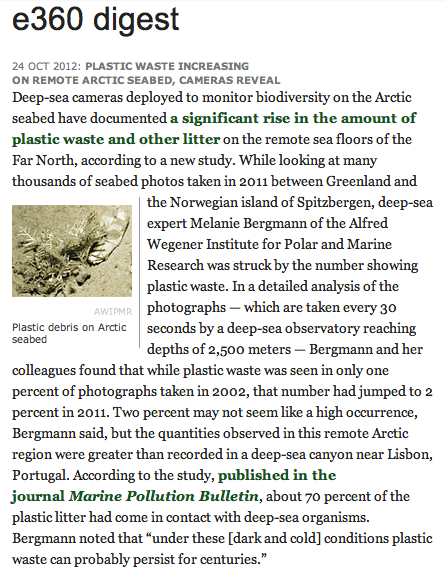
It’s late and I’m about to nod off, but a few headlines caught my eye. The first is on plastics and its growing ubiquitousness in the natural world. If you read an earlier post I did on this subject, then you’ll know that plastics may well be the one thing that will persist long after industrial civilization has passed into the ether of history. Plastics and nuclear waste will be the lasting reminders of carbon man. As the following article explains, this stuff is showing up in the dark, cold depths of the melting Arctic.
Click to go to original article…
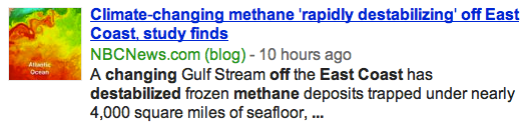
In other news, the ominous threat of a cataclysmic global release of methane from ocean floors is continuing to develop, increasing the possibility of runaway climate change…
A changing Gulf Stream off the East Coast has destabilized frozen methane deposits trapped under nearly 4,000 square miles of seafloor, scientists reported Wednesday. And since methane is even more potent than carbon dioxide as a global warming gas, the researchers said, any large-scale release could have significant climate impacts.
Using seismic records and ocean models, the team estimated that 2.5 gigatonnes of frozen methane hydrate are being destabilized and could separate into methane gas and water.
It is not clear if that is happening yet, but that methane gas would have the potential to rise up through the ocean and into the atmosphere, where it would add to the greenhouse gases warming Earth.
The 2.5 gigatonnes isn’t enough to trigger a sudden climate shift, but the team worries that other areas around the globe might be seeing a similar destabilization.
“It is unlikely that the western North Atlantic margin is the only area experiencing changing ocean currents,” they noted. “Our estimate … may therefore represent only a fraction of the methane hydrate currently destabilizing globally.”
The wider destabilization evidence, co-author Ben Phrampus told NBC News, includes data from the Arctic and Alaska’s northern slope in the Beaufort Sea.
And it’s not just under the seafloor that methane has been locked up. Some Arctic land area are seeing permafrost thaw, which could release methane stored there as well.
An expert who was not part of the study said it suggests that methane could become a bigger climate factor than carbon dioxide.
“We may approach a turning point” from a warming driven by man-made carbon dioxide to a warming driven by methane, Jurgen Mienert, the geology department chair at Norway’s University of Tromso, told NBC News.
“The interactions between the warming Arctic Ocean and the potentially huge methane-ice reservoirs beneath the Arctic Ocean floor point towards increasing instability,” he added.
OK that’s enough information to put me soundly to sleep. Wake me up when the ‘Methane Time Bomb’ nightmare is over. The pot starts to boil, but the frogs are still comfortable…
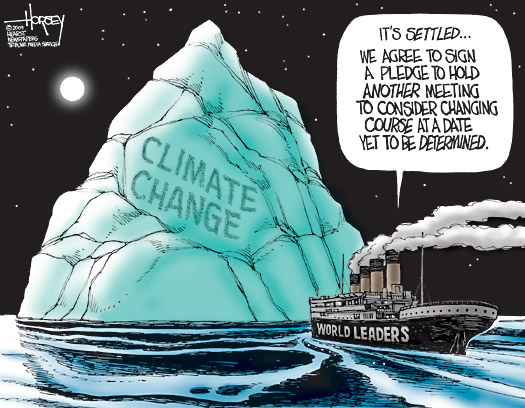
Below is an interesting video documenting the issue of climate change over the last 25 years amongst our ‘talking head’ politicians. It amounts to a lot of lip service while global fossil fuel usage escalates. Could it be that our present way of life just isn’t possible without carbon energy? Without some unforeseen breakthrough in energy and a way to pull CO2 out of the atmosphere, the answer is yes. Current alternative energy sources won’t fill the gap. Can we power down from the globalized industrial economic model to a more sustainable, smaller human-scale economy? Yes, but it would be radically different from what we have now and social power would have to decentralized into the hands of local communities. Even with an environmentally benign energy source, we would still be running into other planetary barriers with our infinite growth economic model.
The “C” Word: Climate Change Goes Missing From 2012 Election:
In this short video, science historian Naomi Oreskes gets at the heart of why we fear withdrawal from our carbon-based way of life.
The price of inaction is obviously too great to ignore – possible runaway climate change, mass starvation, and the collapse of modern civilization. Yet the inertia of the system, corporate dominance of the global economy, and the self-interests of our elite prevent the steps required to avert disaster.
Commodification, economic growth, financial abstractions, corporate power: aren’t these the processes driving the environmental crisis? Now we are told that to save the biosphere we need more of them. ~ George Monbiot
Certainly building personal resilience and preparedness may help you in the short-term, but what about your children and grandchildren? We are all at risk from a global ecological collapse, no matter how big your food vault or how robust your off-the-grid homestead. Getting involved with those who want to change the system is not a waste of time.
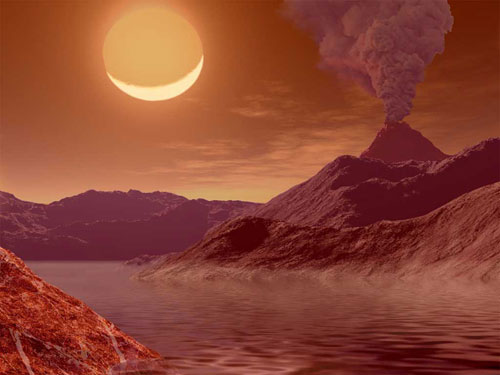
Having lived in the Mohave desert for about a decade, I had the dubious pleasure of enduring its scorching summer temperatures which can push 130° Fahrenheit. Without the usual creature comforts of modern industrial civilization like air conditioning, refrigerated foods and drinks, and piped-in water, life is such inhospitable places would be brutal if not impossible. What if such desert heat was the norm across the land surface of the planet? Then extreme places of desert heat like the Mohave desert would become dead zones for any living plant or animal we have known. Instead of peaking at around 130° F, it would reach unthinkable, Venus-like temps of greater than 200° F. Depending on the source you use, the average land surface temperature that we humans have enjoyed is 13° to 17° Celsius or 55.4° to 62.6° Fahrenheit. For the ocean surface, the average is about 17 °C (62.6 F). According to new research concerning the time of the Permian-Triassic Mass Extinction or ‘mother of all extinction events’, there occurred yet another mass extinction within that time span called the Smithian-Spathian extinction in which lethal global warming developed. The average land temperature in the tropics was an unimaginable 122-140°F (50-60°C)with average sea surface temperatures of 104°F (40°C). Such intolerable temperatures resulted in a massive ‘dead zone’ belt around the Earth:
Plant and animal life had it rough 250 million years ago. As if to add insult to injury, the end-Permian mass extinction was quickly followed by yet another mass extinction, what’s called the Smithian-Spathian extinction. New research suggests that the Earth got excruciatingly hot during this period, creating a veritable ‘dead zone’ in tropical areas, what forced the remaining animal life to head to the poles. And it lasted for nearly 5 million years.
According to research done by Yadong Sun and Paul Wignall of the University of Leeds, UK, this was hottest era on Earth since it cooled down from its initial molten formation. Their study has reset notions of just how hot our planet can get — a disturbing bit of insight that could reset current models of climate change on Earth.
The Smithian-Spathian extinction was time that characterized the shift from the Permian era to the Triassic, just before the emergence of the dinosaurs. By this point, the mysterious Permian Extinction had reduced the life on Earth to a select group of insects, plants, marine life (like fish, coral, sea lilies, and ichthyosaurs), and terrestrial animals (like insects and the reptilian tetrapod).
Sun and Wignall’s research indicates that during this time, the heat at the tropical regions reached an astounding 50 to 60°C (122°F to 140°F) on land, while the waters at the surface reached 40°C (104°F). They were surprised to discover that the water could get that hot; previous estimates assumed that sea-surface temperatures could not surpass 30°C (86°F). Moreover, at 40°C, most marine life dies and photosynthesis stops…
…What happened? Essentially, the superhot Earth was caused by a breakdown in global carbon cycling. Normally, plants help regulate temperature by absorbing CO2 and burning it as dead plant matter. But without plants, the CO2 levels rose unchecked, causing a spike in temperatures. Specifically, the researchers estimate that at least 12×103 gigatons of isotopically depleted carbon as methane was injected into the atmosphere…
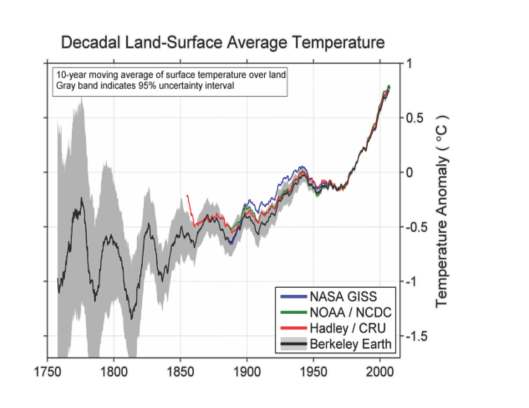
…My total turnaround, in such a short time, is the result of careful and objective analysis by the Berkeley Earth Surface Temperature project, which I founded with my daughter Elizabeth. Our results show that the average temperature of the earth’s land has risen by two and a half degrees Fahrenheit over the past 250 years, including an increase of one and a half degrees over the most recent 50 years. Moreover, it appears likely that essentially all of this increase results from the human emission of greenhouse gases.
These findings are stronger than those of the Intergovernmental Panel on Climate Change, the United Nations group that defines the scientific and diplomatic consensus on global warming…
Are we in the beginning phases of walking headlong into another mass extinction of our own creation, altering the chemistry of the oceans and atmosphere through the burning of fossil fuels? If you’ve been reading this blog, then you know about feedback loops and tipping points and their consequences if humans continue to force changes in the delicate ecosystems of this planet. Monthly reports from the NOAA are not very comforting:
…The average global temperature across land and ocean surfaces during September was 0.67°C (1.21°F) above the long-term 20th century average. This temperature ties with 2005 as the record warmest September in the 133-year period of record. The Northern Hemisphere tied with 2009 as second warmest on record, behind 2005. The Southern Hemisphere also ranked second warmest on record, behind 1997. It was also the highest departure from average for any month in the Southern Hemisphere since May 2010…
The difference between now and 250 million years ago is that profit-seeking corporations were not around to hoodwink the denizens of the planet into perpetuating their own extinction…
…despite its history and today’s unprecedented riches from science, the U.S. has begun to slip off of its science foundation. Indeed, in this election cycle, some 236 years after Jefferson penned the Declaration of Independence, several major party contenders for political office took positions that can only be described as “antiscience”: against evolution, human-induced climate change, vaccines, stem cell research, and more. A former Republican governor even warned that his own political party was in danger of becoming “the antiscience party.
Or the fact that the belief in an unfettered free market has become sacrosanct…
…In order to understand the fervor of this continued popular support for failed policies, it is important to grasp the utopian, quasi-theological nature of neoliberal ideology. In the neoliberal worldview, the self-regulating market is not a merely human construct, but a form of naturally-occurring “spontaneous order” that produces optimum outcomes and maximum individual freedom if left completely unfettered. (13) It is, as Karl Polanyi pointed out in “The Great Transformation,” a radically utopian vision that rests on a blind faith that markets are essentially part of the natural order. (14)
On the political right, this faith has reached its fullest expression, ultimately moving markets into the realm of the sacred, where their legitimacy cannot be questioned. In this utopian setting, regulation is not merely ill advised; it is a violation of natural law that is nearly sacrilegious…
We’re not wiser, just more manipulative and conniving…
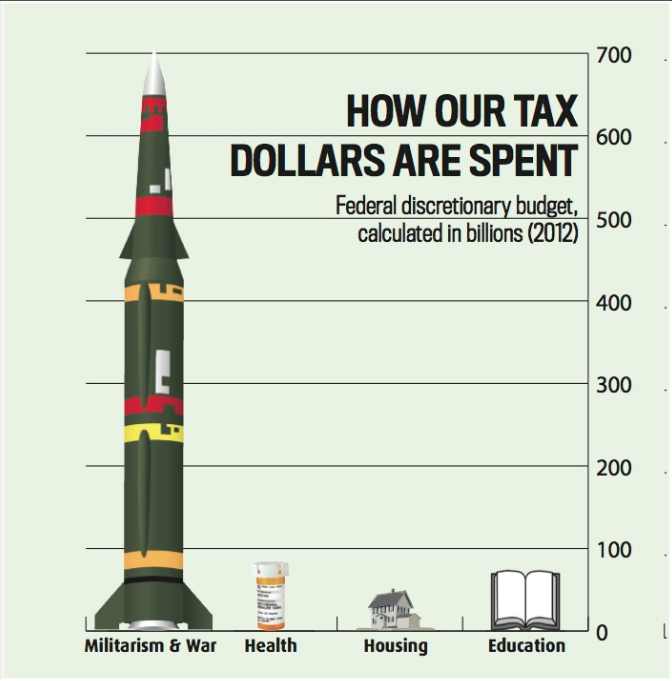
The U.S. military industrial complex is the single biggest leech upon society. Both parties unquestioningly support it. While many view a Romney in the White House would be like adding an accelerant to the flame of U.S. militarism, Obama has proven himself one of the most militarily aggressive American leaders in decades. The military industrial complex sucks up more than half of every tax dollar and enriches weapons manufacturers at the expense of this country’s citizens. If you look back in history and read some of the essays of William Blum, you’ll have all the proof you need that the capitalists of America are not a stabilizing force in the world, but a destabilizing one. As others have noted, empires collapse from within. While they continue expanding outward and investing in their reach of hegemony, the needs of the citizens back at home are overlooked and neglected. We have an empire at the expense of democracy:
…In the first minutes of the debate, Biden gloated about how the economic blockade of Iran orchestrated by Washington had devastated the Iranian economy and caused widespread suffering among the people. He boasted of the US role in aiding the Syrian forces seeking to overthrow the Assad regime. And he repeatedly defended the administration by declaring that it had the full support of the Pentagon brass—accepting Ryan’s premise that the generals should have veto power over foreign policy.
The questions offered by debate moderator Martha Raddatz—an ABC News foreign correspondent with close ties to the US military-intelligence apparatus—took as their point of departure the unchallengeable legitimacy of the operations of American imperialism abroad and the profit system at home.
Many of them touched on foreign and military policy, in every case tacitly assuming that the United States has the right to bomb, invade and conquer any country it chooses. The discussion between the candidates dealt with the expediency of such military actions, not whether they were legally or morally justifiable.
Similarly, the parts of the debate that touched on domestic policy—the economy, health care, taxes and social issues like abortion—took for granted the existing division of the wealth of society between the tiny minority that controls nearly all of it and the large majority who are struggling to survive.
In the entire 90 minutes, there was not a single question or answer about the conditions of life of the working class—about cuts in wages, pensions and other benefits; the growth of poverty, homelessness and hunger; the spreading plague of evictions and foreclosures; the deterioration of public services such as education; the collapse of the social infrastructure…
Do you see a problem with this picture of the U.S.?
Other threats loom larger than the boogeyman terrorist. While we create enemies to fight, real manmade dangers like global warming and climate change are growing, threatening to wipe all of humanity off the face of the Earth. Humans don’t have that much time left on this planet, so it would probably be a wise decision to ratchet back all the war mongering, move away from a war-based economy, and try another approach to how we interact with the rest of the world before it all ends in more and more resource wars and the plume of a mushroom cloud.
Iran appears to be next on our bombing agenda. If we had not covertly overthrown their democratically elected leader, Mohammad Mosaddegh, in 1953 because he wanted to nationalize their oil resources, could we have averted this impending war?…
Is it still possible to limit climate change to a 2 degree increase? If we don’t take into account the loss of sulfate parasols as a result of our emissions controls and if we close our eyes to the multiple feedback loops that have already been unleashed and which, in and of themselves, could dwarf anthropogenic emissions, then it might be possible in such a theoretical and hypothetical world.
(click to enlarge)
But a theoretical and hypothetical world and a world of brutal reality are two very different things. Humans must ultimately answer to brutal reality which discards all of the fabricated economic theorems and pie-in-the-sky myths about the techno-supremacy of modern man that we delude ourselves with. So the cold and hard reality is “No, we are well and truly fucked!” Despite decades of warnings by scientists, we have kept on burning fossil fuels and continue to do so as I write this post. As a matter of fact, growth in fossil fuel consumption is baked into our economic system as far into the future as we care to fantasize. We have backed ourselves into a corner where the only salvation left is some sort of globally coordinated Manhattan project of geo-engineering. And how likely is that to occur, let alone succeed? As David Roberts reports in his latest essay ‘Freaked-out climate scientists urge other freaked-out climate scientists to speak up, fight Man‘, our current enslavement to an infinite growth economic paradigm precludes such a possibility:
…Can we make the radical changes necessary to meet that challenge? No, say climate scientists Kevin Anderson and Alice Bows in a recent commentary in Nature Climate Change, not “within orthodox political and economic constraints.”
There is no political or economic constraint more orthodox than the primacy of economic growth. No solution to climate change that threatens economic growth can get any traction at all — even the most “alarmist” climate hawks fear to tread there. Which is too bad, Anderson and Bows say, because “climate change commitments are incompatible with short- to medium-term economic growth (in other words, for 10 to 20 years).” What’s worse, “work on adapting to climate change suggests that economic growth cannot be reconciled with the breadth and rate of impacts as the temperature rises towards 4 °C and beyond.” In other words: We either give up economic growth voluntarily for a little while or suffer a climate that will reverse economic growth long-term…
…Anderson and Bows stress that, “within orthodox political and economic constraints,” hitting such a target is wildly unlikely. Absent some pretty revolutionary political and economic changes, it won’t happen. For obvious reasons, scientists shy away from saying this kind of thing in public. They don’t want to depress people or come off as “political.” However, say Anderson and Bows, “away from the microphone and despite claims of ‘green growth’, few if any scientists working on climate change would disagree with the broad thrust of this candid conclusion.”…
The article goes on to explain how our scientific community is hamstrung and browbeaten into reciting and presenting only evidence without expounding upon and revealing what the consequences of those findings will be for humanity:
…scientists remain reticent, often assuming that “the most effective way of engaging is by presenting evidence, without daring to venture, at least explicitly, broader academic judgment.” This kind of just-the-facts reticence, Anderson and Bows say, is neither warranted nor wise given the urgency of current climate circumstances:
[W]e need to be less afraid of making academic judgments. Not unsubstantiated opinions and prejudice, but applying a mix of academic rigour, courage and humility to bring new and interdisciplinary insights into the emerging era. This would be controversial enough in itself. Various social and professional incentives work against academic researchers speaking out beyond their narrow specialties. And there is an entire cottage industry devoted to scolding climate scientists for going “beyond the science” to political analysis or policy advocacy. These latter sins, they are warned, threaten their status as “trusted brokers.” (Because the trusted-broker thing is working so well so far, climate-wise.)
What else can you do, though, when danger of such unthinkable scope and permanence is looming and humanity’s actions in the coming decade will determine the fate of future generations? I mean, it sounds like a sci-fi movie, but it’s real. What can you do if you’re one of the scientists who understands how dire the situation is? These are not ordinary times.
And in conclusion, the article talks of something I have posted about here – the failure and inability of the free market to solve this civilization-ending problem of climate change:
Anyway, as controversial as it is to ask climate researchers to venture broad social and economic judgments, the specific critique that Anderson and Bows offer is even more likely to make some of their straight-laced colleagues wince. It has to do with the “catastrophic and ongoing failure of market economics and the laissez-faire rhetoric accompanying it.” Specifically, market economists (and the politicians and scientists in thrall to them) suffer the “misguided belief that commitments to avoid warming of 2°C can still be realized with incremental adjustments to economic incentives.” They urge their colleagues:
Leave the market economists to fight among themselves over the right price of carbon — let them relive their groundhog day if they wish. The world is moving on and we need to have the audacity to think differently and conceive of alternative futures.
One of the objectives of this blog was to speak truth to power and reveal where the human race is headed. Now that we know our final outcome, our predicament is analogous to being diagnosed with terminal cancer. You people reading this post are an infinitesimal percentage of the global population who are privileged, or perhaps cursed, to be in possession of such depressing knowledge. Where do we go from here? What do we do? How do we live our lives knowing what we know of the dismal future of the world’s youth? The entire edifice of human civilization will become a worldwide ghost city before this century ends. Perhaps the only thing left to do is live each day as if it were our last because there really is no future without some miraculous, radical, and global social change accompanied by unprecedented global cooperation. Those in charge of such matters have chosen temporary preservation of the current system over the long-term survival of our species. Evil and suicidal or foolish and ill-informed… Which is it that best describes the self-destructive choices that have been made?
A truly frightening time-lapse visualization by the NOAA of the Arctic Ice Melt:
Julian Cribb, the science writer who gained some notoriety with his letter to the journal Nature urging a rename of the not-so-wise Homo sapiens, has written a recent essay entitled ‘March of the Dead Zones‘. Are we quickly cooking the oceans into a state of mass extinction as has happened in Earth’s ancient past?
…The cause of Dead Zones is well understood: they are driven by the avalanche of nutrients which humanity dumps in the oceans – from agriculture, sewage, leaky landfills, urban stormwater, soil erosion, industrial and vehicle emissions. This rich nutrient soup provides the food source for vast blooms of algae – and as these die off they sink to the sea floor and decompose causing blooms of bacteria which strip the essential oxygen from the water column, often resulting in fish kills – their most visible impact. They are also hastened by global warming, which stratifies the water, trapping the stagnant water and preventing it from mixing with the oxygen-rich surface layer.
What many people do not realise is that some of the worst extinctions in the history of life on Earth occurred because of a process very similar to this. In the biggest of the lot, the Great Death of the Permian around 252m years ago, an estimated 95 per cent of marine species were wiped out – rugose corals, nautiloids, armoured fish, trilobites – never to be seen again.
What triggered it is still a scientific mystery – an outbreak of volcanism, striking asteroids, a giant solar storm, colossal seabed methane eruptions: who knows? – but the geological evidence points to a massive global spike in CO2 levels, accompanied by rapid planetary warming, huge outbreaks of anoxia (loss of oxygen from seawater) and the destruction of marine habitats. One thing is fairly clear – by the end of it all fungi and moulds were rulers of the Earth, feasting on the dead.
The multiplying Dead Zones in the world’s oceans today not only resemble the Permian event on a local scale in terms of what drove them – but have two additional drivers: overfishing and pollution from the 83,000 chemicals which humans manufacture on the land and then carelessly liberate into the global environment.
The biggest contributors of all are the 110 million tonnes of nitrogen, 9 million tonnes of phosphorus and other nutrients which we unleash into the planetary ecosystem every year as we try to feed ourselves. That is off-the-scale compared with what the pre-human Earth circulated naturally.
The really unsettling fact is that, if we continue to depend upon agriculture for our food supply, then humanity’s dependence on artificial fertilisers is likely to double by the 2060s – and so will our indiscriminate release of nutrients into the world’s rivers, lakes and oceans. That release, in turn, will spawn more and larger Dead Zones – like that affecting 22,000 square kilometres of sea at the mouth of America’s Mississippi river…
Below is a screen shot of a project called the Interactive Map of Eutrophication & Hypoxia (low-oxygen dead zones) which have spread to nearly 500 sites, all in places where there is significant human development along the oceans and seas of the world.
A study from late last year, indicates that the latest warming of the planet will be catastrophic to the Earth’s aquatic life, turning much of the oceans and seas into oxygen-depleted ‘dead zones’:
…Their study, published in Nature Geoscience, showed that the average global temperature rise of around at least two degrees Celsius between the peak and the end of the last Ice Age (between about 10,000-20,000 years ago) had a massive effect on the oxygen content of seawater.
“The warmer the global average temperature, the more extended the oxygen minimum zones are, so the volume of these oxygen-poor water bodies is more extended during warm periods than in cold periods,” Jaccard said.
What is worrying is that, currently, global average temperature is predicted to rise by at least two degrees in the coming century due to climate change. This is of a similar magnitude to the warming the planet has undergone since the last Ice Age 20,000 years ago.
“So we would assume that if, indeed, temperatures are increasing in the next 100 years, these oxygen minimum zones would also increase in volume and that the general oxygen concentration of the ocean will decrease,” Jaccard said.
And what is more: “our analysis has shown that not only was absolute temperature important, but also the rate of change, so the faster the warming, the more expanded these zones are…
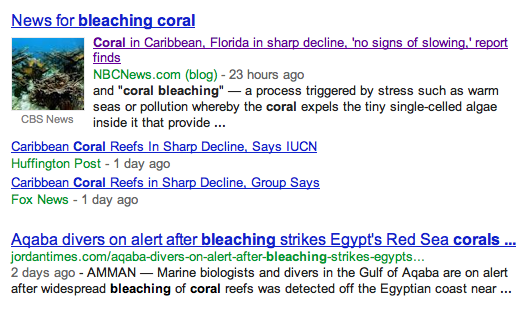
Along with the rest of the planet, our oceans have indeed been heating up. Here’s a quick screen shot I just did to show you a mere sliver of the destruction these rising temperatures are bringing:
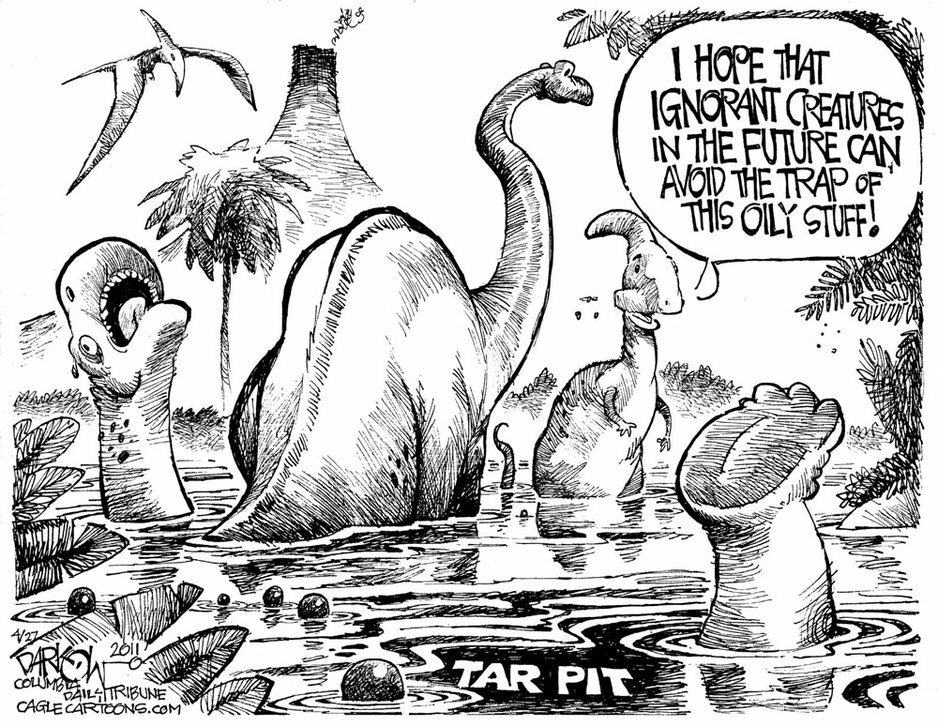
A study to be published Sept. 15 issue in the journal Palaeogeography, Palaeoclimatology, Palaeoecology indicates that the demise of the dinosaurs was preceded by the death of ocean life via greenhouse gases that warmed the oceans. This sounds eerily similar to what we are doing to ourselves with the burning of fossil fuels. In place of CO2-spewing volcanic eruptions, we have millions of cars, planes, factories, coal-fired energy plants and an endless list of other fossil-fuel burning machinery doing the same:
The demise of the dinosaurs, thought to have been caused by an asteroid, wasn’t the only mass extinction around that time, according to new international research.
Evidence suggests that many species of ocean organisms were killed by volcanic eruptions before the asteroid impact. The eruptions took place in India, filling the atmosphere with greenhouse gases that warmed the globe and caused seafloor life to die.
“The eruptions started 300,000 to 200,000 years before the impact, and they may have lasted 100,000 years,” said study lead author Thomas Tobin at the University of Washington in a press release.
The scientists discovered this earlier extinction when they studied fossils from Seymour Island near Antarctica. The island has an unusually thick bed of sediment, where more sediment than normal accumulated in each time period.
This allowed the researchers to date fossils more precisely and create a detailed timeline. They used the prehistoric changes in Earth’s magnetic field to date each fossil sample.
“I think the evidence we have from this location is indicative of two separate events, and also indicates that warming took place,” said Tobin.
“It seems improbable to me that they are completely independent events.”
The first extinction event may have seriously affected some species, making them unable to survive the second extinction, although there’s no evidence for this yet….
Since the Earth’s oceans constitute 90% of the biosphere, a significant percentage of the planet’s total biomass is marine microorganisms, producing more than half of the entire global oxygen supply and serving as a vast sink for much of human-generated CO2. If we destroy the oceans, we will exterminate ourselves. The Earth will not bat an eye. No God will appear to prevent it. No technological solution will arrive to fix it. And no amount of empty platitudes and wishful thinking will mend it. The inexorable process of time and evolution will march on, creating other life forms to fill our vacancy. Humanity had its chance and blew it.
Don’t you think it’s kind of ironic that humans will become extinct from the burning of the very substance that enabled the ascent of the technological age and modern man’s ability to live in electrified and modernized comfort? Our fossil fuel slaves will have become our executioners. I recall hearing some indigenous South American tribesman saying that the people of industrial civilization are just children playing with deadly machines. They know not what grief they have brought unto themselves by raping the Earth of her treasures.
“We are now appearing to wage war on life in the sea with sonars, spotter aircraft, advanced communications, factory trawlers, thousands of miles of long lines, and global marketing of creatures no one had heard of until recent years. Nothing has prepared sharks, squid, krill and other sea creatures for industrial-scale extraction that destroys entire ecosystems while targeting a few species…
The concern is not loss of fish for people to eat. Rather, the greatest concern about destructive fishing activities of the past century, especially the past several decades, is the dismemberment of the fine-tuned ocean ecosystems that are, in effect, our life-support system.
Photosynthetic organisms in the sea yield most of the oxygen in the atmosphere, take up and store vast amounts of carbon dioxide, shape planetary chemistry, and hold the planet steady.
The ocean is a living system that makes our lives possible. Even if you never see the ocean, your life depends on its existence. With every breath you take, every drop of water you drink, you are connected to the sea…” ~ Sylvia Earle
In a previous post entitled ‘Free Market Blinders and the Coercion of Industrial-Corporate Capitalism‘, I posted arguments on why the free market ends up being anything but free. In the pursuit of profit, the shortest path taken includes usurping the instruments of the state. It also means all problems are forced into the ‘free market’ box and what comes out are phony solutions that only serve capitalism such as the scheme of carbon trading which has been described as “halfway between fantasy and fraud.”
Due to the lag time of its effects, climate change is a problem that the ‘free market’ cannot fix:
…This is the sort of problem that democracies and free markets are mostly incapable of solving. Politicians who have to come up for reelection every two to four years aren’t good at annoying business interests in order to solve problems that won’t even show up in a significant way for the rest of their lifetimes.
And even in its most ideal form, the logic of “free market solutions” is predicated on companies getting punished by angry consumers if they don’t do the right thing. There are all sorts of things wrong with this approach, of course: if a bunch of people die due to food poisoning, it’s not as if it’s always easy to identify where in the production chain the problem occurred, or which corporations to punish by not buying their product (not to mention the obvious fact that the deaths should have been stopped by regulation and oversight in the first place.) But in its most simplistic form it might work if the impact of corporate malfeasance is immediate.
But how does a “free market solution” work when it comes to carbon emissions? Whom do consumers punish? Whom do consumers reward? On what timescale? By the time the problem is advanced enough to penetrate consumer consciousness, it will have been far, far too late for the market to change organically.
And that’s, as I’ve said before, why climate change is such a threat to the conservative enterprise. It’s not just that big energy interests would be impacted. It’s that the entire conservative model of problem solving would be rendered obsolete if the realities of climate change were accepted in our public discourse.
So absent some sort of organizational metamorphosis for human societies, business interests will continue to divide nation states against one another as politicians in the major industrialized democracies dawdle and pretend the problem will go away.
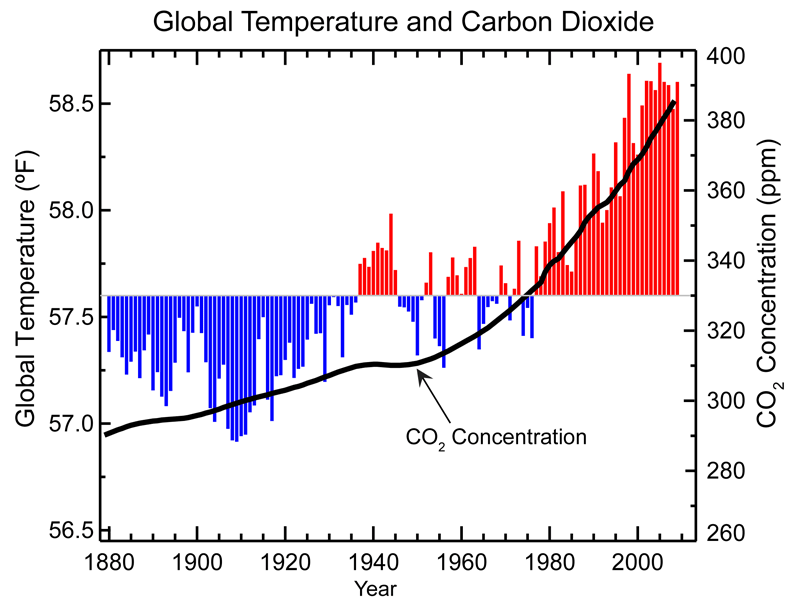
CO2 levels continue to rise despite the sham carbon trading scheme (NOAA):
As you can see from the following video, the warming effects of the CO2 we have been pumping into the atmosphere over the last 130 years are becoming much more pronounced (this video is from NASA and only goes up to 2011).
In regards to the future stability of the human race, consider the conclusions from top climate scientists in a recent article of the highly regarded journal Nature:
The mean global temperature by 2070 (or a few decades earlier) will be higher than it ever has since the human species evolved.” [Human-induced climate change creates] “the potential to transform Earth rapidly and irreversibly into a state unknown in human experience.” “The net effect is that once a critical transition occurs, it is extremely difficult or even impossible for the system to return to its previous state.”
You see, the problem is that we are bringing on these changes to the climate and environment so rapidly that we, along with many other species, will NOT be able to adapt in time. Certainly our food supply will be in grave danger as weather patterns shift and droughts become more intense. The vast and expensive infrastructure we built to take advantage of the stable climate that we enjoyed in the past will no longer apply. Imagine a game of musical chairs with the entire global population scrambling for the last remaining seat. That’s the future in which a chaotic climate makes the access to dwindling resources even more tenuous. Arguing over cause and effect as we all go over the cliff is not an option, but that is the avenue we are taking.
There is unequivocal evidence that Earth’s lower atmosphere, ocean, and land surface are warming; sea level is rising; and snow cover, mountain glaciers, and Arctic sea ice are shrinking. The dominant cause of the warming since the 1950s is human activities. This scientific finding is based on a large and persuasive body of research. The observed warming will be irreversible for many years into the future, and even larger temperature increases will occur as greenhouse gases continue to accumulate in the atmosphere. Avoiding this future warming will require a large and rapid reduction in global greenhouse gas emissions.
The results of industrial civilization’s binge on fossil fuels are happening in full Technicolor right before our eyes:
This NASA map, based on satellite data, shows the new record-low summer sea ice extent of 1.58 million square miles in the Arctic Ocean, as recorded on August 26. The amount of sea ice covering the Arctic Ocean at the end of summer is now 45 percent lower than the average from 1979 to 2000. The black dot represents the region surrounding the North Pole. (NASA) – link
This graph, prepared by the University of Washington’s Pan Arctic Ice Ocean Model Assimilation System (PIOMAS) shows the precipitous drop in the volume of summer sea ice in the Arctic Ocean. Since this graph was prepared, PIOMAS estimates that the volume of sea ice in the Arctic has fallen farther, to 3,500 cubic kilometers — a decline of 72 percent compared to the average from 1979 to 2010. (Polar Science Center/Applied Physics Laboratory/University of Washington) – link
Looking around at those… around me – family, friends, acquaintances and random faces in the crowd of apathy – the level of complacency is so concentrated I can taste it, yet I can’t even describe how bad it tastes. I’m not really talking about the understanding people lack about the numerous predicaments we face as a species – that’s definitely there too… but what I’m talking about is even worse. It’s the assumption that we can just go about our day to day lives, doing our day to day work, having our day to day fun… and humanity will eventually heal itself, no matter how bad the injuries sustained.
This is a cultural phenomenon that has infested the Western world, and refuses to be eradicated. It is where many of us ultimately place our hope and stake our lives, sometimes without even realizing we are doing it. We previously discussed the entertainment enemas that have penetrated modern culture (and the lives of deluded teenagers) in Culturally Programmed Myths of Omnipotence. They have given us the vision that we can always become bigger, “better” and stronger as individuals and nations, evolving towards God-like glory, no matter what obstacles are in our way – all of the stories about superheroes, vampires, werewolves, wizards, robots and aliens – it’s all about the propaganda of pernicious power.
We even see this mentality taking root in academia and scientific research through the field of “transhumanism” (very well portrayed in the documentary, TechnoCalyps). As you can probably guess from the name, transhumanism tells us that we are on the way to becoming something more, something other, than human beings. Forget random mutation and natural selection, the transhumanist says – we can circumvent all of the slow evolutionary nonsense that we only theorized about a century ago. Now we can transform ourselves into a new species over the course of a few decades with the help of modern technology and “intelligent designers”. Just a little bit ironic, don’t you think?…
Surfing the net last night, I see Guy McPherson is trying to pierce the self-delusional bubble described above, but to no avail…
Climate Change is apparently too abstract for the human race at large to wrap their heads around.
“You almost couldn’t design a problem that is a worse fit with our underlying psychology,” says Anthony Leiserowitz, director of the Yale Project on Climate Change Communication.
And so our fate appears to be sealed as long as Humans continue to behave as the punch-drunk creatures they have been since the onset of the Industrial Age and the discovery of fossil fuels, the addiction to which there is no cure. This beast will go down violently. We’re Dodo birds with nukes.
“Environmental degradation proceeds apace as we gleefully trade in living soil for smart phones, clean air for fast computers, potable water for high-definition televisions, healthy food for industrial poison, contentment for exhilaration, decent human communities for hierarchical death camps, and life for death. All the while, we take truth-tellers to task while looking to corrupt governments for leadership. Truth is treason in an empire of lies, so we don’t protest governments that spy on their citizens and then kill them.” ~ Guy McPherson
“…people today have no better grasp of the consequences of their actions than superstitious and unscientific people centuries ago. Modern technological man is just as easily bamboozled by propaganda as ancient man was by superstition and ignorance.” ~ Dr. Paul Craig Roberts
“Evolutionary deadends are much more common in the tree of life than many people realize. Extinction is the most general rule of the game.” ~ George Mobus





 Nature




 Collapse of Industrial Civilization