I think we can safely shorten that time span to no more than 50 years. Right now I’m with my family, so postings will be light to nonexistent until the beginning of October when I will essentially be in seclusion once again to read more often and study the state of the world. As I write this post, one particular story that stands out is the discovery by Russian scientists of ‘methane fields’ exceeding 1 kilometre escaping from the Laptev Sea, as elaborated upon by Arctic News. In the views of these scientists, methane plumes like the ones they are observing could be catastrophic to this planet’s climate. Other than some obscure website, is anyone talking about the destruction to our food supply that climate change will surely bring about? Make no mistake, this is real news as opposed to the MSM’s three-ring political circus or the perverse reporting of decadent Hollywood parties to toast the christening of a new luxury jaguar car.
Many scientists are saying that the only thing that will save us is global coordinated action and a Manhatten project of geoengineering to halt any further damage from our CO2 emissions and its catastrophic impact on the environment. Others have lamented the total failure of governments to look after the well-being of their people:
Fossil fuel companies are still making profits despite the fact that climate change is so clearly upon us. Our politicians are putting corporate interests above scientific warnings and failing in their duties to the public.”
– link
The Arab Spring and Occupy Wall Street were initially grassroots movements which evolved as a response to the gross social inequalities of neoliberal capitalism. Washington inadvertently created both movements through their push of the aforementioned economic policies which have made a few extremely wealthy at the expense of those country’s populations. In the near future, the issue of corporate profits over the environment will become a driving force for future social unrest and revolt.
In the end, our ill-conceived exchange of fossil fuels for a stable biosphere will be worse than a zero-sum game when you take into account the hell that climate change will wreak. On our present course, we will be left with an uninhabitable planet. We have only seen the beginning inklings of what human-induced disasters such as drought, ocean acidification, deforestation, and mass species extinction will mean to industrial civilization which has become completely delusional about its “victory” over nature:
Let us not, however, flatter ourselves overmuch on account of our human victories over nature. For each such victory nature takes its revenge on us. Each victory, it is true, in the first place brings about the results we expected, but in the second and third places it has quite different, unforeseen effects which only too often cancel the first. The people who, in Mesopotamia, Greece, Asia Minor and elsewhere, destroyed the forests to obtain cultivable land, never dreamed that by removing along with the forests the collecting centres and reservoirs of moisture they were laying the basis for the present forlorn state of those countries. When the Italians of the Alps used up the pine forests on the southern slopes, so carefully cherished on the northern slopes, they had no inkling that by doing so they were cutting at the roots of the dairy industry in their region; they had still less inkling that they were thereby depriving their mountain springs of water for the greater part of the year, and making it possible for them to pour still more furious torrents on the plains during the rainy seasons. Those who spread the potato in Europe were not aware that with these farinaceous tubers they were at the same time spreading scrofula. Thus at every step we are reminded that we by no means rule over nature like a conqueror over a foreign people, like someone standing outside nature — but that we, with flesh, blood and brain, belong to nature, and exist in its midst, and that all our mastery of it consists in the fact that we have the advantage over all other creatures of being able to learn its laws and apply them correctly.” ~ Frederick Engels
The Earth giveth and she taketh away. Short-sightedness, greed, and conceit are traits undeserving of long-term survival on this once generous but now scorned planet.
Speaking on climate change in the video above is Sir Robert Watson, retiring chief scientist at Britian’s Department for Environment Food and Rural Affairs. He is warning that governments cannot afford to do nothing about greenhouse gas emissions, irrespective of the current state of the economy. He says the hope of restricting the average global temperature rise to 2C is “out the window”.
If we continue the way we are, we’ve got a 50-50 shot of a 3 degree [Celcius] world – and I would not rule out a 5 degree [Celcius] world.
~ Dr Bob Watson
Hell on Earth is coming to a reality near you:
Here’s the edition of the Royal Society journal that came out of the conference on 4 degrees C of warming. Read through it and see if you think “hell on earth” is an exaggeration. Desertification, water shortages, agricultural disruptions, rising sea levels, vanishing coral, tropical forest die-offs, mass species extinctions, oh my. Kevin Anderson, one of the lead scientists involved, was moved to say that “a 4 degrees C future is incompatible with an organized global community, is likely to be beyond ‘adaptation’, is devastating to the majority of ecosystems, and has a high probability of not being stable.” ~ Grist
The findings point to a link between rapid sea ice loss and enhanced rate of climate warming, which could penetrate as far as 900 miles inland. In areas where permafrost is already at risk, such as central Alaska, the study suggests that periods of abrupt sea ice loss can lead to rapid soil thaw.
Thawing permafrost may have a range of impacts, including buckled highways and destabilized houses, as well as changes to the delicate balance of life in the Arctic. In addition, scientists estimate that Arctic soils hold at least 30 percent of all the carbon stored in soils worldwide. While scientists are uncertain what will happen if this permafrost thaws, it has the potential to contribute substantial amounts of greenhouse gases to the atmosphere.
Arid regions will become much more dry, and wet regions will experience much more rain due to the warming planet, according to scientists:
A paper in Science today finds rapidly changing ocean salinities as a result of a warming atmosphere have intensified the global water cycle (evaporation and precipitation) by an incredible 4 percent between 1950 and 2000. That’s twice the rate predicted by models.
These same models have long forecast that dry areas of Earth will become drier and wet areas wetter in a warming climate—an intensification of the water cycle driven mostly by the capacity of warmer air to hold and redistribute more moisture in the form of water vapor…
…But the rate of intensification of the global water cycle is happening far faster than imagined: at about 8 percent per degree Celsius of ocean warming since 1950.
At this rate, the authors calculate:
The global water cycle will intensify by a whopping 16 percent in a 2°C warmer world
The global water cycle will intensify by a frightening 24 percent in a 3°C warmer world
…The changes will not be uniform across the globe, but trend toward increased drying of arid areas and increased flooding of wet areas.
And the resulting changes in freshwater availability are likely to be far more destabilizing to human societies and ecosystems than warming alone.
“Changes to the global water cycle and the corresponding redistribution of rainfall will affect food availability, stability, access, and utilization,” says lead author Paul Durack at the University of Tasmania and the Lawrence Livermore National Laboratory.
When dealing with a crisis that threatens the very existence of the human species, a rational society would not put the issues of cost-effectiveness and inconveniences to the economy above all else as the deciding factors for taking action. But that is what we are doing, allowing the “ALMIGHTY MARKET” to decide our fate. As explained in another post, this deference to “THE MARKET” to solve such a seemingly abstract problem like climate change is essentially condemning our children to a horrible fate. Climate change is not going to respect or accommodate ‘THE MARKET’, our lifestyle, and mankind’s hubris; it will just wipe us right off the face of the Earth like the pesky and bothersome vermin we have become.
You only have to look at the following graph(click to enlarge) from the BP Statistical Review of World Energy 2012 to understand how much industrial civilization is locked in to fossil fuels. Do you see that thin dark orange line just below the grey band representing coal? Yeah, that’s renewables.
We are so overly dependent on the high energy density of fossil fuels that the system resists change, with those in charge of it even spending large sums of money to alter public perception on the pernicious effects of burning these CO2-emitting energy sources. The advantages of hydrocarbons, summarized by Tom Murphy, have lured us into drinking an addictive and poisonous elixir:
Fossil fuels are cheap and reliable and are their own storage and allow transportation by car, truck, ship, airplane, and fit seamlessly into our current infrastructure.
Reasons for why carbon emissions will continue their upward trend are described in this article:
• About 80% of the power stations likely to be in use in 2020 are either already built or under construction, the IEA found. Most of these are fossil fuel power stations unlikely to be taken out of service early, so they will continue to pour out carbon – possibly into the mid-century. The emissions from these stations amount to about 11.2Gt, out of a total of 13.7Gt from the electricity sector. These “locked-in” emissions mean savings must be found elsewhere.
“It means the room for manoeuvre is shrinking,” warned Birol.
• Another factor that suggests emissions will continue their climb is the crisis in the nuclear power industry. Following the tsunami damage at Fukushima, Japan and Germany have called a halt to their reactor programmes, and other countries are reconsidering nuclear power.
“People may not like nuclear, but it is one of the major technologies for generating electricity without carbon dioxide,” said Birol. The gap left by scaling back the world’s nuclear ambitions is unlikely to be filled entirely by renewable energy, meaning an increased reliance on fossil fuels.
• Added to that, the United Nations-led negotiations on a new global treaty on climate change have stalled. “The significance of climate change in international policy debates is much less pronounced than it was a few years ago,” said Birol…
…Sir David King, former chief scientific adviser to the UK government, said the global emissions figures showed that the link between rising GDP and rising emissions had not been broken. “The only people who will be surprised by this are people who have not been reading the situation properly,” he said.
In 2009 China consumed 96.9 quads. In 2012 their total is estimated to reach 110.7. That’s a compound annual growth rate of 4.54%. That’s twice as fast as the DOE has predicted going forward.
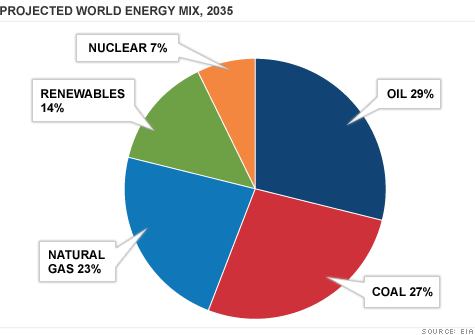
I’ll remind readers that my estimate for energy consumption in 2035 for China is 247 quads–more than twice what the DOE estimates. Recent growth supports my higher estimates.
Even if China succeeds in building the 150 nuclear plants they aspire to over the next 50 years, they will still be burning more coal in 2035 than the entire world burns now.
The Chinese economy, as I predicted, will start to struggle and even sputter at times between now and then. But if the history of other developing countries is any example, that won’t affect energy consumption nearly as much as one might think. In the United States, that Great Depression? Didn’t affect our energy consumption curve. – link
Lastly, how are we doing on transitioning away from our greenhouse gas emitting, industrial agriculture model of food production? As Stuart Staniford conjectured in his essay ‘Fallacy of Reversibility‘, industrial agriculture has become even more dominant in the age of peak oil, but with adverse effects to the environment:
…The farm bill is not only the centerpiece of United States food and agriculture policy, it is also a de facto climate bill. And in this respect, both the Senate and House versions of the legislation are a disaster waiting to happen…
…The proposed farm bill — Senate- or House-style, take your pick — would make American agriculture’s climate problem worse, in two ways. Not only would the bill accelerate global warming by encouraging more greenhouse gas emissions, it would make the nation’s farms more vulnerable to the impacts of those emissions…
…Except in a technical aside, neither the bill passed by the Senate or by the House Committee on Agriculture even mentions climate change.
Coal and cars are blamed, but agriculture is also a major contributor to global warming: by some estimates, it accounts for roughly a third of emissions globally. The industrialized, meat-heavy food system of the United States takes a heavy toll on the atmosphere; it takes an enormous amount of fossil fuel to run farm equipment and harvest the mountains of corn that fatten livestock. And most fertilizers contain nitrous oxide, a greenhouse gas 298 times more potent than carbon dioxide over a century.
Both of the farm bill proposals would maintain agriculture’s large climate footprint, mainly by continuing to skew subsidies toward a mere handful of commodity crops. The “big five” — wheat, rice, soybeans, cotton and above all corn — have received 84 percent of subsidies since 2004, according to the Environmental Working Group, an advocacy group critical of the practice. Subsidies increase with output, encouraging farmers to run highly mechanized operations that plant “fence row to fence row” and apply oceans of fertilizer and pesticide, all of which boost emissions.
But industrial agriculture’s ability to produce gargantuan amounts of food also makes it exceptionally susceptible to climate change. Relying on vast monocultures — the miles and miles of cornfields one passes when driving in Iowa — captures economies of scale. But that lack of diversity invites trouble. A monoculture’s uniformity means that if temperatures spike or a new pest arrives, the damage is likely to spread throughout the entire planted area. By contrast, the diversified landscapes of organic agriculture — corn planted between, say, other vegetables and chicken pens — tend to limit damage.
Farmers can best boost resilience to climate change, scientists say, by improving their soil’s fertility and capacity to retain moisture. That means cutting back on chemical fertilizers, which kill many of the microorganisms that ventilate soil, and shifting to compost and manure fertilizers and crop rotations.
Instead, leading lobbyists for agribusiness want to retain the current production system but shift the mounting climate risks to the taxpayer. Both versions of the farm bill would expand the $11 billion crop insurance program, a move championed by the National Corn Growers Association. The Senate bill, for instance, would authorize $3.8 billion a year for additional insurance.
But neither version would require farmers to take other measures to reduce their climate vulnerability, like investing in healthier soil. In fact, the draft bills would actually make it harder for farmers to do that because the expanded crop insurance would be paid for by cutting the Conservation Stewardship Program, which helps farmers improve their land’s ecological health…
So it looks like we are going balls out in our race toward oblivion. A technologically advanced civilization, once known for sending spacecrafts to distant planets, looks to be headed toward a bleak existence of huddling in subterranean caves and scavenging for insects to eat.
First off, I need to make it clear that I do not subscribe to the bizarre conspiracy theories about planned detonations of the twin towers. Did top government officials know something was afoot? Yes, there were ample detailed warnings concerning an impending attack. As the above news story from the NYT describes, intelligence officials were so convinced that an attack was imminent that they wanted to quit their jobs to avoid being blamed for what was coming. What ensued afterward is best described as taking advantage of a crisis or “not letting a good crisis go to waste.” Iraq’s oil resources were already on the minds of the neocons and the oil corporations; a spectacular terrorist attack on America would be the perfect event by which the Western elite could demonize all of the Middle East in order to make one last run on what was left of the world’s depleting hydrocarbons. When the lifeblood of your economy is running out, more extreme and radical options get thrown onto the table. And so the media whipped up the nationalist fervor of the country and false claims of Al Qaeda ties with Iraq and WMD’s were spun into the national consciousness. Much blood and treasure were spent; the coffers of the Arms Dealers swelled; a security and surveillance state blossomed to tamp down domestic social unrest; and a new enemy was born to take the place of disaster capitalism’s old nemesis of communism. The financial elite and the neocons, the American war machine, and Big Oil gloated over their Machiavellian maneuvers. But blowback is always the counterweight to the perceived success of such unscrupulous deeds. What’s in the news today:
Making the world safe for capitalism and empire definitely has its drawbacks, don’t you think? When you support oppressive tyrants, throwing them under the bus when their usefulness has expired, fund and arm radical Islamist rebels, and only give lip service to democracy, reality has a way of raising its ugly head in the end.
The following interview from yesterday dovetails with the above commentary on 9-11 and foresees the future. Eventually, unfettered capitalism consumes entire planets when left to its own devices:
CHRIS HEDGES: Yes, because it was an understanding that unfettered, unregulated, unchecked, unimpeded corporate capitalism knows only one word, and that’s “more.” They commodify everything. Human beings are commodities, the natural world is a commodity, that they exploit until exhaustion or collapse. And we see that with the melting of the summer Arctic ice, 40 percent gone. What is the response of our corporate overlords? It’s to raid those waters for the last fish stocks, mineral, oil, natural gas. It makes Herman Melville’s Moby Dick the most prescient book in American literature. It’s utterly suicidal. These are all Ahabs. There’s a quote. I think Ahab says, you know, “My means and my methods are sane. My object is mad.” It’s utter insanity. And if we do not wrest power back from these corporate forces, if we do not reverse this corporate coup d’état, they will quite literally kill off the ecosystem on which the human species depends for life and force all of us in this downward race to the bottom, so that the conditions of workers in Immokalee, Florida, begin to replicate the conditions of workers everywhere.
We’re caught in capitalism’s feedback loop of self-destruction. The corporate state will make everything cower before the altar of “The Market”. Unfortunately, the ecosystems of the planet will have the final say on such demands.
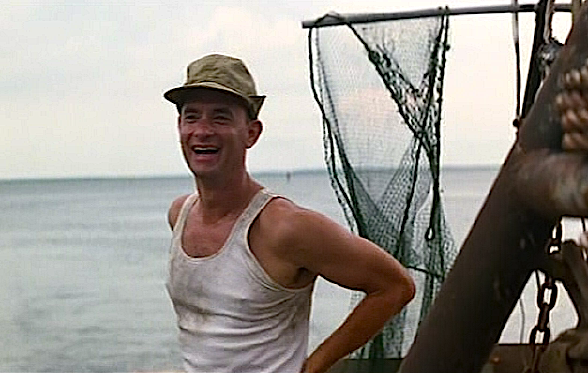
I believe Forrest Gump would have had a better understanding of climate change than the average American today. But if Forrest was still operating the Bubba Gump shrimp company after the Gulf Oil Spill, he would have proclaimed, “Ha! Shrimp with no eyes are easier ta catch!”
…I live in an area where virtually everyone is convinced global warming is a hoax. It drives me crazy…
I must admit that I am in the same boat, surrounded by idiots. I tried to have a conversation with a physician I work with about climate change, and he trotted out the same old arguments about planet Mars warming, prior predictions of ‘Global Cooling’, and that it was warm during the age of dinosaurs and they didn’t drive cars. For those interested, here is a link listing the most popular climate change denier arguments with the appropriate response by scientists. In a recent poll, the importance of climate change was shown to have receded in the American public’s mind:
Climate change no longer ranks first on the list of what Americans see as the world’s biggest environmental problem, according to a new Washington Post-Stanford University poll.
Just 18 percent of those polled name it as their top environmental concern. That compares with 33 percent who said so in 2007, amid publicity about a major U.N. climate report and Al Gore’s Oscar-winning documentary about global warming. Today, 27 percent identify water and air pollution as the world’s most pressing environmental issue.
Still, Americans continue to see climate change as a threat, caused in part by human activity, and they think government and businesses should do more to address it. Nearly three-quarters say the Earth is warming, and just as many say they believe that temperatures will continue to rise if nothing is done, according to the poll.
The findings, along with follow-up interviews with some respondents, indicate that Washington’s decision to shelve climate policy means that the issue has receded — even though many people link recent dramatic weather events to global warming. And they may help explain why elected officials feel little pressure to impose curbs on greenhouse gas emissions…
…“There’s really no movement in recent years in support for the amount of government effort they want to see put into the problem,” Krosnick noted. “But clearly the salience of the issue has declined a bit, [so] the pressure the public puts on government will be less.”
Just under four in 10 polled say global warming is extremely or very important to them, the lowest percentage since 2006 and down from 52 percent in 2007. Just 10 percent say it is extremely important to them personally, down from 15 percent in 2011 and 18 percent in 2007.
“The good news is that the public understands that the global warming problem is serious, and they overwhelmingly support serious solutions. The sad news is that, with reduced mainstream-media coverage and with big polluters and their allies in the media and in Congress falsely screaming hoax, the issue is not as high a priority,” said Gene Karpinski, president of the League of Conservation Voters. “But record-breaking temperatures, intense droughts and wildfires, and other climate-related disasters will hopefully be a wake-up call.”…
So why has the government shelved any push for climate change policy, even though a majority of the public does see climate change as a serious problem? Well, as in all things related to how our sock-puppet politicians operate, it has to do with which corporate hand is pulling their strings. And in this case, that would be Big Oil. Chris Nelder blogged about the money from the fossil fuel industry spreading over the U.S. government like one vast, sticky, and toxic oil spill:
…The oil and gas industry utterly dominates the Energy and Natural Resources category, spending $149 million on lobbying in 2011. The entire complex of renewables falls under the “Misc Energy” category. On this basis, the oil and gas sector outspends Misc Energy by about three to one. But that leaves a lot out of the equation, because the utility sector is over two-thirds powered by coal and natural gas, and coal lobbying is partly represented by the Mining category. The oil and gas industry plus the utility sector outspends Misc Energy by more than five to one…
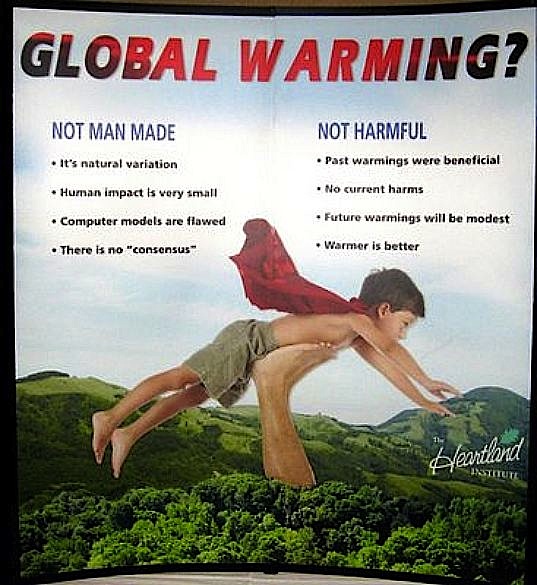
…That’s just the money being spent directly lobbying Congress, and publicly reported. Even more is being spent on disinformation, slander, and outright lies through a complex web of think tanks, fake advocacy groups, and other agencies. Groups like the Heartland Institute, which famously erected a billboard in suburban Chicago in May with a photo of Ted Kaczynski (the “Unabomber”), along with the caption “I still believe in Global Warming. Do you?”
…The fossil fuel industry has spent additional millions to vigorously attack and harass the climate scientists. An excellent feature in the June Popular Science (The Battle Over Climate Science) details the dirty deeds they have sponsored: Death threats. Hate mail. Harassment via spurious and expensive lawsuits. Threatening emails. Political attacks.
The way these scientists, trying to do good honest work in the public interest, are being harassed by paid jackals is horrifying, and reminds one of the McCarthy era. Likewise, the way the industry is paying these various front groups to mislead the public and create the illusion of a debate is straight out of the pages of the tobacco lobby. Indeed, many of the same characters who shilled for Big Tobacco are now doing the same for Big Oil, Gas and Coal…
…While outspoken scientists of human-caused climate change in the United States endure torrents of freedom of information requests, hate mail and even death threats from skeptics, their counterparts abroad have been free to do their work without fear.
Jochem Marotzke, managing director of the Max Planck Institute for Meteorology in Hamburg, said there is “no systematic attempt by a political camp” to target climate scientists in Germany. “I get the odd critical email from a skeptic, but would not classify anything as personally aggressive,” said Marotzke. “Very different from the U.S. scene.”
“I feel for my American colleagues and what they’ve had to deal with,” said Tim Lenton, an earth system scientist who specializes in climate tipping points at the University of Exeter in the UK. Lenton said he has never had to fend off skeptic attacks against his work or his integrity. “British scientists aren’t immune to attacks, but it is a very different level than compared to what is happening in the U.S.”
InsideClimate News contacted scientists working on climate change in Europe, Canada and Japan and learned that virtually everyone believes that the harassment is specific to the United States. They said that it could have long-term consequences for public understanding of global warming…
According to Bob Ward, Australia is just as prone to right-wing climate denial as the U.S. and Britain:
The Australian newspaper proved last week that the echo chamber of climate change denial is not restricted to the United States and United Kingdom.
On 4 September, the newspaper, owned by News Limited, the Australian arm of Rupert Murdoch’s News Corporation empire, published an article by Peter Lilley, a veteran UK Member of Parliament from the right wing of the Conservative Party, promoting his ‘sceptical’ views about climate change…
…The article by Lilley in the Australian publicised a pamphlet which he produced for the Global Warming Policy Foundation, a club for climate change ‘sceptics’ founded in 2009 by Nigel Lawson, Margaret Thatcher’s former Chancellor of the Exchequer, to lobby the UK government about its policies…
…Rather than presenting new evidence, Lilley’s pamphlet simply recycled a series of erroneous allegations about the Stern Review which have been debunked many times over since its publication nearly six years ago. The editorial slot which the Australian handed to Lilley contained the same characteristic blend of flawed science and bad economics as his pamphlet.
For instance, Lilley claimed to accept the assessment of the Intergovernmental Panel on Climate Change (IPCC) “as given”, but immediately rejected one of its fundamental findings that a doubling of carbon dioxide concentrations in the atmosphere would lead to a rise in global average temperature of between 2.0 and 4.5 centigrade degrees (known as the climate sensitivity). Instead, he suggested that the climate sensitivity could be about one centigrade degree, which the IPCC concluded was very unlikely.
It is, of course, a common tactic among some ‘sceptics’ to claim that they accept mainstream science but to downplay or ignore the evidence of the huge risks that rising levels of greenhouse gases are creating.
At current rates of emissions, greenhouse gas concentrations in the atmosphere will be at least 150 per cent higher by the end of this century than they were before industrialisation began in the 18th century. This would mean a significant probability of global warming of 3 centigrade degrees or more to temperatures not seen on Earth for about 3 million years. As the IPCC pointed out in its last assessment report in 2007, those temperatures were associated with much smaller polar ice caps and global sea levels that were 15 to 25 metres higher than today .
Modern homo sapiens has only been around for about 250,000 years so we could be heading for a global climate that is not just without historical precedence but one of which humans have no evolutionary experience.
Yet Lilley’s article expressed remarkable confidence and certainty that our children and grandchildren will prosper regardless of how much the climate changes and will be so rich that they will be able to magically fix any amount of environmental damage that we cause.
But the scientific evidence indicates that unmitigated climate change could transform the planet through sea level rise and altered patterns of extreme weather that will submerge or desertify large regions in ways that will threaten the lives and livelihoods of hundreds of millions, if not billions, of people. Large populations would migrate to escape the worst impacts, leading to widespread and extended conflict.
Under such circumstances, it is difficult to believe, as Lilley apparently does, that economic growth will carry on regardless. Future generations would face huge upheavals that could make them poorer, not richer, than us.
So why did the Australian agree to publish an article that was so inaccurate and misleading? As Robert Manne, a professor of politics at La Trobe University in Melbourne, has pointed out the newspaper has a track record of biasing its coverage with flawed and error-strewn polemics from climate change ‘sceptics’. In this respect, the Australian is different to its News Corporation stablemates in the UK and more akin to its counterparts in the United States, such as Fox News and the Wall Street Journal. So The Australian is clearly part of the media that have embraced unscientific climate change denial as an editorial stance and form the echo chamber which amplifies the misinformation of ‘sceptics’…
But the Australian goes a step further to prevent its readers from learning the truth about climate change. I sent a letter with a colleague to correct the errors in Lilley’s article, but the newspaper refused to publish it, or indeed any other critical correspondence. This filtering out of dissent conveys the false impression that the ‘sceptic’ article did not suffer from fundamental flaws…
So there you have it. The fossil fuel industry really controls our government and, therefore, any meaningful transition away from what they sell has historically been thwarted. This is also why America has, as Kunstler puts it, a public rail system that the Bulgarians would be ashamed of. And you only have to look at how Ralph Nader was harassed by the car industry as further evidence of the rise of corporate power. The shadowy dons of organised money control everything, including public perception and government action, or lack thereof, on climate change.
Without a doubt, climate change is the elephant in the room that no country is dealing with in a manner that reflects its dire consequences for humans and every other living creature on planet Earth. The oceans grow more acidic and warm, eventually to turn into lifeless and hypoxic dead zones. Tropical jungles continue to disappear under bulldozers to make way for monoculture industrial farming. Forests fall to invasions of beetles and burn from epic wildfires in a warming planet. Vast tracts of farmland are desiccated by relentless drought while the government continues its mandate of turning food into fuel for this country’s mammoth population of vehicles. The central banks continue to print money for the hedge funds and casino capitalists to speculate in “THE MARKET”. And the masses, bombarded with infotainment of carnival politics and Hollywood gossip, walk around in an entertained stupor, comforted in the belief that industrial civilization is infallible and exempt from the laws of physics and bankruptcy of an overexploited planet. Like an obsessive compulsive lunatic, growth is still the word that drips from the tongue of every mainstream economist, politician, and captain of industry. Global coal consumption continues its inexorable rise upward, with astronomical consumption predictions heralded for the distant future…
Intelligence, cooperation and foresight are of no use in a system which is intransigent to change. The final, calamitous destination over the cliff and down into the abyss seems clear to a few, but most still hang onto hope and miracles, the beliefs of desperate and delusional men. Scientists are astonished to see changes happening that just a few years ago were predicted only to become reality by the end of this century. A new study says that extreme scenarios are no longer unthinkable:
A new study to be published in the next issue of Current Science predicts up to 2 degrees rise in temperature in India as early as the 2030s. Climate change’s catastrophic effect, it seems, is here faster than anyone had expected.
A two degrees rise in the average global temperature is considered the danger line beyond which climate change will have intense impacts. Till now the general belief was that there is enough time to avert what scientists call ‘catastrophic’ climate change. Perhaps not any more…
…a large section of people find such extreme scenarios hard to believe. So how reliable are these projections? “Scientists are not speculating,”says R K Chaturvedi, the lead author of the study and a national environmental science fellow . “Our findings are based on robust climate models. In fact, for the first time, we have used an average of 18 climate models to arrive at a finding which will have a smaller margin of error. These models have managed to predict our past correctly. So if the temperature rise in the past has been predicted correctly and we have compared them with real data, why will it throw up incorrect projections for the future?”
Ravindranath reaffirms that the situation is serious. “Jammu and Kashmir and a few other parts of the Himalayan region will be the worst affected. The region is projected to experience the highest mean warming up to 8 degrees by 2080s. I’m not joking when I say there will be no snow in Kashmir. The only way to remember snow fall in Kashmir will be to watch the old Shammi Kapoor flick Junglee,” he says wryly.
Even scientists not connected with the study agree that a future doomsday scenario is possible. “The findings are quite reasonable,” says S K Dash, head of the department of Centre for Atmospheric Sciences at IIT Delhi. “Not many studies have been done based on so many climate models . Therefore, the results of this study are likely to be reliable. Our own studies have shown that India has experienced an average temperature rise of about 1.2 degrees in the past 100 years. So it’s not strange to assume a two degrees rise by 2030,” he says.
Many scientists feel that India, especially , would feel the heat of this projected change in temperature more than others. Sudhir Chella Rajan, professor at the department of humanities and social sciences at IIT Madras, who recently evaluated India’s National Climate Action Plan on Climate Change, says that India is more vulnerable because of a variety of reasons. “First, our vast size and geography has hot spots like the Himalayas and the coastal areas. Then there is poverty. The poor are not resilient enough to deal with intense impacts like very warm periods or even floods. That’s why it’s time we reacted faster to this impending disaster.
Scientists are recording the dying of the planet we once knew, but for all intents and purposes, their work is like that of a pathologist studying a body post-mortem. The process we have unleashed is now unstoppable. A team of scientists are now looking more closely at the disappearing forests:
…Until recently, however, ecologists hadn’t really focused on drought-induced die-offs as a discrete category of forest trauma. That began to change, Anderegg said, after a meeting in Austin, Texas, last year. “Several of us decided to sit down, put our heads together and begin to look at the possible effects.”
They looked at dozens of individual studies, and found plenty. The loss of a forest’s dominant tree species has a ripple effect on all the other species that live there, by changing the amount of sunlight that reaches the forest floor; changing the mix of nutrients that enter the soil as leaves or needles decompose; allowing soil to wash away, especially on steep slopes, and — in some cases, at least — encouraging more fires….
…Forests are not only affected by climate; they also affect it. A living tree absorbs carbon from the air; kill the tree, and the carbon stays in circulation to trap heat. Not only that, as the tree decays, the carbon locked inside is gradually released back into the atmosphere. “It’s a double whammy,” Anderegg said….
…Broadly speaking, there are huge gaps in what scientists know. “This whole area has been fairly under-studied until now,” Anderegg said. “We need more research with a really wide net.”
To try and coordinate it, he and several colleagues have created a collaborative website to share knowledge about drought and tree mortality. The urgency of such research is only underscored by the 2012 drought, the worst to hit the U.S. in more than 50 years.
“The droughts of the early 2000’s caught us by surprise,” Anderegg said. “This one is our chance to pay attention as it unfolds.
Desperate calls for geoengineering and a “binge” on nuclear plants to avoid runaway climate change are now surfacing in the headlines:
A leading British academic has called for accelerated research into futuristic geo-engineering and a worldwide nuclear power station “binge” to avoid runaway global warming.
Peter Wadhams, professor of ocean physics at Cambridge University, said both potential solutions had inherent dangers but were now vital as time was running out.
“It is very, very depressing that politicians and the public are attuned to the threat of climate change even less than they were 20 years ago when Margaret Thatcher sounded the alarm. Co2 levels are rising at a faster than exponential rate, and yet politicians only want to take utterly trivial steps such as banning plastic bags and building a few windfarms,” he said.
“I am very suspicious of using technology to solve problems created by technology, given that we have messed up so much in the past but having done almost nothing for two decades we need to adopt more desperate measures such as considering geo-engineering techniques as well as conducting a major nuclear programme.”…
…Wadhams, who is also head of the polar ocean physics group at Cambridge and has just returned from a field trip to Greenland, was reacting to evidence that Arctic sea ice cover had reached a record low this summer.
This latest rate of loss is 50% higher than most scenarios outlined by other polar scientists and coincide with alarming new reports about a “vast reservoir” of the potent greenhouse gas, methane, that could be released in Antarctica if the ice melts equally quickly there. Greenpeace said last night that it agreed with the academic’s concerns but not with his solutions.
“Professor Wadhams is right that we’re in a big hole and the recent record sea ice low in the Arctic is a clear warning that we need to act. But it would be cheaper, safer and easier to stop digging and drilling for more fossil fuels,” said Ben Ayliffe, the group’s senior polar campaigner.
“We already have the technologies, from ultra-efficient vehicles to state-of-the-art clean energy generation, to make the deep cuts in greenhouse gases that are needed to stave off the worst effects of climate change. Unfortunately, we’re still lacking the political and business will to implement them,” he added.
Wadhams, who has done pioneering work on polar ice thinning using British naval submarines from 1976 onwards, said these latest satellite findings confirmed his own dire predictions.
And they feed into the alarming scenarios that the Arctic Methane Emergency Group have been warning about.
“What we are now seeing is a fast collapse of the sea ice that means we could see a complete loss during the summer by 2015 – rather than the 20 to 30 years talked about by the UK Meteorological Office. This would speed up ocean warming and Greenland ice cap melt and increase global ocean levels considerably as well as warming the seabed and releasing more methane.”
Asked whether the latest evidence made a ban on drilling for carbon-releasing oil and gas necessary as Greenpeace has contended, Wadhams said “philosophically” such exploration made little sense. “We have been conducting a global experiment with the burning of fossil fuels and the results are already disastrous and this would accelerate them,” he argued saying that there were also practical worries because of the enormous difficulty of dealing with any spillage or a blowout under moving ice where oil would get trapped inside the ice in a kind of inaccessible “oil sandwich’…
Julian Cribb, the science writer who gained some notoriety with his letter to the journal Nature urging a rename of the not-so-wise Homo sapiens, has written a recent essay entitled ‘March of the Dead Zones‘. Are we quickly cooking the oceans into a state of mass extinction as has happened in Earth’s ancient past?
…The cause of Dead Zones is well understood: they are driven by the avalanche of nutrients which humanity dumps in the oceans – from agriculture, sewage, leaky landfills, urban stormwater, soil erosion, industrial and vehicle emissions. This rich nutrient soup provides the food source for vast blooms of algae – and as these die off they sink to the sea floor and decompose causing blooms of bacteria which strip the essential oxygen from the water column, often resulting in fish kills – their most visible impact. They are also hastened by global warming, which stratifies the water, trapping the stagnant water and preventing it from mixing with the oxygen-rich surface layer.
What many people do not realise is that some of the worst extinctions in the history of life on Earth occurred because of a process very similar to this. In the biggest of the lot, the Great Death of the Permian around 252m years ago, an estimated 95 per cent of marine species were wiped out – rugose corals, nautiloids, armoured fish, trilobites – never to be seen again.
What triggered it is still a scientific mystery – an outbreak of volcanism, striking asteroids, a giant solar storm, colossal seabed methane eruptions: who knows? – but the geological evidence points to a massive global spike in CO2 levels, accompanied by rapid planetary warming, huge outbreaks of anoxia (loss of oxygen from seawater) and the destruction of marine habitats. One thing is fairly clear – by the end of it all fungi and moulds were rulers of the Earth, feasting on the dead.
The multiplying Dead Zones in the world’s oceans today not only resemble the Permian event on a local scale in terms of what drove them – but have two additional drivers: overfishing and pollution from the 83,000 chemicals which humans manufacture on the land and then carelessly liberate into the global environment.
The biggest contributors of all are the 110 million tonnes of nitrogen, 9 million tonnes of phosphorus and other nutrients which we unleash into the planetary ecosystem every year as we try to feed ourselves. That is off-the-scale compared with what the pre-human Earth circulated naturally.
The really unsettling fact is that, if we continue to depend upon agriculture for our food supply, then humanity’s dependence on artificial fertilisers is likely to double by the 2060s – and so will our indiscriminate release of nutrients into the world’s rivers, lakes and oceans. That release, in turn, will spawn more and larger Dead Zones – like that affecting 22,000 square kilometres of sea at the mouth of America’s Mississippi river…
Below is a screen shot of a project called the Interactive Map of Eutrophication & Hypoxia (low-oxygen dead zones) which have spread to nearly 500 sites, all in places where there is significant human development along the oceans and seas of the world.
A study from late last year, indicates that the latest warming of the planet will be catastrophic to the Earth’s aquatic life, turning much of the oceans and seas into oxygen-depleted ‘dead zones’:
…Their study, published in Nature Geoscience, showed that the average global temperature rise of around at least two degrees Celsius between the peak and the end of the last Ice Age (between about 10,000-20,000 years ago) had a massive effect on the oxygen content of seawater.
“The warmer the global average temperature, the more extended the oxygen minimum zones are, so the volume of these oxygen-poor water bodies is more extended during warm periods than in cold periods,” Jaccard said.
What is worrying is that, currently, global average temperature is predicted to rise by at least two degrees in the coming century due to climate change. This is of a similar magnitude to the warming the planet has undergone since the last Ice Age 20,000 years ago.
“So we would assume that if, indeed, temperatures are increasing in the next 100 years, these oxygen minimum zones would also increase in volume and that the general oxygen concentration of the ocean will decrease,” Jaccard said.
And what is more: “our analysis has shown that not only was absolute temperature important, but also the rate of change, so the faster the warming, the more expanded these zones are…
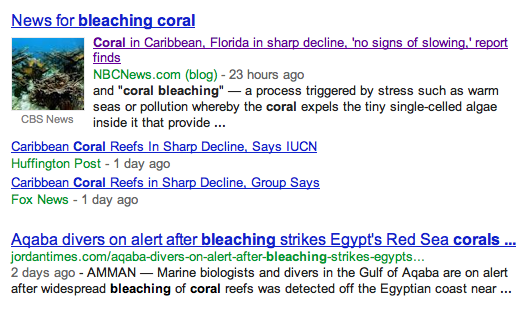
Along with the rest of the planet, our oceans have indeed been heating up. Here’s a quick screen shot I just did to show you a mere sliver of the destruction these rising temperatures are bringing:
A study to be published Sept. 15 issue in the journal Palaeogeography, Palaeoclimatology, Palaeoecology indicates that the demise of the dinosaurs was preceded by the death of ocean life via greenhouse gases that warmed the oceans. This sounds eerily similar to what we are doing to ourselves with the burning of fossil fuels. In place of CO2-spewing volcanic eruptions, we have millions of cars, planes, factories, coal-fired energy plants and an endless list of other fossil-fuel burning machinery doing the same:
The demise of the dinosaurs, thought to have been caused by an asteroid, wasn’t the only mass extinction around that time, according to new international research.
Evidence suggests that many species of ocean organisms were killed by volcanic eruptions before the asteroid impact. The eruptions took place in India, filling the atmosphere with greenhouse gases that warmed the globe and caused seafloor life to die.
“The eruptions started 300,000 to 200,000 years before the impact, and they may have lasted 100,000 years,” said study lead author Thomas Tobin at the University of Washington in a press release.
The scientists discovered this earlier extinction when they studied fossils from Seymour Island near Antarctica. The island has an unusually thick bed of sediment, where more sediment than normal accumulated in each time period.
This allowed the researchers to date fossils more precisely and create a detailed timeline. They used the prehistoric changes in Earth’s magnetic field to date each fossil sample.
“I think the evidence we have from this location is indicative of two separate events, and also indicates that warming took place,” said Tobin.
“It seems improbable to me that they are completely independent events.”
The first extinction event may have seriously affected some species, making them unable to survive the second extinction, although there’s no evidence for this yet….
Since the Earth’s oceans constitute 90% of the biosphere, a significant percentage of the planet’s total biomass is marine microorganisms, producing more than half of the entire global oxygen supply and serving as a vast sink for much of human-generated CO2. If we destroy the oceans, we will exterminate ourselves. The Earth will not bat an eye. No God will appear to prevent it. No technological solution will arrive to fix it. And no amount of empty platitudes and wishful thinking will mend it. The inexorable process of time and evolution will march on, creating other life forms to fill our vacancy. Humanity had its chance and blew it.
Don’t you think it’s kind of ironic that humans will become extinct from the burning of the very substance that enabled the ascent of the technological age and modern man’s ability to live in electrified and modernized comfort? Our fossil fuel slaves will have become our executioners. I recall hearing some indigenous South American tribesman saying that the people of industrial civilization are just children playing with deadly machines. They know not what grief they have brought unto themselves by raping the Earth of her treasures.
“We are now appearing to wage war on life in the sea with sonars, spotter aircraft, advanced communications, factory trawlers, thousands of miles of long lines, and global marketing of creatures no one had heard of until recent years. Nothing has prepared sharks, squid, krill and other sea creatures for industrial-scale extraction that destroys entire ecosystems while targeting a few species…
The concern is not loss of fish for people to eat. Rather, the greatest concern about destructive fishing activities of the past century, especially the past several decades, is the dismemberment of the fine-tuned ocean ecosystems that are, in effect, our life-support system.
Photosynthetic organisms in the sea yield most of the oxygen in the atmosphere, take up and store vast amounts of carbon dioxide, shape planetary chemistry, and hold the planet steady.
The ocean is a living system that makes our lives possible. Even if you never see the ocean, your life depends on its existence. With every breath you take, every drop of water you drink, you are connected to the sea…” ~ Sylvia Earle
In a previous post entitled ‘Free Market Blinders and the Coercion of Industrial-Corporate Capitalism‘, I posted arguments on why the free market ends up being anything but free. In the pursuit of profit, the shortest path taken includes usurping the instruments of the state. It also means all problems are forced into the ‘free market’ box and what comes out are phony solutions that only serve capitalism such as the scheme of carbon trading which has been described as “halfway between fantasy and fraud.”
Due to the lag time of its effects, climate change is a problem that the ‘free market’ cannot fix:
…This is the sort of problem that democracies and free markets are mostly incapable of solving. Politicians who have to come up for reelection every two to four years aren’t good at annoying business interests in order to solve problems that won’t even show up in a significant way for the rest of their lifetimes.
And even in its most ideal form, the logic of “free market solutions” is predicated on companies getting punished by angry consumers if they don’t do the right thing. There are all sorts of things wrong with this approach, of course: if a bunch of people die due to food poisoning, it’s not as if it’s always easy to identify where in the production chain the problem occurred, or which corporations to punish by not buying their product (not to mention the obvious fact that the deaths should have been stopped by regulation and oversight in the first place.) But in its most simplistic form it might work if the impact of corporate malfeasance is immediate.
But how does a “free market solution” work when it comes to carbon emissions? Whom do consumers punish? Whom do consumers reward? On what timescale? By the time the problem is advanced enough to penetrate consumer consciousness, it will have been far, far too late for the market to change organically.
And that’s, as I’ve said before, why climate change is such a threat to the conservative enterprise. It’s not just that big energy interests would be impacted. It’s that the entire conservative model of problem solving would be rendered obsolete if the realities of climate change were accepted in our public discourse.
So absent some sort of organizational metamorphosis for human societies, business interests will continue to divide nation states against one another as politicians in the major industrialized democracies dawdle and pretend the problem will go away.
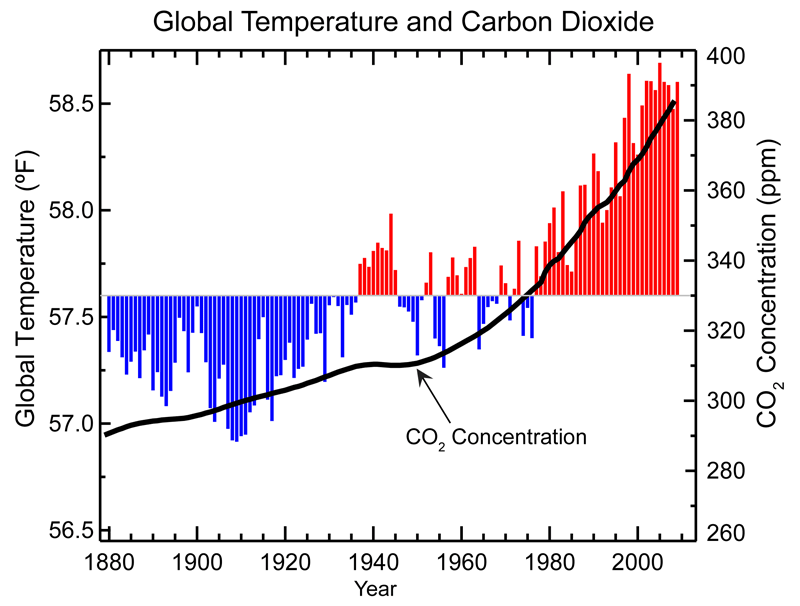
CO2 levels continue to rise despite the sham carbon trading scheme (NOAA):
As you can see from the following video, the warming effects of the CO2 we have been pumping into the atmosphere over the last 130 years are becoming much more pronounced (this video is from NASA and only goes up to 2011).
In regards to the future stability of the human race, consider the conclusions from top climate scientists in a recent article of the highly regarded journal Nature:
The mean global temperature by 2070 (or a few decades earlier) will be higher than it ever has since the human species evolved.” [Human-induced climate change creates] “the potential to transform Earth rapidly and irreversibly into a state unknown in human experience.” “The net effect is that once a critical transition occurs, it is extremely difficult or even impossible for the system to return to its previous state.”
You see, the problem is that we are bringing on these changes to the climate and environment so rapidly that we, along with many other species, will NOT be able to adapt in time. Certainly our food supply will be in grave danger as weather patterns shift and droughts become more intense. The vast and expensive infrastructure we built to take advantage of the stable climate that we enjoyed in the past will no longer apply. Imagine a game of musical chairs with the entire global population scrambling for the last remaining seat. That’s the future in which a chaotic climate makes the access to dwindling resources even more tenuous. Arguing over cause and effect as we all go over the cliff is not an option, but that is the avenue we are taking.
There is unequivocal evidence that Earth’s lower atmosphere, ocean, and land surface are warming; sea level is rising; and snow cover, mountain glaciers, and Arctic sea ice are shrinking. The dominant cause of the warming since the 1950s is human activities. This scientific finding is based on a large and persuasive body of research. The observed warming will be irreversible for many years into the future, and even larger temperature increases will occur as greenhouse gases continue to accumulate in the atmosphere. Avoiding this future warming will require a large and rapid reduction in global greenhouse gas emissions.
The results of industrial civilization’s binge on fossil fuels are happening in full Technicolor right before our eyes:
This NASA map, based on satellite data, shows the new record-low summer sea ice extent of 1.58 million square miles in the Arctic Ocean, as recorded on August 26. The amount of sea ice covering the Arctic Ocean at the end of summer is now 45 percent lower than the average from 1979 to 2000. The black dot represents the region surrounding the North Pole. (NASA) – link
This graph, prepared by the University of Washington’s Pan Arctic Ice Ocean Model Assimilation System (PIOMAS) shows the precipitous drop in the volume of summer sea ice in the Arctic Ocean. Since this graph was prepared, PIOMAS estimates that the volume of sea ice in the Arctic has fallen farther, to 3,500 cubic kilometers — a decline of 72 percent compared to the average from 1979 to 2010. (Polar Science Center/Applied Physics Laboratory/University of Washington) – link
Looking around at those… around me – family, friends, acquaintances and random faces in the crowd of apathy – the level of complacency is so concentrated I can taste it, yet I can’t even describe how bad it tastes. I’m not really talking about the understanding people lack about the numerous predicaments we face as a species – that’s definitely there too… but what I’m talking about is even worse. It’s the assumption that we can just go about our day to day lives, doing our day to day work, having our day to day fun… and humanity will eventually heal itself, no matter how bad the injuries sustained.
This is a cultural phenomenon that has infested the Western world, and refuses to be eradicated. It is where many of us ultimately place our hope and stake our lives, sometimes without even realizing we are doing it. We previously discussed the entertainment enemas that have penetrated modern culture (and the lives of deluded teenagers) in Culturally Programmed Myths of Omnipotence. They have given us the vision that we can always become bigger, “better” and stronger as individuals and nations, evolving towards God-like glory, no matter what obstacles are in our way – all of the stories about superheroes, vampires, werewolves, wizards, robots and aliens – it’s all about the propaganda of pernicious power.
We even see this mentality taking root in academia and scientific research through the field of “transhumanism” (very well portrayed in the documentary, TechnoCalyps). As you can probably guess from the name, transhumanism tells us that we are on the way to becoming something more, something other, than human beings. Forget random mutation and natural selection, the transhumanist says – we can circumvent all of the slow evolutionary nonsense that we only theorized about a century ago. Now we can transform ourselves into a new species over the course of a few decades with the help of modern technology and “intelligent designers”. Just a little bit ironic, don’t you think?…
Surfing the net last night, I see Guy McPherson is trying to pierce the self-delusional bubble described above, but to no avail…
The process of industrial civilization’s collapse has been happening for some time now. It’s not a sudden overnight occurrence that can be appreciated by the fight-or-flight reflexes and here-and-now sensory stimulation of humankind. As the natural world slowly retreats and disappears under the expansion of humans, subsequent generations are normalized to an increasingly biodiverse-poor environment. What appreciation does a child have for an animal only seen in books? In a recent essay by Guy McPherson entitled ‘Global Madness‘, he writes:
If silence is the perfect music, then we’re about to have the (musically) perfect planet. But I doubt we’ll be pleased with the silence as we slip, one by one, into the abyss of unconsciousness.
As the invading cacophony of industrial civilization fills the air – car traffic, fire alarms, ambulance sirens, jet planes, bulldozers – the animal and insect voices of the natural world are extinguished, never to be heard from again. For the last forty years, Bernie Krause has been recording those now-absent sounds of nature:
…such is the rate of species extinction and the deterioration of pristine habitat that he estimates half these recordings are now archives, impossible to repeat because the habitats no longer exist or because they have been so compromised by human noise. His tapes are possibly the only record of the original diversity of life in these places.
“A great silence is spreading over the natural world even as the sound of man is becoming deafening,” he writes in a new book, The Great Animal Orchestra. “Little by little the vast orchestra of life, the chorus of the natural world, is in the process of being quietened. There has been a massive decrease in the density and diversity of key vocal creatures, both large and small. The sense of desolation extends beyond mere silence.
“If you listen to a damaged soundscape … the community [of life] has been altered, and organisms have been destroyed, lost their habitat or been left to re-establish their places in the spectrum. As a result, some voices are gone entirely, while others aggressively compete to establish a new place in the increasingly disjointed chorus.”
Hawaii, he says, is the extinction capital of the world. “In a couple of centuries since the islands were populated by Europeans, half the 140 bird species have disappeared. In Madagascar, 15 species of lemur, an elephant bird, a pygmy hippo and an estimated half of all the animals have gone extinct.”
Even partially disturbed habitats lose much of their life for many years, says Krause. Recordings of a meadow in the Sierra Nevada mountains east of San Francisco before the surrounding forest was selectively logged in the 1980s sounds very different to when Krause returned a year later…
A recent study helps prove how interwoven ecosystems are and that anything other than a holistic approach to conservation is futile:
…Lead researcher Dr Frank van Veen of the University of Exeter’s Centre for Ecology and Conservation said: “Our experiment provides the first proof of something that biologists have argued for a long time: predators can have indirect effects on each other, to the extent that when one species is lost, the loss of these indirect effects can lead to further extinctions. Although our study focused on insects, the principle would be the same for predators in any ecosystem, ranging from big cats on the African plains to fish in our seas.
“Our research highlights the fact that a ‘single species’ approach to conservation can be ineffective and even counter-productive. For example, protecting cod could lead to increased fishing pressure on other predatory fish which then, by the mechanism we have demonstrated here, could lead to further negative effects on the cod…
The feeble attempts humans make at saving the myriad of flora and fauna that support us is now called “conservation triage“. The web of life is looking more like a moth-eaten doily cloth beneath the morbidly obese feet of humanity:
…Even in our existing system we practice a form of triage by simply not funding recovery efforts for species that we don’t think we can afford to save. Many conservationists are saying, ‘Look, it would be much better if we had a more explicit, more rational system for making these decisions.’…
“Many species are threatened by climate change and there’s a concern that some species may be too far gone in some sense to save, that there may be forces that are too broad, too far along and that species is essentially a lost cause,” she said.
On Facebook, Amy J. Loiselle said there is one crucial element left out of this conversation: the impact of humans on other species.
“In all the conversations about species extinction there is hardly ever any mention of the continued impact of human population growth on the environmental problems we face,” she wrote. “This is driving extinction, climate change, poverty etc. All the other ’causes’ are directly related to increases in human numbers. Without solving this problem there is no foreseeable way to solve any of these other problem.
Choosing to control human population goes against a basic drive found in all species to ensure its survival – the desire to reproduce. Being the apex species with no predators does pose a bit of a problem with nature’s ability to check and balance our numbers. Of course the microscopic world of viruses and bacteria will create a growing threat to us in the post-antibiotic and post fossil fuel world:
Drug-resistant organisms will spread across the country in ever increasing numbers, and we are not going to be bailed out by the pharmaceutical industry,” said Gilbert, a physician at Providence Medical Center in Portland. “There is nothing in the pipeline. It takes up to 15 years to bring a new drug through the approval process.
…Long before the actual Runaway emerges, we can expect a host of exotic diseases will spread across the world and wreak havoc – and all the fools clamoring for warm temperatures (e.g. for “longer growing seasons”) will wish they were dead. Especially as we’re already losing efficacy of anti-biotics from over-use(See, e.g. Global Climate and Infectious Disease:The Cholera Paradigm, in Science, Vol. 274, 20 December, 1996, p. 2025.)
If people think the current invasion of West Nile fever is bad, wait until they’re faced with dengue fever (which I caught in the West Indies – and which can – after the 3rd successive bite-infection – lead to hemorraghing from all body orifices). Wait until cholera becomes endemic and other hitherto unseen (and unheard of) diseases appear. Then the morons will understand the enormous downsides of their ‘warmer’ world and huge price for their ‘longer growing seasons’.
Mostly understated in all the talk of exotic disease incursions, is the real risk we will be swamped by parasites throughout the country and even the world…
Will man go extinct? He certainly seems to be doing everything in his power to make sure it happens:
…the worship of an economic system that reduces everything to a financial object.
…the continued exploitation and burning of an increasingly more expensive and environmentally damaging energy source which is causing the climate to swing out of control with various feedback loops.
…the dismantling and perversion of regulations and the rule of law to satisfy greed and a grossly unjust social hierarchy.
…the indoctrination of the population into a materialist society detached from the appreciation of nature’s fundamental role in our survival.
…the degeneration of public debate into infomercial sound bites by way of mass media manipulation.
…the wholesale destruction of the natural world and the latest attempts of a so-called green economy to monetize every bit of nature in order to save capitalism.
…and the spread of the above described culture through globalization.
Guy McPherson, being the anti-establishment voice that he is, says he’s even received death threats against himself. This goes to show how much inertia and willful ignorance are built into the current system. ‘Kill the Messenger’ is the modus operandi of industrial civilization and Empire.
This post features a couple of stories highlighting the total inner rot behind the facade of a free press, completely driven by the profit motives of corporations, and this country’s so-called democratic system with its fictitious “free work force”.
14 Year Ex-MSM ‘Journalist’: “None of it is Real.”
The financial elite and Washington have become a single entity, with the rotating door between lobbyists, industry, and positions of government operating more like an eight-lane autobahn highway. Under the stampede of corporations buying off the instruments of government, the news media or fourth estate has been completely flattened into the grease-palmed asphalt of that profiteering highway. Once in a while a flicker of ethical consciousness propels a few souls to climb out of the corrupt cesspool. A case in point is Andrea Seabrook, a 14-year mainstream media journalist who states, “None of it is Real.”
After 14 years at National Public Radio, Andrea Seabrook left in July and, to hear her talk about her experience covering Capitol Hill, it’s clear that she had one takeaway: It’s damn frustrating. “I realized that there is a part of covering Congress, if you’re doing daily coverage, that is actually sort of colluding with the politicians themselves because so much of what I was doing was actually recording and playing what they say or repeating what they say,” Seabrook told POLITICO. “And I feel like the real story of Congress right now is very much removed from any of that, from the sort of theater of the policy debate in Congress, and it has become such a complete theater that none of it is real. … I feel like I am, as a reporter in the Capitol, lied to every day, all day. There is so little genuine discussion going on with the reporters. … To me, as a reporter, everything is spin.
We’re still light years behind the eight ball of actually doing anything radical enough to save ourselves, but it is reaffirming to hear straight from the horse’s mouth that the system is total B.S..
Climate Change Denier makes it Mandatory his Minions of Coal Miners Attend a Romney Rally.
Earlier this month, Mitt Romney was welcomed for a campaign event at the Century Mine in Beallsville, Ohio, by hundreds of coal workers and their families. Now many of the mine’s workers are saying they were forced to give up a day’s worth of pay to attend the event, and they feared they might be fired if they didn’t, according to local news radio WWVA.
The claims have been mostly denied by Rob Moore, Chief Financial Officer of Murray Energy Company, which owns the mine. He acknowledges that workers weren’t paid that day but says no one was made to attend the event. Well, kind of.
The claims have been mostly denied by Rob Moore, Chief Financial Officer of Murray Energy Company, which owns the mine. He acknowledges that workers weren’t paid that day but says no one was made to attend the event. Well, kind of.
“Our managers communicated to our workforce that the attendance at the Romney event was mandatory, but no one was forced to attend,” he told local news radio WWVA, which has received several emails from workers claiming that the company records names of workers that don’t attend those types of events…
Murray, who is also a climate-change denier, has been an outspoken critic of President Obama’s stance on coal. That view may be why Moore told WWVA that having employees attend the Romney event “was in the best interest of anyone that’s related to the coal industry in this area or the entire country…
Better you not think about the civilization-ending reality of climate change because your job depends on this CO2-polluting substance. That’s got to be the epitome of short-term thinking – today grab a dollar that results in you and your children’s death tomorrow. Nobody ever said this living arrangement was sensible.









 Nature






 Collapse of Industrial Civilization