On a higher level, we have a superorganism, our civilization, which has accessed an energy gradient the same way that old growth forests have.
The human population makes up this superorganism’s myriad of cells. The nervous system is made up of the various mediums that transmit information – internet, television, phone, print media, etc… The circulatory system is the transportation system providing paths of production and distribution – roads, bridges, trains, airline and shipping routes, etc… Of course energy, primarily oil and fossil fuels, are the life-blood that fuels this system. If you have ever tried to fight against this Leviathan, you will have its immune system, the law and security apparatus, thrust upon you so that you may be hammered into conformity or isolated and quarantined in a tiny prison cell. Of course there are many malcontent cells within the belly of the beast, but capitalist industrial civilization is fortified with self-perpetuating social structures which ensure its survival.
Take for instance its education system which churns out countless drones who lack the ability to think critically and are filled with fragmented and specialized knowledge which prepares them as cogs for the corporate world. Everything, including one’s relationship with fellow humans, is reduced to a “business relationship” or “investment”. The various institutions of modern society are configured to reinforce capitalist industrial civilization. The media are corporate mouthpieces and echo chambers for the dominant capitalist system – materialism, conspicuous consumption, atomization and alienation of man from nature and from his own humanity, etc… The entertainment industry fosters an acquisitiveness for high consumption lifestyles. It relies on the corporate state to mass market and mass produce these values. The primary metric of social worth in the corporate state is money, and the class which has managed to accumulate vast sums of it are those who have usurped the levers of governance. You have heard of the two-tiered justice system we have in this country which coddles the elite and discards everyone else. Thus the ethos of society flows downward from those who have at their disposal the power to mold and influence society’s perceptions and norms.
Will man go extinct? He certainly seems to be doing everything in his power to make sure it happens:
…the worship of an economic system that reduces everything to a financial object.
…the continued exploitation and burning of an increasingly more expensive and environmentally damaging energy source which is causing the climate to swing out of control with various feedback loops.
…the dismantling and perversion of regulations and the rule of law to satisfy greed and a grossly unjust social hierarchy.
…the indoctrination of the population into a materialist society detached from the appreciation of nature’s fundamental role in our survival.
…the degeneration of public debate into infomercial sound bites by way of mass media manipulation.
…the wholesale destruction of the natural world and the latest attempts of a so-called green economy to monetize every bit of nature in order to save capitalism.
…and the spread of the above described culture through globalization.
If you think about the modern globalized civilization as a super-organism, then you come to realize how futile it is to think that an organism, any organism, would voluntarily starve itself or constrict its own growth. If you plant a tree in a pot, it will eventually become root-bound or send its roots over the lip of the container or straight through the ceramic wall. This is exactly what our capitalist industrial civilization is doing.
It has utilized every resource available to sustain growth, and now speaks of manipulating the weather in order to avoid the threat that climate chaos poses to its vitality. As far as mineral depletion, there has even been plans drawn up to mine asteroids for their deposits. The next frontier is to break the bonds of Earth itself. But we have irreparably cracked the vase that is our home. The Arctic will soon have an annual “window” in September through which the sun’s rays will work their way inside, prying that annual crack ever wider every year. In addition, we have pushed most other species, the building blocks of biodiversity, out of their habitat and onto the one-way path of extinction. The life-giving fluids of our vase have slowly been poisoned and acidified by the waste from our fossil fuel energy slaves. The hydrologic cycle within our little world has been hopelessly fouled with. The superorganism of capitalist industrial civilization is now starving the majority of its cells in order to keep healthy a few of its privileged cells who sit in places of power and Mammon worship. This potted plant or superorganism we call industrial civilization is looking rather pale and shriveled these days. As a matter of fact, it’s like a tree whose bark has been peeled off. It’s still standing at the moment and it does not know it’s dead, but its days are surely numbered.
The hope of environmentalists can no longer be that this corrupt system will run out of energy(Peak Oil), that the money presses will break down, or that it can be changed through capitalist schemes of “greening the economy”. The only thing that would have stopped the destruction would have been to build a new system that holds the health of the natural world as the primary metric through which all human activity is viewed and planned. Suffice it to say that such a system would not have been capitalism. Of course such a sentiment would brand you as an “eco-terrorist”, but the purpose of this essay is not to give hopium, but to describe the entrenched power structure which has laid waste to the environmental movement and our planet. Although small and ineffective, individual acts of moral courage and sacrifice are all that is left as this Beast of industrialized civilization tumbles to the ground, dying from self-inflicted wounds too numerous to count.
Since I was young, I knew I’d find you
But our love was a song sung by a dying swan
And even now you’ll hear me calling
You’ll hear me calling
And in your dreams you’ll see me falling, falling
Breathe in the light
I’ll stay here in the shadows
Waiting for a sign, as the tide grows
Higher, and higher, and higher…
The decades of escalating heat and dryness, which inevitably returned with a vengeance after some years of waning, had reduced the world’s food production to a mere shell of its former glory. The grocery stores, whose well-stocked shelves city dwellers had grown accustomed to, were now all boarded up and abandoned after being ransacked for their remains – expired cans of food. Industrial agriculture could only be subsidized for so long by an over-exploited and abused environment, but nobody ever really thought that day would come. The green revolution was supposed to be the answer to feeding the world’s growing population. Unfortunately it turned out to be yet another Ponzi scheme built on a finite, dwindling energy source, the burning of which was destabilizing the climate. Nearly all the mega cities and great metropolises had turned into death traps and were quickly emptied of their human inhabitants after a series of violent riots sparked by starving populations. Areas where water was still plentiful were inundated with refugees. Nonetheless, a small population of human scavengers had remained in these great ghost cities of the Post Industrial Age and managed to eke out a life while enjoying the somber solitude of decaying edifices and vacant streets.
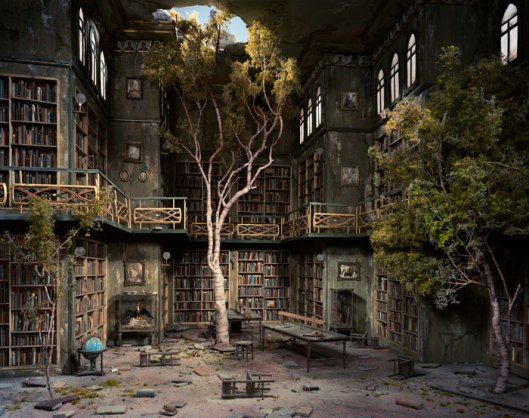
A few of these remnant city-dwellers frequented the dust-laden corridors of old libraries. Television and other electricity-depenedent digital devices, which had once been so pervasive and addictive, were no longer available after the heat engine of carbon-based civilization broke down. Thus books and the written word were the surviving medium for amusement and escapism. Even in these desperate times, people found time to dream and wonder. When the grid flickered and finally blinked out for good, much of what had passed for entertainment was now viewed in retrospect as a widespread collective mental illness. The citizenry of the fossil-fuel crazed civilization had retreated further and further into an artificial world of digital bytes and glowing computer screens while the natural world had disintegrated around them.
The recent past leading up to the final days of industrial civilization was looked upon as an age of irony. Science and technology had created miraculous abilities to save lives while at the same time enabling the wholesale destruction of mankind through hi-tech weaponry. Knowledge and wisdom were available at the touch of a keystroke, while mass death and misery hinged on the push of a button. People appeared on the surface to be free, yet their thoughts and actions were carefully manipulated by a veil of infotainment; people’s lives were affected much more by things left unspoken. The pursuit of “happiness” became the law of the land; the pursuit of truth was criminalized and viewed as the deviant behavior of malcontents and miscreants. Questioning the dominant paradigm was obstructive to progress; solutions to the world’s problems were entrusted to ideologues of free-market capitalism and worshippers of endless technological advancement.
A reduction in complexity was inevitable, but did it have to come at the expense of a bankrupt planet? Cheap and abundant energy slaves no longer existed, and even if they did, there was nothing to transition to on a planet plagued with a destabilized climate for the next millennium. The human population would never again reach anything like the 9 billion at the zenith of the fossil fuel age, and this was a welcome thought for those few who remained. Quoting from a dog-eared book found by one of the humans scavenging in a library, or “book cemetery” as it was now known:
What is the greater danger – nuclear warfare or the population explosion? The latter absolutely! To bring about nuclear war, someone has to DO something; someone has to press a button. To bring about destruction by overcrowding, mass starvation, anarchy, the destruction of our most cherished values-there is no need to do anything. We need only do nothing except what comes naturally – and breed. And how easy it is to do nothing…
…Democracy cannot survive overpopulation. Human dignity cannot survive [overpopulation]. Convenience and decency cannot survive [overpopulation]. As you put more and more people onto the world, the value of life not only declines, it disappears…
And not much did survive. But for those last vagabonds of humanity, the tragedy of the Great Collapse and mankind’s downfall were the grist of post-apocalyptic folklore, never to be forgotten.
…a second Dark Age had fallen on Western civilization, in which denial and self-deception, rooted in an ideological fixation on “free” markets, disabled the world’s powerful nations in the face of tragedy. Moreover, the scientists who best understood the problem were hamstrung by their own cultural practices, which demanded an excessively stringent standard for accepting claims of any kind–even those involving imminent threats. Here, our future historian, living in the Second People’s Republic of China, recounts the events of the Period of the Penumbra (1988–2073) that led to the Great Collapse and Mass Migration (2074)…
The paper starts off with a brief history of industrial civilization’s chemical and material pollutions overloading the Earth’s environmental sinks. The sheer volume of mankind’s activities, from the Ozone Hole created by CFC’s to the resource-depleting diet of industrial cattle-farming, became a force of nature unto itself threatening the very habitability of the planet. The scientific community began to recognize that man’s industrial activities were upending the earth’s life support systems; various organizations and institutions were created to try to ‘protect the environment’, but the interests of free market capitalism with its high-consumption lifestyle created a backlash against any restriction and attempts to recognize the limits of the human economy’s unending growth. The party had to continue no matter how dire the consequences. 1988 is said to have marked the beginning of the “Penumbral Period”, perhaps meaning a time of partial illumination where the threat was seen, but no effective action was taken. Indeed, we dug our grave faster with the building of evermore coal-fired plants and the destruction of the remaining ecosystems in the face of a series of extreme and ominous weather events which had the earmarks of manmade climate change.
By the early 2000s, dangerous anthropogenic interference in the climate system was under way. Fires, floods, hurricanes, and heat waves began to intensify, but these effects were discounted. Those in what we might call active denial insisted that the extreme weather events reflected natural variability, despite a lack of evidence to support that claim. Those in passive denial continued life as they had been living it, unconvinced that a compelling justification existed for broad changes in industry and infrastructure. Scientists became entangled in arcane arguments about the “attribution” of singular events; however, the threat to civilization inhered not in any individual flood, heat wave, or hurricane, but in the overall shifting climate pattern, its impact on the cryosphere, and the increasing acidification of the world ocean…
…what was anomalous in 2021 soon became the new normal. Even then, political, business, and religious leaders refused to accept that the primary cause was the burning of fossil fuels. A shadow of ignorance and denial had fallen over people who considered themselves children of the Enlightenment. For this reason, we now know this era as the Period of the Penumbra.
If you don’t like reality, then withdraw into fantasy and rewrite history; “we’re an empire now, and when we act, we create our own reality,” said Karl Rove.
In the early Penumbral Period, scientists were accused of being “alarmist” in order to increase financial support for their enterprise, gain attention, or improve their social standing. At first, the accusations took the form of public denunciations; later they included threats, thefts, and the subpoena of private correspondence. Then legislation was passed (particularly in the United States) that placed limits on what scientists could study and how they could study it, beginning with the notorious “Sea Level Rise Denial Bill,” passed in 2012 by the government of what was then the U.S. state of North Carolina (now part of the Atlantic Continental Shelf ) and the Government Spending Accountability Act of 2012, which restricted the ability of government scientists to attend conferences to share and analyze the results of their research.
Though ridiculed when first introduced, the Sea Level Rise Denial Bill would become the model for the U.S. National Stability Protection Act of 2022, which led to the conviction and imprisonment of more than three hundred scientists for “endangering the safety and well-being of the general public with unduly alarming threats.” By exaggerating the threat, it was argued, scientists were preventing the economic development essential for coping with climate change. When the scientists appealed, their convictions were upheld by the U.S. Supreme Court under the Clear and Present Danger doctrine, which permitted the government to limit speech deemed to represent an imminent threat.
…robust evidence shows that people systematically overestimate the probability of positive future contingencies, and underestimate the probability of negative ones — only those who are depressed or dysphoric come to accurate assessments…
Diogenes of Sinope must have practiced a sort of philosophical dysphoria.
Another cause for modern man’s downfall was the adoption of an excessively stringent standard for accepting causal links between climate change and human industrial activities:
…Historians have long argued about why this standard was accepted, given that it had no substantive mathematical basis. We have come to understand the 95 percent confidence limit as a social convention rooted in scientists’ desire to demonstrate their disciplinary severity. Just as religious orders of prior centuries had demonstrated moral rigor through extreme practices of asceticism in dress, lodging, behavior, and food–in essence, practices of physical self-denial–so, too, did natural scientists of the twentieth century attempt to demonstrate their intellectual rigor through intellectual self-denial. This practice led scientists to demand an excessively stringent standard for accepting claims of any kind, even those involving imminent threats…
CO2 emissions continued to rise not only in developing countries, but also developed countries as fossil fuel production accelerated with shale gas extraction and Canadian oil-sand processing. The world was firmly in the grasp of the fossil fuel energy trap.
…How did these wealthy nations–rich in the resources that would have enabled an orderly transition to a zero net-carbon infrastructure–justify the deadly expansion of fossil fuel production? Certainly, they fostered the shadow of denial that obscured the link between climate change and fossil fuel production and consumption. They also entertained a second delusion: that natural gas from shale could offer a “bridge to renewables.” Believing that conventional oil and gas resources were running out (which they were, but at a rate insufficient to avoid disruptive climate change), and stressing that natural gas, when combusted, produced only half as much CO2 as coal, political and economic leaders persuaded themselves and their constituents that promoting shale gas was an environmentally and ethically sound approach.
This line of reasoning, however, neglected three crucial factors. First, fugitive methane emissions–CH4 that escaped unburned into the atmosphere–greatly accelerated warming. (Again, scientists had foreseen this phenomenon, but their predictions were buried in specialized journals.) Second, the argument presupposed that net CO2 emissions would fall, which would have required strict restrictions on coal and petroleum use. Third, and most important, the sustained low prices of fossil fuels, supported by continued subsidies and a lack of external cost accounting, undercut efficiency efforts and weakened emerging markets for solar, wind, and biofuels (including crucial liquid biofuels for aviation). Thus, the bridge to a zero-carbon future collapsed before the world had crossed it. The bridge to the future became a bridge to nowhere.
The following scenario seems to me to be our most likely future under the current path of business-as-usual:
…The net result? Fossil fuel production escalated, greenhouse gas emissions increased, and climate disruption accelerated. In 2001, the IPCC had predicted that atmospheric CO2 would double by 2050. In fact, that benchmark had been met by 2042. Scientists had expected a mean global warming of 2 to 3 degrees Celsius; the actual figure was 3.9 degrees. Though originally merely a benchmark for discussion with no particular physical meaning, the doubling of CO2 emissions turned out to be significant: once the corresponding temperature rise reached 4 degrees, rapid changes began to ensue.
By 2040, heat waves and droughts were the norm. Control measures such as water and food rationing and Malthusian drills had been widely implemented. In wealthy countries, hurricane- and tornado-prone regions were depopulating, putting increased social pressure on areas less subject to those hazards. In poor nations, conditions were predictably worse: rural portions of Africa and Asia were already experiencing significant depopulation from out-migration, malnutrition-induced disease and infertility, and starvation. Still, sea level had risen only 9 to 15 centimeters around the globe, and coastal populations were mainly intact.
Then, in the Northern Hemisphere summer of 2041, unprecedented heat waves scorched the planet, destroying food crops around the globe. Panic ensued, with food riots in virtually every major city. Mass migration of under-nourished and dehydrated individuals, coupled with explosive increases in insect populations, led to widespread outbreaks of typhus, cholera, dengue fever, yellow fever, and, strangely, AIDS (although a medical explanation for the latter has never been forthcoming). Surging insect populations also destroyed huge swaths of forests in Canada, Indonesia, and Brazil. As social order broke down, governments were overthrown, particularly in Africa, but also in many parts of Asia and Europe, further decreasing social capacity to deal with increasingly desperate populations. The U.S. government declared martial law to prevent food riots and looting, and the United States and Canada announced that the two countries would form the United States of North America in order to begin resource-sharing and northward population relocation. The European Union announced similar plans for voluntary northward relocation of eligible citizens from its southernmost regions to Scandinavia and the United Kingdom…
World leaders convened to hastily put together a climate geoengineering scheme in an effort to halt the collapse, but unforeseen side effects occurred and the project was immediately stopped, resulting in even more dire consequences. Various feedback loops unleashed a “Venusian death” on planet Earth:
…This massive addition of carbon led to what is known as the Sagan effect (sometimes more dramatically called the Venusian death): a strong positive feedback loop between warming and CH4 release. Planetary temperature increased by an additional 6 degrees Celsius over the 5 degree rise that had already occurred…
The rapid melting of the West Antarctic Ice Sheet and the Greenland Ice Sheet resulted in massive sea level rise and more apocalyptic human and non-human suffering:
…Analysts had predicted that a five-meter sea level rise would dislocate 10 percent of the global population. Alas, their estimates proved low: the reality was closer to 20 percent. Although records for this period are incomplete, it is likely that 1.5 billion people were displaced around the globe, either directly from the impacts of sea level rise or indirectly from other impacts of climate change, including the secondary dislocation of inland peoples whose towns and villages were overrun by eustatic refugees. Dislocation contributed to the Second Black Death, as a new strain of the bacterium Yersinia pestis emerged in Europe and spread to Asia and North America. In the Middle Ages, the Black Death killed as much as half the population of Europe; this second Black Death had similar effects. Disease also spread among stressed nonhuman populations. Although accurate statistics are scant because twentieth-century scientists did not have an inventory of total global species, it is not unrealistic to estimate that 60 to 70 percent of species were driven to extinction…
This doomsday narration then ends with a sort of “happy note” which seems to me to be wishful thinking, an improbable turn of events which saves mankind from total extinction. The last few pages discuss more the pitfalls that mankind fell into leading to such a dire fate: positivism or Baconianism and market fundamentalism.
…power did not reside in the hands of those who understood the climate system, but rather in political, economic, and social institutions that had a strong interest in maintaining the use of fossil fuels. Historians have labeled this system the carbon-combustion complex: a network of powerful industries comprised of primary fossil fuel producers; secondary industries that served fossil fuel companies (drilling and oil held service companies, large construction firms, and manufacturers of plastics and other petrochemicals); tertiary industries whose products relied on inexpensive fossil fuels (especially automobiles and aviation); and financial institutions that serviced their capital demands. Maintaining the carbon-combustion complex was clearly in the self-interest of these groups, so they cloaked this fact behind a network of “think tanks” that issued challenges to scientific knowledge they found threatening…
…When scientists discovered the limits of planetary sinks, they also discovered market failure. The toxic effects of DDT, acid rain, the depletion of the ozone layer, and climate change were serious problems for which markets did not provide a spontaneous remedy. Rather, government intervention was required: to raise the market price of harmful products, to prohibit those products, or to finance the development of their replacements. But because neoliberals were so hostile to centralized government, they had, as Americans used to say, “painted themselves into a corner.” The American people had been persuaded, in the words of President Reagan, that government was “the problem, not the solution.” Thus, citizens slid into passive denial, accepting the contrarian arguments that the science was unsettled. Lacking widespread support, government leaders were unable to shift the world economy to a net carbon-neutral energy base. As the implications for market failure became indisputable, scientists came under attack, blamed for problems they had not caused but merely documented…
Watching the following video, we can see such a future, as describe above, being played out before our very eyes:
Real Time episode with Bill Maher – aired April 5, 2013: Bill Maher led an intense panel discussion on the reliability of science on his show tonight, with Maher, Abby Huntsman, Senator Bernie Sanders, and 19-year-old science education activist Zack Kopplin arguing with Wall Street Journal columnist Steve Moore over scientific consensus on global warming. Moore continually insisted the debate is not over, but Maher repeatedly explained how sound science is not up for debate and that Moore should “have the humility” to defer to actual scientific experts on the issue…
I almost never watch MSM news, but the other day a preview of a show with Dan Rather about the die-off of bees caught my attention. People were horrified that their business would be hurt, profits would be eviscerated, livelihoods would be irreparably damaged. It’s all about the humans and their economy, not the ecological balance of the planet or what humans have done to push all these non-human species into extinction, in turn threatening homo sapiens’ existence.
Everybody’s livelihood is at stake here over a little flying bee.
Mother Nature thinks the same thing of us: “The Earth is being forever defiled by these arrogant, self-centered bastards and all they can think about is their profit margin.”
Guess what. The Earth doesn’t care about human wants or needs. A misused and abused Earth does not consider the inconveniences to the human economy posed by climate chaos and environmental collapse. The other creatures inhabiting this planet are being silently driven off the face of the Earth to make way for humankind’s insatiable appetite for domination and control. A creature which sees itself as a force of nature to be reckoned with, separate and superior to the planet that spawned it, will soon be brought down by such conceit. I hope we can handle being the only thing left on the planet. We can pollinate our own crops like the Chinese, and bring back extinct species at will to be placed in zoos for our amusement. We can geoengineer the Earth ‘s atmosphere to fix what we’ve destroyed in a vain effort to maintain this colossal edifice of industrial civilization. We can genetically modify crops so as to try to adapt to the drastically altered environment we’re handing down to future generations, human and non-human. Better yet, we can genetically modify ourselves to survive within this toxic world we’ve created. There is no fucking end to our God Complex.
Connection with the outside world has been replaced by a virtual world of electronic devices – TV’s, computers, video games, iphones, blackberries, and other assorted digital devices – filling every public and private space with the latest infotainment news and gossip of a throwaway pop culture. The masses watch reality TV shows to escape from their own hollow reality of slave wages, deadend jobs, a collapsing environment, and the faux democracy of corporate rule.
Driven into the military as the only avenue out of poverty, many soldiers commit suicide to escape the clutches of an industrial war machine that chews up foreign countries and cultures in order to extract resources onto the chopping block of the global marketplace. Blood for oil; souls for dollars. The last remaining vestiges of a living planet get pulled into the marketplace to be commodified, priced, and privatized. Damaged soldiers come home to a jobless economy while their leaders who sold them these wars travel the country doing book signings and lauding their war crimes as accomplishments.
How can such a system survive when the only thing it knows how to do is treat everything as inanimate objects whose only real value is to serve the desires of a self-absorbed species? Humans are amusing themselves to death in their fabricated world of alsphalt, concrete, and steel while the real world burns under the slow-motion detonation of climate disruption and mass extinction. The scientists think they can save the world with new technology even while prior technology is ripping the world apart. Rather than add yet another layer of unsustainable complexity, perhaps it’s time to escape this technology trap and simplify our way of life before becoming victims of our own perceived success.
The following is a comment left by Rhiter a couple of months ago (his last comment in fact) on a now defunct thread at the ‘prepping-for-profit’ site Peak Prosperity. It’s food for thought when we think about the non-viability of capitalism, an economic system dependent on growth and infinite resources.
For those not familiar with Steve Keen, the following interviews from last month are a good introduction for the layperson:
[youtube:https://www.youtube.com/watch?v=Fl4LPeQGnJo%5D
I’ll leave the post there because my internet sucks right now. Thank you Hughesnet. I’ll be switching this Friday to another internet provider.
I was researching a bit on the Cyprus meltdown and found the usual exaggerated talk of Russian “black money” and the spendthrift Cypriots, but cutting through the noise are two articles on this subject of the Cyprus debt crisis. The first is by theoretical physicist Mano Singham:
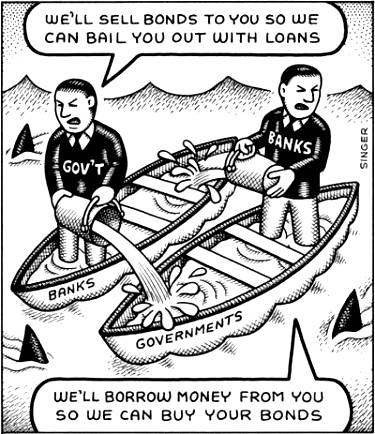
“…Ordinary Cypriots, like ordinary citizens in the Netherlands and Germany and anywhere else, had little or no say in how their governments and banks operate. They just go about their lives, working and putting some money away in savings. But governments and big banks set policies that favor the global financial oligarchy and enable them to send vast amounts of money rapidly around the globe in order to get high returns, by lending to governments through the banks.
But when things go sour and governments cannot repay, what they do is pit ordinary people of the donor countries against the ordinary people of the recipient countries in their efforts to make sure that the oligarchy in untouched. By causing people to think that ‘hardworking’ Dutch and Germans are subsidizing ‘lazy’ Greeks and Spaniards and Cypriots, and throwing in ‘greedy’ Russians into the mix, they manage to obscure the fact that they are all getting exploited because the allegiance of all their governments is to the big banks, and that the global oligarchy is really calling the shots through its puppets in the IMF and the ECB.
One sees this over and over again in other contexts. In the US we see how the oligarchy pits Chinese or Mexican workers against American workers, making them see each other as the enemy and fight with each other, when the real winners, all the time, are the global oligarchy, while the real losers, all the time, are the workers in each country…
As we well know, when you[the Oligarch class] own the media, then you can spin reality anyway you want it and have the plebs fighting amongst themselves. This is why the informed person will never win with brain-washed people quoting Bill O’Reilly and other such talking heads of the corporate-owned media. Just smile and roll your eyes.
The other article is by Yves Smith at naked capitalism which goes more into detail on the American Oligarchy and dispels much of the myths surrounding Cyprus.
…Now notice how much space I’ve devoted to showing that major parts of the conventional narrative about Cyprus are not all that they are cracked up to be. But see another implicit part of the story: that Russia’s oligarchs and “dirty money” are a distinctive national creation. Do you ever hear Carlos Slim or Rupert Murdoch or the Koch Brothers described as oligarchs? To dial the clock back a bit, how about Harold Geneen of ITT, which was widely known to conduct assassinations in Latin America if it couldn’t get its way by less thuggish means? (This is not mere rumor, I’ve had it confirmed by a former ITT executive)…
…there’s been a peculiar sanctimonious reluctance to apply the word oligarch to the members of America’s ruling class. Some of that is that we Americans idolize our rich, and the richer the better. No one looks too hard at the fact many of our billionaires started out with a leg up, parlaying a moderate family fortune (for instance, in the case of Donald Trump) into a bigger one, or having one’s success depend on other forms of family help (Bill Gates’ mother having the connection to an IBM executive that enabled Gates to license MS-DOS to them).
But the fact that some people have advantages and are able to make the most of them, isn’t the reason to pin the “o” word on America’s top wealthy. It’s that, like Simon’s prototypical emerging market magnates, they increasingly dominate our society and are running it strictly for own self interest and devil take the rest of us. And the results on important metrics are worse than in Russia. The Gini coefficient is a widely-used measure of income inequality. The Gini coefficient is worse (higher) for the US than for Russia…
…Top executives have operated in a manner that is less obviously thuggish than the violent ways of some of Russia’s richest, but the hollowing out of labor and shortened job tenures have come with high costs across broad swathes of society. And the oligarchs that Johnson singled out, the elite that control the biggest financial firms, have become singularly, systematically predatory. We discussed long from in ECONNED the scale and nature of the looting that produced the global financial crisis.
And let us not forget that people are dying thanks to bank-related abuses, even though it’s not as direct or obvious as by assassinations. On the mortgage front alone, we’ve discussed for three years how many foreclosures are simply unwarranted, some created by servicers for their own profit, many of the others unjustified because it would have been better for everyone, the borrower, the mortgage investors, the broader community, for the borrower to get a modification, but the servicer put its own bottom line first and foreclosed. There have been cases of suicides on the eve of foreclosures, and even a courtroom death that was attributed to the stress of fighting a dubious foreclosure. But in addition to these clear cases of death by bank, there are many more cases where the financial distress of a foreclosure leads to a later suicide, or the curtailment of spending on health measures that shorten lifespans. The major servicers have blood on their hands as much, likely much more, than the demonized Russian oligarchs, but everyone here is too polite to say so out loud.
Confucius said that the beginning of wisdom was learning to call things by their proper names. The time is long past to kid ourselves about the nature of the ruling class in America and start describing it accurately, as an oligarchy…
The colonization of the language by the corporate media is a large part of the way the masses can be controlled without firing a bullet, as illustrated by a commenter to the above article:
It’s absurd to call the crooks who have robbed or attempted to rob the Russian people of their wealth “oligarchs”, but then to turn around and call the cut-throat corporate vultures of Wall Street elite stewards of capitalism or “philanthropists” or merely “wealthy”.
The Western press has masterfully perpetuated this hypocritical view of the wealth accumulated in the West vs. Russia and vs. China as well. Notice that the press doesn’t dare call the Chinese billionaires in the communist party “oligarchs”.
It’s interesting how these terms get latched on to certain nations and cultures in pop-foreign-affairs discussions. It’s entirely originated by Western journalists pushing a corporate narrative of Americana that excludes the harsh reality of both the inequality and injustice of our modern system.
I’ll add that oligarchy as a term and a topic of political discussion goes back to Aristotle and the Greek philosophers.
You can’t sustain a democracy in an oligarchic state. The writers on Athenian democracy understood that 2000 years ago,”
– Chris Hedges, “The World As It Is: Dispatches on the Myth of Human Progress
The rich in the US are controlling policy. Since the 80′s they’ve been rigging the tax and regulatory framework to redistribute wealth upward.
The reality is that conservatives have been quite actively using the power of the government to shape market outcomes in ways that redistribute income upward. However, conservatives have been clever enough to not own up to their role in this process, pretending all along that everything is just the natural working of the market. And, progressives have been foolish enough to go along with this view.”
– Dean Baker, “The Conservative Nanny State
It started with Reagan, got worse in Clinton, and was maintained and finalized with the W. Bush tax cuts and benign neglect which Obama has continued (the exception are cases like Enron and Madoff, where rich people got hurt).
Oligarchy in its most basic definition is one where the ruling class protect and grow their wealth in their rule of a nation or society. Is there any doubt that, given the trends since the 80′s in both market deregulation, tax expenditures for the wealthy, and the growth in inequality and destruction of the middle class, that we have been in an oligarchal rule under the bankster corporate overlords and the military industrial complex, which includes all the moguls of Wall Street in energies, insurance, and banking.
It’s worth noting that Simon Johnson, someone who has demonstrated his competence in academia and policy at the IMF, and who has also tirelessly attempted to inform the public of the misdeeds of the powerful money changers, has focused specifically on the American oligarchs in the finance industry, as early as 2009:
In times of crisis, if the government doesn’t stand up for the people and use taxation and spending to fix the gross inequality that comes about from forms of unfettered capitalism, then the result is a massive wealth grab…
I think that sums up the situation quite nicely, and in a world of depleting resources we’ll see more of this greedy scramble for the last few slices of the economic pie as it shrinks. Get ready to pitch a tent in an American shanty town coming near you.
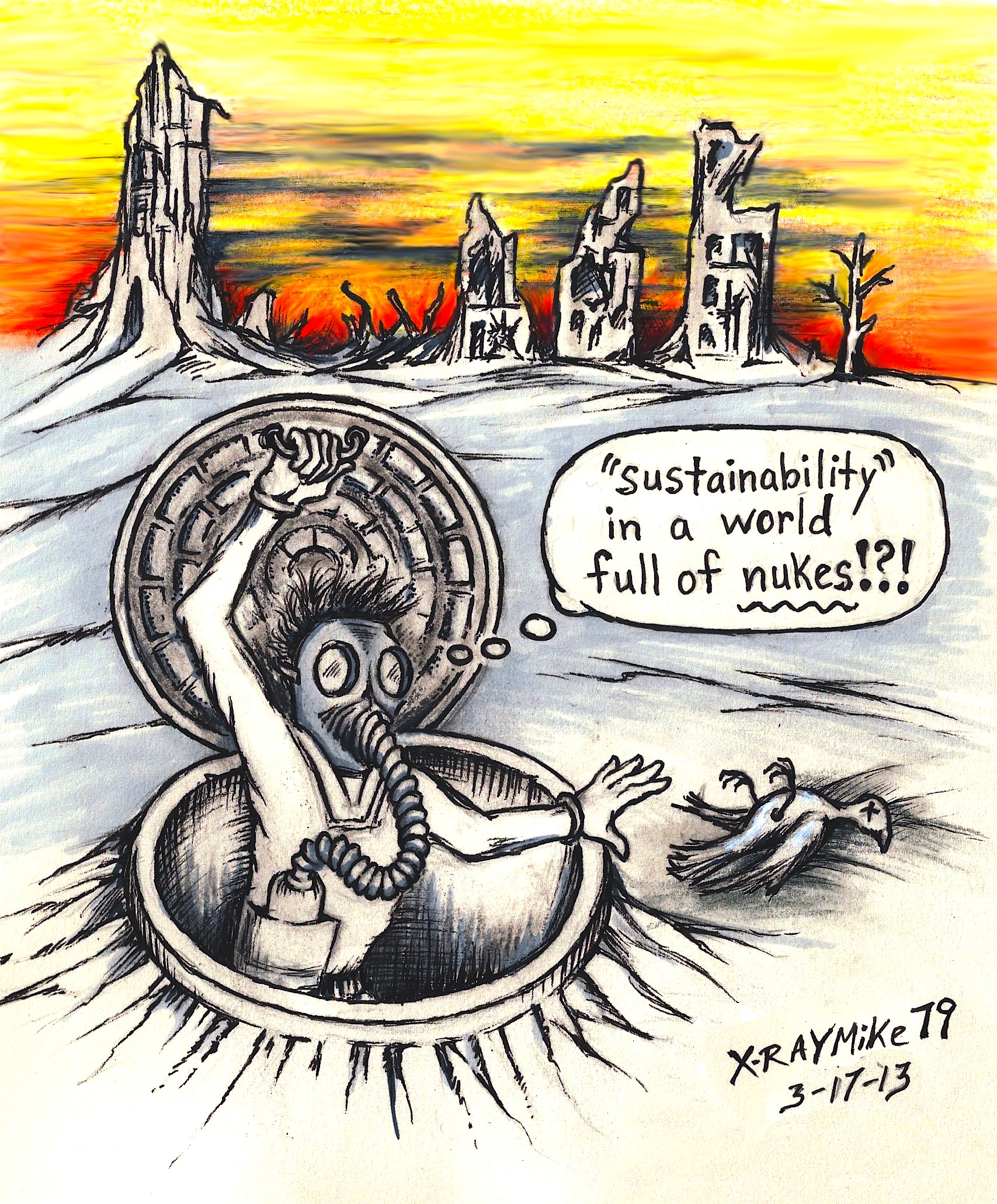
Ever since the dawn of the nuclear age, mankind has been living with the ever-present threat of mass annihilation. From the naive ‘duck and cover’ days of the Cold War to the present-day threat of a terrorist cell sneaking a nuke into a city on a truck, perhaps no single invention has affected the psyche of mankind. Nuclear weapons have only been used twice thus far, Hiroshima and Nagasaki. Contrary to the popular myth that the bombing of those two Japanese cities helped end the war, America used the already defeated Japan as a nuclear sacrificial lamb in order to intimidate Russia and limit Soviet expansion into Asia. So we have set the stage whereby any country, if it wants to gain respect and not face the threat of regime change, must strive to join the nuclear club. Nuclear proliferation cannot be stopped when nations see the power and status they can attain by becoming part of the club.
…For nuclear newcomers, the bomb is both a product of and an instrument for nationalist aspirations. Moreover, in this new, dangerously complicated world, nuclear weapons, while they may not be exploded, are assuredly used in many ways: to bluff, to intimidate, to rally the populace, to throw opponents off balance. “Anyone who says that nuclear weapons aren’t usable should take a look at North Korea,” Bracken writes. “Nuclear weapons are used every single day to extort food and oil from the rest of the world to keep the regime going.” Disarmament, he would say, is a sweet fantasy. The best we can hope for is to “manage” the nuclear menagerie — and we cannot be confident of success… –source
Below is a great interactive infographic showing who is in the nuclear club, who has nuclear plants as part of their energy mix, and who has both. As everyone should know, nations striving for nuclear energy also get on the fast track to obtaining nuclear bombs, if they so choose.
click on the image to use the infographic…
Lately, North Korea has once again been using its nukes as a political tool. The public opinion in South Korea has now fully swung toward the belief that they too must acquire the big stick of nukes in order to counter their neighbor’s threats.
…We, the Korean people, have been duped by North Korea for the last 20 to 30 years and it is now time for South Koreans to face the reality and do something that we need to do,” said Chung Mong-joon, a lawmaker in the governing Saenuri (New Frontier) Party and a former presidential conservative candiate. “The nuclear deterrence can be the only answer. We have to have nuclear capability…
…According to a February poll conducted by South Korea’s private think tank, Asan Institute, 66% of South Koreans said they support developing a nuclear weapons program. The poll suggests that just under half of South Koreans in 2012 believed that the United States would provide South Korea with what’s known as the “nuclear umbrella” in the case of a North Korean nuclear attack, indicating a 7% decrease from 2011…
Having 23 commercial reactors in operation makes South Korea one of the world’s top five commercial nuclear powers and gives it the ability to produce uranium or plutonium for nuclear weapons. South Korea could have nukes within 6 months.
We know that despite the setback Iran faced with the Stuxnet virus, it is only a matter of time before it develops nukes as well.
Now we get to the age of resource scarcity and climate destabilization, both of which have proven to be conflict multipliers. The grotesquely named Operation Iraqi Freedom was about nothing more than freeing up that country’s oil resources. Ten years later the country is in ruins, but Big Oil is benefitting (I’m surprised CNN ran this story):
…Oil was not the only goal of the Iraq War, but it was certainly the central one, as top U.S. military and political figures have attested to in the years following the invasion.
“Of course it’s about oil; we can’t really deny that,” said Gen. John Abizaid, former head of U.S. Central Command and Military Operations in Iraq, in 2007. Former Federal Reserve Chairman Alan Greenspan agreed, writing in his memoir, “I am saddened that it is politically inconvenient to acknowledge what everyone knows: the Iraq war is largely about oil.” Then-Sen. and now Defense Secretary Chuck Hagel said the same in 2007: “People say we’re not fighting for oil. Of course we are.”
For the first time in about 30 years, Western oil companies are exploring for and producing oil in Iraq from some of the world’s largest oil fields and reaping enormous profit. And while the U.S. has also maintained a fairly consistent level of Iraq oil imports since the invasion, the benefits are not finding their way through Iraq’s economy or society.
These outcomes were by design, the result of a decade of U.S. government and oil company pressure. In 1998, Kenneth Derr, then CEO of Chevron, said, “Iraq possesses huge reserves of oil and gas-reserves I’d love Chevron to have access to.” Today it does…
…Iraq’s oil production has increased by more than 40% in the past five years to 3 million barrels of oil a day (still below the 1979 high of 3.5 million set by Iraq’s state-owned companies), but a full 80% of this is being exported out of the country while Iraqis struggle to meet basic energy consumption needs. GDP per capita has increased significantly yet remains among the lowest in the world and well below some of Iraq’s other oil-rich neighbors. Basic services such as water and electricity remain luxuries, while 25% of the population lives in poverty…
…a leading coalition of Iraqi civil society groups and trade unions, including oil workers, declared on February 15 that international oil companies have “taken the place of foreign troops in compromising Iraqi sovereignty” and should “set a timetable for withdrawal.”…
In an age of mass delusion, inverted totalitarianism, and scapegoating, will the logic of MAD (mutually assured destruction) be enough to prevent a nuclear war? The energy skeptic sums up the failure of such thinking in the following quote:
And what of the odds even in a world not facing peak everything and climate chaos?
…The inevitability concept can best be understood by analogy to finance. It does not make sense to talk of an interest rate as being high or low, for example 50 percent or 1 percent, without comparing it to specific period of time. An interest rate of 50 percent per year is high. An interest rate of 50 percent per century is low. And the low interest rate of 1 percent per year builds up to a much larger interest rate, say 100 percent, when compounded over a sufficiently long time.
In the same way, it does not make sense to talk about the probability of nuclear war being high or low — for example 10 percent versus 1 percent — without comparing it to a specific period of time — for example, 10 percent per decade or 1 percent per year.
Having gotten the units right, we might argue whether the probability of nuclear war per year was high or low. But it would make no real difference. If the probability is 10 percent per year, then we expect the holocaust to come in about 10 years. If it is 1 percent per year, then we expect it in about 100 years.
The lower probability per year changes the time frame until we expect civilization to be destroyed, but it does not change the inevitability of the ruin. In either scenario, nuclear war is 100 percent certain to occur….
A few noteworthy news stories came across my desk. If anyone still believes the human race will suddenly become endowed with a collective enlightenment to stop throwing its fossil fuel garbage into the air and avert climate chaos, theses recent news articles should put that pipe dream to rest. The first two are further confirmation that we are on a fast track to nowhere with human-induced climate change. 2012 CO2 levels increased by 2.67 parts per million and marked the second biggest jump since records began in 1959, bringing the planet to just under 395 parts per million (ppm). 1998 has the record with a CO2 jump of 2.84 ppm.
A widely reported study recently confirms that the Earth has not been this warm in 11,300 years. See the spike at the end of the graph up above; that’s from man’s frantic industrial activities over the last few hundred years which have actually reversed what should have been a continued cooling trend. Plants are responding to this aberrant spike in global temperature by migrating northward.
Some major institutions of industrial civilization are taking note of this reality while others are not. Firstly, the U.S. military is reaching out to foreign governments in order to prepare for what will be a humanitarian catastrophe:
…when it comes to pragmatic military planning, Locklear said he is increasingly focused on another highly destabilizing force.
“The ice is melting and sea is getting higher,” Locklear said, noting that 80 percent of the world’s population lives within 200 miles of the coast. “I’m into the consequence management side of it. I’m not a scientist, but the island of Tarawa in Kiribati, they’re contemplating moving their entire population to another country because [it] is not going to exist anymore.”
The US military, he said, is beginning to reach out to other armed forces in the region about the issue.
“We have interjected into our multilateral dialogue – even with China and India – the imperative to kind of get military capabilities aligned [for] when the effects of climate change start to impact these massive populations,” he said. “If it goes bad, you could have hundreds of thousands or millions of people displaced and then security will start to crumble pretty quickly.’- source
While on Wall Street, investors are accepting the mindset that climate change is inevitable and instead of investing in “green energy”, they are taking a more catastrophic approach:
Working under the assumption that climate change is inevitable, they’re investing in businesses that will profit as the planet gets hotter. (The World Bank says the earth could warm by 4C by the end of the century.) Their strategies include buying water treatment companies, brokering deals for Australian farmland, and backing a startup that has engineered a mosquito to fight dengue, a disease that’s spreading as the mercury climbs…
…When investors think about global warming, “there is an overemphasis of its negative impacts,” says Michael Richardson, head of business development at Land Commodities, which advises rich individuals and sovereign wealth funds on purchases of Australian farmland. The company’s pitch: The gloomy prospect of hotter temperatures, scarce arable land, and rapidly rising populations will make inland cropland Down Under—far from rising seas yet close to Asia’s hungry customers—more valuable…
To which a reader makes the following comment about this shameless profiting from doom:
…This could be disastrous for the global economy. As Ceres notes, the global economy would be paralyzed without insurance lubricating commerce. And since the insurance industry is also a major institutional investor-to the tune of $5 trillion-bad bets on companies exposed to climate change risk could erode insurers’ own balance sheets and their ability to cope with multiple Sandy’s in the years to come. Not to mention liability from litigation arising from customers such as power plant operators whose emissions contribute to climate change. “A substantial proportion of the revenue generated by insurers is derived from investment returns,” the Ceres report notes. “Just as climate change may substantially increase insured losses, it may also adversely affect the investment performance that insurers rely on to meet their liabilities.’
In his latest post, scientist Brad Jarvis talks about a “hard shutdown” versus a “graceful shutdown” of industrial civilization:
I have not read the book “Lights Out,” but I imagine one of the devastating consequences of a “hard shutdown” would be the loss of energy to nuclear plants and those unspent fuel rods sitting there like ticking time bombs.
U.S. reactors have generated about 65,000 metric tons of spent fuel, of which 75 percent is stored in pools, according to Nuclear Energy Institute data. Spent fuel rods give off about 1 million rems (10,00Sv) of radiation per hour at a distance of one foot — enough radiation to kill people in a matter of seconds. There are more than 30 million such rods in U.S. spent fuel pools. No other nation has generated this much radioactivity from either nuclear power or nuclear weapons production…
Even though they contain some of the largest concentrations of radioactivity on the planet, U.S. spent nuclear fuel pools are mostly contained in ordinary industrial structures designed to merely protect them against the elements. Some are made from materials commonly used to house big-box stores and car dealerships…”
The Sequester has been the big topic in the news as of late. What it amounts to is austerity for the masses in America. Obama created this stealth austerity maneuver with his newly appointed Secretary of Treasury, Wall Street shark Jacob Lew:
…President Obama and a host of administration spokespersons have condemned the Sequestration, explaining how it will cause catastrophic damage to hundreds of vital government services. Those of us who teach economics, however, always stress “revealed preferences” – it’s not what you say that matters, it’s what you do that matters. Obama has revealed his preference by refusing to sponsor, or even support, a clean bill that would kill the sequestration threat to our Nation. Instead, he has nominated Jacob Lew, the author of the Sequestration provision, as his principal economic advisor. Lew is one of the strongest proponents of austerity and what he and Obama call the “Grand Bargain” – which would inflict large cuts in social programs and the safety net and some increases in revenues. Obama has made clear that he hopes this Grand Betrayal (my phrase) will be his legacy. Obama and Lew do not want to remove the Sequester because they view it as creating the leverage – over progressives – essential to induce them to vote for the Grand Betrayal…
In a rare case of truth-telling, a San Francisco news station spells out exactly what this stealth austerity is intended to do – strip away what is left of the social safety net and the remnants of the New Deal:
So while the financial elite are protected by wealth security insurance programs, aka quantitative easing and endless bailouts, the carcass of Main Street is picked clean by various asset grabs. Conservatives are correct in that you cannot have endless growth of debt and spending, but their demand of government cuts as the way to bring back growth and renew the economy will not work. It will serve only to further push down an already devastated middle class, hastening America’s fall into a barbaric neo-feudal society in a world of resource-scarcity and environmental devastation.
…It follows that neoliberal leaders of governments and their corporate masters view the ongoing economic contraction as a temporary deviation from the “natural” pattern of wealth accumulation-to-elites-trickle down-to-the-masses economics made possible by constant growth. Therefore, economic elites see an “opportunity” to use austerity as a cover to increase upward wealth transfer.[xi] A bonus is to accomplish the long-standing atavistic goal of rolling back[xii] the gains of the New Deal and Great Society.[xiii] Hence the massive governmental and corporate propaganda assaults on Social Security, Medicare and Medicaid –and other social benefits programs- as “Entitlements” that allegedly weaken the collective moral character, fiscal integrity and work ethic of the nation. The central premise of this attack -which is arrantly false yet widely disseminated without skepticism by mainstream media- is that these entitlements[xiv] for the “Lesser People”[xv]place the United States government at high risk of debt[xvi] default[xvii] or bankruptcy.[xviii]
Sixty years ago Karl Polanyi anticipated the present crisis when he wrote that belief in “free market forces” –a dogma at the core of neoliberalism[xix]– is a direct threat to the “natural environment…[which also] would result in the demolition of society.”[xx]…
…It is vital to remember that on the whole, they do not yet understand why modern societies -right now- are entering a post-growth world, which augers a context where government public policy –if it overcomes neoliberalism,[xxxv] which is not guaranteed- faces the central challenge of justly divvying up a shrinking economic pie. (Remember that almost every public health lecture, article and discussion in the United States ends with some variation of this exhortation: “We’re the wealthiest and greatest nation on earth. We’ve got the technology, know-how and resources to do the job; we just need the determination to commit them…”)
Neoliberal governments are blind to the emerging world of degrowth and continue apace facilitating the 1% to impoverish and cannibalize widening segments of the 99%, in essence producing more and more socioeconomically and politically superfluous people in the process. Neoliberalism can only operate in a social world where as the economy contracts -for thermodynamic reasons- wealth and other economic benefits continue to flow upwards, while the costs and burdens fall upon those outside the tiny elite economic… – source
In other words, capitalism is cannibalizing itself – eating the underclass and environment to keep this unchecked growth of wealth accumulation intact for the upper class, as scientist Brad Jarvis also explains:
The big news of the week was, of course, the “sequester,” one of several attempts by radical government-haters to open the door to unrestrained pillage of nature and society; it will cut back on many of the means we currently have for limiting and adapting to environmental damage. The scale of that environmental damage includes, of course, more than climate change: recent research shows that wild bees are more critical to our food supply than honeybees, and being wiped out by the top mechanism of extinction, habitat loss…
…I recalled something I learned a few years ago about what is perhaps the key driver of business operation, pursuit of profit. Profit must continuously increase, preferably at an exponential rate, for a business to be considered successful. There are several ways to do so: add value to what you produce, increase demand for what you’re already making, and reduce costs. The first two approaches increase consumption if the business can provide supply to meet demand, which is bad enough in a resource-constrained world. The last approach, however, is the most damaging when applied exponentially, because there is always a minimum cost required – you can’t get something for nothing – and if you’re “successful,” you are likely just good at forcing someone else to eat that cost. Many of the mechanisms directly causing unhealthy income and social inequality in this country and elsewhere may be directly tied to the application of this approach, but it has even more far-ranging effects. Because business is the most powerful human enterprise, society and the planet’s other species are effectively being forced to give more than they can afford and still survive. We are all dying as a result. – source
What else can I say, but that we will eventually have to eat the rich.
The usual suspects of drought, famine, pestilence and war come to mind when one thinks of a future population crash. The ongoing drought in America’s bread basket appears to be just a foretaste of what’s in the climate chaos pipeline.
…Climate change will also lead to changes in global rainfall patterns, intensifying both droughts and floods across the globe. The Clausius-Clapeyron equation dictates that the saturation vapor pressure of water increases nearly exponentially with temperature. Therefore, a warmer atmosphere will allow for more evaporation of water and an intensification of the hydrologic cycle, leading to increases in rainfall in some regions and decreases in others. At the present, rainfall has increased in the mid- and high-latitudes and in the tropics, while it has decreased in the sub-tropics. If global average temperature increases by 2 °C, dry-season precipitation in northern Africa, southern Europe, and western Australia is projected to decrease by ~20%, and that in the southwestern United States, eastern South America, and southern Africa to decrease by ~10%, which will have a profound impact on crop productivity and water resources. For comparison, the American “dust bowl” in the 1930s was the result of a ~10% decrease in rainfall over a decade. A reduction in mountain snow pack and glaciers will also exacerbate stresses on water resources. Climate change is also predicted to increase the frequency and magnitude of extreme weather events such as hurricanes, heat waves, heavy precipitation events, and flooding. Additionally, if global average temperature increases by 1.5- 2.5 °C, approximately 20-30% of plant and animal species will be at risk of extinction. As in the case of rising sea level, these consequences of climate change are irreversible on a 1,000-year timescale because temperature increases caused by elevated CO2 are expected to persist for that time period even if carbon emissions are fully curtailed [Solomon et al., 2009; IPCC, 2007]…
Now for the current study(actual report is here) which says that we are only eight years away from a life-altering megadrought:
Beginning in just eight years, we could see permanent climate conditions across the North American Southwest that are comparable to the worst megadrought in 1,000 years. (1)
The latest research from the Lamont-Doherty Earth Observatory at Columbia University published in December 2012 has some truly astounding news. The megadroughts referred to in the paper published in Nature Climate Change happened around about 900 to 1300 AD and are so extreme that they have no modern counterpart for comparison (these megadroughts will be referred to in the following as the “12th century megadrought”). The research was funded by the National Oceanic and Atmospheric Administration (NOAA).
We have been warned for decades that we would be facing a megadrought if we did not do something about climate pollution. We did not, and now according to the projections of a new study, that is just what the future may hold. And remember, projected conditions similar to the worst megadrought in 1,000 years would be the baseline conditions. Dry periods, which we normally refer to as drought times today, would be superimposed on top of the megadrought extremeness…
…The results of the new research are critically deserving of an alarmist tone. That we could slip into profound continuous drought so soon is certainly a surprise to most of us, to say the least. The typical consensus opinion of unrestrained climate pollution impacts by the year 2100 only tells us that permanent drought will come to many parts of the world and, basically, that dry areas could become drier. The news that we could be experiencing permanent drought on the scale of megadrought proportions – beginning in only eight years – should be considered a global threat of the highest order…
…This “most severe, but temporary, long-term decrease in flow recorded” is the concept we need to understand. This is the megadrought reference. A 10 percent reduction beginning 2021 to 2040 is extreme enough for these researchers to compare the average conditions projected for the very near future to the 12th Century megadrought. This single message is critical and it was missed by popular reporting. Just to be sure I am clear: this quote “temporary, but long-term decreases in flow” here refers to these 75- to 200 year-long megadroughts, the last one occurring about 1,000 years ago or in the 12th Century. These droughts were temporary, like the droughts of today, but in the near future, conditions comparable to these droughts will be the average climate condition. Dry periods that we know as drought today will be on top of megadrought dryness…
And from a recent talk by Jeff Lukas, the Senior Research Associate of Western Water Assessment at the University of Colorado:
On January 17, 2013, Jeff Lukas, the Senior Research Associate of Western Water Assessment at the University of Colorado, gave an hour-long presentation at the most recent Weather and Climate Summit. The take-away from his presentation is this: droughts will be getting worse, no question about it. Cause: climate change. Time-frame: already started. And a potential megadrought, a phenomena that hasn’t reared its ugly head for at least 150 years, poses a real and serious risk that needs to be planned for…
…Megadroughts, are generally considered to be periods of 20 years or longer where continuous, or mostly continuous extreme drought covers a very large area, typically about 1/3 of the lower 48 (US states). And they’re as bad as they sound – maybe worse.
If such a drought happens, the Colorado River’s flow will drop drastically. The Bureau of Reclamation, which estimates that 25% of the US food supply is grown using Colorado River water, has already done a study to simulate a megadrought; results: Glen Canyon Dam hydro plant would have to stop generating power for about 20 years (two separate stretches of 10 years during the simulation). Both lake Mead and Lake Powell would see water levels drop by about 100 feet…
Jeff Lukas explained in his talk that there have been times in the past 1,000+ years when drought was so bad that the Colorado River (which supplies both Lake Mead and Powell) flowed at 25% below its current flow rate. And that very low level of flow was sustained for decades. Lukas says that such a scenario is definitely possible today. In fact, he says it is such a high risk that it needs to be planned for.
…For those that don’t know, the Colorado River is already maxed out. The Southwest has seen some of the highest US population growth over recent decades, and coupled with farming demands, the river water is nearly all spoken for…
…He concludes that drought is seriously underestimated as a severe threat – even if a megadrought doesn’t develop in the near-future. Because of warming he says there will be more drought than we’ve ever seen before. And the droughts that would otherwise be moderate will now be severe – intensity will ratchet upwards with temperature. He also says that trends of the past several years are worrying when compared to the record that dates back to the year 750…
If a megadrought does unfold, past episodes may be a guide to the future. Lukas outlines a few of the effects that have been uncovered regarding past megadroughts: sand dunes forming in western Nebraska (i.e. no plants, just sand), more frequent wildfire, and rapidly dropping lake levels. One consequence that Lukas didn’t talk about was how drought-killed plants stop pulling CO2 out of the air.
…Right now, the dams and reservoirs along the Colorado can capture and store runoff, even from severe rainfall events, but only up to their maximum storage capacity, which is around 60 million acre feet, or about 4 years worth of water demand. Groundwater can be pumped up (i.e. wells) in many places, but that resource is already in sharp decline.











 Collapse of Industrial Civilization