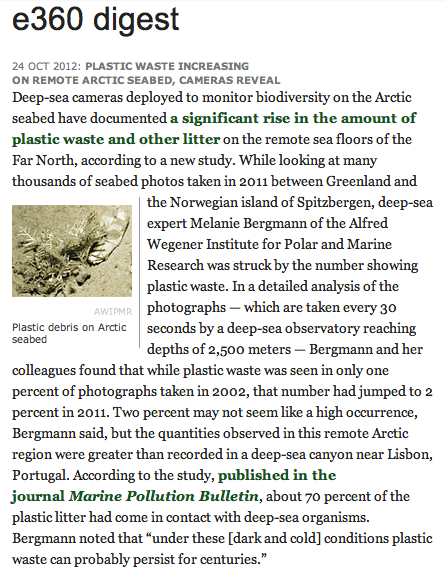
It’s late and I’m about to nod off, but a few headlines caught my eye. The first is on plastics and its growing ubiquitousness in the natural world. If you read an earlier post I did on this subject, then you’ll know that plastics may well be the one thing that will persist long after industrial civilization has passed into the ether of history. Plastics and nuclear waste will be the lasting reminders of carbon man. As the following article explains, this stuff is showing up in the dark, cold depths of the melting Arctic.
Click to go to original article…
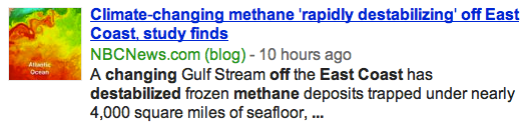
In other news, the ominous threat of a cataclysmic global release of methane from ocean floors is continuing to develop, increasing the possibility of runaway climate change…
A changing Gulf Stream off the East Coast has destabilized frozen methane deposits trapped under nearly 4,000 square miles of seafloor, scientists reported Wednesday. And since methane is even more potent than carbon dioxide as a global warming gas, the researchers said, any large-scale release could have significant climate impacts.
Using seismic records and ocean models, the team estimated that 2.5 gigatonnes of frozen methane hydrate are being destabilized and could separate into methane gas and water.
It is not clear if that is happening yet, but that methane gas would have the potential to rise up through the ocean and into the atmosphere, where it would add to the greenhouse gases warming Earth.
The 2.5 gigatonnes isn’t enough to trigger a sudden climate shift, but the team worries that other areas around the globe might be seeing a similar destabilization.
“It is unlikely that the western North Atlantic margin is the only area experiencing changing ocean currents,” they noted. “Our estimate … may therefore represent only a fraction of the methane hydrate currently destabilizing globally.”
The wider destabilization evidence, co-author Ben Phrampus told NBC News, includes data from the Arctic and Alaska’s northern slope in the Beaufort Sea.
And it’s not just under the seafloor that methane has been locked up. Some Arctic land area are seeing permafrost thaw, which could release methane stored there as well.
An expert who was not part of the study said it suggests that methane could become a bigger climate factor than carbon dioxide.
“We may approach a turning point” from a warming driven by man-made carbon dioxide to a warming driven by methane, Jurgen Mienert, the geology department chair at Norway’s University of Tromso, told NBC News.
“The interactions between the warming Arctic Ocean and the potentially huge methane-ice reservoirs beneath the Arctic Ocean floor point towards increasing instability,” he added.
OK that’s enough information to put me soundly to sleep. Wake me up when the ‘Methane Time Bomb’ nightmare is over. The pot starts to boil, but the frogs are still comfortable…
Having lived in the Mohave desert for about a decade, I had the dubious pleasure of enduring its scorching summer temperatures which can push 130° Fahrenheit. Without the usual creature comforts of modern industrial civilization like air conditioning, refrigerated foods and drinks, and piped-in water, life is such inhospitable places would be brutal if not impossible. What if such desert heat was the norm across the land surface of the planet? Then extreme places of desert heat like the Mohave desert would become dead zones for any living plant or animal we have known. Instead of peaking at around 130° F, it would reach unthinkable, Venus-like temps of greater than 200° F. Depending on the source you use, the average land surface temperature that we humans have enjoyed is 13° to 17° Celsius or 55.4° to 62.6° Fahrenheit. For the ocean surface, the average is about 17 °C (62.6 F). According to new research concerning the time of the Permian-Triassic Mass Extinction or ‘mother of all extinction events’, there occurred yet another mass extinction within that time span called the Smithian-Spathian extinction in which lethal global warming developed. The average land temperature in the tropics was an unimaginable 122-140°F (50-60°C)with average sea surface temperatures of 104°F (40°C). Such intolerable temperatures resulted in a massive ‘dead zone’ belt around the Earth:
Plant and animal life had it rough 250 million years ago. As if to add insult to injury, the end-Permian mass extinction was quickly followed by yet another mass extinction, what’s called the Smithian-Spathian extinction. New research suggests that the Earth got excruciatingly hot during this period, creating a veritable ‘dead zone’ in tropical areas, what forced the remaining animal life to head to the poles. And it lasted for nearly 5 million years.
According to research done by Yadong Sun and Paul Wignall of the University of Leeds, UK, this was hottest era on Earth since it cooled down from its initial molten formation. Their study has reset notions of just how hot our planet can get — a disturbing bit of insight that could reset current models of climate change on Earth.
The Smithian-Spathian extinction was time that characterized the shift from the Permian era to the Triassic, just before the emergence of the dinosaurs. By this point, the mysterious Permian Extinction had reduced the life on Earth to a select group of insects, plants, marine life (like fish, coral, sea lilies, and ichthyosaurs), and terrestrial animals (like insects and the reptilian tetrapod).
Sun and Wignall’s research indicates that during this time, the heat at the tropical regions reached an astounding 50 to 60°C (122°F to 140°F) on land, while the waters at the surface reached 40°C (104°F). They were surprised to discover that the water could get that hot; previous estimates assumed that sea-surface temperatures could not surpass 30°C (86°F). Moreover, at 40°C, most marine life dies and photosynthesis stops…
…What happened? Essentially, the superhot Earth was caused by a breakdown in global carbon cycling. Normally, plants help regulate temperature by absorbing CO2 and burning it as dead plant matter. But without plants, the CO2 levels rose unchecked, causing a spike in temperatures. Specifically, the researchers estimate that at least 12×103 gigatons of isotopically depleted carbon as methane was injected into the atmosphere…
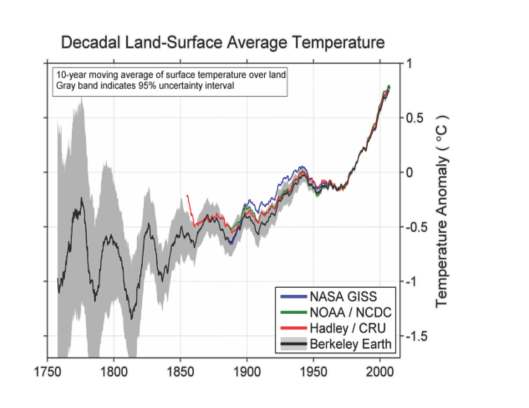
…My total turnaround, in such a short time, is the result of careful and objective analysis by the Berkeley Earth Surface Temperature project, which I founded with my daughter Elizabeth. Our results show that the average temperature of the earth’s land has risen by two and a half degrees Fahrenheit over the past 250 years, including an increase of one and a half degrees over the most recent 50 years. Moreover, it appears likely that essentially all of this increase results from the human emission of greenhouse gases.
These findings are stronger than those of the Intergovernmental Panel on Climate Change, the United Nations group that defines the scientific and diplomatic consensus on global warming…
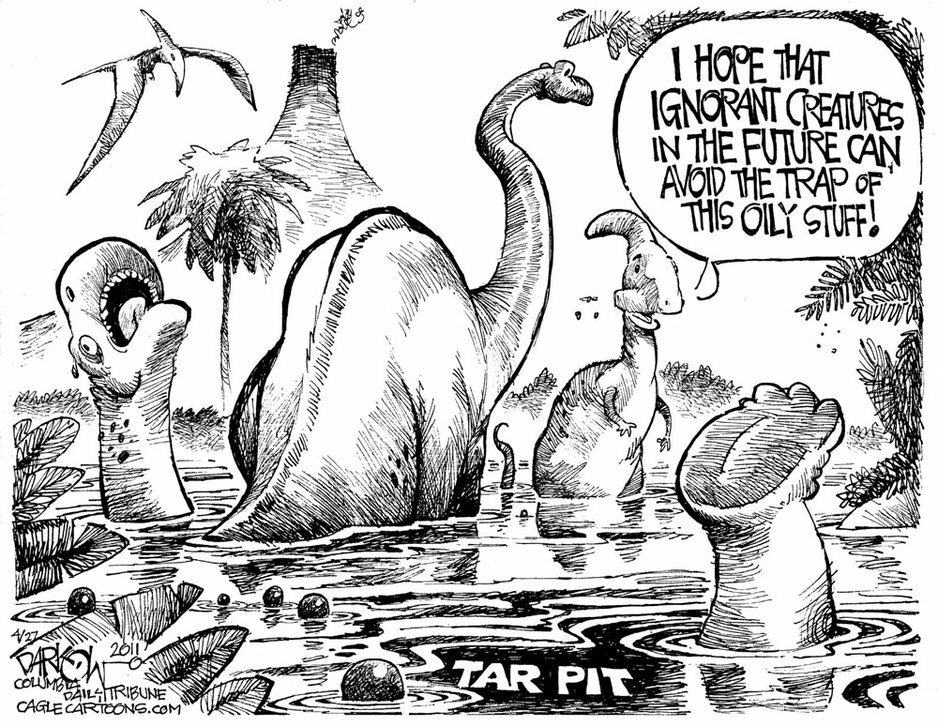
Are we in the beginning phases of walking headlong into another mass extinction of our own creation, altering the chemistry of the oceans and atmosphere through the burning of fossil fuels? If you’ve been reading this blog, then you know about feedback loops and tipping points and their consequences if humans continue to force changes in the delicate ecosystems of this planet. Monthly reports from the NOAA are not very comforting:
…The average global temperature across land and ocean surfaces during September was 0.67°C (1.21°F) above the long-term 20th century average. This temperature ties with 2005 as the record warmest September in the 133-year period of record. The Northern Hemisphere tied with 2009 as second warmest on record, behind 2005. The Southern Hemisphere also ranked second warmest on record, behind 1997. It was also the highest departure from average for any month in the Southern Hemisphere since May 2010…
The difference between now and 250 million years ago is that profit-seeking corporations were not around to hoodwink the denizens of the planet into perpetuating their own extinction…
…despite its history and today’s unprecedented riches from science, the U.S. has begun to slip off of its science foundation. Indeed, in this election cycle, some 236 years after Jefferson penned the Declaration of Independence, several major party contenders for political office took positions that can only be described as “antiscience”: against evolution, human-induced climate change, vaccines, stem cell research, and more. A former Republican governor even warned that his own political party was in danger of becoming “the antiscience party.
Or the fact that the belief in an unfettered free market has become sacrosanct…
…In order to understand the fervor of this continued popular support for failed policies, it is important to grasp the utopian, quasi-theological nature of neoliberal ideology. In the neoliberal worldview, the self-regulating market is not a merely human construct, but a form of naturally-occurring “spontaneous order” that produces optimum outcomes and maximum individual freedom if left completely unfettered. (13) It is, as Karl Polanyi pointed out in “The Great Transformation,” a radically utopian vision that rests on a blind faith that markets are essentially part of the natural order. (14)
On the political right, this faith has reached its fullest expression, ultimately moving markets into the realm of the sacred, where their legitimacy cannot be questioned. In this utopian setting, regulation is not merely ill advised; it is a violation of natural law that is nearly sacrilegious…
We’re not wiser, just more manipulative and conniving…



 Collapse of Industrial Civilization