Contrary to what some may have you believe, future climate projections gleaned from current models have not accurately predicted how truly dire the future is for all living things on Earth. In order to get a true reading of what is in store for us, Prof Julie Brigham-Grette lead her team to a remote meteor crater in Russia where Lake El’gygytgyn rests. What makes this spot special is that this area has never been disturbed by glacier erosion, leaving behind a perfect sediment record of the Earth’s climate dating back millions of years.
Lake El’gygytgyn may be the only place in the world that has this incredible unbroken record of sediments going back millions of years,” said Prof Scott Elias, at Royal Holloway University of London. “When you have a very long record it is very difficult to argue with.
A 2011 study in the journal Paleoceanography showed that during the Pliocene Epoch [~ 4.6 to 2 million years ago] the Earth’s CO2 levels were at the level it is today (400ppm). At that time, temperatures were 8 degrees Celsius warmer in the Arctic summer than they are today. Humans have ramped up the CO2 level so high and in such a short period that the Earth’s climate system has not yet fully reacted to this drastic atmospheric change. This is what we call the climate lag time. In 2005, Hansen estimated the “climate lag time” to be between 25 to 50 years.
An article on this subject given to me by Gail from Wit’s End mentions the “climate lag time” as well:
There is a time lag of up to 30 years for the temperature to be forced up by the extra CO2 in the atmosphere, so the scientists’ findings give a clue to what to expect by the middle of the century…
When looking at these recent Lake El’gygytgyn findings, the NTE estimates of Guy McPherson don’t seem all that strange after all:
My feeling is we have underestimated the sensitivity, unless there are some feedbacks we don’t yet understand or we don’t get right in the models.”
Prof Robert Spicer, at the Open University and not part of the new study, agreed: “This is another piece of evidence showing that climate models have a systematic problem with polar amplification,” ie the fact that global warming has its greatest effects at the poles. “This has enormous implications and suggests model are likely to underestimate the degree of future change.“…
“I think we will feel the effects of climate change quickly – in years or decades – because changes in the Arctic sea ice bring changes in the circulation of the atmosphere and the oceans,” says Elias. ” Arctic sea ice keeps that entire region cool and when it melts, the dark ocean revealed absorbs even more heat.”
“Clearly the Arctic is warming very, very rapidly at the moment,” said Prof Peter Sammonds, at University College London. “And if all the sea ice goes, there is no good reason why it might come back again.
In other eco-apocalyptic news, the public (including JMG) are still asleep at the wheel:
It symbolizes that so far we have failed miserably in tackling this problem,” said Pieter P. Tans, who runs the monitoring program at the National Oceanic and Atmospheric Administration that reported the new reading.
Ralph Keeling, who runs another monitoring program at the Scripps Institution of Oceanography in San Diego, said a continuing rise could be catastrophic. “It means we are quickly losing the possibility of keeping the climate below what people thought were possibly tolerable thresholds,” he said.
I saw yesterday that peak oil historian John Michael Greer weighed in on the current debate over NTE or near-term extinction for humanity. After reading his post The Pleasures of Extinction, I was quite disappointed in his outright dismissal of the possibility of NTE in the face of recent unprecedented climatic changes. His post does not address any of the scientifically backed findings which, with business-as-usual, point to an uninhabitable future for mankind, let alone most other flora and fauna. Indeed, the predictions of the IPCC have been proven to be much too conservative and do not take into account known positive feedback loops. As they say on Wall Street, past performance does not necessarily predict future results. Even if all human-generated CO2 ceased today, we have a future of environmental catastrophe awaiting us with what has already been pumped into the atmosphere. Referring to NTE as “apocalypse machismo”, Greer paints it as some sort of passing cultural fad in keeping with other doomsday scenarios our culture has popularized, such as the Mayan Prophecy of 2012 or the Rapture of Christian Fundamentalists. He also lumps NTE in with the suicide pacts of lunatic-fringe cult groups:
…Those of my readers who remember the Solar Temple mass suicides of 1994 and 1995 may recall that the collective suicide note left behind by the members of that ill-fated order made exactly that claim: Earth would be uninhabitable by the year 2000, Solar Temple founder Luc Jouret insisted, and so the initiates of the Solar Temple were getting out while the getting was good.
After reading through the numerous comments on Greer’s post, I found several people who had the same incredulous reaction I did:
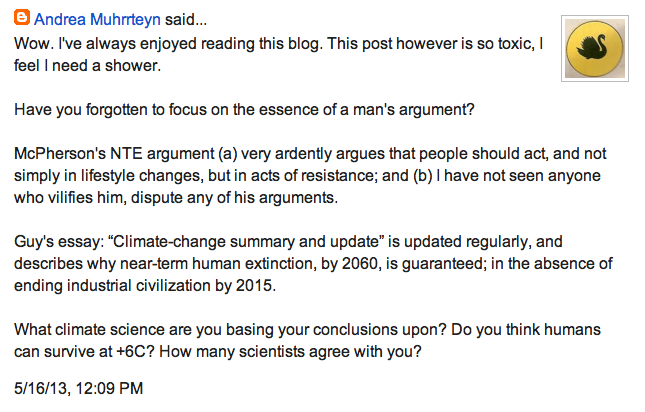
And this one…
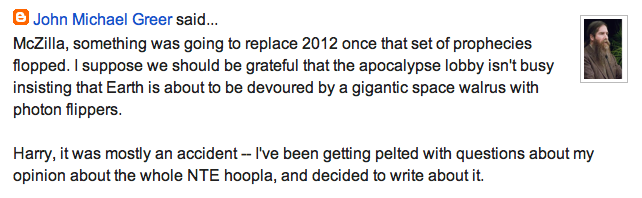
Here was Greer’s response to the above comment by Andrea:
WTF? The science is not the essence of the argument??? I suppose we could say the same for Peak Oil, Ocean Acidification, The 6th Mass Extinction, The Global Die-Off of Forests, etc. They are all part of the doomsday narrative that people are pushing with no science backing up the essence of their argument. Must be a global conspiracy created by some shadowy network of armageddonists.
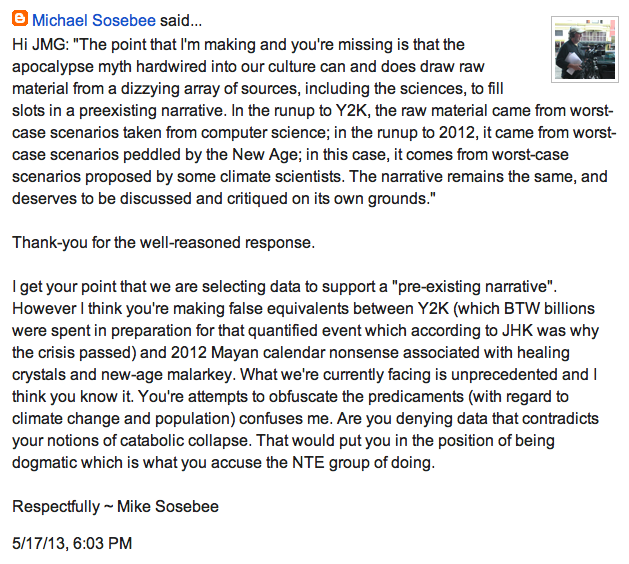
Besides the cultural obsession with doomsaying which Greer describes in his essay, what reason does he give for why people are pushing such disturbing arguments? Well, he answers that in his comments section:
Mr. Greer, aren’t you a part of this apocalypse lobby? And is Peak Oil the only reality you subscribe to?
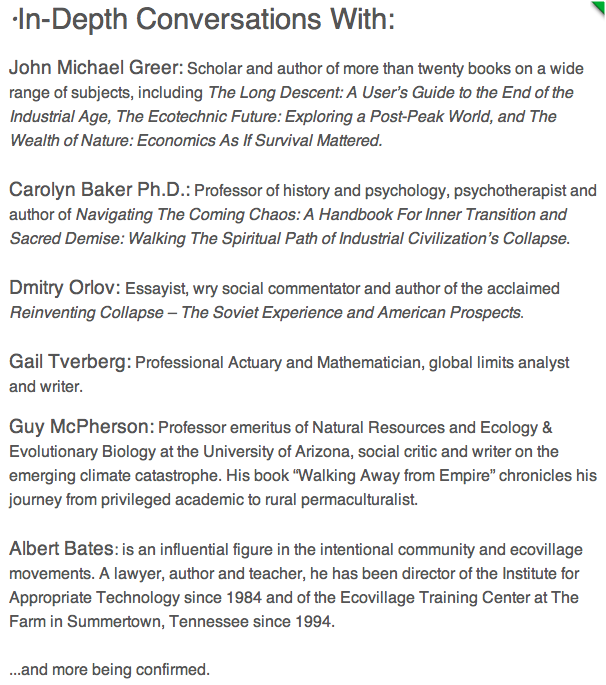
I hear that both Greer and McPherson will be speaking at the Age of Limits conference next week. Hopefully those two can have a debate which someone could videotape for us. Greer better beef up on his climate science.
Ah well, a little controversy never hurt sales. I hear that Nicole Foss of the Automatic Earth will soon join the NTE discussion shortly…
As for my opinion on why all the public fascination with Zombies, Post-Apocalyptic narratives, and the like, I believe it’s the collective subconscious of society bubbling up. For those who dig deeper and actually study what is happening in the world, it’s like looking into a bottomless abyss or the Pit of Hell. If you are honest with yourself, the seeming invincibility of humans and their industrial civilization dissolves before your eyes.
We’re approaching the one year anniversary of this website and I really have not explicitly stated my core beliefs and ideas. So let me begin by stating ten essential positions of this website:
1.) Anti-Capitalist. Capitalism has several fatal flaws which we’ve discussed here in numerous posts. It is at the root of our social and environmental ills. A system which atomizes society, turning each against the other as competitors and targeting all members of society with a nonstop stream of marketing and advertising propaganda, is the antithesis of a community-building ethos.
…cast your eyes on capitalism as a meme that effectively mutates the thinking of people, turning them into over consumers and profiteers. It is the relentless drive to grow profits that pushes us to do what we do. And that meme has metastasized globally. That is the real disease.
The original capitalism arose as a means to aggregate enough excess harvest so as to re-invest in capital equipment (before formal depreciation entered the scene) for the farm or village. It quickly led to investment in growing the capacity of a community to support more people and have more stuff and that led us, eventually, to what we have today — unbridled avarice and waste… ~ George Mobus
2.) Anti-Imperialist. Imperialism is the economic dominance and exploitation of a country, often underwritten by military force.
3.) Anti-Militarist (not the same as Pacifist). This stance goes along with 1 and 2. The Military Industrial Complex (MIC) has become a branch of government unto itself. ‘War for profit’ is big business with retiring generals becoming consultants to the weapons manufacturers. A large percentage of congressmen and senators are personally invested in the American war machine. With the War on Terror, the tail is wagging the dog.
4.) Man is part of nature, not separate from it. All life forms on Earth have intrinsic worth which cannot be accurately monetized or commodified. Economic activity by humans incurs environmental costs, but these costs are externalized. An economy which internalizes these costs is the only sustainable system able to support human societies long-term. What is the final cost of CO2 emissions, but likely the extinction of the human species along with everything else (6th Mass Extinction).
5.) Technology is not corrupt, the system is. I am not anti-technology. How a society applies a particular technology determines that technology’s social worth. Do we use it to keep vegitative patients alive at great cost? Do we use it to produce energy whose byproduct is toxic waste lingering for eons? Do we use it to annihilate each other under a mushroom cloud?
Many citizens of industrial capitalism have become technophiliacs, developing an unhealthy and unrealistic faith in the ability of technology to solve any and all problems. That’s a failure of a social system which deifies technology, promoting it as a cure-all while also using it to reproduce inequality and injustice.
Speaking on the Arab Spring and the Egyptian Revolution, Professor David Correia says:
…In the end, the particular objects and artifacts of everyday “technology” are the tools of corporations and authoritarian governments. And by now it should be clear that democracy and capitalism do not cohere and the revolution cannot be carried out via “technology.” Rather the struggle must become a struggle over the social, political and economic conditions that have made the everyday objects of technology—our digital campfires—nothing more than the tools of authoritarian despotism and capital accumulation.
6.) We live under a form of growing tyranny called inverted totalitarianism. I first read about the term inverted totalitarianism from journalist Chris Hedges who quotes from political philosopher Sheldon Wolin. Hedges has done a great job of documenting and explaining the rise of the corporate state in this country and around the world. From the Fourth Estate to higher education to all other social institutions and venues, we have literally been ‘occupied’ by corporations.
7.) Climate Change, or more aptly ‘climate disruption’, is human-caused.
Our use of fossil fuels since the beginning of the industrial revolution has disrupted the natural carbon cycle of the planet. I have numerous links on this site to scientific findings proving that climate change is happening and is caused by human activity. The evidence is overwhelming and supported by near unanimity amongst the scientific community. The fossil fuel lobby is extremely powerful and has financed a ‘public deception’ campaign to cast doubt on the root cause of climate change.
8.) Peak Oil is real and happening. It’s all about Energy Return on Investment (EROEI), and it’s a liquid fuel crisis. Despite the rampant self-deception of carbon man and the ‘public deception’ campaign by the fossil fuel industry, America is not and will not become energy self-sufficient in its current configuration of ‘urban sprawl to nowhere’ and its capitalist cornerstone of the automobile industry (individualized transportation).
Despite increased efforts to get more drivers to adopt fuel-efficient vehicles, U.S. households spent the highest percentage of their income on gasoline in 2012 than they did in any other year in nearly three decades except for 2008, according to new estimates.
The Energy Information Administration reported that the average household spent $2,912 on gasoline in 2012, or nearly four percent of their pre-tax income. – source
9.) Peak everything is happening. From industrial minerals which serve as the building blocks for modern civilization to the seafood that we eat, humans are eating the planet out of house and home. The energy bonanza of fossil fuels enabled the human population to spread far and wide, becoming a force of nature which now has the dubious distinction of having a geologic era named after it – The Anthropocene – and which has spurred one Professor to start a campaign in order to rename Homo sapiens to something other than ‘wise’. The Four Horsemen of Industrial Civilization (Climate Change, Peak Net Energy, Ocean Acidification, and Peak Water) are converging to bring Homo sapiens reign to an end.
10.) With business-as-usual, humans will likely become extinct by the end of this century or shortly thereafter. Multiple tipping points have already been triggered which will have non-linear and self-reinforcing feedback effects. We have covered many of these feedback loops on this site. Suffice it to say, only the timing of the final consequences is debatable at this point. Massive and radical changes to our society could always be started to lessen the final impacts, but such a proposal is like telling a nicotine addict, who smokes through their tracheostomy, that “it’s never too late to quit.” Ugghh!
So I think we can all agree on most if not all of the above statements. If there are any questions on my core beliefs or if there are ideas which you think should have been included, then let me know. By the way, none of the above positions makes me a “Doomer”. I hate that title. I’m a realist.
Humans are the premier practitioners of hype.
At this very moment, brave conservationists are risking their lives to protect dwindling groups of existing African forest elephants from heavily armed poachers. And here we are in this safe auditorium talking about bringing back the Woolly Mammoth. Think about it… Hype can come back to bite you.
Excellent summary by Jay Hanson(America 2.0) on a new report covering the peak net energy situation in America:
That’s interesting that 2015 is pegged as the time when maximum U.S. production will occur from our present drilling binge. That’s the same year mentioned in this report:
And Nate Hagens mentioned in my previous post that in 2015 Mexico would become an importer of oil due to the precipitous drop in production of their once great Cantrell oil fields.
Craftier, but apparently no wiser than yeast, the human species will follow the same path of other biota in the well-worn process of overshoot and collapse. Gail Tverberg explains:
As far as future scenarios are concerned, I thought the following exchange was telling:
Some believe that a near-term financial crash will prevent the further catastrophic burning of fossil fuels. I think that just the opposite will occur. The financial system will be kept artificially propped up and industrial civilization will indeed burn as much fossil fuels as it can lay its hands on… until climate chaos wreaks havoc on our ability to mass produce food. The money system can be manipulated to keep industrial civilization going until real world biophysical constraints come into play. With higher energy prices, the economy will be cannibalized to keep the whole fetid system chugging along, as it has since 1970 when neoliberal capitalism emerged. Yeast eats itself [autolysis] after using up available sugars, so why would humans behave differently after burning through our keystone resource?
This whole post reminds me of another article I read a few years ago which gave me chills. It’s no longer available at its original source, so I’ve reproduced it here:
We think we have free will and the ability to forge the future, but from a biological systems perspective the human species appears to have no real control over its final fate. As Brutus said, “The future is the future is the future whether we subscribe to it or not.”
The video below is a talk given on Earth Day this year by Nate Hagens at the University of Wisconsin-Oshkosh. It’s entitled “What if the Future is Real?”. This talk is not just about the issue of resource depletion and the multiple crises facing us, but about human behavior, how we perceive the natural world and our responsibilities to future descendants. Nate Hagens [Masters Degree in Finance from the University of Chicago and a PhD in Natural Resources from the University of Vermont] is a former editor of The Oil Drum and worked on Wall Street for a decade before “seeing the light”. I found his talk useful. My notes/summary are below the video.
The extinction event which I talked about in ‘Free Markets, Corporate Profits and Mass Extinctions‘ looks by all unbiased scientific accounts to be happening again. Instead of volcanoes inducing climate change, today it is man’s industrial activities, specifically the burning of stored ancient sunlight, that is bringing about the end of the world as we know it. We will soon breach 400 ppm of atmospheric CO2 levels:
The ratio of carbon dioxide in Earth’s atmosphere is flirting with 400 parts per million, a level last seen about 2.5 million to 5 million years ago, according to the Scripps Institution of Oceanography at UC San Diego….
…The speed at which Earth’s atmosphere has reached that density of carbon dioxide, a known greenhouse gas, has scientists alarmed.
Scientists estimate that average temperatures during the Pliocene rose as much as 18 degrees Fahrenheit. Sea levels during that 2.8-million-year epoch ranged between 16-131 feet higher than current levels, according to Richard Norris, a Scripps geologist.
“I think it is likely that all these ecosystem changes could recur, even though the time scales for the Pliocene warmth are different than the present,” Norris said. Heating the ocean probably will cause sea level rises and change the Ph balance of the ocean, affecting a wide array of marine life, he said. “Our dumping of heat and CO2 into the ocean is like making investments in a pollution bank,” he said…
Let’s go over and update the major tipping points again(covered earlier here and here) which are currently in play:
Jason Box speaks the language of Manhattans. Not the drink—the measuring unit.
As an expert on Greenland who has traveled 23 times to the massive, mile thick northern ice sheet, Box has shown an uncanny ability to predict major melts and breakoffs of Manhattan-sized ice chunks. A few years back, he foretold the release of a “4x Manhattans” piece of ice from Greenland’s Petermann Glacier, one so big that once afloat it was dubbed an “ice island.” In a scientific paper published in February of 2012, Box further predicted “100 % melt area over the ice sheet” within another decade of global warming. As it happened, the ice sheet’s surface almost completely melted just a month later in July—an event that, in Box’s words, “signals the beginning of the end for the ice sheet.”
Box, who will speak at next week’s Climate Desk Live briefing in Washington, D.C., pulls no punches when it comes to attributing all of this to humans and their fossil fuels. “Those who claim it’s all cycles just don’t understand that humans are driving the cycle right now, and for the foreseeable future,” he says. And the coastal consequences of allowing Greenland to continue its melting—and pour 23 feet’s worth of sea level into the ocean over the coming centuries—are just staggering. “If you’re the mayor of Hamburg, or Shanghai, or Philadelphia, I think it’s in your job description that you think forward a century,” says Box. “They’re completely inundated by the year 2200.”…
3.) Unleashing of Tundra methane clathrates and sub-sea methane deposits from (1) and (2):
Courtesy of the work by Sam Carana, the multitude of reinforcing feedback loops from the loss of the Arctic Ice Sheet are listed below:
Albedo feedback: Accelerated warming in the Arctic speeds up the decline of ice and snow cover, further accelerating albedo change.
Methane feedback: Methane releases in the Arctic further add to the acceleration of warming in the Arctic, further contributing to weaken Arctic methane stores and increasing the danger that methane releases will trigger runaway global warming.
Currents feedback: Sea ice loss can cause vertical sea currents to weaken, reducing the cooling effect they had on the seabed. This can thus further cause sediments to warm up that can contain huge amounts of methane in the form of free gas and hydrates.
Storms feedback: Increased frequency and intensity of storms can cause substantially more vertical mixing of the sea water column, causing more warming of the seabed, thus further contributing to the warming of sediments, as above.
Storms feedback: Accelerated warming in the Arctic can result in more storms, causing mixing of cold Arctic air with warmer air from outside the Arctic. The net result is a warmer Arctic.
Storms feedback: More open waters can result in more storms that can push the ice across the Arctic Ocean, and possibly all the way out of the Arctic Ocean.
Storms feedback: Storms also cause more waves that break up the sea ice. Smaller pieces of ice melt quicker than large pieces. A large flat and solid layer of ice is also less susceptible to wind than many lighter and smaller pieces of ice that will stand out above the water and capture the wind like the sails of yachts.
Storms feedback: Storms cause waters to become more wavy. Calm waters can reflect much sunlight back into space, acting as a mirror, especially when the sun shines under a low angle. Wavy waters, on the other hand, absorb more sunlight.
Fires feedback: More extreme weather comes with heatwaves and storms. Thus, this is in part another storms feedback. The combination of storms and fires can be deadly. Heatwaves can spark fires that, when fueled up by storms, turn into firestorms affecting huge areas and causing huge amounts of emissions. Storms can whip up particles that when deposited on ice, snow or the bare soil, can cause more sunlight to be absorbed.
Open doors feedback: Accelerated warming in the Arctic causes the polar vortex and jet stream to weaken, causing more extreme weather and making it easier for warm air to enter the Arctic.
Two papers released last week in the journal Nature Geoscience provide evidence that warming and melt in West Antarctica are occurring at levels that are highly unusual compared to natural variability.
The West Antarctic Ice Sheet contains about 2.2 million cubic kilometers of ice; enough to raise global sea levels by 3 to 4m. What’s making glaciologists nervous is that the ice rests on bedrock which is below sea level; this makes it vulnerable to attack from below by a warming ocean as well as attack from above by increasing air temperatures.
As some of us were heading off for the Easter holiday weekend, the Brazilian government was quietly releasing deforestation trends showing an increase in deforestation for the first time in five years.
These numbers use the DETER rapid response satellite system, a system that provides estimates of deforestation rates every month. Over the time period documented, August 2012 to February 2013, the rates increased an estimated 26.82% and an area of the Amazon larger than the size of the city of London disappeared.
In absolute numbers, that means 1,695 square kilometers (654 square miles) of forest have disappeared. That equals an area the size of 237,000 soccer fields…
…The increase in deforestation rates can be directly attributed to the Brazilian government’s systematic dismantling of the laws and agencies that protect the Amazon…
…President Dilma Rousseff’s approval of a new Forest Code, a law that provides amnesty for crimes committed after 2008 in the Amazon and reduces large areas of protected land, paved the way for the increase in deforestation. The president also structurally weakened government agencies like IBAMA, the federal environmental enforcement agency, so unfortunately it won’t be a surprise if deforestation continues to rise in the Amazon…
After more than a decade, the mountain pine beetle epidemic that surged through British Columbia appears finally to be in remission. Having devastated the province’s lodgepole pine forests, the insect is running out of food.
But forest managers now see new beetle infestations appearing at the edge of the Boreal Forest, in Alberta, and in the Yukon and Northwest Territories — areas well outside the insect’s historical range. As a warming climate lifts the temperature limitations that once kept the beetle in check, scientists fear it may continue its push across the continent, perhaps as far as the Atlantic Coast…
…Without debating the causes of global climate change the effects of forest dieback can be viewed factually. The earth is warming and droughts are increasing in severity and magnitude. Temperature and drought are major contributing factors to forest dieback, so more trees will be dying in the future. As more carbon is released from dead trees, especially in the Amazon and Boreal Forests, more greenhouse gasses are released into the atmosphere. Increased levels of greenhouse gasses increase the temperature of the atmosphere. The negative feedback loop is reinforced and the biological adaptations of the species determine its survival. Projections for dieback vary, but the threat of global climate change only stands to increase the rate of dieback. The issue is complex and models are intricate, so scientists have serious work ahead of them.[8]
Scientists do not know the tipping points of climate change and can only estimate the timescales. When a tipping point, the critical threshold, is reached a small change in human activity can have long-term consequences on the environment. Two of the nine tipping points for major climate changes forcast for the next century are directly related to forest diebacks. Scientists are worried that forest dieback in the Amazon[9] rain forest and the Boreal[10] evergreen forest will trigger a tipping point in the next 50 years.[2]… – source
7.) The Sahara and Sahel in Africa
It is difficult to estimate the overall ability to increase food production, but a recent analysis suggests that human consumption may be approaching the limits of the net primary plant production (NPP) — that is, the maximum photosynthetic production that is possible on the planet.
It is “not whether humans will reach the global NPP boundary but when they will do so.” It seems probable that the developed countries will continue their excessively high levels of consumption. The emerging economies are likely to continue to eat more protein and a larger slice of grain production in countries with an appropriate climate for grain production will be diverted to feeding animals, or ethanol to drive automobiles. A child born in the Sahel today could belong to the first generation to come to maturity in the contemporary world where the ability to feed large numbers of ecological refugees may well diminish. It is also possible that the secondary effects of the collision of population growth and climate change could create what scientists call an “asymmetrical uncertainty.” The possible consequences of this asymmetrical uncertainty on political processes and violence could range from a slow worsening of the current situation to extremely serious conflict over resources and threats to security. Biologically, adverse factors can interact in ways that can cause a rapid downward spiral. For example, as noted above, ambient temperatures over 29°C (84°F) lead to a rapid decline in crop yields.
[At least 95% of the food production in the Sahel is based on rain-fed agriculture. The agricultural sector employs, directly or indirectly, more than half of the Sahel’s population…Global warming will mean that in temperate lands, where much of the global crop production occurs, the most productive regions will migrate away from the equator. While the net aggregate change as a result of climate change at a global level may be slow, the regional effects in the Sahel will be more rapid, significant, and adverse.] – source
8.) The El Nino Southern Oscillation(ENSO):
Climate models appear to be unable to accurately predict ENSO changes. Although scientists can predict some large-scale and long-term effects of anthropogenic global warming, there remains a lot of unknowns about specific regional effects.
The problem may lie in the models’ inability to reproduce the cycling between the ENSO’s El Niño and La Niña phases, especially given that many scientists think that La Niña is the major driver of drought in the southwest. The ENSO “behaves much messier in the real world than in climate models”, says Jessica Tierney, a climate scientist at the Woods Hole Oceanographic Institution in Massachusetts who has investigated the role of the ENSO in East African rainfall variability2. “We’re not sure how it has varied in the past, and we don’t know how it might change in response to climate change. This is really one of the big uncertainties we’re facing.”
In addition to their failure to reproduce El Niño and La Niña, existing models do not fully capture other factors that influence rainfall, such as clouds and vegetation. But Smerdon adds that the atmospheric and oceanic dynamics that inhibit rainfall and favour prolonged drought may be essentially random and so almost unpredictable.
Last week’s findings highlight the broader challenge of predicting how precipitation patterns will change as the global climate warms. Models are often at odds over the very direction of regional changes. For example, different projections prepared for the Colorado Water Conservation Board disagree on whether mean precipitation in the state will increase or decrease by 2050 (ref. 3).
But the uncertainties don’t change the larger picture, scientists say. “Climate models are not perfect, but they do the big things really well,” says Tierney. “We can be pretty confident that the southwest will warm and that water will become scarcer.
…since the 1970s the atmospheric circulation patterns over the Pacific have tended to favor La Nina conditions over El Nino ones. And, they write: “The overall trend towards a stronger, La Niña-like Walker circulation is nearly concurrent with the observed increase in global average temperatures.”
We know from historical data that from these two climatic events – the Medieval Warm Period(the long stable warming period over Europe) and the Little Ice Age(a well-known described historical event) – that the temperature changed, and our big question is, “Does the ocean also respond in this very short time scale?”
And one of the major results and maybe one of the biggest prices is that the ocean and the thermohaline circulation(THC) respond to these thermal drivers within just a decade.
…What we are mostly concerned about is that there is a certain threshold which is then reached, a certain point of no return more or less. So we will have a trend where it’s getting warmer and warmer and warmer, and there will be no return from this warming… and that will change the whole system, the whole flow of the system, and the thermohaline circulation may be changed…
The major threats we see right now to the thermohaline circulation mainly derive from the Arctic region. We see increased melting from the Greenland Ice Sheet. We see a retreat of Arctic See Ice. We see large reorganizations in the Arctic ocean system which accumulate fresh water. All of these things are components which may affect the thermohaline circulation.”
The most important factors affecting changes in the conditions of the thermohaline circulation are:
1.) Global warming itself caused partly by greenhouse gases from human activity.
2.) From AGW, there will be more rainfall in the higher latitudes causing glacial melt.
Density in the water is a key factor for the THC driver mechanisms. Cold surface water temperatures make the water denser and high ocean salinity cause these waters to sink. These are the main engines that run the THC, but now more fresh water is entering the ocean through the melting of the Arctic and Greenland ice sheets.
When this is integrated into the models, a new development of the engines is revealed. In a warmer climate state, the engine of the Labrador Sea seems to simply collapse…
10.) The Indian Summer Monsoon:
…Writing in the journal Environmental Research Letters, researchers at the Potsdam Institute for Climate Impact Research and Potsdam University in Germany said increasing temperatures and a change in strength of a Pacific Ocean circulation pattern known as the Pacific Walker circulation in spring could cause more frequent and severe changes in monsoon rainfall.
The Walker circulation usually brings areas of high pressure to the western Indian Ocean but in El Nino years this pattern gets shifted eastward, bringing high pressure over India and suppressing the monsoon, they said.
Computer simulations show that with future global warming the Walker circulation is likely to bring more high pressure over India even without an increase in El Nino events.
These failures of the monsoon system suggested by the simulation, defined as a 40 percent to 70 percent reduction in rainfall below normal levels, were unprecedented in the researchers’ observational record, taken from the India Meteorological Department dating back to the 1870s.
“Our study points to the possibility of even more severe changes to monsoon rainfall caused by climatic shifts that may take place later this century and beyond,” lead author Jacob Schewe said. – source
Indeed if humans were able to set aside their anthropocentric view of the world, we would be frantically changing our behavior and rearranging our economic and social activities in order to prevent our own demise. But alas, if things aren’t right between one’s ears, then everything else is moot.
(Edit on 3-9-2015: The following video has been made “private”, but it can be viewed in its entirety here.)
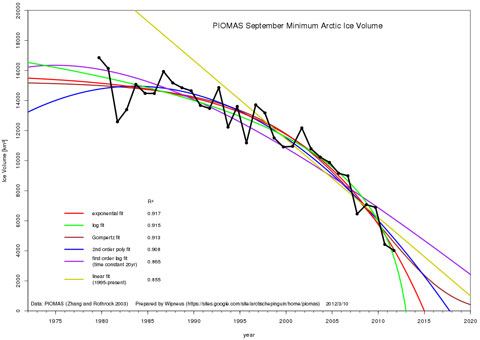
This week, a number of top scientists, experts, DoD and Homeland Security Department notables are convening an emergency meeting warning White House officials that the Arctic Ocean could be ice-free during summertime within two years.
This A-Team (A for Arctic) includes NASA’s chief scientist Gale Allen, National Science Foundation Director Cora Marett, Director of the Oceans Institute of the University of Western Australia marine scientist Prof Carlos Duarte, and nine other top Arctic specialists together with key representatives from the US Department of Homeland Security and the Pentagon.
The Washington meeting is the second major climate emergency meeting of its kind to occur within the past month. Just a few weeks ago, the UK held its own climate meeting in response to severe and unprecedented weather occurring throughout Europe this winter and spring.
Scientists and specialists descending on the White House are now echoing increasingly urgent warnings coming from Arctic…
Paul F. Getty brought to my attention a new essay written by environmentalist Daniel A. Drumright. I featured his writing in a prior post entitled ‘The Day The Whole World Went Away‘. This new one, entitled ‘The irreconcilable acceptance of near-term extinction‘, was a bit long-winded for me, so I have whittled it down to the meat and potatoes and corrected a few typos. It’s worth your time to read it. I cannot find any fault with the machinations of capitalism he describes and his general outline of how things will fall apart, but of course the timing is always up to debate. However, seeing that the disintegration of the Arctic is happening faster than any scientific models had predicted, global famine may come much sooner than most know.
In conjunction with this essay, I would also point you to a recent post by Robert Scribbler – ‘For Central US, Climate Change and a Mangled Jet Stream Means Drought Follows Flood Follows Drought‘ – which should help bring everyone up to speed with some ominous trends in the climate of Earth. Humans are continuing to pump so much CO2 into the atmosphere in such a very short time span, geologically speaking, that a considerable lag time has built up, in terms of human time scales, for the final catastrophic effects to play out over the coming decades and centuries.
As far as how one should live their life from here on out, Daniel says “ethical hedonism” is the choice he has made in the face of NTE[Near Term Extinction]. As for myself, a lot of people are dependant on me, so I cannot take that route.
For anyone else reading this, how will you live henceforth, knowing the end is near?
For the last week or so I’ve been feeling a sort of emptiness, an exasperation of the state of things, a growing acceptance of the intractable way of things. And no matter the reality that a small percentage of us can clearly see, the titanic wheels of the ‘system’ will spin onwards like a runaway train heading over a cliff, taking us all with it. People are not entitled to their own version of reality, but that is the society we live in today where facts are interchangeable with self-serving opinion and corporate spin.
This morning I came across an excellent movie entitled ‘Obey’ based on Chris Hedges’ brilliant book ‘Death of the Liberal Class’. For those who want to hear an insightful and perceptive analysis of the real world in which we exist, please watch:
…Passivity permits societies to transfer their emotional allegiance to the absurd and ignore real problems. It exacerbates despair. It keeps us in a state of mass self-delusion. Once we are drawn into this form of magical thinking, the structure and goals of the corporate state are not questioned. This magical thinking coupled with the bizarre ideology of limitless progress holds the promise of an impossible, unachievable happiness. It has turned whole nations into self-consuming machines of DEATH…
…The giddy, money-drenched choreographed carnival, the petty spectacle of politics will divert our attention from the collapsing world around us. The glitz and propaganda, the ridiculous obsessions imparted by our electronic hallucinations, and the spectacles that pass for political participation will mask the deadly ecological assault by the corporate state. We will convince ourselves that global warming never existed or we will concede that it exists, but insist that we can adapt. Both responses will satisfy our mania for eternal optimism and our huge reckless pursuit for personal comfort. And all around us the natural world will change…
…The death of the planet is just another investment opportunity.
Many human monstrosities have burst forth from the bleak and soulless landscape of American suburbia, reaping their 15 minutes of infamy. The brothers Tsarnaev are simply the latest. American society, for the most part, does not exist; it’s been bought out, chopped up, and repackaged for the corporate state’s consumer culture. A society that has been broken up and atomized is ripe for control and plunder.
I was poking around the twitter account of Dzhokhar ‘Jahar’ Tsarnaev and found some ironic and disturbing reflections on life in America. With the morbid fascination our throwaway culture has with its own social atrocities, perhaps it’s not so odd that ‘Jahar’ now has nearly 85,000 followers.
Sifting through the evidence, people want to know why, but one thing that won’t be analyzed is the society from which such horrors spring.
American society always emerges squeaky-clean out of all the investigations, post-mortems, examinations, inquiries that follow. Its guiltlessness is asserted by implication that the motives for such slayings are incomprehensible, unfathomable…
…The script is now word-perfect. Whenever some violent event erupts in the US, the chronology is identical. The shock is followed by flowers at the site of the deed, which is transformed into a temporary shrine, the comforting of the bereaved and injured, the assertion of solidarity, the lessons to be learned. In the end, American society becomes the hero of the tragedy, with its perpetual penitence, its never-again reflex, its openness to the cleansing effects of trauma, its avowals of solidarity, its ritualistic counselling which is a form of cancelling, as people ‘come to terms with’ their grief.
What is never asked is, what kind of social pathology creates such disorders? ‘No Entry’ signs are posted on all avenues of exploration where some clue is most likely to be found… – source
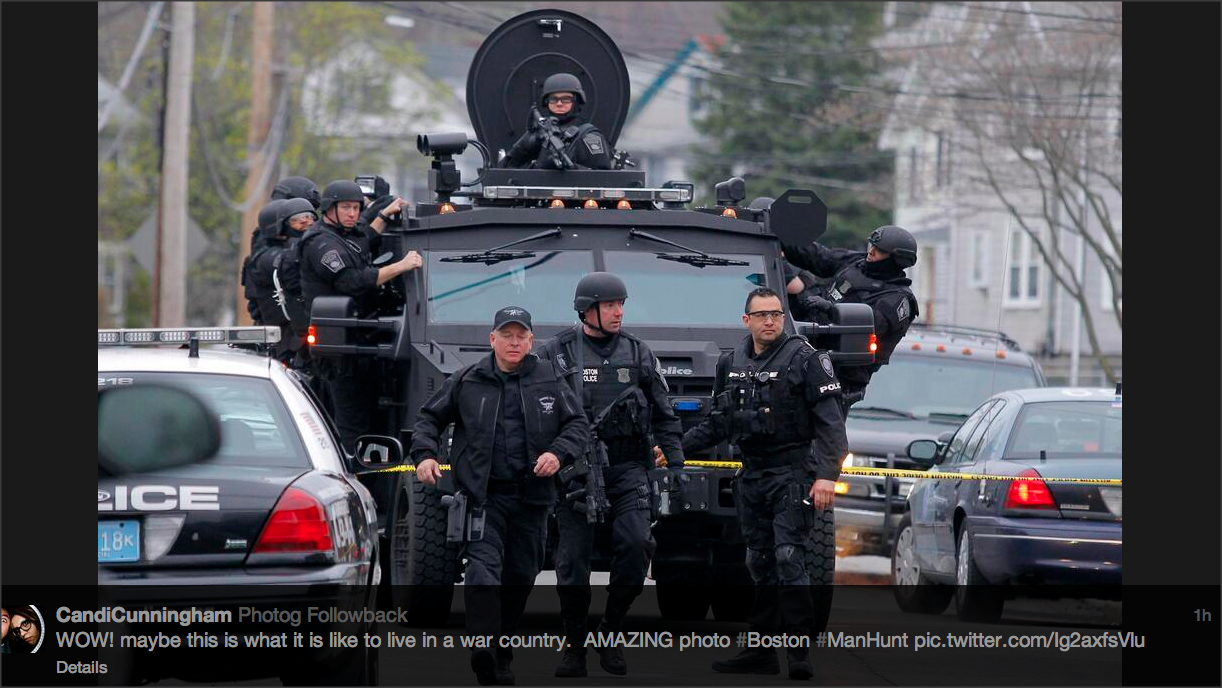
The horrific bombings which took place recently at the Boston Marathon are the most significant terrorist attack to have occurred on U.S. soil since 9-11. My condolences go out to the innocent victims. Ideologies of any sort can be twisted to justify abhorrent acts. This terrorist act opens up old wounds for an Empire which in the last decade has gone on the offensive, spending vast resources on foreign wars and a security and surveillance state. Even with such Herculean expenditures, the asymmetric nature of terrorism demonstrates there is no foolproof solution for preventing such acts. The perpetrators spent perhaps a few hundred bucks on their homemade bombs, and we spend incalculable multiples of treasure and blood in return. This was really the goal of Osama bin Laden – to draw the Empire into costly wars and expenditures of life and limb. As has been stated by others, the best that can be hoped for from a military standpoint is to keep terrorist groups in a constant degraded and disorganized state. As much as left-leaning individuals as myself like to point out the foreign policy “transgressions”(to put it mildly) of the American Empire, decades of capitalist imperialism will never be put back into the bottle. Such bombings are pretty much daily occurrences in war-ravaged Iraq and Afghanistan as well as other areas of the Middle East. Our incursions into those countries only seem to have fueled the fire.
A law enforcement official had some interesting info on the bombings:
…A preliminary analysis of the bombs, which went off near the race’s finish line on Boylston Street, suggests they are similar to the improvised explosive devices found in war-torn regions like Iraq and Afghanistan, the law enforcement official said.
“The shrapnel, the simplicity of it — it’s something right out of the Iraq War. A basic roadside bomb,” the official said.
That “basic bomb” can be seen in the design of the Boston bombs, the law enforcement official said: pressure cookers stuffed with nails, ball bearings and other projectiles, and hidden in black duffel bags left near the 26.2 mile mark in the race.
What appear to be fragments from a pressure cooker were recovered at the scene, along with BBs, nails and black-nylon fragments possibly from a bag used to house the device, the FBI said.
Black explosive powder and a circuit board believed to have been used to detonate the bombs were also found, the federal official said.
Similar explosives have been used in third-world hot spots from South Asia to the Persian Gulf, and one of the devices used in the botched bombing of Times Square in May 2010 employed a pressure cooker.
The Pakistani Taliban, which claimed blame for the 2010 Times Square attempt, said it had no role in the Boston attack, according to The Associated Press.
A 2010 bulletin issued by the Department of Homeland Security and the FBI warned pressure-cooker bombs are as easy to transport as they are to conceal.
“Terrorists can exploit the innocuous appearance of easily transportable items such as pressure cookers to conceal IED components,” the alert said. “Placed carefully, such devices provide little or no indication of an impending attack.”
That some victims lost limbs in the blast puts the device “into a powerful class,” said John Goodpaster, head of the forensic science program at Indiana University–Purdue University, and former chemist with the federal bureau of Alcohol, Tobacco, Firearms and Explosives.
Goodpaster said the blasts appeared to be from a “high explosive of some kind, military explosive, commercial explosive or improvised explosive.”
…
The sooner the world can get off MENA oil, thereby pulling the plug on the financial network of terrorist groups, the better off we’ll all be, not to mention our indispensable biosphere.
According to Wikipedia resources:
…Saudi Arabia is said to be the world’s largest source of funds for Salafi jihadist terrorist militant groups, such as al-Qaeda, the Afghan Taliban, and Lashkar-e-Taiba in South Asia, and donors in Saudi Arabia constitute the most significant source of funding to Sunni terrorist groups worldwide, according to Hillary Clinton.[1] According to a secret December 2009 paper signed by the US secretary of state, “Saudi Arabia remains a critical financial support base for al-Qaida, the Taliban, LeT and other terrorist groups.”[2]
The violence in Afghanistan and Pakistan is partly bankrolled by wealthy, conservative donors across the Arabian Sea whose governments do little to stop them.[1] Three other Arab countries which are listed as sources of militant money are Qatar, Kuwait, and the United Arab Emirates, all neighbors of Saudi Arabia…
…Actually 70 percent isn’t unheard of for Portugal. For a few hours in 2011, Portugal was entirely run on renewable power. Yet this was the first time so much was sustained for a quarter.
Portugal’s investment in modernizing its electricity grid in 2000 has come in handy. Like in many countries, power companies owned their own transmission lines. What the government did in 2000 was to buy all the lines, creating a publicly owned and traded company to operate them. This was used to create a smart grid that renewable energy producers could connect to (encouraged by government-organized auctions to build new wind and hydro plants)…
Of course planet Earth has an avalanche of environmental problems coming to a head in the near future (all caused by humans, mind you), but it’s good to see some accomplishments in at least one area of human impact – reduction of fossil fuels – even if it may be too little, too late.


























 Collapse of Industrial Civilization
