“The end of the human race will be that it will eventually die of civilization.”
~ Ralph Waldo Emerson
The water-energy-food nexus is an interlocking problem. For example, biofuel production takes land and water away from food production. Besides the contamination to water reservoirs, the process of hydrofracking and tar sands utilizes massive amounts of water which could otherwise be saved for farming:
Oil sands extraction uses significant amounts of water (2-4.5 barrels per barrel of oil produced), which ends up in toxic tailings lagoons that have never been successfully reclaimed. An analysis using industry data estimated that these lagoons already leak over a billion gallons of contaminated water into the environment each year. – source
Hydrofracking injects large volumes of water (up to six million gallons of water per gas well) mixed with sand and toxic chemical additives at high pressures to release the gas. Most of the water is then returned to the surface as polluted wastewater – that must be treated by wastewater treatment plants already overburdened and not necessarily designed to remove these chemicals. Industry analysts predict it will cost $3 billion to treat the industrial wastewater associated with Marcellus shale development… Groundwater supplies may become contaminated with these chemicals as they already have in parts of Pennsylvania and other states. Currently, oil and gas companies that use hydraulic fracturing are exempt from regulations under the Safe Drinking Water Act that would require them to disclose the cocktail of chemicals they use.
– source
Scaling back on the production of these unconventional energy sources in order to conserve land and water for food will increase the cost of conventional oil, and thus food prices, since industrial agriculture is dependent on fossil fuels:
Due to the vast size of these [industrial] farms, the farms are operated in a similar manner to that of large industrial factories. And these “factories” require large quantities of synthetic fertilizers, pesticides, and fuel all derived from fossil fuels, which is a limited natural resource on our planet (Hidden Costs of Industrial Agriculture, 2008). “After cars, the food system uses more fossil fuel than any other sector of the economy — 19 percent.” This high dependence on fossil fuels makes industrial agriculture heavily unsustainable. “Twentieth-century industrialization of agriculture has increased the amount of greenhouse gases emitted by the food system by an order of magnitude; chemical fertilizers (made from natural gas), pesticides (made from petroleum), farm machinery, modern food processing and packaging and transportation have together transformed a system that in 1940 produced 2.3 calories of food energy for every calorie of fossil-fuel energy it used into one that now takes 10 calories of fossil-fuel energy to produce a single calorie of modern supermarket food” (Pollan, 2008).
The monkey wrench of climate change is now thrown into the picture…
What happens to the stability of the world when fertile lands become dust bowls, when rainfall no longer follows its traditional seasonal pattern, when crop yield forecasts become less and less reliable as climate change begins to bite? We don’t have to look very far back to see the upheaval caused in countries whose majority population lives on the razor-edge of starvation:
2007–2008 – Food riots in India, Peru, Morocco, Egypt, Bangladesh, Pakistan, Zimbabwe, Mozambique, Namibia,
Uzbekistan, Indonesia, Yemen, Guinea, Cameroon,
Burkina Faso, Mauritania and Senegal. [64][65][66][67][68][69]
And again in 2010-2011:
For those who think that adaption to climate change is feasible, please consider what Kurt Cobb articulates in a recent post:
…costly existing agricultural infrastructure won’t be easily moved or replaced. …soil quality is not uniform from place to place. [Do you] think that as temperatures warm and devastate the American grain belt with recurrent drought, we can simply transfer the growing of much of the world’s export grain crop north to the Canadian Shield which has soil so thin it has never supported agriculture?
The ‘Catch-22’ kicker is that the continued use of fossil fuels, the indispensable elixir of industrial civilization’s existence, is exactly what is causing climate chaos in the first place. And as I showed with one simple chart in a previous post, we are using more of this deadly ingredient than ever before. In his latest article ‘The hunger wars in our future’, Michael Klare warns us about the social disruptions that lie in the future as a result of the insidious water-energy-food nexus that grips our modern-day way of life:
…When we think about climate change (if we think about it at all), we envision rising temperatures, prolonged droughts, freakish storms, hellish wildfires, and rising sea levels. Among other things, this will result in damaged infrastructure and diminished food supplies. These are, of course, manifestations of warming in the physical world, not the social world we all inhabit and rely on for so many aspects of our daily well-being and survival. The purely physical effects of climate change will, no doubt, prove catastrophic. But the social effects including, somewhere down the line, food riots, mass starvation, state collapse, mass migrations, and conflicts of every sort, up to and including full-scale war, could prove even more disruptive and deadly…
At this point, the focus is understandably on the immediate consequences of the still ongoing Great Drought: dying crops, shrunken harvests, and rising food prices. But keep an eye out for the social and political effects that undoubtedly won’t begin to show up here or globally until later this year or 2013. Better than any academic study, these will offer us a hint of what we can expect in the coming decades from a hunger-games world of rising temperatures, persistent droughts, recurring food shortages, and billions of famished, desperate people.
Remember when both Bush, Cheney and Obama famously quipped that “the American way of life was non-negotiable.” Mother Nature and the Grim Reaper have rephrased that self-righteous slogan to read:
“The American way of life is unsustainable, non-redeemable, and a limited-time-only.”
…By accepting and encouraging countries to pay for its oil in currencies other than the U.S. dollar, Iran has deliberately taken the same action that, I argue in Making the World Safe for Capitalism, led directly to the U.S. invasion of Iraq. In September 2000, Saddam Hussein announced that Iraq would no longer accept the “currency of its enemy”, the U.S. dollar, and from that time onwards any country that wanted to purchase oil from Iraq would have to do so in euros. I further argue that the motivation for the United States’ invasion of Iraq was to eliminate the threats a post-U.N. sanctions Iraq posed to the key underpinnings of American economic hegemony, and to install a pro-U.S. client state and permanent American military presence in the region. The book examines how a post-U.N. sanctions Iraq either directly threatened the ongoing success of American economic power, or provided enormous opportunities to extend it.
All the same considerations are in play with Iran, starting with Iran’s direct threat to the dollar as the dominant global reserve currency. But that is just one aspect of the much larger issue: that Iran openly defies U.S. neoliberal hegemony. Like Iraq pre-invasion, Iran is not a member of the WTO, has not had any dealings with the IMF since 1984, and does not have any debt with it or the World Bank. Like Iraq before it, and evidenced by China’s oil development contracts, the U.S. and its oil companies are cut out of any future oil development in Iran. Like a post-sanctions Iraq, Iran has the potential to be the dominant power in the region and to provide development assistance on a vastly different model to that imposed by the WTO, World Bank and IMF, against which so much of the Middle East is rebelling….
The article details how the BRIC countries and many other nations are circumventing the U.S. sanctions with Iran and using gold as well as other commodities to buy Iranian oil. The sanctions have pretty much been rendered worthless because so many countries are defying what was designed to isolate and starve Iran into submission.
He explains how the Petrodollar System works:
In a nutshell, any country that wants to purchase oil from an oil producing country has to do so in U.S. dollars. This is a long standing agreement within all oil exporting nations, aka OPEC, the Organization of Petroleum Exporting Countries. The UK for example, cannot simply buy oil from Saudi Arabia by exchanging British pounds. Instead, the UK must exchange its pounds for U.S. dollars. The major exception at present is, of course, Iran.
This means that every country in the world that imports oil—which is the vast majority of the world’s nations—has to have immense quantities of dollars in reserve. These dollars of course are not hidden under the proverbial national mattress. They are invested. And because they are U.S. dollars, they are invested in U.S. Treasury bills and other interest bearing securities that can be easily converted to purchase dollar-priced commodities like oil. This is what has allowed the U.S. to run up trillions of dollars of debt: the rest of the world simply buys up that debt in the form of U.S. interest bearing securities.
The flip-side of this are the countries that produce and export oil, in particular Saudi Arabia and the other Arab producers. The only way the system can possibly work is if oil producers refuse to accept anything other than U.S. dollars as payment for their oil. This they have done since the Nixon Administration’s manipulation of the OPEC oil crisis in the mid-1970’s, which succeeded in getting Saudi Arabia, traditionally the world’s dominant producer, to agree to accept only dollars for oil. The Saudis used their influence to get the rest of OPEC to agree as well. In return, the U.S. offered to militarily defend not so much Saudi Arabia, but the horrifically repressive monarchy that ruled it.[11]
But there was a kicker: Nixon and his Secretary of State Henry Kissinger also got the Saudis to agree to invest their mega oil profits in the U.S. economy. In addition to buying interest bearing U.S. government securities, the Saudis also invested in New York banks. Because the OPEC oil embargo had quadrupled global oil prices, the Saudis and other Arab producers suddenly had a great deal of money to invest. The money parked in those New York banks then became available to be loaned to the rest of the world, which faced major financial crises due to—yes, you guessed it—the sudden quadrupling of oil prices. By the year 2000 and Iraq’s dramatic switch to selling Iraq’s oil in euros, Saudi Arabia had recycled as much as $1 trillion, primarily in the United States. Kuwait and the United Arab Emirates recycled $200–300 billion.[12]
And because those loans were in U.S. dollars, they had to be paid back in U.S. dollars. When U.S. interest rates skyrocketed to 21 percent in the early 1980’s, interest on the loans also skyrocketed. This in turn precipitated a third world debt crisis, which was mercilessly exploited by Wall Street and the U.S. In this case, the exploitation came in the form of requiring countries to “structurally adjust” their economies along neoliberal lines in return for World Bank and IMF bailout loans. By 2009, the total debt owed on these bailouts and other loans was an astounding $3.7 trillion. In 2008, they paid over $602 billion servicing these debts to rich countries, primarily the United States.[13] From 1980 to 2004, they paid an estimated $4.6 trillion.[14]
The history of how this came about is fascinating, and I discuss it in detail in Making the World Safe for Capitalism. The short version is that from the 1944 Bretton Woods agreement which set up the International Monetary Fund and the precursors to the World Bank and World Trade Organisation, the dollar was accepted as the international currency for all trade. Crucially though, the dollar was backed up by gold, which was fixed at $35 an ounce. This meant the U.S. had to have enough gold on hand to back up any and all dollars it printed.
Faced with escalating costs from the Vietnam War, in the early 1970s Nixon abandoned the gold standard and replaced it with the petrodollar system described above. Almost simultaneously, he abolished the IMF’s international capital constraints on American domestic banks, which in turn allowed Saudi Arabia and other Arab producers to recycle their petrodollars in New York banks.
The petrodollar system, and U.S. ability to manipulate the dollar as the global reserve currency and hence global debt, has been the bedrock of American economic power...
…But as the article explains, since the financial crisis of 2008, the status of the dollar as the reserve currency of the world has been thrown into question and challenged by even formerly staunch U.S. allies. As the lifeblood of a country’s economy, i.e. oil, becomes increasingly hard to come by, the demands of an old ‘friend’, named Uncle Sam, will likely fall on deaf ears, especially when he’s now seen by the rest of the world as a drunken, pickpocketing buffoon swinging at shadows.
Continuing on my last post’s theme of technology and man’s insatiable quest for more lethal weapons, Chris Hedges wrote an article this week in remembrance of the 60th anniversary of the Hiroshima and Nagasaki bombings. He reminds us that science and technology are amoral, advancing of their own accord, and that they have become the new religion, heralding solutions to all that ails modern man. Geoengineering, anyone?
The atomic blasts, ignited in large part to send a message to the Soviet Union, were a reminder that science is morally neutral. Science and technology serve the ambitions of humankind. And few in the sciences look beyond the narrow tasks handed to them by corporations or government. They employ their dark arts, often blind to the consequences, to cement into place systems of security and surveillance, as well as systems of environmental destruction, that will result in collective enslavement and mass extermination. As we veer toward environmental collapse we will have to pit ourselves against many of these experts, scientists and technicians whose loyalty is to institutions that profit from exploitation and death…
It was science, industry and technology that made possible the 20th century’s industrial killing. These forces magnified innate human barbarity. They served the immoral. And there are numerous scientists who continue to work in labs across the country on weapons systems that have the capacity to exterminate millions of human beings. Is this a “rational” enterprise? Is it moral? Does it advance the human species? Does it protect life?
For many of us, science has supplanted religion. We harbor a naive faith in the godlike power of science. Since scientific knowledge is cumulative, albeit morally neutral, it gives the illusion that human history and human progress also are cumulative. Science is for us what totems and spells were for our premodern ancestors. It is magical thinking. It feeds our hubris and sense of divine empowerment. And trusting in its fearsome power will mean our extinction…
Now on to the second point – Transnational Capitalism. This is an excellent article written by a former hedge fund manager that gives an overall, system-wide summation of the capitalist system controlling the world. It’s well worth the read and helps to flesh out what I have alluded to in other posts – the emergence of an elite capitalist class that has no allegiance to any country and shares more in common with its global members than with the fellow countrymen and the nation-state from whence they originated. Some excerpts:
This federation of convenience by the global elite is a lingering problem for the lower economic classes in America. The U.S.-based CEO of one of the world’s largest hedge funds told Chrystia Freeland that his firm’s investment committee often discusses the question of who wins and who loses in today’s economy. In a recent internal debate, he said, one of his senior colleagues argued that the hollowing-out of the American middle class didn’t really matter. “His point was that if the transformation of the world economy lifts four people in China and India out of poverty and into the middle class, and meanwhile means one American drops out of the middle class, that’s not such a bad trade.” Notice the CEO’s reference to “not such a bad trade” as representative of free market lingo, i.e., “trade.” Everything is measured in trade terms, like statistics, if you look in the mirror, you’ll see the reflection of a commodity.
This viewpoint is typical of how the global ruling class thinks, and proof positive of it is reflected in today’s politics in America. The right wing embodies this same viewpoint by striving to strip the federal government of public welfare services, privatizing governmental assets, and undercutting benefits to society at large, especially via manipulation of the federal tax code. This same occurrence is happening in real time right now in Greece, Spain, and Portugal as the cadre of elite technocrats out of Brussels, de facto capital of the EU, dictate nation-state policies to those three forlorn countries. The world’s elites love hard times/recessions because of the set up. It makes it easier for them to strip away government largess via austerity programs that they force upon governments, and it allows for undercutting the wages of average citizens as well as dismantling of governmental regulations. This, in turn, prompts protestors to congregate in the streets of capital cities, but over time, the capitalist class waits them out, temporarily residing in one of their homes elsewhere, away from danger, and with time on their side, the capitalists win.
Upon reading Chrystia Freeland’s article in Atlantic Magazine, one comes away with the impression the elite capitalists look down with disdain upon the masses of people, expressing a contempt for those in society who do not have the personal merit to rise to the occasion of wealth and power. Meritocracy is their biblical source, not equality and fraternity. These are hackneyed terms from ‘America of old’ and no longer applicable in the new technologically enhanced world, which itself is the major source of many of the new self-made wealthy.
This global ruling class controls the levers of an emergent trans-national state apparatus of global decision-making and orders emanate from the IMF, World Bank, the EU, and the WTO. The ruling bloc of this world order consists of chieftains of global corporations and financial conglomerates, major players in the dominant political parties of the world, media conglomerates, and technocratic elites….
…
According to William Robinson: Transnational capital has been able to break free of nation-state constraints to shift the correlation of class and social forces worldwide sharply in its favour and to undercut the strength of popular and working class movements around the world. One new structural dimension of 21st century global capitalism is a dramatic expansion of the global superfluous population or that portion marginalized and locked out of productive participation … constituting some one-third of humanity. The need to assure the social control of this mass of humanity living in slums gives a powerful impetus to neo-fascist projects and facilitates the transition from social welfare to social control, otherwise known as police states. Over time, this system becomes ever more violent and the ability of economic power to determine electoral outcomes opens the door for 21st century fascism to emerge without a rupture in electoral cycles and/or a constitutional change.
The door for 21st century fascism has more than opened. It has been blown off the hinges…
Just as science is amoral, so is capitalism which treats everything living and inanimate as a commodity ripe for exploitation. Welcome to a world ruled by the new globe-trotting, predatory elite who will profit from what remains of the planet’s depleting resources and exhausted ecosystems while paying no heed to the plight of the masses or future generations.
“Earth provides enough to satisfy every man’s needs, but not every man’s greed.”
~ Mahatma Gandhi
Sometimes, in order to move forward we must look back. I am reflecting once more on another man’s life and words, very prescient and witty words. I was reminded again of his legacy this morning after reading the Congressional Record honoring the life and accomplishments of Gore Vidal by US Congressman Steve Cohen who was brave enough to give it. Before we get to Gore, let’s talk a bit about mankind’s technological prowess in terms of lethal weaponry.
In the great expanse of Earth’s history, industrial civilization will be chronicled as a mere blip in geologic memory, but in the human scale of time perception, our self-inflicted demise by way of ecocide is slow and seemingly imperceptible. And so while we quietly commit self-extermination by breaching environmental tipping points, mankind’s annihilation may also arrive via the proliferation of weapons of mass destruction, facilitated by the ongoing advancement of technology:
Scott Kemp, an assistant professor of nuclear science and engineering at the Massachusetts Institute of Technology, says that the worry with SILEX laser technology “is that it is particularly suited for nuclear proliferation, even better than centrifuges. SILEX can also enrich fuel-grade uranium to weapons-grade in fewer steps than a … centrifuge.”
Kemp was until 2011 science advisor in the Office of the Special Advisor for Nonproliferation and Arms Control at the U.S. State Department.
Writing in the latest issue of the Bulletin of the Atomic Scientists, he says that before the plant is licensed the U.S. government or Congress should commission an independent inquiry into whether its benefits outweigh the added proliferation risk. Other U.S. nuclear scientists and arms control specialists have previously called for similar action….
A U.S. State Department assessment in 1999 of the SILEX technology and the plans to start commercial processing conceded that a laser enrichment facility “might be easier to build without detection and could be a more efficient producer of high enriched uranium for a nuclear weapons program.”…
“It seems likely,” the State Department said, “that success with SILEX would renew interest in laser enrichment by nations with benign intent as well as by proliferants with an interest in finding an easier route to acquiring fissile material for nuclear weapons.”
While there are still some details to sort out, it’s pretty clear that making weapons at home using 3-D printers from commonly available materials is going to become much more commonplace in the near future. In fact, as 3-D printing technology matures, materials feedstock improves, and designs for weapons proliferate, we might soon see the day when nearly everyone will be able to print the weapons of their choice in the numbers they desire, all within the privacy of their own homes.
“Through my work at NTI, I’m often asked, “What are the odds of nuclear use by a terrorist group?” Today, I received a letter from Warren Buffett, who is an adviser to NTI, describing the statistical chance of a nuclear, biological or chemical weapon attack in the United States. His letter said:”
If the chance of a weapon of mass destruction being used in a given year is 10 percent and the same probability persists for 50 years, the probability of the event happening at least once during that 50 years is 99.5 percent. Thus, the chance of getting through the 50-year period without a disaster is .51 percent — just slightly better than one in 200.
“If the probability of similar weapons being utilized can be reduced to 3 percent per year, the world has a 21.8 percent chance of making it through 50 years without an event. And if the annual chance can be reduced to 1 percent, there is a 60.5 percent chance of making it through 50 years.
Now back to the insightful and prophetic words of Gore Vidal:
JAY: Fascism in Germany wasn’t a coup; it was a many-year process. [crosstalk] feel normal. I’m not suggesting we’re living in an equivalent period, but there are lessons to be learned about.
VIDAL: But it is equivalent. I mean, don’t be shy of saying that. The response to the Reichstags Fire is precisely that to 9/11, which was invoked by this administration’s people. “And if we don’t fight them over there, we gotta fight ’em over here.” This little fool. How are they going to get here? Greyhound bus? I mean, he is so stupid himself that he assumes everybody else is equally stupid. If he had been really elected, I would say everybody else was stupid, but he wasn’t.
…
VIDAL: After all, you are in opposition to American media, and so am I. And we know how false it is, and how corrupt it is, and how engaged they are for mischief, making money for the ownership of the country. There’s nothing to be done about them. And no wonder, even when the American people might ever again, which I doubt, have an uncorrupted presidential election. 2000 was corrupted. 2004 was corrupted. I don’t think we’ll ever get to know the people’s voice, and the people have no voice because they have no information. That is why you’re doing useful work here. That’s why I’m chatting with you here. That could be useful, to tell them actually what happens around the world. That poor guy running for Congress, everybody jumped on him, particularly [inaudible] people. He suggested that our foreign policy might have had something to do with 9/11, that we were deeply disliked in the Muslim world for other reasons. It’s the same presidential, I guess. “Do you believe in evolution?” said this idiot. I mean, to reveal the leadership of the United States hasn’t made it to the 20th century, that our leadership is as ignorant as that. Five of them said, no, no, thinking little lord Jesus was going to vote for them.
JAY: It’s in these moments of crisis, like terrorist attack, that you start to see people’s colors.
VIDAL: Yellow.
JAY: In Britain as well, and I was really taken aback. After the bus London bombings, Ken Livingstone, ‘Red’ Ken Livingstone, was asked, was there any connection between these bombings and UK foreign policy, and he said there’s no connection whatsoever. This is just people that hate our way of life.
VIDAL: Yeah, that’s the new lie that they like to tell. Well, that’s Bush allover. “They just hate us.” Why? Nobody has to ask them why. He doesn’t know why. “Well, they envy us, our form of government.” Who envies us that can of worms we’ve got in Washington? And it’s been many years in the United States since I have seen a Norwegian coming to get a green card.
JAY: The economic structure of television makes what I’m going to ask difficult to accomplish. But do you think television journalists have learned anything from this last four years?
VIDAL: Well, they’ve always been lazy, and they’re not used to getting to the heart of problems, of matters. They’re not used to investigating anything. Socrates tells us that the unexamined life is not worth living, and that is an absolute truth. Those who want to examine life don’t go in for journalism, because they’re not allowed to. So they’ve got to be very careful. They have to think about tenure if they’re at a university. They’ve got to think about, you know, the publisher and advertisers. So it’s a difficult row to hoe, and we have no intellectual tradition of any kind in the United States. I even told Arthur Schlesinger, “You know, Arthur, one Schlesinger does not make a spring.” He was horrified.
…
VIDAL: …It’s when the news starts to break, how two presidential elections, 2000 and 2004, were stolen and The New York Times would not review the book written about it by Congressman Conyers, nor Washington Post, nor Wall Street Journal, the great instruments of news were silent. Well, they’re saying, “We don’t give a goddamn about the United States. Just stew in your own juice. Leave us alone. We have corporate figures to add up now, and we have certain things we want to put in place, and we may have a couple of candidates for you dumdums, but you probably won’t like them.” You know, I’ve been around the ruling class all my life, and I’ve been quite aware of their total contempt for the people of the country. And the Republican machine became so good at transmitting its own feelings about the world to the enemy, to the liberals, once anyone, any of the right wing hear what I just said, he’ll say, “Oh, the liberals have always hated America. We know that. They despise family values, because they’re only interested in gang bangs and drugs and so forth.” This is the way they deal. And whenever they have a real coward for president, like Bush himself, and you have a hero like Kerry, “Oh, he’s a coward. Didn’t you know that? We’ve got five guys who were in Vietnam with him.” What they do is whatever is their transgression, whatever are their faults, they lie and apply it to the other person. That confuses everything. If I were an average voter in the United States, I wouldn’t know who was telling the truth, whether Kerry really had run away and didn’t get purple hearts, or whether Junior, you know, had actually learned how to fly a plane.
JAY: And television news covers the lies like news.
VIDAL: Yes. It has a lock on it.
…
VIDAL: …There’s not anyone with an IQ above, you know, lowest room temperature who isn’t interested in something like this [truth in news]. Everybody is on to the con act of our media, that they are obeying bigger, richer interests than informing the public, which is the last thing that corporate America has ever been interested in doing. So I think, you know, the sky’s the limit to the amount of audience you can get. And one of the secrets is, aside from telling the truth which most people in America hate because they’ve been brought up on advertising, and they think the truth is just something irrelevant, irrelevant, you know. Everybody lies. You know, I love that line. So it’s alright to steal the election. Well, that isn’t what the world’s about. And I think it’s really come down to we’re going to be blown up one of these days. We have now acquired so many enemies with so much power in the world that, well, they’re going to take a couple of cracks at us. I would rather have Real News here telling us just where it was they struck, where it is, intelligence says they may strike again, and maybe why they’re doing it – we blew up their mosque, we killed their president, or whatever it was that set them off. What our fictional news does now, and this is–all it is is fiction, whether it’s CNN or CBS or NBC, it’s all fiction. The people making this junk know that. The viewers suspect it. But where are they going to turn to? Where are they going to find out? They can’t all go out and get a, you know, subscription to The Nation, which would help straighten them out, at least in print. So you’re going to be the only alternative, and the word will start to spread. Look at the speed with which, you know, just by telling jokes, John Stewart and company, got the attention of everybody. And now they say, well, most of the real news that the people know about they get from the satirizing of it that Stewart does. And very funny he is, too. In other words you build a better mousetrap, and the mouse will come to your door.
“…You can’t just go into Iraq and smash them to pieces and pretend that they are an enemy. They will become one if you knock down their houses and kill them. They get very grumpy, you know, when you do things like that to them. So he [Bush] managed to make a lot of enemies. We’re the ones the bombs are going to fall on… He’ll [Bush] be in his bunker in that awful place in Texas where he lives. He’ll be hidden away. He’ll be safe. It will be our cities that are going to get it when some of these suicide bombers get angry at us and blame us for his misdeeds… It was a coup d’état after 9-11. A bunch of ambitious hoods, from the oil and gas business mostly, decided now is the time to take over everything. And the neoconservatives were right there with them, and they wanted big armies in the Middle East to destroy countries they didn’t like. They wanted to get rid of Syria, Iraq, Afghanistan, Iran… they have a long list, they’ve still got it. I don’t think they’re going to have a chance to utilize it because we ran out of money…”
Climate Change is apparently too abstract for the human race at large to wrap their heads around.
“You almost couldn’t design a problem that is a worse fit with our underlying psychology,” says Anthony Leiserowitz, director of the Yale Project on Climate Change Communication.
And so our fate appears to be sealed as long as Humans continue to behave as the punch-drunk creatures they have been since the onset of the Industrial Age and the discovery of fossil fuels, the addiction to which there is no cure. This beast will go down violently. We’re Dodo birds with nukes.
“Environmental degradation proceeds apace as we gleefully trade in living soil for smart phones, clean air for fast computers, potable water for high-definition televisions, healthy food for industrial poison, contentment for exhilaration, decent human communities for hierarchical death camps, and life for death. All the while, we take truth-tellers to task while looking to corrupt governments for leadership. Truth is treason in an empire of lies, so we don’t protest governments that spy on their citizens and then kill them.” ~ Guy McPherson
“…people today have no better grasp of the consequences of their actions than superstitious and unscientific people centuries ago. Modern technological man is just as easily bamboozled by propaganda as ancient man was by superstition and ignorance.” ~ Dr. Paul Craig Roberts
“Evolutionary deadends are much more common in the tree of life than many people realize. Extinction is the most general rule of the game.” ~ George Mobus
Dateline 1981, Orange County, CA and what was to become ground zero for global mortgage fraud, perpetrated by the likes of Angelo Mozilla, nicknamed by the media Agent Orange for his decadent fake (and very nearly orange) tan of the criminal overclass, we begin with the nascent dawn of Reagan’s “Morning in America” on the cusp of the soon to break Savings and Loan Crisis.
The scene was a 2 ½ hour drive to a nondescript 3 bedroom tract home in Huntington Beach, about a mile or two from the ocean. It was the parent’s home of a fellow college student who was taking advantage of their parent’s vacation to host a party, replete with backyard keg and the requisite single light bulb lamp nearby to prevent spills.
With all the irony of the two working parent hierarchy of the times, the homeowners were so busy with their jobs that neither had time to go to the beach, the dreary patina of tract home living had quietly subsumed the idealism of living near the beach.
This was not lost on the college aged son, who upon learning that the house would be vacant, promptly released word of the party. We arrived to the house after the considerable drive, and found amplifiers and a drum set already assembled in the living room, with microphone stand at the ready. After mingling aimlessly for an hour or two amongst the preppy college students with Izod shirt logos and sweaters with arms carefully folded around their necks, the cacophony of Bob Seger and the “Silver Bullet Band” began to grate on our nerves.
There is only so much you can take, but we knew something they did not-there was to be a special guest.
Indeed, after another stultifying hour, a beat up van pulled up out front, and three guys wearing surfer shorts and tee shirts came inside and plugged in their guitars. They played but three songs, and this was one of them:
Afterwards, they abruptly left. In the vacuum left behind, there was a palatable unease, sweaters were nervously adjusted, no one really said anything. Someone put the Bob Seger album back on, which thankfully was put out of its misery with the elliptical trajectory of an angry beer bottle.
Forward to 2008, high rise office towers with names like “Dieco”, “Countrywide”, and “Indy Mac” prominently displayed, which housed platoons of tens of thousands of mortgage workers who filled these towers every day. Their “products” were mortgages and refi’s, doling out money to whoever had a pulse and a desire to own a piece of the American dream, then securitizing these phony loans to sell off to pension funds and other unsuspecting investors.
The well publicized financing arm of the mortgage crisis gets all the attention, but behind the scenes we have something much more interesting occurring. To illustrate, we again go to the epicenter of all that went wrong in the mortgage cum real estate biz, Orange County, CA.
To enable the construction of vast numbers of new homes that will serve as the collateralization of these new dollars to be leant, we need institutional infrastructure designed to encourage inventor participation and insure equity growth. In other words, we need giveaways.
With infrastructure too big a charter for small independent developers and investors, a new entity emerged, that of the Master Planned Community. Usually dominated by large regional landowners with significant political connections already in place, they began in earnest to create circumstances favorable to large scale tract development, a process that was prototyped with the first large scale master planned community in the ‘70’s (Irvine, CA), and then rapidly ported to other states and counties.
In California, Prop 13 limits the amount of YOY property tax that can be assessed. But to grow and develop hundreds of thousands of new homes, this requires infrastructure, such as schools, utilities and roads. In the first major attempt to privatize large swaths of the public domain, a bond mechanism legislation called “Mello-Roos” was enacted, enabling developers to externalize all of the infrastructure costs onto the homeowners in the form of a tax supplement, which is not governed by Prop 13. It is very nearly impossible to buy new construction in CA without falling under this forced bond payment. It is often very near 100% of the standard (mandatory) State property tax. The bonds are nominally for 20 years, but most homeowners will tell you they never go away, constantly renewed with no redress for residents.
This privatization sets in motion the walling off of entire communities, and in so doing, of course some type of privatized governance must be constructed and imposed on the new homeowners so as to “protect their investment”. This is done in the form of an H.O.A, or homeowners association, who govern and regulate the homeowners under a privatized army of volunteers, enforcing a Byzantine set of rules and regulations. They do so by collecting the H.O.A dues, which can range up to $800-900/month in some communities, paid monthly by each homeowner, and it should be noted that failure to pay will result in forfeiture of your property.
The bylaws and regulations that are administered by the H.O.A are published in a lengthy document (usually several hundred pages) listing all the infractions that can result in a penalty being assessed. They govern what color you can paint your house, what contractor you must use for painting your house, how neat your yard must be (mandatory landscaping) strict architectural rules (no changes allowed) and incredibly, how long your garage door may remain open during the day, how long your trash cans may remain on the street after pickup, and strict “lifestyle” provisions.
If you violate any one of the hundreds of regulations, you will be assessed a fine, and if you fail to pay the fine, you will forfeit your property. To enforce this, a group of volunteers usually “walks” the neighborhood, clipboards in hand, to note any and all infractions that can result in fines being assessed.
Hell hath no fury like a HOA privatized government volunteer with clipboard in hand and hard hat jauntily worn, the stern gaze of compliance ready to stare down errant homeowners foolhardy enough to think their carbon copy “Plan B” faux Mediterranean air conditioned nightmare is their castle. The lender has collateralized 30 years of any and all possible equity appreciation in the form of a mortgage, the HOA has established a privatized, regulation filled “government” that under the guise of mutual contractual consent has put in place rules and regulations that no public government on earth would get away with, sublimely forfeiting many constitutional protections (such as due process), including specifically forfeiting the ability to file homestead claims on your own property (protection for the primary residence from creditors in the event of a personal bankruptcy), the authoritarian noose of end stage capitalism begins to tighten the slipnot of compliance around the necks of the middle class homeowners, who almost universally wave their tiny flags and shout liberty, down with government, and up with free markets, blissfully unaware just how far down the river they have been sold.
Home ownership was originally advocated at the national level in the late ‘40’s just after WWII as a means to give the middle class a “stake” in their future, but mostly to discourage civil unrest under the principle that property ownership was an impediment to middle class organization of anti-establishment activities.
Growing up in the seat of American power gave Gore Vidal, historian and scathing critic of the Empire, a front row seat to its inner workings. He was raised in Washington, D.C. at the home of his grandfather, Oklahoma Senator Thomas P. Gore. Being related to Jacqueline Kennedy, he held close ties to the Kennedy clan. He was also distantly related to Al Gore and Jimmy Carter. Gore Vidal himself ran for public office twice, once for Congress in 1960 in New York and once for the U.S. Senate in California in 1982. He knew his subject well enough to speak of the skeletons in its closet and the truth behind the glossy facade. In fact, he once said, “You know, I’ve been around the ruling class all my life, and I’ve been quite aware of their total contempt for the people of the country.”
My belated tribute to Gore Vidal will simply be to present twelve quotes from him and let his words speak for themselves. You could do much worse with your time than to spend it studying the writings of Gore Vidal:
The genius of our ruling class is that it has kept a majority of the people from ever questioning the inequity of a system where most people drudge along, paying heavy taxes for which they get nothing in return.
~~~~~~~
…fifty years ago, Harry Truman replaced the old republic with a national-security state whose sole purpose is to wage perpetual wars, hot, cold, and tepid. Exact date of replacement? February 27, 1947. Place: The White House Cabinet Room. Cast: Truman, Undersecretary of State Dean Acheson, a handful of congressional leaders. Republican senator Arthur Vandenberg told Truman that he could have his militarized economy only IF he first “scared the hell out of the American people” that the Russians were coming. Truman obliged. The perpetual war began. Representative government of, by, and for the people is now a faded memory. Only corporate America enjoys representation by the Congress and presidents that it pays for in an arrangement where no one is entirely accountable because those who have bought the government also own the media. Now, with the revolt of the Praetorian Guard at the Pentagon, we are entering a new and dangerous phase. Although we regularly stigmatize other societies as rogue states, we ourselves have become the largest rogue state of all. We honor no treaties. We spurn international courts. We strike unilaterally wherever we choose. We give orders to the United Nations but do not pay our dues…we bomb, invade, subvert other states. Although We the People of the United States are the sole source of legitimate authority in this land, we are no longer represented in Congress Assembled. Our Congress has been hijacked by corporate America and its enforcer, the imperial military machine…
~~~~~~~
We should stop going around babbling about how we’re the greatest democracy on earth, when we’re not even a democracy. We are a sort of militarised republic.
~~~~~~~
Apparently, a democracy is a place where numerous elections are held at great cost without issues and with interchangeable candidates.
~~~~~~~
Think of the earth as a living organism that is being attacked by billions of bacteria whose numbers double every forty years. Either the host dies, or the virus dies, or both die.
~~~~~~~
…I think it is tragic that the poor man has almost no chance to rise unless he is willing to put himself in thrall to moneyed interests.
~~~~~~~
Happily for the busy lunatics who rule over us, we are permanently the United States of Amnesia. We learn nothing because we remember nothing.
~~~~~~~
We have ceased to be a nation under law but instead a homeland where the withered Bill of Rights, like a dead trumpet vine, clings to our pseudo-Roman columns.
~~~~~~~
We must always remember that the police are recruited from the criminal classes.
~~~~~~~
The hatred Americans have for their own government is pathological, if understandable. At one level it is simply thwarted greed: since our religion is making a buck, giving a part of that buck to any government is an act against nature.
~~~~~~~
As societies grow decadent, the language grows decadent, too. Words are used to disguise, not to illuminate, action: you liberate a city by destroying it. Words are to confuse, so that at election time people will solemnly vote against their own interests.
~~~~~~~
Every four years the naive half who vote are encouraged to believe that if we can elect a really nice man or woman President everything will be all right. But it won’t be. Any individual who is able to raise $25 million to be considered presidential is not going to be much use to the people at large. He will represent oil, or aerospace, or banking, or whatever moneyed entities are paying for him. Certainly he will never represent the people of the country, and they know it. Hence, the sense of despair throughout the land as incomes fall, businesses fail and there is no redress.
…In the State Department we used to discuss how much time that mythical average American citizen put in each day listening, reading, and arguing about the world outside his country. It seemed to us that ten minutes a day would be a high average.” So why bore the people? Secret bipartisan government is best for what, after all, is or should be a society of docile workers, enthusiastic consumers, obedient soldiers who will believe just about anything for at least ten minutes…
…Of course, there were elections during the crucial time, but Truman-Dewey, Eisenhower-Stevenson, Kennedy-Nixon were of a single mind as to the desirability of inventing first a many-tentacled enemy–communism, the star of the chamber of horrors–then, to combat so much evil, install a permanent wartime state at home, with loyalty oaths, the national peacetime draft, and secret police to keep watch over homegrown traitors, as the few enemies of the national security state were known.
Then followed forty years of mindless wars, which created a debt of $5 trillion that hugely benefited aerospace companies and firms like General Electric, whose longtime TV spokesman, Ronald Reagan, eventually retired to the White House…
Mr. Vidal, you told the truth with wit and wisdom and may you now rest in peace for that valuable legacy.
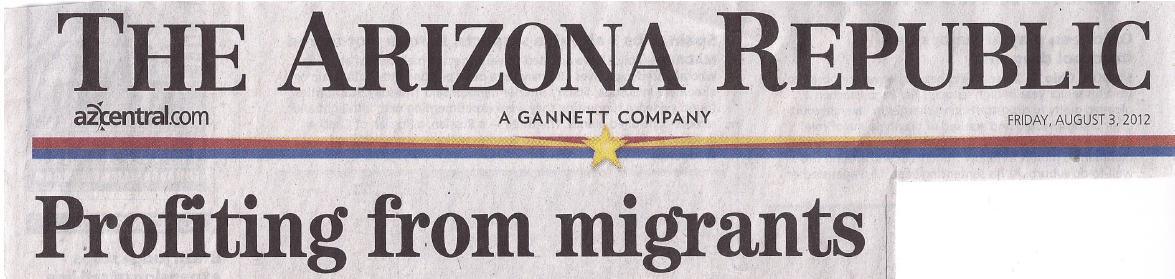
Since we were on the subject of rent-seeking in our last two posts, I happened to be in Phoenix over the weekend and was reminded of this insidious subject when I saw the following headline at the local newsstand:
This story was covered more in-depth at the Huffington Post. This post is not an endorsement of illegal immigration, but an expose’ of how the relentless and amoral function of profit-seeking in capitalism has taken over our correctional institutions through privatization, becoming another wasteful and corrupt form of rent-seeking. For-profit prisons are one of the more grotesque formations in the annals of capitalism.
According to the aforementioned articles, the for-profit prison industry has grown from just 10% of beds to the present proportion of one half. And this growth has come off the backs of taxpayers who are footing the bill for the expansion of federal facilities to house the roughly 400,000 illegal immigrants jailed each year. The cost to taxpayers will be nearly 2 billion this year. The question is how has this growth occurred in an environment of falling illegal immigration:
Much of the drop in illegal immigrants is due to the persistently weak U.S. economy, which has shrunk construction and service-sector jobs attractive to Mexican workers following the housing bust. But increased deportations, heightened U.S. patrols and violence along the border also have played a role, as well as demographic changes, such as Mexico’s declining birth rate.
If you read between the lines, the answer is in the amount of lobbying that the for-profit industry has carried out in order to milk the system and secure governments contracts:
The industry’s giants – Corrections Corporation of America, The GEO Group, and Management and Training Corp. – have spent at least $45 million combined on campaign donations and lobbyists at the state and federal level in the last decade, the AP found…
…it wasn’t until 2005 – as the corrections companies’ lobbying efforts reached their zenith – that ICE got a major boost. Between 2005 and 2007, the agency’s budget jumped from $3.5 billion to $4.7 billion, adding more than $5 million for custody operations.
Dora Schriro, who in 2009 reviewed the nation’s detention system at the request of Homeland Security Secretary Janet Napolitano, said nearly every aspect had been outsourced…
…An AP review of Federal Election Commission data found the prison companies and their employees gave to key congressional leaders who control how much money goes to run the nation’s detention centers and who influence how many contracts go to the private sector…
Besides the fact that it’s your tax dollars being stolen, how does this affect you? You’re not an illegal immigrant, you say. The tentacles of the prison industrial complex have a way of entangling more of the ever-growing ranks of the poor, an increasing number of which are the former members of the crumbling middle class. If you fall off the capitalist treadmill of debt peonage and run afoul of the law, the 1%’ers have a bed in one of their for-profit prisons waiting for you…
Since most of us will eventually be relegated to the ranks of the poor or ‘working poor’, I thought it fitting to feature an expert on poverty, Barbara Ehrenreich, author of Nickel and Dimed. She is now heading the Economic Hardship Reporting Project whose goal is to “force this country’s crisis of poverty and economic insecurity to the center of the national conversation.” I have added their blog to my list of RSS feeds. For anyone who thinks that Mrs. Ehrenreich is unaware of the larger apocalyptic picture unfolding in the world, please listen to what she says about the demise of industrial civilization. And since our last post by Darbikrash centered around the rent-seeking financialization of the economy, in particular its effects on small businesses and individual liberties, it behooves us to look at how corporations and government entities prey on the poor and use them as a vast resource pool from which to extract dollars.
In what ways do the poor get used as a source for rent-seeking financialization? Here are a few:
…as Business Week helpfully pointed out in 2007, the poor in aggregate provide a juicy target for anyone depraved enough to make a business of stealing from them.
The trick is to rob them in ways that are systematic, impersonal, and almost impossible to trace to individual perpetrators. Employers, for example, can simply program their computers to shave a few dollars off each paycheck, or they can require workers to show up 30 minutes or more before the time clock starts ticking.
Lenders, including major credit companies as well as payday lenders, have taken over the traditional role of the street-corner loan shark, charging the poor insanely high rates of interest. When supplemented with late fees (themselves subject to interest), the resulting effective interest rate can be as high as 600% a year, which is perfectly legal in many states.
It’s not just the private sector that’s preying on the poor. Local governments are discovering that they can partially make up for declining tax revenues through fines, fees, and other costs imposed on indigent defendants, often for crimes no more dastardly than driving with a suspended license. And if that seems like an inefficient way to make money, given the high cost of locking people up, a growing number of jurisdictions have taken to charging defendants for their court costs and even the price of occupying a jail cell….
You might think that policymakers would take a keen interest in the amounts that are stolen, coerced, or extorted from the poor, but there are no official efforts to track such figures. Instead, we have to turn to independent investigators, like Kim Bobo, author of Wage Theft in America, who estimates that wage theft nets employers at least $100 billion a year and possibly twice that. As for the profits extracted by the lending industry, Gary Rivlin, who wrote Broke USA: From Pawnshops to Poverty, Inc. — How the Working Poor Became Big Business, says the poor pay an effective surcharge of about $30 billion a year for the financial products they consume and more than twice that if you include subprime credit cards, subprime auto loans, and subprime mortgages.
These are not, of course, trivial amounts. They are on the same order of magnitude as major public programs for the poor….
From for-profit prisons subsidized by taxes to government-mandated premiums for the private health insurance industry, I bet if the amount of rent-seeking as a proportion of the GDP in America was able to be quantified, we’d find that this country and its captive denizens are treated as just one big plantation from which to harvest greenbacks. According to economist Joseph E. Stiglitz, an inordinate proportion of those at the top of the free market heap have made rent-seeking the primary method by which they have accumulated their riches:
…The magnitude of “rent seeking” in our economy, while hard to quantify, is clearly enormous. Individuals and corporations that excel at rent seeking are handsomely rewarded. The financial industry, which now largely functions as a market in speculation rather than a tool for promoting true economic productivity, is the rent-seeking sector par excellence. Rent seeking goes beyond speculation. The financial sector also gets rents out of its domination of the means of payment—the exorbitant credit- and debit-card fees and also the less well-known fees charged to merchants and passed on, eventually, to consumers. The money it siphons from poor and middle-class Americans through predatory lending practices can be thought of as rents. In recent years, the financial sector has accounted for some 40 percent of all corporate profits. This does not mean that its social contribution sneaks into the plus column, or comes even close. The crisis showed how it could wreak havoc on the economy. In a rent-seeking economy such as ours has become, private returns and social returns are badly out of whack.
In their simplest form, rents are nothing more than re-distributions from one part of society to the rent seekers. Much of the inequality in our economy has been the result of rent seeking, because, to a significant degree, rent seeking re-distributes money from those at the bottom to those at the top.
But there is a broader economic consequence: the fight to acquire rents is at best a zero-sum activity. Rent seeking makes nothing grow. Efforts are directed toward getting a larger share of the pie rather than increasing the size of the pie. But it’s worse than that: rent seeking distorts resource allocations and makes the economy weaker. It is a centripetal force: the rewards of rent seeking become so outsize that more and more energy is directed toward it, at the expense of everything else. Countries rich in natural resources are infamous for rent-seeking activities. It’s far easier to get rich in these places by getting access to resources at favorable terms than by producing goods or services that benefit people and increase productivity. That’s why these economies have done so badly, in spite of their seeming wealth. It’s easy to scoff and say: We’re not Nigeria, we’re not Congo. But the rent-seeking dynamic is the same….
Below is a good discussion from a couple days ago of the expanding poverty problem in America featuring Barbara Ehrenreich. Don’t mind the free market lackey from the ultra-conservative think tank American Enterprise Institute. He thinks that the access to information the internet created has made people less poverty-stricken than in the past. For those who can afford a computer and internet subscription, the information age has only made them more aware of how fucked they are in a world of depleting resources run by a ruthless transnational oligarchic elite.
What we have in America is a twisted form of socialism for the elite wherein the few are supported by the collective wealth extraction from the many, as precisely described by Dennis Kucinich:
The rancorous debate over the debt belies a fundamental truth of our economy — that it is run for the few at the expense of the many, that our entire government has been turned into a machine which takes the wealth of a mass of Americans and accelerates it into the hands of the few. Let me give you some examples…
It would be a mistake to view today’s finance capitalism as the “final stage” of industrial capitalism. The name of the new game is neofeudalism and austerity, and its preferred mode of exploitation is debt peonage. Like creditors in ancient Rome, today’s financial power is seeking to replace democracy with a financial oligarchy. The result is a resurgence of pre-capitalist “primitive accumulation,” by debt creation and foreclosure rather than the military conquests of past epochs.
Much of the dismantling of the social fabric that describes the general malaise of our times is not visible to the consumer or generic citizen. However, to peer down the darkened hallways in the backstage of American business is to glimpse the machinations of a frightening leviathan that subsumes social power in a manner that cannot be conceptualized in the traditional left vs. right paradigm.
The issue at hand is privatization, the stalwart conviction that free markets are the only means of adjudication for the natural tension between self seeking utility maximization of the individual, and the needs and rights of society as a independent entity. The perpetrators have constructed an arena of false contest, populated with sacrificial ideological tropes in pursuit of their real agenda.
It is the purpose of this article to examine some of the hidden means by which privatization- as practiced by the bourgeoisie- is being used to subsume the sovereignty of both individuals and small businesses.
A critical component to understanding privatization is to understand the need for obfuscation, e.g. to become invisible. Barring this, the next best defense against revolution and dissent is to deny that any disagreement exists, or if it does, then to valorize it and present it as irrefutable status quo, thus enjoining the conservatives who are loathe to change anything deemed as established, and can be counted on to circle the wagons in the so called “pursuit of liberty”.
Staunchly in the category of invisibility is the entire concept of rent-seeking, which is to say, the premise of unearned labor, or in plain English, getting something for nothing. Much of the financial economy of today is nearly totally dedicated to rent-seeking activities, so called financial engineering that attempts, through various debt mechanisms, to extract value from either land or industrial production without adding any value whatsoever. (For a particularly good and thorough discussion of rent seeking see this article)
If you are getting something for nothing, the last thing you want is for anyone else to know of this; so much of the current media discussion is either valorizing the financial class, or by working to maintain the invisibility of the rent-seeking genre. An understanding of this rent-seeking activity, and it’s relationship to so-called “free market” dynamics is critical to debunking the more mainstream conservative and Libertarian theories of economics, which crumble rather quickly within this framework.
Another frame of reference which adds to this discussion is a remedial listing of the three circuits of Capitalism, a.) Industrial capitalism, b.) Mercantilist Capitalism, and c.) Finance (Money lending) Capitalism. All three strains utilize exploitation to achieve access to surplus value, and all three seek to exchange supra-profits for social power. To illustrate, we can look at the Forbes list of the top 10 wealthiest Americans, and we can see that these three strains are all represented:
1. Bill Gates Microsoft (Industrial Capitalist)
2. Warren Buffett Berkshire Hathaway (Finance Capitalist)
3. Larry Ellison Oracle (Industrial Capitalist).
4. Christy Walton Walmart (Mercantile Capitalist)
5. Charles Koch manufacturing, energy (Industrial Capitalist)
6. David Koch manufacturing, energy (Industrial Capitalist)
7. Jim Walton Walmart (Mercantile Capitalist)
8. Alice Walton Walmart (Mercantile Capitalist)
9. S. Robson Walton Walmart (Mercantile Capitalist)
10. Michael Bloomberg (Finance Capitalist)
What is interesting about the relationship of these three strains is the internal competition for surplus value which is quite remarkable and very vigorous. Most of the publicized argument for regulatory constraints against the Finance Capitalist for example, is not from consumers or citizens, but stems from Industrial Capitalists who are loathe to give up surplus value to rent-seekers, preferring instead to capture this surplus for their own uses.
To further set the stage for our discussion, we can examine briefly the extents of control on modern media and the political economy by these three strains. The Financial Capitalists dominate the levers of power through direct capture of government figures, usually by interchanging and exchanging employees back and forth through key positions, as well their highly documented financial contributions. The Mercantilists however, are dominant in the advertising media, preferring instead to take their case directly to the consumer, shaping and stimulating demand by convincing consumers to purchase products and services that they did not know they needed. The long standing and principal Industrial Capitalists of course use both media and government to advance their objectives, but they add another dimension to their ideological control by purchasing controlling stakes in free market think tanks, such as the Libertarian Cato Institute (Koch brothers), the Heritage Foundation, and many others. Most of the so called “free market” think tanks that are influential on public policy can be traced to a controlling interest from Industrial Capital.
So we can see that the three strains of capital have hegemony in their own unique portals, influencing public policy with free domain to the exchange of their out-sized surplus values into social power.
The end game of all this is for the furtherance of rent-seeking activities. This is done in many different ways, but the subject of this article is a focus on privatization, and specifically the behind-the-scenes activities that are imposed on small businesses as well as employees.
The top level observation regarding the push to privatization is that it simply allows capitalist enterprise, large and small, to subvert constitutional protections by engaging private citizens in superficially mutual contracts. Modern political philosophy has been co-opted to allow wide ranging civil rights abuses under the cover of “mutual consent” in the context of a contract between private parties.
Examples would be private party contracts between employees (employment agreements) and between large and small businesses (supply agreements) .
Once private citizens enter into so called mutual contracts, the court system provides wide latitude for enforcement of virtually any draconian measure, as long as two private parties ostensibly agree. In many cases, basic constitutional protections are circumvented, and the entire principle of political economy is upended in the favor of the author of the contract. In theory, the employee or small business has the “right” to not sign any agreement which runs roughshod over his best interests, but in practice, such options are not readily available, particularly for employment agreements, when a prospective employee may be in desperate need of a job, as he or she is forced to sell his labor power for sustenance wages. If there are insufficient offerings of competing private employment contracts (as is often the case) the prospective employee must take what he can get- however onerous and biased the contractual terms are.
This is of course the objective of the Capitalist economy, to 1.) insure a standing army of unemployed workers, at the ready, to fill on demand openings in the Capitalist mode of production, incurring no costs to the Capitalist until such time as this labor power is needed, and then when needed to hire only using draconian and highly biased employment agreements that transfer State-like control to a Capitalist entity that is much better positioned to provide enforcement. 2.) To externalize costs to the greatest degree possible, such as societal infrastructure costs, by creating a privatized, Capitalist entity to take over former State controlled functions and to apply the aforementioned labor principles to realize this new profit center, that can cater such services only to these that can afford them, while exploiting those that provide labor power to these privatized entities.
Once these externalized functions are brought under the umbrella of the Capitalist mode of production, the issue of mutually agreeable contract law can be brought to bear to strip these workers of their Constitutional rights, and further weaken any efforts to consolidate and resist.
The folks over at Crooked Timber have provided some particularly good examples and arguments around this notion of using contract law to subvert even basic liberties:
Life at Work
To understand the limitations of these …….. we have to understand how little freedom workers enjoy at work. Unfreedom in the workplace can be broken down into three categories.
1. Abridgments of freedom inside the workplace
On pain of being fired, workers in most parts of the United States can be commanded to pee or forbidden to pee. They can be watched on camera by their boss while they pee. They can be forbidden to wear what they want, say what they want (and at what decibel), and associate with whom they want. They can be punished for doing or not doing any of these things—punished legally or illegally (as many as 1 in 17 workers who try to join a union is illegally fired or suspended). But what’s remarkable is just how many of these punishments are legal, and even when they’re illegal, how toothless the law can be. Outside the usual protections (against race and gender discrimination, for example), employees can be fired for good reasons, bad reasons, or no reason at all. They can be fired for donating a kidney to their boss (fired by the same boss, that is), refusing to have their person and effects searched, calling the boss a “cheapskate” in a personal letter, and more. They have few rights on the job—certainly none of the First, Fourth, Fifth, Sixth, and Seventh Amendment liberties that constitute the bare minimum of a free society; thus, no free speech or assembly, no due process, no right to a fair hearing before a panel of their peers—and what rights they do have employers will fight tooth and nail to make sure aren’t made known to them or will simply require them to waive as a condition of employment. Outside the prison or the military—which actually provide, at least on paper, some guarantee of due process—it’s difficult to conceive of a less free institution for adults than the average workplace.
2. 2. Abridgements of freedom outside the workplace
In addition to abridging freedoms on the job, employers abridge their employees’ freedoms off the job. Employers invade employees’ privacy, demanding that they hand over passwords to their Facebook accounts, and fire them for resisting such invasions. Employers secretly film their employees at home. Workers are fired for supporting the wrong political candidates (“work for John Kerry or work for me”), failing to donate to employer-approved candidates, challenging government officials, writing critiques of religion on their personal blogs (IBM instructs employees to “show proper consideration…for topics that may be considered objectionable or inflammatory—such as politics and religion”), carrying on extramarital affairs, participating in group sex at home, cross-dressing, and more. Workers are punished for smoking or drinking in the privacy of their own homes. (How many nanny states have tried that?) They can be fired for merely thinking about having an abortion, for reporting information that might have averted the Challenger disaster, for being raped by an estranged husband. Again, this is all legal in many states, and in the states where it is illegal, the laws are often weak.
3. 3. Use of sanctions inside the workplace as a supplement to—or substitute for—political repression by the state
While employers often abridge workers’ liberty off the job, at certain moments, those abridgments assume a larger function for the state. Particularly in a liberal state constrained by constitutional protections such as the First Amendment, the instruments of coercion can be outsourced to—or shared with—the private sector. During the McCarthy period, for example, fewer than 200 men and women went to jail for their political beliefs, but as many as 40% of American workers—in both the public and private sectors—were investigated (and a smaller percentage punished) for their beliefs.
And, perhaps most succinctly:
What makes the private sector, especially the workplace, such an attractive instrument of repression is precisely that it can administer punishments without being subject to the constraints of the Bill of Rights. It is an archipelago of private governments, in which employers are free to do precisely what the state is forbidden to do: punish without process. Far from providing a check against the state, the private sector can easily become an adjutant of the state. Not through some process of liberal corporatism but simply because employers often share the goals of state officials and are better positioned to act upon them.
So this is the end state that the “free market” evangelists push for, this is the holy grail of privatization, externalized costs to a system that can act outside of the constraints of the Bill of Rights.
We can extend this discussion to the even further reaches of transparency, that of the nature of contracts between large and small businesses. In addition to the above noted employer/employee social relations enforced under a Capitalist entity governed by private contract, the same private contract modality has some startling repercussions for business:
1.) Mercantilists demand slotting fees to product producers for prominent product (shelf) placement at retail locations. They routinely create profit centers with draconian shipping requirements, for example, if a shipping label is off center from a specific location on a carton by even an inch, the producer is fined for each instance of this deviation. Missing or incorrectly filled out paperwork, spelling errors, any excuse for a “deviation” results in a back charge (fine) to the producers. It is not unusual to see small manufacturers shipping product to “big box” retailers, and to have so many back charges that their entire profit margin is consumed before the first unit is even sold. Which of course, is the goal.
2.) Small manufacturers are expected to honor dubious return policies, many large retailers force contract language on suppliers that require them to accept returns months, sometime years after shipment, often when the product was clearly misused. Replacement costs are often entirely pushed onto the supplier, yielding a system that is nearly impossible to accurately track inventory, when such products are never really sold, if they can be returned for full credit months later.
3.) Contract language for even small, non-mercantilist orders has escalated dramatically over the last few years. Consider:
a. Supply agreements can dictate and restrict any outspoken political dissent or endorsement.
b. You can be forced to decline sales within certain industries, to certain customers deemed competitive to the purchaser, or constrained to within certain geographic radii.
c. You can be prohibited from selling a certain product or service to anyone but the original purchaser.
d. You can be forced to accept liability for failures that have nothing to do with your product or service.
e. You can be forced to submit to a dress code for certain customer facing events, and translate this code internally to your own organization.
f. You are often forced to agree to all types of intrusive audits, in some cases unannounced, and can be forced to absorb any lost production costs or accounting support costs in support of these audits- regardless of their outcome.
4.) But perhaps most egregiously, it is now increasingly common to submit to mandatory electronic form of payment, wherein you provide your confidential banking account information, and payment is only made, and cannot be made any other way, by means of a wire transfer directly into your private business account. Reading of the small print in the contract yields an almost universal caveat, the payer can reverse any payment immediately and electronically, directly from your account, without notice and without permission; further, if there is any payment dispute, fines or penalties, or the occurrence of any perceived damages and liability that can result in charge backs to you, the supplier, these can be extracted without notice and without permission.
If you read the fine print on any recent home mortgage documentation you will see similar examples of this from our friends the Finance Capitalists, and if you are foolish enough to consider borrowing money for a business venture from a Finance Capitalist, you will get a first class education in exploitation via contract documents.
The sum total of all this, under the mantle of privatization, is the absolute and unchallenged control by the large scale Capitalist of both consumer and small business based endeavor, seeking to capitalize any surplus value that is achieved though small business or consumer debt onset, and to reduce this to rent-seeking in a fashion that would put Mussolini to shame.
Turns out the devil you don’t know is far worse than the devil you do know.





 Collapse of Industrial Civilization