
Tags
Alastair Campbell, Arms Dealers, Capitalism, CIA, Colin Powell, Corporate State, Corporatocracy, Dick Cheney, Empire, FBI, Financial Elite, George Bush, Halliburton, Homeland Security, Imperialism, Inverted Totalitarianism, KBR, Military Industrial Complex, Neoliberal Capitalism, NSA, Peak Oil, Police State, Privatization of War, Rupert Murdoch, The Elite 1%, Tony Blair, War on Terror

“The Saudis have a saying that acknowledges their luck in being born on top of billions of barrels of oil and the inevitability of its depletion:
“My father rode a camel, I drive a car, my son flies a jet plane, his son will ride a camel.”
Delusional Americans believe they have a right to cheap plentiful oil forever. They refuse to acknowledge that luck has played the major part in their rise to economic power. The American saying will be:
My great grandfather rode a horse, my grandfather drove a Model T, my father drove a Buick, I leased a Cadillac Escalade, my son died in the Middle East fighting for my oil, his son will never be born.” – Jim Quinn
If you needed further proof of the ulterior motives behind the invasion and destruction of Iraq, I give you this post from Farooque Chowdhury’s Diary. [I have embedded links in the article and done some grammatical edits.]
Murdoch’s Iraq War
It is not only the interests behind waging the war, but also the principles and interests the bourgeois press uphold, and the secretive and conspiratorial way the bourgeois democracy works, the lies that are fabricated, how the readers are misinformed, and the manipulation of mass psychology that is being divulged.
The Guardian, British newspaper and AFP, news agency, reported the facts.
The news reports said:
Campbell’s assertions were made in The Burden of Power: Countdown to Iraq, diaries from his years at Blair’s side. [Here is his blog]
The news reports said:
Citing Campbell the news reports said:
The reports said:
“‘But I think Tony did feel that there was something a bit crude about it. It was another very right-wing voice saying to him: ‘Look, isn’t it about time you got on with this?’”
The news reports said:
Already known is the Bush – Blair 2003 Iraq memo or Manning memo, a secret memo of a meeting between Bush and Blair. The historic meeting took place on January 31, 2003 in the White House. The memo, written by David Manning, Blair’s chief foreign adviser, showed that the US had already decided on the invasion of Iraq at that point. Manning participated at the meeting. The memo showed Bush and Blair made a secret deal to carry out the invasion regardless of whether WMD were discovered by UN inspectors. The fact contradicts statements Blair made to the British parliament that Saddam Hussein would be given a final chance to disarm. Existence of the memo was made by Philippe Sands in his book Lawless World. The New York Times collected the memo and confirmed its authenticity.
Then, there is the Colin Powell case. While arguing for invading Iraq Powel claimed that Saddam was hiding a secret biological weapons program. Powell dramatically and confidently held up a vial he said could contain anthrax during his presentation of the Iraq case at the UN in 2003. But, later, the claim proved bogus.
Powel relied on information provided by an Iraqi defector. The defector was code-named “Curveball”. CBS News identified Rafid Ahmed Alwan al-Janabi as “Curveball”. Rafid made the false claims to German intelligence officials. The US used the claim that ultimately turned out to be a lie. But the Empire used the false information to start the war. The UN inspectors found no evidence of a biological weapons program, which was claimed.
In interviews with The Guardian, Rafid told the way he sought asylum in Germany and wanted to see an end to Saddam’s regime. “They gave me this chance. I had the chance to fabricate something to topple the regime. I and my sons are proud of that […]”
Man whose WMD lies led to 100000 deaths confesses all (4-1-2012)
The “story” of falsehood and fabrication doesn’t end there.
So, the profit issue emerges. The Iraq war brought profit to all interested: weaponeer, supplier, infrastructureer, defense contractor, mercenary companies, and a section of media and politicians.
According to MSN Money(link to Cheney and his war profits), Halliburton’s KBR, Inc. division made $17.2 bn in the desert war in the 2003-2006 period, which was one-fifth of KBR’s total revenue for the 2006 fiscal year. Halliburton was involved with construction and maintenance of military bases, oil field repairs, and infrastructure rebuilding projects in the country.
And, after the Bush Blair, Murdoch, Halliburton war business, where stood Iraq?
Thomas E. Ricks, Washington Post Pentagon correspondent quoted Mohammed Abdullah, an Iraqi in his Fiasco: The American Military Adventure in Iraq: “They said they came to liberate us. Liberate us from what? They came and said they would free us. Free us from what? We have traditions, morals, and customs. We are Arabs. We’re different from the West. Baghdad is the mother of Arab culture, and they want to wipe out our culture, absolutely.”
Iraq now stands devastated, a bold sign of Naked Imperialism (title of a book by John Bellamy Foster). Parts of life in the land have been wiped out. Does imperialism have the power to restore what has been lost in Iraq? It’s incapable. Imperialism’s devastating power lacks power to create and nourish life and nature. Iraq is one of the monuments of destruction imperialism has constructed in many parts of the world.
Mankind’s Greatest Shortcoming: Death by Numbers
19 Tuesday Jun 2012
Tags
Exponential Growth, Mass Die Off, Mike “Mish” Shedlock, Overpopulation, Paul Chefurka, Peak Oil, Professor Albert Bartlett, Professor Stephen Hawking
The tipping point is only recognized and acknowledged after it’s too late. Exponential, or non-linear, growth is sneaky in that one minute things appear manageable, even benign, when in fact we are mere moments away from total saturation and death. That’s the situation we are in now, having reached the limits of growth on a finite planet. Despite all the handwringing about the Euro Crisis and fixing the problem there, the only way out is degrowth and an awareness that we must live within the means that the earth will allow. For self-serving reasons, the social hierarchy that benefits from the current system will not allow this to happen because it would mean a radical restructuring of how the economy works and how the world’s resources are used and distributed. This is the straitjacket we are caught in by those benefiting at the top of the ponzi scheme who want to use austerity in an attempt to preserve the current scheme at the expense of the masses. But under our capitalist economic system, austerity becomes self-defeating:
The reasons given by S&P, the rating agency concerned, is revealing: “we believe that a reform process based on a pillar of fiscal austerity alone risks becoming self-defeating, as domestic demand falls in line with consumers’ rising concerns about job security and disposable incomes, eroding national tax revenues” (www.standardandpoors.com).
Without growth, debt reduction becomes impossible – and yet the only way capitalism has to stimulate growth is by government intervention, thus increasing debt! Capitalism is caught in a vicious pincer movement from which it cannot escape.
The following post explains why we have reached the limits of cheap fossil-fuel driven growth, requiring an out-of-the-box thinking in order to solve our current problems.
The true danger posed by our exploding population is not our absolute numbers but the inability of our environment to cope with so many of us doing what we do.
Population: The Elephant in the Room; Peak Oil Implications on Population Growth; What Level of Human Population is Sustainable?
“In the last 200 years the population of our planet has grown exponentially, at a rate of 1.9% per year. If it continued at this rate, with the population doubling every 40 years, by 2600 we would all be standing literally shoulder to shoulder.” says Professor Stephen Hawking as reported by Edward Morgan in Looking at the New Demography.
Suffice to say the rate of population growth will not continue, and Morgan makes the case we are already in stage 5 of The Demographic Transition Model

Peak Oil Implications on Population Growth
Whereas Morgan presents a relatively benign view of things, even wondering if there are ways to reverse stage 5 decline, Paul Chefurka in Population: The Elephant in the Room sees things quite differently, primarily because of oil usage.
Each of the global problems we face today is the result of too many people using too much of our planet’s finite, non-renewable resources and filling its waste repositories of land, water and air to overflowing. The true danger posed by our exploding population is not our absolute numbers but the inability of our environment to cope with so many of us doing what we do.
It is becoming clearer every day, as crises like global warming, water, soil and food depletion, biodiversity loss and the degradation of our oceans constantly worsen, that the human situation is not sustainable. Bringing about a sustainable balance between ourselves and the planet we depend on will require us, in very short order, to reduce our population, our level of activity, or both. One of the questions that comes up repeatedly in discussions of population is, “What level of human population is sustainable?“
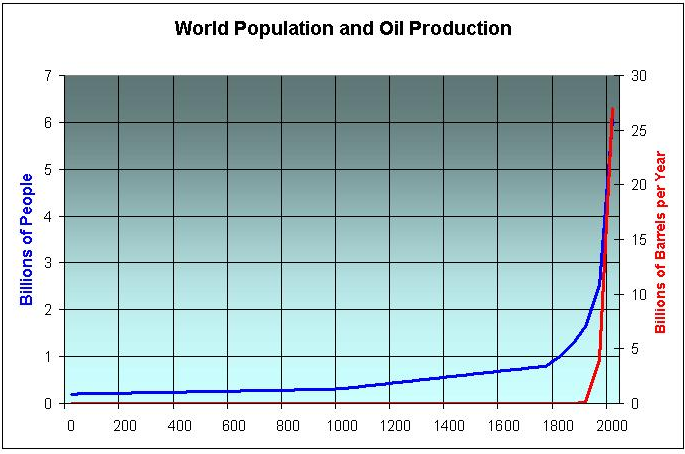
Oil first entered general use around 1900 when the global population was about 1.6 billion. Since then the population has quadrupled. When we look at oil production overlaid on the population growth curve we can see a very suggestive correspondence:
A closer look at the two curves from 1900 to the 2005 reinforces the impression of a close correlation:
The first questions everyone one asks when they accept the concept of Peak Oil is, “When is it going to happen?” and “How fast is the decline going to be?”
The steepness of the post-peak decline is open to more debate than the timing of the peak itself. There seems to be general agreement that the decline will start off very slowly, and will increase gradually as more and more oil fields enter decline and fewer replacement fields are brought on line. The decline will eventually flatten out, due both to the difficulty of extracting the last oil from a field as well as the reduction in demand brought about by high prices and economic slowdown.
The post-peak decline rate could be flattened out if we discover new oil to replace the oil we’re using. Unfortunately our consumption is outpacing our new discoveries by a rate of 5 to 1. to make matters worse, it appears that we have probably already discovered about 95% of all the conventional crude oil on the planet.
A full picture of the oil age is given in the graph below. This model incorporates actual production figures up to 2005 and my best estimate of a reasonable shape for the decline curve. It also incorporates my belief that the peak is happening as we speak.
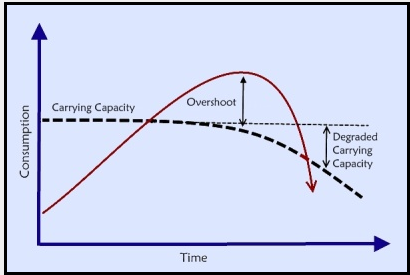
In ecology, overshoot is said to have occurred when a population’s consumption exceeds the carrying capacity of its environment, as illustrated in this graphic:
Overshoot
Populations in serious overshoot always decline. This is seen in wine vats when the yeast cells die after consuming all the sugar from the grapes and bathing themselves in their own poisonous alcoholic wastes. It’s seen in predator-prey relations in the animal world, where the depletion of the prey species results in a die-back of the predators. Actually, it’s a bit worse than that. The population may actually fall to a lower level than was sustainable before the overshoot. The reason is that unsustainable consumption while in overshoot allowed the species to use more non-renewable resources and to further poison their environment with excessive wastes.
In the case of humanity, our use of oil has allowed us to perform prodigious feats of resource extraction and waste production that would simply have been inconceivable before the oil age. If our oil supply declined, the lower available energy might be insufficient to let us extract and use the lower grade resources that remain. A similar case can be made for a lessened ability to deal with wastes in our environment.
Excess Deaths
[Chefurka goes through a series of grim charts culminating with with this explanation of what is coming]
The Cost
The human cost of such an involuntary population rebalancing is, of course, horrific. Based on this model we would experience an average excess death rate of 100 million per year every year for the next 75 years to achieve our target population of one billion by 2082. The peak excess death rate would happen in about 20 years, and would be about 200 million that year. To put this in perspective, WWII caused an excess death rate of only 10 million per year for only six years.
Given this, it’s not hard to see why population control is the untouchable elephant in the room – the problem we’re in is simply too big for humane or even rational solutions. It’s also not hard to see why some people are beginning to grasp the inevitability of a human die-off.



UN Population Projections
Let’s put aside the really grim projections and simply ponder the “low population track” in the following charts of population projections from the UN.

I cannot find the article or source for that chart but the image is from a link on Seeking Alpha.
Demographic and Economic Questions
- Is that low UN track that unbelievable? If not, what if the starting point is now, not 2040?
- Who is going to pay the medical costs of all the retirees in the developed-world if people live longer and the population simply stagnates?
- Where are the energy resources going to come from if the population keeps growing instead?
- Where are the energy needs of China alone going to come from at the current rate of China’s economic growth regardless of whether the Chinese population grows or not?
Those who think we are going to “grow” our way out the the current global economic mess better have good answers for the questions in points number one and three above.
Problem number two is a huge problem in Japan right now. The US will face the same problem not too far down the road.
Those who suggest immigration and population growth is the solution to problem number two better have an answer to question number three while also explaining how immigration and population growth is nothing more than a can-kicking exercise.
The China problem is right here, right now. Peak oil all but ensures China’s growth rate is going to plunge in the not too distant future, there is going to be a huge global showdown over oil supplies with China the winner, or a cheap easy to produce means of renewable energy is found in the next five years?
Mike “Mish” Shedlock
The Meek Shall Inherit the Earth
18 Monday Jun 2012
Posted in Ecological Overshoot, Environmental Degradation, Peak Oil
Tags
Antibiotic-Resistant Bacteria, Brane Space, Dr Edo McGowan, Modern Healthcare System, Pandemic, Peak Antibiotics, Peak Oil, Professor Timothy Walsh, The Black Plague, World Health Organization
The following video is from 2degrees and helps visualize human population growth from “1 AD up to 2030 AD. Each dot represents 1 million people.” The only time global population shrank was during the Black Death in Europe from 1348 to 1350 with the death toll estimated at somewhere between 75 and 200 million people or 25% to over 60% of the population.
Yesterday the author of The Elements of the Corporatocracy at his site Brane Space published a post called ‘Could the ‘Black Death’ Strike Again?‘ in which he brings up a recent case in Oregon and posits that with austerity measures imposed on our indebted economy in the age of peak oil, our infrastructure will inevitably deteriorate faster without the funds or cheap energy to maintain such things as the endless labyrinth of water pipes and waste management infrastructure. This scenario certainly is what we are facing. The American Society of Civil Engineers’ Report Card on America’s Infrastructure gave the country an overall grade of “D” in its most recent report and put a price tag of $2.2 Trillion to make it meet adequate conditions. Another fast approaching reality is that of “peak antibiotics“. The director-general of the World Health Organization, Dr. Margaret Chen, says that we are facing a world without antibiotics:
If current trends continue unabated, the future is easy to predict. Some experts say we are moving back to the pre-antibiotic era. No. This will be a post-antibiotic era,” Chan said. “In terms of new replacement antibiotics, the pipeline is virtually dry…The cupboard is nearly bare.
A snippet from a story in February of this year:
Experts fear diseases ‘impossible to treat’
The UK is facing a “massive” rise in antibiotic-resistant blood poisoning caused by the bacterium E.coli – bringing closer the spectre of diseases that are impossible to treat.
Experts say the growth of antibiotic resistance now poses as great a threat to global health as the emergence of new diseases such as Aids and pandemic flu.
Professor Peter Hawkey, a clinical microbiologist and chair of the Government’s antibiotic-resistance working group, said that antibiotic resistance had become medicine’s equivalent of climate change.
The “slow but insidious growth” of resistant organisms was threatening to turn common infections into untreatable diseases, he said. Already, an estimated 25,000 people die each year in the European Union from antibiotic-resistant bacterial infections.
“It is a worldwide issue – there are no boundaries,” he said. “We have very good policies on the use of antibiotics in man and in animals in the UK. But we are not alone. We have to think globally.” Between 2005 and 2009 the incidence of E.coli “bacteraemias” [the presence of bacteria in the blood] rose by 30 per cent, from 18,000 to over 25,000 cases. Those resistant to antibiotics have risen from 1 per cent at the beginning of the century to 10 per cent…
Also worth reading are these three articles from last year:
The ‘return of our old enemies in an untreatable form‘
How Superbugs Will Affect Our Health Care Costs – The Atlantic
Are you ready for a world without antibiotics?
Professor Timothy Walsh told Wales on Sunday that in the “Darwinian” battle against disease-carrying bacteria, we are on the losing side.
And he said that we will all have to face up to a world where antibiotics simply do not work anymore.
His claim came after he and his team of scientists at Cardiff University found 37 cases in the UK of a deadly new form of superbug that is resistant to ALL antibiotics….
He said: “This is Darwin’s survival of the fittest – and we are on the losing side.
“The real test is – can bacteria evolve resistance and maintain resistance quicker than we can develop antibacterial drugs?
“The ultimate answer to that is yes, it can.
“We have all been scratching around to try to find new classes of antibiotics, but ultimately bacteria’s DNA systems can evolve and transfer very quickly so the odds are not in our favour.
“We have to be realistic and accept that this is potentially the future we will have to face.”
The world’s population has exploded from two billion people 80 years ago to more than six billion today – all thanks to the discovery and mass production of antibiotics like penicillin.
Because bacteria multiply every 20 to 30 minutes, they evolve very quickly and become resistant to antibiotics used against them.
In the past, this has not mattered because scientists were producing so many new types of drug, but in the last 15 years development of new antibiotics has almost ground to a halt, meaning bacteria are catching up fast…
Worth reprinting in relation to the above article is a response by Dr Edo McGowan PhD, Medical Geo-hydrology, Environmental and public policy analyst, environmental scientist, medical geo-hydrologist working with environmental contaminants:
“A principal route for the spread of newly emerging infectious diseases is through sewage treatment plants which generate these bugs and then release them. Genetic information is rapidly spread amongst the very large number of bacteria found in sewage treatment works. The issue of over prescribing antibiotics may now be vastly over-shadowed by the generation and release of pathogens and superbugs by sewer plants. There have been some good studies coming out of India on the augmentation and generation of sewage assisted superbugs derived from hospitals, see: (http://www.indmedica.com/journals.php?journalid=6&issueid=21&articleid=179&action=article)
This tie to sewer plants is also well described by the Michigan study (http://www.ur.umich.edu/0809/May18_09/19.php). The US/EPA has known about this since the later 1970s or early 1980s but has been moribund to deal with it. It conducted a major study demonstrating this and then removed the results from its data base, one might ask why?—-, see:(http://www.ncbi.nlm.nih.gov/pmc/articles/PMC241834/pdf/aem00183-0119.pdf).
What we are finding in America is that the regulatory community, including the US/EPA and the US CDC have been asleep at the switch when it comes to how superbugs are made and then multiplied in sewer plants, thence spread through sewage byproducts such as biosolids into the environment. Several U.S. scientists as well as scientists around the world have documented the spread of antibiotic resistance via treated sewage, biosolids or released treated wastewater. For example, see: “Vancomycin resistant enterococci (VRE) in Swedish sewage sludge”, by Leena Sahlström, Verena Rehbinder, Ann Albihn, Anna Aspan, and Björn Bengtsson. Acta Veterinaria Scandinavica 2009, 51:24 doi:10.1186/1751-0147-51-24.
Documentation of antibiotic resistance spread by sewage goes back decades but the regulatory community continued to ignore it—-or worse, hid it. The standards used are antiquated and the regulators are well aware of this also. Thus, along the great rivers in the U.S. and other nations, each successive city gets its drinking water from the immediate up-stream sewage outfall of the preceding city. Agricultural lands with applied biosolids also drain into these rivers carrying antibiotic resistant pathogens, see: “Increased frequency of drug-resistant bacteria and fecal coliforms in an Indiana Creek adjacent to farmland amended with treated sludge” by Shivi Selvaratnam and J. David Kunberger.
This process cycles these bugs and each time they get stronger. The fact that we are now finding pharmaceuticals in drinking water shows one that the wastewater systems are not working. Unbeknown to most, there are antibiotic resistant genes, so small that they pass through most water treatment plants and are in fact now found in drinking water. These are not affected by chlorine at currently used levels. They easily transit within the human gut to the gut bacteria and there wait like tiny time bombs for an incoming pathogen, thus arming this pathogen with yet more resistance and virulence.
Once in the gut biota this damaging genetic information can remain for years and also because of the very large number of bacteria in the normal gut biota, there are opportunities for creating higher level pathogens. Antibiotic resistant infections in the United States now cause more deaths than AIDS. This is not an easy issue for U.S. regulators to accept, especially if they want you to believe all is well and rosy. But unless we want to return to amputation as the cure for infections, the regulatory community around the globe needs to wake up.
We may delay what Professor Timothy Walsh indicates by immediately dealing with the current standards for wastewater and redesigning sewer plants. There are extant systems and designs that greatly diminish the flow-through of pathogens. Additionally, the current use of sewage sludge on agricultural land merely spreads more antibiotic resistance into farming areas, thence into the food supply. The current use of reclaimed water on food crops does the same. We have created this problem. It may be that current surgeries will not be possible because of the risk of unstoppable infection and cure for infection may revert to amputation.” – Dr. Edo McGowan
Another factor is our moribund health care system in America:
…A permanently contracting economy will result in a bioethical crisis as fewer resources are available to an increasingly stressed global population. We need to reconsider our goals of expansion of capitalism-driven wealth as the system loses its surplus energy. Instead we need to consider the sustainable good of the entire country during the contraction of the economy. We need justice in terms of basic needs for all, with more attention to the health of entire communities rather than individual rights. Failure to provide basic needs for all affects the whole system, with increases in epidemics due to stress, overcrowding, poor nutrition, dirty water and pollution, and failures in vaccination programs and general control of illnesses.
Based on the apparent politics of today, as we continue to descend, what we will probably get as the system becomes more imbalanced and unsustainable is limited fee for service care for the wealthy (with eventual failure of insurance), very limited care for the poor, and early mortality for many….
So if we take into account these various elements of peak oil, austerity cuts, a crumbling infrastructure and ineffective waste treatment facilities, a for-profit healthcare system that primarily serves the wealthy, and “peak antibiotics”, then the outlook does not look good for avoiding another outbreak or plague of some sort. In fact, it appears inevitable if you also consider that bacteria have been imbued with superior mutation and survival abilities from their unbroken 3.5 billion year reign on this planet.

Disaster Capitalism and its Aftermath
15 Friday Jun 2012
Tags
Arms Dealers, Corporate State, Corporatocracy, Empire, Glenn Greenwald, Inverted Totalitarianism, Jesselyn Radack, Military Industrial Complex, Neoliberal Capitalism, Obama, Peter Van Buren, Privatization of War, Resource Wars, War on Terror, War on Whistleblowers
I first heard about Peter Van Buren through a guest post by Jesselyn Radack on Glenn Greenwald’s blog discussing another case of Obama’s ever-widening war on whistleblowers:
Today, I’m not writing about the Espionage Act being used to chill journalists and whistleblowers, but something equally as troubling: the assault on whistleblowers’ First Amendment rights, illustrated by the creepy case of Peter Van Buren.
Van Buren is a Foreign Service Officer with the State Department who wrote a book critical of U.S. reconstruction projects in Iraq, We Meant Well: How I Helped Lose the Battle for the Hearts and Minds of the Iraqi People (Metropolitan Books 2011). He also maintains a personal blog at www.wemeantwell.com….
Here is Peter discussing the outright corruption of what I call our military-media-congressional complex:
And another interview he did recently with Eliot Spitzer on CurrentTV:
Van Buren has a sardonic, humorous writing style with many of his posts which makes them enjoyable to read. As Van Buren explains in the following blog entry, the vast black hole that is Iraq continues to milk American citizens dry through the privatization of war via guns-for-hire eager to project America’s increasingly militarized foreign policy. Besides having our pocketbooks raided by this outsourcing of war for profit, these paid mercenaries aren’t the best of ambassadors for spreading good will and a positive image for America, if there ever existed such a thing from our naked grab for resources by way of military invasion. But in a land of such high rhetoric and such low character, when you need someone to carry out the dirty work of our economy, extrajudicial assassins are a President’s best friend. A case in point is the infamous war profiteer Blackwater, then changed to Xe, and now metamorphosized into Academi (still operating with the testosterone-laced, self-righteous warrior-of-God mentality):
God’s Will: Academi and Mercs at State
June 14, 2012
I wrote recently about the return of Blackwater to the State Department, with the mercenary guns-for-hire company changing its name once again (now called Academi in a homage to bad spelling) and buying an existing contract to put it back into the State Department’s world.
It gets creepier, as government seems to get these days.
Slam Dunk on Inman
Academi now boasts two celebrities on its Board of Directors, former attorney general John Ashcroft and retired admiral Bobby Inman. Ashcroft of course is Mr. Homeland Security, the guy who set in motion the smorgasbord of unconstitutional wiretapping, spying and detentions without trial that followed 9/11. He is also the guy who was so offended by the marble statues at the Department of Justice that he had them draped to hide classical nude details.
From a State Department-Blackwater love fest perspective, Inman is a slam-dunk. Inside Foggy Bottom, Inman is permanently associated with the up-armoring of embassies abroad through the 1985 “Inman Report,” a call to arms that resulted in the moated, blast-proof, unapproachable fortress embassies America promotes its image through today. The Report was also the catalyst for the establishment of the part of the State Department which titularly oversees the deployment of mercenaries, everyone’s favorite Bureau of Diplomatic Security, DS. Inman’s word is gospel to DS, so his appearance on the Academi Board is no accident.
Small World
Keeping the circle of life theme going, Academi’s CEO Ted Wright used to be president of mega-contractor KBR, the firm Dick Cheney worked for and the firm that made billions running the backstage logistics portion of the Iraq and Afghan crusades. One of Academi’s VPs worked for Queen Noor of Jordan, and has ties to the Bush dynasty. It is indeed a small world.
More creepiness?
Academi, on its “pro shop” web site, sells God’s Will T-shirts, pictured above. Just the thing for the budding merc crusader to wear while gunning down Muslims for profit. Jeez, and people wonder why we’re not winning.

A Devil’s Bargain
In the days since 9/11, State has undergone a fundamental shift, one that has required the organization to make a Devils’ Bargain with mercenaries like Academi. Prior to 9/11, State’s policy was generally to evacuate embassies in countries at war, reinserting diplomats when things quieted down to the point that diplomacy was again possible. This strategy worked well for some 220 years of American history.
After 9/11, State felt compelled to out-macho the military, to prove its manliness in the testosterone-fueled Bush (and now Obama) years. This meant opening and/or keeping open embassies in the midst of shooting wars, originally just in Iraq and Afghanistan, but now spread alongside America’s increasingly one-tune foreign policy of belligerence to places like South Sudan, Yemen and elsewhere in drone land. The US military, already stretched thin by endless war, has neither the forces nor the interest in guarding State’s pasty pseudo warriors, and so the Department of State is forced to turn to private armies, like Academi, mercenaries, to enable its macho posture abroad.
I saw groups like Blackwater in action in Iraq, often alongside our own military. The mercs were what our military would be like without the NCO corps to enforce discipline, a frat house with guns, lots of guns. While State makes wordplay out of claiming to supervise its mercs, overpaid, ‘roided ‘dudes with guns named Smitty, J-Dub, Spider and the like take little notice when requested to follow the laws of war in protecting diplomats so far out of their environments. It is a situation that isn’t just likely to go wrong, it is one that practically demands to devolve into crisis.
The solution is straightforward. State should understand and admit that it is neither equipped, trained nor needed for combat situations. State should take a step back from adventures that assure its role as negotiators, diplomats, public diplomacists and the like will be misunderstood at best, and refocus its resources away from spending billions on private armies. Until then, State is forced into bed with creepy organizations like Academi, and will suffer for it.
How are things in Iraq these days in the aftermath of our implementation of disaster capitalism? … just peachy. This video best describes the privatization of the Iraqi economy and its oil that is presently going on:
The Vicious Price/Demand Cycle of Peak Oil & Blackouts in Greece
06 Wednesday Jun 2012
Posted in Peak Oil
Tags
American Enterprise Institute, Corporate Neo-Colonialism, Ecological Overshoot, Electricity Blackouts, Euro Crisis, Greece, Land Grabs, Overpopulation, Peak Fish, Peak Minerals, Peak Oil, Peak Soil, Peak Water, Social Unrest
Various groups will continue to deny Peak Oil because to accept that oil is finite is to completely pull the rug out from under their entire construct of free markets and unlimited economic growth. To accept the reality of Peak Oil would turn their entire life upside down since Capitalism cannot exist in the energy constrained world coming at us full speed. And as you know, the resource constraints of our modern world with 7 billion humans, and 250,000 added every day, is not confined to just energy, but across the board with minerals, soil, fish, fresh water, etc.
So it comes as no surprise that we would have such a denial coming out of The American Enterprise Institute. If you do a quick search on the background of the AEI, then it becomes obvious why they would be using old-world, linear thinking to make sense of our present situation:
Some AEI scholars are considered to be some of the leading architects of the second Bush administration‘s public policy.[7] More than twenty AEI scholars and fellows served either in a Bush administration policy post or on one of the government’s many panels and commissions. …AEI is the most prominent think tank associated with American neoconservatism, in both the domestic and international policy arenas.[13]
Peak oil does not mean peak price. As I explained in an earlier post, Peak Oil: the Yoke on Future Growth, we are now in the world of a vicious cycle where the economy fluctuates with spurts of GDP growth which increase demand for oil and thus a rise in price. The consequent rise in price then dampens the economy which results in a decrease in demand and the price drops. This is the ‘rinse and repeat’ cycle we will see while riding the plateau of peak net energy, as explained by people such as Colin Campbell PhD:
…I’ve reached the conclusion that this industrial age that opened only about 200 years ago — started with coal which provided the energy which changed the world radically; provided the steam engine, the trains and everything that started to stimulate trade and industry and transport grew and that was followed by oil, as you say. And over the last 100 years or so we’ve seen the rapid expansion of oil that has just fueled everything that you can imagine.
But we are now more or less half way through the oil age and the production begins to go down and, as you say, once you reach the barrier of supply, the price goes through the ceiling, it prompts a recession, demand collapses, the price falls again and then the governments, who don’t really seem to understand what we’re talking about, they print more money out of thin air, make more credit available in the hope of stimulating consumerism and restoring past prosperity, but — and they meet a little brief success, but as they do, the demand for oil goes up again; it soon goes through the barrier and the price starts to surge. So the future price of oil is an interesting subject. And I would say myself that we’re talking about something in the range of $100-150 a barrel because if it goes above that, it just kills demand and you have growing recessions.
So I think you’re absolutely right. We have these, sort of, cycles of a little surge of prosperity followed by another recession. And we are entering the second half of the age of oil when this stuff just gradually declines.
Blackouts may occur in Greece this summer due to the acute problems it is facing in its energy flows:
Ekathimerini reported DEPA’s Haris Sachinis has advised the caretaker government that the liquidity crisis is so dire that the issue of a probable blackout should be considered a “special national emergency.”
DEPA[Greek Public Gas Corporation] is owed around €300 million by electrical energy producers, leaving DEPA unable to pay its own Turkish, Italian and Russian suppliers. Meanwhile Greece’s Public Power Corporation, DEI, is struggling to cope with hugely increased costs in its energy purchase bill. Athens News reported prices for natural gas and oil, which it relies on to produce electricity, have increased by 83 percent.
To compound the energy crisis Greece faces, the issue of oil imports is critical. Since the suspension of Iranian oil imports to Greece due to the EU embargo on Iranian oil, the debt-ridden nation is forced to purchase oil at premium prices, Ekathimerini reports.
Prior to the EU ban on Iranian oil Greece was largely dependant on the Persian state to supply crude oil on credit. Greece initially vetoed the ban on Iranian oil imports until it succumbed to pressure from its European partners, the majority of whom were not reliant on Iranian imports.
Now the bulk of oil imports are provided by Glencore and Vitol who charge a premium due to the risk. Ekathimerini reports that neither supplier would say if they would continue to supply oil to Greece in the event of a default and euro exit.
There can be no doubt that with our present way of life, which is extremely energy and resource intensive, we are somewhere over the arc of ecological overshoot. As we push the planetary boundaries past some unknown breaking point, there will be a convulsion of enormous magnitude in our complex and fragile, interconnected global civilization which will take out large chunks of the world population. Corporations have been on a land grab in recent years, securing dwindling resources at the expense of millions of subsistence farmers.
John Michael Greer & The Long Descent
04 Monday Jun 2012
Posted in Peak Oil
Tags
Collapse of Industrial Civilization, Economic Collapse, Net Energy and Societal Complexity, Peak Oil, The Archdruid Report, The Long Descent
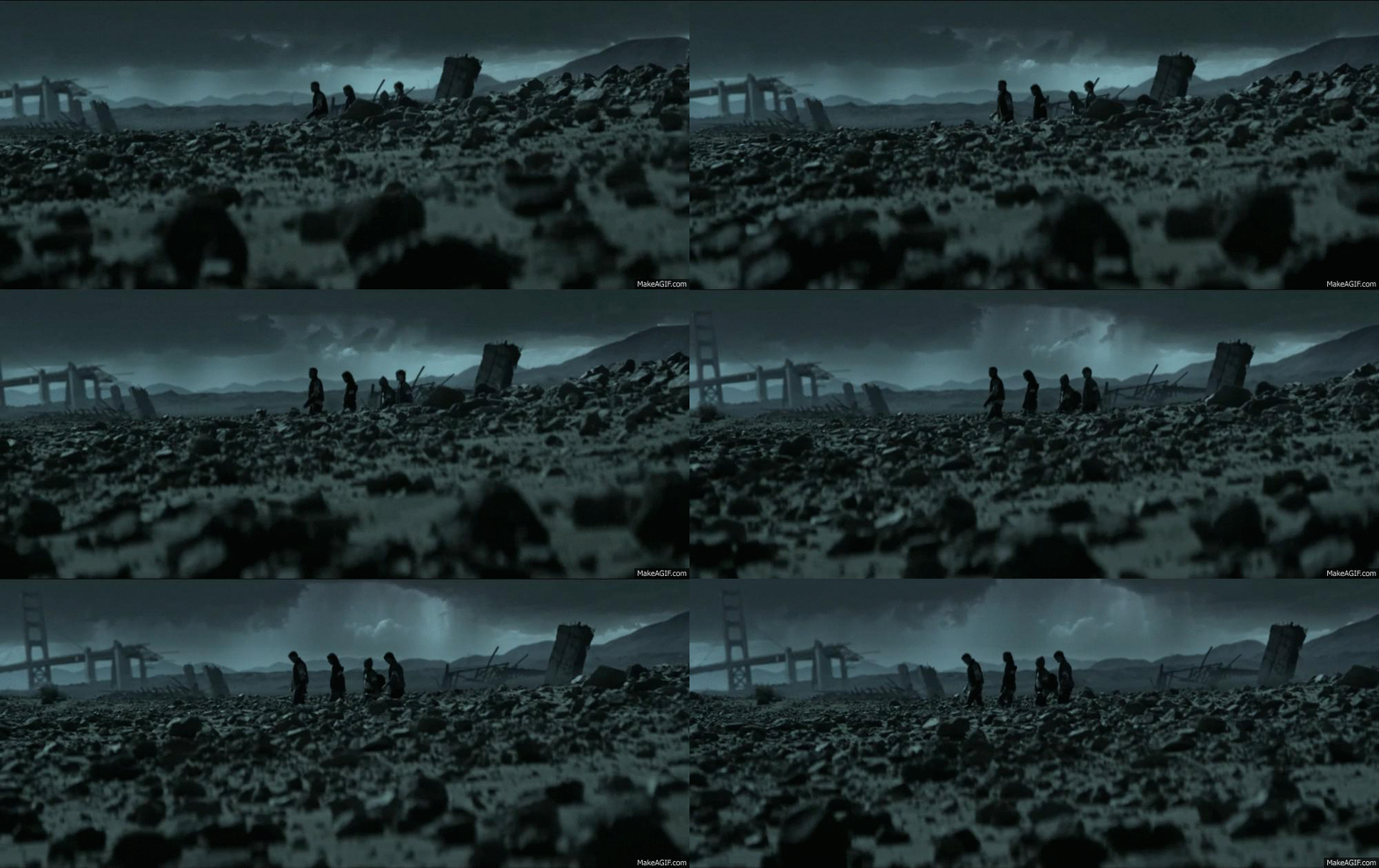
Here is a new and lengthy interview with John Michael Greer on a website called Legalise Freedom:

“The politicians don’t know what’s going on; they have no clue. They don’t get it. There’s a lot of very good reasons why they shouldn’t get it because one of the things that’s going to happen down the road is that they are toast. Their entire world is toast. The only reason that the politicians and the financiers, the modern rich and powerful, have the wealth and the power that they do is that they know how to manipulate. They are in a position to manipulate this very complex, very intricate, very brittle, very fragile system that runs on vast amounts of fossil fuel energy. As that system breaks down, their power goes away. And they’re going to be in roughly the same situation as all those heads of Communist Parties in Eastern Europe when the Communist Parties in Eastern Europe suddenly dissolved out from under them. This is what happens when very complex civilizations start breaking down. The former leadership finds that it has no skills at all that are relevant to the current situation. In the meantime they’re going to increase their grip on the levers of power and flows of money with everything they’ve got.
And you can go out there and protest; you can wave a sign; you can shout obscenities at the status quo or what have you and it will either be ignored or, if it causes sufficient embarrassment, the police are going to come and beat the living crap out of you. Or eventually you may be dragged from you bed at 3 a.m. and shot in the head and tumbled into an unmarked grave. This is the kind of thing that can happen, and it does happen all the time in the Third World. And this is something we can understand in our current situation where the modern industrial nations are becoming Third World countries. The Third World country is a country in the modern world that doesn’t have access to a lot of energy.” – JMG
A bit of background on Mr. Greer:
Background
The world is finally beginning to wake up to its critical dependence on oil and the vitally important issues associated with it such as rapidly rising energy prices and the threat of climate change. Unlike the energy crisis of the 1970s, however, there is a lurking fear that now the times are different and the crisis may not easily be resolved.The Long Descent examines the basis of such fear through three core themes:
1. Industrial society is following the same well-worn path that has led other civilizations into decline, a path involving a much slower and more complex transformation than the sudden catastrophes imagined by so many social critics today.
2. The roots of the crisis lie in the cultural stories that shape the way we understand the world. Since problems cannot be solved with the same thinking that created them, these ways of thinking need to be replaced with others better suited to the needs of our time.
3. It is too late for massive programmes to implement top-down change; the change must come from individuals.
Hope exists in actions that range from taking up a handicraft or adopting an ‘obsolete’ technology, through planting an organic vegetable garden, taking charge of your own health care or spirituality, and building community.
John Michael Greer is a certified Master Conserver, organic gardener, and scholar of ecological history… Follow him at The Archdruid Report.
The Parasitic War Profiteers Continue to Grow while the Masses are Targeted for Austerity
03 Sunday Jun 2012
Tags
Arms Dealers, Austerity, Corporate State, Corporatocracy, Economic Growth, Empire, General Dynamics, Gross Inequality, IMF, Koch Brothers, Military Industrial Complex, Obama, Peak Oil, The Elite 1%, World Bank

Two blog posts caught my eyes this weekend, one on our parasitic war economy and the other on the parasites readying their blueprint to bleed the masses dry. A related article to the first story lays out Obama’s pre-election connections to one of the primary recipients of tax dollars feeding the Military Industrial Complex – General Dynamics, as mentioned also by John Hively here.
In regards to the second blog post on the elite’s blueprint for squeezing the life out of the rest of us, austerity is a failed option because it attempts to preserve the paradigm of perpetual economic growth in a world of depleted resources, and it’s designed to preserve the social hierarchy of the capitalist system. Dr. Dan Bednarz at Health After Oil talks about this in his latest essay:
Socioeconomically, reaching the limits to growth means the impossibility of repaying accumulated debt and that massive unemployment will worsen under current institutional conditions. Politically we are witnessing governments not only caught up in a contraction of tax and revenue bases, but utterly failing and concomitantly repressing their citizens so as to maintain –and deepen- class inequalities and support for too big to fail private entities. This is the antithesis of resilience…
Until recently energy was cheap and seemed limitless, as did other natural resources; climate change risks remain “political,” not corporeal and existential. The overexploitation of natural resources and population growth should be apparent and frightening, but they are not; and wastes and pollution continue to be –from a grossly misguided economic growth point of view- “externalized” or “discounted” for future generations to gag on….
And the hypocritical remarks by the IMF chief Christine Lagarde:
Her hypocrisy–she claims to have great concern and sympathy for poor African schoolchildren, whose plight she compares with the problems of comparatively well-off Greeks–is frankly nauseating in light of the IMF’s contribution to African suffering and misery. The agency’s so-called structural adjustment programs, akin to austerity for Europeans, have forced African nations to slash spending on healthcare, food, and education, and to boost exports of raw materials and privatization of industries by multinational corporations, resulting in dramatically increased national debts. Not for nothing do critics of the IMF and its partner in exploitation in the name of assistance, the World Bank, speak of Africa’s new “overlords.”
But one suspects that there is more to the Lagarde affair than mere hypocrisy. The IMF managing director’s Africa reference can be seen as a telling slip of the tongue that calls attention to her true aim–the strategic objective of the global elites whose interests she serves–which is the permanent pauperization of the middle classes of the industrialized world. The objective isn’t to raise Africa up to the level of Europe–not even close to that. Rather, the elites seek to lift Africa only marginally while bringing the West down–meaning, the workers who have become too prosperous and too politically powerful in the eyes of the powers that be–closer to the level of the impoverished inhabitants of the resource-rich continent that was ravaged by imperialism and colonialism. A global leveling off is the real goal. Grinding Greece down is the beginning of what is intended to be a grand restructuring for purposes of creating a new world order in which a few privileged population segments will labor in well-paying, favored industries, including high technology and finance, with decent benefits and opportunities for advancement and upward mobility, while the great masses of workers will be condemned to toil like drones, or serfs, in deadening, dead-end jobs that will barely pay subsistence wages and little or no benefits of any kind.
Hence, the seemingly irrational, international obsession with promoting austerity during times of depression and recession. For the IMF and its backers, mass unemployment isn’t a problem to be solved; it’s a strategy to bemanaged. Degrees of joblessness that have not been seen since the Great Depression are meant to become the new normal; meaningful social safety nets and social services, things of the past.
Already, the argument can be made that “we are all Greeks.” Absent a reversal of the trend, unless the IMF’s iron heel is broken before it can complete its crushing mission, we will soon all be Africans … and Asians … and Latin Americans … anything but the middle class Americans and Europeans we once were … as social services are dismantled and workers rights are shredded in the name of “reform.”
Now on to the two blog posts I mentioned at the beginning:
“More than a decade after George W Bush launched it, the “war on terror” was supposed to be winding down. US military occupation of Iraq has ended and Nato is looking for a way out of Afghanistan, even as the carnage continues. But another war – the undeclared drone war that has already killed thousands – is now being relentlessly escalated.”
The drone wars are all about raising corporate profits, for General Dynamics and other master’s of war. They have President Obama on a leash. He is their good little boy in the white house, ordering the murder of innocent people for profits. Sure, there might be a terrorist that he gets now and then, but the terrorists aren’t his targets; Wall Street analysts tell corporate CEO’s what their profit targets will be every quarter, and every drone strike is intended to push up those profits to reach Wall Street expectations. The more drone strikes, the more drones need to be built, the more profits are obtained, and all at tax payer expense.
That means the drone wars are all about redistributing income from working people to the rich via higher corporate earnings, rising dividends and soaring share prices. The drone wars also mean the president, like President Bush before him, is the terrorist.
America’s murderous drone campaign is fuelling terror

VIDEO: Scott Walker’s Divide-and-Conquer Strategy Is
“The New Model For The Country”
Coming soon to your state: The anti-union, education-cutting, free-market-leaning, divide-and-conquer playbook of Wisconsin Gov. Scott Walker.
According to a leading conservative activist, the Walker agenda in Wisconsin is the new conservative game plan for all states in the union. That was the key message delivered at a rally Friday evening in Madison by Tim Phillips, national president of Americans for Prosperity, the conservative nonprofit started with money from the billionaire industrialists Charles and David Koch. “The Wisconsin approach to changing and making state government better is the new model for the country,” he said. “You are the model for the country.”
Here a video of Phillips’ remarks:
Since taking office in January 2011, Walker has slashed collective bargaining rights for public-employee unions, cut funding to public schools by $800 million, signed a controversial voter ID bill that critics say discriminates against students and minorities, and approved a divisive redistricting bill that benefitted his fellow GOP lawmakers. Walker managed to eliminate a $3.6 billion deficit, but did so, his critics say, at the expense of workers’ rights, teachers and students, and the public sector as a whole. In a January 2011 conversation with billionaire businesswoman Diane Hendricks, a top donor of his, Walker admitted that his plan was to “divide and conquer” the unions in Wisconsin. Walker’s agenda has turned Wisconsin into the most polarized state in America.
This agenda, AFP’s Tim Phillips insisted, is the new model for state governments. “Today every other governor in the country and every state legislator in the country is watching Wisconsin,” he said. “Because the Wisconsin approach to changing and making state government better is the new model for the country. You are the model for the country. For fiscal prosperity and economic freedom and getting the state moving again. You’re the model!”…
Setting Newt Gingrich Straight on Oil Shale and Shale Oil
25 Friday May 2012
Posted in Military Industrial Complex, Peak Oil
Tags
Military Psyops, Newt Gingrich, Oil and Gas Propaganda, Oil Shale, Peak Oil, Shale Oil, unwashed public
Ed Hanox sets Newt Gingrich straight on the viability of oil shale/shale oil playing any part in making America “energy independent”.
” Newt Gingrich has rebounded from his embarrassing presidential campaign to take to the op-ed pages to slam President Barack Obama’s energy policy.
But Newt seems to be confusing oil shale with shale oil (and its close relative shale gas). The latter are conventional hydrocarbons (crude oil and natural gas) trapped within impermeable shale rock; the former is something quite different. Oil shale actually contains no “oil” at all, but rather a precursor hydrocarbon known as kerogen. Given enough time and pressure and kerogen will turn into hydrocarbons like crude oil. Exploiting oil shale means finishing the job Mother Nature started by pulverizing the shale rock, heating the crushed rock under pressure to release the kerogen and then processing it into usable shale oil (not to be confused with the shale oil mentioned earlier). It is a complex, expensive and energy-intensive process. In fact, the Energy Return on Investment (or EROI, an industry measure of production efficiency) for oil shale is typically about 2:1, meaning one unit of energy is used to produce two units of usable shale oil; by comparison the EROI for conventional crude oil averages 20:1, with some oil fields having a much higher EROI than that.
This is the main reason why oil shale deposits have often only been exploited when no other energy alternatives exist. The nation with the biggest reliance on oil shale today is likely tiny Estonia, where much of that country’s power comes from oil shale. But the oil shale power industry accounts for 91% of the water usage in Estonia, and is responsible for almost all of the country’s air pollution. And Estonia is using raw shale oil in their power plants. To use shale oil to produce gasoline, it needs to be processed further before being ready to use as a substitute for conventional crude oil in petroleum refining, all of which adds to the complexity and cost in using oil shale.
While the U.S. oil shale deposits may be three times larger than Saudi Arabia’s proven oil reserves, much of America’s oil shale is located in Utah, Wyoming and western Colorado; a fairly arid part of the nation. As mentioned earlier, the production of oil shale is a water-intensive process; between one and three barrels of water are needed for the production of just one barrel of oil shale. To exploit domestic oil shale at Gingrichian levels would mean either setting up a massive pipeline infrastructure to move water from wetter areas of the country to the oil shale, or taking that water from cities and farmers across Utah, Wyoming, and Colorado. These factors are likely the reasons why the National Oil Shale Association itself (the trade group set up to promote oil shale) discusses oil shale not as a way to get cheap and plentiful gasoline, but rather as a domestic “bridge fuel” for America to use in a decades-long project to move the country off a fossil fuel-based economy.
…”
With political stooges putting out misinformation to the gullible public, is it any wonder the average Joe has no idea what the fuck is going on. He is getting bombarded with propaganda and misinformation in all directions. Even military psy-op techniques are being used on his pea brain.

Liberty through better Shopping & Consumerism as Hegemony
24 Thursday May 2012
Posted in Consumerism, Corporate State, Peak Oil
Tags
2008 Financial Meltdown, Banking, Chris Hedges, Collapse of Industrial Civilization, Consumerism, Corporatocracy, Global Elite, Globalization, Inverted Totalitarianism, Mortgage Fraud, Neoliberal Capitalism, OWS, Security and Surveillance State, Sheldon Wolin

“Most people [Americans] have been reduced to a market demographic. They’re consumers, they’re not citizens. No matter how active they are within the system [employment, religion, government, etc.] the system is the problem.” – Joe Bageant
The ideology we have today permeating every aspect of life in America is neoliberal capitalism which takes its ultimate expression in the form of megacorporations or multi-national corporations whose tentacles of power and influence reach deep into government and other nations as well, considering that their wealth and budgets are larger than that of many small countries. Indeed in America the government and the corporate world are one, merely separated by a revolving door.
As long as you conform to what they have programmed you to be, an obedient consumer, then behavior which is in line with that mindset is deemed permissible or legal. Similar behavior which questions the consumer culture and the power structure behind it is deemed illegal and is either squashed or otherwise corralled through State violence and coercion. In an article in the early 1980s in which he referred to the American people as ‘consumer-depositors’ in thrall to the financial elite, Gore Vidal saw into this aspect of the system decades ago.
Consumerism as Hegemony:
By hegemony, Gramsci meant the permeation throughout society of an entire system of values, attitudes, beliefs and morality that has the effect of supporting the status quo in power relations. Hegemony in this sense might be defined as an “organizing principle” that is diffused by the process of socialization into every area of daily life. To the extent that this prevailing consciousness is internalized by the population it becomes part of what is generally called “common sense” so that the philosophy, culture and morality of the ruling elite comes to appear as the natural order of things.
With government and corporations merging as one we now have what is called the Corporate State. Neoliberal capitalism is essentially unfettered, unrestrained capitalism, the very thing that caused the financial meltdown of 2008:
It was Wall Street banks and hedge funds, not home buyers, who created the enormous demand for high-risk mortgages to pool, to securitize, and to turn into Ponzi-like gambling structures with names like CDOs, CDO squared and synthetic CDOs. It was the money-grubbing rating agencies that blessed these pieces of garbage with AAA ratings. As a result, trillions of dollars of worthless toxic assets polluted our financial system. When the bubble they induced burst, our system crashed, causing 8 million working people to lose their jobs in a matter of months due to no fault of their own. Anyone who still blames low-income home buyers, or regulations or Greece — or anyone other than Wall Street — should be checked for dementia.
This deregulation of capitalism into a more predatory and destructive form has occurred at the same time as our government has slowly militarized this nation’s domestic police force and turned our country into a Security and Surveillance State. We are paying for our own enslavement. The rapacious corporate forces that were behind the meltdown of our economy in 2008 are now backed in power by this strengthened Authoritarian State. The inverted totalitarianism that Sheldon Wolin talked about has come to fruition. The great irony is that this totalitarianism is not coming from some socialist revolution as feared by the far right, but from Neoliberal Capitalism, the very system that Fox news and the corporate mainstream media trumpet.
With the dawning of an age of depletion and peak resources, Consumerism and the antisocial behavior of neoliberal capitalism can no longer survive and are simply being propped up and enforced by the iron fist of the Corporate State. Peak oil had a hand in bursting Wall Street’s housing bubble. This scenario of an ever-growing oppresive State in the face of an energy-starved future bodes ill for the rest of us who are not so privileged to be sitting in ivory towers, oblivious to the coming storm. Author Brian Davey describes this disconnection with reality that the elite suffer from, ensconced as they are in their own world of narcissism and luxury:
…There is nothing new in the phenomena of power arrogance and hubris. Since the earliest civilisations, rulers have made decisions and overreached their power in the confident belief that they had God on their side. In more modern times our rulers have believed that nature rewards the fittest, in other words, them.
Irrespective of what point in history they emerge, the starting point of most elites is the comfortable assumption that, as things have typically gone right for them in the past, they will continue to go right in the future. This belief is compounded by the fact that for a long time it has been the “little people” who bear the costs while those higher up the food chain reap the benefits. Power means that they are effectively cocooned from the negative kick-back from their actions. Long before the rulers themselves are successfully challenged and fall — and this typically happens only in the final stages — millions of others have already lost out badly and immense damage has been done.
What we term hubris is the cruel arrogance that arises from a failure of bottom-up feedback in systems where vast social and geographical distances exist between the powerful and the powerless. The punishment of Nemesis, the Greek goddess who was supposed to re-impose limits on those who overstepped their power, typically befalls entire societies before it befalls the rulers. Today the vast distance that separates the global elite from ordinary people is magnified further by the high-power technologies of communications, transport, production and weaponry. Nemesis, when she comes, will be global….

Andrew Haldane
22 Tuesday May 2012
Posted in Peak Oil
In my last post The Armageddon of the Financial Arms Race, I featured Andrew Haldane and one of his speeches, highly critical of the banking sector. I thought it odd that a top official in banking, the British version of Ben Bernanke, would be so forthright about the malfeasance and recklessness of the sector that he is a part of. Isn’t he supposed to be propagandizing for the banks and subservient to their interests like our own Ben Bernanke and his predecessor Greenspan? I looked a little deeper and found that those same thoughts have come to other Americans. Here is Justin Fox, editorial director of the Harvard Business Review Group and author of The Myth of the Rational Market: A History of Risk, Reward, and Delusion on Wall Street:
…Several times over the past couple years he has called into question the industry’s most basic philosophical and financial underpinnings. Which is an interesting thing for the executive director of financial stability at the Bank of England to be doing.
…Why isn’t anybody in the U.S. writing stuff like this? I don’t know of any official at the Fed or the bank regulatory agencies doing the kind of searching examination of how the world works that Haldane has become known for (maybe Ben Bernanke’s upcoming lecture series will be a start, but I doubt it) — and I don’t know of any non-government economists or journalists here doing it in quite the sweeping, convincing way he has, either (if I’m just missing out, let me know in the comments). I think part of it is politics. In the UK the notion that something was flawed about the way financial markets and big banks were organized seems to be universally shared, allowing Haldane to take that as a starting point and then leap into his investigations. In the U.S. there’s still a substantial minority (even among economists) that attributes all our problems to Fannie and Freddie, the Federal Reserve, or some other malign Washington force. Which makes it much harder to move forward with the discussion…
(3-14-2012)The Regulator Who Explained the World – Justin Fox
 Collapse of Industrial Civilization