They built the chamber from tile and steel,
And whispered lies of cleansing showers,
Where innocence was made to kneel,
Devotion to the Reich’s dark powers.
The chamber’s walls were blizzard and snow,
In Stalin’s gulags, hope misled,
Where Marx’s dream died in woe
For orders scrawled, lives were shed.
The chamber became Tiananmen Square,
Where freedom’s anthem dared to run,
A storm of bullets split the air,
And dreams fell silent, every one.
The chamber’s roof was a mushroom cloud,
A physics riddle coldly solved,
Where the rising sun lay in its shroud,
As human flesh and life dissolved.
The chamber rose, twin towers of pride,
Where traders’ dreams and fortunes flew,
With burning jet fuel trapped inside,
While choking dust erased the view.
The chamber lay in Singur’s field,
Where progress came with gun and fire.
At Nandigram, the steadfast kneeled
To feed a corporate funeral pyre.
The chamber now is sand and stone,
Where drones sing out a deadly tune,
A crowded strip where bombs are thrown
Beneath an unforgiving Gazan moon.
Gas chambers may fall as bombs from the sky,
Or bullets, or edicts in boardrooms pristine,
Yet the chamber endures—where the helpless still die,
As we polish the brass on our killing machine.
We call ourselves enlightened, just, humane—
Yet chambers are born anew with each war.
So long as men draw profit from pain,
The promise of peace will linger at the door.
So pray, when next we speak of peace or war,
Recall how all our poisons taste the same;
For each new chamber, dressed in reasons, lore—
Is just another mask for murder’s name.
In lands where rivers split the soil, and borders draw a line,
Two cities share the sun and earth, yet fates do not entwine.
One thrives in ordered liberty, the other’s hope grows cold—
Not by gold or ancient myths, but by those for the power they hold.
The seeds of wealth are sown in fields where many voices speak,
Where laws are not the playthings of the cunning or the meek.
A council broad, a restless crowd, a parliament of dreams—
These birth the chance for newness, and the strength to mend the seams.
Yet power’s hand is seldom still; it grips the past with might,
And those who taste its honeyed wine will seldom yield the right.
They build their walls of privilege, their towers of decree,
And fear the storm of change that comes to set the many free.
For every age of rising light, a shadow stalks behind,
The fear of loss, the dread of change, the prison of the mind.
The press was silenced by decree, and rebels stormed the stage,
And all the while, the world awaits the birth of a lesser age.
But history is not a stream that flows in one fixed bed,
It twists with chance and accident, with dreams and with the dead.
A plague, a war, a merchant’s sail, a voice that dares to speak—
These turn the wheel of fortune’s game and lift the low, the weak.
No law of stone or blood or land shall set who will be blessed,
But only how we choose to bind the rulers and the rest.
For when the many shape the rules, and power’s chains are checked,
The soil of hope is watered deep, and futures intersect.
So let the lesson echo out: the world is what we make,
Not by the whims of gods or kings, but by the paths we take.
In every heart, a nation’s fate, in every mind, a key—
To open doors, to break the chains, and set the spirit free.
Let institutions not entomb, but nurture and renew,
For only where the many build can justice come to view.
The past is not our destiny, nor fate a final wall—
But in the hands of all who live, rests the power to rise for all.
And so the wheels keep grinding down the hungry crowds in pain.
As gilded halls ignore the cries and justice dies in vain.
The banquet’s set, the candles drip, the laughter starts to twitch,
At last, the table turns: the poor rise up to eat the rich.
He counted the dead by their boots, not their names.
Their mothers would never pronounce them the same.
Forty-three soldiers. A child with no shoes.
He smoked while perfecting the art of bad news.
He walked until the road forgot his feet.
A column passed him, shuffling through the heat.
One looked at him. He looked back, cold and gray.
He signed their death like any other day.
His wife stopped asking where he went at night.
His daughter flinched whenever he held her tight.
His hands smelled of metal. No one would say.
Home learned to be quiet in a careful way.
The war ended with singing and lights in the square.
He watched from a window like he wasn’t there.
His daughter ran outside to join the crowd.
She didn’t wave to him. He was almost proud.
A boy lay flat beside the garden wall.
He played at dying, waiting for the call.
He saw the soldier watching. Grinned and stood.
“I got three enemies—killed them like you would.”
He didn’t answer. Turned and walked inside.
The boy kept playing: shoot, kill, hide.
He closed the shutters. Poured himself a drink.
He sat until the room began to sink.
His hands began to shake around the glass.
The room was still. The shaking wouldn’t pass.
He gripped the table. Steadied. Breathed. And then
His men shuffled through the room again.
His wife came down and stood without a word.
She’d lived with this for years. She’d seen and heard.
She didn’t touch him. Threw his drink away.
They didn’t speak. What was there left to say?
He stood at last. The chair scraped on the floor.
He walked past her and through the open door.
The street was pale. The last lamp flickered out.
His shadow vanished down an unknown route.
The column shuffled on. He joined the count.
No one said his name or looked about.
Forty-four soldiers. A child with no shoes.
The dead don’t speak. The dead don’t get to choose.
He wore his ribbons, bore their praise,
Smiled through the crowd’s empty gaze.
But sand still grinds behind his eyes—
A child’s shoe burning where she lies.
Some nights he leaves his body and soul,
Floats where the dead consume him whole.
Their silent faces never part—
A spectator to his own dark heart.
He came back home to his wife’s stare,
She kissed a stranger standing there.
The kids asked why he screamed at night—
He learned to say he was alright.
One night he made a list of names.
The men in suits who lit the flames.
He traced their addresses in red—
He had new orders in his head.
He found them in their gated homes,
Behind their walls of glass and chrome.
One by one he carved their life—
The wars came home. He was the knife.
But in the silence after death,
He heard a question on his breath:
“Does vengeance cleanse, or sow the seed—
The monster you swore to never feed?”
They found the knife but not the man.
He vanished like the war began—
No grave, no name, no final stand,
Just grains of rumor in the sand.
Another climate conference has once again come and gone, echoing hollow promises and ugly unspoken realities. I won’t waste anyone’s time analyzing the verbiage of this so-called agreement which failed to even mention the term fossil fuels, probably at the behest of those who financed the entire farce, i.e. the carbon-extraction companies. Suffice it to say that countries were approving fossil fuel exploration projects before the ink of the global climate agreement had fully dried. As long as corporations are able to push environmental and social costs off their balance sheets and onto the backs of the weak and defenseless, dirty coal will be burnt and the cheapest slave labor will be employed. Questioning root causes like our inherently unsustainable way of life is still very much taboo and will remain so even after our descendants are sifting through the wreckage. Sure, mainstream publications have expanded their coverage of man-made climate change and global warming, but these existential threats to life on Earth remain an enigma to the vast majority, a footnote in some obscure textbook.
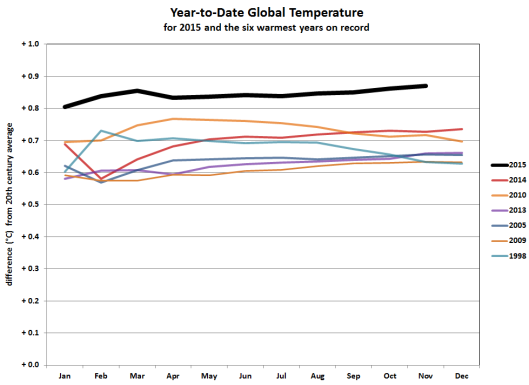
Retailers on the East Coast talk about a crisis for winter clothing sales because the weather has been too unseasonably warm to attract buyers, but nary a mention of man’s role in influencing these abnormal events, such as a super El Niño amplified by global warming. As the developed world continues to roll the climate chaos dice, we now face a higher chance of turbo-charged El Niños every 4 to 12 years and all the destruction that they bring —mass coral bleaching events, die-offs of marine mammals, record flooding and drought, crop failure and famine, refugee crises, etc. This year’s El Niño is on track to becoming the strongest on record with meteorologist Eric Holthaus exclaiming, “Our planet’s climate has undergone a step-change this year.”:
This climate “step-change” may also be indicative of a considerable underestimation of the Earth’s climate sensitivity. What should be painfully obvious by now is that the carbon footprint for everyone will have to decrease dramatically and quickly in order to slow emissions. In other words, the world’s richest will have to radically alter their lifestyles. That’s never going to happen in any variant of capitalism, a system so entrenched that it is inconceivable to imagine anything substantially different taking its place. Instead we get things like corporate greenwashing, carbon trading, decades of climate conferences, First World offshoring of manufacturing emissions into the Third World, and out-and-out fraud like the VW auto emissions scandal. The problem has been identified for nearly half a century, yet we continue to deceive ourselves with half-baked solutions and hypocritical indignation. The inertia of the system is simply too great and the dominant culture has a tendency to kill the messenger of bad news, so there is a strong incentive to sugarcoat things, but a deus ex machina is nowhere on the horizon. We’ll only change in response to the hard realities from an increasingly inhospitable planet. Sunken costs and material incentives built into our socio-economic system prevent radical change and fetishize the myth of the easy techno-fix, a yet-to-be-invented technology that will magically sustain modern civilization while at the same time keep the wolves of ecological collapse at bay. Even more delusional, a prominent tech magnate has urged humanity to pursue interstellar colonization before we render the Earth uninhabitable, but as an internet commenter quipped, “A post-nuclear war, global warming-baked and hyper polluted Earth will still be paradise compared to Mars.” Some technophiles admit the future actually looks rather grim:
…But the most worrisome threats are not merely anthropogenic, they’re technogenic. They arise from the fact that advanced technologies are (a) dual-use in nature, meaning that they can be employed for both benevolent and nefarious purposes; (b) becoming more powerful, thereby enabling humans to manipulate and rearrange the physical world in new ways; and (c) in some cases, becoming more accessible to small groups, including, at the limit, single individuals…
Just as technology is not neutral, so too is the economic system driving this technology. The institution of capitalism, which has been copied and exported all over the world since WW II, has established widespread acceptance for the condition of mass production, mass consumption, and waste at an ever accelerating rate, pushing the world deeper and deeper into ecological crisis. For example, the ubiquity of plastics now exhibits itself as microscopic pieces on every beach in the world and in our dinner with trillions more pieces in the oceans than previously thought. Scientists estimate that nearly all sea birds will be ingesting some sort of plastic by 2050. In spite of this growing evidence of a plasticised planet, the production of plastics has only increased while recycling remains an effort in futility:
For more than 50 years, global production of plastic has continued to rise. Some 299 million tons of plastics were produced in 2013, representing a 3.9 percent increase over 2012’s output. With a market driven by consumerism and convenience, along with the comparatively low price of plastic materials, demand for plastic is growing. Recovery and recycling, however, remain insufficient, and millions of tons of plastics end up in landfills and oceans each year – link
There’s no going back from this global complexity trap we’ve built around ourselves. All those bits of plastic will end up in the sedimentary layer of the Anthropocene along with elevated concentrations of CO2, radionuclides from nuclear fallout and waste, as well as novel metals and pollutants never before seen. Once underway, mass extinctions cannot be reversed, especially when driven by over seven billion pleasure-seeking, individualistic “consumers”. Materialism and greed, we are told, are natural human instincts, and they are all too eagerly rewarded by an economic system which reduces everything to a financial object and monetizes every aspect of the natural world. Today’s environmentalism is, as Derrick Jensen pointed out, similar to the palliative care given to prisoners in Nazi Germany death camps. The emaciated ecological ghosts of so many species are right before us, yet nearly everyone is blind to the unfolding catastrophe of the 6th mass extinction:
…we lose a huge chunk of the world’s diversity that will never come back. We lose the potential for communication with other lifeforms, with the only remaining ones eventually whittled down to domesticated animals or weed species that thrive in civilized man’s destructive footsteps. The conversation of life itself is turning into small talk, but the only recognition that seems to be made by this culture is how [biodiversity loss] “reduces carbon storage”. How trees and animals can provide “ecosystem services”, as if they existed for nothing more than to continue the existence of the mad king ape. – pathofraven
Yes, we are pretty far gone when a four minute comedy routine makes more sense than anything broadcasted on the evening news. Corporate mass media-controlled public debates have degenerated into infomercial sound bites. In a society where success is measured by the key metrics of money and profit, it should be no surprise that a wealthy, xenophobic businessman is able to garner mass appeal by hogging publicity and playing on the fears and base desires of the populus. “Make America Great Again” is a catchy slogan for a society ignorant of the collapsing world around them and oblivious to the over-consumptive, profligate way of life that is proving to be their undoing. For a celebrity-obsessed culture whose world is falling apart, the next logical choice for its leader would seem to be a reality TV show star who says he can restore the illusion of the American dream and build a great wall to keep all the riff-raff out.
A fascist right-wing administration might just provide that extra push that takes us all over the edge into collapse. With the Presidency largely serving as a figurehead position for the Deep State, I’m not convinced a different candidate would make a measurable difference in the grand scheme of things anyway. Our “democracy” is, after all, just one more illusion in a bread-and-circus election cycle:
“Today, we must look to the city of Las Vegas, Nevada, as a metaphor of our national character and aspiration, its symbol a thirty-foot-high cardboard picture of a slot machine and a chorus girl. For Las Vegas is a city entirely devoted to the idea of entertainment, and as such proclaims the spirit of a culture in which all public discourse increasingly takes the form of entertainment. Our politics, religion, news, athletics, education and commerce have been transformed into congenial adjuncts of show business, largely without protest or even much popular notice. The result is that we are a people on the verge of amusing ourselves to death.” – Neil Postman, Amusing Ourselves to Death: Public Discourse in the Age of Show Business
So while terrorism takes center stage in the overstretched Empire of Amnesia, remember this simple fact: 303 Americans were killed in terrorist attacks worldwide in the last decade while 320,523 Americans were killed because of gun violence in that same time period. Random mass shootings, capitalism’s “free market” genocides, the disruption of the Holocene’s stable climate regime by anthropogenic climate disruption, tipping points in the earth’s biosphere, terminal industrial disease, and many other things come to mind that pose a much bigger danger to the average American, but the War on Terror, conceived as open-ended, serves as a conveniently omnipresent boogieman for jerking the chain of the taxpayer and justifying the growth of an intrusive security state. What better way to control the masses as the wheels continue coming off the global economy and the biosphere becomes evermore threadbare. The rich will retreat into their luxury spider holes until the coast is clear.
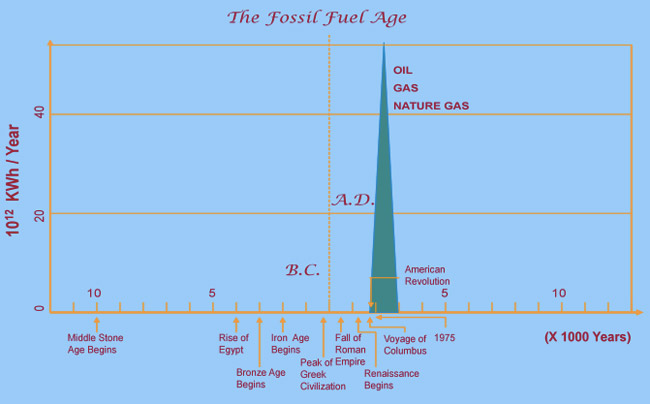
But how can we define an oil age? It has been about 150 years since the first deep oilwells were sunk, and just over 200 years since the viable steam engine was developed. The two are linked, because the steam engine made deep drilling of oilwells possible and gave us access to a hundred million years worth of fossilized sunlight. Perhaps we have not strictly had an oil age, but rather the first and only age where we enjoy vast amounts of surplus energy that we have extracted from hydrocarbon fuels, of which oil is the most energy dense. It has brought us material wealth, and the means to indulge in wholesale killing of each other and all other species. It gave excesses of food and a population that consumed that food and grew to five or six times the sustainable level of the planet. In the timespan of human existence, the ascendance of modern industrialised man has been a short flash of light and heat that has briefly lifted us out of the mire of the middle ages, but at a considerable cost to the environment.
Our mistake has been to think of that elevation as both divine and permanent. That certainty of permanence explains the mad scramble to come up with ‘alternatives’ and ‘renewables’ in the last decade or two. Something to keep current politicians in office and the masses pacified. It is important that we accept the seductive indoctrination that prayers will be answered and technology will continue to deliver all that can be imagined. The majority have come to believe in the economics of cornucopianism, where wishing for something will make it happen, while ignoring the reality that everything we have is derived from finite hydrocarbon fuels. If we spend enough money, alternatives will always be found to sustain our lifestyle. They won’t of course, and the conflicts that have been fought over oil are proof that they won’t. The pivot of world oil economy is Saudi Arabia, (the concept of ‘Saudi America’ is too ludicrous for discussion here), but that fantasy land of sand dunes and tall towers is being encircled by fanatics who know that when the jugular of global oil is cut, the industrial complexity of the developed west will die.
When (not if) that happens, we might be lucky to hold onto an existence akin to that of the 14th century, which is what the religious zealots want to inflict on all of us. If we’re unlucky, then we must expect something that will be much darker and as yet inadmissible to modern minds that do not have the scope to deal with its implications. That infers an unpleasant imagery of pre-history that we prefer to ignore. Understandably, most think the same way; this is why we cling to the comforting promise of ‘infinite growth’. The alternative is just too awful. Instead we have been encouraged to believe that we can do without oil and not only still run around on wheels, but have a purpose for doing so. And by some means yet to be invented, keep our wings as well.
Our oil age will not end through lack of it, but by fighting over what’s left. So choose your luck‐factor and take that thought where you will, you are on your own with it. Many reasons are given for starting wars, but ultimately there is only one: the pursuit of (energy) resources. Human greed drove improvements in weaponry, and the means of destruction and acquisition became more deadly over thousands of years even though there was more than enough for everyone. The input of oil was the game changer of warfare; history over the last century has shown that conflict was not diminished, but amplified, by the prosperity and technology created by oil. Since the 1860s when black gold gushed from the earth, the economic and political thinking of the pre‐oil era was seamlessly grafted onto the industrial potential of the 19th century, thereby enabling Rockefeller, Ford, Carnegie, Vanderbilt and many others to accumulate fabulous wealth. Their business acumen was undeniable, but none of it could have been brought into existence without energy-rich oil. The use of fossil fuels in our military machines industrialised our methods of killing while at the same time becoming synonymous with progress and commerce. War became a business, the purpose of which was the acquisition of more energy in the pursuit of profit. Battlefield deaths on an industrial scale were an unlisted debit on balance sheets.
WWI started with the muscle power of horses and ended with tanks, demonstrating the murderous scope of mechanized warfare. Recognizing the critical value of oil and its sources, leaders carved up the Middle East to ensure its supply. An exercise in map making in the 1920s by the English and French civil servants Sykes and Picot set the scene for carnage that has raged throughout the Middle East ever since. Arbitrary lines in the sand were drawn, artificial oil states in the Persian Gulf region were created without regard to tribal affiliations, and a quarrelsome orphan Israel was dumped into the lap of unwilling Bedouins. As the quantity of oil there became apparent, all the major nations were drawn into the race for it because those who controlled this key resource were certain to subjugate those who did not.
The critical nature of oil made WWII inevitable. To sustain their empires, the Germans and Japanese slaughtered their way across Europe and Asia in a grab for resources, primarily oil. They promised infinite prosperity and their peoples cheered them on while deaths elsewhere were being counted in millions. With most of the world’s known oil supplies in the hands of his enemies, Adolf Hitler knew he had to have the oilfields of southern Russia and the Middle East to sustain his war machine. He failed, and his dream of a ‘Greater Germany’ collapsed not because of inferior soldiers but because there was insufficient energy input to sustain his plan for world domination. Hitler’s perception of infinite growth in his ‘thousand year Reich’ mirrors our present-day view of ‘permanent affluence’: vast quantities of oil had to be burned to sustain his fantasy. In our desperate scramble for ever-diminishing energy resources, we are in the same mad race to perpetuate the delusion of infinite economic growth. The oil pendulum has swung the other way with roughly 85% of world oil now outside the borders of the USA and Canada in countries not always of a friendly disposition. And just like the Fuhrer, political leaders of today are promising that which is beyond their means to provide. To mask this reality, they have invaded oil-producing nations in the name of ‘freedom’, claiming ‘victories’ which have left only wreckage and simmering animosity behind. So too did Hitler spread a similar line of propaganda that he was liberating other nations from the threat of communism. The second world war that left Europe and Japan flattened in 1945 might be seen as history, but it was just the first of many oil wars, and the politics of it were a side issue. WWII serves as a grim reminder of how violent and destructive humans can be in their ruthless pursuit of energy resources. Hitler’s own ‘oil age’ lasted just twelve years, and it set the pattern for the world oil age that is now in terminal decline.
Don’t be deceived by the democratic righteousness that defeated Hitler’s fascism. 150 years earlier the American empire was created with the same kind of energy grab. The European immigrant peoples who forced their way across America from the 1700s onwards needed resources on which to survive and to sustain the prosperity of an expanding nation just as the Germans and the Japanese did in 1940. The native inhabitants of the American continent were in the way of civilization and progress; their subjugation was a precursor to what happened later in Europe and Asia. Expansive prairies had to be cleared to convert the energy locked in grain and meat to feed the invaders and provide negotiable currency. This self-perpetuating process went into overdrive with the discovery of oil, and the ultimate conversion of that oil into more food resources and hardware added to the wealth of the growing nation. An expanding population needed employment, and the raw energy from oil, coal, and gas supplied it. America and the rest of the industrialised world had the means to build bigger, better, faster machines in endless succession, and created the most powerful country on earth. Everybody was going to be rich, forever. The universal law of consumption was relentless: more demanded more.
Meat and grain grew with relatively little human intervention, but other crops needed to be worked with human muscle. So the slave trade came into being. Slavery might be given many unpleasant names, but essentially it is the acquisition of one energy form to convert it into another for profit. Buy and feed the slave, use slave labour to do work, sell the product of that work. By the time the slave is worn out, several more will have been produced. This was simple economics by 18th century standards but the human consequences were again horrific, costing more millions of lives. It also brought on the American civil war where the slave‐muscled South was overwhelmed by the industrialised muscle that drove the armies of the North.
All the European empires forged out of so-called ‘empty lands’ across the world followed a similar pattern of resource acquisition and an absolute disregard for weaker peoples. It is an unpleasantness that we choose to ignore, but it confirms the killing force that drives us to acquire and convert energy to our own use. The seemingly limitless amount of oil and its energy density appeared to be the answer to all our labour problems. Oil became our ultimate slave. Or so we thought.
We now have maybe 20 years worth of usable oil left. There are certainly no more than 30, perhaps as little as 10. If one of the crazy sects running loose in the Middle East managed to get hold of a nuclear device, setting it off on the Gharwar oilfield of Saudi Arabia, it would be endgame overnight. That is perhaps too bleak a prospect, but we should not discount that notion entirely.
Before our oil to food arrangement, the planet supported something over one billion people. We now have over seven billion, and the mothers of the next two billion are alive now and approaching the age of reproduction. Preachers, scientists and politicians will not stop the basic human function of eating and procreation, so if unchecked nine billion people will be here by 2040/50, and set to go on rising after that. Every new arrival expects to be fed, watered, clothed and housed, but by no stretch of the imagination will the global food system be able to feed that number let alone sustain them with what would be expected by way of the most basic material comfort. No one dares to stand up and make the rather obvious point that we are not going to reach 9 billion. Something has to give, and that giving is going to be very unpleasant.
In the first decade of the 21st century, numerous wars have been fought over oil, and are being fought now. Wars are fought over resources because on nature’s terms, gentle contentedness is not a good strategy for survival; we are collectively powerless against genetic forces that dictate our lives no matter how much we protest otherwise. Downsized to whatever level, nature will ultimately force the choice of survival or death, and the outcome will be of no consequence other than to you and yours. To expect humankind to change within a single generation is stretching credibility beyond breaking point. Those who look forward to a life of bucolic bliss in a downsized oil‐less world might do well to think about that. Whether killing and butchering an animal to eat it, or invading another nation to secure oil supplies, we must appropriate energy sources to facilitate survival. You may think there’s a choice about doing that, but there isn’t, other than in the matter of scale. Whether paying a butcher to cut and wrap your steak, or paying soldiers to invade Iraq, securing sufficient energy to live is what we have to do to survive.
For the moment, nature keeps us supplied with oil, and we’ve pulled off the neat trick of converting it directly into food. Not knowing when our oil is finished and our food supply will run out is the little teaser for the early 21st century. Right now, most people think that food comes from supermarket shelves and freezers, which is just as well. The food trucks moving around the country are basically mobile warehouses, delivering food just in time for it to be consumed. When the realization dawns that the food trucks have stopped, the food held in stock by retailers will be stripped bare in hours. The oil age for everyone will have come to an end.
But oil carries man’s destiny in far more subtle ways than food supplies. It holds nations together. The USA is a vast territory of disparate peoples and ideas, held together by a common bond of prosperity and a basic consensus that government and law generally works for the good of all. And the inhabitants of empires are always convinced that theirs is permanent and protected by gods. That definition would apply to many large nations to a greater or lesser degree. But the bonds that hold it together, godly or otherwise, are entirely subject to availability of affordable oil. Empires (and the USA is an empire) remain whole so long as the means exists to maintain them. Oil has become that means.
Without oil, the nation will begin its decline into disparate regions. Without interconnecting transport, the United States of America cannot remain united. The force necessary to prevent a breakup will not be there, so within a decade (probably far less) of oil supply failure, the USA will cease to exist. The cracks are already there along linguistic, economic, racial, political and geographic lines. Even now it would be possible to take a pretty good guess at where those regions will split off.
This will be denied and resisted of course, but armies and police forces have power only as long as their fuel lasts. They will be unable to prevent secession in whatever form it takes. It might just be that Washington will come to govern not much more than the original colonies. Given a suitably deranged political leader and prayers to the right god, fully armed groups are ready to believe that the ‘American Dream’ can be restored. Such demagoguery sets the stage for years of regional violence over the basics of life, particularly food and water. The horror of it will be justified by warped views of right and wrong, clinging to a denial mentality magnified beyond any imagining by the privation that an oil-less society will bring.
This scenario is not exclusive to the USA. The British Empire was built on coal. When the coal was gone the empire faded away. Then in the 80s and 90s the UK became awash with cheap oil from the North Sea, and everyone was reasonably prosperous, particularly Scotland. Now the oil surplus has gone, and the UK is in decline again as a net importer. The ‘oil prosperity’ is fading away. Scotland is losing its main source of income and wants to secede from the United Kingdom, convinced that independence will somehow restore their wealth. Things will get very unpleasant when they realize that an independent Scotland will eventually be reduced to the economic level of Greece. The link between oil and the ability to eat is clear. The UK has to import 40% of its food, and much of the rest depends on oil to produce it, which also has to be imported. It is the end of the UK’s oil age, but few admit to it being the end of a food age as well. The same problem is being revealed in the current fiasco of the European union, but a little more advanced than the USA and UK. Oil-fueled prosperity is falling dramatically in the poorer southern countries. Greece, Spain and Portugal and a swathe of smaller nations have to import all their oil which only worked when oil was cheap. Now it’s expensive, and they are facing bankruptcy. 50 years of ‘unity’ is dissolving like a mirage in the face of the difficulties that smaller states are suffering. Without cheap oil, their economies cannot function, and so are disintegrating. United Europe needs oil to stay united just as the USA does. Russia’s oil dependent economy is crumbling, and Putin is having to make threatening postures to divert attention from his problems. His oil age is ending in a different way and yet we cannot tell if his posturing is just that, but a shortage of resources in the past has invariably brought conflict.
Move to the Far East and the nations around the South China Sea are all threatening one another, again the focus of the argument being the oil and gas fields of the region. They all know that without oil they cannot survive, and are prepared to fight for every last drop of the stuff, no matter what the cost. As a measure of what the dispute is about, the volume of oil in question is 11 billion barrels. One billion barrels is less than a month of world consumption. They are preparing to fight over the last dregs in confirmation of man’s desperation over oil shortages. Eventually, this problem will hit every nation and individual on earth as our oil‐crutch is kicked away. And with the oil age fading into history for us all, there will be no shortage of violent resistance to this inconvenient truth.
Mankind’s exothermic machine of industrial civilization recently blew past the 400ppm CO2 mile post, causing a few passengers to exclaim, “Homo sapiens have never existed at these levels of heat-trapping gases!” Hundreds and even thousands of years will pass before the full aftermath from our fossil fuel orgy plays out, but we’ll see plenty of nasty surprises in feedback loops and tipping points this century, perhaps most notably sea level rise. Another area of glaciers once thought to be stable has fallen to the human CO2 spike which is occurring 14,000 faster than natural processes and 10-200 times faster than the PETM extinction event. Every so often I feel the need to try to wrap my mind around these horrific statistics and re-examine our place in time as we continue whistling past the graveyard. Keeping in mind that we have yet to take our foot off the gas pedal of economic growth, I’ll try to make sense of what we are doing to the earth by looking back at paleoclimate records when such atmospheric conditions did exist:
– The last time carbon levels reached 400 ppm, and “mean global temperatures were substantially warmer for a sustained period,” was probably 2-3 million years ago, in the Mid-Pliocene era. – Sedimentary cores taken from a Siberian lake north of the Arctic Circle shows that mid-Pliocene atmospheric CO2 measured between 380 and 450 parts per million. Those same cores contain fossil pollens from five different kinds of pine trees as well as numerous other plants we don’t find in today’s Arctic. – Temperatures were 2-3 ˚C higher—about 4-6 ˚F—above pre-industrial levels. – Arctic temperatures were between 10-20 ˚C hotter. – Sea levels were, on average, between 50 and 82 feet higher. – A warmer Arctic saw the spread of forests and forest biology to the far reaches of the north. – Many species of both plants and animals existed several hundred kilometers north of where their nearest relatives exist today. – The Gulf Stream and North Atlantic Current experienced enhanced heat transport pushing warm water further to the north. Similar heating in the Pacific impacted the areas as far north as the Bering Sea. – Arctic ice was “ephemeral”, as in, not permanent, and melted in the warm season. – North Atlantic regions warmed considerably. – Australopithecus afarensis, an early hominid at the time, roamed East Africa and slept in trees, eating mostly fruit, seeds, roots, and insects with the occasional lizard and scavenged meat.
(sources: Motherboard, wfs.org, and yalescientific.org)
Until this prehistoric hominid changed its diet to high protein,
expanding its brain to enable complex tool and weapon-making,
it was easy prey for the saber-toothed tiger.
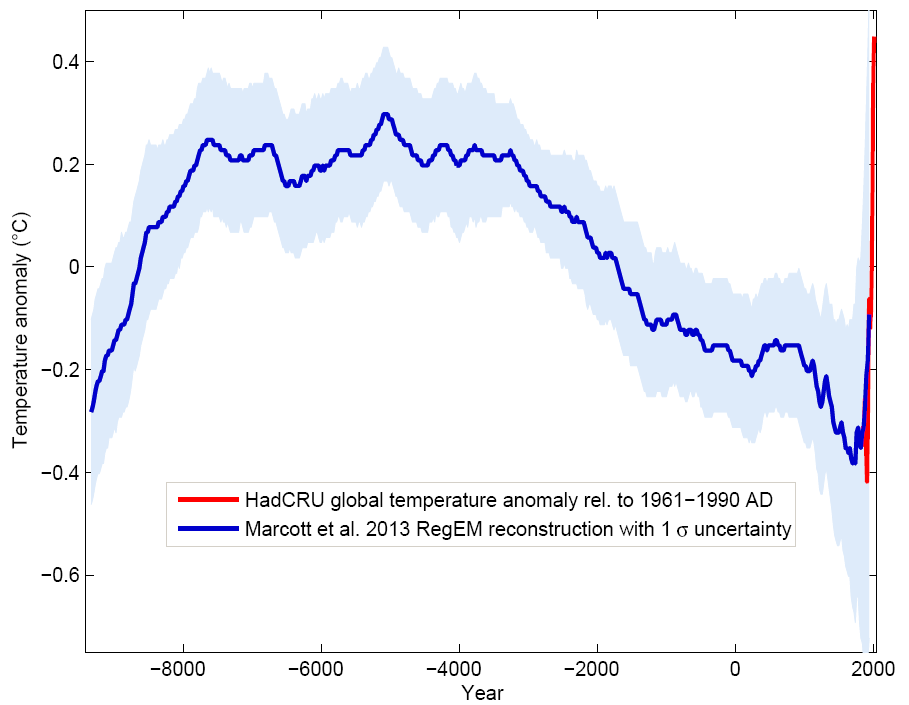
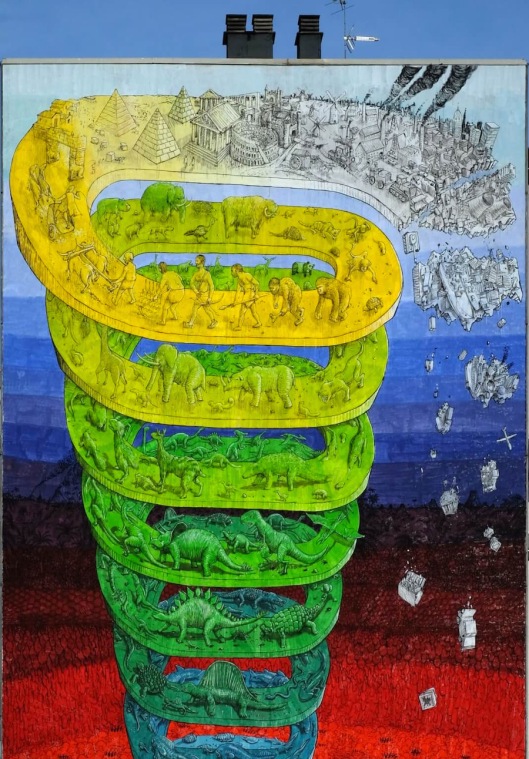
The prehistoric environment described above is not compatible with modern-day civilization and its billions of infrastructure and supply chain-dependent people. Billions will perish without the technological exoskeleton that houses, feeds, and nurtures them. Nearly all are under the spell that our money system, economy, and energy resources are somehow more vital to us than the environment upon which those manmade structures were built. What they don’t realize, or appreciate, is that nature’s ecosystems are what provide the foundation for any civilization if we want breathable air, potable water, arable land, and a planet hospitable to humans. We have gone a long way in undermining this foundation and now hold the dubious honor of being this planet’s first sentient beings to predict, document, and witness their own self-inflicted demise. This was the Holocene, as discussed here. Notice the red “temperature anomaly” spike at the very end of that era. Put in context with other geologic eras, it looks like this. See the difference? The Holocene was a very stable period compared to any other time in the deep past, but we wrecked it with our greenhouse gases. The climate system’s lag time prevents us from seeing the full effects just yet, but changes in the earth’s hydrologic cycle and weather patterns are already apparent. In response to such changes, trees are adjusting the speed at which they cycle water.
I peg the dawn of the Anthropocene at the mid 19th century when fossil fuel consumption began to take off, ramping up anthropogenic climate change:
If we expand our historic view of industrial civilization’s gargantuan appetite for energy, we see it as an aberrant blip in evolutionary time when Homo sapiens, fueled by hydrocarbon, disrupted all the major biochemical processes of the planet.
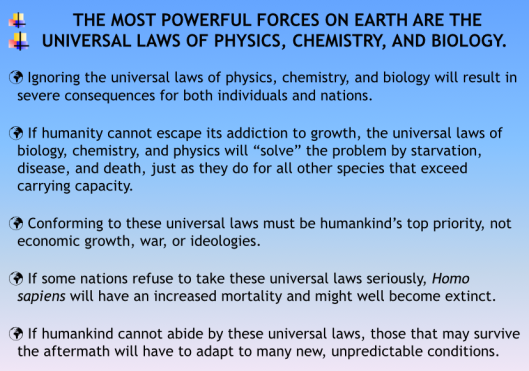
We have a 10% chance that the earth will warm 6°C by 2100 according to scientists, but the fossil fuel industry is betting it’s a sure thing by planning its future business around magical, nonexistent technologies that would remove CO2 emissions. Notwithstanding the armchair technotopian dreams of a future world that includes driverless cars, zero-point energy, and asteroid mining, we are living at the peak of capitalist industrial civilization which produces a continual flood of products promising to improve and enhance our lives but which, in the end, only complicate them. We are trapped between mindless consumerism and the thoughtless destruction of the environment. Tim Garrett calls our dilemma a double bind. The only thing that will save us from a deadly warming of the planet is the very thing that will destroy most of us if it happens —the complete crash of the global economy and its CO2 emitting process of “building wealth.” Homo economicus is too busy converting his rich environment into monetary tokens to think about the consequences of what he is doing or perceive the impending crash of the earth’s biosphere that will take care of the human overshoot problem and all the transient material wealth that has been covetously accumulated and guarded. Rising oceans, floods, fire, drought, and various superstorms from a damaged biosphere will take it all back and destroy it. For a species that has created a throw-away society, such an end is fitting. With every loss we inflict upon biodiversity, extinction creeps ever closer toward us. The consequences of ignoring the hard laws of physics, chemistry, and biology will be dire:
Countries once thought of as having relatively stable and developing economies like Brazil are now openly contemplating the use of their military in order to keep the megacity São Paulo from spiraling out of control in the face of severe climate change-driven droughts. And in the so-called First World country of America, president Obama’s science adviser is warning that “climate change could overwhelm California,” a state that grows a large percentage of what the country eats:
…The huge inertia built into the energy system — a $25 trillion worldwide investment in a mainly fossil-fuel infrastructure — is colliding with enormous momentum in the climate, which responds slowly to the buildup in greenhouse gases. The world is not even yet fully experiencing the results of emissions put into the atmosphere years ago, he said. It will take decades to turn both systems around.
“If we stopped emitting today, the temperature would still coast up for decades to come,” Holdren said.
He recalled sitting on a presidential science advisory panel during the Clinton administration.
“Quite a lot of folks were saying the impacts of climate change are uncertain and far away, the costs of dealing with it are large and close — therefore, we should wait and see what happens,” Holdren said.
“Well, like it or not, that’s pretty much what we did.”…
The mental traps and psychological defense mechanisms employed by the naked ape makes him a basket case of contradictions and ironies, simply adding more insurmountable obstacles to the insoluble problem of capitalist industrial civilization. That’s why we love dystopian operas that reflect our own twisted culture and capitalist society.
A sobering video…
Extreme weather events are rapidly increasing. Right now we are in the 6-sigma risk zone of climate change.
“I fear their euphoria of merchandise will have no end and they will entangle themselves to the point of chaos. They do not seem concerned that they are making us all perish with the epidemic of fumes that escape from all these things…” ~ Davi Kopenawa, Yanomami leader and shaman
Another year has turned over on Earth, home to an exothermic, bipedal omnivore known as capitalist carbon man whose expanding numbers and army of fossil-fueled machinery spans the globe. There’s nothing subtle or restrained about his reign of terror. He pokes and prods the climate change beast while taking for granted the stability of the Holocene, a peculiar aberration in the paleoclimate record. Plotted on a graph, the history of Earth’s climate resembles the jagged teeth of a demonic monster, a volatile creature whose abrupt and catastrophic shifts have wiped landscapes clean of most life. The consequences of burning the equivalent of an olympic sized swimming pool of oil (300,000 liters) per second, year after year, into the atmosphere will ultimately prove lethal to the planet’s habitability. Recently, scientists were surprised to discover a “Delaware-sized methane cloud” hovering over the U.S. southwest, the remnant of “years of intentionally released and errantly leaked natural gas during fossil fuel drilling operations.” No less problematic to the Earth’s homeostasis are the many other destructive habits of capitalist carbon man such as moving ten times more dirt than all natural processes, fixing more nitrogen than all terrestrial bacteria, and producing more sulfate than all ocean phytoplankton.
The exponential melting of Earth’s cryospheric regions is a foreboding harbinger of devastating sea level rise, altering oceanic and jet stream circulation, changing hydrologic cycles, and wholesale disruption of the entire planet’s biospheric system. A brief retrospective of our unfolding environmental meltdown by a major news source concludes that “2014 will likely go down as the year that melting polar ice caps graduated from being a geographic abstraction to a symbol of the irreversible ways we’ve warped the planet.” News reports continue to grow more ominous with recent warnings that the oceans are on the verge of belching their decades of stored heat from human industrial activity. CIVILIZATION is in the process of going ‘poof’ as its leaders play monkey politics and the masses are drowned in a sea of consumerist images. As Dr. McPherson recently pointed out, gallows humor is the 6th stage of grief for coping with a civilization that is blind to its own demise.
“Going Green” is a Marketing Slogan and Inverted Totalitarianism is the Most Successful Form of Tyranny
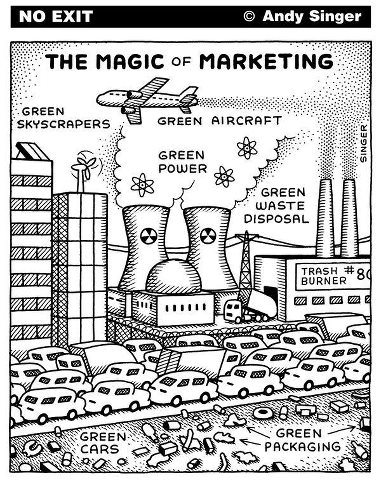
The unsettling truth is that the slogan “going green” has become a marketing ploy to greenwash capitalism and keep business-as-usual going. The speeches of corporate and political leaders are sprinkled with conscious-soothing key words such as “sustainable”, “eco-friendly”, and “2°C climate goal”, but there’s nothing sustainable about globalized techno-capitalism and the target of limiting warming to 2°C is a cruel illusion. So-called “green energy” is severely limited by suitable geography and intermittency of power production. The behemoth Google learned from its own extensive research that “today’s renewable energy technologies won’t save us.” The top business firms appear to be having a problem squaring their green rhetoric with reality, and there seems to be no way to make automobiles truly sustainable. Germany, the poster child for a green economy, is now “burning more coal than at any point since 1990.“:
“We already are on the edge of what is possible,” Mr. Löllgen said in an interview at his Düsseldorf office. “Is it worth it if we as a country succeed in reaching our targets in reducing carbon emissions, but sacrifice good jobs and our industrial base?”
Another misleading headline I get tired of reading states that humans may be headed for a 6th mass extinction. Let’s clarify this statement once and for all by admitting emphatically that we are well in the throes of a mass extinction which will likely include ourselves within this century. By all rational evidence, industrial civilization with its billions of inhabitants cannot survive without fossil fuels. The only way capitalist carbon man will ever be sustainable is as fertilizer beneath the crumbled concrete and asphalt ruins of industrial civilization. Don’t expect any mea culpa from a culture which has been programmed to believe converting all of nature into inanimate symbols of wealth is “progress” and “development”. Not even the dire warnings of esteemed scientists and religious leaders can break the spell cast by capitalism and its definition of progress. Our institutions have become intransigent, petrified monoliths to which all will be sacrificed.
“I think the notions of free will and self-determination have the appearance of reality during a civilization’s gestation and expansion phases, when there is more opportunity and social mobility. As things calcify, instruments becoming institutions that serve their own ends, the facade is harder to maintain. Human existence has always been contingent and constrained by circumstances. These ‘free’ notions are illusions, narrow windows of perception with a limited range of influence during times of transient prosperity.” ~ BP
The term inverted totalitarianism, coined a decade ago by philosopher Sheldon Wolin, describes America’s brand of despotism in which “every natural resource and every living being is commodified and exploited to collapse as the citizenry is lulled and manipulated into surrendering their liberties and their participation in government through excess consumerism and sensationalism.” Opposition to this dominant consumer culture is systematically co-opted and suppressed by the marginalization and alienation of alternative thought. Neoliberal capitalism governs not only states and economies, but extends right down to an individual’s behavior and way of living:
One of the goals of neoliberalism is to foster a population of individuals who will play an active role in their own self-governance by interacting with the market and consumption through calculated acts and investments… sets of rules and conditions are established between institutions, economic and social practices, and patterns of behavior. They generally function outside of conscious awareness and they habitually influence social behavior. Examples of dominant consumer culture discourse include the political linking of consumer sovereignty and choice with freedom, the linking of citizenship and national pride with consumption, the work and spend treadmill that many people choose to pursue, the commercialization of childhood and adolescence, and the celebration of consumer values through the mass media and advertising.
– Social Psychology and Theories of Consumer Culture: A Political Economy
Who better to label people as “unpatriotic” if they acknowledge the reality of climate change than the host of TV’s quintessential symbol of capitalism, The Wheel of Fortune? Beneath this digital web of commercials and TV infotainment is the iron fist of militarized local police and the panopticon surveillance state which can quickly stomp out those troublesome malcontents who break free of the American hologram. What better way is there for controlling entire populations than to condition them to enjoy their chains of slavery? America’s form of tyranny, a blend of covert and overt oppression, is the most successful in the history of mankind.
None of This Can Really Be Happening, Can It?
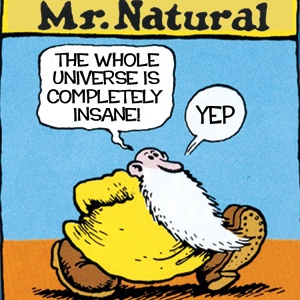
With all the disjointed and delusional thinking out there, I feel compelled to write a blog post periodically to get the facts straight and assure myself that what I see and hear every day is really happening. Yes, we really are terraforming the Earth into a barren wasteland while convincing ourselves that it’s worth it for the sake of a cubicle job and life in cookie-cutter suburbia. Yes, we really are ruled by the Washington-Wall Street-Pentagon complex. No, you will never get the raw truth from mainstream news outlets. Yes, I’m getting older and need to exercise more because a sedentary lifestyle is as bad as smoking. Yes, industrial civilization is still on track to collapse within my lifetime. As Robert Crumb’s mystic guru Mr. Natural exclaimed, “The whole universe is completely insane!”
“Mother nature is a brutal bitch, red in tooth and claw, who destroys what she creates.”
~ Ernest Becker, The Denial of Death
The root of the problem
Despite modern man’s unparalleled ability to gather and synthesize mountains of data on climate change and other growing dangers, he is helpless to stop the inevitable and well-worn trajectory that all previous complex societies have followed. This time, however, is different in that the scale of environmental overshoot is planet-wide – the world’s oceans are becoming too acidic to sustain life, the soil too eroded and degraded to grow food, and the atmosphere too polluted with heat-trapping gasses. As the green mantle of the Earth is swallowed up in the geologic blink of an eye, eon-long processes of plant and animal evolution are stopped dead in their tracks. Of all the horrors modern civilization has brought forth, the most damaging and longest-lasting legacy is the wholesale loss of genetic and species diversity. Global ecocide is certain suicide.
Faith in technology and “free market” capitalism to solve the planet’s ills has already proven to be a very dangerous and faulty belief. Politicians are always looking for easy solutions to complex problems, and they see technology as the mechanism by which to reconcile endless growth on a finite planet. Public Relations and greenwashing are all-pervasive. Science has been privatized to the highest bidder. Essentially, those who are anti-environmental and those who claim to be environmentalists are both proponents of the same omnicidal death machine. One recognizes that fossil fuels are indispensable to industrial civilization while discounting or refuting anthropogenic climate disruption(ACD). The other acknowledges the reality of ACD but falsely believes that “renewable energy technologies” can harmlessly supplant carbon-based energy sources. In both cases, neither can accept that the root of the problem is capitalist industrial civilization. Neither the anti-greens nor the faux environmentalists are willing to give up their globetrotting airline flights, sprawling suburbia and car culture, oversized McMansions, overprocessed fast food, virtual world of cyberspace and all the rest of their energy-intensive, unsustainable way of living:
…This“standard of living”is a product of an alienated society in which consumption for the sake of consumption is the new god. In a grow-or-die economy, production and consumption must keep increasing to prevent economic collapse. This need for growth leads to massive advertising campaigns to indoctrinate people with the capitalist theology that more and more must be consumed to find “happiness” (salvation), producing consumerist attitudes that feed into an already-present tendency to consume in order to compensate for doing boring, pointless work in a hierarchical workplace. Unless a transformation of values occurs that recognises the importance oflivingas opposed toconsuming,the ecological crisiswillget worse. It’s impossible to imagine such a radical transformation occurring under capitalism, whose lifeblood is consumption for the sake of consumption…
…As Murray Bookchin argues,“If we live in a ‘grow-or-die’ capitalistic society in which accumulation is literally a law of economic survival and competition is the motor of ‘progress,’ anything we have to say about population causing the ecological crisis is basically meaningless. Under such a society the biosphere will eventually be destroyed whether five billion or fifty million people live on the planet”[“The Population Myth”inWhich Way for the Ecology Movement?, p. 34]… – link
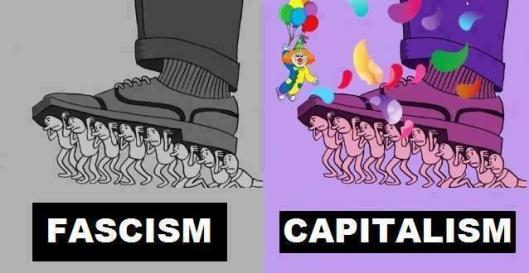
Civilization is not in of itself evil; the problem lies in how it is organized and functions. Capitalism encourages the unregulated growth of gigantic corporations that exploit the environment and people, create economic disparity, promote hyper-consumerism, and usurp and corrupt governments. In addition to using military might for exploiting foreign resources and pools of labor, capitalism encourage war for the sole purpose of profit, i.e the military industrial complex. It also encourages overpopulation by the gross maldistribution of wealth:
…There is an inverse relationship between per capita income and the fertility rate — as poverty decreases, so do the population rates. When people are ground into the dirt by poverty, education falls, women’s rights decrease, and contraception is less available. Having children then becomes virtually the only creative outlet, with people resting their hopes for a better future in their offspring. Therefore social conditions have a major impact on population growth. In countries with higher economic and cultural levels, population growth soon starts to fall off. Today, for example, much of Europe has seen birth rates fall beyond the national replacement rate. This is the case even in Catholic countries, which one would imagine would have religious factors encouraging large families.
To be clear, we are not saying that overpopulation is not a very serious problem. Obviously, population growth cannot be ignored or solutions put off until capitalism is eliminated. We need to immediately provide better education and access to contraceptives across the planet as well as raising cultural levels and increasing women’s rights in order to combat overpopulation, which only benefits the elite by keeping the cost of labour low in addition to fighting for land reform, union organising and so on. However, the “population explosion” is not a neutral theory, and its invention and continual use is due to its utility to vested interests. We should not be fooled by them into thinking that overpopulation is the main cause of the ecological crisis, as this is a strategy for distracting people from the root-cause of both ecological destruction and population growth: namely, the capitalist economy and hierarchical social relationships it requires. – link
Ferguson is only a small spark before the conflagration
Those communities that are the most discriminated against and disenfranchised will be the first to erupt in violence as the social fabric is stretched to the breaking point. The city of Ferguson, Missouri experienced ‘white flight’ since 1990 which changed its demographics, creating a majority of African-American residents but with whites still dominating the institutions governing the city. The racially charged social unrest in Ferguson has its roots in the rapacious system of capitalism. Several policies and effects of neoliberal capitalism worked to drain wealth and opportunity away from Ferguson: “outsourcing of American industry, the housing bubble and credit crunch, and education reform and privatization”. In addition, the militarization of local law enforcement and targeting of African-Americans with fines to fund the police department is another tactic of rogue capitalism preying upon the poor:
Emerson Electric, the dominant employer in the area, offshored its production little by little over time to foreign factories with cheap labor.
Many African-Americans bought homes in Ferguson during the housing bubble, only to become underwater in their mortgages in the credit crash and Great Recession that followed. As of 2013, 49% of homes in the Ferguson zip code were underwater.
Mortgage lenders targeted predominantly black and Hispanic areas for the highest-risk, highest-cost types of mortgage loans, such as adjustable-rate mortgages and loans with high prepayment penalties. This led to higher-than-average default rates, according to the Housing Commission established by the Bipartisan Policy Center in Washington, D.C.
The mayor of Ferguson and its all-white city council then collaborated to keep property values low around the historic district for reinvestment and redevelopment.
On the basis of its state test scores, the impoverished Normandy School District where Michael Brown attended was declared a failure and its accreditation was pulled by the state. Because of this, Normandy School District was obligated to pay for the transfer of its students to other wealthier schools. (This is one of the schemes of the privatization of education and “school shopping” that the state is using rather than funding and providing resources to these schools.) The costs of student transfer bankrupted Normandy School District, so the state then dissolved the district and created a new one which it exempted from accreditation so that students would no longer be allowed to transfer out to other better-funded schools. The pipeline from such poverty-stricken, failed educational systems to prisons–many of which are for profit–is direct.
The militarization of the domestic police force in the U.S. has been occurring for several decades and is in line with the ever-increasing militarism of America’s foreign policy. With the entire globe now treated as a battlefield in the ‘War on Terror’, summary executions can be carried out by remote-controlled drone aircraft. Americans have now joined the ranks of those in South America, the Middle East and the rest of the Third World who have been exploited by the neo-coloniali exploitation of U.S. corporations over the last century. As the economy fails to ‘improve’ and global unrest becomes more frequent, the brutality of a fascist corporate state will reveal itself right here at home in more overt ways. The growing police state in America is the response by those planning to protect their elite positions at the top of the capitalist hierarchy in this corrupt state of ever-widening wealth disparity, resource depletion, and environmental collapse:
…Combat in large cities is central to the military doctrine that is being developed by the US armed forces. This is spelled out in a document entitled “Megacities and the United States Army: Preparing for a complex and uncertain future,” which was released in June by the Army’s Strategic Studies Group and endorsed by its chief of staff, Gen. Raymond Odierno.
Predicting that it is “highly likely that megacities [described as metropolitan areas with populations of more than 10 million] will be the strategic key terrain in any future crisis that requires U.S. military intervention,” the report reveals that the Pentagon has conducted “case studies” and “field work” in preparation for such interventions in: Dhaka, Bangladesh; Lagos, Nigeria; Bangkok, Thailand; Mexico City, Mexico, Rio de Janeiro and Sao Paulo, Brazil … and New York City.
Describing the conditions that it anticipates will require US military intervention, the report warns, “As inequality between rich and poor increases … Stagnation will coexist with unprecedented development, as slums and shanty towns rapidly expand alongside modern high-rises. This is the urban future.”
“Radical income disparity,” is further described as the foremost “driver of instability” in these far-flung urban areas.
In other words, the Pentagon brass is seeking to prepare the US military for directly counterrevolutionary interventions aimed at quelling popular revolts that it sees as the inevitable consequence of the unprecedented social inequality created by world capitalism in crisis… – link
As reported by Cyrano’s Journal Today, the Obama administration’s call to review U.S. government funding of military equipment for local/state police departments is simply a PR ploy to calm the nerves of uneasy Americans. In reality, the U.S. government will work to normalize and standardize the militarization of domestic law enforcement:
…The aim of the Obama administration’s review—beyond being a public relations exercise—will be to cut down on such unprofessional displays and make the use of domestic military police more systematic, widespread and regular. In this it will be similar to the administration’s reviews of its domestic spying programs, each of which has only resulted in the extension of illegal spying by the US intelligence agencies.
Far from acting as a restraining influence on local police departments, the federal government has been the most active facilitator of police militarization. In June, the American Civil Liberties Union released a report entitled “War comes home: The Excessive Militarization of American Policing,” which concluded that “the federal government has justified and encouraged the militarization of local law enforcement.”…
To add insult to injury, the Ferguson police made it a practice to feed off the poor by filling its coffers with millions of dollars in fines and court fees that it collected by specifically targeting and harassing African-Americans. I seldom quote ZeroHedge here because it is pro-capitalist and attributes all social and economic problems to Federal Reserve monetary policies rather that correctly placing the blame on the inherent workings of capitalism, but I did read an informative article from them on the scale of poverty that is affecting not only Ferguson, but all major metropolitan areas in the U.S.:
The biggest concern, however, is that Ferguson is merely the canary in the coalmine. According to Brookings, within the nation’s 100 largest metro areas, the number of suburban neighborhoods where more than 20 percent of residents live below the federal poverty line more than doubled between 2000 and 2008-2012. Almost every major metro area saw suburban poverty not only grow during the 2000s but also become more concentrated in high-poverty neighborhoods. By 2008-2012, 38 percent of poor residents in the suburbs lived in neighborhoods with poverty rates of 20 percent or higher. For poor black residents in those communities, the figure was 53 percent.
A long history of colonialism, slavery, and racism underlies the economic, political, and social disenfranchisement of African-Americans today in communities like Ferguson. Their exploitation has been institutionalized, and thus deemed acceptable.
We’re just an extra in this global reality freak show
The world certainly appears to becoming much more unstable with Russia and the Ukraine flirting with nuclear war, barbaric decapitations at an all time high in the perpetually destabilized Middle East, the failure of Japan’s ice wall to stop its radioactive clusterfuck fallout, redneck commando wannabes of America’s local police departments running roughshod over those they are sworn to “protect”, the Wall Street Casino Royale reaching all-time highs as average Americans get new lone shark PayDay loans to pay their previous lone shark PayDay loans, and our corporate overlords celebrating even higher profits while paying even less taxes. And while this circus of humanity plays out, both poles continue their meltdown with new outgassings of methane promising to wipe us out with one monstrous belch.
The techno-utopians will continue their crusade to save mankind from himself. The free market fundamentalists will seek comfort in the fantasy that Adam’s Smith’s invisible hand will fix everything. The climate change deniers will continue to rationalize the increasingly destabilized biosphere as a new normal that has happened before. The things we know that should be done to save ourselves are only philosophical narratives running in our head, never to see the light of day. All you can do is watch it all unfold because this reality freak show is global and you’re just an extra in it, whether you want to be or not. After all, I don’t think any of us are completely free from some sort of delusion. If we were, we wouldn’t be human.
I’ve become rather jaded at the stream of ever-worsening environmental reports these days. Surely if we had some sort of techno-fix to halt the cascade of biospheric tipping points we have breached, we would have deployed them by now. Nevertheless, the carrot of a civilization-saving technological breakthrough is forever dangled before our eyes. By all accounts, we appear hellbent on doing everything humanly possible to maintain and perpetuate industrial civilization by deploying “earth-friendly” renewable energy technologies which, in the end, turn out to be nothing more than “reconstituted fossil fuels”.
The role that fossil fuels play in the creation, maintenance and support of alternative energy technologies is not discussed or analyzed at all by those peddling it to the masses who live with the hope of a “green” economy and carbon-neutral civilization. From the massive mining operations and manufacturing processes necessary to extract the rare earth metals essential in constructing wind turbines, solar panels, and electric car batteries to their daily maintenance, de-activation, and final discardment, the amount of fossil fuel energy embedded in the entire life cycle of such alternative energy technologies renders moot their benefits when compared to what is actually more effective in solving our energy and climate conundrum —reducing our consumption through energy efficiency improvements and waste reduction programs. Alternative energy technologies cannot replace our dependence on fossil fuels and are, in the final analysis, diverting us from coming to grips with a way-of-life that cannot go on for much longer. We have a consumption crisis.
Here is an excerpt from a must-see talk by engineer and energy analyst Ozzie Zehner, author of Green Illusions:
“Common knowledge presumes that we have a choice between fossil fuels and green energy, but alternative energy technologies rely on fossil fuels through every stage of their life cycle. Most importantly, alternative energy financing relies ultimately on the kind of economic growth that fossil fuels provide. Alternative energy technologies rely on fossil fuels for raw material extraction, for fabrication, for installation and maintenance, for back-up, as well as decommissioning and disposal. And at this point, there’s even a larger question: where will we get the energy to build the next generation of wind power and solar cells? Wind is renewable, but turbines are not. Alternative energy technologies rely on fossil fuels and are, in essence, a product of fossil fuels. They thrive within economic systems that are themselves reliant on fossil fuels.
Now, I’m no fan of fossil fuels. Fossil fuels are finite and dirty, but we use them for five principal reasons. Fossil fuels are dense. Their energy is storable, portable, fungible (which means they can be easily traded), and they are transformable into other products like pesticides, fertilizers, and plastics.
Now, these qualities cannot be measured in kilowatts, so what happens when we spend our precious fossil fuels on building alternative energy. Well then we get energy that is not dense, but diffuse. It’s not easily storable. It’s not portable. It’s not fungible. And it is non-tranformable.
Now to increase the quality of the energy, we then have to spend more fossil fuels to build batteries, to build back-up power plants, and other infrastructure. And of course this is incredibly expensive. Ultimately that expense represents the hidden fossil fuels behind the scene.
There’s an impression that clean energy can supply a growing population of high consumers. There’s an impression that alternative energy can displace fossil fuel use, but the evidence doesn’t show that.
As Ozzie Zehner states, fossil fuels are finite and dirty. If you look at the headlines, the geopolitical wrangling and wars that takes place over the extraction of fossil fuels are another nasty and destabilizing side-effect of our dependency on fossil fuels. America’s global network of bases and its military industrial complex are yet another hidden cost of our fossil fuel addiction. Does President Obama tell the people of America the real underlying reason for why we are again bombing Iraq?
The US military intervention, despite its “humanitarian” propaganda, is nevertheless part of clear political objectives that are to protect American diplomatic personnel stationed in Erbil (which is also home to a CIA base) and large multinational companies in the hydrocarbon/oil sector such as Mobil, Chevron, Exxon and Total exploiting the oil production in the region and having already invested more than $10 billion there, but the primary purpose above all is to keep the Iraqi regime ally, inherited from the American invasion. The United States did not intervene when Mosul fell and other regions and more than 200 000 refugees were on the road in the direction of Iraqi Kurdistan, but only when IS was threatening to conquer the Kurdish areas of the North and the capital Baghdad in the South. – link
Here we are once again back at war because we need that black goo lying beneath the ground that those lunatic terrorists are running around on. And it also doesn’t help that America has become a warfare state with the corporations and the über rich benefitting every time we crank up our war machine.
Among many others who have written about this subject, here are two people from The Fertile Ground Institute who have also looked into alternative energy technologies and come away with the same conclusion as Ozzie Zehner:
I agree with commenter ‘C 1 Max’ whose many thoughtful comments at Robert Scribbler’s site were summarily deleted.
As long as we ignore the limitations of technology and the unsustainable nature of our economic system, the battle is lost for mankind. The grave we are digging for ourselves will only get deeper and deeper, spurred on by our alternative energy fetishes and temples to technology.










 Collapse of Industrial Civilization