Paul Ryan, cool cat wannabe, loves Rage Against the Machine’s music, he says. He must not listen to the lyrics. Here’s what the band’s guitarist/activist Tom Morello has to say:
Ryan’s love of Rage Against the Machine is amusing, because he is the embodiment of the machine that our music has been raging against for two decades. Charles Manson loved the Beatles but didn’t understand them. Governor Chris Christie loves Bruce Springsteen but doesn’t understand him. And Paul Ryan is clueless about his favorite band, Rage Against the Machine.
And of course he had to recently disavow himself from his ethical and spiritual idol, Ayn Rand:
Such pompous, self-serving, and seemingly sociopathic behavior among the elite in capitalist America is nothing new. As a matter of fact, it seems to have always been the norm in American history:
I recently read a book by University of Maryland historian Terry Bouton,Taming Democracy, which is an account of the intense struggles over wealth and power that emerged in the earliest days of the United States. Bouton’s detailed research was focused on Pennsylvania, but he describes patterns that also appeared elsewhere in the infant republic.
The core of the story he tells is that the colonial coalition that made possible the political break with Britain fractured even while the Revolutionary War was still in progress, as wealthy interests in the colonies quickly had second thoughts about the democratic fervor that they had helped to set in motion and how it might jeopardize their ability to amass still more wealth….
…The story demonstrates that strong class consciousness and class-specific drivers of policy have been a major part of American politics since independence. A key part of that class struggle all along has been a strong sense among a wealthy elite of separateness from the non-wealthy, and of having a right to push hard for public policies that favor their own class even if they are clearly detrimental to others.
A major figure in Bouton’s account is the Philadelphia merchant and financier Robert Morris…
…An even more blatant ploy of using government to favor his own class’ interests at the expense of others concerned speculation in war debt. Amid poverty, scarcity of money, and uncertainty about government funding of debt, many holders of IOUs — who had furnished support to the war effort ranging from food to blacksmithing — sold them for cents on the dollar to speculators who hoped to redeem them eventually for much more than that.
Morris not only participated in this game but openly promoted it. He told the Continental Congress in 1782 that speculators should be encouraged to buy up the IOUs “at a considerable discount” and then have the government bring the pieces of paper “back to existence” by paying them off at top dollar.
This big transfer of wealth would provide the affluent with “those funds which are necessary to the full exercise of their skill and industry.” Bouton writes, “As Morris saw it, taking money from ordinary taxpayers to fund a huge windfall for war debt speculators was exactly the kind of thing that needed to be done to make America great.”
We have tended to whitewash such aspects of American history from our consciousness, for several reasons. One is the hagiography we customarily apply to the Founding Fathers. Another is that we lose sight of the connections between class consciousness of the past and that of today by euphemizing today’s version and espousing more subtle notions of trickle-down economics than the crude version that Morris espoused.
People of his economic stratum were known at the time as “gentlemen”; today they would more likely be called “job creators.” A further reason is Americans’ belief in the national myth that America is less stratified into classes, and exhibits more mobility between classes, than do other countries and especially the old countries of Europe. That myth has become increasingly distant from fact in recent decades…
For those who believe that class structure and the struggles therein do not exist in America, history shows that it has always been a part of our country, reasserting itself with a vengeance in recent times. With the elite having a lock on mass media and now the use of the empire’s security and surveillance state to squash dissenters, malcontents, and any challengers of the status quo, there does not seem to be any going back to a society embodied by a strong middle class, especially in an age where the economic pie is forever shrinking.
Jeffrey Sachs’ op ed piece entitled “America Has Lost the battle Over Government” in the Financial Times explains how the budget plans of our two corporate candidate stooges are strikingly similar and offer no real choice for the American citizen. With the modern-day instruments of mass media manipulation being the most sophisticated tool for mind control in the history of man, you are made to think that the current election is an epic struggle between the forces of good and evil, but the American’s fate of joblessness, dwindling social assistance programs, a permanently growing underclass, and the slide into an oligarchic Third World country has already been written in stone by the transnational capitalist forces and its corporate state. Crime will surely go up, lifespan expectancy will go down for the underclass, and the infrastructure of the nation will continue its trajectory into dilapidation and decay. Sacrificing your body in the Empire’s foreign resource wars and geopolitical games will be one of the only jobs available for our debt-ridden youth:
…Mr Ryan’s plan calls for federal revenues of 18.4 per cent of gross domestic product in 2016 and 18.5 per cent in 2020 (though his lower tax rates would probably put those targets out of reach). His budget outlays come in at 19.7 per cent and 19.5 per cent in 2016 and 2020, respectively. Of the total outlays in 2016, Mr Ryan targets “discretionary” programmes at 5.9 per cent of GDP; social security, 5 per cent; Medicare, 3.2 per cent; other mandatory spending, 3.7 per cent; and interest payments, 1.9 per cent.
Now consider Mr Obama’s budget unveiled in February. Federal revenues are targeted at 19.1 per cent of GDP in 2016 and 19.7 per cent of GDP in 2020, only about 1 percentage point above Mr Ryan’s revenue targets. In Mr Obama’s 2016 budget targets, discretionary spending is set at 5.9 per cent of GDP; social security, 5 per cent; Medicare, 3.2 per cent; other mandatory spending, 5.8 per cent; and interest payments, 2.5 per cent.
In fact, Mr Obama’s overall discretionary spending targets are essentially the same as Mr Ryan’s. Whether Mr Obama or Mr Romney wins, the “non-security” discretionary budget – for education, job skills, infrastructure, science and technology, space, environmental protection, alternative energy and climate change adaptation – is on the chopping block. Mr Obama’s budget would shrink non-security discretionary programmes from an already insufficient 3.1 per cent of GDP in 2011 to 1.8 per cent in 2020. That is the “liberal” alternative.
In bemoaning Mr Obama’s budget, I do not mean to equate it with Mr Ryan’s. Mr Ryan’s budget is nothing short of heartless in the face of the dire crisis facing America’s poor. It is also reckless, guaranteed to leave millions of children without the quality of education and skills they will need as adults. Yet the sad truth is that the Democrats offer no progressive alternative. Both parties are accomplices to the premeditated asphyxiation of the state. Viewed from an international perspective, the constricted range of the US fiscal debate is striking. Total US government revenues (combining federal, state and local governments) in 2011 came in at about 32 per cent of GDP. This compares with an average of 44 per cent in the EU and 50 per cent in northern Europe.
Many Americans will say that they are dodging the European curse by keeping taxation so low but they should look again. Northern Europe (Germany, the Netherlands, Denmark, Finland, Norway and Sweden) gets great value for its tax revenues: lower budget deficits, lower unemployment rates, lower public debt-to-GDP ratios, lower poverty rates, greater social mobility, better job training, longer life expectancy, lower greenhouse gas emissions, higher reported life satisfaction and greater macroeconomic stability.
America’s two political parties depend on wealthy contributors to finance their presidential campaigns. These donors want and expect their taxes to stay low. As a result, social divisions, broken infrastructure, laggard educational attainments, high carbon emissions and chronic budget deficits are likely to continue no matter who is elected, even though the public supports higher taxes on corporations and the rich…
Chris Hedges was back in court over the government’s appeal of Judge Forrest’s earlier injunction of the NDAA. As a matter of fact, the government has refused to comply with the injunction. Hedges states he and the other plaintiffs “will most likely have to continue this fight in an appellate court and perhaps the Supreme Court.” He also notes that no matter the results of the rigged U.S. elections, no meaningful change will come to the deteriorating lives of ordinary Americans:
…The corporate state has convinced the masses, in essence, to clamor for their own enslavement. There is, in reality, no daylight between Mitt Romney and Obama about the inner workings of the corporate state. They each support this section within the NDAA and the widespread extinguishing of civil liberties. They each will continue to funnel hundreds of billions of wasted dollars to defense contractors, intelligence agencies and the military. They each intend to let Wall Street loot the U.S. Treasury with impunity. Neither will lift a finger to help the long-term unemployed and underemployed, those losing their homes to foreclosures or bank repossessions, those filing for bankruptcy because of medical bills or college students burdened by crippling debt. Listen to the anguished cries of partisans on either side of the election divide and you would think this was a battle between the forces of light and the forces of darkness. You would think voting in the rigged political theater of the corporate state actually makes a difference. The charade of junk politics is there not to offer a choice but to divert the crowd while our corporate masters move relentlessly forward, unimpeded by either party, to turn all dissent into a crime…
A lot of Americans buy into this “cult of individualism” and anti-government sentiment which the elites of the corporate state artfully peddle in order to dismantle any remnants of a functioning government that might serve the common good of its citizenry. In this way, the corporate state has convinced the masses to cheer the destruction of government and its beneficial roles. But of course we cannot call our lobbyist-infested, corporate-controlled government an actual representation of the people’s interests. Just as our two-partied presidential election is an orchestrated illusion of democracy, so is the false dichotomy of government and corporations which are merely separated by a revolving door. The government has become, for the most part, a tool for wealth extraction by multinational corporations. During a period of multiple civilization-ending crises when leadership is in dire need, the degeneration of government from a socially beneficial entity into a puppet of Wall Street’s rapacious greed is the greatest tragedy of our time.
If Ayn Rand was alive today, she would believe that climate change was a conspiracy theory.
I want to preface this post by saying I don’t endorse either Wall Street stooge of our political system’s two-headed corporate hydra monster. The Democratic party fell sway to Big Money a long time ago. See ‘Death of the Liberal Class‘ by Chris Hedges. But I do want to focus on the party that doesn’t mince words or even pretend (at least not very well for those who read) to represent the greater good of society. The primary ideology of the Republicans (and faux Democrats) is neoliberal capitalism whose tenets are laid out here. If there ever was a time when ‘the greater good’ should be our primary objective, the time is now. We are facing an environmental crisis, financial crisis, economic system crisis, food crisis, energy crisis, wealth disparity crisis, etc. Oh, I should have mentioned we’re also facing the possible probable extinction of our own species. But the modus operandi that the our leaders rulers are following is not to solve any of the civilization-ending crises, but to do what Richard Heinberg described as the “Last Man Standing” strategy:
I thought that world leaders would want to keep their nations from collapsing. They must be working hard to prevent currency collapse, financial system collapse, food system collapse, social collapse, environmental collapse, and the onset of general, overwhelming misery—right? But no, that’s not what the evidence suggests. Increasingly I am forced to conclude that the object of the game that world leaders are actually playing is not to avoid collapse; it’s simply to postpone it a while so as to be the last nation to go down, so yours can have the chance to pick the others’ carcasses before it meets the same fate.
The elite 1% are playing a similar game against the 99% which I call “The Last Man Scrambling”. Paul Rosenberg’s latest essay discusses a 2006 book by Yale University political scientist Jacob S. Hacker who explains how the 99% are being financially eaten alive by what is termed the “risk-shift” – the systematic shifting of risk from large institutions onto the backs of citizens, including the most vulnerable among us, under the neoliberal rhetoric of “individuals taking personal responsibility”:
…The figures Hacker cited were staggering. First, regarding basic economic security: Personal bankruptcies increased from 300,000 in 1980 to 2 million in 2005 – a 567 per cent increase. The chance that an average American’s income will drop 50 per cent or more over a two-year period increased from 7 per cent in the 1970s to 17 per cent in 2002 – a 143 per cent increase. Long-term unemployment (more than 6 months) at the peak of the business cycle is triple what it was in the 1960s.
Second, regarding health security: The number of Americans without health insurance was 46.6 million, up from about 24 million in 1980. The decline was entirely due to cuts in employer-provided health coverage. Worse still, over 80 million Americans lack health insurance over some time during a two-year period.
Third, regarding retirement security: The percentage of large and medium-sized corporations offering traditional “defined-benefit” pensions, with a guaranteed monthly benefit for life, fell from more than 80 per cent in 1980 to less than a third in 2006. And 401(k)s that replaced them? There’s a reason folks call them 201(k)s now.
Fourth, the burden was particularly hard on families with children, whom conservatives claim to care about most. Their bankruptcy rates are twice that of childless couples.
These are just a few of the frightening figures Hacker cited, and in every case, he argued, the basic cause was the same: risk had been systematically shifted from large institutions most capable of handling it onto the shoulders of the most vulnerable. This was largely a result of a rhetoric of “personal responsibility”, but what was actually being shifted was not responsibility, but risk.
Rosenberg then ties this in with what Romney/Ryan have planned for the American plebs:
So what does all that have to do with Paul Ryan? Simple: Ryan’s infamous budget plan has many well-known problems with it, but it would also vastly intensify the Great Risk Shift, as Democratic strategist Mark Schmitt cogently pointed out in April 2011 (“The Ryan Plan: The Biggest Risk Shift Ever“).
“It’s not just that Ryan slashes spending,” Schmitt wrote, “he places the burden of risk on American families’ shoulders.” That’s precisely what the Great Risk Shift has done step-by-step over the past 30 years. With the Ryan plan, the process would be dramatically accelerated.
In one concise paragraph, Schmitt summarised Hacker’s point about the true value and function of the welfare state that America’s elites have been gradually dismantling since the 1970s:
The achievement of the New Deal and the Great Society was not primarily in providing benefits to the poor and the old, although that’s often how both liberals and conservatives talk about it now. What those programmes did best was to reduce risks for individuals by sharing them across society. Whether it was health insurance through Medicare and Medicaid, insurance against poverty in old age through Social Security, federal mortgage insurance that made homeownership possible, or the Federal Deposit Insurance Corporation that enabled people to save for the future with confidence, when government absorbed and shared some of the risks of life, individuals were able to take chances and make the most of their potential.
And, in contrast, he noted:
Today, though, the only risks we’re sharing are the wrong ones: Wealthy investors are protected by real or implicit guarantees such as “too big to fail,” while the risks that should be shared, through social insurance, are instead privatised – that is, pushed down the line onto us as individuals.
…if you knew you were running for president, wouldn’t you perhaps spend at least five years before running making your taxes look as clean as a whistle? I’m saying no Grand Caymans, no Switzerland, no stashing bullion in the cargo bay of Curiosity to reach the low-tax surface of Mars (ok, one of these might be an exaggeration).
Not Romney, though. He apparently had to use every manoeuvre known to man and man’s most deceitful accountant to ensure he paid low-to-no taxes. So how has he handled the fallout? Stonewalling, uncomfortable denials, and lashing out at those who attack him for his hidden returns, such as Senator Harry Reid – thereby keeping the whole story in the news that much longer (genius!).
He’s even got porn star Jenna Jameson saying she is going to vote for him because “when you’re rich, you want a Republican in office.” (Of course, other porn actors interviewed by The Daily Beast are pro-Obama, showing that even in the world of X-rated entertainment, Mitt can find a way to divide the top 1 per cent from everyone else)…
Amazingly, if you look at the polls, a large percentage of American’s(aka the clueless, MSM spoon-fed plebs) would still vote for someone who is part of the cosseted 0.001% responsible for hiding 20 to 30 trillion in off-shore tax havens and who boldly regurgitate the lie that corporations in America have the highest tax rate in the world (the nominal rate is meaningless; it’s the effective rate produced from all the tax loopholes that counts). But as they say, the propaganda-ridden minds of the American public are mere putty in the hands of the corporate-owned media machine. Mind you, I know there is no real measurable difference between Obama and Romney when it comes to our self-inflicted trajectory toward a post-human era, but voting for Romney, a financier of the criminal class on Wall Street, takes ‘voting against your own interests’ to a whole new level. I mean this guy financed Bain Capital with blood money from death squad oligarchs in South America. I understand the utter failure Obama has been for the masses who bought into the “Hope” slogan, but voting for King Romney is like saying, “I give up; please rape me and then throw me to the lions.”
In a comment section of Schecter’s piece, a reader sumarizes perfectly what King Romney is about:
Let us focus that the issue is not Rommey or the VP RP, the issue is what is behind Rommey. Rommey is the representative of global capitalism; he is not interested in the American people as a nation, but as consumers; for him the solvency of the middle class is of no importance. It is the maintenance of corporate America and global capital that matters for him. He advocates trickle down economics and the emancipation of corporations over people. [In] the end Rommey, like any other warmonger, will use war [as] an economic incentive.
– ’nuff said. So how are the American plebs doing? For starters, a recent study found that nearly half the population in the U.S. dies penniless and dependent on Social Security. Basically we are now a nation of the grotesquely wealthy, the ‘just-getting-by’, and the crumb scrapers. The ‘just-getting-by’ segment is always in danger of falling into the ranks of the crumb scrapers. And the elite 1%, as we have discussed in prior posts, have built up a security and surveillance state as well as the prison industrial complex in order to deal with those who have any funny ideas of changing that status quo.
…now back to our two corporate stooges who are vying for the coveted PR position of the corporatocracy. Matt Taibbi has a new article out which shows how our tax system favors the wealthy and how Big Money from Wall Street perverts our political system:
…We’ve known for seven months now, for instance, that Romney paid $3 million in federal taxes in 2010 on $21.7 million in taxable revenue, an effective tax rate of 13.9 percent. Which, as most people know, is less than half the rate most people pay on their income tax.
When Romney released these numbers, he said they were “entirely legal and fair,” and added, “I’m proud of the fact that I pay a lot of taxes.”
The Romney tax returns are a prime example of our increasingly two-tiered bureaucratic system, in which there is one set of rules for poor and middle-class people, and another set of rules for people like Mitt Romney. …
<snip>
In Mitt’s case, the money you and I make to support ourselves is called income and is taxed up to 35 percent, but the money Mitt makes raiding companies with borrowed money and extracting draconian management fees from captive companies that have no choice but to pay them is called “Carried Interest,” and taxed at a top rate of 15%.
The ostensible excuse for this outrageous difference is based upon a built-in cultural value judgment, which says that the work Mitt Romney does raiding companies with borrowed money is more valuable than the work ordinary people do laying asphalt or teaching autistic children. Here’s what one private equity spokesperson said by way of explanation for this difference:
Steve Judge, the president of the Private Equity Growth Capital Council, a trade group for private equity funds, said carried interest is a way to reward risk takers in a way that tax havens do not. “They don’t have the purpose of incentivizing risk taking,” Judge said. “That makes it inappropriate to blend carried interest with them.”
So the carried interest tax break is a way to “incentivize” the kind of work Mitt Romney does. One wonders then if the relatively higher tax rates paid by teachers and librarians and cops is … what? A disincentive? Anyway, it’s this skewed set of obligations that Mitt Romney thinks is “fair.”
The Obama administration, if it wanted to, could make a lot of hay over this. It could say, “Mitt Romney doesn’t want to release his tax returns for years and years during the last decade. But the years for which he did release returns, he paid a rate that’s less than half of what most ordinary American professionals make – and he thinks that’s ‘fair.’”
Now, Obama has gone after Mitt’s tax returns – a little. He’s released a few ads here and there, including one called “Makes You Wonder” that called Mitt’s use of carried interest in his tax return a “trick,” a semantic move for which Obama was criticized, since it was actually nothing of the sort. Mitt Romney’s ability to pay a top rate of 15% for his work was no trick at all but a fully-legal expression of the values of our current political system, a system, again, that Mitt Romney is “proud of” and thinks is “fair.”
The reason the Obama administration hasn’t gone after this aggressively is probably the same reason it hasn’t fought harder to repeal that carried interest tax break (which Obama incidentally promised to do four years ago), and the same reason that everyone from Corey Booker to Bill Clinton has urged Obama to lay off the theme of private equity thuggery in his campaign against Romney. Big-time politicians are still afraid to explain to the American people how exactly it is that many Wall Street firms make their money, because they’re afraid to lose access to the crumbs those firms sometimes toss their way.
In the case of Romney, what we’ve mostly heard is that he’s a turnover specialist who sometimes creates jobs and sometimes eliminates them – a kind of ideologically-neutral efficiency consultant who takes a cut when poorly-run companies cut out the fat. The Obama ads about Bain have been emotionally effective, but they’re still frustratingly vague about the actual mechanics of these takeovers. We learn from these ads that a bunch of rich guys took over plants and fired workers, but what we don’t learn is how companies like Bain raise the money for those takeovers, why the plants subsequently become cash-poor, how this industry works generally, and not just at Bain.
In fact the takeover method espoused by Bain and many other private equity firms is a lot closer to the Tony Soprano-takes-over-Davey-Scatino’s-sporting-goods-store “Bust Out” model (and we’ll be getting into this more in the magazine in upcoming weeks) than it is to anything like legitimate consulting.
Barack Obama is one of the few politicians with the communication skills to explain this to middle America, but he’s refusing to go there, probably because he’s still hoping for a post-election rapprochement with Wall Street. He wants to go after Bain Capital, but not private equity in general; he wants to go after Mitt Romney’s missing tax returns, but not the tax returns of all people like Mitt Romney.
So there you have it. Both sock-puppet politicians continue to protect the monied interests, skirt the real issues, and bamboozle the sheeple. But as I said, in a post-human era of the not-too-distant future, you can’t get too riled up about such trivialities.
Continuing on my last post’s theme of technology and man’s insatiable quest for more lethal weapons, Chris Hedges wrote an article this week in remembrance of the 60th anniversary of the Hiroshima and Nagasaki bombings. He reminds us that science and technology are amoral, advancing of their own accord, and that they have become the new religion, heralding solutions to all that ails modern man. Geoengineering, anyone?
The atomic blasts, ignited in large part to send a message to the Soviet Union, were a reminder that science is morally neutral. Science and technology serve the ambitions of humankind. And few in the sciences look beyond the narrow tasks handed to them by corporations or government. They employ their dark arts, often blind to the consequences, to cement into place systems of security and surveillance, as well as systems of environmental destruction, that will result in collective enslavement and mass extermination. As we veer toward environmental collapse we will have to pit ourselves against many of these experts, scientists and technicians whose loyalty is to institutions that profit from exploitation and death…
It was science, industry and technology that made possible the 20th century’s industrial killing. These forces magnified innate human barbarity. They served the immoral. And there are numerous scientists who continue to work in labs across the country on weapons systems that have the capacity to exterminate millions of human beings. Is this a “rational” enterprise? Is it moral? Does it advance the human species? Does it protect life?
For many of us, science has supplanted religion. We harbor a naive faith in the godlike power of science. Since scientific knowledge is cumulative, albeit morally neutral, it gives the illusion that human history and human progress also are cumulative. Science is for us what totems and spells were for our premodern ancestors. It is magical thinking. It feeds our hubris and sense of divine empowerment. And trusting in its fearsome power will mean our extinction…
Now on to the second point – Transnational Capitalism. This is an excellent article written by a former hedge fund manager that gives an overall, system-wide summation of the capitalist system controlling the world. It’s well worth the read and helps to flesh out what I have alluded to in other posts – the emergence of an elite capitalist class that has no allegiance to any country and shares more in common with its global members than with the fellow countrymen and the nation-state from whence they originated. Some excerpts:
This federation of convenience by the global elite is a lingering problem for the lower economic classes in America. The U.S.-based CEO of one of the world’s largest hedge funds told Chrystia Freeland that his firm’s investment committee often discusses the question of who wins and who loses in today’s economy. In a recent internal debate, he said, one of his senior colleagues argued that the hollowing-out of the American middle class didn’t really matter. “His point was that if the transformation of the world economy lifts four people in China and India out of poverty and into the middle class, and meanwhile means one American drops out of the middle class, that’s not such a bad trade.” Notice the CEO’s reference to “not such a bad trade” as representative of free market lingo, i.e., “trade.” Everything is measured in trade terms, like statistics, if you look in the mirror, you’ll see the reflection of a commodity.
This viewpoint is typical of how the global ruling class thinks, and proof positive of it is reflected in today’s politics in America. The right wing embodies this same viewpoint by striving to strip the federal government of public welfare services, privatizing governmental assets, and undercutting benefits to society at large, especially via manipulation of the federal tax code. This same occurrence is happening in real time right now in Greece, Spain, and Portugal as the cadre of elite technocrats out of Brussels, de facto capital of the EU, dictate nation-state policies to those three forlorn countries. The world’s elites love hard times/recessions because of the set up. It makes it easier for them to strip away government largess via austerity programs that they force upon governments, and it allows for undercutting the wages of average citizens as well as dismantling of governmental regulations. This, in turn, prompts protestors to congregate in the streets of capital cities, but over time, the capitalist class waits them out, temporarily residing in one of their homes elsewhere, away from danger, and with time on their side, the capitalists win.
Upon reading Chrystia Freeland’s article in Atlantic Magazine, one comes away with the impression the elite capitalists look down with disdain upon the masses of people, expressing a contempt for those in society who do not have the personal merit to rise to the occasion of wealth and power. Meritocracy is their biblical source, not equality and fraternity. These are hackneyed terms from ‘America of old’ and no longer applicable in the new technologically enhanced world, which itself is the major source of many of the new self-made wealthy.
This global ruling class controls the levers of an emergent trans-national state apparatus of global decision-making and orders emanate from the IMF, World Bank, the EU, and the WTO. The ruling bloc of this world order consists of chieftains of global corporations and financial conglomerates, major players in the dominant political parties of the world, media conglomerates, and technocratic elites….
…
According to William Robinson: Transnational capital has been able to break free of nation-state constraints to shift the correlation of class and social forces worldwide sharply in its favour and to undercut the strength of popular and working class movements around the world. One new structural dimension of 21st century global capitalism is a dramatic expansion of the global superfluous population or that portion marginalized and locked out of productive participation … constituting some one-third of humanity. The need to assure the social control of this mass of humanity living in slums gives a powerful impetus to neo-fascist projects and facilitates the transition from social welfare to social control, otherwise known as police states. Over time, this system becomes ever more violent and the ability of economic power to determine electoral outcomes opens the door for 21st century fascism to emerge without a rupture in electoral cycles and/or a constitutional change.
The door for 21st century fascism has more than opened. It has been blown off the hinges…
Just as science is amoral, so is capitalism which treats everything living and inanimate as a commodity ripe for exploitation. Welcome to a world ruled by the new globe-trotting, predatory elite who will profit from what remains of the planet’s depleting resources and exhausted ecosystems while paying no heed to the plight of the masses or future generations.
“Earth provides enough to satisfy every man’s needs, but not every man’s greed.”
~ Mahatma Gandhi
Growing up in the seat of American power gave Gore Vidal, historian and scathing critic of the Empire, a front row seat to its inner workings. He was raised in Washington, D.C. at the home of his grandfather, Oklahoma Senator Thomas P. Gore. Being related to Jacqueline Kennedy, he held close ties to the Kennedy clan. He was also distantly related to Al Gore and Jimmy Carter. Gore Vidal himself ran for public office twice, once for Congress in 1960 in New York and once for the U.S. Senate in California in 1982. He knew his subject well enough to speak of the skeletons in its closet and the truth behind the glossy facade. In fact, he once said, “You know, I’ve been around the ruling class all my life, and I’ve been quite aware of their total contempt for the people of the country.”
My belated tribute to Gore Vidal will simply be to present twelve quotes from him and let his words speak for themselves. You could do much worse with your time than to spend it studying the writings of Gore Vidal:
The genius of our ruling class is that it has kept a majority of the people from ever questioning the inequity of a system where most people drudge along, paying heavy taxes for which they get nothing in return.
~~~~~~~
…fifty years ago, Harry Truman replaced the old republic with a national-security state whose sole purpose is to wage perpetual wars, hot, cold, and tepid. Exact date of replacement? February 27, 1947. Place: The White House Cabinet Room. Cast: Truman, Undersecretary of State Dean Acheson, a handful of congressional leaders. Republican senator Arthur Vandenberg told Truman that he could have his militarized economy only IF he first “scared the hell out of the American people” that the Russians were coming. Truman obliged. The perpetual war began. Representative government of, by, and for the people is now a faded memory. Only corporate America enjoys representation by the Congress and presidents that it pays for in an arrangement where no one is entirely accountable because those who have bought the government also own the media. Now, with the revolt of the Praetorian Guard at the Pentagon, we are entering a new and dangerous phase. Although we regularly stigmatize other societies as rogue states, we ourselves have become the largest rogue state of all. We honor no treaties. We spurn international courts. We strike unilaterally wherever we choose. We give orders to the United Nations but do not pay our dues…we bomb, invade, subvert other states. Although We the People of the United States are the sole source of legitimate authority in this land, we are no longer represented in Congress Assembled. Our Congress has been hijacked by corporate America and its enforcer, the imperial military machine…
~~~~~~~
We should stop going around babbling about how we’re the greatest democracy on earth, when we’re not even a democracy. We are a sort of militarised republic.
~~~~~~~
Apparently, a democracy is a place where numerous elections are held at great cost without issues and with interchangeable candidates.
~~~~~~~
Think of the earth as a living organism that is being attacked by billions of bacteria whose numbers double every forty years. Either the host dies, or the virus dies, or both die.
~~~~~~~
…I think it is tragic that the poor man has almost no chance to rise unless he is willing to put himself in thrall to moneyed interests.
~~~~~~~
Happily for the busy lunatics who rule over us, we are permanently the United States of Amnesia. We learn nothing because we remember nothing.
~~~~~~~
We have ceased to be a nation under law but instead a homeland where the withered Bill of Rights, like a dead trumpet vine, clings to our pseudo-Roman columns.
~~~~~~~
We must always remember that the police are recruited from the criminal classes.
~~~~~~~
The hatred Americans have for their own government is pathological, if understandable. At one level it is simply thwarted greed: since our religion is making a buck, giving a part of that buck to any government is an act against nature.
~~~~~~~
As societies grow decadent, the language grows decadent, too. Words are used to disguise, not to illuminate, action: you liberate a city by destroying it. Words are to confuse, so that at election time people will solemnly vote against their own interests.
~~~~~~~
Every four years the naive half who vote are encouraged to believe that if we can elect a really nice man or woman President everything will be all right. But it won’t be. Any individual who is able to raise $25 million to be considered presidential is not going to be much use to the people at large. He will represent oil, or aerospace, or banking, or whatever moneyed entities are paying for him. Certainly he will never represent the people of the country, and they know it. Hence, the sense of despair throughout the land as incomes fall, businesses fail and there is no redress.
…In the State Department we used to discuss how much time that mythical average American citizen put in each day listening, reading, and arguing about the world outside his country. It seemed to us that ten minutes a day would be a high average.” So why bore the people? Secret bipartisan government is best for what, after all, is or should be a society of docile workers, enthusiastic consumers, obedient soldiers who will believe just about anything for at least ten minutes…
…Of course, there were elections during the crucial time, but Truman-Dewey, Eisenhower-Stevenson, Kennedy-Nixon were of a single mind as to the desirability of inventing first a many-tentacled enemy–communism, the star of the chamber of horrors–then, to combat so much evil, install a permanent wartime state at home, with loyalty oaths, the national peacetime draft, and secret police to keep watch over homegrown traitors, as the few enemies of the national security state were known.
Then followed forty years of mindless wars, which created a debt of $5 trillion that hugely benefited aerospace companies and firms like General Electric, whose longtime TV spokesman, Ronald Reagan, eventually retired to the White House…
Mr. Vidal, you told the truth with wit and wisdom and may you now rest in peace for that valuable legacy.
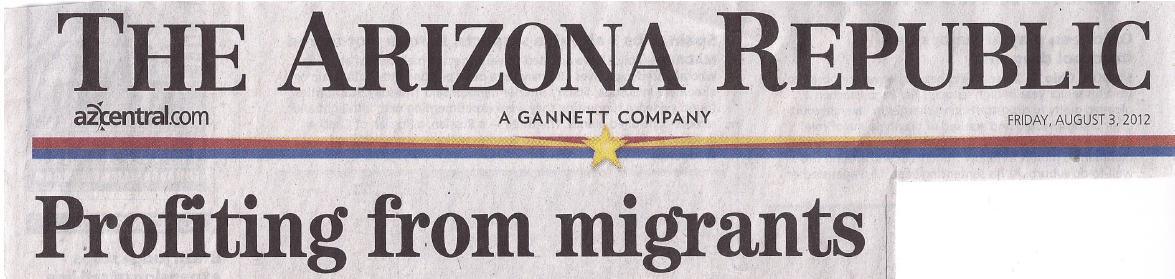
Since we were on the subject of rent-seeking in our last two posts, I happened to be in Phoenix over the weekend and was reminded of this insidious subject when I saw the following headline at the local newsstand:
This story was covered more in-depth at the Huffington Post. This post is not an endorsement of illegal immigration, but an expose’ of how the relentless and amoral function of profit-seeking in capitalism has taken over our correctional institutions through privatization, becoming another wasteful and corrupt form of rent-seeking. For-profit prisons are one of the more grotesque formations in the annals of capitalism.
According to the aforementioned articles, the for-profit prison industry has grown from just 10% of beds to the present proportion of one half. And this growth has come off the backs of taxpayers who are footing the bill for the expansion of federal facilities to house the roughly 400,000 illegal immigrants jailed each year. The cost to taxpayers will be nearly 2 billion this year. The question is how has this growth occurred in an environment of falling illegal immigration:
Much of the drop in illegal immigrants is due to the persistently weak U.S. economy, which has shrunk construction and service-sector jobs attractive to Mexican workers following the housing bust. But increased deportations, heightened U.S. patrols and violence along the border also have played a role, as well as demographic changes, such as Mexico’s declining birth rate.
If you read between the lines, the answer is in the amount of lobbying that the for-profit industry has carried out in order to milk the system and secure governments contracts:
The industry’s giants – Corrections Corporation of America, The GEO Group, and Management and Training Corp. – have spent at least $45 million combined on campaign donations and lobbyists at the state and federal level in the last decade, the AP found…
…it wasn’t until 2005 – as the corrections companies’ lobbying efforts reached their zenith – that ICE got a major boost. Between 2005 and 2007, the agency’s budget jumped from $3.5 billion to $4.7 billion, adding more than $5 million for custody operations.
Dora Schriro, who in 2009 reviewed the nation’s detention system at the request of Homeland Security Secretary Janet Napolitano, said nearly every aspect had been outsourced…
…An AP review of Federal Election Commission data found the prison companies and their employees gave to key congressional leaders who control how much money goes to run the nation’s detention centers and who influence how many contracts go to the private sector…
Besides the fact that it’s your tax dollars being stolen, how does this affect you? You’re not an illegal immigrant, you say. The tentacles of the prison industrial complex have a way of entangling more of the ever-growing ranks of the poor, an increasing number of which are the former members of the crumbling middle class. If you fall off the capitalist treadmill of debt peonage and run afoul of the law, the 1%’ers have a bed in one of their for-profit prisons waiting for you…
Since most of us will eventually be relegated to the ranks of the poor or ‘working poor’, I thought it fitting to feature an expert on poverty, Barbara Ehrenreich, author of Nickel and Dimed. She is now heading the Economic Hardship Reporting Project whose goal is to “force this country’s crisis of poverty and economic insecurity to the center of the national conversation.” I have added their blog to my list of RSS feeds. For anyone who thinks that Mrs. Ehrenreich is unaware of the larger apocalyptic picture unfolding in the world, please listen to what she says about the demise of industrial civilization. And since our last post by Darbikrash centered around the rent-seeking financialization of the economy, in particular its effects on small businesses and individual liberties, it behooves us to look at how corporations and government entities prey on the poor and use them as a vast resource pool from which to extract dollars.
In what ways do the poor get used as a source for rent-seeking financialization? Here are a few:
…as Business Week helpfully pointed out in 2007, the poor in aggregate provide a juicy target for anyone depraved enough to make a business of stealing from them.
The trick is to rob them in ways that are systematic, impersonal, and almost impossible to trace to individual perpetrators. Employers, for example, can simply program their computers to shave a few dollars off each paycheck, or they can require workers to show up 30 minutes or more before the time clock starts ticking.
Lenders, including major credit companies as well as payday lenders, have taken over the traditional role of the street-corner loan shark, charging the poor insanely high rates of interest. When supplemented with late fees (themselves subject to interest), the resulting effective interest rate can be as high as 600% a year, which is perfectly legal in many states.
It’s not just the private sector that’s preying on the poor. Local governments are discovering that they can partially make up for declining tax revenues through fines, fees, and other costs imposed on indigent defendants, often for crimes no more dastardly than driving with a suspended license. And if that seems like an inefficient way to make money, given the high cost of locking people up, a growing number of jurisdictions have taken to charging defendants for their court costs and even the price of occupying a jail cell….
You might think that policymakers would take a keen interest in the amounts that are stolen, coerced, or extorted from the poor, but there are no official efforts to track such figures. Instead, we have to turn to independent investigators, like Kim Bobo, author of Wage Theft in America, who estimates that wage theft nets employers at least $100 billion a year and possibly twice that. As for the profits extracted by the lending industry, Gary Rivlin, who wrote Broke USA: From Pawnshops to Poverty, Inc. — How the Working Poor Became Big Business, says the poor pay an effective surcharge of about $30 billion a year for the financial products they consume and more than twice that if you include subprime credit cards, subprime auto loans, and subprime mortgages.
These are not, of course, trivial amounts. They are on the same order of magnitude as major public programs for the poor….
From for-profit prisons subsidized by taxes to government-mandated premiums for the private health insurance industry, I bet if the amount of rent-seeking as a proportion of the GDP in America was able to be quantified, we’d find that this country and its captive denizens are treated as just one big plantation from which to harvest greenbacks. According to economist Joseph E. Stiglitz, an inordinate proportion of those at the top of the free market heap have made rent-seeking the primary method by which they have accumulated their riches:
…The magnitude of “rent seeking” in our economy, while hard to quantify, is clearly enormous. Individuals and corporations that excel at rent seeking are handsomely rewarded. The financial industry, which now largely functions as a market in speculation rather than a tool for promoting true economic productivity, is the rent-seeking sector par excellence. Rent seeking goes beyond speculation. The financial sector also gets rents out of its domination of the means of payment—the exorbitant credit- and debit-card fees and also the less well-known fees charged to merchants and passed on, eventually, to consumers. The money it siphons from poor and middle-class Americans through predatory lending practices can be thought of as rents. In recent years, the financial sector has accounted for some 40 percent of all corporate profits. This does not mean that its social contribution sneaks into the plus column, or comes even close. The crisis showed how it could wreak havoc on the economy. In a rent-seeking economy such as ours has become, private returns and social returns are badly out of whack.
In their simplest form, rents are nothing more than re-distributions from one part of society to the rent seekers. Much of the inequality in our economy has been the result of rent seeking, because, to a significant degree, rent seeking re-distributes money from those at the bottom to those at the top.
But there is a broader economic consequence: the fight to acquire rents is at best a zero-sum activity. Rent seeking makes nothing grow. Efforts are directed toward getting a larger share of the pie rather than increasing the size of the pie. But it’s worse than that: rent seeking distorts resource allocations and makes the economy weaker. It is a centripetal force: the rewards of rent seeking become so outsize that more and more energy is directed toward it, at the expense of everything else. Countries rich in natural resources are infamous for rent-seeking activities. It’s far easier to get rich in these places by getting access to resources at favorable terms than by producing goods or services that benefit people and increase productivity. That’s why these economies have done so badly, in spite of their seeming wealth. It’s easy to scoff and say: We’re not Nigeria, we’re not Congo. But the rent-seeking dynamic is the same….
Below is a good discussion from a couple days ago of the expanding poverty problem in America featuring Barbara Ehrenreich. Don’t mind the free market lackey from the ultra-conservative think tank American Enterprise Institute. He thinks that the access to information the internet created has made people less poverty-stricken than in the past. For those who can afford a computer and internet subscription, the information age has only made them more aware of how fucked they are in a world of depleting resources run by a ruthless transnational oligarchic elite.
What we have in America is a twisted form of socialism for the elite wherein the few are supported by the collective wealth extraction from the many, as precisely described by Dennis Kucinich:
The rancorous debate over the debt belies a fundamental truth of our economy — that it is run for the few at the expense of the many, that our entire government has been turned into a machine which takes the wealth of a mass of Americans and accelerates it into the hands of the few. Let me give you some examples…
I took a look into Direct Democracy for Switzerland at Wikipedia [link], where I found : –
In Switzerland, single majorities are sufficient at the town, city, and canton level, but at the national level, double majorities are required on constitutional matters. The intent of the double majorities is simply to ensure any citizen-made law’s legitimacy (Kobach, 1993).
Double majorities are, first, the approval by a majority of those voting, and, second, a majority of cantons in which a majority of those voting approve the ballot measure. A citizen-proposed law (i.e. initiative) cannot be passed in Switzerland at the national level if a majority of the people approve but a majority of the cantons disapprove (Kobach, 1993). For referendums or propositions in general terms (like the principle of a general revision of the Constitution), the majority of those voting is enough (Swiss constitution, 2005).
In 1890, when the provisions for Swiss national citizen lawmaking were being debated by civil society and government, the Swiss adopted the idea of double majorities from the United States Congess, in which House votes were to represent the people and Senate votes were to represent the states (Kobach, 1993). According to its supporters, this “legitimacy-rich” approach to national citizen lawmaking has been very successful. Kobach claims that Switzerland has had tandem successes both socially and economically which are matched by only a few other nations, and that the United States is not one of them. Kobach states at the end of his book, “Too often, observers deem Switzerland an oddity among political systems. It is more appropriate to regard it as a pioneer.”
Unfortunately, I found the political spin in the states worth giving emphasis from the same wikipedia link above : –
Direct democracy was very much opposed by the framers of the United States Constitution and some signers of the Declaration of Independence. They saw a danger in majorities forcing their will on minorities. As a result, they advocated a representative democracy in the form of a constitutional republic over a direct democracy. For example, James Madison, in Federalist No.10 advocates a constitutional republic over direct democracy precisely to protect the individual from the will of the majority. He says,
“A pure democracy can admit no cure for the mischiefs of faction. A common passion or interest will be felt by a majority, and there is nothing to check the inducements to sacrifice the weaker party. Hence it is, that democracies have ever been found incompatible with personal security or the rights of property; and have, in general, been as short in their lives as they have been violent in their deaths.”
John Witherspoon, one of the signers of the Declaration of Independence said,
“Pure democracy cannot subsist long nor be carried far into the departments of state — it is very subject to caprice and the madness of popular rage.”
Alexander Hamilton said,
“That a pure democracy if it were practicable would be the most perfect government. Experience has proved that no position is more false than this. The ancient democracies in which the people themselves deliberated never possessed one good feature of government. Their very character was tyranny; their figure deformity…”
Interestingly, Edward Bernays, that wonderful spinmeister of double speak – worthy of debate, due to the outcome of much of his folly in the present world – had this to say at the opening of his (1928) book Propaganda [PDF] : –
The conscious and intelligent manipulation of the organized habits and opinions of the masses is an important element in democratic society. Those who manipulate this unseen mechanism of society constitute an invisible government which is the true ruling power of our country.
Our invisible governors are, in many cases, unaware of the identity of their fellow members in the inner cabinet.
They govern us by their qualities of natural leadership, their ability to supply needed ideas and by their key position in the social structure. Whatever attitude one chooses toward this condition, it remains a fact that in almost every act of our daily lives, whether in the sphere of politics or business, in our social conduct or our ethical thinking, we are dominated by the relatively small number of persons-a trifling fraction of our hundred and twenty million-who understand the mental processes and social patterns of the masses. It is they who pull the wires which control the public mind, who harness old social forces and contrive new ways to bind and guide the world.
It is not usually realized how necessary these invisible governors are to the orderly functioning of our group life. In theory, every citizen may vote for whom he pleases. Our Constitution does not envisage political parties as part of the mechanism of government, and its framers seem not to have pictured to themselves the existence in our national politics of anything like the modern political machine. But the American voters soon found that without organization and direction their individual votes, cast, perhaps, for dozens of hundreds of candidates, would produce nothing but confusion. Invisible government, in the shape of rudimentary political parties, arose almost overnight. Ever since then we have agreed, for the sake of simplicity and practicality, that party machines should narrow down the field of choice to two candidates, or at most three or four.
In theory, every citizen makes up his mind on public questions and matters of private conduct. In practice, if all men had to study for themselves the abstruse economic, political, and ethical data involved in every question, they would find it impossible to come to a conclusion without anything. We have voluntarily agreed to let an invisible government sift the data and high-spot the outstanding issue so that our field of choice shall be narrowed to practical proportions. From our leaders and the media they use to reach the public, we accept the evidence and the demarcation of issues bearing upon public question; from some ethical teacher, be it a minister, a favorite essayist, or merely prevailing opinion, we accept a standardized code of social conduct to which we conform most of the time.
We are governed, our minds molded, our tastes formed, our ideas suggested, largely by men we have never heard of. This is a logical result of the way in which our democratic society is organized. Vast numbers of human beings must cooperate in this manner if they are to live together as a smoothly functioning society.
I therefore believe that the kind of oppression that threatens democratic peoples is unlike any the world has seen before. Our contemporaries will find no image of it in their memories. I search in vain for an expression that exactly reproduces my idea of it and captures it fully. The old words “despotism” and “tyranny” will not do. The thing is new, hence I must try to define it, since I cannot give it a name.
I am trying to imagine what new features despotism might have in today’s world: I see an innumerable host of men, all alike and equal, endlessly hastening after petty and vulgar pleasures with which they fill their souls. Each of them, withdrawn into himself, is virtually a stranger to the fate of all the others. For him, his children and personal friends comprise the entire human race. As for the remainder of his fellow citizens, he lives alongside them but does not see them. He touches them but does not feel them. He exists only in himself and for himself, and if he still has a family, he no longer has a country.
Over these men stands an immense tutelary power, which assumes sole responsibility for securing their pleasure and watching over their fate. It is absolute, meticulous, regular, provident, and mild. It would resemble paternal authority if only its purpose were the same, namely, to prepare men for manhood. But on the contrary, it seeks only to keep them in childhood irrevocably. It likes citizens to rejoice, provided they think only of rejoicing. It works willingly for their happiness. It provides for their security, foresees and takes care of their needs, facilitates their pleasures, manages their most important affairs, directs their industry, regulates their successions, and divides their inheritances. Why not relieve them entirely of the trouble of thinking and the difficulty of living?
Every day it thus makes man’s use of his free will rarer and more futile. It circumscribes the action of the will more narrowly, and little by little robs each citizen of the use of his own faculties. ~ Alexis de Tocqueville ~ 1835
I sense that the work is almost complete, since the exportation of most every wealth – with its replacement of exhorbitant debt – complete a nation without appeal to their constitutional rights – has squandered; for want of a stance in sensibility, even what abilities are left remaining to resolve it …





 Collapse of Industrial Civilization