I’m being more selective in my reading these days since I’m not so interested anymore in the minutia of the everyday happenings concerning industrial civilization’s decline. Certainly if the planetary tipping points continue to be breached by an economy dependent on infinite growth, then all these social issues everyone frets about will be meaningless anyway.
I read a very good article on urban decay by the Rogue Columnist this evening called ‘Growthgasm!‘ which reminded me of a very recent trip to one of my old stomping grounds in Phoenix, the Metrocenter Mall. Not too long ago when I was a teenager this was quite a popular hang-out, filled with thousands of shoppers on any given day. Today it has become a veritable ghost town. On my visit I saw no more than a few dozen customers within this expansive mall. Many of the shops are now vacant and locked-up. As you can see from the pictures below that I took, the empty building casts an eerie feeling of abandonment and lifelessness. The few tenants that remain are desperate to attract customers and some have posted employees outside their doors to try to make a hard sale and entice passersby to come in.
If you are a reader of this blog, then you’ll know I’m not a fan of the mass consumerism that was spawned after World War II, but in my younger days I was a reluctant participant growing up in that environment. Since the bursting of America’s last big bubble, the suburban utopia that this nation built for itself through the Great Ponzi Scheme of Sprawl is decaying. Those who can flee, the affluent who have managed to hold on to their economic well-being, are moving to newer ‘exurbs’ to be with others in their social status and to insulate themselves from the spreading poverty:
…suburbs facing the highest burdens of the new poverty will be least able to meet them because of the economic recession and the spatial retreat of the better off. Just as many white Americans fled the cities for the suburbs in the 1960s, leaving the cities behind with declining tax revenues and fewer job opportunities, there is new cycle of exodus of the well-to-do from inner-ring metropolitan suburbs. As the better-off retreat, the provision of amenities and essentials from parks to schools to garbage pickup, heavily funded by property taxes, are bound to flounder for those left-behind.
One recent study conducted by Sean Reardon and Kendra Bischoff of Stanford University documented the spatial sorting by income that is going on, with the wealthy flocking together in new exurbs as well as gentrifying pockets of urban centers. In 1970 — the high-water mark of a more homogeneous suburban America — only 15 percent of families in metropolitan areas lived in socio-economically segregated neighborhoods categorized as affluent or poor. In 2007, that figure was 31.7 percent.
The replacement of America’s middle-class suburbs, however flawed, by wealthier exurbs and secondhand suburban remnants is a leading symptom of America’s 21st-century reinvention as a society of stark class divisions, spatial segregation and inherited social status…
So will the suburbs of a country whose transportation and infrastructure was built on cheap oil become the favelas of the first world? It certainly seems inevitable in a world where class lines are growing deeper, high unemployment is intractable, and the age of cheap fossil fuels has drawn to a close.
Surfing the net this evening brought me to some eerie photography by a man named Edward Burtynsky. This collection is from his 12 year project about modern man’s Oil Age. Here are a few of the pictures under the title ‘The End of Oil‘ from his epic work (others can be seen here):
Click for Enlarged Slideshow
Mass Consumerism befouled the planet.
I work with Native Americans and see the rampant alcoholism, unemployment, and poverty, but their condition in the globalized capitalist economy seems to be replicated with other native people of the world as this cartoonist depicts:
Perhaps we aren’t the be-all and end-all of human progress.
David Cameron could be replaced by any number of heads of state. The externalization of costs is intrinsic to capitalism and not something that can be changed without radically altering what we know to be this current economic system. I’ll be on sabbatical for a few weeks, so I won’t be analyzing too much, but Monbiot just put out an essay that deserves some commentary when I get more time.
David Hilfiker is someone I’ve quoted before, but I haven’t revisited his website until recently. I’m glad to find that he’s still producing. His work is licensed under a creative commons, so I’m re-publishing a recent essay of his worth reading:
If we can’t fix something, does it make sense to try?
It’s too late to prevent climate change; it already happening, and much worse is coming. The powerful forces of consumerism, a capitalist economic system, government, the power of the corporations, and the influence of the media create a web that we will not untangle without profound changes in our society. If we can’t actually solve the problems of global warming and climate change, if the results are going to be tragic, where do we find hope? How do we respond? Paradoxically, responses are popping up everywhere. Something new is afoot.
I sometimes teach classes about the environmental crises facing us and the devastation they’ll cause. One of the basic messages of the course is that preventing climate change is no longer possible. It’s already here and much more is inevitable. I explain at the beginning of the course that the forces arrayed against environmental sanity are simply too strong for the usual political or personal fixes to be effective. And until we understand what we’re up against, we can’t react effectively. American consumerism, the structure of our government, the nature of our economic system, the power of the corporations, and the dominance of media are a tightly interwoven web that is virtually invulnerable to human attack. I warn class members that the first two-thirds of our time together will be depressing, but I ask them to hang in there with me until our last sessions when we can begin to talk about what hope might look like.
But they never do hang in there. By the third or fourth session, each class has, in one way or another, resisted or outright refused to continue examining the web and has insisted on asking, sometimes angrily, what we can do about it.
But to ask “What can we do about it?” usually means “What can we do to fix it?” When I respond that there’s nothing we can do to fix it, there’s near rebellion within the class. Where’s the hope, then? What good does it do to understand it if we can’t fix it? Why should we do anything at all?
Every class so far has responded this way. It seems built in, programmed. You may have similar feelings as you read on. What’s going on?
The Positive Outlook as Problem
Our country’s historical optimism and positive outlook are blinding us to the painful future that awaits us. We Americans have an unshakeable faith in progress, in our capacity to overcome obstacles. “Things’ll turn out,” we remind each other. “Look at the bright side,” we say. Even when things clearly won’t work out, even when there is no bright side, it’s rude to say so in mixed company.
This official optimism is thoroughly grounded not only in the Enlightenment thinking that suffuses the West but also in our particular history as a nation. The colonization of the Americas, the taming of the frontier, and the growth of an affluent middle class all required confidence unwarranted by the chances of success. But the eventual success reinforced our native optimism. Until the last fifty years, our experience has been that as a nation we can accomplish whatever we set our minds to.
We’ve been understandably proud of our can-do attitude. We attribute much of our success to our optimism and willingness to forge on against seemingly insuperable odds. We have risen above nature, we believe, and are no longer subject to it. Our intellect and our technology will ultimately solve any problem. Anything less than a positive outlook is considered “defeatist” or “needlessly depressing.” We shouldn’t be “quitters.” Optimism is part of the American creed. It’s official.
So what’s the matter with that?
The circumstances of our history have changed dramatically and our persistent optimism is obscuring reality, shrouding what’s really happening and diverting us from our real work. The United States is the only industrialized country, for instance, where there is no national, politically effective response to our environmental future. The most benign bill to establish a system of cap-and-trade of carbon emissions didn’t stand a chance in Congress. Of the 65 Republicans who agreed to answer the question (most refused an interview), “only five said they believed a ‘significant amount’ of climate change was due to human activity.”[1] As we’ll see, there are political and economic reasons for this stance, but it could not dominate the public discussion except for our official optimism that, really, we can manage anything that happens.
Global Climate Change
The environmental challenges we face are overwhelming, any one of which could rise to the top of our list of concerns under the right circumstances:
climate change
the loss of farmland the size of Nebraska around the world every year
the decimation of ocean fisheries from overfishing
the loss of biological diversity with an estimated rate of species extinction 1000 times the rate of normal loss
the pollution of air and water, the long-term effects of which (cancer, fetal abnormalities, cognitive dysfunction, and so on) often take decades to reveal themselves, and
the loss of freshwater, which will almost certainly lead to 21st century resource wars
Any of these is a profound threat to our civilization, but the most immediate and most on our minds is climate change, so I’ll stick with that. Carbon Emissions, Tipping Points, and Likely Outcomes
Most readers will know a fair amount about global climate change, recognize that it’s primarily the result of carbon dioxide (CO2) emissions from human activity, and accept the scientific consensus of an ominous future if carbon emissions are not controlled. To recapitulate briefly, climate change is the result of a drastic rise greenhouse gases—CO2, methane, nitrous oxide and others—unlike any the Earth has seen in 200,000 years. Sunlight can pass unchanged through this layer of gases, but the warmth produced when it strikes the Earth can’t pass back out. So the Earth has warmed an average of 0.7º Celsius (C) or 1.0º Fahrenheit (F) above the baseline that had been consistent for millennia.
What some are just beginning to acknowledge is that the battle to prevent climate change is already lost. Even some mainstream TV has dropped the conditional. It’s no longer “possible” or “some-scientists-say” climate change or “if” or “when” climate change occurs. With rising oceans; frightening changes in disease distribution; the increasing occurrence of record-setting heat waves and droughts; and record floods, hurricanes and tornados; the climate is changing fast. As environmentalist Bill McKibben writes in his book Eaarth, we live on a new planet … and we won’t get the old one back.
Given the current forty percent increase in the concentration of greenhouse gasses, the unwillingness of major polluters like China and the United States even to consider real changes, and how long it will take to reach sustainable levels of emissions even after major polluters have sincerely committed themselves to radical action, CO2 emissions won’t even begin to decrease anytime soon, and certainly not before further, even more dangerous, destabilization of the climate.
Reports from the UN’s Intergovernmental Panel on Climate Change (IPCC) warn that if we don’t keep the total temperature rise below 2º C, the risks will be too great to accept. Unfortunately, because of CO2’s long half-life in the atmosphere, just the CO2 we’ve already emitted commits us to a rise of 1.5º C.
One must understand, however, that the IPCC’s estimates and predictions are very conservative. Their mandate is to carefully present data that is unassailable, but individually many scientists on the panel are more forthcoming and, in general, deeply pessimistic. For them, the science is bad enough, but the practicalities are worse. We’ll examine those practicalities below.
The End of the Long Summer
There’s a further dark cloud on the horizon that—in keeping with our innate optimism—has been only minimally publicized. The last 11,700 years have been a period of unusual climatic stability, labeled by one author “The Long Summer.”[2] Without this stability, many scientists believe, agriculture and the establishment of our civilizations would have been unlikely. But in the last 120,000 years, no other stable period like this has occurred. The normal has been wild swings in climate with temperature changes of up to 10º C in as little as fifty years, perhaps fewer.
Scientists aren’t yet sure what has given us the long summer, but, given the much more common instability in our history, they fear that even small temperature changes will tip us out of this fragile balance and into almost unimaginable scenarios. The details (when and how bad) are unknown but could include: sea level rises of twenty feet or more that inundate Florida and much of the tip of Manhattan; an uninhabitable tropical belt and American Southwest; the loss of the Amazon rainforest; and the deaths of even billions of people from hunger, thirst, and the resultant political instability.
Unfortunately, this is not science fiction. How could it happen? One reason we can’t make reliable specific predictions is that “positive feedback loops” are one of the big unknowns that science doesn’t yet understand well. The loss of albedo (the fraction of the sun’s rays reflected away from the Earth) that causes the Arctic’s melting ice is well known. Ice reflects most sunlight harmlessly back into space, but the darker, ice-free water absorbs it, warming the sea. As warming shrinks the ice cap, less ice and more open sea causes further warming, melting the ice cap even faster. That’s a positive feedback loop, a destructive spiral.
A potentially more ominous example comes from the massive amounts of methane stored in the arctic permafrost, frozen Siberian peat bogs, and vast deposits under ocean beds. Molecule for molecule methane is twenty times more potent a greenhouse gas than CO2 although its much smaller concentrations in the atmosphere make it, currently, less important than CO2. When the permafrost or peat bogs begin to melt, however, the methane is released, intensifying the greenhouse effect, warming the earth, further melting the permafrost and round we go. There’s so much methane locked in the permafrost and peat bogs that once serious amounts begin to be released, all bets about climate future are off. The even greater amounts of methane under ocean beds are very sensitive to the temperature of the water just above them; even a small change could cause large “burps” of methane release, which are believed to have caused dramatic warming and mass extinctions earlier in Earth’s geological history.
There are many other known positive feedback loops:
Oceans are a major sink for CO2, but as they warm they can’t hold as much CO2.
Rain forests sequester huge amounts of CO2, but as the tropics warm, they dry out and release all that carbon, further warming the Earth.
Ocean plankton, small plants responsible for approximately half of the Earth’s photosynthesis,[3] metabolize CO2, taking the carbon with it when it dies and sinks to the bottom. Warming seas reduce not only the amount of ocean plankton but also its metabolism, decreasing CO2 uptake, increasing the concentration in the atmosphere and creating another vicious feedback loop.
The timing of such feedback loops and the resultant sudden rise in temperature can’t yet be predicted, but their likelihood renders the IPCC’s gradual curve hopelessly conservative. Even more worrisome are the still unknown feedback loops in this complex organism that is Earth.
Such feedback loops will be important in the end of the long summer. Rising temperatures will almost certainly push the climate off the perch it’s balanced on. How soon? According to the geological record, even the current 0.7º C rise has previously been enough to bump the earth off balance. And once that happens, it’s a whole new ballgame. The Earth itself becomes the major player—and the illusion of human control of the environment will dissipate quickly.
No amount of optimism can change the reality that we live on a new planet.
Political and Social Realities That Will Make Change Very Difficult
So far what I’ve said will be not be news to anyone who has made it their business to study these matters. The nation’s response to this frightening reality, however, has been muted. Some individuals have changed their lifestyles considerably to reduce their carbon footprint; some states have followed the leads of California and New England in passing laws to limit CO2 emissions. But the federal government has done virtually nothing.
If we don’t understand the reasons behind this minimal response, we will either continue in our blind optimism or descend into despair. Even most national environmental groups still talk—publicly at least—about avoiding the coming tragedy if we do such and so: if the people were to push hard enough, if politicians could be convinced, if the media were to wake up, and so on. But these environmentalists have apparently not been talking to the political or social scientists, for the “ifs” aren’t going to happen. Few of the writings on climate change (or other environmental crises, for that matter) have taken political and/or economic realities, consumerism, the power of modern media, or the influence of the corporations into account,[4] which is something like ignoring sexual desire when considering overpopulation.
Each of these forces is powerful in itself. But it is their interaction that creates the impenetrable web that will make escalating climate change inevitable.
A small diversion: As a physician I’m in the habit of being precise with my language, and I’m quite aware that, logically, nothing in the future is inevitable. But climate change has already happened and given the physics of CO2 and the time it will take to reduce emissions once the world agrees to reduce them significantly, much more climate change is utterly certain. But I’m saying something more. What I mean is that given this web of forces, calamitous climate change is as certain as human predictions get. There will be no world-wide binding agreement to reduce emissions in the foreseeable future. Only a literal miracle or a momentous breakdown in the social and economic order soon would be enough to open new possibilities.
Given the precarious position of our economy, the dysfunction of our politics, and the coming environmental realities, of course, such a breakdown is likely eventually, say within 50 years, if not sooner. But when it eventually happens and the requisite changes are eventually made, it will be too late to prevent widespread suffering.
The danger is that recognition of the inevitability of this catastrophe can lead to despair and inaction. My purpose is not to snuff out hope but to open our eyes. Gar Alperovitz has written that within human history change is “as common as grass.” And we must prepare ourselves for that moment, ready to take advantage of it to limit the coming catastrophe as much as possible. And until those changes can occur we must find ways of acting that will relieve as much suffering as possible.
Let’s begin to tease the web apart.
Consumerism
Although the majority of Americans recognize the reality of climate change and want governmental action, there has been no sustained popular demand for a change in policy. Why not?
Most Americans are deeply committed to their material lifestyle. The unspoken reality is that any effective challenge to climate change will require a radical transformation of that material lifestyle. Environmentalists and their organizations generally want to avoid this “inconvenient truth,” but the energy for indoor temperatures to our satisfaction, transportation of food, importation of goods from distant lands, personal transportation, manufacturing and much else all guzzle fossil fuels and emit CO2. A sustainable level carbon emissions—ie a level that the natural earth could recycle without rises in atmospheric CO2 levels—would be about two tons of CO2 for each person in the world per year. The average American uses 20 tons. As China, India and other poor countries develop economically, it’s utterly unrealistic—to say nothing of unjust—to expect them to keep to a 2-ton limit unless the Western world reduces its consumption accordingly.
What would 2 tons per year for the average American look like? It’s difficult to imagine, but for starters it would mean:
no air travel (period)
mostly local transportation on foot or bicycle (or the not-yet-existent) adequate public transportation
vegetarian, if not vegan, diets
only locally produced food … even in the winter
no air conditioners … even in the South
elimination of individual ownership of luxuries (and many other things we consider necessary), for instance, TVs, computers or washing machines
reducing the average size of our homes by at least a third, if not a half (or having others share our space)
and so on
Virtually no national environmental group acknowledges publically that a truly sustainable lifestyle will require such drastic changes. In Al Gore’s otherwise excellent and important film, Inconvenient Truth, we are left with the impression that changing to CFL light bulbs, driving a Prius, recycling, and buying carbon offsets would be enough. Well, no, it won’t be enough. In this sense those opposing carbon limitations are absolutely right: our “way of life” will have to change. Polls may show that most Americans are concerned about the environment, but how many will voluntarily vote for such changes until absolutely forced to?
This consumerism is powerfully encouraged by media advertising. Corporations and the US government are powerful purveyors of consumerism. Only economic reality (that is, major declines in personal incomes) will force a possible (though not guaranteed) loosening of the vise-like grip of American consumerism. But consumerism is only one element of the web.
The Capitalist Economic System
Our current economic system has been a direct cause of our environmental crises. Absent government intervention, capitalism’s fundamental theory precludes a significant reduction in carbon emissions. Think about these basic assumptions of capitalism:
Self-interest should be the primary economic motivator.
Monetary profit is the only goal.
The value of everything is measured by money.
Who gets what is determined by how much money they have.
Property is private and—within broad legal limits—owners can do anything they want with their property, regardless of the suffering it may cause others.
I am not exaggerating; these assumptions are recognized in basic economic textbooks. While individual owners and corporations serving a local area may, and fortunately often do, ignore some of the assumptions for the sake of the wider community, large publicly-held corporations adhere to them rigorously. But if we examined these assumptions carefully, most of us would find each one immoral as a basis for our behavior. Who of us, for instance, believes that pure self-interest, defined as monetary profit, should be one’s goal, especially one’s sole goal?
How does capitalism lead inexorably to environmental devastation? First, the problem of “externalities” is well recognized. An externality is a cost of producing a product that is foisted onto someone else in order to sell the product at the cheapest price. Environmental costs, for instance, are usually externalized. When a coal-fueled electric plant discharges CO2 into the air, for instance, the company doesn’t pay for the cost of the resulting damage; the rest of us do. The public thus subsidizes electricity generation from fossil fuels which allows the companies to lower their prices. If companies had to pay the full cost of their production, however, wind and solar power would be more than competitive, and we’d have much more of it.
Competition will force externalization of environmental costs upon even the CEO who is truly concerned about the environment. If the company were to buy the expensive equipment necessary to sequester the CO2, its electricity would be priced out of the market. It’s not necessarily greed (although it sometimes is); it’s not necessarily an unconcerned management (although it sometimes is). The problem is built right into capitalism and wouldn’t change significantly if you or I were the CEO. The morally right decision would too often run a company out of business.
A second, related, built-in characteristic of capitalism is that businesses must grow to survive; growth generally requires higher and higher levels of consumption fueled by powerful advertising that increases consumer desire and the sense that luxury items are actually necessities. Consumer desire increases, creating growth and the increased consumption of natural resources.
Third, the private nature of property legally inhibits the government from many of the regulations that could limit greenhouse gas emissions.
Adam Smith, the first theorist of capitalism, recognized another problem. Extremes of inequality are built into free-market capitalism. Under capitalism, government intervention is required through some kind of redistribution of income, for instance, progressive taxation. Free-market theorists claim that in material terms the market “lifts all boats.” Even if this were true, it’s clear that in practice the freer the market, the greater the inequality. Inequality ultimately destroys democracy because of the power of the wealthy and the powerlessness of the poor. The wealthy not only have massively disproportionate influence on government, they also control the media, which can obscure what’s actually happening politically. This demoralizes the population who consequently won’t become active and work to change policy. This has become especially obvious in the United States over the last thirty years.
The theory of capitalism loudly trumpeted by those in power, constrains government from “interfering in the market,” but that “interference” is, in fact, the only way to control capitalism’s built-in environmental devastation.
Corporations and Their Structure
Their wealth and power give corporations commanding influence over attempts at environmental sanity. Whole communities can be held hostage to a corporate threat to abandon the area, destroying jobs. Corporate political contributions and lobbying provide overwhelming influence over politicians. Their immense size allows them power over the structure of the economy, for instance, over economic agreements among and within countries.
Much of the corporate impact on the environment is exacerbated by the legal structure of the corporation. Small or local businesses tend to moderate capitalism’s underlying assumptions through loyalty to employees, concern about environmental impact on the local community, and rigorously honest behavior. But the “owners” of large corporations are many thousands of investors—whether working-class individuals through their retirement funds, wealthy individuals, or other corporations—who have bought stocks for the sole purpose of financial returns. Management has only one mandate, to maximize profits, which leads to the pure capitalism described above. Regardless of the environmental consciousness of the management, corporate managers are constrained from any other concern except the best interests of the stockholders, the bottom line.
Since the late 1800s, corporations have, notoriously, had most of the legal rights of individuals. Outside narrow legal limits, the right to free speech, for instance, allows the most blatantly exploitative advertising, which pushes the conspicuous consumption at the heart of global climate change. The right to free speech also allows corporations to offer essentially unlimited financial support to advancing a particular political position. The corporate right to privacy prevents routine public examination of the internal records which could hold them accountable for their practices; such accountability could have prevented the operational “shortcuts” that led to the Gulf oil disaster. The corporate right to equal protection before the law makes the efforts of West Virginians to prevent mountain-top removal much more difficult. And so on. We are so used to these individual rights being afforded to corporations that—except when their most egregious behavior leads to disasters—we hardly think about it.
But corporations are not persons.
They are immortal.
They are wealthy beyond imagination and collectively have dominance over the economic lives of millions of voters.
No live person or group of persons has actual legal responsibility for their actions. Shareholders cannot be held accountable for even illegal behavior by the corporation. Corporate managers have no personal responsibility for corporate actions that might hurt, or even kill, others, as long as the action is technically legal. True, the corporation may go bankrupt, but the worst actual persons can suffer is the loss of their investment.
As inanimate “persons” corporations feel no sense of moral responsibility, for instance, to their communities.
The power of corporations has not always been so overwhelming. Those of us of a certain age can remember
when unions were strong enough to successfully stand up to employers,
when CEO salaries were “only” forty times their employees;’ not six hundred,
when their impact upon democracy was not so detrimental, and
when it was possible to get elected without corporate support.
But in the late 1970s—after media became crucial to getting elected and campaign costs skyrocketed—the business community developed new and powerful tactics. Previously, individual companies or industries had lobbied for their own interests, often at cross-purposes with one another. But, as documented by Jacob Hacker and Paul Pierson in Winner-Take-All Politics, in the 1970s, several national business associations (such as the Chamber of Commerce and the Business Roundtable) organized their members to act in concert. Within only two or three years the impact on government had become profound, forcing Democrats—who controlled the presidency and both houses of Congress in the late 1970s—to reduce corporate and capital gains taxes and preventing them from passing labor and consumer-protection legislation. While there have been important exceptions, virtually no one gets elected and no bill gets passed if the corporations are united and strongly opposed. And even when they lose the vote in Congress, the corporate lobbying presence at every step of the way assures their influence in writing the details of the laws, writing the regulations, pressuring the regulatory agencies, and assuring their own impact in enforcing the law. Corporations can lose the election and win the wars. An obvious example is the failure of even the Democrats—despite vast popular support—to agree on minimal tax increases on the wealthy.
Corporations provide the cheap goods and encourage the consumerist culture of more. They own the media and are thus powerful influences on the cultural and political beliefs of the consumer.
Media
Progressives will sometimes respond to these concerns by suggesting that, when economic conditions turn bad enough, the middle class will soon start voting for the 99%. And virtually every progressive essay on either the environment or economic inequality will eventually suggest new legislation or a constitutional amendment that could change things for the better. And there is no shortage of workable ideas: public financing of campaigns, tax rates as progressive as they were thirty or fifty years ago, a Tobin tax that would put a minuscule tax (perhaps ¼ of one percent) on stock transactions, powerful cap-and-trade legislation, and so on. The ideas are endless, and they are all good ones that would indeed improve the situation markedly. What those who suggest these ideas usually ignore or vastly underestimate, however, is the power of advertising and, thus, the media, to influence our thinking.
We are all aware of the power of advertising to keep us addicted to consumerism. We can be sold things we don’t need, don’t really want, and certainly can’t afford … even if they are collectively destroying us. As individuals, however, most of us believe that we are immune to the effects of advertising. But advertisers would not spend over $3 billion a year in the US alone if it were not effective. A hundred years of psychological research has provided the industry the tools to influence us well underneath our conscious radar. Even media content that’s not technically advertising is, for the most part, a powerful advertisement for a consumerist lifestyle as we watch the way that the mostly affluent characters in the dramas live.
Also often missed is the ability of a well-funded advertising campaign to sway voters’ preferences and their understanding of an issue. Polls suggest that less than 5% of people know much about political issues or how politics work. In our ingnorance, it’s not difficult for the media to use the same techniques used to sell us new cars in order to sell us political opinions and policies. A good example is the sophisticated advertising campaign against that majority of Americans who, at the beginning of the campaign, supported required caps on carbon emissions. At the end of the advertising campaign, however, large swaths of the population viewed the bill as damaging to the economy, certain to raise prices, and devastating to employment. The bill, toothless as it was, didn’t stand a chance against the media.
Other than poorly funded public radio and television, the national media are large corporations themselves, almost always owned by other corporations. Like most corporations, media claim to be strongly pro-environment. But their impact on global climate change has been devastating.
Yes, it’s true that American voters could radically change the system to reduce carbon emissions, but they won’t … at least until things get much worse. Against the propaganda, fear techniques, and commitment to consumerism, the likelihood of a majority of the electorate demanding the very painful change necessary is extraordinarily low. And when it does finally happen, it will be far too late to prevent truly catastrophic change.
Government
Only government—when it is functioning as government—can mandate limits on carbon emissions or regulate the many other changes necessary. With a democratic government, a nation’s people decides what the majority wants and creates laws to make it possible.
The government could modify the economic system to force the internalization of environmental costs or alleviate inequality. It could drastically reduce the political power of corporations through public financing of campaigns and limitations on corporate lobbying. Government could control the power of media by breaking up the oligopoly, reinstating the fairness doctrine, mandating balanced coverage of political issues, and requiring a certain percentage of public service programming. It could eliminate economic subsidies for oil companies or corporate farming. And it could use its “bully pulpit” to enlist the support of the population in reducing our material consumption. Needless to say, little of this will happen anytime soon.
Perhaps the most dangerous and successful tactic of the far right over the last forty years has been to convince most of us—liberals and conservatives alike—that the federal government is incompetent at its best and malevolent at its worst. Considering the government a negative force, voters have been willing either to “starve the beast” by supporting tax cuts and reducing government impact or to withdraw from the democratic process completely. As the government becomes weaker, of course, it becomes less capable of providing services effectively, which makes voters even less willing to invest in it, a vicious circle of emasculation. As government loses its public support, however, the corporations and the 1% remain by far the strongest kids on the block.
Like the corporations, government is also firmly committed to economic growth fueled by consumerism. George W Bush’s notorious comment after 9/11, “Go shopping,” is emblematic. What the public learns is that “growth” (ie material growth) is necessary to the American way of life … which is true if increasing material wealth is essential to the American way of life.
The government’s unwillingness to face climate change is typified by President George HW Bush’s statement twenty years ago at the first Earth Summit: “The American way of life is not negotiable.”
Unfortunately, the founders of our country deliberately and explicitly designed the Constitution to prevent radical change. The presidential system (rather than a parliament led by a prime minister) and the two separate houses of Congress (one of which is elected to two-year terms, the other to staggered six-year terms) means that the president often belongs to a different party from the legislature and/or that the legislature itself is divided. Since the consent of both houses of Congress and the president is almost always necessary, controversial change is seriously hampered. An amendment to the Constitution requires two-thirds vote of each house of Congress, plus ratification by 75% of state legislatures. The filibuster—while not established by the Constitution—is a matter of Senate rules. This requirement of a supermajority can hamstring the Senate … as it has, most notably since the last presidential election.
This governmental structure makes blocking change much easier than creating change. With its power to block legislation, the minority can control and paralyze government, as the Republican Party is now doing. While government has the technical capacity to make the needed changes, in fact, it is virtually impotent in the face of the wealthy and the corporations.
The “impossibility” of making change with the usual means
So, that’s the web of forces blocking the way to environmental sanity. The political histories of DDT and tobacco teach us that it can take decades after a scientific consensus is reached to create adequate regulation. And those political struggles were before the corporations developed their extraordinary power. Each strand in the web is supported by each of the others, making any one element virtually impervious to change from below. I’ve taken these many paragraphs outlining these forces because I really do mean that change is not possible within the current social, economic, and political structure of our country. Despite our native optimism, many of us know this: voting, political organizing, running pro-environment candidates, lobbying, recycling campaigns, running for office, or anything else we have imagined have not fundamentally challenged these dominant forces and won’t until other powerful forces confront them.
I’m sure I sound like an utter cynic or nihilist. But I’m not emphasizing the inevitability of tragedy out of cynicism, perverseness or sensationalism. Nor do I have a secret roadmap to a solution that I’m about to reveal. Rather, I think we need to consciously face up to what most of us at some level really know. Only this will allow meaningful hope and appropriate response.
How Do We Respond to the Coming Tragedy?
Despair, grief, even cynicism and apathy are normal responses to the coming tragedy. We must not push them aside but recognize their reality and allow ourselves to grieve. And we must help each other navigate through these painful waters.
But we must also remember that what’s coming makes it even more important to find hope within our grief and act with courage and decisiveness. We can’t make it all better, but we have been given the opportunity to participate in what is perhaps the greatest human struggle in recorded history. We are witness to a time in history like no other, and we can make a difference. Helen Keller once said, “I rejoice to live in such a splendidly disturbing time.” [5]
What can we do? One response is to continue our work to reduce carbon emissions even in the face of the lost opportunity to prevent climate change. One of the great tasks before us is to alleviate as much as possible the human suffering that is coming. Because there will be so much pain, even our seemingly small response—reducing our own consumption, educating others about the realities of what we face, working for (even minimal) political change, or forcing an oil company to slow down (or even back down from) some planned expansion—anything that slows the process down even minutely will still have profound impact on this greatest of all challenges.
Another important task will be to mitigate the impact of the climate change that will occur. Two obvious examples are the Dutch strengthening of their dikes and the prior preparations to relocate residents of South Pacific islands that will soon be inundated. One impact of climate change will be a disruption in the economy. Such disruptions always impact the poor most heavily so any work for justice is also an important response to climate change. Creating structures that will give the best chances for survival in a post-carbon world (local sustainability, learning basic skills, farming and farmers markets, for example) will be important.
Until recently many environmentalists have resisted such work for mitigation for fear of relaxing societal pressure to reduce carbon emissions. It’s a legitimate point, but since complete prevention is no longer an option, mitigation must be part of any response we make.
Such responses may feel puny and insufficient to us who are used to fixing things. We will need each other’s help to work through those feelings of despair and hopelessness.
Localization
As one important kind of reaction, the localization movement is particularly important. Even small responses by individual citizens, small cities, or regions with common interests are crucial to the survival of our civilization. In any ecological niche, diversity and complexity give the needed resilience against threats. But the modern obsession with efficiency has destroyed much of that complexity. In her book The End of the Long Summer, Dianne Dumanoski points out that “the electronics industry has relied on specialized semiconductor chips made by [only] two companies who manufacture them in the same industrial park” in Taiwan.[6] A small earthquake or terrorist strike could wipe them out.
But local initiatives to create, grow or manufacture what is absolutely needed in the immediate area mean that many separate locations within the world are supplying necessities, offering a functional diversity that, like any ecology, offers stability in the face of multiple threats. Protest against local environmental damage can provide an opportunity for social and political change that tends to unite the community. Democracy, too, can be localized through the intimacy of town meetings or individual meetings with elected officials who are more likely to be neighbors than bureaucrats. Jobs that are localized, that is, tied to local needs—in hospitals, schools, garbage collection, and so on—can’t be exported abroad.
This localizing of power, production and social connection is well underway. In his book Blessed Unrest, Paul Hawken describes his lecturing on environmental issues in the mid-1990s. He noticed that, at the end of his talks, people would often come up, describe their (mostly) local environmental or political projects, and hand him their business cards. Soon he had thousands of cards. Wondering what this meant, he started researching such small groups around the world. He estimates that there may be over a million such groups from the massive Sierra Club to individual young people selling local produce in the farmers’ market. If we Include not only the social justice groups, indigenous rights groups and those with no official standing that Hawken recognizes but also the many direct-service nonprofits, there are millions around the world. Hawken points out that the first group formally created to meet the needs of others was the Society for Abolition of the Slave Trade organized in England in 1787. Now they are countless. And their explosive growth continues, spreading inexorably.
These are not, Hawken stresses, an organized movement, with any kind of central leadership. Their goals are often quite different from one another, sometimes working at cross-purposes. They come into existence and may disappear. But they’re part of a spiritual awakening that’s happening around the globe.
The Earth’s Immune System
Hawken likens this loose network to the human immune system, which has usually been characterized in top-down military images, but, in fact … there’s nobody in charge. There are different parts to the immune system that actually work independently, and within each of those parts there are millions of individual elements that do their job with considerable independence. The immune system is only minimally coordinated and comprises diverse, disordered and imprecise entities … and yet without it we’d die in a matter of days.
Like the immune system, these countless organizations in this global web may have little individual power to cure the earth’s sickness, and there’s no guarantee of any individual’s or group’s positive impact. You might think that—given the vast and powerful forces aligned against them—their uncoordinated efforts would have only minor impact. But Hawken’s work suggests that the whole may be much greater than the sum of its parts.
The city of Cleveland, for instance, is experimenting with worker-owned cooperatives that supply laundry to hospitals and educational institutions, creating local jobs that pay reasonable wages and are not going to move away. Hawken has long lists of other examples, for instance, small local banks that have sprung up to meet the financial needs of the community (and have been relatively immune from the 2008 crash, largely because their loans were made on a personal basis); they are a good example of functional redundancy. Volunteer organizations form free clinics, social service organizations, or foot patrols to protect the neighborhood. Credit unions and other co-ops (with about 120 million members across the country), 10,000 worker-owned firms, and community- or customer-owned businesses have all begun to change the face of capitalism.
These millions of organizations may be something like an ant colony. No single ant grasps the big picture or needs to direct the group’s effort, but following a few simple innate principles, the shortest route to the food is located, the anthill is built. Perhaps these few simple principles of the global movement are care for the Earth, care for one another, and care for future generations.
Hawken subtitles his book How the Largest Movement in the World Came into Being and Why No One Saw It Coming.
Its grass-roots origins, minimal ideology and loose coordination give this movement a resilience that no top-down organization could ever have; you can’t kill it by co-opting the leadership … because there isn’t any overall leadership. Its use of modern communications technology give the whole a power never before available to dispersed groups. The “movement” constantly grows and renews itself; one organization may disappear because of whatever, but others take its place. Those that are small with few resources by necessity use their resources efficiently and work with profound dedication. They are familiar with local conditions. They go with whatever works rather than ideology, so they tend to be far less polarizing than national politics. Unlike most larger organizations, they’re much more able to switch their activity in response to the actual conditions on the ground. They can make mistakes, even disappear, without seriously undermining the whole.
The current international order won’t last forever; it never does. As Alperovitz writes, the details are never clear in advance, but fundamental political, economic, and social change is routine in world history. The upheavals of the last decade are only the foreshocks. And we’re right in the middle of that now. What will happen when the current order falters? Could it be that a new order has been developing, unnoticed, right under our nose? The Polish union Solidarity had its political uprising, but after that was crushed, it continued organizing, providing needed services that the government couldn’t handle, developing a powerful base. It became almost a shadow government, so that, when the Polish government collapsed in the 1980s, Solidarity was there to pick up the pieces.
Hope
Do I think that these organizations are going to save the environment? No, I don’t. Do I think that they will topple the current order, bring about justice, and restore human rights? Possibly, but not anytime soon.
Then what about hope? If the future is so bleak, where does one find hope? My response is: Hope for what? What do you want to be able to hope for? Hope that we’ll prevent climate change? Hope that our lifestyle will survive? Hope that our grandchildren will inherit the same Earth we’ve known? I don’t know where to find that kind of hope except in illusion.
But if we hope to ameliorate the worst of climate change, if we hope to prepare ourselves so that the damage is minimized, or if we hope to create new structures that provide for local communities, then there is reason for hope. If, at a personal level, we hope for fulfilling and deeply meaningful work; if we hope for joy in participating with others for the general good; if we hope for community; in fact, if we hope for any of the most important things in life, then there’s hope and a lot of it.
Let me offer one possible scenario. The collapse, whether it comes now or in fifty years, will be painful, one we probably can’t imagine now … not just from the environment but from financial instability, inequality, resource wars and so on. In the rubble of all that, some new order will have to develop. It could be fascist totalitarianism, but it could also be the fundamental rebuilding we are hoping for. After the economic collapse of the Great Depression, Franklin Roosevelt picked up ideas and small projects that had been lying around and working on a small scale. He expanded them into national programs. As our future new order is built, it may also be the ideas lying around, the already existent small structures we’ve created that will be picked up. And they could form the basis for a new society. For that, it’s reasonable to hope.
Given the uncertainty of the future, we can’t know what’s going to be picked up and what will disappear. But we do know that loving others, having compassion for our neighbor, prioritizing the poor, caring for the Earth, and following our deepest yearnings are both needed now and must be the hallmarks of the new society that will survive. Anything based on those values is worth doing.
So we follow the leadings we’re given: OccupyingOurLocalCommunity, personal recycling, getting arrested to stop the XL pipeline, putting pressure on politicians to stop mountaintop removal, teaching adult education, fostering community-supported agriculture, growing our own food, supporting large national organizations, working for a constitutional amendment, lobbying political representatives, running for office, and on and on. It may be that we continue to do the very same things we’re doing now. Those things that are not going to change the immediate future may well be part of the coming new order. If our understanding of reality deepens and is not blinded by optimism, we are less susceptible to being blown away by our failure to fix the crisis or the criticism that what we’re doing won’t make any difference. Perhaps our preparation will ameliorate the future crisis and lessen much suffering. Perhaps our preparations will be taken up as building blocks for a new society. We live under fewer illusions. We cannot hope to get the same Earth back, but we can hope to soften what’s coming. We can find hope in the process, in the community, in our work together. These are hopes we can count on.
I’ll be going on sabbatical for a while, so I’ll leave you with a further discussion of the failings of Capitalism. Any talk of growth is simply another version of the capitalist system. In order to ensure the survival of our species, we must break from that paradigm. It’s as simple as that. Below are excerpts of an essay which hits on the major problems of our current economic system. I’ll post again when I can, but the next two weeks will be sporadic.
… Harmony in the world—among its people and between humans and the rest of the ecosystems—is not possible in the context of capitalism. Capitalism, a system that has been in existence for some 500 years (merchant capitalism for approximately 250 years and industrial capitalism for about 250 years)—a relatively short time in the 150,000 year history of anatomically modern humans—has shown that it fosters interpersonal relations and metabolic interactions with the earth that are detrimental to achieving a harmonious existence. This is a result of capitalism’s basic characteristics and the relationships it creates as it normally functions. The purpose of capitalism is not to satisfy human needs and preserve the environment. There is only one purpose and driving force—ultimately responsible for both its dynamic periods and its crises and long periods of slow growth (stagnation)—and that is the accumulation of capital without end. The capitalist system has a number of basic characteristics and also fosters specific human characteristics and relationships. Here are ten key aspects of capitalism:
It has to grow (or else it is in crisis) and its very logic and motivating force impels growth.
It has no other driving force than the accumulation of ever greater amounts of capital.
Through the creation of so-called “externalities” (or side effects) it wreaks damage on humans as well as the ecosystem and the life support systems needed by humanity and other species. In Paul Sweezy’s words: “As far as the natural environment is concerned, capitalism perceives it not as something to be cherished and enjoyed but as a means to the paramount ends of profit-making and still more capital accumulation.”1
It promotes the use of nonrenewable resources without regard to the needs of future generations, as if there was no end to them, and abuses even renewable resources such as ocean fisheries and forests.
It creates vast inequality in income, wealth, and power both within and between countries. Not only class, but race, gender, and other inequalities are built into its laws of motion.
It requires and produces a reserve army of labor—people precariously connected to the economy, most kept in poverty or near poverty—so that labor is available during economic upswings and workers can easily be fired when not needed by businesses.
It promotes national economic and political competition and imperialism, leading to wars for domination and access to resources.
It fosters and rewards those particular human traits that are useful for thriving or even just existing in such a possessive-individualist society—selfishness, individualism, competition, greed, exploitation of others, consumerism—while not allowing the full expression of those human characteristics needed for a harmonious society (cooperation, sharing, empathy, and altruism).
It leads to the breakdown of human health since people operate in a hierarchical society, with many working under dangerous and physically debilitating conditions or in jobs that are repetitive and boring—while subject to job loss or fear of losing their job. (There are many adverse long-term health effects following the loss of one’s job.)2
It leads to the breakdown of healthy communities as people become more solitary in outlook and behavior and indigenous culture is replaced by the dominant national or international capitalist culture and outlook. People become dedicated to obtaining more for themselves and their families and depending less on reciprocal relationships with others.
The growth imperative of capitalism deserves special attention because it is one of the major stumbling blocks with respect to harmony between humans and the environment. Accumulation without end means using ever greater quantities of resources—without end—even as we find ways to use resources more efficiently. An economy growing at the very meager rate of 1 percent a year will double in about seventy-two years, but one growing at 2 percent a year, still a low rate, will double in size in thirty-six years. And when growing at 3 and 4 percent, economies will double in twenty-four and eighteen years respectively. China recently has seen recorded growth rates of up to 10 percent, meaning economic output doubles at a rate of approximately every seven years! Yet, we are already using up resources far too fast from the one planet we have—depleting the stocks of nonrenewable resources rapidly and misusing and overusing resources that are theoretically “renewable.” If the world’s economy doubles within the next twenty to thirty years this can only hasten the descent into ecological, and probably societal, chaos and destruction.
Thus capitalism promotes the processes, relationships, and outcomes that are precisely the opposite of those needed for an ecologically sound, just, harmonious society.
…
Rational and useful alternative solutions to any problem depend upon a realistic analysis and diagnosis as to what is causing it to occur. When such analysis is lacking substance the proposed “solutions” will most likely be useless. For example, there are people fixated on nonrenewable resource depletion that is caused, in their opinion, by “overpopulation.” Thus, they propose, as the one and only “solution,” a rapid “degrowth” of the world’s population. Programs that provide contraceptives to women in poor countries are therefore offered as an important tool to solving the global ecological problem. However, those concerned with there being too many people generally do not discuss the economic system that is so destructive to the environment and people or the critical moral and practical issue of the vast inequalities created by capitalism. Even the way that capitalism itself requires population growth as part of its overall expansion is ignored.
Thus, a critical aspect almost always missing from discussions by those concerned with population as it affects resource use and pollution is that the overwhelming majority of the earth’s environmental problems are caused by the wealthy and their lifestyles—and by a system of capital accumulation that predominantly serves their interests. The World Bank staff estimates that the wealthiest 10 percent of humanity are responsible for approximately 60 percent of all resource use and therefore 60 percent of the pollution (most probably an underestimate). Commentators fixated on nonrenewable resources and pollution as the overriding issues cannot see that one of their main “solutions”—promoting birth control in poor countries—gets nowhere near to even beginning to address the real problem. It should go without saying that poor people should have access to medical services, including those involving family planning. This should be considered a basic human right. The rights of women in this respect are one of the key indicators of democratic and human development. But how can people fixated on the mere population numbers ignore the fact that it is the world’s affluent classes that account for the great bulk of those problems—whether one is looking at resource use, consumption, waste, or environmental pollution—that are considered so important to the survival of society and even humanity?
In addition to the vast quantity of resources used and pollution caused by wealthy individuals, governments are also responsible. The U.S. military is one of the world’s prime users of resources—from oil to copper, zinc, tin, and rare earths. The military is also is the single largest consumer of energy in the United States.5
While capitalism creates many of the features and relationships discussed above, we must keep in mind that long before capitalism existed there were negative societal aspects such as warfare, exploitation of people and resources, and ecological damage. However, capitalism solidifies and makes these problems systemic while at the same time creating other negative aspects.
Living in Harmony with the Planet
It is certain that there is no way to reach a truly harmonious civilization with an economic system in which decisions are made by private individuals based on how much capital will be accumulated as well as personal greed and consumerism. In such a society “[s]ocial relations became but reflections of the dominating force of society’s capitalist economics.”6Hierarchical class structures are solidified—with workers (blue and white collar), small business owners (this includes farmers and craftspeople working on their own or in small units), and owners and managers of large businesses. The relationship of a worker to a business manager or owner reflects differences of wealth and power in the workplace and in the world outside. And the worker and the boss have differing interests. The boss is trying to maximize profits while the worker is trying to get more income and better working conditions. Because of the motive force of capitalism and the procedures, practices, and approaches embedded in its DNA, there is no way to reform or modify the system to accomplish the goals of sustainability, harmony, or ecological civilization. Capitalism, in its very essence, is anti-sustainability, anti-harmony, and anti-ecology. For Marx capitalism generated an “irreparable rift” in the metabolism of nature and society, requiring the “restoration” of this basic metabolism essential to life—a restoration that necessitated a more harmonious social order beyond capitalism.7
No one can predict the details of any future civilization. But, to be ecological and socially sustainable—basic requirements for harmonious society—an economy will need to have the sole purpose of satisfying basic human material and nonmaterial needs (which, of course, includes a healthy ecosystem) for all people. As with many pre-capitalist societies, economics will need to be submerged within human relationships and must be under control of the people…
I mentioned in my last post “Things are Heating Up for Heads on a Pike” that Las Vegas is building another straw below the existing water intake pipes which are in danger of going dry due to a sinking water line in the Colorado River and Lake Mead. Since Vegas gets 90% of its drinking water from the river, its evaporation and depletion puts in jeopardy not only that city but also the 38 million people in the Southwest dependent on the river. If you read the article I linked to, then you’ll know Vegas has been plagued by all sorts of problems like cave-ins and floodings in the construction of this new, longer straw to suck out what remains of a river in critical condition from severe drought and over-usage, both of which are exacerbated by global warming:
The Lake Mead surface level has dropped about 100 feet in elevation since the lake was full in 2000, bureau spokeswoman Rose Davis said. It is about half-full today — displaying a distinctive white mineral “bathtub ring” between the low and high water lines. – source
———————
…water authority General Manager Pat Mulroy has described the third intake project as a race against time. The problem is there is nothing very speedy about construction on this scale.
The finished, 20-foot diameter intake pipe will allow the authority to draw up to 1.2 billion gallons of water a day from Lake Mead even if the surface drops another 90 feet.
It also will give the authority access to the deepest part of the lake, where the coolest, cleanest water is found. – source
The German-buit machine used to dig this new water intake looks like something out of a science fiction movie, over 600 feet long and costing $25 million:
The $25 million tunnel boring machine was designed and built in Germany specifically for the third intake project.
“It’s the BMW of TBMs,” McDonald joked.
The machine crossed the globe on a container ship. It took 61 tractor-trailers to deliver it in pieces from the Port of Long Beach, Calif., to the job site at Lake Mead.
Fully assembled, the machine is the length of two football fields and weighs more than three Boeing 747 jetliners. The cutter head, a ridged platter 231/2 feet tall and studded with disks made from a special alloy, weighs 150 tons all by itself. – source
This project doesn’t come cheap at a cost of $800 million dollars. Now I find it rather humorous when the Vegas customers get their new water bills, causing them to fly off the handle and grab a pitch fork:
A couple of weeks ago, the Las Vegas Valley Water District got an earful from customers about a steep rate hike on businesses.
On Thursday, it was the Southern Nevada Water Authority’s turn.
A handful of angry business owners and residents attacked the rate increase during the authority board’s monthly meeting, and many more people have called and sent letters about their ballooning bills.
The barrage of complaints and concerns prompted Clark County Commissioner Steve Sisolak to issue an unusual apology of sorts: He didn’t understand what he was voting for when he voted for the rate hike earlier this year.
“I was under a totally different impression when we passed this increase,” Sisolak said.
He said he had no idea that the new infrastructure surcharge he helped approve would boost the monthly bills for some businesses, churches and nonprofits by 200 percent or more. He thought most people would have to pay a flat monthly increase of about $5.
If he didn’t know then, he certainly does now…
…Sisolak and others are trying to speed up a planned review of the charge, which was originally supposed to be done as part of a larger planning process over the next year and half by a new citizens committee being assembled.
Sisolak said some water customers may not be able to wait that long.
“What I’m hearing from the business community is they’re not going to make it 18 to 20 months,” he said.
McAnallen said something needs to be done. The business owners he is talking to can scarcely afford the current surcharge, which is slated to last for the next three years. If no other solution is found by 2016, the charge will have to be doubled to cover the authority’s debt load, he said.
Authority officials have acknowledged that the surcharge affects businesses more than residents, but they said the new fee is necessary to pay down roughly $2.5 billion in construction debt and finish funding an $800 million intake being built to keep water flowing to the valley even if Lake Mead continues to shrink.
Such projects used to be paid for with the spoils of growth, namely connection charges from new homes and commercial buildings. When growth stopped, so did the water authority’s primary source of construction money.
It’s not just business owners who are complaining about the surcharge.
While the average single-family home saw its bill go up by about $5, some older homes with larger lots and water lines took a bigger hit.
Lifelong Las Vegas resident Mary Joy Alderman lives in a 60-year-old downtown home that sits on an acre of land served by a 1-inch water meter. She said her bill just jumped to about $36 though she has slashed her monthly water use to around 1,000 gallons – less than a tenth of what the average home consumes – and doesn’t water her landscaping at all…
Did you read that:
“Such projects used to be paid for with the spoils of growth, namely connection charges from new homes and commercial buildings. When growth stopped, so did the water authority’s primary source of construction money.”
Now this falls in line with the analysis that suburbia is one giant Ponzi scheme, as argued here.
Now I want to go back and talk also about one of those heads that belongs on a pike. One of the major problems facing industrial civilization and mankind is the failure to be honest with ourselves. And that problem is compounded when you are not given the facts of your predicament. The captains of industry who benefit from business-as-usual like to keep the public in the dark and brain-washed about free-market capitalism, a dogma that has brought the planet to its knees and the continued existence of the Homo-Sapien species into question. Gina Rinehart, the richest woman in the world, is a case in point:
Addressing a libertarian think-tank in Perth last July, the British climate change sceptic Christopher Monckton urged Australians to create a home-grown version of Rupert Murdoch’s Fox News. The “super-rich”, he said, should invest in the media, install like-minded commentators and give the country “a proper dose of free-market thinking.
Lord Monckton’s visit was part-funded by one of his biggest Australian fans, Gina Rinehart, the multi-billionaire iron ore magnate. A year on, Ms Rinehart – the country’s wealthiest individual – is on the verge of becoming its newest media mogul, a prospect that is sending a chill through newsrooms, boardrooms and the corridors of government…
…Rinehart never gives interviews. But her values – pro-free market, cheap foreign labour and tax concessions for mining, and anti-government regulation, red tape and climate change science – are well known…
“She regards journalists as either socialists or communists,” says Paul Barry, an investigative journalist and author. “Not only does she know nothing about the media business, but she doesn’t understand or sympathise with the media.
“I think she would be considerably worse than Rupert Murdoch as a proprietor, not least because she’s coming into a newspaper [group] with an entirely opposite stance to the one she would like it to take.”
This lady’s mindset sounds almost cartoonish in its prejudice and ideological bent. Firstly, she can’t possibly understand what freedom of the press means other that the dictate of ‘freedom to buy the press’ and convert it into a mouthpiece for her wealth-extraction agenda. Secondly, Mrs Rinehart and her ilk don’t acknowledge the reality that capitalism cannot exist without the ability to pollute freely and externalize as much costs as possible onto the environment and communities in which she does not reside. But as I said in Tuesday’s post, the über wealthy will not be spared from escalating climate chaos. Thirdly, capitalism cannot exist without cheap and plentiful fossil fuels of which we are starting to scrape the bottom of the barrel as evidenced by more extreme and environmentally destructive measures such as tar sands, deep-sea drilling and gas fracking. Fourthly, capitalism depends on infinite growth to survive, as explained here. Euan Mearns talked about the death of capitalism recently at the 2012 ASPO meeting. Jeremy Grantham also sees the problems with capitalismcoming down to debt, politics, environmental damage, and inhumanity.
Capitalism ultimately leads to barbarism and heads on a pike for those not willing to face harsh certainties.
I’ve been at this blogging for about six weeks now, reading and researching industrial civilization’s demise. The more one goes back and looks at the wholesale destruction we have done and continue to do to this planet, and in turn ourselves, the more you come to realize how blind and foolish we have been. Entire ecosystems have been wiped off the face of the earth and whole environmental systems altered beyond their normal evolution. In place of forests, jungles, and deserts, we have constructed vast tracts of monoculture industrial farming, endless vistas of cookie cutter suburbia, thousands upon thousands of miles of asphalt roads, parking lots, and concrete paths, and cathedral-like malls for the citizenry to partake in the consumption of goods made by someone we’ll never meet and shipped from lands we may never visit.
What underpinned the creation of this entire edifice of modern man in less than two centuries? The power to transform the earth in our image came from cheap, energy-dense fossil fuel, i.e. oil. So highly dense in energy is oil that just one barrel of it equates to the labor of one man working forty hours a week for twelve years. Was all of this frenetic, ant-like labor worth it if, at the end of the day, we find that all of that effort to be for nought, cleared away by an escalating, civilization-ending climate chaos? It seems that we went to a party and drank so much of the intoxicating drinks offered to us that we ended up killing ourselves from the overdose and subsequent poisoning. For those sitting at the top of the capitalist hierarchy, do they not fully understand that a world thrown out of balance will not spare the elite sitting behind their barb-wire walled and guarded mansions? Is the desperate clawing at low EROEI fossil fuel sources worth the expense of further, unmitigated environmental destruction just to eke out a few more decades of what is inevitably a self-destructive system? What will we be left with but a completely poisoned and pillaged planet with no resources left to construct an alternative that might replace the current bankrupt system.
Right now we are in the intoxication phase, blind to the self-imposed eradication that comprises our present course in energy policy. So blind are the elite that they are willing to lie and propagandize in order to make sure the plans go forth. Having poisoned the biosphere, oceans, and land, the only place left seems to be deep beneath the ground beyond everyone’s sight where the remaining life-giving reservoirs of water rest.
…many of our official pronouncements – echoing those of most elite institutions and organizations – proudly and confidently insist that our future lies in “globalization.” Globalization – for lack of a better term – is, in actuality, the building out of a monoculture, a singular culture based upon basic presuppositions of modern political, economic and social theory.
Nature abhors monocultures. Nature abhors them so much that they do not exist in accordance with nature. They would be unknown but for modern man.
A monoculture is a single form of life – or, by extension, a single culture – that exists over a large expanse of space, even globally. Nature abhors monocultures because they are so susceptible to annihilation by one agent of destruction. In plant or animal life, for example, a single virus or bacteria, a single destructive fungus or disease, a single hostile predator or pest would wipe out an entire monoculture without the barest resistance. It is the very nature of nature to avoid monocultures – indeed, it cannot be otherwise since any form of monoculture cannot long exist in nature. Life in the natural realm is manifold and varied, precisely so that some life will weather the inevitable deadly challenges that arise. – Patrick J. Deneen
The following is an excellent essayby Chris Williams, a professor in the Dept of Chemistry & Physical Science, Pace Universityand author of Ecology and Socialism: Solutions to Capitalist Ecological Crisis (Haymarket Books, 2010). It goes well with my previous post on the corporatized Rio Earth Summit. In the last two decades only four out of ninety United Nation environmental sustainability pledges have been fulfilled, a pretty dismal failure by anyone’s standards. The four were: reducing ozone depletion, removing lead from gasoline, improving access to water supplies and boosting research for marine pollution. The reason for its epic failure is that the whole process of sustainability and scaling back ecologically destructive megatrends have been co-opted by our economic system, i.e. capitalism. The need for continuous growth and expansion into new markets is inherent in capitalism. It has come to define our culture and relationship with nature and our fellow man. As history has clearly shown, capitalism will be the death of us all if we allow this ethic-less system to define ourselves and to continue its rampant, unbridled destruction in the name of ‘development’ and profit.
Sometimes, the calendar of international conferences attended by global elites serves up potent lessons for the rest of us, when they shine a spotlight on the deliberately murky affairs of the people who run the system. As the 20 most powerful world leaders deliberate on economic issues in Los Cabos, Mexico for the G20 summit, representatives of the rest will be simultaneously converging on Rio de Janeiro to consider how to follow up on the original Earth Summit, 20 years ago this year.
At these seemingly separate gatherings, we in truth observe the two sides of the capitalist coin. Namely, how can the capitalist elite continue the necessary work of exploiting both humans and the natural world in the service of profit, while cloaking their intentions in the benign language of growth, development and sustainability? Fine words to cover nefarious ends. No doubt, as people’s livelihoods and world decay around them as a direct consequence of the system the elite oversee, and in response the flame of revolt is rekindled from Cairo to Athens, political elites in the two locations will reflect on the fact that it’s not getting any easier. From the other side, critics and commentators of the two conferences are missing an important and significant lesson when they consider them in isolation.
At the original Earth Summit in Rio, it was generally accepted that environmental questions could not be separated from economic ones. This year, the two conferences, occurring concurrently at different ends of the South American continent, bring to light how this thinking has been undermined. Furthermore, they indicate with geographical and political precision where the priorities of the global elite lie. While the most important world leaders hot-foot it to Mexico to discuss global economic development, they send low-level delegates to Brazil to discuss issues they deem less vital; to be exact, planetary ecological crisis.
Indeed, so desperate were the Brazilian organizers of Rio+20 to cajole the British premier to attend, they changed the date of the conference so as to avoid conflicting with the much more important and worthy 60th anniversary celebrations of the Queen of England’s ascension to the throne. An attempt that proved ultimately and embarrassingly futile, as British Prime Minister, David Cameron, chose to cling to the coattails of President Obama and other G20 leaders in Los Cabos, as they calculate, connive and concoct the further dismemberment and disenfranchisement of communities of workers and peasants around the world.
In a further sad irony, to enhance attendance at Rio, Brazil is providing flights courtesy of the Brazilian air-force to those countries too poor to send delegates. It’s hard to imagine that the countries who can’t afford to send delegates to an environmental conference will have the financial capacity to take action to preserve biodiversity and a stable climate without international funding and technology transfer. But the concept or even use of the word “transfer” is exactly what the United States delegation is trying to excise from any document emerging from Rio+20.
In Los Cabos, 20 people wielding enormous economic power gather to ensure that nothing stands in the way of the international accumulation of money by their respective corporations; that capitalist growth continues, uninterrupted by paltry considerations such as democracy. Scheming and plotting in Los Cabos, the 20 leaders will huddle, concerned that their plans have been exposed by the people of Greece. As they jet to Mexico, one of the first countries to be devastated by the neoliberal prescription of privatization, deregulation and cuts to social spending, the election results in Greece ring in their ears as a collective rebuke to austerity and unemployment. In unprecedented numbers, Greeks exercised their democratic rights by voting for a previously obscure and marginal left coalition, SYRIZA and against handing the welfare of their country over to unelected technocrats governing from afar. A vote, it should be emphasized, carried out in the teeth of apocalyptic warnings of doom from central bank acolytes of the 1%, desperate to stop the people voting ‘the wrong way’.
As for the Global South, capitalist economic development, particularly since its neoliberal mutation, has been a disaster of gigantic proportions as money and natural wealth are siphoned into Western financial institutions. According to Oxfam, gross capital flows to developing countries fell from $309 billion in 2010 to $170 billion in 2011. Last year, aid donations from major donors experienced the first decrease in 14 years, dropping by $3.4 billion; overall aid was $16 billion below what the G8 committed to delivering in 2009. The drop in aid, along with legal and illicit financial transfers out of the developing world, mean that for every dollar received in aid (much of it tied to the purchase of materials from the West), 7-10 dollars go out. In 2009 alone, the developing world saw $903 billion disappear overseas thanks to a rigged system from which the majority cannot benefit. While 16 of the 20 members of the G20 have seen inequality increase over the last 20 years, as complement to that process, is it any wonder that developing countries seem to be permanently ‘developing’ even as social and ecological conditions there also worsen?
The violent dispossession that characterized the bloody dawn of capitalism captured by Marx in his writings on the enforced removal of peasants in the 1500’s amid the first acts of privatization – the land enclosures, is repeated in contemporary form through land grabs; his writing has a remarkably contemporary ring to it: “Thus were the agricultural people, first forcibly expropriated from the soil, driven from their homes, turned into vagabonds, and then whipped, branded, tortured by laws grotesquely terrible, into the discipline necessary for the wage system.”
In the 20 years since the optimism of the first Earth Summit in Rio, carbon emissions have increased by 50% and, since 1950, while the rest of the world has seen an average increase in temperature of 0.70C, the arctic, due to various positive feedback loops, has experienced double that. Absent serious action, whereas the world is now on track for 20C of warming, the arctic is on course for a truly calamitous 3-60C. The June 16th 2012 special edition of The Economist pondered an ice-free arctic with a mixture of trepidation, casual racist indifference and a general leaning toward monetary excitement: “In the long run the unfrozen north could cause devastation. But, paradoxically, in the meantime, no arctic species will profit from it as much as the one causing it: humans. Disappearing sea ice may spell the end of the last Eskimo cultures, but hardly anyone lives in an igloo these days anyway. And the great melt is going to make a lot of people rich.” Yes, to The Economist, while the change may be “devastating” to ancient and indigenous cultures, along with cold-adapted species, a certain small subset of humans will become rich while ‘making a killing’ – in all senses of the phrase.
We and the land have certainly changed and the continuation planned by the capitalists and their political representatives has unquestionably become impossible, as further capitalist development begins to contradict not just human rights or a sense of social progress, but the thermodynamic laws of the universe, which underpin a stable biosphere, upon which all life ultimately depends.
To quote British journalist George Monbiot on the reasons for the failure of so many environmental conferences, “These summits have failed for the same reason that the banks have failed. Political systems that were supposed to represent everyone now return governments of millionaires, financed by and acting on behalf of billionaires. The past 20 years have been a billionaires’ banquet. At the behest of corporations and the ultra-rich, governments have removed the constraining decencies – the laws and regulations – which prevent one person from destroying another. To expect governments funded and appointed by this class to protect the biosphere and defend the poor is like expecting a lion to live on gazpacho.”
From the other side of the political spectrum, representatives of the US environmental organization, Environmental Defense Fund, writing in a New York Times op-ed concede that “As the Arctic becomes ice-free, we can expect that it will be drilled for oil”. But, nevertheless, despite two decades of failure, hold out hope that with just a little more effort and market reforms such as cap and trade, 10 years from now we’ll be okay “with determination and the right policies, by the time Rio+30 rolls around, optimism might be the order of the day.”
Now, socialists are often decried as Utopians. We are told, our ideas may sound good in theory, but humans living equitably with one another in a democratic system based on cooperation, in a society that lives in harmony with the natural world, will simply never work in practice. Is it more realistic to believe that the same system that got us to this point will extricate us? The message from the ‘realists’ seems to be that while we may well have covered the arctic in drilling rigs by then, just give it another 10 years and things will be fine. Going beyond the wrong-headed pronouncements of the EDF, UN Secretary-General, Ban Ki-moon managed a level of fervor that would have put Dr. Pangloss himself to shame, “Increasingly, we understand that, with smart public policies, governments can grow their economies, alleviate poverty, create decent jobs and accelerate social progress in a way that respects the earth’s finite natural resources.”
One has to ask, who are the real Utopians? To many people around the world, leftwing and explicitly socialist ideas, along with class-based revolt, are re-emerging as real alternatives precisely because our rulers quite clearly have no answer other than an extension of the market into whole new areas. Meena Raman of the Malaysia-based Third World Network, was unequivocal in her denunciation of the US’s role in derailing climate negotiations in Durban in 2002 and in Rio+20: “Given the US stance, we do not want President Obama or any US leader to come to Rio to bury what was agreed in 1992 in Rio. We cannot expect the US to show any leadership in truly wanting to save the planet and the poor. So it is better for President Obama to stay at home.”
Meanwhile, 105 scientific institutions are urging action at Rio on population and consumption “For too long population and consumption have been left off the table due to political and ethical sensitivities. These are issues that affect developed and developing nations alike, and we must take responsibility for them together,” said Charles Godfray, a fellow of the Royal Society. Except that population growth is a function of poverty and it is in fact the countries with the largest levels of consumption, such as the United States and Europe, that not only are the historical cause of the ecological crisis, but are helping to drive it to its logical conclusion – a cascading collapse of ecosystems – by advocating continual economic expansion and the generation of poverty through the promotion of financial and trade agreements that accentuate inequality. Capitalism is like a shark; just as these animals can never stop moving forward for fear of drowning, so capitalism must grow or die.
It’s important to understand why negotiators see the primary way to save the environment is through putting a price on it. This is the main thrust of the talks and accepted by all negotiating parties inside the conference, representing a major schism with the tens of thousands of protesters attending the Rio+20 People’s Summit who are being forcibly kept out of the deliberations by armed riot police.
The argument goes that only by giving natural resources “value” in monetary terms can the environment be protected. On the one hand, it’s easy to see the further privatization of every molecule of water, every tree and every piece of land as dovetailing beautifully with the desires of the corporations. Extending the “free” market to new areas for exploitation is a tried and true method to enhance profits. Those who run the corporations are not slow to catch on and self-advocate: “For companies this is enlightened self interest…Those who can afford water should pay. Water is essentially over exploited because we are not valuing it as an economic good. Introducing methodologies such as escalating tariffs, which some countries have already done, will help in terms of using water intelligently, often for the first time.” So said, Gavin Power, deputy director of the UN Global Compact, which is acting as an umbrella group for 45 of the most powerful CEO’s, from such well-known environmentally conscious concerns as Coca Cola, Glaxo-SmithKline, Nestle, Merck and Bayer, to ensure their voice is heard at Rio+20.
But advocacy for the “valuation” of natural resources occurs not just or even primarily because it coincides with what corporations want. Many of the people arguing for such quantization of nature genuinely believe it will help preserve biodiversity, slow climate change and reduce the pressure on natural resources.
More fundamentally, the need to place “fair value” on everything is part of the ideological foundation of capitalism. Within the philosophy of capitalism, if something does not have a price, it cannot have value. Hence, putting the correct price, otherwise known as internalizing the cost, of a natural good, is to make possible its rational exploitation and simultaneous conservation. To those mired deep within the labyrinth of a capitalistic value system, there is no contradiction between these two aims: the commodification of nature can be seen both as a way of making money from it, and as a way of saving it, as perfectly expressed by Ban Ki-moon.
The quantification of nature is the rational end-point of capitalism’s philosophical approach to nature and hence a practical approach to ‘saving nature’. The non-quantifiable, qualitative side of nature, the purely spiritual and awe-inducing beauty of watching a sunrise for example, is not only entirely absent, or under-appreciated, it is essentially unknowable. Hence, assuming you’re not prepared to advocate regulatory reforms to place limits on the operation of corporations and boundaries beyond which they cannot cross, or you’re not advocating revolution, then extending the market becomes the only option left, consequently the focus at Rio+20 on doing exactly that.
However, for those of us who truly want to see a better world, the extension of its commodification to every single particle of nature cannot be an answer. Taking our inspiration from the rising struggles of 2011 around the globe, it is imperative that we link up the movements of social resistance, and forge new alliances with organized labor and the disenfranchised of the planet to force regulatory changes onto those who would foist false solutions on us. Only by linking social and ecological change and fighting on both fronts, autonomous of mainstream political parties, while creating our own independent battle organizations, can we hope to make progress.
Ultimately, however, it is just as vital that fighters for social emancipation, human freedom and ecological sanity, recognize that capitalism represents the annihilation of nature and, thus, humanity. A system based on cooperation, real democracy, long-term planning, and production for need not profit, i.e., socialism, represents the reconciliation of humanity with nature. And its achievement will, as Marx pointed out, of necessity be much less violent than the process by which capitalism was born in the first place:
“The transformation of scattered private property, arising from individual labor, into capitalist private property is, naturally, a process, incomparably more protracted, violent, and difficult, than the transformation of capitalistic private property, already practically resting on socialized production, into socialized [common] property. In the former case, we had the expropriation of the mass of the people by a few usurpers; in the latter, we have the expropriation of a few usurpers by the mass of the people.”
We currently live in an age that has been characterized as the Anthropocene, the Age of Man, by some scientists to take into account how drastically human civilization has altered the biosphere on a geological time scale. Only by overthrowing capitalism and moving toward a cooperative, planned economy based on democracy and sustainability can we move toward an age characterized, after Epicurus, as the Oikeiotocene – The Age of Conformity to Nature.
The following article is perhaps the most important one I have posted thus far on ‘Collapse of Industrial Civilization’ because it gets at the root cause from which all the global crises have emerged, threatening not only the mass extinction of all flora and fauna, but also mankind’s own annihilation. This is the final act in the tragedy of the commons and it’s capitalism’s last gasp to commodify the rest of the planet for GDP growth, profits and the externalization of costs onto communities and the environment. There can be no price tag put on ecosystems because they are a finite entity priceless to the existence of life as we know it. But this is what is being created by the profit-at-any-cost transnational corporations in a so-called ‘green economy’ and its ‘sustainable development’. We can see this in the global land grab that was discussed in my post Hydro-Colonialism.
The Church of the Almighty Free Market is sending out its missionaries to ensure that neoliberal capitalism extracts the last bit of life from a ravaged planet teetering on the verge of ecological bankruptcy. If you want the unvarnished, non-commercialized report of the Rio Earth Summit, go here.
The upcoming Rio Earth Summit gives us a window into a fierce battle for the future of global environmental action. Danny Chiversexplains what it’s all about.
Many people don’t even know it’s happening. But from 20-22 June more than a hundred heads of state, along with an estimated 50,000 representatives from businesses, NGOs, trades unions, local government and others will gather in Rio de Janeiro for the 2012 UN Earth Summit.
The conference’s official website makes it look like a friendly gathering of world leaders and other ‘stakeholders’ from business and civil society. However, underneath the surface layer of polite discussion documents and optimistic press releases, a battle is raging.
Harmless-sounding phrases like ‘green economy’ and ‘sustainable development’ have become grounds for bitter dispute, as different governments and business interests attempt to redefine these terms to meet their own agenda.
Like a door that swings unexpectedly open to reveal a family squabble, the 2012 Rio Summit gives us a glimpse of an argument that’s been rumbling away largely out of the public eye – an argument about the future direction of intergovernmental environmental action.
This year’s event is commonly referred to as Rio+20 as it falls exactly two decades after the famous 1992 Earth Summit in the same city. That earlier UN conference is often cited as a key moment in the history of environmental politics: it established the UN Framework Convention on Climate Change, the Convention on Biological Diversity, the Rio Declaration and Agenda 21.
The price of everything
While these measures contained many fine words and good ideas, they didn’t have much regulatory force behind them and relied on voluntary actions by governments, business and civil society.
This row of well-meaning policy sandcastles have spent the past 20 years being eaten away by a rising tide of fundamentalist free-market economics, unfettered financial speculation, and consolidated corporate power.
As a result, any environmental and social gains from the first Rio summit look small next to the destruction wrought by a voracious corporate sector and by governments obsessed with growth in GDP before all else.
Global inequality has increased, natural habitats have been degraded and climate talks have been stalled by a mix of corporate lobbying and self-interested political horse-trading.
Much of this has been done by companies and politicians under the banner of ‘sustainable development’ – sustainable in this case meaning ‘able to keep making money into the future’.
A shift to a genuinely sustainable society will require us to challenge these negative forces, rein in the excesses of corporations and markets, and build an entirely different economy based on wellbeing for the many rather than profits for the few.
But Rio+20 shows little sign of achieving this. It could make things worse. The preparatory Green Economy Report launched by the UN Environment Programme (UNEP) in 2011 provoked outrage among NGOs by focusing on market-based and technological responses to the environmental crisis, rather than the underlying economic and political causes.
Silvia Ribeiro from the campaign group ETC Mexico points out: ‘Collapsing financial markets in Northern countries mean that banks and other investors are now looking desperately for new areas of expansion and speculation. We can see these desires leaving their mark on the Rio+20 process. The “Green Economy” now under discussion would unleash a wave of risky but lucrative new technologies such as synthetic biology, nanotechnology and climate technofixes. This isn’t about finding the best environmental solutions: it’s about creating profitable new investments.’
Another key theme of the 2011 UNEP report – which had investment banker Pavan Sukdhev as a lead author – was that placing a financial value on natural systems, cycles and habitats would allow markets to price them properly, and thus prevent them from being degraded.
Large polluting industries… like mafia bosses invited to a meeting on reducing gang violence
This approach has broad support from many Northern governments and institutions like the World Bank and International Monetary Fund, but has set off alarm bells elsewhere.
Thomas Barlow from the World Development Movement says: ‘The global market is a fundamental part of the problem. Through its quest for never-ending growth, it helps to drive our insatiable appetite for the things – like clean air, water, biodiversity – that nature provides.
‘Protection of these cannot be left in the hands of this market – we cannot afford to live in a world where ecosystems are protected if, and only if, there is more profit to be made by protecting them than by trashing them.
‘Protection of natural systems will only happen through bringing the market under control, not by giving it yet more power over nature.’
Unacknowledged power
What price a gliding treefrog in the costing of ‘eco-system services’ that the Rio+20 process seems to be heading towards?
How has this controversial vision of the green economy crept into the Rio+20 process? Part of the problem is that the UN is attempting to figure out a global governance system that would prevent environmental destruction, but is allowing those most responsible for that destruction to claim a disproportionate voice within the process. Large polluting industries, business lobby groups and financial institutions are welcomed in as well-meaning ‘stakeholders’ – like mafia bosses invited to a meeting on reducing gang violence.
While the UN’s stated commitment to dialogue and consensus is laudable, the process fails to acknowledge the imbalances of power that allow the wealthiest governments to wield greater influence within the negotiations, while small farmers, indigenous groups, and other representatives of affected communities are given token representation but largely ignored.
The businesses with the most wealth and power are those that have flourished in an economy based on the unrestricted use of natural resources and the exploitation of many of the world’s people. Those with the most to lose from a shift to true sustainability are therefore those with the most power to block that change. Some, like South African petrochemical giant Sasol, influence the UN process through cosy relationships with national governments. Some, like Brazilian miner Vale, muscle in on civil society networks and influence their input in the Rio process. Still others work via lobbying organizations such as the International Emissions Trading Association. Meanwhile, industry groups, like the World Business Council for Sustainable Development, have had an organizing role within the various Rio+20 pre-meetings.
this kind of research accepts and reinforces the terms laid down for us by the existing system – the idea that nothing can be valued unless it has a price tag
The scientific community has also been getting increasingly vocal. A major conference called Planet Under Pressure brought together almost 3,000 scientists in London in March, with the aim of giving some stark warnings and policy advice to politicians in the run-up to Rio. The ‘State of the Planet’ declaration issued from the conference didn’t mince its words: ‘Research now demonstrates that the continued functioning of the Earth system as it has supported the wellbeing of human civilization in recent centuries is at risk… creating the potential for a humanitarian emergency on a global scale.’
The accompanying policy papers recognized the need for social change and better environmental governance, not just more technology. Useful concepts like planetary boundaries and the ‘Inclusive Wealth Index’ (an alternative to GDP) were presented, and speakers from the stage spoke repeatedly for the need for a ‘paradigm shift’ in society.
However, there was little acknowledgement of what this would mean in practice, that there are powerful interests working against such a shift and that they will need to be challenged. Instead, the general plan seemed to be just to keep on telling people about the problem and hoping that good folks from across society will agree to work together to fix it – including the big corporations.
The waters were particularly muddy in the discussions around ‘valuing ecosystem services’. Researchers have been assessing the monetary value of crucial environmental services such as the water-filtering properties of wetlands, in order to explain to policymakers just how much would be lost by damaging or destroying them. For example, the Stockholm Environment Institute calculated that the economic value of the oceans could be reduced by up to $2 trillion per year if climate change is left unchecked.
These studies are doubtless carried out with the best of intentions and may help to protect some ecosystems in the short term. However, they could also represent a dangerous first step towards the ‘costing’ of ecosystem services for trade on the open market. Rather than seeking that much-vaunted paradigm shift, this kind of research accepts and reinforces the terms laid down for us by the existing system – the idea that nothing can be valued unless it has a price tag.
Timid monstrosity
Of course, scientists aren’t a lab-coated homogeneous mass. Nor are activists all of one mind. Some NGOs and civil society groups have fully engaged with the Rio+20 process, sending submissions into the draft document and delegates to the meetings; others have preferred to spend their time mobilizing people elsewhere, including at a parallel People’s Summit which will take place in Rio during the UN talks. Many are pursuing a dual strategy, both inside and outside the talks.
However, most are united in their criticism of the draft declaration that’s been put together so far – the ‘outcome document’ that governments will sign up to at the end of Rio+20. An initial 19-page ‘zero draft’ document was launched in January as a starting point for discussion. It contained no binding resolutions of any kind, just a wish-list of voluntary actions that business and government would be ‘encouraged’ to take, and lots of mentions of a poorly defined ‘green economy’.
In response, civil society and industry groups put forward their own suggested amendments. Environmental campaigners, indigenous peoples and Southern farmers’ groups called for major changes; meanwhile, the business lobby were generally happy with the document, asking for adjustments like the removal of references to technology transfer and the role of small farmers.
Governments – often grouped into ‘blocs’ – then submitted formal amendments to the draft, with suggested additions and removals. These suggestions swelled the document from 19 to over 150 pages, reflecting the level of disagreement involved. Derek Osborn of the Stakeholder Forum has described the new draft as a ‘monstrosity’ full of ‘timidity, caution, suspicion, protection of vested interests, and even attempts to undermine and go backward on rights, actions and issues already agreed.’
Groups like the Indigenous Environmental Network (IEN) and La Via Campesina are calling for a very different Rio+20 agreement based on respect for people’s rights to land, food and clean water. Tom Goldtooth, Executive Director of IEN, said: ‘Systems such as “payment for ecological services” and using forests in carbon offset markets do nothing but make Mother Earth into the World Trade Organization of nature.’ He stated that Indigenous Peoples from around the world would be coming together at Rio to ‘oppose an agenda based on the privatization and commodification of nature’. Campaigners like theETC Group are calling for proper technology assessment measures to be built in to any agreement, before untested geo-engineering and synthetic biology techniques are unleashed in the name of the green economy.
Quite how all of this will be boiled down into any kind of coherent final statement remains to be seen. However it emerges, the new Rio declaration will give us a snapshot of where we’re at with these crucial debates, and how far we still need to go.
Moving forwards
On a more positive note, Rio+20 has been a good opportunity to raise the profile of some interesting and potentially useful sustainability ideas. It’s also helped to bring together disparate groups and build important new alliances. For example, an international pre-Rio+20 conference organized by the Central Workers of Argentina reinforced alliances between trades unions and environmental movements. According to Lucia Ortiz of Friends of the Earth Brazil: ‘Trades Unions are getting very concerned about the “green economy” agenda, because it represents a deepening of neoliberal policies, and threatens to undermine the social rights already secured by past struggles. They are working in solidarity with environmentalists, indigenous peoples, farmers and women’s rights activists, calling instead for a transition to a sustainable and just society free from the exploitation of workers and of nature.’
The best thing to come out of Rio+20 could be the strengthening of social movements in opposition to one of its core ideas. The false green economy’s grand Brazilian showcase might just be the event that helps to trigger its downfall.
Note: The People Summit held dialogues outside of the UN participation structure and published ‘Another Future is Possible’ in direct opposition to the orientations the UN negociators have been taking in the past few months. Their position: the green economy as defined in the negociations deepens “the commodification, privatization, and financialization of nature and its functions. It is a reaffirmation of full control of the entire biosphere by the economy” and is to be rejected.
Most who are up on current news are aware of the Great Pacific Garbage Patch and our throw-away culture. By the way, there are five of these ocean gyres filled with plastics across the world’s waters. Last month a report was released from the Scripps Institute which puts into perspective what has been the environmental price of our convenience-obsessed culture:
Scripps Institute graduate Miriam Goldstein was chief scientist on a similar expedition to the Great Pacific Garbage Patch in 2009. According to her research, there has been a 100-fold increase in plastic garbage in the last 40 years, most of it broken down into tiny crumbs to form a concentrated soup.
The particles are so small and profuse that they can’t be dredged out. “You need a net with very fine mesh and then you’re catching baby fish, baby squid — everything,” Goldstein says. “For every gram of plastic you’re taking out, you probably take out more or less the equivalent of sea life.”
Scientists are worried that the marine organisms that adapt to the plastic could displace existing species. Goldstein said this was a major concern, as organisms that grow on hard surfaces tend to monopolize already scarce food, to the detriment of other species.
“Things that can grow on the plastic are kind of weedy and low diversity — a parallel of the things that grow on the sides of docks,” she says. “We don’t necessarily want an ocean stuffed with barnacles.”
Eriksen says the mood on the Sea Dragon has been upbeat, with crew members playing a ukulele and doing yoga, “but the sobering reality is that we’re trawling through a synthetic soup.“
LOL. The researchers mood has been “upbeat” despite the “sobering reality” of their work. Forensic detectives usually develop a morbid sense of humor to deal with the gruesomeness of their work. This might be a tactic that the environmental scientist will want to adopt as we continue working on our own self-eradication from a ravaged planet.
The plastic stuff is broken down into parts so small as to make it impossible to clean them out of the ocean, not to mention the astronomically prohibitive cost of doing so. In other words, we are unable to clean it up:
Stiv Wilson of the ocean conservation group 5 Gyres has made a first attempt to tally how much plastic is in the global ocean.
In a new post on 5gyres.org, Wilson takes what appears to be the first-ever stab at trying to figure it out.
The number he comes up with is staggering: he conservatively estimates there are 315 billion pounds of plastic in the oceans right now.
Now, Wilson will be the first to admit a lot of assumptions were made in order to arrive at that number, but most of them err on the side of caution. It’s worth going through his thought process and calculations here.
To help visualize that massive heap of trash, Wilson divides by a “supertanker” — that is, a giant ship that could theoretically sail through the seas, skimming out the plastic junk as it goes (much of which hovers down to 90 feet below the surface).
No such ship has been outfitted to skim plastic. But let’s say it did, and it could hold 500 million pounds of plastic. You’d need 630 of them to do the job, or about 17 percent of the planet’s current fleet of oil tankers.
Yipes.
To make it a little more personal, every American produces about 600 pounds of garbage each year. The proportion of plastic varies from household to household, but overall about half of all waste is synthetic. Some of that probably ends up in landfill, or recycled (Wilson says only about 3 percent of virgin plastic gets recycled).
Either way, the pile of plastic you inadvertently dump into the ocean each year is probably more than you can lift.
The point of the calculations is this: cleaning up the plastics in the ocean ain’t gonna happen. Well-intentioned programs designed to take the fight to the high seas, like Project Kaisei and the Environmental Cleanup Coalition, for example, are exercises in futility.
“I’m not trying to call them out,” Wilson told Discovery News. “What I really fear is a barge full of plastic coming in under the Golden Gate bridge, the media taking pictures and people thinking ‘oh good, we’ve solved that problem.'”
A real cleanup would be astronomically expensive, both in terms of dollars and equipment
According to scientists from the Algalita Marine Research Foundation, the patch is just too large and too “broken down” to be cleanable. As plastic is exposed to the sun, it photodegrades (breaks down) into fine plastic chips. In some areas, the plastic is as fine as dust. Once the plastic turns into dust, it sinks to the bottom of the ocean, making it even more difficult to clean.
…removing plastics from the ocean would expend energy about 250 times plastic’s mass .
The following video is a short documentary made back in 2008 by Vice, but it’s worth the watch to give you an idea of the problem which has gotten worse since then:
In his book GARBOLOGY, Pulitzer Prize-winning author Edward Humes says that the plastic we expel out into the ocean every year is the weight equivalent of 40 aircraft carriers. Since plastic is not biodegradable, it only gets broken down into smaller pieces which persist in the environment, acting as accumulators of hydrophobic pollutants “like DDT, an extremely toxic pesticide, and PCB’s – dangerous persistent organic pollutants. These can be up to one million times more concentrated on the surface of these bits of plastic than they are in the ambient sea water.” Being mistaken for plankton or other food, they get eaten by fish and birds and have now entered the food chain for long into the future. This plastic, as it degrades, also releases chemicals that are endocrine disruptors:
The team analyzed sand and seawater from more than 200 sites in 20 countries, mainly in Southeast Asia and North America. All contained what Saido described as a “significant” amount of BPA, ranging from 0.01 parts per million (ppm) to 50 ppm. They concluded that polycarbonates and epoxy resin coatings and paints were the main source.
Plastics may be the most persistent memory of mankind that we leave behind:
The tipping point is only recognized and acknowledged after it’s too late. Exponential, or non-linear, growth is sneaky in that one minute things appear manageable, even benign, when in fact we are mere moments away from total saturation and death. That’s the situation we are in now, having reached the limits of growth on a finite planet. Despite all the handwringing about the Euro Crisis and fixing the problem there, the only way out is degrowth and an awareness that we must live within the means that the earth will allow. For self-serving reasons, the social hierarchy that benefits from the current system will not allow this to happen because it would mean a radical restructuring of how the economy works and how the world’s resources are used and distributed. This is the straitjacket we are caught in by those benefiting at the top of the ponzi scheme who want to use austerity in an attempt to preserve the current scheme at the expense of the masses. But under our capitalist economic system, austerity becomes self-defeating:
The reasons given by S&P, the rating agency concerned, is revealing: “we believe that a reform process based on a pillar of fiscal austerity alone risks becoming self-defeating, as domestic demand falls in line with consumers’ rising concerns about job security and disposable incomes, eroding national tax revenues” (www.standardandpoors.com).
Without growth, debt reduction becomes impossible – and yet the only way capitalism has to stimulate growth is by government intervention, thus increasing debt! Capitalism is caught in a vicious pincer movement from which it cannot escape.
The following post explains why we have reached the limits of cheap fossil-fuel driven growth, requiring an out-of-the-box thinking in order to solve our current problems.
The true danger posed by our exploding population is not our absolute numbers but the inability of our environment to cope with so many of us doing what we do.
“In the last 200 years the population of our planet has grown exponentially, at a rate of 1.9% per year. If it continued at this rate, with the population doubling every 40 years, by 2600 we would all be standing literally shoulder to shoulder.” says Professor Stephen Hawking as reported by Edward Morgan in Looking at the New Demography.
Suffice to say the rate of population growth will not continue, and Morgan makes the case we are already in stage 5 of The Demographic Transition Model
click on chart for sharper image
Peak Oil Implications on Population Growth
Whereas Morgan presents a relatively benign view of things, even wondering if there are ways to reverse stage 5 decline, Paul Chefurka in Population: The Elephant in the Room sees things quite differently, primarily because of oil usage.
Each of the global problems we face today is the result of too many people using too much of our planet’s finite, non-renewable resources and filling its waste repositories of land, water and air to overflowing. The true danger posed by our exploding population is not our absolute numbers but the inability of our environment to cope with so many of us doing what we do.
It is becoming clearer every day, as crises like global warming, water, soil and food depletion, biodiversity loss and the degradation of our oceans constantly worsen, that the human situation is not sustainable. Bringing about a sustainable balance between ourselves and the planet we depend on will require us, in very short order, to reduce our population, our level of activity, or both. One of the questions that comes up repeatedly in discussions of population is, “What level of human population is sustainable?“
Oil first entered general use around 1900 when the global population was about 1.6 billion. Since then the population has quadrupled. When we look at oil production overlaid on the population growth curve we can see a very suggestive correspondence:
A closer look at the two curves from 1900 to the 2005 reinforces the impression of a close correlation:
The first questions everyone one asks when they accept the concept of Peak Oil is, “When is it going to happen?” and “How fast is the decline going to be?”
The steepness of the post-peak decline is open to more debate than the timing of the peak itself. There seems to be general agreement that the decline will start off very slowly, and will increase gradually as more and more oil fields enter decline and fewer replacement fields are brought on line. The decline will eventually flatten out, due both to the difficulty of extracting the last oil from a field as well as the reduction in demand brought about by high prices and economic slowdown.
The post-peak decline rate could be flattened out if we discover new oil to replace the oil we’re using. Unfortunately our consumption is outpacing our new discoveries by a rate of 5 to 1. to make matters worse, it appears that we have probably already discovered about 95% of all the conventional crude oil on the planet.
A full picture of the oil age is given in the graph below. This model incorporates actual production figures up to 2005 and my best estimate of a reasonable shape for the decline curve. It also incorporates my belief that the peak is happening as we speak.
In ecology, overshoot is said to have occurred when a population’s consumption exceeds the carrying capacity of its environment, as illustrated in this graphic:
Overshoot
Populations in serious overshoot always decline. This is seen in wine vats when the yeast cells die after consuming all the sugar from the grapes and bathing themselves in their own poisonous alcoholic wastes. It’s seen in predator-prey relations in the animal world, where the depletion of the prey species results in a die-back of the predators. Actually, it’s a bit worse than that. The population may actually fall to a lower level than was sustainable before the overshoot. The reason is that unsustainable consumption while in overshoot allowed the species to use more non-renewable resources and to further poison their environment with excessive wastes.
In the case of humanity, our use of oil has allowed us to perform prodigious feats of resource extraction and waste production that would simply have been inconceivable before the oil age. If our oil supply declined, the lower available energy might be insufficient to let us extract and use the lower grade resources that remain. A similar case can be made for a lessened ability to deal with wastes in our environment.
Excess Deaths
[Chefurka goes through a series of grim charts culminating with with this explanation of what is coming]
The Cost
The human cost of such an involuntary population rebalancing is, of course, horrific. Based on this model we would experience an average excess death rate of 100 million per year every year for the next 75 years to achieve our target population of one billion by 2082. The peak excess death rate would happen in about 20 years, and would be about 200 million that year. To put this in perspective, WWII caused an excess death rate of only 10 million per year for only six years.
Given this, it’s not hard to see why population control is the untouchable elephant in the room – the problem we’re in is simply too big for humane or even rational solutions. It’s also not hard to see why some people are beginning to grasp the inevitability of a human die-off.
UN Population Projections
Let’s put aside the really grim projections and simply ponder the “low population track” in the following charts of population projections from the UN.
I cannot find the article or source for that chart but the image is from a link on Seeking Alpha.
Demographic and Economic Questions
Is that low UN track that unbelievable? If not, what if the starting point is now, not 2040?
Who is going to pay the medical costs of all the retirees in the developed-world if people live longer and the population simply stagnates?
Where are the energy resources going to come from if the population keeps growing instead?
Where are the energy needs of China alone going to come from at the current rate of China’s economic growth regardless of whether the Chinese population grows or not?
Those who think we are going to “grow” our way out the the current global economic mess better have good answers for the questions in points number one and three above.
Problem number two is a huge problem in Japan right now. The US will face the same problem not too far down the road.
Those who suggest immigration and population growth is the solution to problem number two better have an answer to question number three while also explaining how immigration and population growth is nothing more than a can-kicking exercise.
The China problem is right here, right now. Peak oil all but ensures China’s growth rate is going to plunge in the not too distant future, there is going to be a huge global showdown over oil supplies with China the winner, or a cheap easy to produce means of renewable energy is found in the next five years?





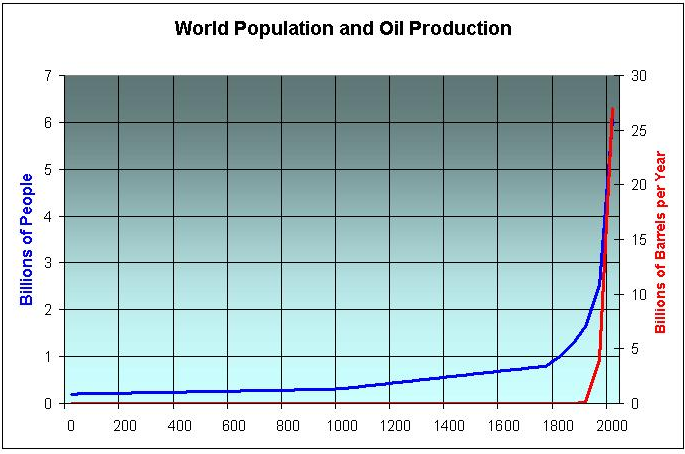


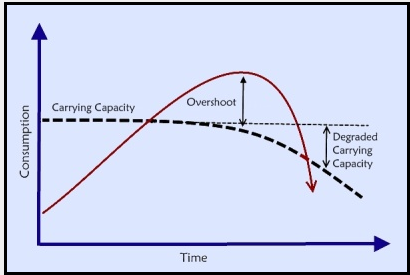


 Collapse of Industrial Civilization