Things have been getting quite dark here lately with all the collapse scenarios casting an ever-growing shadow into the increasingly hard-to-believe fairy tale world of carbon man. As Jb said:
…All around me I see people desperately trying to satisfy their self-worth through consumption. I keep telling myself that I should stop trying to explain the connection between petroleum and the mirage of western civilization, but the headlights keep getting bigger and brighter…
So to lift the spirits of myself and other fellow collapsitarians, a few funnies are in order. The first one is billed as “one of the funniest GIF’s you’ll ever see“, and I must admit I busted my gut when I saw it this evening. What with all that Super PAC dark money rounded up by Karl Rove and his plutocratic cronies, King Romney was convinced he had bought his way into the White House:
It makes sense that Mitt Romney and his advisers are still gobsmacked by the fact that they’re not commandeering the West Wing…
…Team Romney has every reason to be shellshocked. Its candidate, after all, resoundingly won the election of the country he was wooing.
Mitt Romney is the president of white male America.
Maybe the group can retreat to a man cave in a Whiter House, with mahogany paneling, brown leather Chesterfields, a moose head over the fireplace, an elevator for the presidential limo, and one of those men’s club signs on the phone that reads: “Telephone Tips: ‘Just Left,’ 25 cents; ‘On His Way,’ 50 cents; ‘Not here,’ $1; ‘Who?’ $5…
…Romney and Tea Party loonies dismissed half the country as chattel and moochers who did not belong in their “traditional” America.
The next one up is a Romanian TV ad for gasoline. Sorry for being sexist, but I thought it was humorous. Apparently French maids are a universal fixture in the male libido. From the Business Insider:
American gasoline brands tend to advertise their products with images of cars driving on the open road, stats about mileage, and CGI animations of pumping pistons.
That wouldn’t fly in Romania, judging by this new ad for Eastern European petrol brand Rompetrol. In the Romanian imagination, Rompetrol unleashes a bevvy of dancing French maids who clean out your firing chambers.
Now you would think that the most powerful four-star bureaucrat and top spy in the American military industrial complex would know that he might come under scrutiny at any time and therefore keep his missile under lock and key, only to be deployed in the proper circumstances. But apparently his trigger is no more restrained than that of America’s bloated and bomb-happy war machine:
The book title is perfect…now that we know the general was “all in” Ms. Broadwell. Kinda casts a questionable light on the objectivity of the author, don’t you think?
Sen. Bernie Sanders said corporate leaders should look in the mirror before lecturing the American people on ways to tackle the deficit. After the heads of more than 80 big companies issued a statement Thursday on deficit reduction, Sanders released a report detailing how many of the companies headed by the same CEOs have avoided taxes, sent American jobs overseas and took taxpayer bailouts. “There really is no shame,” Sanders said. “The Wall Street leaders whose recklessness and illegal behavior caused this terrible recession are now lecturing the American people on the need for courage to deal with the nation’s finances and deficit crisis. Before telling us why we should cut Social Security, Medicare and other vitally important programs, these CEOs might want to take a hard look at their responsibility for causing the deficit and this terrible recession.
Next we have Physicist Paul Beckwith’s open letter to the Canadian PM about the destruction of our food supply by way of human-induced eco-collapse. This letter should be sent to all leaders of industrialized nations.
Click to go to original…
And finally we have poetic justice in the form of what has been dubbed a ‘Frankenstorm’ bearing down on the seat of power in the U.S. As nature continues to drop hint after hint to those in charge, how much longer can the fossil fuel PR machine of climate change denialism continue to pull the wool over the eyes of the public?
Physicist Paul Beckwith explains here how this ‘Frankenstorm’ is a result of anthropogenic climate change:
All storms veer to the right in the northern hemisphere due to the spinning of the earth (1 revolution per day). Except when there is a tilted high pressure region northward and it has to go left and there is a massive low pressure region left that sucks it there as well. Why the high pressure ridge and massive low pressure? Because the jet stream is wavier and slower, a situation that is happening more and more often, because of massive sea ice decline this summer. Which is due to Arctic amplification feedbacks. Which in turn is due to rising greenhouse gases. Which is due to humans.
I noticed that reader Tall commented on this site’s ‘About’ section with a link to Charles C. Mann’s new article:
The crux of the argument is the following (from an audio interview with the author)…
…All species are the same at some fundamental level. They are all living creatures, and all species seek to increase, to multiply, and to fill the Earth… If we are serious as conservationists then we should recognize that human beings are just another species, and they have the same impulses that animate bacteria. And the natural course of events for us will be to fill up the Earth, consume all the resources, and then kill ourselves off. And that would be the normal thing for us to do. So that conservation, the idea that we should hold back, was in fact deeply unnatural, almost perverse from the point of view of biology, to imagine we would be doing this [conservation] …
This thinking goes along with the theme of ‘Are Humans Smarter Than Yeast?‘ From a purely primordial urge for survival, we are no different than other organisms. But we are intelligent enough to recognize that what we are doing will lead to our own extinction in the not too distant future. I don’t believe any other species has that ability to forecast the future and see dangers. So perhaps the battle for humanity is partly recognizing that we have these basic biological impulses to multiply and consume, but that such urges will eventually lead to our own extinction. This is where embracing climate and environmental science as well as biophysical economics will go a long way in halting our own self-destructive behaviors. It may well take a much greater materialization of our ongoing ecological crisis before the powers-that-be internalize that message.
A picture I took off the highway in northern Arizona next to Dead River:
The age of the automobile has taken nearly three times as many American lives as has all the wars of this nation since 1899. Nearly 4 people died by vehicle every hour of everyday in just the year 2011 for a total of 32,310. That number excludes those countless victims who survived, impaired with injuries. Now if we add in the number of humans sacrificed in oil wars over the years for the gas tanks of the West’s automobiles, then we would have to add millions more to the list of dead. The number of car crash fatalities since 9-11 has been calculated by the site death-by-car whose findings are that Osama bin Laden doesn’t hold a candle to the carnage on our roads:
From 1/1/2002 through 12/31/2011, National Highway Traffic Safety [sic] Administration statistics show that 392,621 people were killed by motor vehicle collisions in the United States. So, that’s about 100 9/11s. (And it does not count those who died from automotive air pollution and physical deconditioning.)
Recently while driving on the northern outskirts of Lake Havasu City, something odd with a car driving just ahead of me grabbed my attention. When I caught up to the tracks of the preceding car, I realized that what had appeared to be a brown paper bag tumbling under the car’s wheels was actually a desert rabbit. As I passed I could see his back legs had been crushed and he was dragging himself off the road with his front legs. I imagine the number of animals becoming roadkill during the last 113 years is unfathomable, but a few organizations have taken a stab at it:
…During the late 1950s, in a roadside version of the Audubon’s Christmas bird counts, the Humane Society of the United States conducted some Fourth of July body counts. During the 1970s, again groping for numbers, the Humane Society compiled data from isolated scientific studies of single roads or single species. Its secondary sources yielded the same national death toll as its field studies: one million animals a day.
Two regional surveys during 1993 and 1994 offer updated species death counts. Called “Dr. Splatt” and coordinated by the preppy Pinkerton Academy, the ongoing project involves mostly pupils in grades six to nine from 40 schools throughout the Northeast U.S. Concerned readers of the monthly Animal People also participate. Reliable death data, however, still remains elusive…
…The first victim was a New York City real estate agent with the appropriately ominous name of Henry H. Bliss. On Sept. 13, 1899, Mr. Bliss alighted from a New York City trolley car, then turned and offered his hand to assist a companion, identified in news reports only as “Miss Lee.”
In that instant, a speeding taxi cab hit the man and ran over him, crushing his chest and skull. He was taken to Roosevelt Hospital, where doctors said it was hopeless. Henry Bliss died the next day, the first known automobile fatality in U.S. history. Millions of his countrymen would follow him to the grave.
In the ensuing 113 years, vehicular traffic on the highways and byways of this country has taken a toll in human suffering that can be accurately described as a holocaust. The total number of dead from that September day in 1899 to this October day in 2012 is approximately 3,573,384.
For the first half of 2012, traffic fatalities in the U.S. have ticked back up!:
Traffic deaths in the U.S. jumped 9% in the first half of 2012, making it the biggest half-year jump since 1985.
More than 16,000 people have died on the roads so far this year, according to a new report from the National Highway Traffic Safety Administration.
“This news is very disturbing,” Lon Anderson, spokesman for AAA Mid-Atlantic, said in a statement, according to CNN. “We have worked decades to reduce fatalities in America… but this is a serious shot across the bow, a warning that as we drive more, our roads may not be as safe as we thought they were, CNN reports…
Traffic accidents are the leading cause of death for people in China under the age of 45, according to public health experts…
…China has nearly 70,000 police-confirmed traffic deaths a year, twice the figure for the United States. The actual discrepancy may be even greater. Chinese and Western traffic safety experts say that while the United States figures are extremely reliable and take into account virtually every death, only a small fraction of all traffic deaths in China show up in official figures because of widespread underreporting by the local police.
A comparison of government and industry data shows that the annual frequency of police-reported traffic deaths per million registered vehicles in China appears to be roughly six times as high as in the United States. And if the chronic underreporting by the police of China’s traffic deaths is factored in, the true annual rate of traffic deaths per million registered vehicles appears to be nearly 20 times as high.
A joint study last year by the Johns Hopkins School of Public Health in Baltimore and Central South University in Changsha, China, of traffic deaths throughout China in 2007 found that nearly three times as many traffic deaths showed up in the Health Ministry’s death registration data than had been reported by the police…
If the above reasons don’t give you a clue, our highly individualistic mode of transporthas another Achilles’ heel, among others, which gives real meaning to the term Carmageddon:
…Oil, the source of the car’s pervasiveness, is a rich soup of carbon-based compounds used in almost everything we see and use around us: paraffin, artificial fertilizers, all types of plastics, endless industrial chemicals, asphalt, pesticides, tires, medicine etc. Burning a lot of it on the road is a certain way to make these goods costly or hard to produce. However, while we could survive without asphalt, the same cannot be said about food. In 1940, it took one calorie of fossil fuel energy to produce 2.4 calories of energy in the form of food. 1974 was a turning point: that year, the ratio was 1 calorie of fossil fuel energy for 1 calorie of food. Today, huge amounts of energy and artificial fertilizers are used to work the land, irrigate and package food, transport it over thousands of kilometres to its target markets, refrigerate it etc. All this contributes to a ratio of 10 calories of fossil fuels for every calorie we get from the food itself. In terms of energy, we are eating oil and as it seems, there is not much of it left. As we hail the birth of the 7 billionth person alive today, we are looking in the face of a large scale humanitarian disaster in the decades to follow and the last thing we should be doing is burning up a key food production resource to get to the theatre on a Saturday night…
With India and China adopting America’s asphalt-laden, roadkill-smeared car culture…
…the day of Carmageddon reckoning is fast approaching.
I was doing a little net surfing this morning and wondered what my buddy Jeremy Scahill has been up to. Shoot, it’s been 6 months since I’ve seen an article from him. A recent video of him reaffirms why I like him so much…
We live in this culture where we have this reality television which has become the real world, and what’s being done with our dollars, and with our soldiers, and in foreign countries in our name has become page seven. ~ Jeremy Scahill
He still has a sense of humor too.
Concerning those debates, which in this day and age are only another reality TV production brought to you by Wall Street, Democracy Now had a truly jaw-dropping show on the corporate takeover of the political debates over the last couple of decades. Secret agreements were formed between the two parties which framed the “debates” so that only predetermined, soft-ball questions would be asked and no third party candidates would be allowed to participate. When you watch a “presidential debate”, what you are seeing is pure fluff and staged answers. You might as well be hearing ventriloquist voices emanating from manikins. And to top it all off, one of the primary corporate sponsors of the debates is Anheuser-Busch. How fitting… Bud Light and cheesy made-for-TV “reality” shows constitute the method by which the American sheeple choose their ‘leaders’. I don’t know whether to laugh or cry.
I urge you to watch this interview. It explains a lot about the development of the modern American Cororatocracy and the dumbing down of its population of “consumers”.
Here is George Farah’s Website (click the pic to go there):
I found the following story pathetic, predictable, and a microcosm of America’s inverted totalitarianism. This is the corporate state flexing its fascist muscles with for-hire private armies, replete with the latest face-stomping boots and weaponry from Homeland Security. You can never have too much police intimidation in the land of the fearful and home of the paranoid.
Basic rights are what the workers were requesting, but the corporations are working hard to ensure American workers are on the same footing as laborers of Third World sweatshops.
…and don’t forget the sonic cannons to completely suppress the oppressed:
Criminalizing dissent extinguishes free speech. The threat of a nightstick cracking open your head is a good silencer. I fail to see much difference between America and China at this point. A lot has been written recently about the rise of America’s ‘Security and Surveillance State’. Let’s recap:
…the financialization of the economy and culture has resulted in the poisonous growth of monopoly power, predatory lending, abusive credit card practices and misuses of CEO pay. The false but central neoliberal tenet that markets can solve all of society’s problems has no way of limiting the power of money and has given rise to “a politics in which policies that favor the rich … have allowed the financial sector to amass vast economic and political power.”[24] As Joseph Stiglitz points out, there is more at work in this form of governance than a pandering to the wealthy and powerful: There is also the specter of an authoritarian society “where people live in gated communities,” large segments of the population are impoverished or locked up in prison and Americans live in a state of constant fear as they face growing “economic insecurity, health care insecurity [and] a sense of physical insecurity.”[25] In other words, the authoritarian nature of neoliberal political governance and economic power is also visible in the rise of a national security state in which civil liberties are being drastically abridged and violated.
As the war on terror becomes a normalized state of existence, the most basic rights available to American citizens are being shredded. The spirit of revenge, militarization and fear now permeates the discourse of national security. For instance, under Presidents Bush and Obama, the idea of habeas corpus with its guarantee that prisoners have minimal rights has given way to policies of indefinite detention, abductions, targeted assassinations, drone killings and an expanding state surveillance apparatus. The Obama administration has designated 46 inmates for indefinite detention at Guantanamo because, according to the government, they can be neither tried nor safely released. Moreover, another “167 men now confined at Guantanamo … have been cleared for release yet remain at the facility.”[26]
With the passing of the National Defense Authorization Act in 2012, the rule of legal illegalities has been extended to threaten the lives and rights of US citizens. The law authorizes military detention of individuals who are suspected of belonging not only to terrorist groups such as al-Qaeda but to “associated forces.” As Glenn Greenwald points out, this “grants the president the power to indefinitely detain in military custody not only accused terrorists, but also their supporters, all without charges or trial.”[27] The vagueness of the law allows the possibility of subjecting US citizens who are considered in violation of the law to indefinite detention. Of course, that might include journalists, writers, intellectuals and anyone else who might be accused because of their dealings with alleged terrorists. Fortunately, US District Judge Katherine Forrest of New York agreed with Chris Hedges, Noam Chomsky and other writers who have challenged the legality of the law. Judge Forrest recently acknowledged the unconstitutionality of the law and ruled in favor of a preliminary barring of the enforcement of the National Defense Authorization Act.[28]
The anti-democratic practices at work in the Obama administration also include the US government’s use of state secrecy to provide a cover or prevent being embarrassed by practices that range from the illegal use of torture to the abduction of innocent foreign nationals. Under the rubric of national security, a shadow state has emerged that eschews transparency and commits unlawful acts. Given the power of the government to engage in a range of illegalities and to make them disappear through an appeal to state secrecy, it should come as no surprise that warrantless wiretapping, justified in the name of national security, is on the rise at both the federal and state levels. For instance, the New York City Police Department “implemented surveillance programs that violate the civil liberties of that city’s Muslim-American citizens [by infiltrating] mosques and universities [and] collecting information on individuals suspected of no crimes.”[29] And the American public barely acknowledged this shocking abuse of power. Such anti-democratic policies and practices have become the new norm in American society and reveal a frightening and dangerous move toward a 21st century version of authoritarianism.
This police state the über wealthy are building better live up to all the hype that’s been advertised about it. There are too many horsemen (Climate Change, Peak Oil, Neoliberal Economic Policies, 6th Mass Extinction, Water Scarcity, Ocean Acidification) bearing down on humanity to even entertain the idea that the starving masses will go die quietly in some dark corner.
He and some friends wrote a paper, released yesterday, arguing that increases in food prices over the last few years can be explained almost entirely by two factors: financial market speculation and the growing use of corn for ethanol production rather than food.
Now these arguments have been madebefore, and also disputed or minimized. The new paper rejects a lot of those criticisms; more interestingly, it constructs a fairly simple four-parameter model that can pretty closely match the actual trends in food prices over the last few years:
So, neat. Also disturbing. And more disturbing is this:
That’s from their companion, non-mathy paper that proposes “that protests may reflect not only long-standing political failings of governments, but also the sudden desperate straits of vulnerable populations. If food prices remain high, there is likely to be persistent and increasing global social disruption.” The main graph is food prices, the red dotted lines are incidents of rioting. Charmingly the numbers in parentheses are death tolls. They predict global doom in 2012-2013.
We apparently value feeding our cars over alleviating worldwide hunger and misery as well as preventing global unrest. A little unrest is always good for the bottom line of the Military Industrial Complex.
“Food prices (blue) and food price model (red) including projected increases in coming months. The social unrest threshold, corrected for inflation (purple dashed line) is a level of food prices that is likely to cause food riots of impoverished populations and social disruption. Parameters as in July update, modified to include larger recent reported FAO food price index increase of 6%.” – link
And a new report buy Oxfam, Extreme Weather, Extreme Prices, looks into the grim future of food production in a world of extreme climate change:
Even under a conservative scenario, another US drought in 2030 could raise the price of maize by as much as 140 per cent over and above the average price of food in 2030, which is already likely to be double today’s prices.
Drought and flooding in southern Africa could increase the consumer price of maize and other coarse grains by as much as 120 per cent. Price spikes of this magnitude today would mean the cost of a 25kg bag of corn meal – a staple which feeds poor families across Africa for about two weeks – would rocket from around $18 to $40.
A nationwide drought in India and extensive flooding across South East Asia could see the world market price of rice increase by 25 per cent. This could see domestic spikes of up to 43 per cent on top of longer term price rises in rice importing countries of such as Nigeria, Africa’s most populous country.
My prediction is that we will continue to sacrifice land and human lives at the altar of American, and now Chinese, car culture. Walmart, the enduring symbol of happy fascism in America, will enjoy a growing pool of cheap labor amid cut-throat competition to ensure stellar profit margins. And a new reality TV series featuring climate change survivors will air on America’s propaganda box. Why not? We’ve already got a reality TV series to promote our perpetual war economy.
Here is the interview with Alf Hornborg along with a couple of essays of his. To understand our predicament, you must understand that the flow of energy, fossil fuels, humans have tapped into for running our economy, machinery, and energy-intensive mode of living has some serious environmental drawbacks, namely climate change and ocean acidification, which will certainly lead to our own destruction with the business-as-usual path we are so determined to follow. Some of the other consequences of basing our way of life so heavily upon fossil fuels are resource wars, support of brutal dictatorships in resource-cursed countries, hypocritical foreign policies based on resource control rather than the publicly professed mantra of human rights and democracy, the fomentation of resentment and terrorism towards the West, etc. So if you couple fossil fuels with capitalism, then you have a truly planet-destroying system. Capitalism is coerced competition for finite wages and resources, pitting person against person, company against company, and nation against nation. What the State calls Terrorism is really defined as those who have grievances with the plunder of their homeland’s resources to support the unsustainable lifestyles of OECD countries. If China continues to follow the same arc of resource consumption as America, the ‘War on Terror’ will be theirs as well. My favorite quote from Horborg:
Is the war on terrorism and climate debate two sides of the same coin? Imports of cheap oil are just as crucial as exports of carbon dioxide for a high-energy future. Both are confined to the parts of the world that have amassed the most purchasing power.
14 July 2011, 12:54 PM
Alf Hornborg on How We Have Been Mystified by Technology
by Adam Robbert & JP Hayes
Alf Hornborg, professor in the department of Human Ecology at Lund University, Sweden has long been untangling the tightly fused networks that merge the material dimensions of the environment with the cultural processes of society. “Machine Fetishism” Hornborg’s term for the way in which we have been mystified by technology highlights the links between technology and asymmetries in global exchange and uncovers the relationship between ecology and power. As technological devices multiply exponentially in a vain attempt to make our lives “efficient,” “luxurious” and “productive,” Hornborg, restless in his critique of technocapitalism, reminds us that on planet earth everything is a zero-sum game – one person’s gain is always another’s loss. Last January we caught up with Professor Hornborg to see where his latest thinking on machines, money and climate change stand and how we, as the concerned and informed, can intervene to make a difference.
Q: You have suggested that the difficulties in understanding the relationship between the environment, the economy and technology arise partly out of the separation between the social and natural sciences within the university. Bringing the natural and social sciences together implies entangling material dimensions of the environment with the cultural processes of society. How has this split mystified our understanding of the relationships between ecology and economics, and how is this affecting our ability to respond to major events such as the mass extinction of species, climate change and global inequality?
It is becoming increasingly obvious that material processes in the biosphere are very much intertwined with cultural aspects such as our ways of thinking and our consumption patterns. The most obvious example is perhaps climate change, which we know is largely driven by our patterns of consumption. If ecologists look at the biosphere as if there were no human societies in it, and economists look at societies as if they didn’t depend on the biosphere, none of them will know how to handle things like climate change. As long as economists continue to think that the only relevant metric for measuring global trade is money, they will not see the asymmetric net transfers of real resources such as energy and matter that make technological expansion possible within some areas of the world.
Q: Your analysis of technology as a globally situated event that requires the establishment of multiple asymmetric economic linkages to be in place raises questions about the role of technology in current ecological problems. If technology, and in particular machine technology, requires inequalities in the terms of global trade, how are we to assess the appropriate use and level of technology employed in solving ecological problems?
I don’t think modern technology will be of much use in solving ecological problems, because modern technology is basically a way of shuffling around resources and problems between different social groups. For example, by shifting to ethanol European car drivers may think they are becoming sustainable, but Brazilians engaged in growing sugar cane may be growing less sustainable as a result. Solving ecological problems should not be about finding new technological solutions, which generally means shifting the problems onto someone else, but about developing new economies and lifestyles which reduce environmental degradation.
Q: You advocate a “zero-sum” approach to your analysis of the relationship between ecology and economics, with technology acting as a kind of basin within which material exchanges of the biosphere and economic or political policies churn. In this way, what you call “machine fetishism” produces the image of a machine that exists without its connections to culture, power and ecology. Could you elaborate on how the illusion of machine technology came to take hold and what relevance unmasking machine power for what is –a globally situated object- has for encouraging a more politically just and environmentally sound society?
Our faith in technology emerged most markedly in the early nineteenth century, as colonial Britain was accumulating resources from all over the world and investing its economic surpluses in new machinery. To British economists of the time, it seemed as if ecological (land) constraints had been overcome once and for all, and the magic wands of labor and capital would suffice for economic progress to continue. That is exactly the time when modern economic ideology was born. What these Europeans could not grasp was that their capital was built on the exploitation of land and labor elsewhere in the world. In other words, the factors of production were NOT substitutable in an absolute sense. We are all ultimately dependent on land.
Q: Following David Harvey’s analysis of money, you have suggested that money is a social institution that generates “space-time” in such a way that is both an “objective, political ecological framework” and a “subjective experience.” In other words, money becomes the medium by which society, technology and even the whole biosphere are transformed within a particular set of cultural ideas. Given the latest financial crises, what do you foresee the role of currency to be in the transformation of the relationship between ecology and economics?
The financial crises illustrate the risks a society takes when it permits monetary assets and real, biophysical resources to become so thoroughly dissociated from each other. Our current problems with overconsumption would not have been possible if money had not become so completely disconnected from material resources. I am not saying that the gold standard that we abandoned in the seventies was a solution, but at least it limited the possibilities of printing ever more money to keep the treadmill of consumption (and production) spinning at a pace that satisfies the corporate demand for profits. But the real problem with money is not that it is fictitious, as all money must be, but that it embodies the idea that everything can be exchanged for everything else. What we need is an economy with at least two incommensurable currencies, to distinguish between values that should not be interchangeable, such as local subsistence and survival versus globalized entertainment.
Q: In your analysis of the industrial revolution you suggest that the “technomass” of industrial civilization is now competing with the “biomass” for living space on planet earth. How are we to approach the reality that we are already thoroughly enmeshed within a technosphere that now seems to require our continued maintenance (so as not to leak the wrong toxic substances into the wrong environments) and the fact the we need to be equally attentive to the livelihood of the biosphere which we depend upon for life?
The sooner we stop prioritizing the metabolic needs of our “technomass”, at the expense of human and other biomass, the better. Our technological fixes are no less absurd than the fetishism that brought earlier civilizations to collapse, whether through overinvestment in armies (Rome), temples (Maya), or megalithic statues (Easter Island).
Q: Given that you believe that an integration of the social and natural sciences would lead to better policy strategies, could you comment on the differences or similarities between these two spheres? Do the cultural, political and economic relations that social scientists study differ in nature from the ecological and material systems that a natural scientist study? Their conjunction seems necessary, and yet problems of integration seem numerous. What is our way forward here?
Yes, the social and natural sciences study different kinds of phenomena and need to respect the limitations of either approach. Societies have always implicated questions of power, unequal distribution, and collective processes of meaning-creation and ideology. Ecosystems can be studied and understood without insights about any of these things. On the other hand, as economists and others illustrate, social systems can be studied (if not understood) without any regard to the flows of matter and energy that preoccupy the ecologists. To understand the interface between social and ecological systems we need to understand POWER as partly material, partly symbolic. Social power is based on unequal access to material resources, but also on the ideological mystification of such inequalities.
Q: Uncertainties of measurement and misleading methodological approaches characterize current economic attempts to manage the world system. Such a measurement/theory mismatch creates uncertainty and error in understanding what is occurring in the present state of economic-ecological affairs. As a result of these poor methodologies, modern bureaucracies have created a routine of socioeconomic functioning that is notable for its lack of applicability to social & environmental reality. How can we characterize and develop change that ensures the development of a truly sustainable world system? How can we, as academics, activists, and concerned citizens, best intervene, as you say, “in the destructive logic of our current economic system?”
First of all by recognizing the dilemma as I have outlined it in my earlier responses. Second by using their political agency (ultimately as voters in democratic political systems) to choose representatives who are prepared to reorganize the economy for the long-term good of all people and ecosystems, rather than for the short-term benefits of corporate interests.
Q: Could you comment on the role of emergent popular discourses on the environment such as “green capitalism,” “sustainable development” and “ecological economics?” Though each is different in character and always subject to a variety of uses, do you think that these movements, in general, are adequate to the tasks they set out to solve?
I don’t believe in “green capitalism” or “sustainable development” the way they are currently conceived, as both are oxymorons. “Ecological economics” is a very important arena for discussion, but will lead to real changes in our thinking only if it is able to radically transcend the assumptions of conventional economics.
Q: What, in your opinion, are the most effective modes available with which to express a need for change within the current political and economic regimes? If traditional models of education, politics and economic theories are not serving the urgency of the crises at hand, what action do you advise concerned peoples to take?
The best we can do is to develop awareness of our global predicament and resort to it as opportunities for real change appear, not least as we confront crises of various kinds in the future. Crises, whether financial, environmental, or other (or a combination of them), can offer possibilities of change, and it is important for society not to be confused by such events, but to understand what is happening and be prepared to safeguard the health and security of citizens.
Q: If you are correct in asserting that “mainstream” thinking about the environment is fundamentally flawed and will not lead to positive change (as advocated by the sustainable development movement, for example) where do we start? Must we begin from scratch so as to completely re-interpret the ingredients and causes of our crises, or do we in fact have something like a base or foothold from which we can begin a renewed attempt to make a difference in the world? Who are the primary thinkers involved that provide us with tools that the 21st century can believe in?
The Internet has provided humanity with a unique chance to globally communicate about crises and how to handle them. I will not mention any specific thinkers, only note that the social and natural sciences both have rich traditions of thought that attempt to show how social power and inequalities are interconnected with natural circumstances such as land constraints, soil fertility, and thermodynamics. We need more current researchers working on how these different kinds of knowledge can be stitched together. Unfortunately, a very small minority of researchers is dedicated to such challenges.
Published January 6, 2010 – 10:00
Updated January 7, 2010 – 09:31
What will future historians say about the early 2,000’s?That it was the turning point.In the course of that decade were visualized the unsustainable contradictions within global fossil fuel-driven industrial capitalism.
First came 9/11. We sat glued in front of the television screen and saw the towers fall, again and again. We were just as shocked as the European upper classes two hundred years ago when the mob guillotined the royals in Paris. How could such a hit happen to us? Where did all this hate come from? Are there really such contradictions in the global community? Could it have to do with oil, this stored solar energy from the ancient landscape that drives most of our lives, that we can afford to continue paying for it? And to whom then is this resource so critical that some countries are prepared to go to war for it.
Then came the Peace Prize of Al Gore, a person who appeared to have become the world’s most powerful man able to say that we were destroying the planet, and be rewarded for it. If a U.S. Vice President, Nobel Committee and the UN climate panel agree on the reality of global warming, may we take it seriously? Should we stop using fossil fuels?
Then came the financial crisis – the worst stock market collapse since 1929.Is the world economy really so vulnerable?And how is it that economists could not predict it?Are there contexts in the world that economists have not understood?
The early 2,000’s was the decade when we passed the peak of conventional oil production, that which in English is called peak oil. We now, therefore, use the remaining oil faster than we can find new deposits. We realize that oil prices will rise in the future, making our current lifestyle increasingly untenable… a two hundred year old bubble approaching the breaking point.
In two centuries we have been able to forget that the earth’s land surface is the resource that limits us.We have become used to deriving our energy from drilled holes in the earth’s crust instead of from our landscape.We have lived in the former solar energy of epochs instead of the annual insolation stored in living plants.
What should we do when we can no longer afford oil? How will the land be sufficient when it once again will have to support both people and vehicles? It used to be horse feed we had to compete with, now it is the cane for ethanol.
Not only do biofuels take up land space needed for food for a growing world population, but they also can not be nearly enough to sustain the consumption levels that the rich world has become accustomed to.
The early 2,000’s was also the decade when we definitely realized that the balance of power in the world would not be forever. China became an economic power by cashing in on cheap labor and lax environmental laws. We buy Chinese goods like never before. But is continuing to wallow in their products the best thing we can do for the Chinese, their environment and our common atmosphere?
The early 2,000’s was also the decade when a new kind of president moved into the White House. A whole world had understood that the American people could no longer hope to solve global conflicts by taking up arms. But what options are there really for Obama?
During the past decade, two of America’s most powerful politicians received the Nobel Peace Prize, the one for his warning us of what can happen to the climate if we continue to burn oil, the other in hopes that he will refrain from war…always for oil.
And just before the decade is over, we will experience COP 15. Fifteen thousand delegates and a hundred heads of state will gather in Copenhagen to discuss whether there is any hope. We know that carbon dioxide emissions are only continuing to increase despite all the warnings and promises. We recognize that emissions are as unevenly distributed in the world as money. An average American emits 18.7 tons of carbon dioxide per year; an average of 1.3 tons for Indians.
Perhaps we can imagine a connection between these various trends and events? Is the war on terrorism and climate debate two sides of the same coin? Imports of cheap oil are just as crucial as exports of carbon dioxide for a high-energy future. Both are confined to the parts of the world that have amassed the most purchasing power.
Economic growth is basically about earning money to expend resources.And the more money we earn today, the more resources we can afford to consume tomorrow.No wonder it is difficult to reduce carbon emissions.
But this is a logic that economists are not trained in. Can we hope that the next decade offers more insight – and more power shifts?
Alf Hornborg
Professor of Human Ecology, Lund University
For my own records and for your curious minds, I’m posting some abstracts on papers that were written for an upcoming symposium called the 17th World Congress of the IUAES (Manchester, UK; 5th-10th August 2013). Many of these papers sound very interesting:
Papers
That Big Slow Curve: Fossil Fuel Based Growth meets A Prosperous Way Down
This century and the last may someday be called the Oil Years. Many who view our human economies in biophysical terms have come to conceive the peak of oil production as a turning point for peoples of the world. For the Odum’s, A Prosperous Way Down (2001) is in no part inevitable as oil production peaks and declines. Their book offers guidelines for a preferable future, a hopeful scenario, but with clear recognition that there are many less desirable and more likely directions that the world may take. In this paper I will reprise the Odum’s preferred scenario as it relates to undesirable alternatives. I will place these scenarios along the path of a big slow curve—the 80-year curve of world oil consumption. At human time scales, we might think that the big slow curve is difficult to detect or attend to. However, I will argue that the effects of asset growth and decline are indeed attended to, and have dramatically affected cultural trends in these oil years. This is because the detection of the growth (or its absence) of cultural assets is of central concern to all ‘consumers’ within ecosystems, but especially to human consumers who produce and manage their own food in various ways. These issues will be explored with mini-model simulations.
Accumulation by Displaced Emission: On Climate, Consumers, and the Rhetoric of Confidence
Whether referred to as ecological modernization, bright green environmentalism, or the rationalization of lifestyles, technological improvement has long been presented as a “win-win” strategy resulting in both economic growth and improved environmental health. Yet significant and mounting research suggests that these strategies have not delivered on their promises. Efficiency gains are being rapidly outstripped by sustained net growth in consumption. Drawing on in-depth ethnographic research, this paper explores a series of reports published by the Swedish Environmental Protection Agency and their subsequent impact on other nations. The report authors advocate a zero-sum approach to understanding green house gas emissions – recognizing that while Sweden has reduced domestic emissions since 1990 — simultaneous growth in the consumption of imported goods and services has resulted in net increases elsewhere. The Swedish “consumption approach” to global GHG emissions accounting helps to elucidate the zero-sum reality of outsourcing emissions to nations where the need for economic development results in environmental injustice. While it is certainly more just to attribute all environmental costs to the consumers who benefit from the products associated with emissions, this perspective was contentious in Sweden where many saw it as anti-market. Its logical conclusion implied moving past economic and environmental de-coupling, toward de-growth. While these reports have had a substantial impact on several other nations, I argue that the approach they advocate is unlikely to gain much traction within UN climate talks until the pro-growth rhetoric surrounding consumer choice, responsibility, and freedom are challenged.
In this paper I argue that the metaphors that we use to think about global economic processes suffer from inherent limitations. The metaphors come from early moral and vitalistic thinking about the economy, and from modernist mechanical models which have now been enhanced with systems thinking, nationalism, and what I call “ecologism” which fetishizes nature. I propose that both cornucopian and zero-sum limited-good ideas about the future are fundamentally flawed, and are incapable of projecting a credible imagination of sustainability. I focus particularly on the language and metaphors of temporality and boundaries, both of which incorporate assumptions which we know to be false. I also discuss the prevailing dualism in discourse about the economy, and the way it limits our thinking and blinds us to what Latour calls “the proliferation of hybrids.” The economy is a cyborg, partially human and partially machine, and the sooner we recognize this, and stop fighting the pre-determined wars of modernism, the better we will be capable of thinking about a planet with 10 or 11 billion human beings on it.
Rethinking Economy
Author: Stephen Gudeman (University of Minnesota/ Max Planck Institute for Social Anthropology) email
Long Abstract
Most economists see material life as consisting of markets surrounded by market-like behavior: everything else is a positive or negative externality on market exchange. The anthropological perspective is different. I see economies as fields of value defined by crosscutting coordinates. One axis locates economies on a scale from High Relationship to Low Relationship transactions; the other positions economies on a measure from High Markets to Low Markets. Set diagonally to this “graph view” are five, increasingly abstract and encompassing institutional spheres that shift from the House, to Community, to Commerce, to Finance, to Meta finance. This view offers a comparative way to understand economies, change, and the contemporary crises. It suggests that economy is built on a material base whose uses change and are differentially valued. The more abstract spheres, through cronyism, oligopolies, information control and other devices, extract “value” that is first achieved through production and innovation. Unless mollified by communal action, this power of abstraction heightens unequal distribution and leads to environmental degradation seen in terms of entropy and pollution. I contest the belief in growth that is generated by market competition and consumption desires, as well as the ideology that growth, with its increasing toll on the environment, is the remedy to unequal distribution. Placing limits on the growth of inequalities in wealth counters the entropic toll we are incurring, and the reverse.
Revisiting the Image of Limited Good: On Sustainability, Thermodynamics, and the Illusion of Creating Wealth
Author: Paul Trawick (Idaho State University) email
Long Abstract
This paper focuses on worldview, examining two cultural models that are now contending for dominance on the world stage: the open-system model long promoted by economists, referred to as the ‘image of unlimited good’, and a closed-system model, the ‘image of limited good’ made famous by George Foster, who attributed it to members of peasant societies throughout the world. The former worldview is based on the idea that people ‘create’ wealth, an illusion arising from a fundamental confusion about the respective properties of real wealth and virtual wealth, or productive capital and finance capital. This perspective ignores the near-total reliance of the global economy on fossil fuels and other non-renewable resources, finite forms of real wealth whose exploitation is governed by the laws of thermodynamics. The alternative “zero-sum” worldview rests on the axiom that most of the ‘goods’ that people value in life are inherently scarce, being derived from those limited resources and raw materials, a scarcity that must somehow be shared. Based on an ethnographic and ethnological argument, a radical shift toward the closed-system view is said to be necessary if people are to act collectively to impose sustainable limits on their expanding consumption, a cultural change that may already be underway.
The moral economy and moral ecology of organic food in Western Sicily: from growth to degrowth?
Author: Giovanni Orlando (Independent Scholar) email
Long Abstract
For almost a century now the dominant socio-ecological regime of the world agri-food system has rested on the two pillars of productivism and mass consumption. An idea of limitless growth is thus intrinsic to it. Such growth has resulted in the degradation of ecosystems and the exploitation of farmers and consumers. The organic food movement has sought to counter this situation by developing agri-food systems that renew, rather than deplete, natural resources, and that do justice to farmers and consumers. Potentially, then, organic food can be grounded in non-accumulative paradigms such as agroecology and degrowth. From a cultural point of view, what values and symbols would underpin these ‘sustainable’ paradigms? This paper tries to answer this question in Western Sicily, Italy. By looking at the practices and discourses of people who grow, sell and eat organic foods, it explores the degree to which subjects hold values about nature and people that speak to notions of degrowth and agroecology. The paper uncovers a common thread in people’s emphasis on what might be termed ‘excess’. From the fear of the dietary abominations created by an excessive use of technology in food manufacturing and processing, to the outrage for the abuses caused by a desire for excessive profits in food retailing, the paper shows how the ideal of sufficiency, documented by anthropologists in a variety of non-Western societies, creates a moral economy-ecology of organic food.
The Revival of Survival: Pioneering a Post-Financial America
The financial crash of 2008 precipitated the renaissance of a primordial American tradition: survivalism. Often stigmatized as an eccentricity, the survivalist ethos is in fact deeply ingrained in American cultural production, from post-apocalyptic film to millenarian religious movements, as well as in American capitalism, generating millions of dollars in annual profits through the production of demand for palliative commodities. In recent years survivalism has indeed infiltrated mainstream American politics at multiple scales, from New York City’s “go-bag” scheme to Wyoming state’s “doomsday bill” to the CDC’s “zombie-preparedness” initiative. Like its historical predecessors, Great Recession survivalism is predicated upon a zero-sum logic simultaneously economic and environmental, entailing fears of an imminent collapse of finite financial and ecological resources as well as alternative visions for post-crisis continuity. This paper examines the history of survivalist ideology as a heterodox response to capitalistic crisis that is cyclically subsumed by its alleged antithesis: a cultural manifestation of deep-seated doubts about the propensity for endless growth which has itself been absorbed into the warp and weft of capitalist expansion through commoditisation.
Why Solar Panels Don’t Grow on Trees: Technological Utopianism and the Uneasy Relation between Ecomarxism and Ecological Economics
Ever since the Industrial Revolution saved Britain from ecological crisis in the early nineteenth century, visions of miraculous new technologies have alleviated Euro-American anxieties about the impending doom of the fossil-fuelled capitalism that it inaugurated. Although Malthus’s worries about land shortages were transcended by world-historical events as well as by Ricardo’s and Marx’s different versions of technological optimism, they were soon reincarnated in Jevons’s warnings about the depletion of coal. Today economists generally dismiss the pessimism not only of Malthus and Jevons, but also of current concerns over peak oil, by expressing faith in human ingenuity. To retrospectively ridicule pessimists by referring to technological progress that they did not anticipate has become an established pattern of mainstream thought. Almost regardless of ideological persuasion, the seemingly self-evident concept of “technological progress” inherited from early industrialism has been resorted to as an article of faith serving to dispel the specter of truncated growth. The increasingly acknowledged threats of peak oil and global warming are thus generally countered with visions of a future civilization based on solar power. In this paper I discuss this technological scenario as a utopia that raises serious doubts about mainstream understandings of what “technology” really is, and what it means to say that something is “technologically” feasible. The technological utopianism professed, for instance, by ecomarxists raises difficult but fundamental analytical questions about the relation between thermodynamics and theories of economic value.
Decoupling waste from growth
Author: Catherine Alexander (Durham University) email
Long Abstract
The correlation between increased waste production and increased wealth
headlines the EU’s environmental strategy. On the basis of trends so far,
the OECD projects a 45% increase in waste from 1995. The need for
continual economic expansion is taken as an unproblematic given. The
question that therefore seems to present itself is how to continue to
increase wealth without environmental despoilation. The EU’s Sixth
Environment Action Programme identifies waste prevention and management
as one of its top priorities. Its primary objective is to decouple waste
generation from economic activity, so that EU growth will no longer lead
to more and more rubbish. In the paper I make three points in response.
The first is that the desirability of growth remains unquestioned,
alternatives unexplored. The second is that environmental justice or
equity seems now to be foregrounded, often at the expense of other
inequalities produced by capitalist relations. The answer to waste
production, however, appears to be shifted away from economic rationales
of constant expansion to technocratic solutions or campaigns to change
consumers’ ‘attitudes and behaviour’ or the sleight of hand involved in
reclassifying wastes as energy (with the potentially bizarre prospect of
an economy that demands more waste in order to feed energy demands). I
suggest that the production of wastes is intimately tied to every aspect
of mass economic activity from extraction, through production,
distribution and consumption to disposal, and crucially, capitalist growth
depends on things breaking down, the inability to repair things, fashion.
One of the first steps forward might be to recognize that this kind of
growth is inseparable from social and environmental degradation.
Occam’s razor suggests that the more likely explanation for some phenomenon is the explanation which requires the fewest number of assumptions or required assertions. Even though in science the correct answer is sometimes the more complex one, rationally speaking, the fewer amount of assumptions that we have to make in order to get a theory to work, the better.
For example, think of how many assumptions you have to make to consider the September 11th attacks a government conspiracy. So many claims about time, space, engineering, politics, prior knowledge, flight patterns, etc., must be made to even start bridging the gap. On the other hand, the simpler explanation that requires less assumptions (and indeed has more evidence) is that a group of terrorists hijacked some planes and flew them into the buildings.
By association, Occam’s razor regularly dismantles most conspiracy theories without much effort. Of course, any of the conspiracies could be true, but without evidence the numerous assumptions that need to be made push these theories into irrational confines.
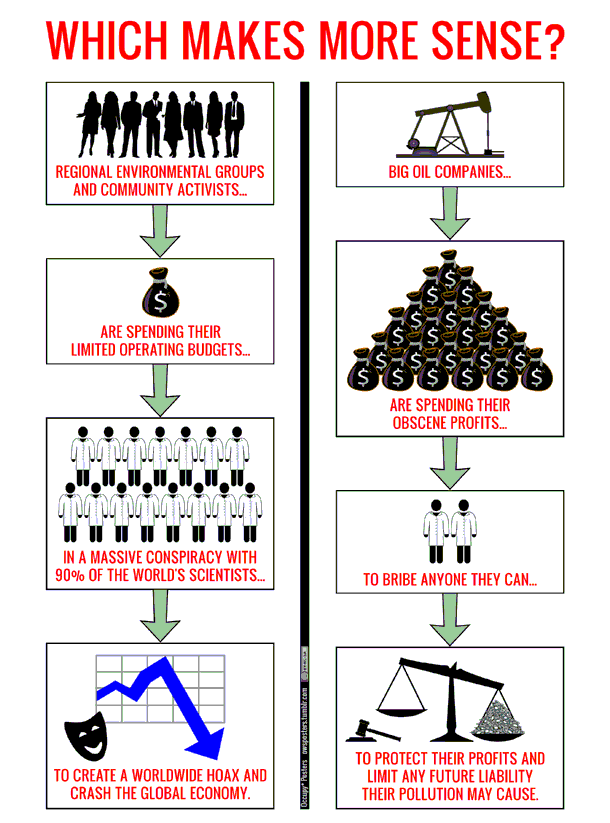
The infographic below takes a similar approach. On the side that accepts anthropogenic (human-caused) global warming, it takes many more assumptions to make the idea that the majority of the world’s climate scientists are in collusion to make a worldwide hoax from which they see no benefit work than it does to think that oil companies are protecting their bottom line. We know that there are huge oil lobbies, oil companies that have scientists in their pockets, and that large corporations are trying to purposefully undermine the science of climate.
Therefore, which makes more sense?
At the root of the Anthropocene Crisis of the 21st century is the unabated expansion of humankind fueled by fossil fuels. We are pushing all other living things off the cliff of extinction, with ourselves soon to follow.
…32 per cent of livestock breeds are under threat of extinction within the next 20 years, the UN Food and Agriculture Organization says. And 75 per cent of the genetic diversity of agricultural crops has been lost since 1900.
“Because we don’t really know the full impacts of climate change down the line, we don’t really know what’s going to happen in terms of growing conditions around the world. It’s just safer for us to have a lot of these other varieties in our pocket,” said David Ainsworth, spokesman of the CBD Secretariat.
Cooper said the pace of extinctions among the planet’s estimated 9 million species – plants, animals from insects to whales but excluding legions of tiny bacteria – was perhaps 100 times the background rate estimated in fossil records.
“If you project the rates into the future, the rest of the century, they are likely to be 100 times larger still,” he said. The rising human population threatens ever more habitats with expanding cities, farms and roads…
The machine of industrial civilization has become the master of our fate. It rolls onward under its own colossal impetus, crushing all in its path. The billions of people in the globalized economy are now mere cogs in its wheel. ‘Economic development and growth’ is the mantra chanted by all. ‘Green’ and ‘sustainable’ are the adjectives used by corporations to whitewash the continued plunder of the environment. Capitalism, an economic system that requires continued expansion and control, is inherently unstable and incompatible with the long-term habitability of the planet. Will the principles of biophysical economics become accepted as truth before we destroy ourselves?
The answer lies in this excerpt from Chris Hedges’ latest essay:
…perhaps the most egregious assault will be carried out by the fossil fuel industry. Obama, who presided over the repudiation of the Kyoto Accords and has done nothing to halt the emission of greenhouse gases, reversed 20 years of federal policy when he permitted the expansion of fracking and offshore drilling. And this acquiescence to big oil and big coal, no doubt useful in bringing in campaign funds, spells disaster for the planet. He has authorized drilling in federally protected lands, along the East Coast, Alaska and four miles off Florida’s Atlantic beaches. Candidate Obama in 2008 stood on the Florida coastline and vowed never to permit drilling there.
You get the point. Obama is not in charge. Romney would not be in charge. Politicians are the public face of corporate power. They are corporate employees. Their personal narratives, their promises, their rhetoric and their idiosyncrasies are meaningless. And that, perhaps, is why the cost of the two presidential campaigns is estimated to reach an obscene $2.5 billion. The corporate state does not produce a product that is different. It produces brands that are different. And brands cost a lot of money to sell…
I think we can safely shorten that time span to no more than 50 years. Right now I’m with my family, so postings will be light to nonexistent until the beginning of October when I will essentially be in seclusion once again to read more often and study the state of the world. As I write this post, one particular story that stands out is the discovery by Russian scientists of ‘methane fields’ exceeding 1 kilometre escaping from the Laptev Sea, as elaborated upon by Arctic News. In the views of these scientists, methane plumes like the ones they are observing could be catastrophic to this planet’s climate. Other than some obscure website, is anyone talking about the destruction to our food supply that climate change will surely bring about? Make no mistake, this is real news as opposed to the MSM’s three-ring political circus or the perverse reporting of decadent Hollywood parties to toast the christening of a new luxury jaguar car.
Many scientists are saying that the only thing that will save us is global coordinated action and a Manhatten project of geoengineering to halt any further damage from our CO2 emissions and its catastrophic impact on the environment. Others have lamented the total failure of governments to look after the well-being of their people:
Fossil fuel companies are still making profits despite the fact that climate change is so clearly upon us. Our politicians are putting corporate interests above scientific warnings and failing in their duties to the public.”
– link
The Arab Spring and Occupy Wall Street were initially grassroots movements which evolved as a response to the gross social inequalities of neoliberal capitalism. Washington inadvertently created both movements through their push of the aforementioned economic policies which have made a few extremely wealthy at the expense of those country’s populations. In the near future, the issue of corporate profits over the environment will become a driving force for future social unrest and revolt.
In the end, our ill-conceived exchange of fossil fuels for a stable biosphere will be worse than a zero-sum game when you take into account the hell that climate change will wreak. On our present course, we will be left with an uninhabitable planet. We have only seen the beginning inklings of what human-induced disasters such as drought, ocean acidification, deforestation, and mass species extinction will mean to industrial civilization which has become completely delusional about its “victory” over nature:
Let us not, however, flatter ourselves overmuch on account of our human victories over nature. For each such victory nature takes its revenge on us. Each victory, it is true, in the first place brings about the results we expected, but in the second and third places it has quite different, unforeseen effects which only too often cancel the first. The people who, in Mesopotamia, Greece, Asia Minor and elsewhere, destroyed the forests to obtain cultivable land, never dreamed that by removing along with the forests the collecting centres and reservoirs of moisture they were laying the basis for the present forlorn state of those countries. When the Italians of the Alps used up the pine forests on the southern slopes, so carefully cherished on the northern slopes, they had no inkling that by doing so they were cutting at the roots of the dairy industry in their region; they had still less inkling that they were thereby depriving their mountain springs of water for the greater part of the year, and making it possible for them to pour still more furious torrents on the plains during the rainy seasons. Those who spread the potato in Europe were not aware that with these farinaceous tubers they were at the same time spreading scrofula. Thus at every step we are reminded that we by no means rule over nature like a conqueror over a foreign people, like someone standing outside nature — but that we, with flesh, blood and brain, belong to nature, and exist in its midst, and that all our mastery of it consists in the fact that we have the advantage over all other creatures of being able to learn its laws and apply them correctly.” ~ Frederick Engels
The Earth giveth and she taketh away. Short-sightedness, greed, and conceit are traits undeserving of long-term survival on this once generous but now scorned planet.
I’ve never seen such an avaricious society……John Adams
Far from the valorized notion of job creators, father figure capitalists and the land of milk and honey, Morris Berman rightly points out the roots of a system that demands one sell their labor power for substinence wages must of necessity- at some point- redirect to a swindle.
The mandate of selling one’s own labor power in a system that requires exploitation to function reduces the calculus of survival to one of two options:
1.) The availability of plentiful jobs with wages ratcheting upwards over the years, allowing the worker to attain financial independence through an eventual participation in rent seeking retirement.
-Or-
2.) Hitting the big payoff, the mother lode, striking it rich-in other words achieving success at the envied goal of rich accumulation, usually through starting their own business, day trading or some other similar scheme of differential accumulation.
I suppose there is a third option, which is the life of crime, e.g. using criminal means to achieve sufficient accumulation to attempt to satisfy, in perpetuity, the need to sell one’s labor power for substinence. This is also the thesis that professional gamblers prefer, but as we shall see from this post, there is not much difference from these options and option # 2 above.
Great wealth unexplained is often the accumulation of a series of crimes and illegalities undiscovered, from insider trading to market manipulation, monopolies and official corruption, occasionally mixed in with sheer dumb luck and ruthless disregard for the law.
That is why the wealthy are rarely the great artists, athletes, or inventors who they hold up as the example of excellence to which they can hardly presume. The modern wealthy generally create nothing except a climate of injustice, fraud, and corruption.
When times are good, as in the period of most of the 19th and early/mid 20th century, when labor is relatively scarce and wages relatively high, option 1 provides passable solace to the American middle class worker. From about 1970 onward, roughly coinciding with the onset of neo-liberal capitalism, we have toggled to a relative surplus of workers with the onset of cheap labor in the Far East. Now we have too many workers competing with a highly discounted foreign labor pool, with entire industries “offshored” to China with the easily anticipated resultant of a hollowed out community structure left behind, with insufficient tax base to support itself.
In addition, the capitalist mode of production has at the same time affected a massive maldistribution of wealth, wherein entire segments are using accumulated profits for rent seeking endeavor, extracting as much money from the economy as fast as possible with no regard to the consequences. So we have vast numbers of affluent and wealthy individuals with no place to invest with consistent returns, as the low hanging fruit of reliable investment opportunities for this class has been consumed by simply too much wealth chasing too few investment opportunities.
The intersection of these two phenomena goes a long way to explain our current situation, how we got here and why we are not likely to leave. Of course, all of this has been written and discussed previously ad nauseum, but for me, the puzzling question is why do people go along with what must now be for most, a clear case of cause and effect?
Even a cursory look at income and wealth distribution shows a 3σ distribution of income, in statistics this means that 99.6% of all income is captured with average value of some $22,500 in annual wage earner income. None of the values within this 3σ distribution of income is sufficient to satisfy the basic objective of achieving enough of a “nest egg” to catapult oneself into a comfortable retirement, given the current FDIC insured interest rates typically used for most retirees.
The conclusion- you must be a statistical outlier to achieve financial independence, you must somehow, against all odds, land in the 4σ-6σ range of incomes, which is to say .4%-.0001% of total wage earners. These are the probabilities of lotteries, hence my declaration to “The Lottery of the Middle Class”.
Why do vast numbers of people accept a system of forced exploitation with such small numbers of possible positive outcomes? It is a near statistical certainty that you will die with insufficient money to take care of yourself and family-even after 30 or 40 years of labor- why roll the dice on this almost certain bust?
The answer lies partially in Marx’s theory of class consciousness, and to be sure, if times are good and sufficient standard of living upgrades are provided, usually through technology, then people are not likely to dig too deeply into the underpinnings of probabilities. But when times are not good, when a labor surplus is apparent, and when even so called “guaranteed” rates of return are fast evaporating, what then?
Sociology has shown us that class consciousness is not all it was cracked up to be, it turns out Americans don’t necessarily begrudge others –in fields other than their own- the realization of outsized incomes, profits, and wealth. On a street where all the residents are plumbers, the house on the end of the street owned by an attorney is not criticized, under the presumption that he has more education, more experience, and has taken more risk-supposedly- to the furtherance of his “well deserved” wealth. After all, each plumber had the option to choose a field in law, goes the rationale, and instead went in to plumbing, and you reap what you sow, so to speak.
So this is part of it. And class consciousness is also a part of it too.
But increasingly, it is becoming evident that other factors are influencing the relative success of others within our immediate frame of reference. Many freshly minted law school graduates can’t get a job. Many “blue chip” trades and vocations cannot get work- at all. So something is wrong with this narrative, and this specter of doubt and confusion intersects nicely with the emergence of pop culture figures in professional sports, reality TV shows, and other public spectacles of wealth and accumulation.
This leads us to the lottery mentality, the barely conscious realization that we had better come up with some huge and rapid “winnings” if we are to propel ourselves into the outlier category, and achieve financial independence.
The specific reaction to this notion varies by income stratification, but the underlying themes are always the same, get rich, get rich quick, and get it at the expense of someone else. But for this to work, we need the lottery equivalent of the 2nd Law of Thermodynamics, we need a tacit acceptance of the necessity of exploitation, as we need to allow it’s existence- at our expense-until such time as we can harness the very same exploitative skill sets against someone else to benefit ourselves.
For those in the middle to upper middle class, this usually means some type of business scheme, a Walter Mittyesque flight of fancy that the intrepid entrepreneur will someday cook up a batch of Kettle Korn or beef jerky to sell at the local swap meet, or who has an invention of a Pet Rock or similarly useless contrivance with no redeeming social quality. These fanciful daydreams are part of the illusion, the faintly obscure vision that within all of our grasp is the Big Reveal, that golden idea that will launch us into the glorious world of senseless accumulation.
But statistics are unkind to the dreamer, the probabilities of any of these “ideas” propelling the prospective entrepreneur into the outlier categories is slim indeed. In a world were aggregate demand has been obliterated by a near complete loss of disposable income, and private debt has choked off any semblance of borrowing for such trinkets, the “market” for many of the useless doodads is non existent. And of the more substantial contributions to society that might garner realistic revenue, such as a new pharmaceutical compound or medical device, the squadrons of scientists needed and tens of millions of dollars of capital required relegate any substantive ideas to the universe of monopoly scale corporations.
Like the gleam of the Powerball Lottery MegaMillions, the pull is too great and the desperation too profound to ignore. So the Faustian bargain of turning a blind eye to the accelerating exploitation intrinsic in the capitalist mode of production is undertaken with a sigh and a shrug of indifference, for someday, it will be your turn. To deny the exploitation is to quit 5 minutes before the miracle has happened, to close off any avenue of the Walter Mitty fantasy, because if no one else gets it, than neither do you.
At the other end of income stratification, the lower class, we see a strikingly similar protocol, these actors are quite a bit more likely to buy an actual lottery ticket, preferring to dispense with the tedium of writing a business plan. Or perhaps it is to aspire to professional sports, or a reality TV show, or perhaps a rap star. All with statistically similar outcomes. But surprisingly, the mnemonic of the Donald Trumps of the world, haranguing and extolling those to bootstrap themselves off the dole into the riches that capitalism offers does trickle down to the trailer parks and tenements of the world.
Nowhere is this sad and pathetic prophesy more humorously portrayed than the outrageous Canadian television show (now off the air) Trailer Park Boys. Filmed as a faux “mockumentary” this show, which ran 7 seasons in Canada (and sporadically on American cable) was brilliant in its over the top portrayal of life in a trailer park. Dismissed by some as just crude humor (and be warned it is crude and profane in the extreme) the opening scenes of bucolic wonder with golden sunsets and neatly manicured yards, children playing on the swings all goes very, very wrong. The characters represent what it looks like when a community either cannot- or will not- sell their labor power and cannot exist in a normative society. The characters are perennially down market, no education, no social mobility and no future, they bond together under a thick haze of alcoholism and drug use, the show uses side splitting humor as salve to an extremely pathetic covalence, with the characters unable to differentiate between petty crime and legitimate commerce, as the differentiation is reduced to shades of barely discernable grey.
At this level of stratification the difference between a “business” that involves stealing shopping carts for scrap metal is no more or less noble than a Harvard graduate selling financial derivatives.
Stripping away any overture of intellectual loftiness, absent any academic commentary, the Trailer Park Boys reduce those bucolic sunsets into the banal vision of life on the fringes of Capitalism- and expose a nation of swindlers and hustlers, relying on a lottery to survive.











 Collapse of Industrial Civilization